12-Year-Old’s Nonprofit Gives ‘Three Wishes’ to Senior Citizens
Meet Daily Point of Light honoree Ruby Kate Chitsey. Read her story and nominate an outstanding volunteer or family as a Daily Point of Light.
With an inquisitive mind and a big heart, Ruby Kate Chitsey is helping to change the senior citizen community in her Harrison, Ark. town and all across the country.
While visiting the nursing home her mom Amanda works at, Ruby encountered a resident named Pearl who was in the process of giving up her dog due to lack of funds to take care of it. That’s when Ruby learned the home’s residents were living on a $40-per-month stipend to cover all of their needs. Upset by the news, Ruby asked Pearl ‘If you could have any three things in the world, what would they be?’
A simple question to one resident turned into a nonprofit dedicated to providing for nursing home residents and connecting generations. Three Wishes for Ruby’s Residents has raised more than $250,000 for the residents at five nursing homes in Ruby’s area. The organization also has a program that anyone in the country can participate in for their local nursing home as well.
Points of Light spoke with both Ruby and Amanda, who serves as the nonprofit’s president, to learn more about how Ruby is helping senior citizens in need.
Describe your volunteer role with Three Wishes for Ruby’s Residents.
Ruby: Three Wishes is mostly about a story about Pearl. She only received $40 a month for things like haircuts, new clothes, shoes, pet food, cell phone service and meals out, and there’s a lot of other things that she could buy. There are a lot of people just like Pearl. I felt like that was not enough money. She also had a dog named Gigi and she actually had to give up her dog to have more spending money and I felt like that was really sad and I just wanted to help her. I helped Pearl and I changed her life and now I want to help the millions of other residents just like her.
I asked Pearl if she could have any three things in the world, what would they be? She said she just wanted a Chicago pizza, pet food for her dog and a little bit extra spending money. We can’t [give money] yet because we have to fill out a lot of documents, but we definitely got her pizza, even though it wasn’t Chicago pizza.
I almost felt like she was so happy even when I asked her because nobody had gone to her room and talked to her. I just felt really bad for her because her reaction was priceless.
What led you to ask that question to other residents?
Ruby: I brought an old third-grade notebook with me and I went around and I asked them ‘If you could have any three things in the world, what would they be?’ I wrote them down and I showed them to my mom and she was just stunned and everybody else was stunned. I definitely knew I should do this with everyone, every nursing home resident at every home ever.
I still ask the people if you could have any three things in the world what would they be. Sometimes after a long period of time, we ask them again if you could have any three things in the world, what would they be. Sometimes we don’t even ask them. We’ll give them [gifts] some days. Amanda: It’s really grown bigger. We still do the individualized wishes and we organize those with classrooms in our community. We partner with schools in our district to come in and do that with us, and then on our website we have the Three Wishes Project in a printable format so schools across the country can use our program as well as a model to do a field trip. We’ve received posts from across the country where kids — especially middle schoolers, fifth grade, fourth grade, sixth grade — they use their field trip money to go in the nursing homes and do the Three Wishes Project. Instead of using that money for their typical field trip, they’ll use that money to actually buy the residents their wishes. It’s a great project. Instead of making it about the student, and making it about ‘me, me, me,’ they turn it around and make it about giving back. That’s available on our website so that’s one of the ways we promote that nationally.
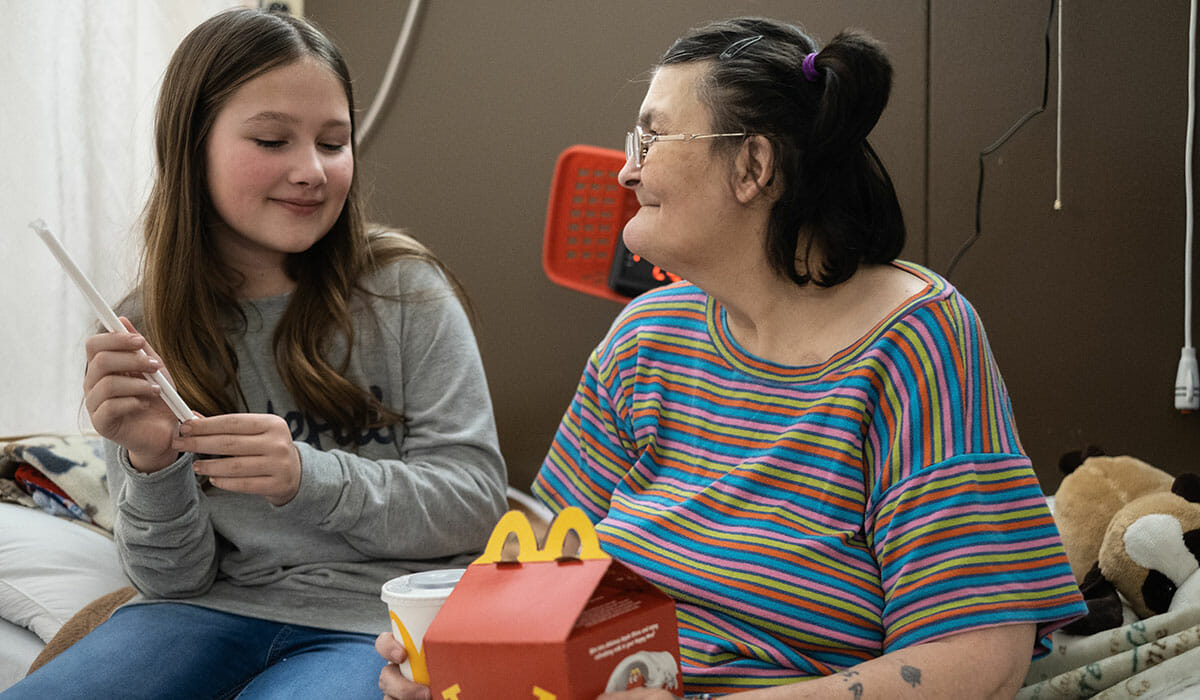
Then locally we do much bigger things for the wishes, like coat drives, food drives. We had Operation Happy Meal, which was one of my favorite things and I think Ruby’s too, where we go get Happy Meals for everyone for the day. We bring in Domino’s pizza. We raised so much money, we’re able to do so much bigger things now. We brought in memory foam pillows for every resident. We have new shoes for every resident now, whereas before they were responsible for buying their own shoes out of that money, so now our residents don’t have to worry about that locally. Those are just a few examples. We also have a mailbox cup in our nursing home where [residents] can drop their wishes inside that mailbox and then we go collect those and fulfill them that way as well.
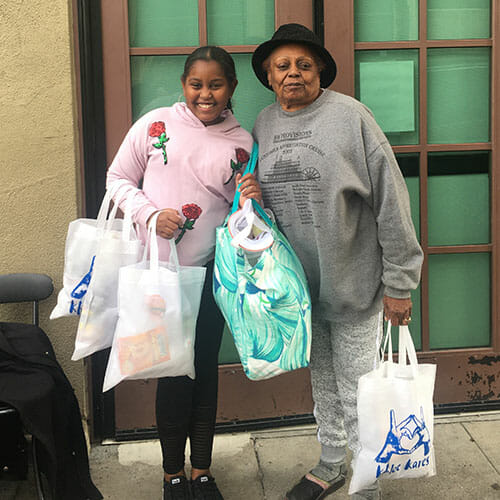
Ruby Kate Chitsey, left, provides food and needed items to residents of nursing homes with her nonprofit.
What kind of wishes have you granted?
Ruby: They ask for food most of the time, like little snacks, like little bags of Cheeto puffs or chocolates. Those are our foods and then we give out blankets, and post cards, and a lot of pillows. There’s a lot of things they ask for and we just grant as much as we can.
Amanda: I would say the pillows are big. We get back scratchers. Some of the homes like entertainment so we do get a lot of requests for DVD players, music, updated card games, the larger print books. One of the things one of our kids discovered is that their books were really the thrift store castaways. I don’t know that I would ever read one of their books, the quality was terrible. We get a lot of requests for Western and some genre books that are kind of hard to get, so we get a lot of requests for really higher-quality books.
How do the residents react when they receive these items?
Ruby: Their reaction is priceless. They’re always happy. Some cry in happy tears and I’m just like ‘Woah, I did something very good for someone today.’
Amanda: It’s incredible. I can’t compare it. As a family we’re really well traveled. They’ve been everywhere, they’ve seen lots of different things and we’ve never had the ability to move a human like we have in this respect. I can’t think of a way you can move someone like you can in these poor nursing homes. Ruby can give someone a 37-cent can of Vienna sausage and it’s as if you gave one of Ruby’s friends an iPad. They will cry and they will hug Ruby. It moves them in a way that’s really incredible. Ruby and I both said it a hundred times, we feel like we’re the ones being gifted. It fills your soul with such a great feeling to know you made someone this happy. I don’t get the opportunity in America many times to do that. For Ruby being a child, and we’ve been doing this now for two years, I think it’s really made her such a great little human to have had this impact on others for so long. I love seeing her do this and what it does to her.
Have you been able to share this with your friends or other kids your age?
Ruby: We have a kid board and some of my friends are on there. I feel like the kid board is a super big part of Three Wishes.
Amanda: Our organization is really powered by that kid board. It is a youth-led organization. We would not be here if it weren’t for Ruby. When she pulled out that notebook and went to ask those residents, ‘if I could grant you any three things, what would they be?,’ I told her not to do it. I thought it was a really silly idea that would not work. And she went on to raise $250,000 because of that question. My adult mind honestly told her not to do it. You can see where I crossed our her questions three times, and she stuck with it. When we were doing our bylaws and getting prepared to make this a nonprofit, we were steadfast that we were going to have an adult board but we were also having a kid board, so we would always have that child perspective, those kid goggles, and we would never make that mistake I made again. We would always be led with kid eyes and they would continue to show us and steer us in the right direction with the organization. We’ve been so right in doing that. We have five kids on that board and every time we meet, they give us the best ideas ever. They introduce us to ideas that we would never consider ourselves. They’ve kept us on track in ways that I can’t even describe to you. They work so hard. Over 75 percent of the projects that we’ve carried out this year have been done by those children ages 9-12. They are powerhouse volunteers and they work super hard for the elderly. I’m so proud of each of them. They’re great kids.
Are there any future partnerships, programs, or events that you are excited about?
Ruby: We are building a community center where kids and elderly can connect. We’re making it out of a really old building … I’m just excited about it.
Amanda: The center, I don’t know of anything like it. It’s very unique. One of the themes of our organization is connecting the generations. We’re super proud of that. We have built the front of our community center to have classroom-sized tables so we can continue to connect with our local high schools and middle schools and elementary schools. We can accommodate a classroom at a time. We are going to have our elders from the community who — you know, a lot of our parents who are in a nursing home, they want to give back just like Ruby and I do. So one of our goals is to have those people who can still ambulate a little bit, and still want to give back, to come volunteer with us. We’re going to have kids from the community have free birthday parties there. We’re going to have huge crafting tables and free art and free canvases and free paints where a kid can come have a birthday party there. It’s going to be staffed by your mom who’s still able to give back in that small way, kind of like a Walmart greeter, so she still feels like she’s still giving back, she’s still valuable, she’s still worth something. It’s kind of a win-win.
Our veterans in the nursing home, we’ve been having them teach classes to our middle school and high schoolers about their service and what it meant to them and what it was like to be in some of the wars. We’re learning that they’re better than a textbook in some way. So we’re going to carry that over to our community center and continue those classes. We’ve been doing the STEM program that’s really common in our schools. We’ve been doing STEM with Seniors so our seniors actually do the STEM program with the students, and we’re going to continue doing that there as well. That should open up in the next six weeks. We have pictures of that on our Facebook site. We’re about to do a campaign on GoFundMe Charity, which is the new charity crowdfunding [campaign]. We’ve done three phases to get this off the ground and we’re in the last phase now, so there will be a small campaign on that to help us finish out those last six weeks.
What’s been the most rewarding part of your work?
Ruby: I really like their reactions and I love giving them what they wish for because it’s almost like Christmas to them.
What have you learned through your experiences as a volunteer?
Ruby: I learned that I should respect what I have and it really helped me in the heart because I feel like my heart just grew ten times bigger.
Why do you think it’s important for others to give back?
Ruby: I feel like it’s great for people to give back to the community because everyone’s community is great. I feel like it’s awesome to give back and it really makes your heart ten times bigger and it makes you feel awesome.
New Jersey Volunteer Helps Burn Survivors Realize Their Scars Don’t Define Them
Meet Daily Point of Light Award honoree Drew Sander. Read his story and nominate an outstanding volunteer or family as a Daily Point of Light.
Drew Sander was just three years old when he, his brother and two other boys were playing “gas station” in the garage. They were filling a car with a five-gallon gas can when one of the boys lit a match, setting the car and garage ablaze. Nearby construction workers heard the explosion and pulled the boys out of the fire, but the damage was already done. Drew suffered severe burns to more than 40% of his body and was constantly in and out of the hospital to receive skin grafts.
But growing up, Drew didn’t let his scars define him and now at age 51, Drew and fellow burn survivor, Joe Matits, have founded The Sander and Matits Burn Foundation, which helps burn survivors, especially young ones, feel accepted and realize there is life after being burned.
While Drew didn’t let his scars get to his self-esteem and he credits his family and friends for creating an environment where he felt accepted, there were still moments in his childhood where he felt discriminated against because of how he looked.
“I remember as a kid I had very big keloid scars,” Drew said. “We were at a pool in Long Island and the life guards asked us to leave because we were scaring the other children.”
Drew says this childhood memory is why he started volunteering. He became certified as a counselor by Phoenix SOAR (Survivors Offering Assistance in Recovery) to meet with burn survivors in the hospital, answering whatever questions they might have and reassuring the parents that a normal life for their child was definitely possible.
But what really set off Drew’s drive to help burn survivors was when he attended his first World Burn Congress where hundreds of burn survivors, their caregivers, burn professionals and firefighters gathered to connect with each other and gain more knowledge and support from this special community.
“When I went to the World Burn Congress, I saw all of these children and they were kind of lost,” Drew said. “I cried like a little baby hearing some of their stories and the struggles they went through. Joe Matits was with me too and I said, ‘We’ve got to do more for these kids. I want to start a foundation and pay for their families to come out here. Help them go to burn camp.’ And he said that’s a great idea.”
Drew (left) and his foundation were able to send Austin (center) to the World Burn Congress this year. Austin was so moved by the experience that he took off the gloves he usually wears to cover his scars./ Courtesy Sander and Matits Burn Foundation
So Drew and Joe established their foundation in 2015 and are providing after-school programs to teach students not to bully their classmates who have burn scars. These after-school programs proved especially beneficial for Munia, who suffered severe burns to her face, back, and hands after a chemical put in her hair to kill lice caught on fire when she walked past a candle.
“When Munia went back to class, they had a big welcome party for her,” Drew said. “She had compact bandages on her face for two years. The day she took her bandages off and went to school without a problem and seeing the smile on her face is what makes it worth it for me.”
The Sander and Matits Foundation also raises money to send a burn survivor and their family to the World Burn Congress every year. This year, Austin Lewis and his parents Greg and Kelli Schneider attended the conference.
Kelli says her son was so moved after meeting with other burn survivors that it inspired him to take his gloves off that covered his scars.
“It wasn’t just four of five people, but it was hundreds and hundreds of people that didn’t have their garments [that cover their scars] on,” Kelli said. “Years have gone by and he has never wanted to take his gloves off because he didn’t want other people to think he looked gross or anything. So it was really overwhelming to see that.”
Greg says Drew and Joe have become part of their family and that they check up on Austin every week.
“They have been with us every step of the way,” Greg said. “We don’t go a week, a week and a half without talking. …We really can’t put into words what they mean to us, what they’ve done for us, but they’re really such great people.”
Drew hopes his foundation can eventually run their own camp for burn survivors in New Jersey so that he can tell all burn survivors this:
“Looks may get you in the door, but it doesn’t keep you there. What you do and what value you bring, that’s what they’re going to judge you on. … There’s a full life after a burn injury.”
Feeding the homeless love and kindness with a side of lunch
Meet Daily Point of Light Award honoree Liam Hannon. Read his story and nominate an outstanding volunteer or family as a Daily Point of Light.
Mother Theresa famously said, “If you can’t feed 100 people just feed one.” For Liam Hannon, this advice hit close to home, literally. When challenged by a 2017 summer project to reach out to the homeless community, then 10-year old Liam had only to look out his front door. He and his family live in Cambridge’s Central Square, a neighborhood that attracts a steady number of homeless people. His idea – to make lunch for some of the folks he saw in the Square, mushroomed. Twenty lunches became 40 became 60 and Liam’s Lunches of Love was born. With his dad’s help, Liam built a solar-powered electric wagon that can carry 1,500 pounds of food and includes fold-out tables and a coffee station.
Passionate about kindness, about ending hunger at home, about treating all people with dignity and respect, Liam and his GoFundMe campaign has raised more than $40,000 to feed the hungry. If food is love, then Mother Theresa is surely smiling.
What inspires you to volunteer?
The summer of 2017 I didn’t want to go to summer camp, but I had signed up for Brain Chase, which is kind of a summer camp online with productive and academic challenges. And one of the categories was service to the homeless – that’s what got me started. We made 20 lunches and it was really great, so I asked my dad if I could do it again.
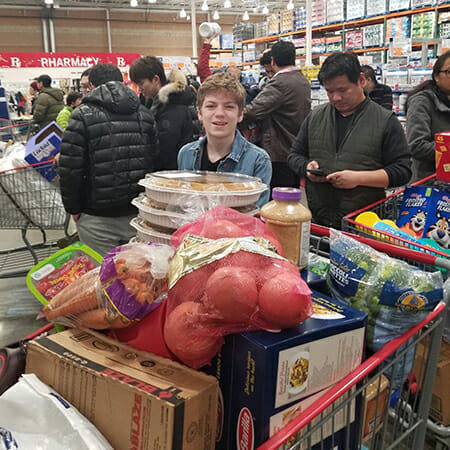
Liam in a shopping mode for some of the 300 lunches he makes every month. /Courtesy Liam Hannon
Describe your volunteer role with Liam’s Lunches of Love.
I am the founder and I still do a lot of the work, making lunches and handing them out. I work with volunteers and try to get my friends to volunteer. I have also become I guess the face of the project – I always and work on partnerships and fund raising. We started our GoFundMe page with a few thousand dollars and since we’ve raised more than $40,000.
What’s been the most rewarding part of your work?
Meeting the people on the streets, being able to connect with them, have real conversations with them – that’s the best part for me.
What have you learned through your experiences as a volunteer?
I’ve learned that bad things can happen to all kinds of people and is where they can end up. And that it’s possible to do things to help them. My perceptions about homelessness have been educated.
Are there any future partnerships, programs, or events that you are excited about?
I was so excited to be on the Today Show for Giving Tuesday. Also I recently went to Hartford CT to do an event with Hartford Bags of Love, a group that gives out care packages in their community. I also work with Hildebrand Family Self Help Center to raise money for school supplies for more than 400 local kids experiencing homelessness. I’m especially excited about #themillionlunchchallenge program we have launched – we have heard from people giving lunches in places like China, Canada and all over the U.S. Social media is a very important way for us to track our programs and let people know what we are doing.
Why do you think it’s important for others to give back?
I think it’s important because everyone needs some kindness in their lives, no matter how they identify – we should treat everyone the same as we want to be treated.
What do you want people to learn from your story?
Sometimes the smallest, simplest ideas can really take off!
Teen Uses Passion for Origami to Help Teach Students
Meet Daily Point of Light nominee Karthik Jetty. Read his story and nominate an outstanding volunteer or family as a Daily Point of Light.
Seventeen-year-old Karthik Jetty has always loved origami, the art of paper folding, and credits it with both his creativity and his love for math. When the Louisville, Ky. resident was in tenth grade, he realized a lot of his friends hadn’t been exposed to the art form after his math teacher tried to use the practice to help explain curriculum. Along with his fellow origami-loving friend Raymond Suo, Karthik founded the nonprofit Origami for Education shortly thereafter.
Through workshops and a yearly convention, Origami for Education helps advance education through origami, which helps with math, cognitive and motor skills, as well as creativity and mental wellbeing. In two years, the organization has expanded to seven different chapters throughout the U.S. and South Korea. Through his nonprofit, Karthik has helped reach over 3,000 students.
Describe your volunteer role with Origami for Education.
Right now I’m CEO of Origami for Education. I started it in the middle of my sophomore year which was around December 2017. Right now, I organize several of the workshops that are run. We’re currently doing seven workshops. In total, we’ve done over 16 workshops in my local community. Every week I go to a different school and I teach kids a little about origami, a little bit about the math behind origami, just so they can get more immersed into origami and so they can develop a new hobby. I also run every year, we have a convention, so it’s kind of like a workshop but for people of all ages. We try to make it really fun. It’s about three to five hours. We do a lot of fun activities. We have a competition during it where people can make their own designs and present it and the winner gets a prize.
In addition to the workshops and the convention, I also do a lot of fundraising for Origami for Education. Right now we’ve raised over $30,000 and we do this in a couple of different ways. On our website we have an origami store and we sell origami pieces we’ve made or some of our volunteers made. We also set up little origami pop-up stores around our community, kind of like a lemonade stand but with origami instead of lemonade. Usually we make about $200-300 for each one, and in the past I think we’ve set up 30 in Louisville. We also get sponsorships from local education centers in my community and we’ve also applied for grants.
There’s a lot of people in other regions of the U.S., and even we have one chapter in South Korea, who are interested in starting their own Origami for Education initiative in their community. What I do is provide them with supplies and curriculum. I kind of show them how they go around in their local community promoting origami and its benefits and exposing a lot of different people to origami. We call them chapters. We have six in the U.S. and one in South Korea. I think the other big thing I work on is we have origami kits that we make. In these origami kits, we put our origami book we published, some origami papers and instructions and some other material so people can do origami by themselves without having somebody like me be there. We did this to expand the reach of origami since most of our classrooms are about 20 to 30 students and it’s hard to impact a lot of people just by teaching one class at a time.
What inspired you to start Origami for Education?
Since I was a kid, I always did origami. To be honest, I credit my creativity that I have right now and the reason that I do enjoy math because I did origami as a kid. I remember in tenth grade, which is when I started this organization, my math teacher in class [had us do] this little project where we made an origami model. I realized a lot of my classmates weren’t as exposed to origami. I had a very fun time with the project, but a lot of my friends didn’t want to do anything artsy. They just wanted to do the math because they signed up for a math class. That is when I decided to start Origami for Education. I really wanted to make an impact on young students who are impressionable. Over time, I realized that I could do a lot more with origami. At the very beginning, I did one workshop. We just folded stuff. Over time, I realized there are a lot more benefits to origami than even I had realized. There’s a lot of research detailing that origami is very important [and] can benefit a child. It has a lot of psychological and mental benefits, a lot of critical thinking benefits and children just get more excited to learn stuff after they do origami. I realized that I had to do more to spread my mission. After I realized that, Origami for Education grew into what it is today.
Can you describe what a workshop entails?
We make it so it accommodates what the school wants. Each workshop typically lasts about four weeks and we meet once a week. At the beginning of every workshop, we start off with some math principles that are related to origami. For example, we usually go to middle schools [as well as] higher grades and elementary school, and geometry is a big point of emphasis because a lot of people struggle with geometry. It’s really cool to present geometry concepts through origami. We spend anywhere from five to 20 minutes teaching geometry by folding paper, teaching different concepts, answering any questions. After that, we typically go into folding. I show them patterns that arise from the concepts we just learned at the beginning of the session. We fold at the end of each session. We typically fold around for fun, we talk to each other. At the end of every workshop, we also give each of the students an origami book so they can continue from where they left off, so they can continue different math concepts and learning about the benefits, different origami folds. The workshops are our way of directly reaching out to students. In other chapters, they do similar workshops.
Different schools have different requirements. Some schools just want to focus a lot more on the math aspect of origami because that’s where their school is lacking, so we tweak the curriculum a little bit and focus more on the math. We might not do as much folding but we might show a lot of math concepts through folding, and then at the end students can go home and do the origami on their own. In other schools, they want to focus a little more on the art and maybe a little bit about the history of the origami. For those schools, we typically spend most of our time folding. We still try to point out any patterns that might pop up, but in those schools we focus on the art.
Karthik Jetty, center, has hosted several workshops to teach students origami with his nonprofit Origami for Education./Courtesy Karthik Jetty
How exactly does origami benefit the kids you are teaching it to?
Origami means the art of paper folding. Every time you make a paper airplane or you make a cube or something with paper, it’s origami. When students do origami, especially when they’re young — first of all it’s just a fun hobby to have. A lot of kids like it … It’s a good hobby to have instead of doing other stuff like playing video games. But in addition to that, it also builds the child’s creativity, especially because when you’re folding, you’re not always just reading instructions. You have to be creative when you’re folding especially when you’re making your own design or you’re just playing around with paper. You end up discovering a lot of new stuff. It opens up the other part of your brain. It kind of connects both the math aspect and the art aspect. A lot of my friends either only like math or they only like art, but doing origami kind of mixes both of them and allows kids to be more engaged with both of them. There’s a lot of benefits for doing origami in the classroom. There’s research that says with origami, a lot of students are more attentive, more engaged in their classroom, and it results in them doing better in school.
What’s been the most rewarding part of your work?
I think it’s just seeing students get passionate about something, and seeing them be passionate about the same thing I was passionate about when I was super young. And seeing their development, because our workshops are typically four weeks long and there are so many times I see a student at the beginning who is really hesitant about origami. They didn’t like art, they said they weren’t into folding or something like that. And by the end, they’re super passionate about it. They show everybody, they come up to me and they say thank you. It’s just a really nice feeling to have, to see [students’ perspectives] change from beginning to end of a workshop, or even our convention or any other program we do.
What are your longterm goals for Origami for Education?
I think I want to spread this to a lot of other communities. I think that’s the biggest way we can grow right now. I want to recruit people from places around the U.S., even internationally. I know the chapters that we did start are the results of our advertising. I asked a lot of my friends to start chapters and a lot of them said no. When they said yes and they began doing it, they might have been a little bit reluctant at first, but they always enjoyed the experience. I want to create a community of volunteers, a community of people who are passionate about origami and want to spread this to people in their community, people that haven’t been exposed to what they enjoy.
Why do you think it’s important for others to give back?
I think it’s important to be a good role model for everybody else in your community. If you start helping one person, that person will feel really happy. They’ll feel like there’s somebody out there looking out for them, and they’ll have a mindset of paying it forward. If everybody has this mentality, then I think the world can become a much better place. I think the world can be filled with people who want to help others. We can bring each other up instead of dragging each other down.
What do you want people to learn from your story?
I think it’s important for others to know that they can make a difference in their community with anything that they do. You can take something you enjoy, like for example if you like reading, and find a way to spread it in your community. It might be doing something small at the beginning, like getting books and donating it to students, but if you’re passionate about it, over time it will grow. Over time you will enjoy what you’re doing. You’ll make a difference in your community, even if it’s just one person, and the feeling is worth it.
High School Student Volunteers for Lonely Seniors with Heart and Talent
Meet Daily Point of Light Award honoree Vincent Wu. Read his story and nominate an outstanding volunteer or family as a Daily Point of Light.
Vincent Wu was raised in part by his grandparents, and shared a close bond with them as a result. Understanding the importance of spending time with seniors who may be separated from their families, Vincent decided to dedicate his time to solve one of the persistent problems seniors face: boredom and loneliness.
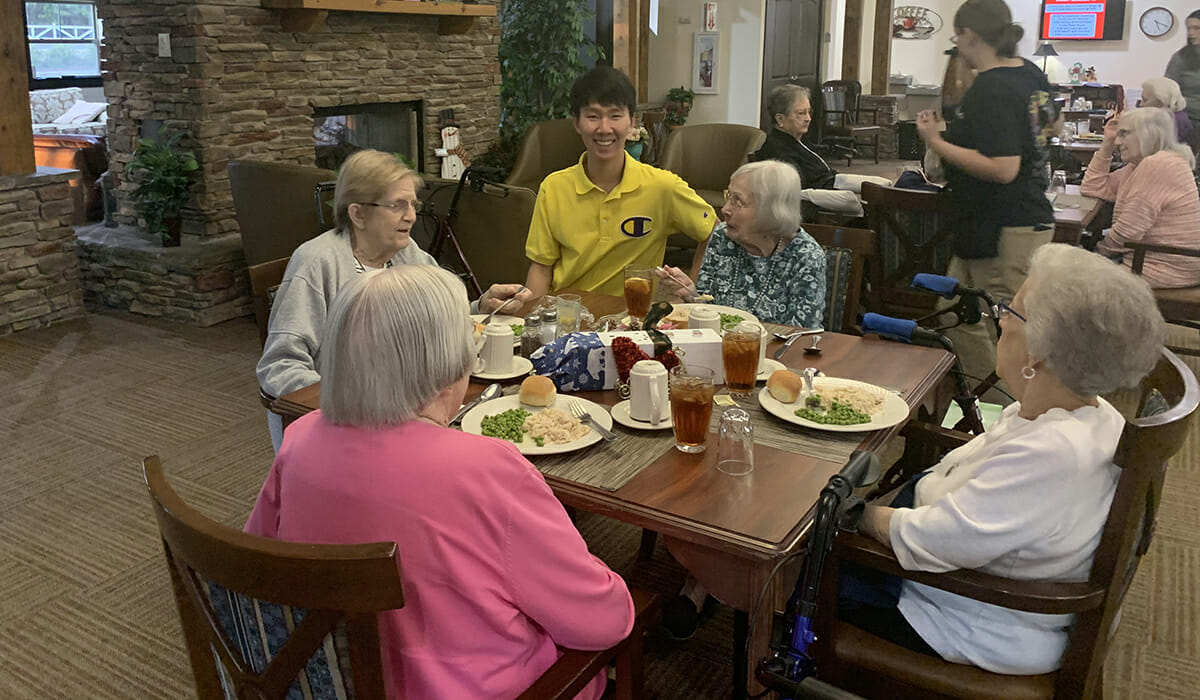
As a volunteer at Oaks at Hampton Assisted Living Community in Cumming, Georgia, the 17-year-old high school senior visits senior residents weekly, playing classical piano and saxophone during dinner in addition to calling Bingo on Sundays. Through his time, talent and heart, Vincent is strengthening the assisted living community and is a warmly anticipated visitor for seniors each week.
What inspires you to volunteer?
I grew up with my grandparents living in my home, and I know firsthand how important it is for senior citizens to interact with other people as otherwise, they sometimes don’t have many other things to do. A lot of these seniors don’t get to see their children and grandchildren, and I thought volunteering my time would give them some joy in their days.
Describe your role with Oaks at Hampton Assisted Living Community.
I volunteer weekly by playing piano and saxophone for the seniors during dinner time as their entertainment. I also call Bingo for the seniors on Sundays.
What made you decide to entertain seniors by playing music?
I started playing piano and saxophone at the assisted living community because I’d stopped playing instruments in school to focus more on academics, and I didn’t want to lose my ability to play. This was my way to not give up music completely, and use my skills to entertain others.
Share one personal story with me from your volunteerism.
Selma was one senior that would attend every day I volunteered. One day she wasn’t there, and one of her best friends, Ruth, told me that Selma passed. I was taken aback because she had been at every single one of our Bingo events, and I never even got to say goodbye. These people have lived such fulfilled lives and for a life to be taken away so fast just underscored for me why volunteering my time and effort is important.
What’s one way you hope to inspire others in your service?
Even if you have a passion you don’t put to use day to day, it can still be used in other ways. For example, I gave up on piano and sax, but these passions could still be utilized. I shifted my focus from competing and playing the piano to inspiring and performing for others. These seniors don’t necessarily have much left in their lives, but I can still bring happiness to them in some way with my music and Bingo.
Vincent Wu is a volunteer at Oaks at Hampton Assisted Living, where he calls Bingo and plays instruments for seniors. /Courtesy Vincent Wu
You’ve been recognized for strengthening the senior community with your heart, talent and time. What does that mean to you?
It’s amazing because this is not just a routine thing that I go through every week. My service has an impact, and I give my time because I just want to help them.
What’s been the most rewarding part of your service?
Listening to the stories from the seniors. There are so many. From WWII veterans to people that outlived their children, I’ve learned from them and they’ve learned from me. That’s truly what motivates me to volunteer. One WWII veteran, Mr. Richard, told me how he survived grenades and bullets flying past him while fighting. The way he shared details about his story like it was yesterday, it was amazing.
What’s your favorite song to play?
A group of songs by the musician Richard Clayderman, ‘Love Story’ is one of his most iconic pieces. Everyone at the assisted living community knows it now because of how often I play it. There’s this one resident, Bob, who loves music. He used to memorize my music so that when I’d perform, he’d hum the tune along with me. He knew the names of my songs that I planned to play before I did sometimes!
What have you learned through your experiences as a volunteer?
I can have a greater impact if I use my full intention. If I give my full effort with my whole heart, I receive satisfaction and know that I am impacting seniors in a big way.
How can readers help?
Please visit the Oaks at Hampton Assisted Living Community website for more information about how you can give back.
Corporate Executive Dedicates His Life to Instilling Volunteerism in Hearts of Employees at Disney and Beyond
Meet Daily Point of Light Award honoree Jeff Hoffman. Read his story and nominate an outstanding volunteer or family as a Daily Point of Light.
They say Disneyland is “The Happiest Place on Earth,” and while characters like Mickey and Cinderella are known to bring smiles to children at the park, there’s one person who worked behind the scenes at Disney for over 30 years to ensure the company brings smiles to the faces of less fortunate, but equally deserving children. That person is Jeff Hoffman.
Jeff’s journey at The Walt Disney Company started humbly in 1978 with him selling shrunken heads, rubber snakes and other souvenirs at Adventure Land theme shops in Disneyland. This was also the moment Jeff met his future husband, Bob Lane, who describes Jeff as his soulmate and a person who has always had a passion for service.
“Even as a kid, he would volunteer at pancake breakfasts and things like that,” Bob said. “He’s always been involved in service one way or another.”
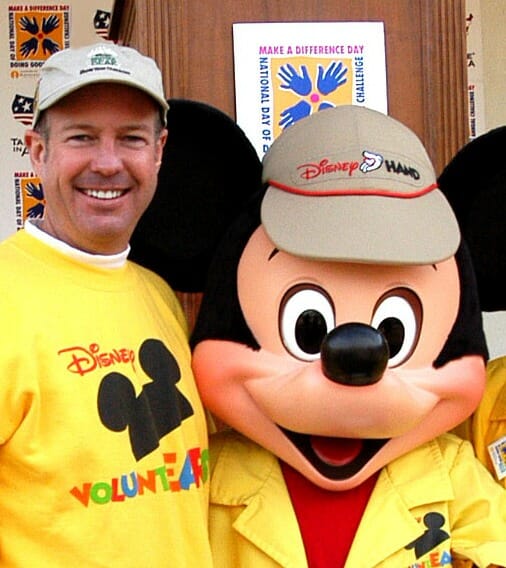
Jeff’s dedication to volunteerism led him to eventually become Vice President of Disney Worldwide Outreach, in which he was responsible for the company’s philanthropy, community relations and award-winning employee volunteer program, Disney VoluntEARS. Each year, dozens of nonprofit organizations nominated by Disney employees receive more than $350,000 through the program and employees volunteer tens of thousands of hours at local events such as food banks, community playground constructions, and toy drives.
Carmen J. Smith, Vice President of Creative Development at Walt Disney Imagineering, worked with Jeff for over 20 years, including on an event where Disney characters read books for about 8,000 underserved children from Harlem and New York City.
“Jeff led volunteer efforts for the Walt Disney Company around the world,” Carmen said. “By being able to organize ways to be of service, he brings together people across cultures, across discipline, across generations, across orientation. He has that ability to be the great collaborator and connector of people.”
Jeff has dedicated his life to ensuring companies do their part in reaching out to the community and bettering society./ Courtesy Bob Lane
After leaving Disney, Jeff went on to start his own consulting firm called Jeff Hoffman & Associates, which helps other companies develop their own employee volunteer programs and charitable projects. He is also founding leader of The Conference Board’s Center on Corporate Citizenship and Philanthropy and serves as Chair and program director of the organization.
Polly O’Brien Morrow, Vice President of the Pitney Bowes Foundation, served with Jeff on the National Council on Workplace Volunteerism. She says Jeff’s passion for corporate social responsibility is important because “it’s a real win-win for the company, for their employees and for their communities.”
“It always strikes me odd when some companies are not as involved as they could be or have so many resources they could bring to bear, so there’s still a lot of work to be done in the field, but I’m glad that Jeff is out there helping to inspire others to do it,” Polly said.
Jeff’s leadership in this field even caught the eye of former California Governor Arnold Schwarzenegger, who appointed Jeff to the California Commission on Service and Volunteerism where he served as Chair. Jeff has also served on the Meridian International Center Global Service Leaders Advisory Council, International Association of Volunteer Efforts’ Global Corporate Volunteer Council and the California Business Partners Program.
The list of organizations Jeff hasworked with never seems to end, but Carmen says whatever organization Jeff is working with, he’s “always demonstrating and sharing his knowledge with others, and helping the greater group or organization fulfill their promise.”
This includes Points of Light and its HandsOn Network, where Jeff has been a member of the Board of Directors.
“Jeff has been an exemplary Points of Light board member for 23 years,” said Natalye Paquin, president & CEO, Points of Light. “But more importantly, throughout his life he’s been a volunteer leader. His commitment to philanthropy, volunteerism and corporate responsibility has led him to be chairs of state and local commissions, and serve on numerous other boards. Through his work and service, he enables business, organizations and individuals to reimagine a world full of hope, promise and opportunity.”
Teenage Cancer Survivor Founds Nonprofit to Help Children in Need
Meet Daily Point of Light honoree Grace Callwood. Read her story and nominate an outstanding volunteer or family as a Daily Point of Light.
Nothing has held back Grace Callwood from helping out those in need — not even being diagnosed with non-Hodgkins lymphoma at the age of seven. In fact, her illness is what led her to starting her very own nonprofit organization.
When she was diagnosed at the start of her first grade year, Grace decided to donate her new back-to-school clothes to two little girls within her community who had just lost their home in a fire. Inspired by hearing how grateful they were for the donation, Grace started to put together a few more projects to donate to fellow kids in need. With support from her mother and her Bel Air, Maryland community, the projects snowballed into her founding the We Cancerve Movement in 2012. The nonprofit organizes giving opportunities for the community to bring happiness to homeless, sick and foster children.
Grace is now 15 and has been officially cured of her cancer since February 7 of this year. She is the chairwoman of the We Cancerve Movement’s board, which consists of nine other volunteers aged from 8 to 18. They organize an average of 12 projects a year to help children, including running a summer enrichment camp for homeless youth, opening three libraries, throwing a holiday party for teenagers in foster care, donating toys to kids sick in the hospital and much more. Overall, the We Cancerve Movement has served over 17,000 homeless, sick and foster children at 10 homeless shelters and transitional housing programs, nine hospitals and organizations that serve sick kids, three group homes and three orphanages, including two in Africa.
Describe your volunteer role with The We Cancerve Movement.
The We Cancerve Movement is a nonprofit organization that helps homeless, sick and foster children through projects and events. We’re a youth-led organization. We’re all youth ages 8 to 18. Together we bring swift solutions to children in need because we believe that happiness shouldn’t have to wait. All these projects are community-based at a very low cost. We like to ask the community for their time, support and effort. They’re all with the goal of bringing happiness to children in need. I am the founder and chairwoman of the nonprofit organization.
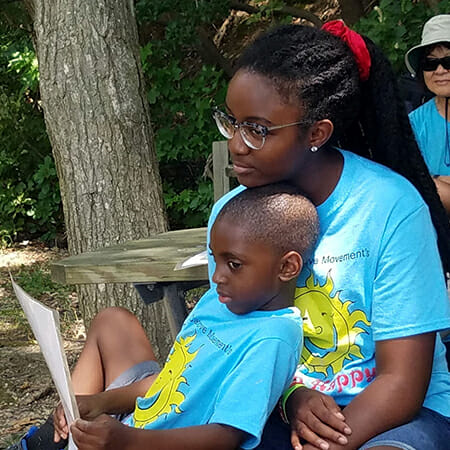
Grace Callwood, right, hangs out with a kid attending Camp Happy, which she created through the We Cancerve Movement at the age of ten./Courtesy Grace Callwood
What led to you founding this nonprofit?
I’ve been doing community service ever since I was two years old. When I was seven years old, shortly after I started the first grade, I was diagnosed with non-Hodgkins lymphoma. It was a very scary and new thing for me because I had no idea what cancer was or what it really meant until I had it. There were a bunch of changes that came with this new sickness, including being homeschooled, gaining weight from the medicine, having to learn how to take medicine, all these other things. One day a family friend told me about a family who had lost their home in a fire. They had two little girls and all I could think about was how I related to them and how they had entered homelessness and I had just entered sickness. I decided to donate my brand new back-to-school clothes to those two little girls. I was too sick to go, so my mom went to deliver the clothes for me. When she told me about how happy they were, I knew giving back was what I wanted to do for the rest of my life. I did a few more projects and was able to gather some support from the community and I started the We Cancerve Movement, Inc., in 2012.
Why was it important for you to help children specifically dealing with homelessness, sickness and foster care?
It’s important to me because they’re all children put in sad situations that are not their fault. When I was first diagnosed, I was seven. When something bad happened, it was usually something that was caused, so I tried to figure out what caused cancer for me. At first I thought it was my fault because I didn’t know what other reason it could have been. That’s why I help homeless, sick and foster children, because they’re all children put in sad situations that are not their fault. I want to make sure that, number one, they have some happiness in the horrible situation they’re in, and two, know it’s not their fault and they can have a smile even during a tough time.
What are some of the different projects you do with the We Cancerve Movement?
A project that we’re in the midst of right now actually is called Breakfast Bags Bonanza. It’s where we give nonperishable breakfast food items to homeless and foster youth over the Thanksgiving and winter breaks. Often children that are under the poverty line are on free or reduced meals during the school year, but during these breaks they may not get as much food as they need. With Breakfast Bags, we’re now able to give these kids food over the Thanksgiving and winter break. In the past we’ve usually given about 600-800, but this year thanks to a ton of community support, we are able to give about 3,000 bags. I’m very excited for the rest of this project.
Another big project we have is Eggstra Special Easter baskets which we’ve been doing since I started We Cancerve. Through this project, we give homeless, sick and foster children Easter baskets. These are actually bags because they’re better for the environment and they’re cheaper to buy than actual baskets. This is a great project as well for the community because lots of schools and different groups and youth groups, churches, everybody likes to come together, raise money to buy candy, to collect candy and small toys, some people like to come to our stuffing parties where we actually put the bags together, decorating the bags, things like that. So it’s a great project for the community and we’ve donated over, I think the number is 5,000 so far to date. I’m very excited for the new year coming up soon so we can get ready to do Eggstra Special Easter bags again.
What gives you the idea for these projects?
There’s quite a few things that give me the ideas for these projects. Some of these are personal experiences from being a sick kid in the hospital, like the project Beach in a Bucket. I was close to being in remission in February of 2014 when there was a horrible ice storm and things went bad in the operating room so I ended up being hospitalized for about 14 days. During this time I was real sad and I wasn’t doing too well, so my mom threw me a beach party in my hospital room that was able to lift my spirits and make me really happy. It was my grandma who suggested that we make that into a project so now we have a project called Beach in a Bucket where we give sick children sand pails filled with different crafts and activities, sand art, sunglasses, inflatable beach balls and all these fun things to bring the beach to them.
Some of these projects come from personal experiences, but a lot of these projects are also just addressing a need that I realized was happening, especially with Camp Happy. I had gone to a local homeless shelter called Anna’s House in 2015 when I was ten years old, looking to start a library. It turns out they didn’t need one, but instead the director at the time of Anna’s House said they wished they had a summer enrichment program for the youth there. Within a week, my mom and I came back and presented a four-week summer camp and they approved it. Ever since, we’ve been able to grow and expand. We’ve now had Camp Happy at four different locations with curriculums going from either four weeks to one week. We have different themed weeks and/or days. We go on field trips, we bring in special guests, and we’ve had just a lot of blessings with that project. We cover a pretty broad spectrum of different needs, but I love what we’re doing and I’m very grateful to the community we have.
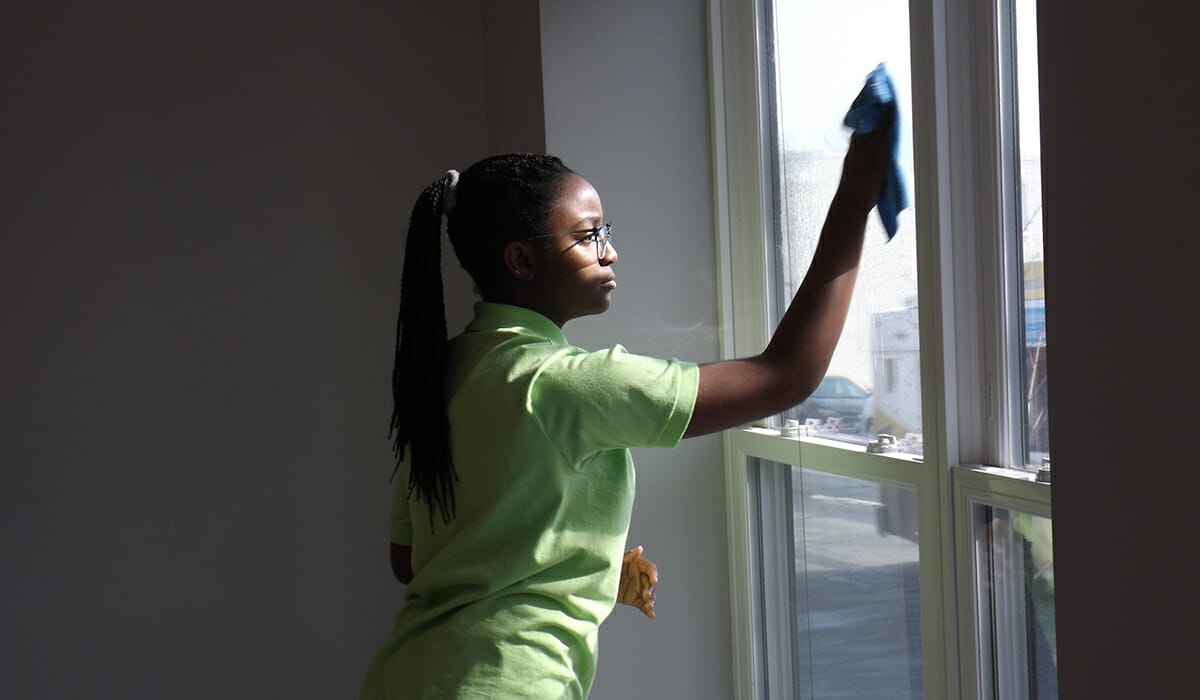
Grace Callwood cleans at the Ulman House in Baltimore for We Cancerve’s “Hook up a Home” project, which provides cleaning services for those in homeless and respite transitional housing./Courtesy Grace Callwood
What’s been the most rewarding part of your work?
The most rewarding part of my work is probably during Camp Happy — being able to witness the happiness that I’ve been able to bring or just even my idea of weekends there, whether it’s with me personally, whether it’s a board member giving an idea to someone else, just being able to see that happiness. Ever since I was born, I’ve loved making other people happy. It’s what I love to do whether it’s with my friends, my family or children in need, so Camp Happy is my favorite project because I get to interact with the homeless children one on one for days and days at a time. I get to see how happy they are and how vulnerable they are and how much they enjoy being with us.
The same thing goes even for just two weeks ago, we set up our third library at Halls Cross Elementary. We set it up within two hours. We stocked the shelves, we put stickers on the book shelves, we cleaned everything, we added in pillows and cushions for the windows. Two teachers who had stayed after school to let us set this up for them, when they came in and they had these huge smiles on their faces after seeing the library, that meant the world to me because I knew they loved it and they thought the youth were going to love it too.
What have you learned through your experiences as a volunteer?
I’ve learned a lot not only about giving back to the community and about being a person who advocates for young people, but also I’ve learned a lot about myself. Some of the main things I’ve learned is to always have the spirit of learning, being willing to learn and accept new things and try new things and being flexible, being a champion and definitely being an advocate for young people. I believe there is no age limit on service, and that’s why my board members are all young people ages 8 to 18. And I’ve also learned to definitely ask questions and make sure what I’m giving is what’s needed so that we don’t become a burden on the recipient or organization. A lot of these places don’t have very much storage so giving them an abundance of things can sometimes be troublesome. As well as just learning different tips about speaking engagements and even phone interviews like the one I’m having with you now. I’ve learned a lot to just trust the process because even when some small errors come up, I’ve learned to stay calm because in the end it always works out well.
Why do you think it’s important for others to give back?
I think it’s important for others to give back to the community because of the impact it has on all levels, really. It makes a big impact on other people in the community just seeing that others care. It’s cool to know that people at my high school or within the community know that I give back to others because it inspires them to want to give back to others, too. Same thing goes for the impact it has on me personally. Not only does it make me feel good being able to give back, it just feels good knowing that I’ve been able to bring a smile to someone who needs it most. And then also the kind of impact it has on the person you’re helping. Being able to know that people like me care enough about them to spend my time giving back to them, trying to make them happy and seeing everything I can do to bring them a smile.
With #GivingTuesdayKids, 12-Year-Old Changemaker Encourages Kids to Unlock Their Power to Improve to World
Meet Daily Point of Light Award honoree Khloe Thompson. Read her story and nominate an outstanding volunteer or family as a Daily Point of Light.
Smile money is the world’s greatest currency, according to Khloe Thompson. Just 12 years old, the Los Angeles native began her service journey four years ago when she came face to face with homelessness in her community. Seeing women and families living on the streets, Khloe felt compelled to help and in 2015 she founded Khloe Kares – making and distributing sturdy, handmade “Kare Bags” to Los Angeles’ homeless community, each one filled with two-to three-month supply of toothbrushes, toothpaste, soap, lotion, feminine hygiene products, socks and underwear. What began as the single act of service of creating and distributing 25 Kare Bags, has grown into a movement, with more than 5,000 Kare Bags handed out to those in need through partnerships with local companies, churches and nonprofit organizations.
In partnership with local organizations, Khloe has distributed more than 5,000 “Kare Bags” to people experiencing homelessness in the Los Angeles community.
And she didn’t stop there. With an infectious smile and a heart for service, she has become an unstoppable force of good, both domestically and around the world. At her core, she knows that getting outside of her comfort zone to engage with people in need is how to start ripple effects of meaningful change – and she is passionate about inspiring other kids to create change, proving that there is no age limit on the impact an individual can have in their community, and around the world.
That passion is the driving force behind Khloe’s latest endeavor: #GivingTuesdayKids. Created in partnership with global generosity movement #GivingTuesday, this new youth-led initiative encourages young people to take action around the causes they care about most on #GivingTuesday. Thanks to Khloe’s leadership, this year on Dec. 3, kids all over the world will lead volunteer projects and acts of kindness in their communities, proving that everyone has the power to make change and that everyone has something to give.
“Being 12, I like to be the example that at any age you are capable of making an impact,” said Khloe. “Never let your age stop you from being the next changemaker. I am hopeful that kids all over the world will step up and make a difference.”
If #GivingTuesday is a day all about giving, then why can’t kids be added to the mix? This is what ran through Khloe’s mind as she brought #GivingTuesdayKids to life. Instead of focusing on monetary donations, Khloe understands that giving can be in numerous forms. During #GivingTuesdayKids’ first year, a team of youth ambassadors is encouraging young people from all around the world to create epic moments of generosity and positive action in their communities. Kids and teens can search for an ambassador or youth-led service project in their community, or they can create their own. In Los Angeles, Khloe will lead a supplies packing project for people experiencing homelessness.
The #GivingTuesday movement is built so that anyone can find a way to plug in and give back, and #GivingTuesdayKids is a natural fit for youth to connect their unique skills to volunteer service. “In just seven years, #GivingTuesday has radically changed how people think about generosity. Now we’re helping to harness the energy of the next generation of young leaders for social change,” said Kathleen Murphy, director of digital strategy for #GivingTuesday. “When Khloe raised her hand to lead the movement for her age group, we were beyond excited.”
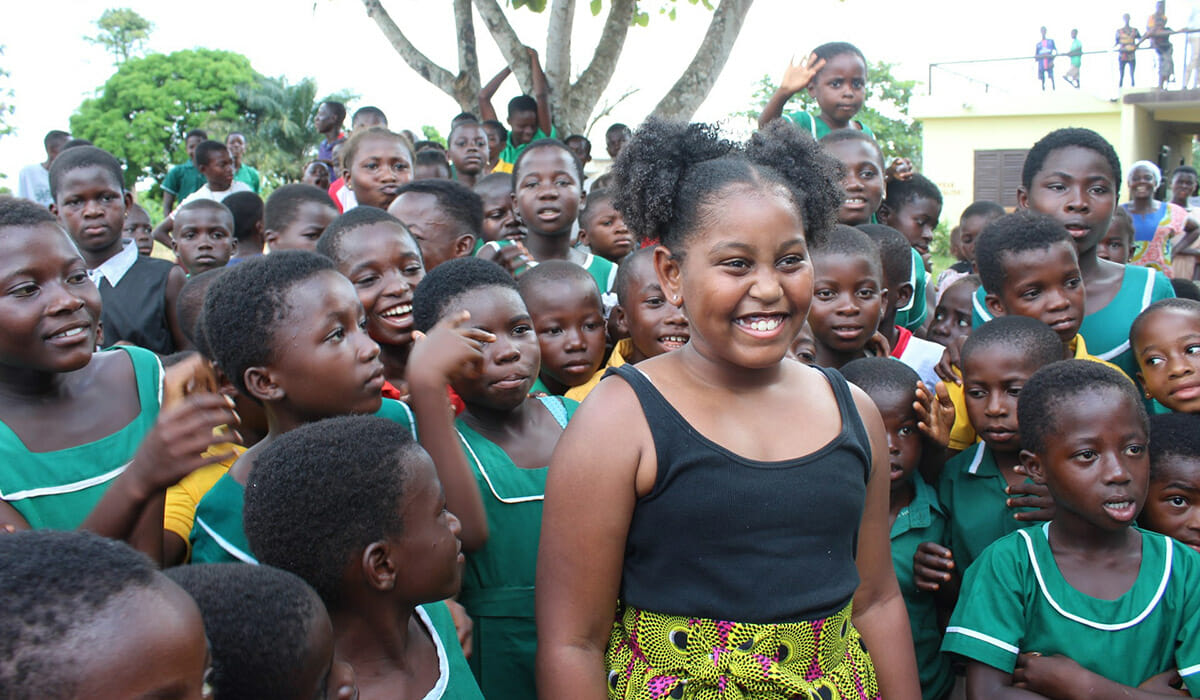
#GivingTuesdayKids is not Khloe’s first experience with changemaking on a global scale. As Khloe Kares has grown, she has led initiatives to provide water pumps and bathroom facilities in schools throughout the West African country of Ghana. Partnering with philanthropist Dawn Sutherland, Khloe also created Dawn’s Sunday Girls, a weeklong seminar focused on empowerment, encouragement and motivating Dawn’s girls to be anything they want to be. Khloe has developed impactful relationships with Ghanaian youth, and will return to Ghana on Dec. 5 to continue her efforts there.
With help from her mother, Khloe has also built workshops for youth to develop core entrepreneur skills and confidence. Hosted through schools and partner organizations, Khloe’s leadership series is designed to teach and educate youth about business planning, building confidence through public speaking and the importance of not only setting goals, but also achieving them. According to Khloe, these workshops are significant because “youth are the future, but we are also the now.”
Through Khloe Kares, Khloe is helping to provide water pumps and bathroom facilities in schools in the West African country of Ghana, and is building meaningful relationships with Ghanaian youth.
Why does Khloe volunteer? “Why not?” is her response. “I’m doing this to make someone else feel good,” she said. “It’s not one of the things you do for yourself. Yes, you feel great, but it’s not all about feeling great. It’s about somebody else doing great.”
Khloe believes that the only way to understand what’s going on in a community is to go out in that community and see for yourself. And the best way to spark change is to get involved – because when one person gives, another person gives. Leading with these values, Khloe effortlessly reflects the vision of our founder, President George H.W. Bush, who believed that the power of the human spirit can drive positive change. For her extraordinary efforts to create change in her community, and in communities around the world, Khloe was an recipient of the 2019 George H.W. Bush Points of Light Awards. Her everyday actions and words continue to light the path for other points of light of all ages.
In recognizing Khloe’s extraordinary service, Points of Light President & CEO Natalye Paquin said, “Khloe represents a generation of awake and engaged young people who are not only creating the world we want to see tomorrow – they are designing the world we experience today.”
Through Soccer and Academics, Volunteer Builds More Inclusive World for Underprivileged Children
Meet Daily Point of Light Award honoree Nile Liu. Read his story and nominate an outstanding volunteer or family as a Daily Point of Light.
As a soccer player in high school, Nile Liu says the sport provided the opportunity for camaraderie, where players could depend on each other and unite for one shared goal. Now, the 20-year-old is giving back to children in need through soccer and academics, imparting the same meaningful benefits for both body and mind that Nile himself gained through the team sport.
As a volunteer for Soccer Without Borders, the Baltimore, Maryland resident coaches children on soccer skills and academics weekly. Through the accessibility of a game and serving with a mission of inclusion, Soccer Without Borders offers marginalized populations such as refugee and immigrant children a familiar space to build friendships, gain confidence, experience success, acclimate to new surroundings, and heal.
Nile has connected with dozens of students through Soccer Without Borders, helping to provide an avenue for positive engagement, a platform for personal growth and a toolkit for a brighter future.
What inspires you to volunteer?
I was lucky to be provided opportunities and resources as a child, and I want to give back to kids that don’t have the same opportunities as I did. It’s nice to help and teach others, and helping them to understand academic material is really fulfilling to me.
Describe your role with Soccer Without Borders.
As a soccer volunteer, I help elementary and middle school students interact and play nicely as a team. We focus on practicing values like acceptance and making sure that no one is excluded from activities. In the academic setting, I help small groups of kids with homework. Our volunteerism is about getting everyone involved and working together across this group of marginalized children.
Share one personal story with me from your volunteerism.
I connected with this one kid because we’d do math together and if he did well with his homework, we’d play chess afterwards. I taught him how to play chess, and he’d always say that one day he’d beat me at the game. It took awhile for him to master those skills, but last year, he beat me. He was really proud of winning and I was really proud of him too, because I could see his improvement each time we played.
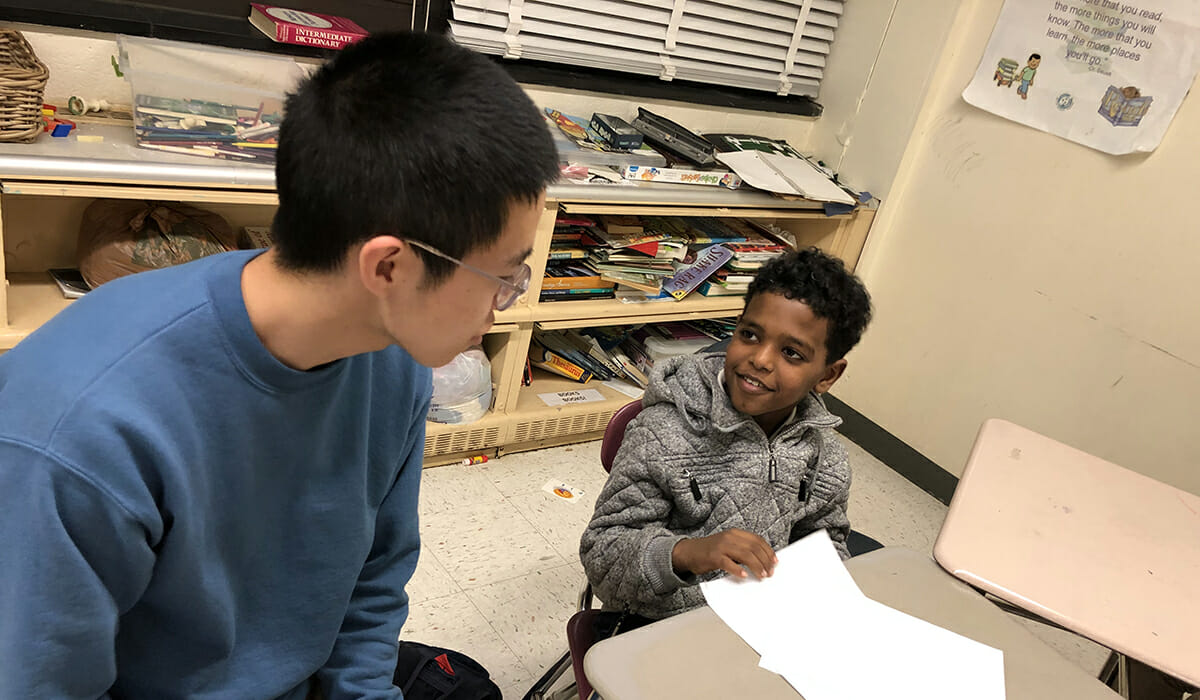
Through soccer and academics, Nile has connected with dozens of students, helping to provide an avenue for positive engagement, a platform for personal growth and a toolkit for a brighter future./Courtesy Nile Liu
What’s one way you hope to inspire others in your service?
For people like me who are citizens and born here in the U.S., we have great opportunities and chances to succeed. The kids I volunteer with are refugees or immigrants, they come to the country not knowing English, not having connections or resources to rely on. We have to give back and help improve life for them because it’s important to help others.
What’s been the most rewarding part of your service?
Doing our academic volunteering, when I’m teaching the kids a specific concept, it takes awhile for them to understand. But when I see the look on their face, that “aha” moment when they finally understand the concept, it makes me feel really good. That is very inspiring and makes me very happy.
What have you learned through your experiences as a volunteer?
The time I spend volunteering with these students isn’t enough time to change their life, but any amount of time helping them, little by little, is very important. You don’t see immediate tangible results, but we are making their lives just a little bit easier and happier.
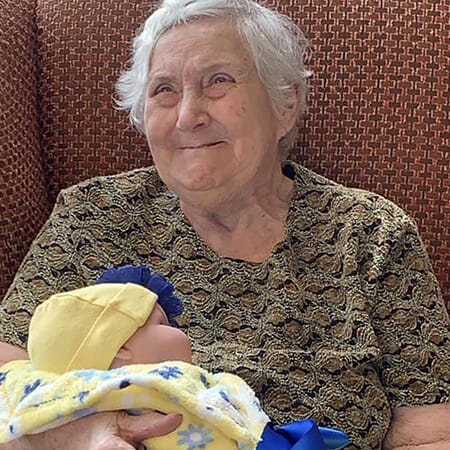
Volunteer Duo Provide Comfort and Joy to Alzheimer’s Patients with Baby Dolls
Meet Daily Point of Light Award honorees Shannon Blair and Sandy Cambron. Read their story and nominate an outstanding volunteer or family as a Daily Point of Light.
Sandy Cambron had explored many avenues in seeking comfort for her ailing mother-in-law, who was depressed and unable to communicate because of Alzheimer’s disease. A mechanical stuffed animal and the distraction of a television did no good. Sandy’s husband was shopping one day when she suggested that he buy a baby doll for his mother, an item Sandy herself had cherished as a child. The positive change in her mother-in-law’s demeanor was immediate, Sandy says, and she and her husband began to informally bring baby dolls as gifts to other Alzheimer’s patients, witnessing the joy they brought.
When Sandy’s co-worker, Shannon Blair, was struggling with the care of her own mother who suffered from Alzheimer’s, Sandy asked if she could buy her a baby doll. The unexpected result was emotional to watch, says Shannon. “I took the baby into my mom’s room, and when I lifted the baby doll up out of the basket my mom’s roommate immediately held out her hand and started to cry.” Nurses told Shannon that night her mother’s roommate refused to be changed out of her clothes, clutching the doll hours after she’d received her.
That lasting connection has been gifted to over 800 Alzheimer patients since 2018, through Pearl’s Memory Babies, an organization named after Sandy’s mother-in-law. By customizing and then personally delivering as gifts baby dolls and stuffed animals to Alzheimer’s and Dementia patients residing in memory care facilities, Sandy and Shannon are providing love and comfort with something soft and familiar that individuals can cherish.
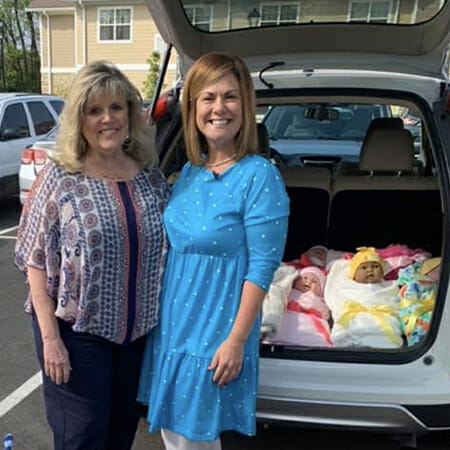
Sandy Cambron (left) and Shannon Blair (right), Pearl’s Memory Babies co-founders, pictured with the “Pearl Mobile” loaded up to make a baby doll delivery to a local memory care unit in Louisville, Kentucky. /Courtesy Pearl’s Memory Babies
What inspires you to volunteer?
Shannon: I know what it felt like being a caretaker of someone with Alzheimer’s. It’s a brutal disease and they lose so much of what they know, they’ve lost all their connections. We volunteer even if just 30 minutes of our time with one person brings back memories, a connection and a little happiness.
Sandy: We saw how lonely my mother-in-law was, she’d sit and stare. My husband and I saw a drastic change in my mother-in-law after we gave her the baby doll, and we felt compelled to get more babies out to more people.
Your story of service went viral. Explain.
Shannon: When I brought the baby doll to my mother, it was just such a neat thing. All the women from the facility came to my mom’s room and it created a stir because everyone wanted one. Sandy suggested we deliver baby dolls to all 41 patients in that memory care unit, so we went back on Valentine’s Day in 2018 armed with baby dolls for each patient, and the experience was super emotional for everybody. I posted videos and photos of the day to my Facebook page, and the next day, the post had received half a million shares. It went viral overnight. We received tons of messages, and people started donating to us. That’s when we created Pearls Memory Babies.
Describe your role with Pearl’s Memory Babies.
Sandy: We receive emails and messages every day from people looking to donate and for more information, sometimes we can get 50 emails a day. Through donations, we are able to purchase baby dolls, we then re-package them, outfitting them with a diaper and hat and wrapped in a blanket so that they look like real babies, and then we deliver the dolls to patients in memory care units. Our efforts don’t end there, because we spend time with each patient after we’ve delivered the doll.
What’s one way you hope to inspire others in your service?
Shannon: These people need visitors. And not just Alzheimer’s and dementia patients. I hope that we inspire people to go visit anybody in a nursing home. I leave more blessed after visiting with patients because they have so many stories. Those stories might be from 30 or 40 years ago, but they’re so meaningful.
Some patients cry tears of happiness, some laugh when they receive their baby doll, intended to bring love and comfort to patients who have lost many connections in their lives./Courtesy Pearl’s Memory Babies
What’s been the most rewarding part of your service?
Sandy: The moment I hand over the baby is the most rewarding. The excitement I see in the patient’s face, they just light up. They’ll say, ‘oh look at their pretty teeth, their pretty eyes’. They’ll take the soft blanket the baby is wrapped in and bring it up to their face. They’ll stock rocking them. The emotion they exhibit is varied, they start crying, or sometimes they’ll laugh. It’s just such a comfort to them, and the doll brings out a nurturing sense that the patient still has, even if they don’t remember much else.
What have you learned through your experiences as a volunteer?
Shannon: I never dreamed I’d be hanging out in nursing homes after my mom passed away. Once our post about the baby dolls went viral, I realized this service is what I am intended to do. It’s not a choice, the good Lord is in control and he wants us to do this.
Sandy: We’ve heard from people across the world – 48 different countries and counting. People write us sharing stories about their family, and they’ll send pictures of their loved one. They can’t thank us enough for sharing the message of Pearl’s Memory Babies, and how it’s helped their loved one. We always say we’ll deliver as far as our donations will take us. We’ve delivered babies to patients in Kentucky and Indiana thus far, and hope to go even further next year.
How can readers help?
Please visit our Facebook page for more information about how you can help and donate.