Teen Starts Mentoring Program to Help Students Learning English
Meet Daily Point of Light Award honoree Gabriela Garcia-Perez. Read her story and nominate an outstanding volunteer or family as a Daily Point of Light.
Starting a new school can be hard enough for a kid without also adding in not being able to speak the same language as most of your classmates. Spanish is Gabriela Garcia-Perez’s first language, but she quickly learned English growing up in her predominately English-speaking Guilford, Conn. community. While she was attending an event for Puerto Rican families moving to her area following the island’s 2017 hurricanes, Gabriela realized just how hard it would be for many of the young Spanish speakers to integrate into their new schools without having the same English-language proficiency. Wanting to help, Gabriela reached out to the New Haven Board of Education to see if she would be able to start some sort of mentoring program specifically for the new English-language learning [ELL] students. She was allowed to create a program within New Haven Public Schools’ already-existing Saturday Academy, an extracurricular tutoring program for students.
Now 18, Gabriela has spent the last three years running the Community Integration Mentoring Program [CIMP]. Each Saturday, she brings about ten volunteers —all middle or high school students themselves — to the Saturday Academy at Fair Haven School, which is located in one of New Haven’s heavily Latino communities. The CIMP mentors pull the elementary-aged ELL students out of the regular programming in order to provide them with individualized tutoring focused on improving their English proficiency. Throughout CIMP’s duration, Gabriela and her mentors have impacted the lives of over 45 ELL students.
Describe Community Integration Mentoring Program.
We provide the opportunity for English-language learners within an urban community called New Haven to develop their English communication skills from the help of students from neighboring school communities. It’s the idea of kids helping kids. The end goal is for them to integrate into society and become active members within our towns. It also promotes integration among communities, so we hope to create a symbiotic relationship and cultural learning experience between the communities involved. Guilford, Conn. is a very sheltered, privileged community, so for them to go into the city of New Haven which is less than 20 minutes away, it’s a real cultural-shock experience they get. These elementary school ELL students, they’re in fourth and fifth grade, and the mentors which are the students coming in to help them, are middle schoolers and high schoolers. A lot of the mentors are from Guilford, so by them interacting with students from the New Haven community, they’re really being exposed to a lot of issues and situations that they don’t necessarily hear about on an everyday basis within their community. In reality, the New Haven students are really acting as a resource to the mentors as well. The mentors are providing the ELL students with individualized help. They’re becoming role models and mentors and they are becoming their friend and someone for the New Haven students to trust. For the younger students, they are the ones who are getting access to a whole new perspective because they’re interacting with kids who are a little older than them. It’s great because in reality, kids learn best from their peers.
My program works through the Saturday Academy program in New Haven which is an extracurricular that they offer. We pick out the students based on who the teachers and the principal within the school think is best for us to work with. I run through [the students recommended] and then I pair them with the mentors based on who I think would click best. I take them out of the classroom for about 45 minutes while they’re having downtime or while the student is given some sort of assignment they can complete quickly, so that the students working with us can come. Then we work with them on an individual basis and execute the lesson plan. After the lesson plan, everybody goes to gym class and then we join all the other classmates, and that way the other students are then interacting with us as well and everybody is getting to meet each other.
What is your role with the mentoring program?
About three years ago, I started it. In order to do this, I first had to contact the Board of Education and see the possibility of doing this at all. They allowed me to then have a meeting with the principal at Fair Haven School, and he talked to me about how his school in New Haven itself has an extracurricular program called Saturday Academy. The students have the possibility of going to school on Saturdays for half a day. The students are provided lunch, and they’re given math classes, reading classes, they develop interpersonal skills. It’s a great way for the parents to then go to work and know that their kids are in a safe place.
My program, CIMP, works within the Saturday Academy in New Haven. I bring all of the mentors from Guilford especially, but we do have mentors from other different towns as well. We have opened it up to anyone who wants to get involved. We drive them up to Fair Haven School on Saturday mornings. We then work with the students on a one-to-one or two-to-three ratio, because we want to keep that idea of individualized help. We execute the lesson plan that I’ve planned. I make sure to have the mentors take notes on what the students they’re working with need to work on, and their strengths, their weaknesses, things that interest them. I then create different lesson plans based off of those notes. I make sure to make them fun but at the same time educational, because we want to keep those kids engaged and we want them to want to keep coming back to us. We then go to the gym class that Saturday Academy provides. They tend to do lots of cultural activities during gym. It’s great because now the mentors and the teachers are being taught by the younger students.
Within the program, I have to execute the planning of everything. I do the lesson plans, I reach out and recruit mentors, I do lots of presentations with them within my community to recruit younger people to want to get involved. Through my program, I’ve been able to connect with lots of different groups within New Haven to help me develop this. I volunteer at the New Haven Board of Education where I learned about all the different issues these kids may be facing. Lots of these students within New Haven are exposed to lots of issues we don’t hear about in our communities, so when the kids start talking about homelessness or immigration issues or potentially bullying, I’m then knowledgeable on those topics and how New Haven has handled them. I can then become a resource for the mentors on how to approach that with their students.
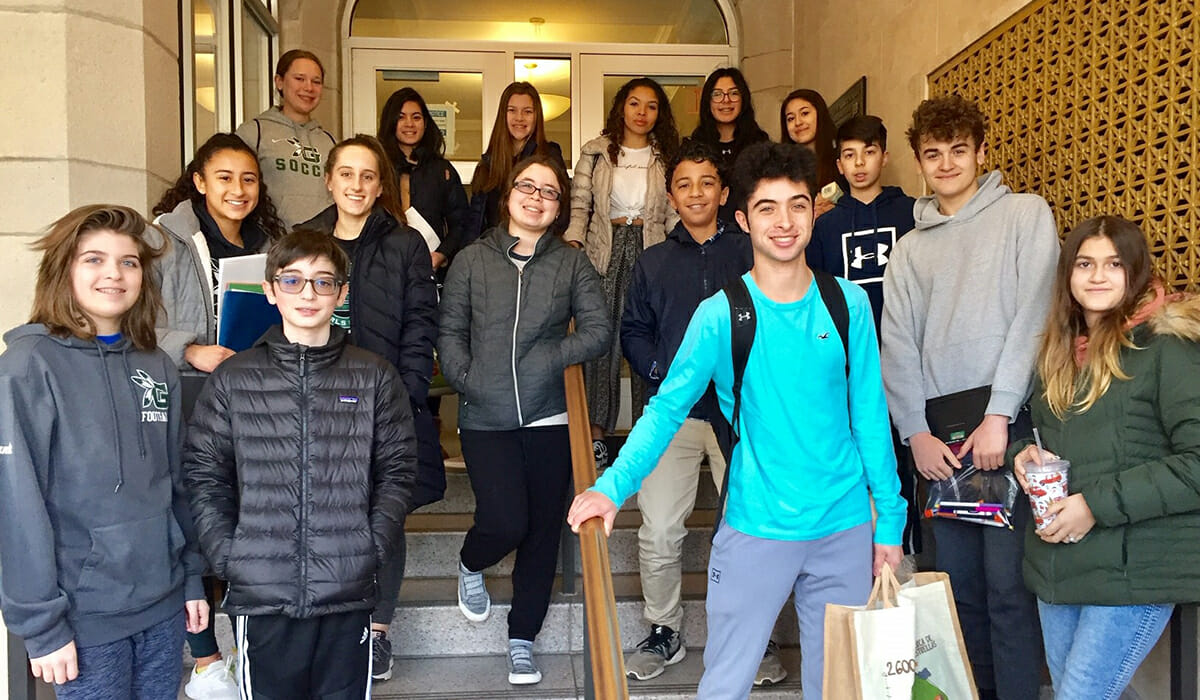
Gabriela Garcia-Perez, center row, left, has a team of about 40 mentors who help her tutor ELL students at Fair Haven School. /Courtesy Gabriela Garcia-Perez
Why did you want to start this program?
About three years ago, I went to an event that was tailored for the Puerto Ricans families who were coming here from the [2017] hurricane disaster. At the event, the idea of students coming in and not being able to speak the language really hit me at that moment. Obviously, I was aware of it, but it became a lot more evident to me at that event. My first language is Spanish but I grew up in a community where I was surrounded by everybody who spoke English and my parents chose for me to speak Spanish. It’s not like they didn’t speak English, but they did that because they knew I would learn [English] quickly being surrounded by everybody who spoke English. For kids within the New Haven community — specifically Fair Haven which is a very Latino-based community within New Haven — it’s a lot harder for them to become integrated into the English language-speaking culture. They go to the grocery store and supermarket, they are able to speak Spanish to the clerk. They go to school, they’re able to speak Spanish to the teacher. They go to school and talk with friends, they can interact with them in Spanish. At home, they’re obviously going to speak their native language. Unfortunately, this does really have an effect on their academic abilities later on. A lot of these students are not immigrants, a lot of them are native born, so they are entitled to all the same rights as any other students. New Haven particularly only gives their students about 30 months in a bilingual setting. After those 30 months, the students are then put into mainstream learning and unfortunately we know that not all kids learn at the same rates … There are many different factors that tie into these students not being able to be proficient within English, like how their community is mainly of one ethnic background which does not force them to speak the English language. It’s great for the mentors to be able to come into these communities and see the situation that the kids are living in. It’s more of a cultural experience for both groups because then the younger ELL students are able to see all these different opportunities that they can strive for. We open their perspective to different career choices, to different aspirations they may not have thought of beforehand.
Have you noticed a change in the kids and mentors who have gone through the program?
Absolutely. Lots of the times, we see the students who are not as proficient in English perceive themselves as submissive. They’re not as outgoing because of embarrassment or because of many different factors that prevent them from being themselves. Lots of times, language barriers make people introverted and prevent them from showing the personalities they actually have. Working with lots of our students, we’ve see them open up and blossom in miraculous ways.
It was our first year doing this, and we had one little girl come up to us after doing a lesson plan that we had just ended. She started explaining what had happened last week, the reason she didn’t come to CIMP. It was because ICE had come to her house and she was telling us about the speech that her mom gave her because she thought they were going to get deported. Her mom was telling her that she had a social worker and everything was going to be ok and she was going to stay with her brother. It was so impactful for these words to come out of a seven-year-old. Lots of times we kind of think, ‘Oh, they’re just kids,’ but in reality these students are exposed to a lot more of the realities of life than the mentors. That was really crazy for the mentors to hear. Lots of times when we hear about these sorts of problems, we hear them on the news, and although we feel sad for two minutes, unfortunately, we just keep going on with life and it doesn’t really hit us as hard as it really should. Having these mentors interact with these type of students, it really does help a lot for them to build sensitivity and build love for each others’ cultures.
What’s been the most rewarding part of your work?
Honestly it’s going to sound very cliche, but just seeing how the kids react to us coming in every Saturday. It’s a whole new aura that has brought so much light into my life and into all the other students within the program. It’s so great to see how the different grades within the mentors themselves have been able to interact. When you get to high school the freshman are at the bottom of the totem pole. I have freshmen in my program, sophomores, seniors, juniors, 8th graders, 7th graders, 6th graders, and despite their age, they’ve all been able to interact and learn from each other and been able to talk about different classes and school, give advice to each other on how they should tackle these classes. Just seeing how everybody has been able to connect with each other and learn from each other has been so rewarding. It’s great to see how these students within Guilford and all the other towns involved … have learned from all the kids who are mentees that are a part of the program. They have been exposed to all these different situations they don’t hear about on a normal basis and they’re developing love for each other and for each other’s cultures and backgrounds. We’re developing sensitivity and we’re developing a bridge between a very prevalent cultural divide.
What do you want people to learn from your story?
I want to show the idea that especially for students and kids, it’s important that they learn that getting involved starts at the get go, and from a young age particularly. When we have students like these who are going out and they’re showing the younger students how to be people within their community that are important, that are respected, it really speaks volumes. I hope that my program, as far as students around everywhere and around every age, [inspires them] to want to get involved in their community and find something they’re passionate about, a cause that drives them to want to push people to be better.
Meet Daily Point of Light Award honoree Zoe Nelles. Read her story and nominate an outstanding volunteer or family as a Daily Point of Light.
Many schools offer meals to students who don’t get adequate nutrition at home and Palmer High School in Palmer, Alaska is no exception. Zoe Nelles, 18, took the idea a step further when she wondered what these kids ate on the weekend. That moment of empathy was the impetus for The Sandwich Project, an idea Zoe had to assemble bags of nonperishable food to distribute to these students for weekend meals. What started as food for seven teens is now a community movement involving a local food bank and neighborhood donors, with 80 students in five local schools know getting enough to eat on the weekends.
Points of Light spoke with Zoe about her commitment to service.
Describe your volunteer role?
The Sandwich Project began in my kitchen at home where I assembled bags of food for seven students at the beginning of the 2018 school year. I wondered how these kids were eating on the weekends -and consulted the school nurse to identify who needed help. With the support of teachers and the home economics department, we were able to grow the project to what it is today. My role includes raising money, organizing food drives, and seeking support from the local food bank. I also handle budgeting, inventory: tracking, coordinating volunteers and preparing food packages and fresh sandwiches on Fridays. I am also developing a manual for future students in the National Honor Society to take over the project once I graduate in May.
Why is it important to you to support your community in this way?
It’s important because we have a large number of students who are food insecure at home and don’t have access to resources. To be able to help those students is incredibly rewarding. Creating the Sandwich Project is important to me because I’ve grown up in a small community all my life and to know that a portion of these meals are going to students that I’ve grown up with is incredibly eye-opening.
What’s the most challenging aspect of your volunteer service?
It’s challenging to make sure the project runs completely smooth and that we have enough food for each student. Then there’s communicating with everyone who works with the project. Another hard part of volunteering is just being aware of how many kids don’t get enough to eat – that makes me sad.
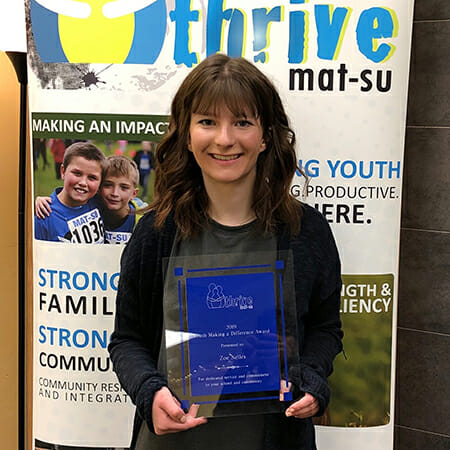
High school senior Zoe Nelles recently was awarded the Prudential Spirit of Community Award for the Sandwich Project/Courtesy Zoe Nelles
Why do you think it’s important for others to give back?
Volunteering is important for yourself and your community. Being a resource and benefiting your community means caring about one another and helping others even when it doesn’t benefit you. That is how strong communities are built.
What’s been the most rewarding part of your work?
One of my favorite parts of creating the sandwich project is the idea that these students know that someone is thinking about them and realizes their situation and wants to help. I know it’s hard to be a teenager on many levels – but I couldn’t imagine not knowing where my next meal is coming from.
What have you learned through your experiences as a volunteer?
So many skills! I’ve learned how to take inventory, how to coordinate and create partnerships and how to think ahead and accommodate to change. Through the Sandwich Project, I’ve learned how to enlist help from my community and have seen them willing to help and offer support.
Are there any future partnerships, programs, or events that you are excited about?
We recently put in for another grant to help with sustainability. I’m excited to be honored with the Prudential Spirit of Community Award which I will receive in Washington D.C. where I’ll get to meet students from all over the country. I will be graduating in a couple of months and I will have to make sure that the Sandwich Project will continue and grow after I go to college. It’s exciting to see where the project could go.
What do you want people to learn from your story?
I would like people, especially teens, to know that at any time you can make a difference in your community. I know it can be daunting to think about, but it’s so rewarding once you begin. Another lesson I’d like people to learn is that there are problems in every community and with every problem, there is a solution.
Ten-Year-Old Starts Recycling Company to Help Save Environment
Meet Daily Point of Light Award honoree Ryan Hickman. Read his story and nominate an outstanding volunteer or family as a Daily Point of Light.
Ryan Hickman may be the ultimate example of proving you can make a difference no matter your age. When he was just three and a half years old, he was so inspired by a visit to a local recycling center with his dad that he decided to start recycling for his neighbors as well. Now ten, Ryan has translated his passion for recycling to Ryan’s Recycling Company. He travels around his Orange County, Calif. community picking up neighbors’ cans and bottles, which he then sorts and delivers to a recycling center.
Ryan’s passion for recycling has led him to travel the world in order to raise awareness on saving the planet. He also participates in beach cleanups and sells Ryan’s Recycling Company T-shirts, donating all of the proceeds to the Pacific Marine Mammal Center in Laguna Beach. Since its inception in 2012, Ryan’s Recycling Company has recycled over 800,000 cans and bottles and raised over $10,000 for the Pacific Marine Mammal Center.
Points of Light spoke with Ryan as well as his dad, Damion Hickman.
Describe your volunteer role with Ryan’s Recycling.
Ryan’s Recycling is a recyclable company that recycles cans, bottles and glass. I’ve recycled since I was three and a half, when my dad took me to a recycling center. I just loved it and I wanted to keep recycling.
Why is recycling important to you?
I like recycling because it’s really fun and I love saving the environment and saving animals so they don’t get sick and die.
Where do the proceeds of your recycling shirts go?
All of the money for my Ryan’s Recycling shirts I donate to the Pacific Marine Mammal Center in Laguna Beach. I thought it would be a great charity to donate money to, plus I really like sea animals.
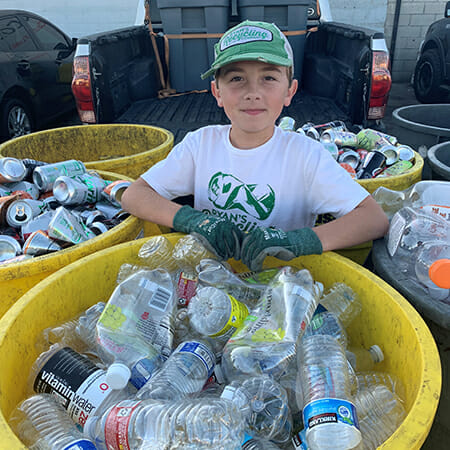
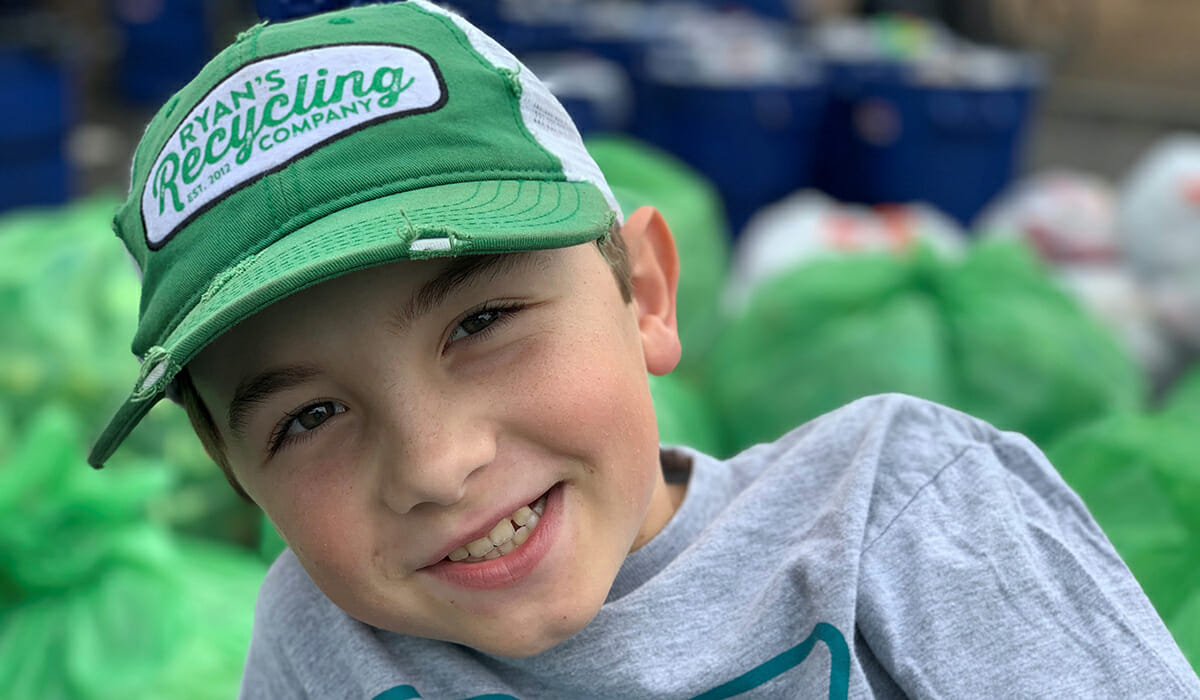
Ryan Hickman created Ryan’s Recycling Company in 2012 after accompanying his dad to a local recycling center./Courtesy Ryan’s Recycling
Are there any future partnerships, programs, or events that you are excited about?
I am going to be going to New Orleans, San Jose, and Budapest, Hungary. I’m going to speak in San Jose talking at a recycling center that just opened up, New Orleans at a waste expo conference for people who recycle, and Hungary, I’m going to be speaking to a bunch of people. And [in] Virginia, I’m going to be having two events back to back, day after day, speaking to people for two hours each which is very fun.
When you speak to people around the world, what do you tell them?
I tell them how important it is to recycle and and also what they could do to make a difference.
what is something that people could do to make a difference?
Something they could do is probably pick up trash if they see it on the ground. If they’re drinking Coke, make sure they recycle the beverage container instead of throwing it away. Maybe do a beach cleanup. Help a local charity. Things like that.
What would you want the people who are throwing trash on the ground, or anyone who doesn’t think recycling is important, to know?
I think they should know it’s really easy because I started when I was three and a half and they’re way older than me, like really older than me. I’m ten and I’ve recycled almost a million cans and bottles. They could be saving the planet too, but they just aren’t trying. They should really try to help save their planet.
Do you have a favorite memory from your time volunteering?
People in Belize recognized me from all the beverage glass containers we had. We found a recycling center there and when we went to recycle them, a lady was cashing in her bottles and the guys that worked there recognized me, like ‘Hey, you’re the kid from Youtube!’ We gave them some shirts and some hats. The next day, we saw them on the island wearing my shirt, because the island was pretty small that we were staying on off of Belize.
Despite being only ten years old, Ryan Hickman has made a huge difference in his Orange County, Calif. community by helping to recycle thousands and thousands of cans and bottles./Courtesy Ryan’s Recycling
Do you have any plans for your future when it comes to your volunteer work?
Ryan: I’m starting a nonprofit coming up, probably in a few months. [It’s] recycling awareness. … I just want to start it because I feel like the beach cleanups do that, and people could donate money to help me get equipment for beach cleanups and stuff separate to Ryan’s Recycling. Also, to travel all the way around the world to teach people about recycling. The name is probably going to be Project 3R.
Damion: We’re in the middle of registering that right now so there is a slim chance that we might have to change the name, but we’re pretty sure that’s it. Ryan gets hundreds of emails a day from around the world from all other countries — people asking how can they recycle in India, Africa, all sorts of places. Ryan already goes around the country here talking to people about recycling and what they can do better, and kind of the next step for him is having the resources to potentially go to other countries and maybe help them set up recycling centers and education [for] countries that don’t have the infrastructure.
What’s been the most rewarding part of your work?
The most rewarding probably is being able to save the environment and not have animals get sick and die, and inspiring kids all around the world.
Why do you think it’s important for others to give back?
I think it’s important for others to give back to their community because it’s good for the environment. Whatever they’re doing, it will make a big difference in the environment and their community.
GTM Research Reserve Volunteer Emphasizes the Importance of Conservation
Meet Daily Point of Light Award honoree Ruben Allen. Read his story and nominate an outstanding volunteer or family as a Daily Point of Light.
Ruben Allen started volunteering as a young boy, engaging in community service projects with his church and the Boy Scouts. He says his father was a great mentor in learning to give back to the community. When the Guana Tolomato Matanzas National Estuarine Research Reserve (GTM Research Reserve) in Ponte Vedra Beach was looking for volunteers, Ruben decided to join. He’s been volunteering with the reserve since 2014. He volunteers on the turtle patrol as well as a teacher for GTM for All, helping hearing-impaired kids be able to experience the splendor of the beach and marshlands.
“It’s what we did back then, and it’s what you do now,” says Ruben. “You give back to the community.”
His involvement in the Boy Scouts and his experience as a hunter helped Ruben cultivate an appreciation for nature. Ruben grew up near the Chesapeake Bay National Estuarine Research Reserve (CBNERR) which is one of 29 protected areas that make up the National Estuarine Research Reserve System (NERRS). He’s familiar with and passionate about nature and maintaining the integrity of ecosystems.
“Hunters are the biggest conservationist,” says Ruben. “I love being outdoors. The world doesn’t live by itself.”
From April 15th to November 1st, Ruben works on the turtle patrol, where two-person teams identify turtle tracks and nests. During the turtle nesting season, Ruben patrols the beach every Thursday with his partner. At 5:30 am they drive up the beach searching for the tracks that will help them identify the turtles and the location of nests. The turtle patrol works to identify three turtles that nest on the beach of GTM: loggerhead, leatherback, and green sea turtles. They’re able to identify the different species of turtle by their unique tracks. They locate where the egg clutch should be and take some of the eggs for DNA sampling. They share the DNA to find out where the turtles are and add the information to the Sea Turtle Conservation database.
Florida has the largest loggerhead nesting in the world. The GTM and the turtle patrol keep a close eye on the nests that are about to hatch and they count the hatched eggs and release the turtles. They take inventory of the entire nest.
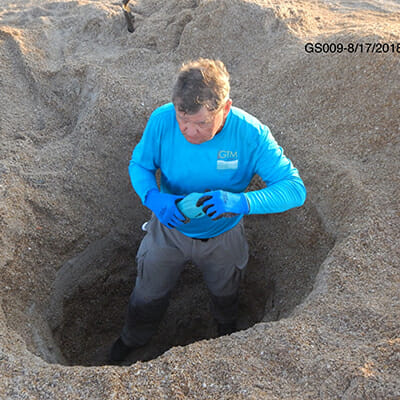
Turtle patrol taking inventory of eggs. Photo Credit: Ruben Allen
“Watching the baby turtles—they take two steps forward five steps back trying to get to the water,” says Ruben. “But as soon as they figure out how to duck under the waves, they’re gone. It’s awesome because of how many are going to make it back. Every time they go back there’s a chance that they might come back and lay more eggs.”
Ruben also volunteers with GTM for All which accommodates Florida School for Deaf and Blind where the students engage in the biology programs at GTM. The children rely on Ruben to be their eyes as they enter the waves and hold a fish for the first time. Ruben says it’s rewarding and they want to integrate different experiences in the reserve.
“It gives them chills and happiness to help kids experience something they’ve never been able to,” says Ruben. He loves being a mentor to the students and helping them experience wildlife for the first time.
Ruben says his favorite part is being able to get out in nature. He says no two days on the GTM Reserve are the same. He enjoys being able to educate kids about nature and let them touch a fish, snake, etc. He volunteered with a title one school in Florida, where the students had never seen the beach before even while living in Florida. Being able to facilitate the kids seeing the ocean for the first time was a special moment for Ruben. He emphasizes the importance of the estuary for all Florida animal life. The reserve is a special haven for migrating birds, and a nursery for the fisheries to lay their eggs. Ruben wants to educate future conservationists and the local community about the importance of the estuary.
Texas Teen Commits to Civic Activism to Empower Youth
Meet Daily Point of Light Award honoree Sage Hirschfeld. Read their story and nominate an outstanding volunteer or family as a Daily Point of Light.
Spurred by the historic 2018 nationwide student gun violence walkouts, 18-year-old Sage Hirschfeld has committed to engaging in civic activism as they work to elevate student empowerment across their community.
Inspired to be more informed after the planned walkout, the Austin, Texas high school senior launched Westlake Activism Club as a part of their Girl Scout Gold Award Project to encourage young people to be politically aware and engaged. Working with the Student Empowerment Association (SEA), a student organization formed following the gun safety walkouts, Sage is empowering their peers to advocate for themselves within their community and beyond.
What inspires you to volunteer?
I’ve always cared about community issues, but I was super inspired by the walkouts for gun safety in 2018. Watching youth get involved, the energy felt like youth were saying, “we need this change”, and if the adults weren’t going to make the change, then these students were going to take the reins.
I am a member of the SEA, which is a 20-person organization that promotes student activism. As the founder of the Westlake Activism Club, I host club meetings and stay informed about local opportunities for club members to participate in. I also plan activities including teaching youth how to fact check a source, how to track down scripts to call their representative or how to find lobby days for their congressional offices.
Sage Hirschfeld: “Watching youth get involved, the energy felt like youth were saying, “we need this change”, and if the adults weren’t going to make the change, then these students were going to take the reins.”/ Sage Hirschfeld
Share one personal story with me from your volunteerism.
We left school in the middle of the day to attend a recent climate strike at the state capitol. A member of Westlake Activism Club had been quiet and shy when she first joined the club, but at the event, she spoke about the issue and the crowd was so supportive. It was just a really great moment to witness and I felt so supported and empowered.
What’s one way you hope to inspire others in your service?
Energy is contagious. By being a strong leader and empowering other youth, we can start a movement with youth feeling their power and continuing to be civically engaged citizens throughout their life.
Tell me about some of your recent civic activism events.
A few of our Westlake Activism Club members recently voted together for the first time, and some recently spoke at a climate strike. SEA holds workshops to help promote engagement, including topics such as sex ed and student rights in schools, protesting and free speech.
In one word, describe what volunteerism means to you.
Empowerment.
What’s been the most rewarding part of your service?
The bonds that I’ve formed with other people and the network of really engaged youth that I’ve met throughout Austin. My service has definitely deepened my interest in human rights and various civic engagements.
What have you learned through your experiences as a volunteer?
People can make a difference in society and the government, we’re not just stuck in how we are.
When you’re not busy with school or volunteering, what do you do for fun?
I do taekwondo, I’ve been doing it for over a decade now. It’s a good way to get exercise and have fun. I also write slam poetry.
How can readers help?
Please visit SEA’s website for more information about how to get involved.
To read more about listening and learning, download the latest issue of Civic Life Today.
Twins Fight Period Poverty By Donating Menstrual Products to Girls in Need
Meet Daily Point of Light Award honorees Brooke and Breanna Bennett. Read their story and nominate an outstanding volunteer or family as a Daily Point of Light.
For most women and girls, hygiene products such as pads, tampons, toothbrushes and body wash are just another arbitrary item to toss into the shopping cart. However, there are also many girls living in underserved communities who can’t afford the monthly cost of such products. During their period, many of these girls skip school, miss work, use household items in place of pads and tampons, or use the same menstrual product repeatedly.
When twins Brooke and Breanna learned that students at the all-girls school their mother worked at were using socks and toilet paper during their periods because they couldn’t afford to buy menstrual products, they knew they wanted to help end “period poverty.” The girls founded Women in Training, Inc. (WIT) in order to provide monthly donations of WIT KITS, bags containing menstrual and hygiene products, to young women in need. Now 12 years old, Brooke and Breanna have donated about 300 WIT KITS to girls in their Montgomery, Al. community and surrounding area. They even inspired State Rep. Rolanda Hollis to introduce a bill currently in the 2020 Legislative Session which would require schools to provide free menstrual products in bathrooms.
Points of Light spoke with Brooke and Breanna as well as their mother, Adeyela Bennett, who is the Vice President and CEO of Women in Training.
What gave you the idea to start Women in Training?
Brooke: My mom used to work at an all-girls school where her students would go up to her and ask her for pads because they didn’t have it. They would use socks and tissue paper and stuff like that instead of pads because they couldn’t afford it. My mom would give it to them. We decided that we would do something like Women in Training so we could help those girls.
Describe what Women in Training does.
Brooke: We make these WIT KITS which are kits with pads, tampons and a bunch of stuff to keep you in good shape. We have toothbrushes, toothpaste, body wash. We give them away to underserved girls. … We published a brochure on the menstrual cycle. It tells you a bunch of stuff about your menstrual cycle and in the WIT KITS we also give away these little cards with more information about your menstrual cycle so girls can be more informed.
Breanna: Also in the kits, we include handmade bracelets for these girls, and we include some fluffy socks and shampoo and conditioner. We have journals for them to write in and we have some more female anatomy brochures. We also include toothbrushes and things to keep your hygiene good.
Adeyela: Dr. LaToya Clark is our medical advisor, so whenever we do a giveaway, she does a 20-minute menstrual education talk to educate girls about the biology of their bodies, how to take care of themselves and what to expect. The reason she’s doing it is in her practice, she has adult women in their 30s, 40s, 50s and beyond who still don’t understand the female anatomy and how to properly care for themselves, so she wants to make sure that the next generation is more informed. That’s an important part of the program.
Twins Brooke and Breanna Bennett founded Women in Training in 2019 in order to help fight period poverty./Courtesy of Grace Photography:
Why is it important that girls have access to these hygiene products?
Breanna: It’s so important for girls to have access to these products, especially for free, because you can’t really control that females have a menstrual cycle. Because you can’t control it, I think it should be provided to you to keep you healthy and clean.
Why did you want to include additional items, like bracelets and journals, along with the hygiene products?
Brooke: So they can write their feelings down and what they feel like and stuff like that.
Breanna:We also put inspirational quotes in these journals to keep the girls staying positive.
Brooke: We have Dr. Lee Farrow make the bracelets and she puts words on it like ‘brave,’ ‘strong,’ ‘beautiful,’ so they can encourage the girls to be inspired to be those things.
Adeyela:The girls were making them but time got to be a big issue. Dr. Lee Farrow heard about them and called us and volunteered to make them. She teaches Russian [history] at Auburn University at Montgomery, so it’s amazing to me that a history professor would want to take her time doing this, just to relieve the girls and to support the project. Breanna came up with the idea of the bracelets because she didn’t want the girls to feel like charity cases. She wanted to give them something just to make them feel special, and that’s how they got started making the bracelets.
Can you describe the advocacy work you’ve helped with, and why the bill is important?
Brooke: Representative Rolanda Hollis filed a bill that girls in public schools could have pads and stuff like that in Alabama. We went to the state house to meet her.
Breanna: I think it would just be amazing for the girls at public school to not have to use socks and unhygienic products every month for their menstrual cycle. It’s really important for them to stay healthy and clean.
Adeyela: When we went to visit Rep. Hollis, she said that Breanna and Brooke were the inspiration behind her introducing the HB-237. She heard about the work they were doing and said ‘They’re doing Montgomery and neighboring counties, but what about girls in other parts of Alabama?’
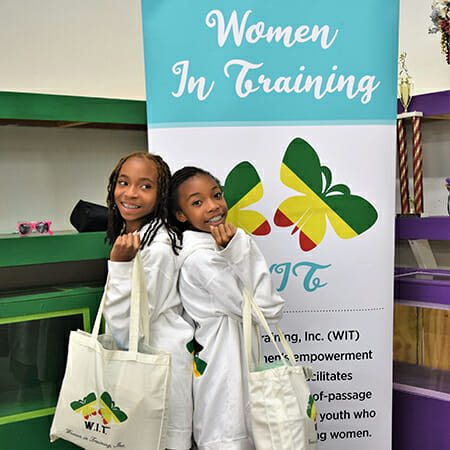
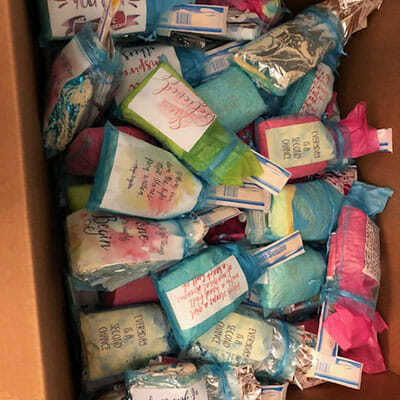
Twins Brooke and Breanna Bennett pose with WIT KITS, bags filled with menstrual and hygiene products that Women in Training donates to girls in need./Courtesy of Jill Friedman
How did it feel to hear that from Rep. Hollis?
Breanna: It made us feel really good to see that so many people support the work we are doing and so many people want to spread it to their counties and even their whole different state.
Are there any future partnerships, programs, or events that you are excited about?
Adeyela: [There is] a Christian organization [First Christian Church] that provides foster care for young people in the community. One of the social workers with that group was telling us that they often don’t have the basic things they need, so on April 18, we’re having a big event where Dr. Clark will do the menstrual education and we’ll give out hundreds of WIT KITS to youth in foster care in Alabama. Then in May, we’re doing a Mother’s Day giveaway to girls whose mothers are imprisoned.
Brooke: We have the WIT Tea Party on July 18.
Breanna: We’re going to have refreshments and celebrate a whole year of founding WIT and talking about what we want to do in the future of WIT.
What’s been the most rewarding part of your work?
Breanna: Seeing the happy smiles and faces of the girls we give these kits to, and also seeing how supportive people are.
What do you want people to learn from your story?
Breanna: I want people to learn that even us young people can make a difference in the world. You don’t have to wait until you’re older to start making a difference and change the world for better. I hope people learn that you shouldn’t be embarrassed about your menstrual cycle because it’s something that all women have to go through.
Do you want to make a difference in your community like Brooke and Breanna? Find local volunteer opportunities.
Teen Volunteer Plays Chess to Effect Social Change Across Community
Meet Daily Point of Light Award honoree Jonathan Martinez. Read his story and nominate an outstanding volunteer or family as a Daily Point of Light.
A two-time state chess champion, 16-year-old Jonathan Martinez says the knight is his favorite chess piece, because according to Jonathan, “it’s the most confusing piece, but once you know how to use it, it’s really useful.” Similarly, the Tucson, Arizona teen is using his chess skills to serve others and do good, by empowering underserved populations in his community.
Launching The Pawn Initiative in 2018, Jonathan is using chess as a tool to build community, empower individuals, and bring about social change across people from all backgrounds. Through outreach, workshops and chess instruction sessions with at-risk youth, seniors, refugees and asylum seekers, Jonathan is helping individuals to keep their minds active, develop friendships and learn life skills.
What inspires you to volunteer?
It makes me happy to teach people how to play a game I’m passionate about. Through chess, some individuals are improving their mental health, some get more confident and focused.
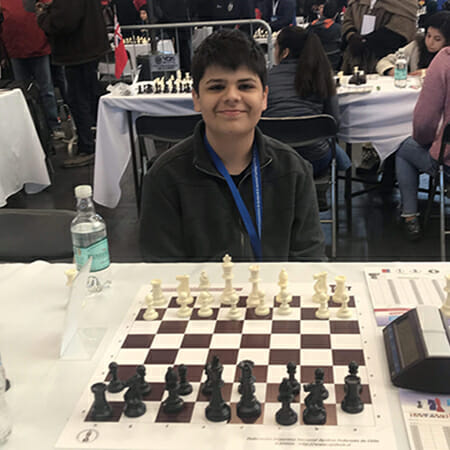
Jonathan Martinez represented the U.S. at the 2018 Panamerican Youth Chess Championships in Santiago, Chile./Courtesy Jonathan Martinez
Describe your role with The Pawn Initiative.
As founder, I am always looking for new organizations who are interested in bringing chess to their community. I teach students chess privately, and the money I make from those classes goes directly towards paying expenses for The Pawn Initiative. I’m hoping to officially establish The Pawn Initiative as a nonprofit in the coming year.
Share one personal story with me from your volunteerism.
I was teaching a man named Miguel at St. Luke’s Home, which is an assisted living facility in Tucson. Miguel already knew how to play chess, but he attended every session I held to learn more about the game. He doesn’t speak much English, but we communicate through chess. Miguel is always excited to come and learn, and chess is an activity he’s confident in, which has positively impacted his life overall.
What’s been the most rewarding part of your service?
It’s been rewarding to see how chess can really create social change and that I have been able to build a community of people who have a shared interest in the game.
How do you hope to inspire others through your service?
I offer weekly chess sessions to at-risk youth at the Boys & Girls Club, Jim and Vicki Click Clubhouse, seniors at St. Luke’s Home and refugees and asylum seekers new to southern Arizona at the Casa Alitas Program hospitality center and at Tucson Refugee Ministry. In addition to teaching specific subjects and strategy, we talk about our lives. I’m connecting on a personal level to build community and empower individuals facing challenges.
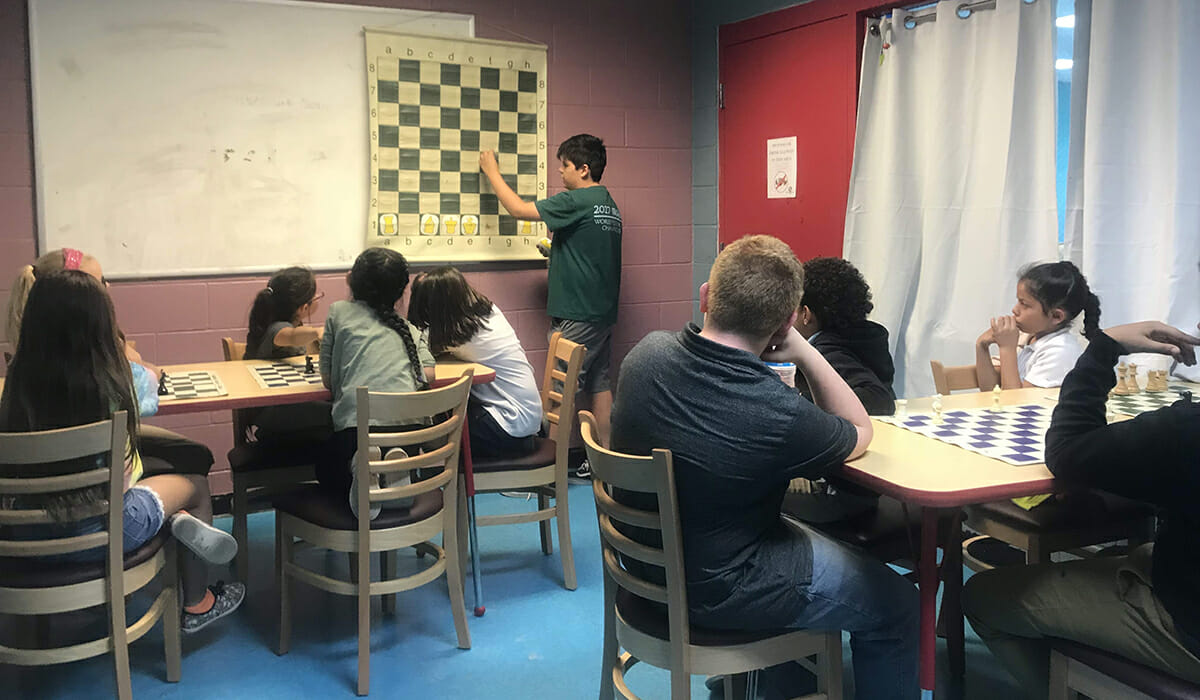
The Pawn Initiative founder Jonathan Martinez (pictured) using a demo board to teach chess to children at the Boys & Girls Club, Jim and Vicki Click Clubhouse in Tucson, Arizona./Courtesy Jonathan Martinez
In one word, describe what volunteering means to you.
Change. Because I see people change when I volunteer and I change myself through volunteering as well.
What have you learned through your experiences as a volunteer?
At first I was nervous to teach chess to a large group of people, but eventually I got better at public speaking and now enjoy fostering people’s love for the game.
How can readers help?
Please visit The Pawn Initiative’s website for more information about how you can help.
Teenager Builds Feminine Hygiene Kits to Combat Period Poverty
Meet Daily Point of Light Award honoree Lindsay Wheeler. Read her story and nominate an outstanding volunteer or family as a Daily Point of Light.
Lindsay Wheeler and her best friend are two proud Las Vegas-born high-schoolers who want to make a difference – one Project Dot kit at a time. They came up with the concept for Project Dot after volunteering at many homeless shelters in their community. Lindsay saw that many of the homeless people coming to the food kitchens were women. However, when they volunteered with nonprofits that made hygiene kits for the homeless community, they noticed that the items in the bags were geared toward men.
Lindsay Wheeler realized that the women in the homeless community didn’t have any tampons or pads to help them when it was their time of the month. Most of the women only had one pair of clothes and a water bottle, but nothing for their periods. Lindsay realized homeless shelters also needed feminine hygiene products. There are a few shelters that have so many tampons and pads. However, women in the homeless community might but they don’t know how to use them correctly. The shelters don’t know how to discuss using feminine hygiene with the women as well and so there is a cycle of misuse.
Project Dot’s hygiene kits for women who do not have access to feminine products. Photo Credit: Lindsay Wheeler
Furthermore, she discovered low-income students in her school district may not have needed items unless they had to make a humiliating trip to the school nurse. For Lindsay, the worst results of period poverty are the young girls who miss school because they do not have access to feminine hygiene products.
“This is a problem within the entire homeless community,” says Lindsay Wheeler. “When saving and spending money, they’re only thinking about food, shelter, but not sanitation and feminine hygiene. They can buy coffee with SNAP but they can’t use it to purchase tampons or pads.”
Lindsay founded Project Dot to put an end to period poverty. Once a month, her team builds feminine hygiene kits for homeless shelters and schools. They work together in an assembly line. For homeless shelters, they add four tampons and four pads and for kits going to schools they include eight pads. Every kit includes lotion, wipes, toothbrush, nail file, inspirational message, and a little piece of candy, hair ties. Each kit is wrapped and placed in a felt back. Project Dot creates over 200 a month. Working with United Way, they had a kit building fundraiser that created over 500 kits in one month. Recently, Project Dot has been awarded a $9,000 grant from Wynn Hotel.
Lindsay says the main issue with periods and why feminine hygiene products are inaccessible is the stigma around it. There is a lot of shame and privacy surrounding periods. Instead, she believes the subject needs to be approached clinically and thoughtfully.
“We should talk about it as more of a positive thing,” says Lindsay. “It hurts, it’s not easy, but it’s perfectly normal. If we were to teach parents or kids how to deal with it, it may not stop period poverty, but it can help mitigate it.”
Lindsay feels like she is making a difference every day. The whole process makes her feel like she’s doing something right. When she delivers the hygiene kits she feels she is making an impact.
Portland Teen Starts Nonprofit to Promote Relationship Between Youth and Law Enforcement
Meet Daily Point of Light Award honoree Britt Masback. Read his story and nominate an outstanding volunteer or family as a Daily Point of Light.
In bold numbers marking Youth Educating Police’s homepage, three statistics will stand out to visitors of the nonprofit organization’s website. Annually in the United States, 3.5% of police interactions involve youth aged 16 to 18, but 30.1% of use-of-force interactions involve youth of that age group, and 81% of use-of-force cases are initiated by police.
While these national statistics are lower for Britt Masback’s hometown of Portland, he still recognized the sense of distrust and fear between his community’s youth and law enforcement officers. In 2017, he decided to address his community’s problem through co-founding Youth Educating Police. The youth-led organization works to promote a positive relationship between police and young people by creating police training specifically for interacting with youth, and by holding discussion forums between youth, law enforcement and community leaders. In 2020, Britt saw his hard work come to fruition when the Portland Police Bureau began implementing Youth Educating Police’s training program. Now 18-years-old, Britt hopes to be able to spread the program to other cities around the country as well.
Describe Youth Educating Police.
I and a few of my peers here in Portland started Youth Educating Police to combat apathy and to combat the use of force against young people from police officers. We’re working to decrease distrust between both sides and work toward a relationship that is more productive, and that is ultimately more safe for both young people and police officers. We started because of the national awareness around police brutality and around police reform, but also on a local level, looking at the breakdown of trust between police and youth.
What led you to create this organization?
It was a really interesting story. I come from a place of privilege. I’ve never had an interaction with police officers either positive or negative, but I actually have family members who are either law enforcement officers or involved in the law enforcement community. Then my cofounder [Taji Chesimet] grew up in Portland but across the city. He’s grown up with a very different background, where he’s grown up fearing the police and fearing even using basic police services. In the spring of 2017, we came together and we realized the need for this on both sides. Not only are young people fearing these services and facing a disproportionate use of force from police officers, which was a clear problem, but also police officers, on the other hand, have a lower life span because of the stresses in the job. There was really a need for this on both sides and we came together in the middle to try to find a solution that would be beneficial for everyone — a training curriculum, basically, that would educate police officers on the youth mindset, explaining where youth are coming from, explaining what needs youth have in certain situations so that ultimately they can be better served. We came together because of our respective backgrounds and then a shared interest for change.
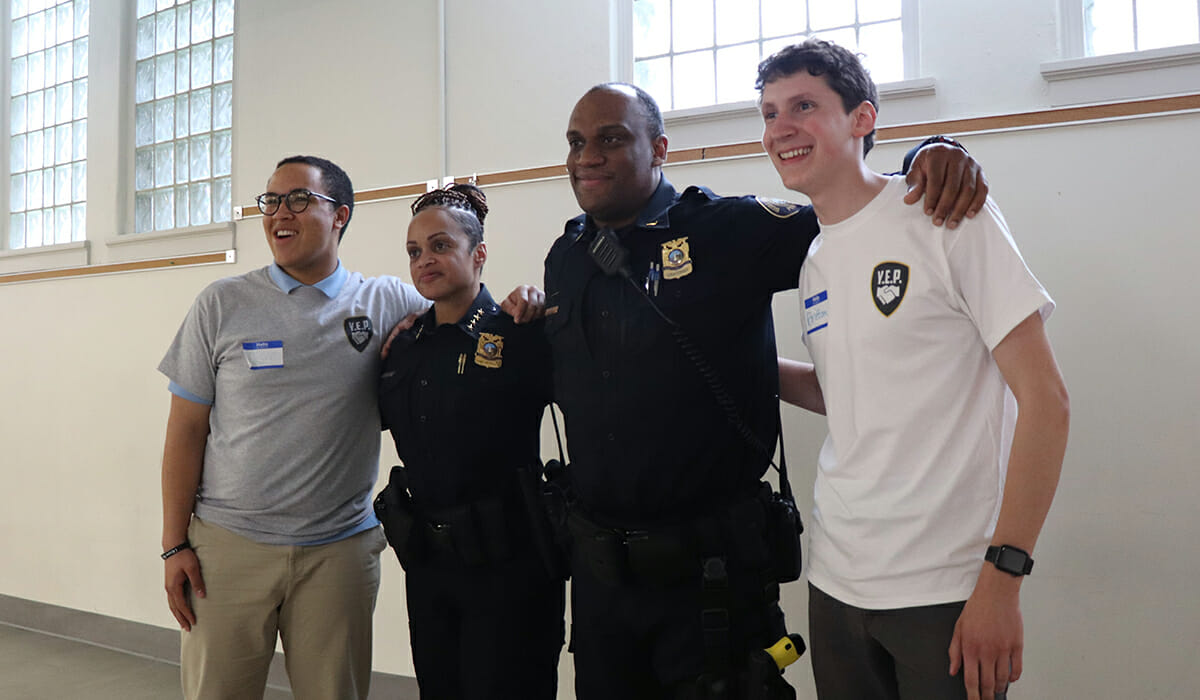
Britt Masback, right, stands with police officers and his Youth Educating Police cofounder, Taji Chesimet. /Courtesy Britton Masback
Can you describe Youth Educating Police’s programs?
We have three main programs. Our founding mission, again, was to develop a training curriculum. The current iteration, that we actually released to the Portland Police Bureau after two to three years of work on it, is a two-component thing. It’s a 15-minute explainer video that we released to all 1,000 [Portland Police] officers. It aggregates voices from young people, from police officers, especially school resource officers, and then also from psychologists and other trained professionals that have expertise in trauma. We bring all these voices together to paint a picture of who young people are today in Generation Z and in Portland, what sorts of stresses because of school, because of family, because of other societal pressures that they face, and also looking at the brain-science component of where developmentally youth are at and what sort of things can influence youth action. It’s trying to give police officers a better picture of who youth are, and then an entryway into better interacting with young people. That’s the first component of our training, and then the second component is an in-person module where we bring officers in and we test their response to what they learned in the video. It’s a school scenario. We bring in youth actors and we test officers to see if they remember things from the video and where there are more areas for improvement. Then we have a debrief after that to talk about things. That’s our first and our main program that we really want to scale to other communities. We released it to all 1,000 officers in Portland and it’s running from January to June. Throughout this process, we’re assessing how things are working, what future changes we can make to make the training even more effective.
The second program that actually really fed into the training is a series of dialogue events we hosted. We call them the Police Peace PDX forums. We hold them every year. It’s a time to bring young people together, police officers together, as well as other decision-makers, so for example, legislators in the city and county councils, to talk about and share updates with the community — about here is where police policy is now, [and] from the youth perspective and the police perspective, here is where we want to be going, and talking about some ways to get toward those longer-term goals. That’s been a really important program in many ways because it can stand alone as an important way for people to talk to each other, but also inform the training. There’s been a lot of important stories and opinions that we heard that can feed into the training, so that sort of served a dual purpose.
The third program that my co-director and I found really important over time is called our Youth Education Initiative. This doesn’t even specifically relate to the police [component], but rather, it’s sort of a testimony to everything we learned starting a nonprofit as young people. More and more people are doing that. I’ve met a lot of other cool youth founders. This process has been really important to us for finding our voice and speaking out on an issue that matters to us. The Youth Education Initiative is basically a framework for how we can help other youth start their passion projects and make progress on other social issues. It’s really all about social entrepreneurship and social change, where we work with other youth to start their initiatives, either through general knowledge support and then in some cases also through funding.
What kind of feedback have you received from both law enforcement and the youth involved in this?
The feedback has been very positive. From the youth perspective, it’s been amazing to see how literally we can bring youth into a room with officers, who previously were really fearing the basic interaction going into the room, but then they come out of that room exchanging phone numbers and really seeing that new relationship with the officer as one of mentorship and community support. On another hand, youth definitely feel empowered by the opportunity to talk to police, and that’s been a really important part of what we’re doing. Most of our training in some ways is based on brain science and fact, but really it’s a way to uplift youth voices and to say here’s where youth are at. I know many of our peers have found that empowering.
From the police perspective, there’s certainly a lot of bureaucracy in what we do. It’s hard to enact change in a system that has been around for so long. But the police leadership, at least in Portland, has put their support behind this. They have acknowledged that it’s an important change and that’s been really critical to what we’ve been able to do. It’s taken awhile, but throughout all the steps, they stood alongside us on this and that’s been really great.
Are there any future partnerships, programs, or events that you are excited about?
We’re just finishing up our training here in Portland and now we’re really looking at ways to expand this curriculum to other communities. We think this is applicable to any community. Some communities have more of a problem with this than others, but Portland actually interestingly is not reflective of the national statistic. Three-point five percent of all police interactions involve the age group 16 to 19-year-olds, but 30.1% of the same age group involves the use of force, so [there is] a clear disparity there. In Portland, it’s actually much less. There aren’t exact statistics, but we know the problem isn’t as bad. But what the police have told us and what youth have told us is because of what’s going on a national landscape, these are still the things that youth believe. They still see officers with that badge representing what is going on nationally. So even though we test this in Portland, we believe it’s applicable to pretty much every community, all 18,000 police departments across the country. Now we’re really trying to scale it. We’re trying to take what we learned and migrate it to other communities. We’re actually starting with that right now. We developed a partnership with a local city nearby, directly next to Portland, called Gresham. It’s a slightly smaller city but it’s also a more diverse city — a lot more youth of color, people we’re certainly trying to address through this training. Also, we’re trying to bring the training to some other major cities like Philadelphia and Seattle, where we’re developing connections. It’s definitely an exciting stage for us because we’re been so hyper-focused on this local community where we’re from, but now we’re really trying to say hey, it can be applicable to other people, and we’re trying to make that happen.
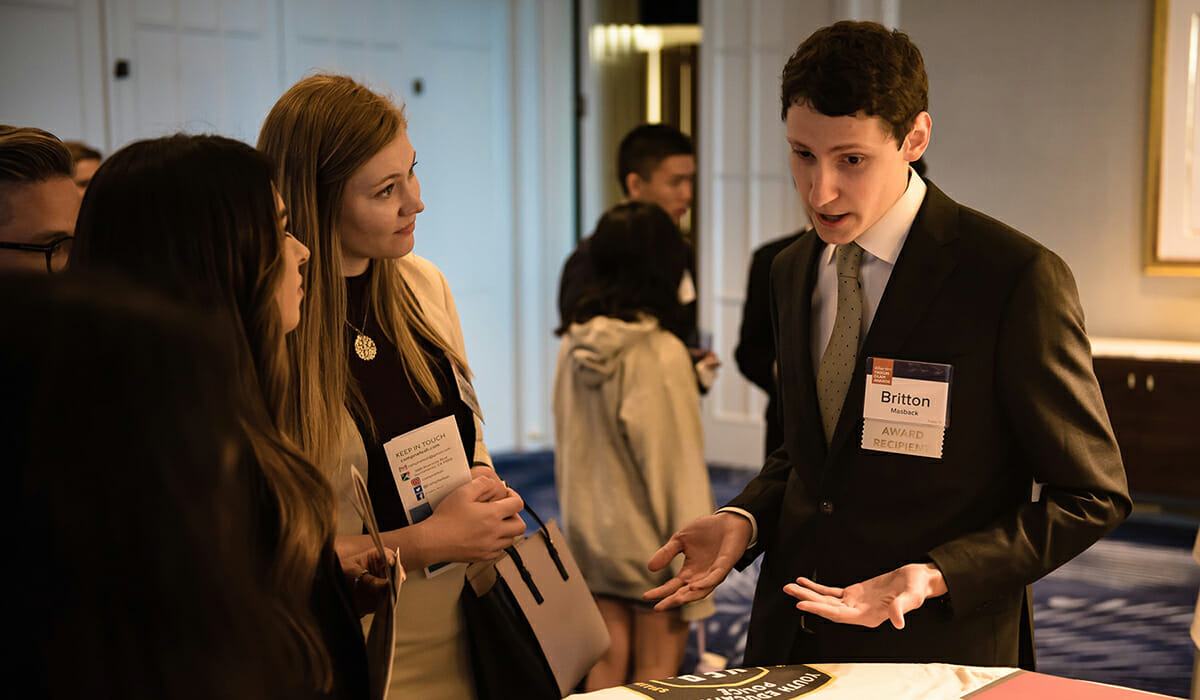
Britt Masback, right, founded the nonprofit organization Youth Educating Police when he was only 16 years old./Courtesy Britton Masback
What’s been the most rewarding part of your work?
I think honestly just meeting a lot of other passionate young people. I had done some basic political organizing work a few years before I started this, just at the end of middle school and early high school, and that was interesting. I had grown a general interest in politics and government at the time, but doing this work and getting to know young people through something that is so community-driven has been really special to me. I made a lot of friends through it, made a lot of close connections. I think collectively we really feel like we’re making a change in our community, so that’s probably been the most rewarding part.
What do you want people to learn from your story?
I think that ultimately what I would say to other young people is really to not worry about making a new project or a new idea perfect — not to worry about perfection. When myself and my cofounder started our organization, we had no idea what a 501(c)(3) was, or what writing a grant application looked like, or what working with city officials meant. But we knew that we were passionate about this and we knew there was a need for it, and so we put our heart and soul into it and made it happen. I think that especially for our generation, for Generation Z, it’s important that everyone is a part of the social change. That includes youth. I think that sometimes you have to put perfection aside and just go for it, and know that at the end of the day as long as you’re coming to the work from a place of passion and need, then eventually you can get there.
Why do you think it’s important for others to give back?
It’s crucial. I think that either if you feel supported by your community or if you want to fit into your community in a better way, it’s important to be part of work that bolsters community, that supports everyone in your community. I come to this work from a place of public service, but I think even if that’s not on your mind, even if you’re not involved in political work, you have to realize that the community only works for everyone if everyone’s voice is accounted for.




 Meet
Meet