Content Warning: Points of Light is proud to share the following uplifting and inspiring story. However, we acknowledge that a small portion below may be difficult for some readers. We encourage you to please care for your own wellbeing above all.
Tabby Chapman has seven-year-old twin boys, both on the autism spectrum, taking care of whom she considers her day job. As a California family they spend time relaxing at the beach, but they also enjoy playing Legos and video games. Tabby’s career is as a marriage and family therapist and a professional clinical counselor. She’s currently working on her PhD in forensic psychology, public policy and law with the intention of redefining the legal concept of coercive control.
Unbeknownst to many, Tabby was a member of the infamous NXIVM cult for several years until her escape in 2014 when she used lack of finances as a way to get out without attracting litigious attention from leadership as many ex-members did. NXIVM started as a personal development company using a multi-level marketing scheme by Keith Raniere and ended with him going to prison for sex trafficking—among other crimes. Now, Tabby is taking a difficult period of her life and turning it into a force for good with her nonprofit, The Freedom Train Project, through which she helps people get away and recover from cults and coercive control.
The idea initially came to her while filming the documentary miniseries Seduced: Inside the NXIVM Cult alongside other Raniere victims and cult experts in 2018. Even after the investigation, arrests and negative press, some NXIVM members remained dedicated, and victims were discussing possible reasons behind the phenomenon. So, in 2020, without any philanthropic grants or government funding, Tabby and her team became the assistance Tabby would have liked to have had during her days with NXIVM.
What inspires you to volunteer?
I was victim of a cult myself. They used financial abuse towards me, so I didn’t have money to leave. I eventually left with maybe $900 and a lot of debt, but I think with a victim outreach agency I would have been able to get out faster. There really isn’t a space for cult victims in victim advocacy, so what we’re doing at the Freedom Train Project is unique.
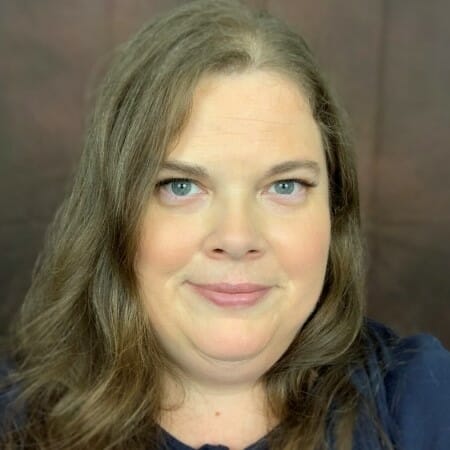
Tabby Chapman, founder of The Freedom Train Project, a nonprofit that helps survivors of coercion to recreate their lives./Courtesy Tabby Chapman
Describe your volunteer role with The Freedom Train Project.
As a victim advocate, I reach back out to the people who contact us with a cry for help. An intake form helps me rule out someone who’s having a mental health crisis versus someone who’s in a cultic environment or experiencing coercive control. After the intake, I do an interview and provide referrals and resources for help in either situation.
Most people in cultic environments call me when they’ve left and are looking for therapists who are friendly towards cult victims. Cults will often tell members that therapists, doctors and law enforcement are out to hurt them. There are also therapists who believe that cult victims are not coerced.Or, unknowingly, they will use the same verbiage or vernacular that people in the cult used, so it’s very traumatizing. A lot of cults will repurpose psychological language as part of their manipulation tools.
As executive director, I also run the rest of the organization – from program support for victims to creating buzz around the mission and organization. I create partnerships with shelters, therapists, medical facilities and more to have expedited support for clients. I’m working on submitting a policy change request to Congress to expand the Victims of Crime Act to include coercive control as a specific victimization to enable organizations like mine to receive grants to help victims.
How would you define coercive control?
In California, coercive control is defined as part of domestic violence. The goal is to get it separated out on its own, because coercive control can be used in any situation. Even a car salesman can use it. The broadest definition is using manipulative tactics to get someone to do something against their will. It can be anything: financial, verbal, mental or emotional abuse. Anything that is not physical abuse.
Do you mainly work with people in Southern California?
So far, I’ve only had one or two Southern California clients; I do more national work. There are only two or three states that have laws against coercive control in domestic violence. There are one or two states where there are laws against coercive control, but they’re not often upheld. And if there are no laws against whatever’s happening to victims, it’s a lot harder for them to get the help they need.
Another challenge is the high number of male victims who need help. Domestic violence can happen to anyone, but it’s often women. As a result, there aren’t a lot of places that can help men, like homeless shelters. I utilize the shelters as a resource, so when I have a male victim who’s calling me, that can be challenging.
Do you have other volunteers?
We have an amazing board of directors who are all professionals in victim related fields including doctors, therapists, housing specialists and public policy experts. They make mission-level decisions and support the work being done. Including myself, we have three victim advocates, one of whom specializes in domestic violence and the other in sexual assault.
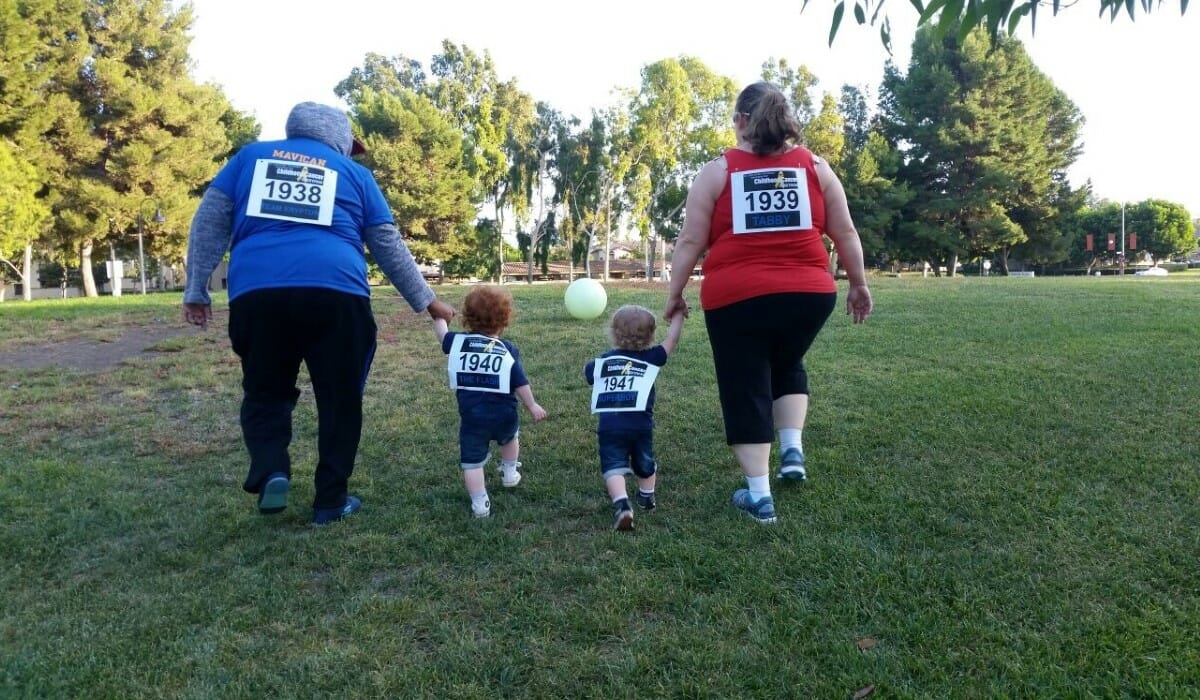
Tabby [right] raises money for St. Jude’s with a virtual walk with her family./Courtesy Tabby Chapman
What’s been the most rewarding part of your work?
It’s getting the phone calls. I didn’t know how it would go, and we’re not doing a lot of advertising. Another documentary that I was in just came out, and many people are looking me up from that. Seeing that we’re being effective without any kind of budget is great. Ultimately, my goal is to run a whole team and become a research institution for cultic and coercive control.
What have you learned through your experiences as a volunteer?
As the executive director, I’ve learned everything. I’ve never done that before. As a victim advocate, I’ve learned that sometimes people know they need help, but they’re not quite ready for it. I can’t push my agenda on them. They might not believe they’re in a cult, but what they’ve read on my website strikes a chord. And they’re usually a bit scared.
Why is it important for others to get involved in causes they care about?
Coming from my psychology background, I feel like there’s a lot of evidence that shows that working with causes that are bigger and outside of ourselves causes us to feel connected to a sense of community, which increases our sense of efficacy in the world and belief in ourselves. There is nothing but benefits to volunteer service, especially for someone with low self-esteem or who has experienced abuse. They can often grow through areas they’re stuck in as they’re healing from abuse simply by helping others in similar situations.
What do you want people to learn from your story?
If you have an idea, start building it one step at a time. And always keep your mission in mind. If everything you do for your organization points towards that, you’ll get there faster. If there are any agencies interested, we’re happy to speak with people about what we’ve done and how we can help them expand to work with cult victims or create their own agency.
Join the Global Volunteer Month celebration! Download our Global Volunteer Month toolkits and access resources to encourage volunteerism and civic action, recognize volunteers, and raise awareness for your organization’s needs and funding opportunities.
Content Warning: Points of Light is proud to share the following uplifting and inspiring story. However, we acknowledge that a small portion below may be difficult for some readers. We encourage you to please care for your own wellbeing above all.
Alyssa Keener-Lexa, of Kansas City, is committed to supporting and advocating for survivors of sexual abuse and assault. Her drive comes from personal experience: she herself is a survivor of an assault that took place when she was 16.
At the time, following the assault, Alyssa felt ashamed, guilty and embarrassed. These feelings were reinforced when her mother took her to the local police department and the only detail that the police were concerned with was her clothing. They said that Alyssa “probably shouldn’t have been wearing that.” She was dismissed and she had to move on.
Almost 10 years later, Alyssa was watching a documentary called “Audrie and Daisy” in which a police officer said things about the girls’ sexual assaults that carried the same tones as the police officers in Alyssa’s own experience. At that moment, Alyssa knew she had to do something. She paused the documentary and Googled what she could do to help. After a few hours of research, Alyssa applied as a volunteer with the Metropolitan Organization to Counter Sexual Assault (MOCSA), a nonprofit serving the Kansas City metropolitan area with a mission to improve the lives of those impacted by sexual abuse and assault, and to prevent sexual violence in its community.
Alyssa supports callers in many ways, from crisis intervention and emotional support to community resources and referrals. Alyssa is knowledgeable on the forensic and reporting process. She helps callers navigate housing and personal safety solutions. She connects survivors to the MOCSA services to help them build long-term solutions for healing.
In the two years that she has been with MOCSA, Alyssa has helped countless survivors. In 2022, she logged 1,677 hours of service. Alyssa lives in Kansas City, Kansas with her husband, Benjamin, who always supports her volunteer work, and their two cats, Teddy and Raserei, who are also supportive.
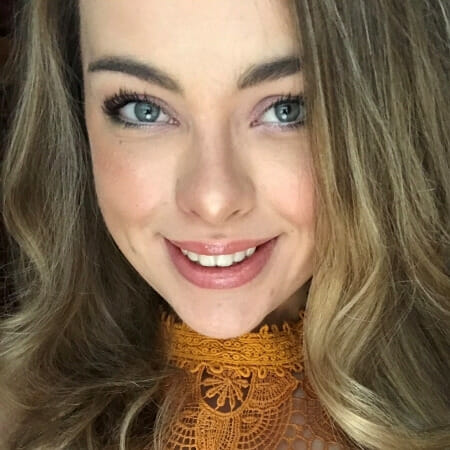
Alyssa Keener-Lexa has volunteered over 1,500 hours in the past two years supporting survivors of sexual abuse and assault as a MOCSA crisis line volunteer./Courtesy Alyssa Keener
What inspires you to volunteer?
My own experiences, plus the fact that survivors are still being victim-shamed, inspire me to help. I want to spread awareness that the blame is 100% on the perpetrator of any violent crime but it’s more than that; it’s also about healing and putting broken lives together after an assault.
Describe your volunteer role with MOSCA.
As a MOCSA volunteer, I help run the 24-hour crisis line where people can call and get immediate support, information on resources or a safety plan. The safety plan is very important. We need to make sure someone is in a safe place and if they aren’t, we guide them to safety whether it’s with a relative or friend, or in a shelter.
What’s been the most rewarding part of your work?
The most rewarding experiences have taken place with the people I’ve gotten to interact with. One of the most crucial things for survivors is that they want to be heard and believed when they tell their story. It’s rewarding to know through this program and others we are giving them that right.
What have you learned through your experiences as a volunteer?
I have learned that I am grateful that something like MOCSA exists, because its necessary to have the resources and advocacy for survivors – especially because there is still an unacceptable amount of misinformation, stigma and double standard for sexual assault and abuse survivors. Every time those reasons are cited for a survivor being scared or concerned to advocate for themselves, it continues to light a fire for why I volunteer and why I think others should too.
It’s important to get involved in the community and it’s important when a survivor tells their story that they feel empowered, supported and brave. They need to know that they’re telling their story to people who care and believe them. I would always encourage you to volunteer for any cause that you are passionate about if you are able, and if that cause happens to be to help counter sexual assault, you can email us at [email protected] to volunteer or learn about other ways to get involved.
MOCSA is a nonprofit serving the Kansas City metropolitan area with a mission to improve the lives of those impacted by sexual abuse and assault, and to prevent sexual violence in its community./Courtesy MOCSA
Are there any future partnerships, programs or events that you are excited about?
Yes, there are continued programs like our hospital advocacy, which is when volunteers support survivors as they undergo the forensic exam process and educate volunteers to help teach children about body safety. I’m looking forward to our program continuing to grow and for us to be able to do more service in our community!
What do you want people to learn from your story?
What I want people to learn from my story is to never count yourself out, and if you are worried your impact won’t be enough, don’t be. Every effort and every action matters. If you can be there for even one person, its worth doing.
If you or someone you know has experienced the trauma of sexual assault or rape, you can support them by listening, letting them know you believe them and offering to help them find medical attention or mental health support. Contact RAINN to find help near you or call 800-656-HOPE (4673) to talk to a trained crisis counselor. These services are free and confidential.
Join the Global Volunteer Month celebration! Download our Global Volunteer Month toolkits and access resources to encourage volunteerism and civic action, recognize volunteers, and raise awareness for your organization’s needs and funding opportunities.
Shining Her Light: Eight-Year-Old Volunteer Lends a Hand Across Metro Atlanta
When we speak with Dylan Pace, 8, she is on her way to a Saturday morning soccer game. An avid sports fan, she participates in basketball, golf, horseback riding and tennis, too. She’s also a big fan of Zeus, her Great Dane of the same age. Animals hold a special place in her heart, especially dogs and kangaroos.
As a young girl, Dylan doesn’t meet the age requirement for many opportunities to work with animals, but that doesn’t stop her from lending a helping hand to other causes. She and her mom, Lauren, help with the inventory of donations, sorting and re-stocking goods, and more at multiple food pantries around the Atlanta area: The Place of Forsyth, Meals by Grace, and Solidarity – Sandy Springs.
“We usually meet new people, and then they tell us what to do. And then we do it,” Dylan says. “Sometimes people can’t reach stuff, because they can’t bend down because their back is hurting. They like to ‘throw me in’ to help, and I just hand people food.”
Other work she has done includes sorting and delivering donations to Teacher Reuse Exchange, planting and harvesting duties at Aquaponics Farm and Old Rucker Farm, and packing bookbags with donations for children entering foster care through Adventure Bags.
Dylan finds happiness in helping others and feeling productive at the same time. It gives her pride to complete a task or lead an inventory exercise.
“One time I saw a lady in a wheelchair who came into one of the food pantries. She lit up after I got her food to her,” Dylan recalls.
Through her volunteerism, Dylan is shining a light across her community and inspiring others. During Global Volunteer Month this year, she was highlighted by Hands On Atlanta as part of their annual Spring for Service campaign. With the mission to mobilize the Atlanta community to tackle the city’s most pressing needs, Points of Light Global Affiliate network member Hands On Atlanta mobilized over 30,000 volunteers, like Dylan, across Atlanta in 2022.
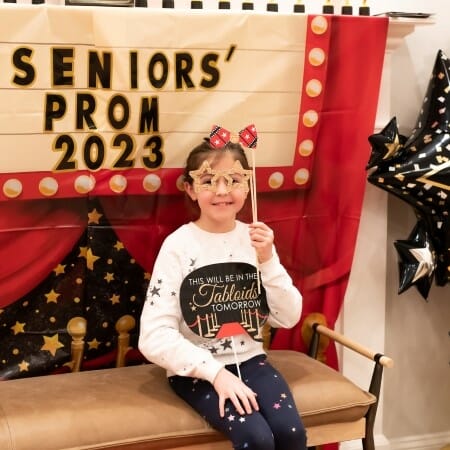
Dylan poses for a photo at a Seniors’ Prom for an assisted living facility in Sugar Hill, Georgia, where she volunteers./Courtesy Lauren Thompson
For Dylan, volunteerism starts at home. Her mom, Lauren, is a lifelong volunteer and professional photographer who donates her services through a program she’s created called Living Legends for a demographic she feels is often overlooked or invisible. She and Dylan will play Bingo at nursing homes but also take portraits of the residents and give them 5×7 photo prints to decorate their room. Together, they’ve done 57 portraits so far and plan to continue.
“Dylan helps to take some of the pictures, and she helps with lighting. The residents love when kids come to visit, so we incorporate the volunteering by being there and taking their pictures, too. Sometimes Dylan will wheel the residents around from room to room. They love that,” Lauren explains. “Dylan is super helpful, and in two years, I think she’ll be taking all the pictures.”
Lauren suggests nursing homes as a great place to get young kids started with volunteer service, as they are in many communities, and residents of older generations particularly love having kids visit for games and crafts. It’s fun for everyone.
The pair also photographs local preschoolers and women at Mary Hall Freedom Village who are re-entering the workforce, delivering prints for free. Aside from simply enjoying the work together, Lauren sees it as a way to get out of the house every day. Dylan is homeschooled, and homeschooling can mean spending a lot of time at home. Volunteering is also a way to combine lessons with hands-on work. When Dylan was learning to read, Lauren made her read all the packages as they inventoried food at food pantries. She learned spelling by writing labels.
“They would have a box of lettuce, for example, and we would challenge Dylan to try to spell the word herself and write it, so she was learning spelling and penmanship. We did a lot of math there, too,” Lauren recalls.
Volunteering has been a way for Dylan to expand her community and meet — and learn from — organization leaders and people who are different from her. Not only are most of the volunteers older than Dylan, but they are often from different backgrounds.
Over the last two years, Dylan’s consistent service has earned her the President’s Volunteer Service Award, an honor earned by clocking over 100 hours of volunteering each year.
“It’s our goal is to achieve the gold level for the PVSA, which requires over 75 hours of volunteer service, every year through high school,” Lauren says of incorporating the work into their daily life. “It keeps us busy and productive. We both really enjoy it, and it helps to meet that little goal for us, too.”
During one week of every summer, Lauren puts together a schedule for Dylan and her friends who go to public school and don’t get to join during the school year. Each day, they volunteer somewhere different.
“We get to invite new friends who don’t normally get to volunteer. We’re able to expose them to some of those places where they would maybe never volunteer on their own,” Lauren says. “Some people just don’t ever get started. So, we’re hoping we can change that with some of our neighbors and friends and get them more engaged.”
“My friends Kaitlyn and Caroline, they only go to one food pantry, and we introduced them to another,” Dylan highlights.
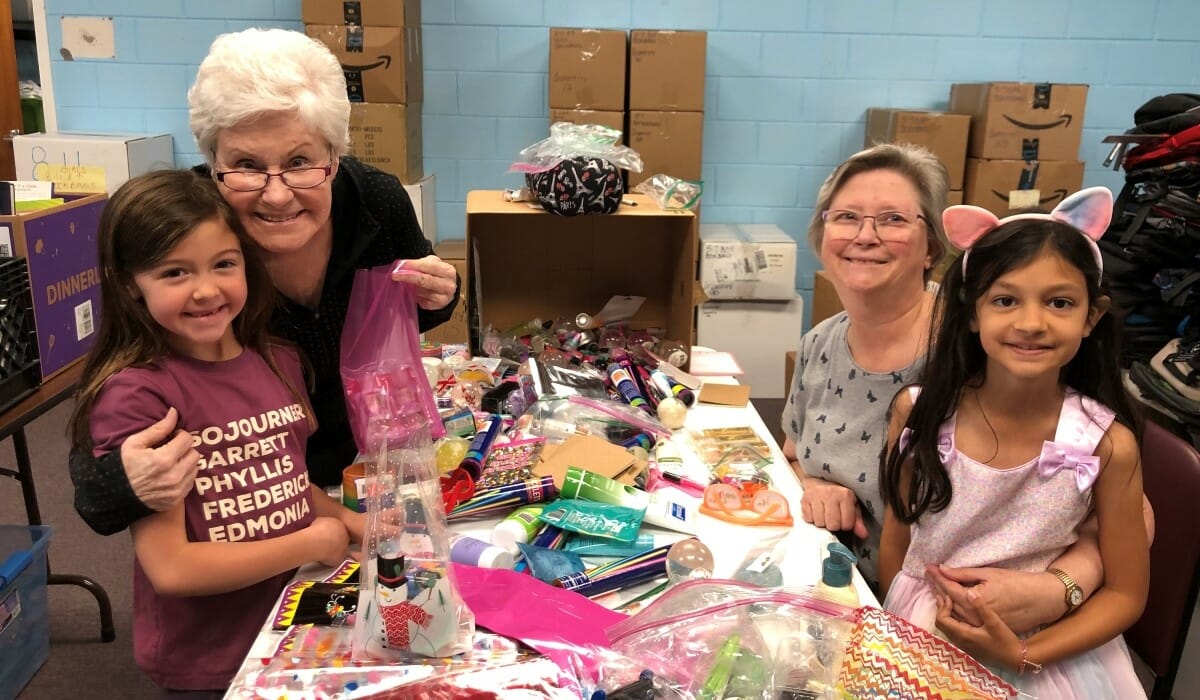
Dylan; Dylan’s grandmother, Joan Pace; friend and fellow volunteer, Hailey Correa; and Hailey’s grandmother pack backpacks with fun and essential things for kids temporarily moving into foster care in Georgia./Courtesy Lauren Thompson
Getting to help others with the company of her friends is especially enjoyable for Dylan, and she relishes expanding their volunteer horizons. Her mom predicts she’ll be even more inclined to bring friends to work on different projects as she gets older and when she finds something she thinks is a good match for them. In the meantime, Dylan loves the time with her mom and sees her as a role model.
“She’s a great photographer. She helps me with editing her pictures. And she just helps me every day. She’s just really helpful,” she says.
While she’s got plenty of time to decide, Dylan noted that she would consider a career following in her mother’s footsteps with one exception: She would prefer to focus on photographing animals.
“She is my favorite person in the world,” Lauren states. “I can see her thriving with these projects. It gives her the opportunity to shine with these talents that she has. She’s learned so much just by being around these other people in a healthy environment.”
As the school year comes to an end and the heat of the summer looms ahead, Dylan is already making plans. What’s she looking forward to most during her time off?
“Going swimming,” Dylan says simply.
It’s hard to argue with that.
Join the Global Volunteer Month celebration! Download our Global Volunteer Month toolkits and access resources to encourage volunteerism and civic action, recognize volunteers, and raise awareness for your organization’s needs and funding opportunities.
Bank of America Employee Uses Leadership Role in Service to the Community
Theodore Hansen, of Oakleaf, Texas, has found some of his greatest fulfillment through volunteering. While acts of service in his local communities bring great personal satisfaction and enjoyment, Theodore also enjoys leading volunteer teams and working with nonprofits to set up events.
Theodore is a volunteer leader with the Bank of America Community Volunteers Team North Texas. As someone who supports his parents, he tends to gravitate towards nonprofits that support the elderly or homebound.
Read on to find out what inspires Theodore to volunteer, the many organizations and causes he advocates for, and his advice to those considering volunteering.
What inspires you to volunteer?
I think several years ago, after starting to volunteer, I realized that doing something for someone or something other than yourself makes you feel good. There’s never a time where you’re sorry you did that, where you volunteered and afterward you think, man I wish I hadn’t done that.
You kind of get hooked on that feeling or that sense of helping someone or working for something without strings attached. You do it because it’s the right thing to do. It makes you feel good. And I guess you kind of get used to that. On a larger level, you start to ask yourself, well why is that? There’s probably a reason for that, in terms of why we’re here. Big questions!
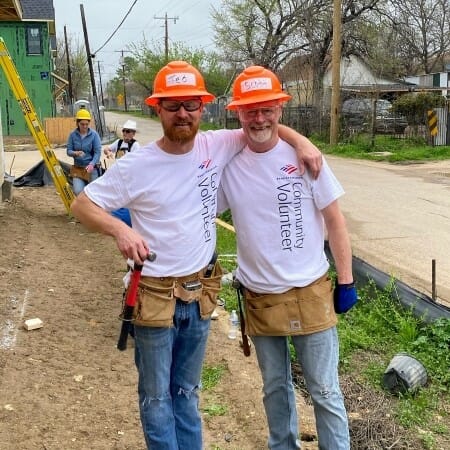
Theodore and his father collaborate through volunteerism at a Habitat for Humanity build./Courtesy Theodore Hansen
Describe your volunteer role.
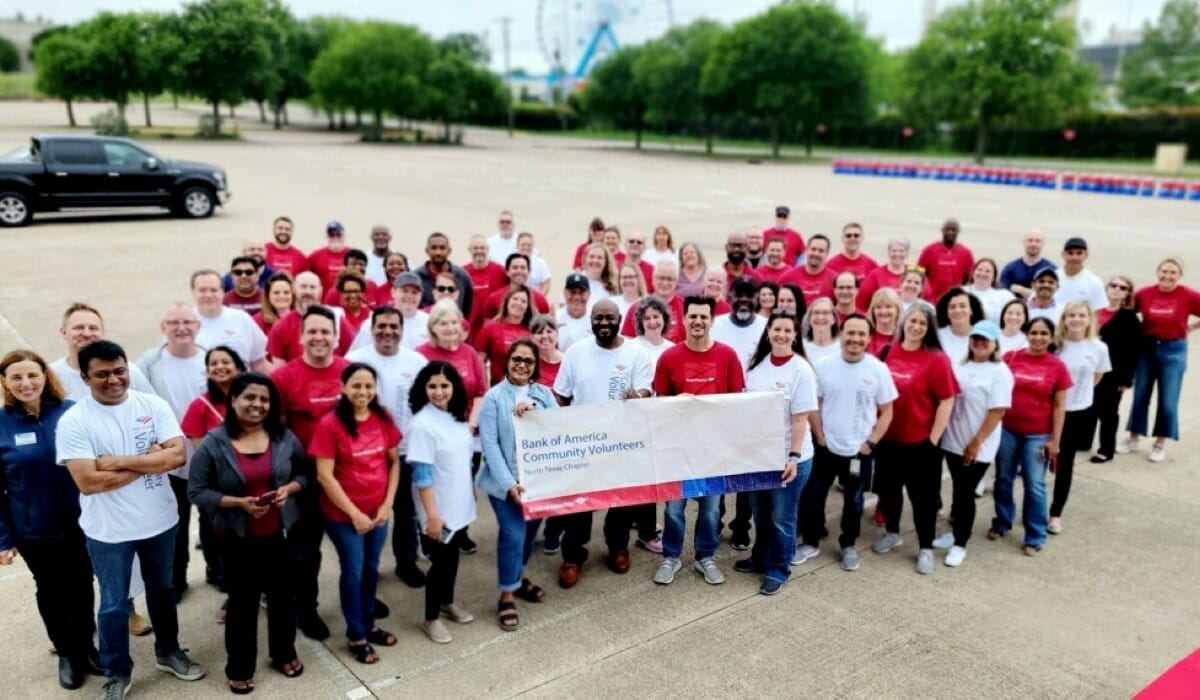
I have a couple of different leadership roles through Bank of America. I lead the Collin County chair for all the events that go on in Collin County, just north of Dallas. So I represent over 13,000 employees and work with local nonprofits to get their needs met by way of creating volunteer events.
I work with other volunteers and employees to help them get their events vetted and on the calendar, and make sure everything’s set up. I also lead the Community pillar at the corporate site council where I work, where we have 2,500 employees. I try to promote engagement with volunteer events, communicate what’s available and get people to engage. The idea is to engage people in my market.
I also work with Habitat for Humanity every year. We sponsor at least one house. I pick up builds and lead builds throughout the different stages of building that house. I work a lot with different iterations of Meals on Wheels in my area. I work a lot with the Walk to End Alzheimers, and set up a lot of blood drives for the Red Cross.
Any rewarding stories from your volunteer work?
The most rewarding event I ever got to do was in Waco, Texas. Bank of America gave a home to a veteran and his family through a program that the bank offers. On the day of the event, we handed the keys over to this family. We do final-stage tasks like last-minute landscaping and getting the house prepped. The family shows up and we hand over the keys. This is their new home, free-and-clear, paid for. That was probably the most rewarding, emotional, awesome event I experienced.
Recently, my dad, who had been diagnosed with Alzheimer’s a little over a year ago, moved in with me. So I get to take him out to volunteer events, like the recent Habitat build I did. This is an opportunity to help keep him engaged and active. That’s recently the most rewarding one – he had a blast! He’s out doing stuff, and that’s helpful for us both.
Bank of America sponsors at least one home per year, as well as donating to many other social causes./Courtesy Theodore Hansen
Why is it important for people to get involved with the causes they care about?
I think especially today, it’s really easy to say something via social media, to have a judging reaction and speak your opinion on a post. But there’s only one way to affect change. If you find something you’re passionate about, then you’ll never end up regretting spending time doing it. It’s probably the most rewarding thing you can do.
I love what I do for work, but the volunteer leadership roles I have, which aren’t part of my actual job, are what feed my soul. You help other people, but you’re helping yourself too. It makes you feel good. So it’s understanding that your happiness is very much bound up in everyone else’s.
Are there any upcoming programs, partnerships or events?
We have our Day of Caring as part of Bank of America’s Global Service Month. So we have a big event with VNA Meals on Wheels on April 28, where we try to get volunteers. Before COVID, we had over 650 volunteers show up and deliver meals around the VNA. We haven’t been able to get back to that level of engagement since COVID, so trying to get us back to high volunteer engagement.
This is a big event where we’ll be at Fair Park in Dallas. We’ve rented out lots 10A and 10B, and we’re trying to get as many people involved as possible.
What’s your advice for people who want to start volunteering?
I think the best way is to just do something. Like I said, I don’t think I’ve ever volunteered and then regretted spending the time to do it. I think you’ll find that in a volunteer event or when everyone’s there to volunteer, people have a different mindset. It’s very easy to get along. Everyone’s there just to help. Concerns about fitting in or what you’re going to do should be the least of your worries. The fact that you’re there means everything.
Join the Global Volunteer Month celebration! Download our Global Volunteer Month toolkits and access resources to encourage volunteerism and civic action, recognize volunteers, and raise awareness for your organization’s needs and funding opportunities.
Human Interaction Is What Drives Oregon Volunteer’s Decade of Service in Her Community
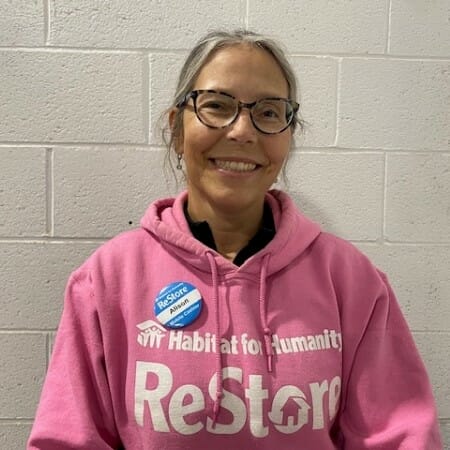
As an avid volunteer and activist in racial justice and human rights. Alison lends three days a week in volunteer service at the Habitat for Humanity ReStore in her town of Beaverton, Oregon. And she’s been doing so for the past 10 years!
This inclusive, strong-minded and fiercely independent volunteer has been helping with the ReStore efforts and making customers feel seen and welcome. Alison embodies creativity and productivity, and has a great sense of humor.
Read on to find out what inspires her and how she contributes her time and talent to support her community.
Describe your volunteer role.
I have been volunteering at Habitat for Humanity’s ReStore in Beaverton, Oregon consistently since March 2013. I started out with once a week, and currently I’m volunteering three or four days a week, logging over 3,450 hours. Some of my duties include merchandising and organizing shelves so that they’re shopable for our customers.
Alison Wedig has been volunteering for 10 years with Habitat for Humanity’s ReStore in Beaverton, Oregon./Courtesy Alison Wedig
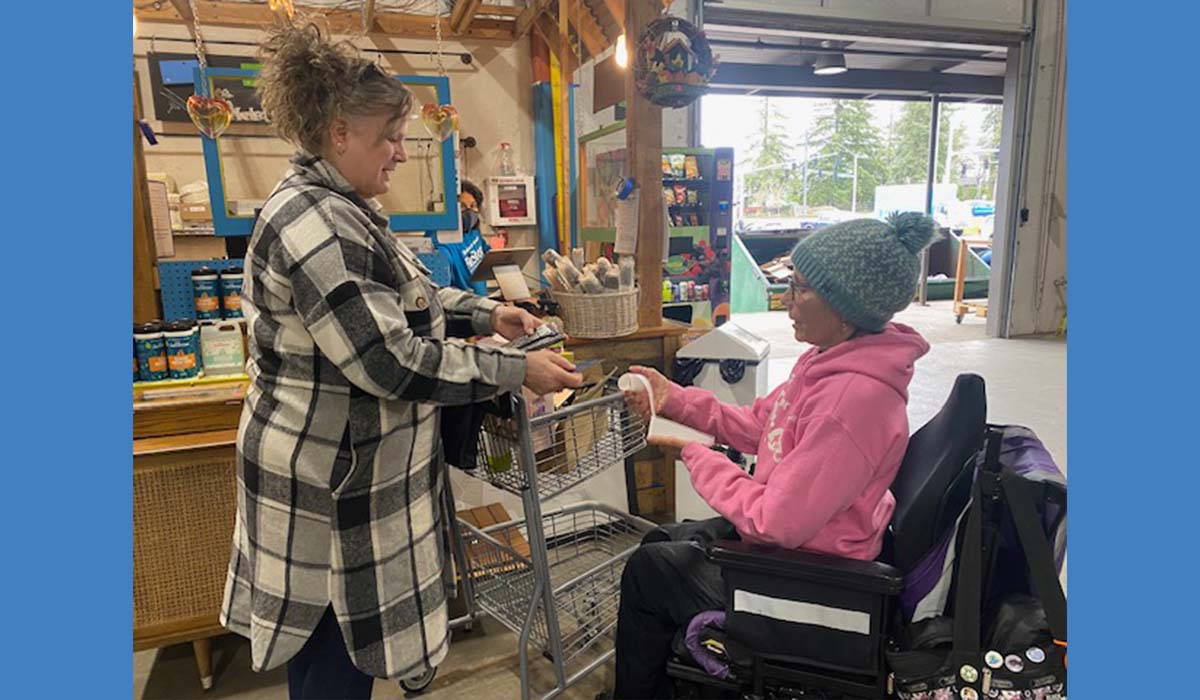
At busy times, I help the cashier with a small handheld register, checking customers out. I also welcome customers to the store with a smile and answer certain questions they may have.
What inspires you to volunteer?
I’ve always found pleasure in helping people and contributing to communities. Volunteering is a rewarding experience. I help the community out while having fun!
Humans are social beings and need human contact. With all the technology these days, it’s valuable to get out of ourselves and do for others, and to be part of something bigger than ourselves. I believe housing is a human right and our mission at ReStore is to create a clean, organized and pleasant environment for our customers to shop.
What’s been the most rewarding part of your work?
I appreciate being part of a volunteer team and working closely with staff. We help each other out, look out for one another and support each other.
The most rewarding parts are working with the other volunteers and also engaging in conversation with the customers and helping them out with what they’re looking for. Also, getting to know more about them – we have some regular customers who come in and I chat with them!
Why is it important for others to get involved with causes they care about?
So that they can feel a part of something larger than themselves. They can support a cause. For me, it feels good to support other people in their goals.
Alison enjoys interacting with other volunteers and meeting new customers. She believes that social interaction is vital for all humans./Courtesy Alison Wedig
What’s your advice for people who want to start volunteering?
I would say, come in and see what we do and how we help other people out. For me, helping the community and people is a huge part of why I volunteer.
For me, it was a natural fit because I always enjoyed and found pleasure in helping the community out. So it wasn’t a big choice for me – I just jumped right in! I support humanity and so it was a natural fit.
What do you want people to learn from your story?
Volunteering can be very rewarding if you really put your heart into it. Being a part of something larger than yourself is a rewarding part of the journey. Not everyone might have that same experience with the first thing they try, but it’s been my experience. If you are passionate about a cause, it will come easily.
Join the Global Volunteer Month celebration! Download our Global Volunteer Month toolkits and access resources to encourage volunteerism and civic action, recognize volunteers, and raise awareness for your organization’s needs and funding opportunities.
Schwab Employee Leads Financial Literacy Efforts in Underserved Classrooms Around the Nation
As a former history and economics teacher turned Charles Schwab employee, Kris Anest of Chandler, Arizona, is a long-time advocate for financial literacy and brings this passion to her community through service on two non-profit boards.
Since her childhood, Kris has been volunteering, whether through community service in school or as a candy striper in the local hospital.
“My mom is so important in my story,” Kris said. “She grew up dirt poor in South Tuscon. And she did everything she could to make sure we were educated, and I’m now in my third year of a Ph.D… She was tough, tough, tough. But all of the values she had, all that she learned, she passed on to us kids. She had us involved in everything, including community service. My mom planted the seeds and I never lost them.”
Kris Arnest is a heart-driven employee volunteer at Charles Schwab./Courtesy Kris Anest
In 2022, Kris recruited 67 fellow Schwabbies to volunteer with the ACEE, a record for the organization. She leads Schwab Intern Day Volunteer events, participates as a judge in the SIFMA Foundation’s InvestWrite program, volunteers regularly with Boys & Girls Club and is a key mentor in Schwab Moneywise America program, which brings personal finance to under-resourced communities.
“Through Charles Schwab, I lead a committee where we’re trying to get financial literacy content into Title I and rural classrooms, and those with indigenous populations – underserved classrooms, because that’s where the reach is needed and it’s hardest to get to,” Kris shared. “That’s where my passion is. I taught world history, economics and advanced placement macro-econ at the high school level. I love hearing from former students who now own their own businesses and are thriving.”
The course content was built from the perspective of students, using current-day language. “So kids are learning from people who talk like them and look like them,” Kris shared about the representation seen in such an important and impactful learning experience.
Since 2017, Kris has volunteered over 400 hours and coordinated nearly 40 volunteer projects to engage fellow Schwabbies in service to the Phoenix community. “I really enjoy inspiring other employees to want to engage in the same kind of work and effort.”
To prospective volunteers, Kris is an advocate of jumping in where they can. “There’s such a need out there, and there are so many people who have compassion in their hearts, want to do more and want to help, but there’s a disconnect on how they can do it. It’s not always easy to find the path to get to where you want. And sometimes, time is the factor. It takes sacrifice. But the reward – what you get in return – doesn’t even come close to the sacrifice you’ve made.”
Join the Global Volunteer Month celebration! Download our Global Volunteer Month toolkits and access resources to encourage volunteerism and civic action, recognize volunteers, and raise awareness for your organization’s needs and funding opportunities.
NYC Native Honors the Fallen at the 9/11 Museum and Gives Back to His City
Wayne Tappe is not only a volunteer at the National 9/11 Memorial and Museum, where he is a docent and greets guests and visitors, but he also goes above and beyond volunteering with unhoused individuals on Thanksgiving, Christmas and other holidays. Additionally, Wayne is a volunteer at The High Line in New York City and The Metropolitan Museum of Art.
Wayne grew up on Long Island and has been living in the city for almost 40 years now. He grew up in a family in which community service mattered and giving back to the community was paramount to the family’s everyday lives. Wayne is the youngest of three and his mother had a great influence on his life. Wayne says, “She was such a caring and magnanimous individual.”
Read Wayne’s story to learn how he is sharing his time and talent throughout the city he calls home.
What inspires you to volunteer?
I worked almost 20 years in the financial asset management business and learned so much at my job traveling around the world. Thankfully, I was fortunate enough to retire early and pursue my own endeavors. New York City has been very good to me and I am so elated and grateful that I am able to give back to this fabulous metropolis I call home.
There are many reasons why I choose to volunteer and get involved. Volunteering helps me stay attentive, alert and motivated plus boosts self confidence. It promotes growth and maturity too. I also feel that getting involved is an opportunity to expand my own life experience.
Describe your volunteer roles with the organizations you work with.
I currently volunteer with several organizations in New York City.
I have been a docent and educational interpreter at The National 9/11 Memorial and Museum for about 11 years now. The 9/11 Memorial and Museum honors those who were killed during the 2001 and 1993 attacks, and is the country’s principal organization dedicated to documenting the impact of 9/11 and exploring its continued significance.
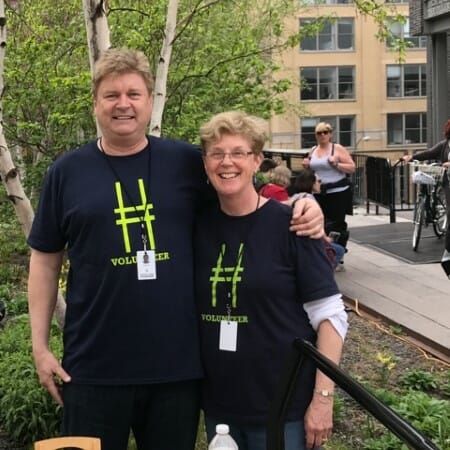
Wayne volunteering at the Information Greeter Cart on The High Line./Courtesy Wayne Tappe
Actually, I was supposed to be down there on that day. Thankfully, I was uptown when the first plane hit the North Tower at 8:46 A.M. I lost dozens of very good friends on that day. It is a place to honor and remember those 3,000 innocent people who lost their lives and to honor the first responders who risked their lives to save others. I was in the inaugural docent program and have been associated with the museum since the beginning. Initially I was part of the Visitor Services team but now I’m an educational interpreter. It is very important to educate the public about the events that transpired on that fateful day. To this day, I am amazed by how NYC came together post 9/11. We mourned together and grieved together. I’ve never seen anything like it. It really showed the perseverance and resilience of the city and its residents.
I also volunteer at other organizations. I have been a Visitor Experience and Enrichment committee member at the Metropolitan Museum of Art for six years. Each year, the MET welcomes millions of visitors. I have been a Visitor Services information guide and ambassador at The High Line for 10 years, a public park built on a historic freight rail elevated above the street on the west side of Manhattan. I have been a patron greeter and information guide at Carnegie Hall for six years. For each of these organizations, I am primarily responsible for enhancing a visitor’s experience by educating and interpreting the artifacts or materials during their visit. I am also involved in some fundraising efforts. I have always been a supporter of the arts in NYC, donating my time and effort, and supporting them in a philanthropic way.
I have also been volunteering at The Bowery Mission for several years. This faith-based mission has been helping underserved and unhoused people in all aspects of their lives since 1875. It is such a wonderful organization treating each person with dignity and respect.
What’s been the most rewarding part of your work?
The most rewarding part of volunteering is giving back and enjoying the fruits of my labor whether it’s a tour somewhere, chatting about a painting at The MET, discussing a musical number at Carnegie Hall or just working in the soup kitchen at The Bowery Mission. I feel so lucky and fortunate that I can share life’s experiences and give my time and energy to the community.
What have you learned through your experiences as a volunteer?
I’ve learned how to work more efficiently with others and the importance of teamwork.
Are there any future partnerships, programs or events that you are excited about?
I am looking forward to starting docent training at The MET which is quite a difficult task. There is another project which I am looking forward to pertaining to the restoration of NYC landmark preservation buildings.
Why is it important for others to get involved with causes they care about?
It gives a person a purpose to get out and be involved. It is much different to just chat about something vs. actually getting out and being involved. So gratifying.
What do you want people to learn from your story?
It’s never too late to start volunteering …just get out there and get motivated. It is so rewarding!
Join the Global Volunteer Month celebration! Download our Global Volunteer Month toolkits and access resources to encourage volunteerism and civic action, recognize volunteers, and raise awareness for your organization’s needs and funding opportunities.
Bringing the Library to Them: Texan Volunteer Helps Children Learn and Love to Read
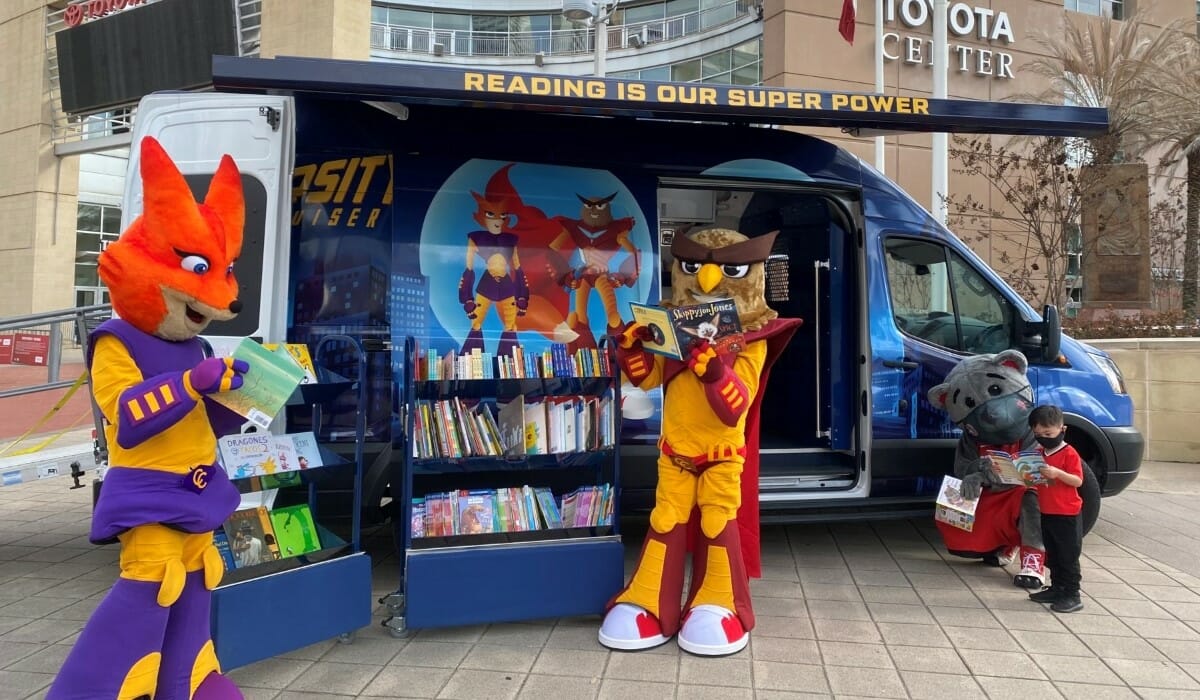
While most people have heard of Batman and his trusty Batmobile, you might be surprised to hear that Houston has its own set of superheroes – Owlbotron and Northtale. Instead of fighting crime, the “Super Owl” and “Super Fox” duo combat illiteracy. And instead of a Batmobile, they jump around neighborhood to neighborhood in their Curiosity Cruiser, a mobile library filled with hundreds of children’s books.
When the Curiosity Cruiser drops by community centers and schools around Houston, children will run to Owlbotron and Northtale to greet them. But little do they know that the real-life superheroes are the ones working behind the scenes of the Curiosity Cruiser, such as today’s Daily Point of Light Award honoree, Betty Hrncir.
Betty Hrncir is a co-founder of the Ladies for Literacy Guild, a volunteer auxiliary group of the Barbara Bush Houston Literacy Foundation. Since starting the Guild back in 2015 with co-founder Julie Baker Finck, Betty has helped grow the Guild to nearly 400 members, all working to keep the legacy of the late former First Lady Barbara Bush alive by advocating the power of literacy.
One of the Guild’s greatest feats was launching the Curiosity Cruiser mobile library initiative in partnership with the Harris County Public Library in 2017. With a fleet of four state-of-the-art mobile libraries, tens of thousands of children from historically underserved communities in Houston have been able to pick out their own books from the Curiosity Cruiser for free. The Curiosity Cruiser initiative also provides access to STEM and reading programs after school and during the summer.
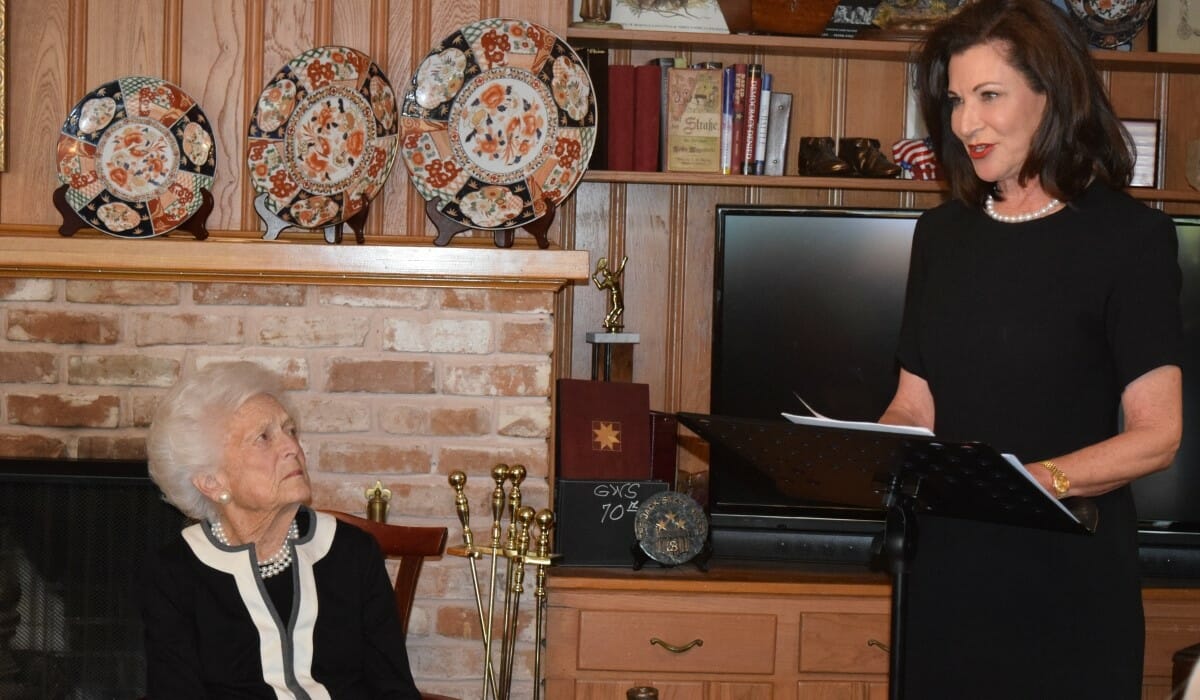
Through her volunteer work fighting for literacy, Betty Hrncir (right) keeps the legacy of the late Barbara Bush (left) alive./ Courtesy Betty Hrncir
“Two out of every five Houston children fail to read at or above grade level by the end of third grade. Research shows that when a child does not read on grade level by this academic milestone, they are four times more likely to drop out of school,” Betty said. “We want children to have access to the endless opportunities our country has to offer and for them to realize their fullest potential in life. We recognize that can only be achieved if they have strong reading skills. The Curiosity Cruiser has helped us accomplish this, fostering a culture of reading across Houston and lifting literacy rates among children of low-income neighborhoods.”
With Betty at the helm, the Guild also established the Power of Literacy Luncheon, which has raised more than $1.5 million over the years. On top of keeping the Curiosity Cruisers stocked, the funds have gone towards helping families build their own home libraries and installing children’s libraries at four social service facilities including at New Hope Housing, an affordable apartment development serving families that are unhoused or placed at-risk.
“Betty has played an instrumental role in forming the Ladies for Literacy Guild, which has become a driving force for good in advancing the mission of the Barbara Bush Houston Literacy Foundation and Barbara Bush’s vision of ‘literacy for all,’” said Julie Baker Finck, the Guild’s other co-founder and President & CEO of the Foundation. “Betty is truly a point of light who has enlisted other points of light, all collectively creating a laser focus on improving lives through literacy.”
Northtale, Owlbotron and Houston Rockets’ mascot Clutch read in front of the Curiosity Cruiser with a young Rockets fan./Courtesy Curiosity Cruiser
After serving as the inaugural president of the Guild for two years, Betty went on to serve as Co-chair of the Grants Committee and then as Co-Chair of the Power of Literacy Luncheon. Today, Betty is a member at large, continuing to advise the Guild’s current leaders and volunteering wherever she can. She has also served for the past two years as a Guild volunteer at Clemente Martinez Elementary School, where she reads to her “adopted” classroom regularly.
“It’s so important to me to foster Mrs. Bush’s legacy of championing literacy. This was what she took on for life,” Betty said. “As we continue our work, we will strive to improve literacy across our city, which is one of the largest and most diverse in the country.”
Join the Global Volunteer Month celebration! Download our Global Volunteer Month toolkits and access resources to encourage volunteerism and civic action, recognize volunteers, and raise awareness for your organization’s needs and funding opportunities.
Retired Nurse Volunteers to Keep Central Park a Sanctuary for All
Mary Geiger, 78, always knew she wanted to live in New York City. Originally from northeastern Pennsylvania, she made her way to the Big Apple after becoming a nurse at Memorial Sloan Kettering Cancer Center. She spent her career caring for patients and, in her last role before retirement, as a research coordinator at Mount Sinai Hospital.
When she decided to step back from the hospital, she stepped into another passion as a volunteer with the Central Park Conservancy. The Conservancy was founded in 1980 and maintains Central Park under contract with the City of New York and NYC Parks. They aim to “preserve and cultivate” the Park and to “enhance the enjoyment and wellbeing of all.”
When the pandemic hit, the world went inside, and everything changed. Mary could read and watch foreign movies. But travel had also been a big part of her life, and she’s had to cancel a trip to Croatia three times because of COVID-related disruptions. Despite everything, since May 2011, she has dedicated over 2,850 hours to the Central Park Conservancy as a greeter and member of the horticulture volunteer team.
Mary is currently recovering from a surgery, so she’s been unable to go to the Park for a few weeks but looks forward to the coming months when she can return to the role she has loved for over a decade. And to when she can finally take that trip to Croatia.
What inspires you to volunteer?
As I was approaching retirement, I knew I’d seek volunteer work. I was a Girl Scout and a Junior Catholic Daughter in my teen years. Community service was just what you did. I used to see the Conservancy volunteers gardening and guiding people in the Park, and it inspired me to join.
Describe your volunteer role with the Central Park Conservancy.
I began as a greeter, and it was a good way to get a thorough understanding of the Park. There was extensive training. I was assigned to a three-sided map near the Belvedere Castle for just three hours a week. We had classes and written assignments, and we had to explore all areas of the Park.
As a greeter, I try to provide a positive experience for visitors. I try to determine their interests — nature and wildlife, sculpture, history of the Park — and gauge their mobility level. The designers, Vaux and Olmsted, really wanted visitors to discover the beauty of nature, not marked by signs, so I also highlight their route on a map. It’s so rewarding and unexpected when they return to tell me what they saw and how pleased they are.
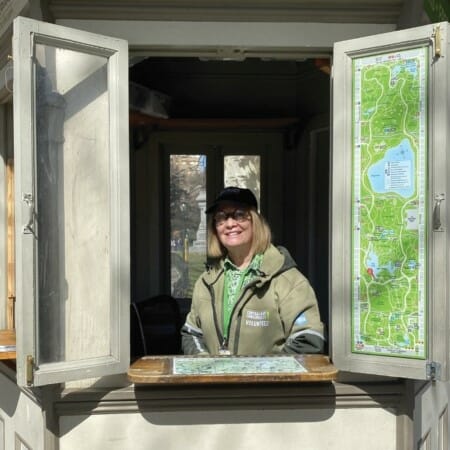
As part of her role, Mary greets visitors, gives directions, and answers questions from a visitor kiosk./Courtesy Mary Geiger
I do horticultural activities — weeding, pruning, raking, mulching and planting — as well, which really enhances the health and the beauty of the Park. I’ve worked with corporate groups who donate to come and do the same tasks, often returning later as volunteers. I supervise and assist. It’s a very positive experience for the teen groups, school groups and family groups I’ve worked with, too. You really want to instill a sense of stewardship of the Park, because it’s 843 acres. It’s a vast backyard for all of us.
And I often try to sign up for special community events, because they’re wonderful. The day before the Pumpkin Flotilla, kids carve pumpkins and bring them back to put on a float on the Harlem Meer. There are usually about 100 all tied together with LED lights inside. At dusk, a Conservancy staff member with a kayak takes them out on the water. It’s a beautiful sight.
What’s your favorite time to visit the Park?
The Park is beautiful in the spring, because of the cherry blossoms and the magnolias. But I think any season is wonderful. It’s so diverse. There are woodlands up in the northern end where you feel you’ve left the city and gone to the Adirondack Mountains. There is the Hallett Nature Sanctuary with wood chip paths, the Conservatory Garden, and Shakespeare Garden. I enter the Park take a deep breath and feel whatever stress I had just disappear.
What’s been the most rewarding part of your work?
It’s a small thing, but it has stuck with me forever. It was at a special youth event at the Harlem Meer. Kids can come and learn more about nature. A company had lent us microscopes, and they set them up with slides of the water.
I’d spent time showing several children how to use them, and there was one little girl, about six, with her grandmother who spoke no English. She was translating for her and was there for about two hours. I have never seen someone so transfixed. When she left, a gentleman from the company said, “I really wish I could have given her a microscope to take home.” I just felt that it ignited a spark in her. It was an opportunity she might never have had.
What have you learned through your experiences as a volunteer?
I’ve learned how wonderful the Park and the Conservancy are. Also, there’s a monthly program for volunteers to learn more about the Park. It could be history presentations by the Park historian, the horticultural staff telling us more about the flora and fauna, or the operations staff giving us updates and information on the maintenance of the Park grounds.
It’s also taught me that this community service is really for a higher purpose than ourselves. A diverse group of volunteers can come together for three hours on a project, complete the task and leave feeling satisfied and inspired to return.
Are there any future partnerships, programs, or events that you are excited about?
As a greeter, you’re by yourself; there’s less of that team feeling. So, the Conservancy has decided to institute greeter walks. A small group meets at a particular spot. Then, they pick a route, go to the highlights and discuss the best way to get to each. I haven’t been able to join that yet, because we haven’t returned to in-person meetings.
Why is it important for others to get involved in causes they care about?
If people didn’t get involved, many of those causes would not really be able to continue. We have several thousand volunteers in the Park, and without them, staff simply could not do all of the maintenance work.
What do you want people to learn from your story?
I’d like to think that, especially during the pandemic, people have realized that the only way to get through things is by doing some service for others. It’s satisfying, but it also means a lot to those people and to whatever organization you choose to join. I miss it. It’s been about three weeks, and it’s going to be a bit longer. The Central Park Conservancy gave my life a purpose after retirement that I’m very grateful for.
Join the Global Volunteer Month celebration! Download our Global Volunteer Month toolkits and access resources to encourage volunteerism and civic action, recognize volunteers, and raise awareness for your organization’s needs and funding opportunities.
Marathon Runner Changes Lives of Service Members and Their Families
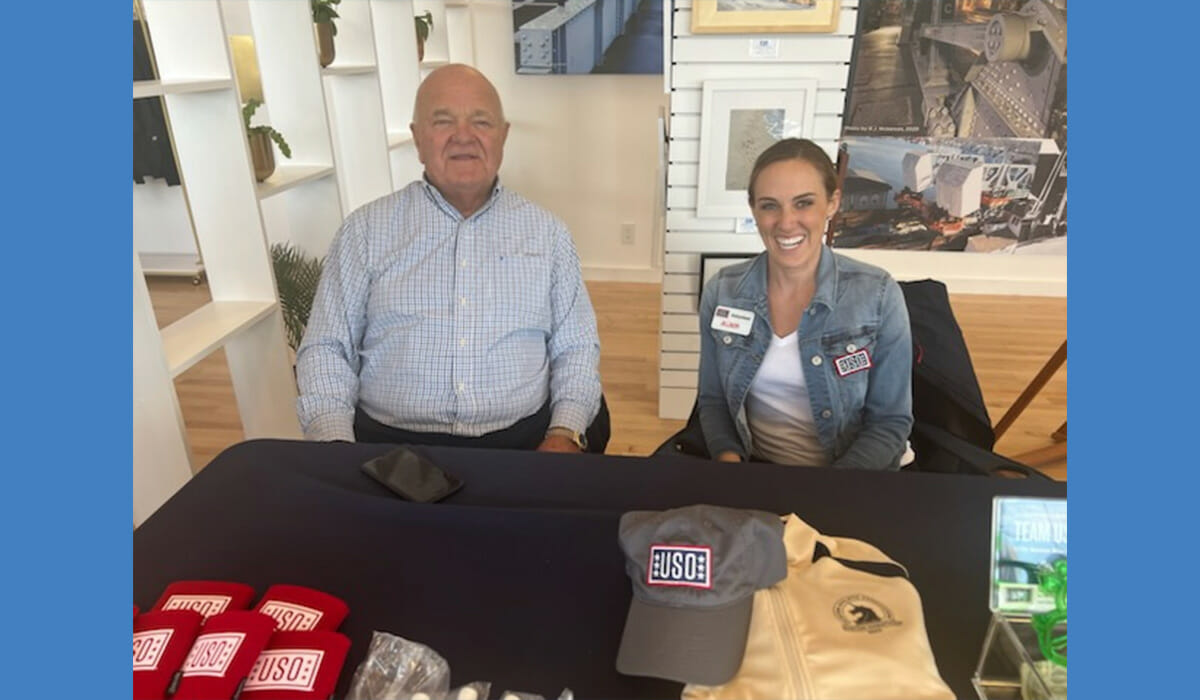
Allison Hayes considers two different places home: she was born and raised in Maplewood, New Jersey, but has lived and loved living in Mystic, Connecticut, for the last nine years. Today, she is a volunteer and ambassador for the United Service Organization (USO), a nonprofit organization serving active-duty service members and military families. She is a true champion of the mission and ambassador of USO programs.
Read Allison’s story to learn what inspires her to volunteer and why the Boston Marathon holds a special place in her heart.
What inspires you to volunteer?
My older sister, Kendra, is my biggest role model. Kendra is 10 years older and would sometimes bring me along to do her volunteer work. I always wanted to be just like Kendra, and as I grew older, volunteering seemed natural to me because of the work I saw Kendra doing. We have had different passions in our volunteer work, but Kendra’s kind heart and generous soul sets a standard that I strive to live up to. I consider Kendra resilient, compassionate, courageous, patient and downright irreplaceable. Caring for the world and giving back has been important to me, and I hope to be a role model to both my nephew and my own future children, as Kendra was to me.
Wonder Woman is my idol (other than my sister, of course), and one of her quotes is “Only love can truly save the world.” I actually have it tattooed on my spine.
Allison Hayes volunteers with the United Service Organization, a nonprofit serving active-duty service members and military families./Courtesy Allison Hayes
Specific to the USO, I first began volunteering because I was notified that a new center had opened nearby and they were looking for people to help keep the center open. As I learned more about the organization, I realized how large of an impact they can make on the military community. There are many service members who are on base alone, without their families. Most of them come in for a friendly face or a conversation, or to tell a story. I love stories – both telling them and listening to them – and it is amazing how different everyone’s lives are, especially from mine – different upbringings, travel experiences, interests.
The USO started in 1941, which got me thinking about both of my grandfathers and their service to the United States Navy, specifically how both of them would have benefited from the services the USO offers now, including support for their family members in the United States.
Describe your volunteer role with United Service Organizations
With the USO, I serve as a welcome center representative at the Submarine Base New London in Groton, Connecticut. My duties include greeting active duty service members and their families as they enter our doors, answering questions, making sure they always have snacks and drinks available, and creating a relaxing and inviting environment.
Outside of the center, I have volunteered by serving doughnuts and lunch at submarine deployment send-offs and homecomings, have participated in handing out 100 brand new bicycles before the holidays and set up a shopping experience for military children to select their new backpack and school supplies before the school year.
My passion for the USO has grown through my work. When our center’s director recommended that I consider applying to represent the USO in the Boston Marathon, I had no doubt about it. Over the last several months, I have been training and fundraising for the event on April 17. It is my commitment to raise $20,000 for the USO, all of which will be allocated toward resources and programs that the USO provides and holds worldwide.
What’s been the most rewarding part of your work?
Neither of my grandfathers talked much about war or their time in the Navy, but we have lost both of them in the last three years and I felt that volunteering with the USO was the best way to repay the support they received many years ago and to keep their legacies alive. When I run the Boston Marathon in a few weeks, I will be carrying a photo of both of them pinned to my singlet, and will be wearing both of their dog tags on my body.
Being able to form relationships with people who are different from me, whom I may not have met otherwise, is also rewarding. This applies to both volunteers I am serving with and those I am serving. In addition, I love seeing the growth and progression within the communities that I am serving and knowing that I have played a part in the innovation of programs that has gotten them one step closer to where they want to be in the future.
Are there any future partnerships, programs or events that you are excited about?
Right now, my future is focused on running the Boston Marathon on behalf of the USO, and then I will decide what the next exciting program is!
Why is it important for others to get involved with causes they care about?
There was a time when I was younger that I recall complaining about the way something was going at school. It was a club that I was hoping to be part of, and I told my parents that I did not want to be part of it after one meeting because I felt they were disorganized, messy and cliquey. My dad said to me that I shouldn’t walk away, and instead stay in the club and find ways to make the club a better environment for myself and for others. He said in order to see positive change and progress, you sometimes have to be right in the mud working on it.
We are all capable of sitting back and watching, avoiding challenges or efforts, but if we truly care at the end of the day, we will step in the mud, sometimes up to our ears, and work for what we believe in, for the communities and the causes that mean something to us.
Allison Hayes volunteers weekly at the USO Center in New England./Courtesy Allison Hayes
What do you want people to learn from your story?
If anyone wants to volunteer, but is not sure where to start, they should check first with their heart. We all have a story, something that has happened to us or a loved one, or a friend who is part of a community that could use extra support.
I would like to share the story behind why I am running the Boston Marathon in support of USO.
I am representing Team USO because I truly believe in the mission to strengthen America’s service members by keeping them connected and grounded to home regardless of their physical location. I have seen the direct impact that the USO has made on people both through my volunteer work at the USO (Submarine Base New London), and personally via friends and family.
Both of my grandfathers served in the United States Navy, and I grew up learning about their experiences during World War II and beyond. My paternal grandfather was part of the first underwater demolition team which eventually became the SEALs, and my maternal grandfather was a radar systems operator, following both his father and grandfather in the career. We lost one in 2020 at age 96, and the other in 2021 at age 92. On August 3, 2015, I was stopped on I-287 in New Jersey, like the many cars around me, when a distracted driver slammed into the rear corner of my car. She was driving 57 miles per hour and threw both of us into the guardrail. I was lucky enough to walk out of the car on my own and into the next vehicle, but the injuries within my neck and back will never go away. While distance running was not something I enjoyed doing previously being that I was a sprinter in high school, I realized that it would be my best measure of progress since the accident.
Approximately two years after the accident, I ran my first race, a 6K, followed by a 5-mile race, a 10-mile race and then a half marathon. I was in such disbelief that I could possibly finish the half marathon that I did not tell anyone I was running it, in case I didn’t finish. While I hit neck pain around mile 8, I successfully ran another half marathon just over a year later with no pain at all! Since then, I have added seven more half marathons to my list. To me, this marathon could be a one and done, or it could be the beginning of many more marathons. Regardless, I want this first one to be the most meaningful, and not just because I run and finish it.
I want to run in a city that means something to my family and where the roots run deep. While I may be born and raised a true “Jersey girl,” Boston holds a special place in my heart.
Join the Global Volunteer Month celebration! Download our Global Volunteer Month toolkits and access resources to encourage volunteerism and civic action, recognize volunteers, and raise awareness for your organization’s needs and funding opportunities.