She Turned a Rare Cancer Diagnosis into a Mission to Serve
Meet Daily Point of Light Award honoree Jaye Pedante. Read her story, and nominate an outstanding volunteer or family as a Daily Point of Light.
For most of her life, Jaye Pedante has found meaning through volunteerism. But after a cancer diagnosis in 2022, the cause became personal. Jaye was diagnosed with intrahepatic cholangiocarcinoma, a rare and aggressive bile duct cancer. After a difficult year of chemotherapy and radiation, she began feeling better—and wanted to channel her energy into helping others facing the same
In 2023, Jaye attended a local 5K hosted by Team Cure Cholangio and felt an instant connection to its mission. Since then, she’s joined the board, helped organize multiple fundraisers, rallied her community and family across the country, and played a key role in launching an online storefront to raise money and awareness.
Jaye’s passion is fueled by her own journey as a cancer warrior—and her desire to create a future where others won’t face the same uncertain road she has.
What inspired you to start volunteering with Team Cure Cholangio?
Volunteering has been part of my life for as long as I can remember. I’ve always believed in giving back. But in 2022, after being diagnosed with cholangiocarcinoma, that year was lost to treatment and recovery. Then in 2023, as I started feeling better, I came across a 5K benefitting Team Cure Cholangio and decided to sign up.
That’s where I met Jan Meyer, the founder. She’s also a cholangiocarcinoma warrior who lost her mother to the disease. I was so moved by her dedication to funding research for this specific cancer, which is often overlooked due to how rare it is. After that race, I just knew I wanted to do more. I started helping her prepare for the next race, packing kits and helping with logistics. Soon after, she invited me to join the board and I was honored to accept.
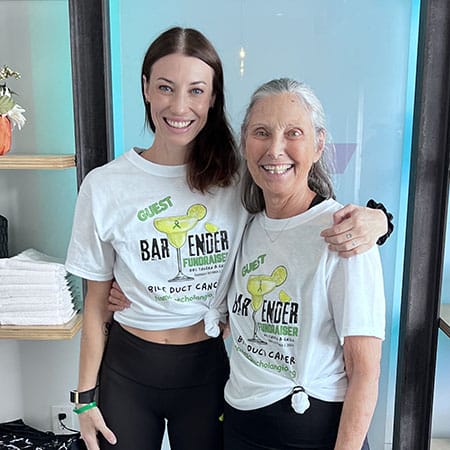
After facing a rare cancer diagnosis, Jaye Pedante (right) turned her battle into a mission—raising awareness, funds, and hope for others through Team Cure Cholangio.
How does living with cholangiocarcinoma shape your approach to this volunteer work?
I have a passionate commitment to this cause. I feel like I’m making a difference—not just for myself, but for others who will be diagnosed in the future. One thing I appreciate about Team Cure Cholangio is that our funds go directly to research for this specific cancer. That’s in our bylaws. So we know exactly where the money is going, which isn’t always the case with larger cancer charities.
There’s also a pharmaceutical company headquartered right here in Wilmington called Incyte. They’ve supported our efforts and even developed a chemotherapy treatment for cholangiocarcinoma. It’s encouraging to see those kinds of advances happening locally.
How have your friends and family supported your efforts?
They’ve been wonderful. I’m really fortunate to have a large support system—my daughters, my sisters, nieces, nephews, friends from college, friends all over the country. They show up to events, donate, and help spread the word.
When I visited my daughter Leanne in Pasadena, California, we held a fundraiser at the gym where she works. She teaches classes there, and we organized a special workout where people paid to participate. All of that money went to Team Cure Cholangio. We raised $2,000. Even those who couldn’t attend donated online. I’m so honored by the kindness and generosity people have shown.
What are some other events you’ve helped lead and organized?
We partnered with the Kendra Scott store at the Christiana Mall in Delaware. During that event, we set up a table with information about cholangiocarcinoma, including symptoms, and gave out swag like bracelets and pens. A big part of what we do is raise awareness—not just among the public, but even with doctors who may not recognize the early signs of this cancer.
Twenty percent of purchases made during those hours go to us, and they also include online orders from the weekend. It’s a simple but effective way to reach people.
We also held a Guest Bartender Night at a restaurant called BBC Tavern & Grill. For three hours, 18 volunteers rotated through the bar as guest bartenders. All tips went to us, and 10% of meal sales did too. We had a raffle, a silent auction, and a lot of fun. We raised $14,000 at that event. We’re doing it again this September.
Is there a moment from your volunteer work that really stuck with you?
That first 5K I attended in 2023. I was amazed by the number of people there—about 400 participants in person, and many more who joined virtually. Seeing other warriors, families walking for loved ones they’d lost, people connecting and sharing stories—that event really moved me. It made me realize this is where I need to be right now.
What else are you working on right now?
We’re getting ready to launch an online marketplace. We’ve collected and made a lot of swag—bracelets, hats, tote bags, notebooks, magnets—and we want to make it available for people to purchase through our website. Jan Meyer has been making most of these items by hand, but now that we have an active board, we’re pitching in to help manage it.
We’ll also continue doing events like the Kendra Scott fundraisers and the Guest Bartender Nights. As long as people keep showing up, we’ll keep doing the work.
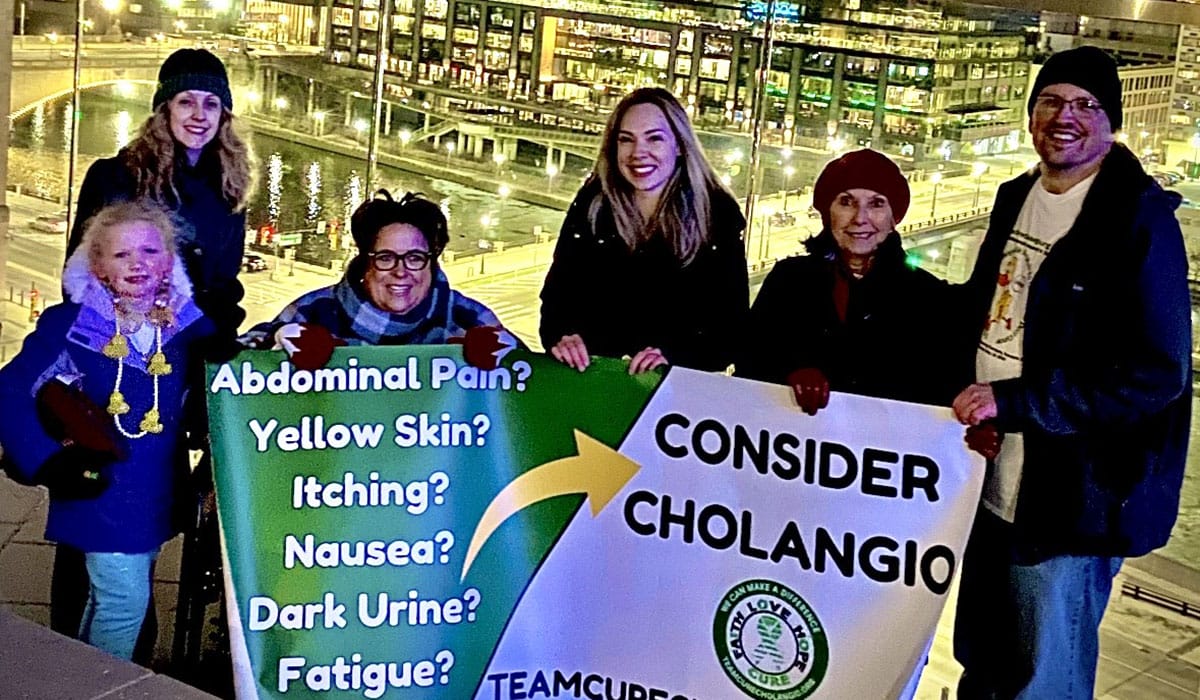
Jaye, second from right, gathers with supporters in front of the PECO Building in Philadelphia. The sign displays the symptoms of Cholangiocarcinoma./ Courtesy Jaye Pedante
What keeps you motivated to continue doing this work?
Knowing that the money goes directly to research, and that research is what’s keeping people like me alive. Treatments don’t just appear. They come from years of research and funding. And in a time when research budgets are being cut, I think it’s more important than ever for us to step up and help where we can.
Why do you think it’s important for people to volunteer?
Because if we don’t do it, who will? There’s so much work that needs to be done. And having people you can count on makes a huge difference. A lot of people say they’ll help, but don’t follow through. The people who show up, do the work, and stay committed—they’re the ones who really make things happen.
What do you hope people take away from your story?
That there’s hope. Treatments are improving. People are working hard to make a difference. And if you’re wondering how you can help, this is how—show up, support events, donate, spread the word. Even something as simple as asking your doctor about cholangiocarcinoma can make a difference.
THERE’S SPACE FOR A COMMUNITY UNDER THIS VOLUNTEER’S UMBRELLA
Meet Daily Point of Light Award honoree Christina Cheng-Patel. Read her story, and nominate an outstanding volunteer or family as a Daily Point of Light.
Christina Cheng-Patel isn’t getting much sleep these days. But she wouldn’t have it any other way.
A single mom of two sons, Christina works as a pediatric researcher. But when she’s not at work or caring for her kids, she’s creating opportunities for them to help others. A lifelong volunteer, Christina wanted to find an opportunity that would allow her to volunteer alongside her boys. However, when they were younger, she struggled to find opportunities that permitted that. Eager to bridge the gap in her community, Christina formed Under My Umbrella, a grassroots organization that focuses on mindful, direct outreach that serves people with dignity. By creating an opportunity to volunteer with her sons, Christina forged a path to get her entire community involved.
Under My Umbrella seeks to help community members who tend to fall through the cracks. Their Neighbor Outreach program feeds and clothes 100 unhoused community members weekly, while the Rainy Day Fund helps bridge the gaps, like providing an individual with a bus pass or emergency car repairs. She Leads, the newest initiative, empowers women to build confidence and expand their skills through free workshops while highlighting women-owned businesses. Whether it’s a free cookie decorating workshop or CPR training, the community is always welcome at no cost.
Entirely powered by volunteers, Under My Umbrella doesn’t have the hefty operating budget of many larger organizations. However, what it does have is dedication. Christina dedicates 12 to 36 hours per week to the organization, on top of her full-time career and child rearing. As a result of her devotion, the organization upcycles 1,200 articles of clothing and 200 grocery bags every month. Whether they’re distributing hygiene essentials or bottles of water on a hot day, Under My Umbrella steps in where the need is. Christina’s dedication shows just how far one person’s passion for helping others can go in a community.
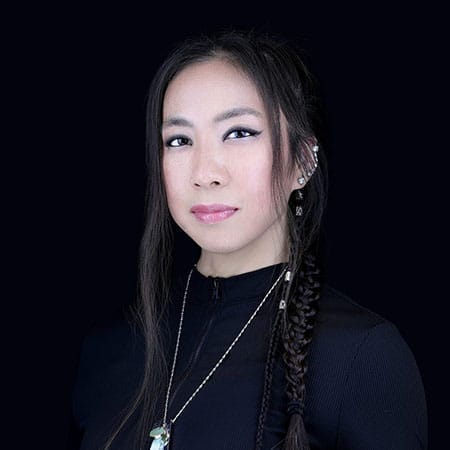
CHRISTINA CHENG-PATEL IS THE FOUNDER OF UNDER MY UMBRELLA, A GRASSROOTS ORGANIZATION THAT FOCUSES ON MINDFUL, DIRECT OUTREACH THAT SERVES PEOPLE WITH DIGNITY. /COURTESY CHRISTINA CHENG-PATEL
What inspired you to get started with this initiative?
I’ve volunteered ever since high school. When I had my children, I wanted to give them that same type of volunteer spirit, but we had trouble finding volunteer opportunities that would fit our schedule. There were not a lot of volunteer opportunities for me with my kids, as young as they were. Just like people said, I thought, if there’s no seat for me at the table, I’d have to make my own. That’s exactly what I did. There are a lot of benefits that can be achieved at the grassroots level. Our larger systems and larger organizations do a wonderful job of serving the majority of the people who are in need, but some people fall through the cracks.
Tell us about your volunteer role with Under My Umbrella.
We don’t have any staff, and we don’t keep any overhead. All of our supplies are in our living room and garage. Everyone’s doing everything on their time, on their dime. We just do a little bit of everything. My boys help, as far as our stocking, inventory and social media. My youngest one created our website. We all do pretty much all the roles. We do the public relations, social media, on-site coordinating of volunteers, grant writing and everything else.
What are your long-term plans or goals for the organization?
We have gotten such great support from our community, and the goal is to grow and expand our reach. I think the long-term goal for me would be to see another community do the same thing that we did with their community, because each city and each community is going to have different needs. I think that if you take the model that we’ve established with Under My Umbrella, and you take that model and duplicate it, I think this is something that could work. That, to me, would be the ultimate goal – to see those concepts in a different city or area, and see how they can fill in the gaps for their community, whether it’s Dallas, or somewhere else.
What’s been the most rewarding part of your work?
The human interaction is the most rewarding part. Not only from the people that we serve, but also seeing that spark light up in our volunteers, whether they’re 7 years old or 70 years old. To see that spark and to have them know that they can make a difference, I think that’s the most rewarding thing. When we feel like we can’t make any impact, we’re not so likely to take action. But if we can harness that from everyone in the community, you’re talking a lot of money, time and resources. I think seeing somebody understand the impact that they can make is the most rewarding thing for me.
What have you learned through your experiences as a volunteer?
You have to be okay with rejection, and you have to be adaptable and be able to pivot. Because we run operations the way we do from our house, and because we are so small, we don’t qualify for a lot of the big grants that require you to have a $100,000 operating budget. We’ve had to learn to adapt to still get the job done. I think our stats show that you don’t need a large margin or a big overhead. If you collaborate with the members in your community and like-minded people, then you can get those metrics.
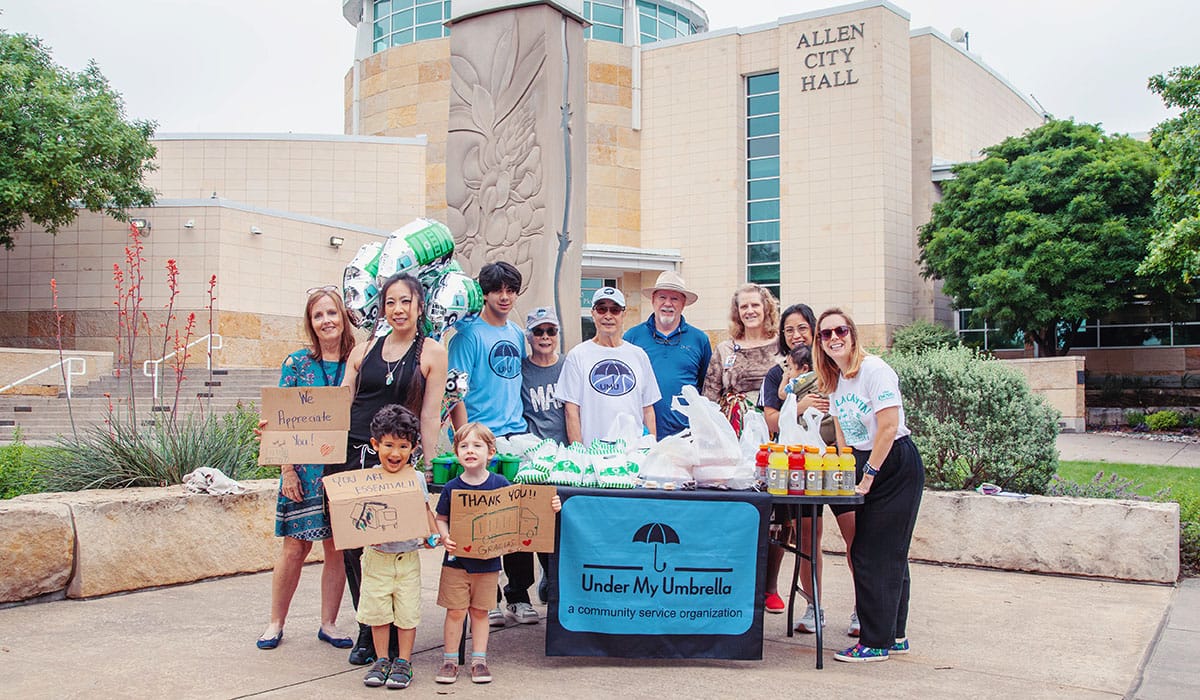
UNDER MY UMBRELLA HOST CHRISTINA-CHENG PATEL HOSTS THE ANNUAL THANK YOU LUNCH FOR COMMUNITY SANITATION WORKERS. /COURTESY CHRISTINA CHENG-PATEL
Tell us about future partnerships, programs or events that you are excited about.
I’m super excited about one coming up on Saturday. We just started a new program called She Leads. It’s personally exciting for me because it’s all about women collaborating and empowering other women in our community and supporting women-owned businesses. I do workshops within the community for women to come and attend and learn for free. We did a self-defense workshop, and we did a super popular decorating workshop. We did an art workshop. This one coming up, we’re doing community CPR, and we’re letting the gentleman in on it, because I think education is very important. CPR is a skill that we all need to know. It gives our community a chance to learn or do something new.
Why is it important for others to get involved with causes they care about?
To have compassion and be empathetic. It’s really hard to do that on paper. It’s one of those things that requires actual contact. You get that through experience. You also need education. I think it’s important for us to make that part of our daily routine, because if everybody were to just give one hour out of their week to help somebody or to do something, the impact would be massive.
What do you want people to learn from your story?
I want people to learn that if you want to make a difference, you need to set your mind to it. You need to put one foot in front of the other and get it done. The result may not look like what you thought you were going to get. I never thought that my kids and our little ideas would end up with us having this nonprofit, but here we are. I’m extremely grateful to the community support that we’ve garnered, and happy to see our community come together. For a nonprofit like ours, that’s the only way we’re going to be able to make an impact – with the support from our community.
A Legacy of Service: Texas Veteran Supports Fellow Vets and Military Members
Meet Daily Point of Light Award honoree Tim Stroud. Read his story, and nominate an outstanding volunteer or family as a Daily Point of Light.
Tim Stroud’s dad was a hero. He served the country in the Army, just as his father before him. Then, he came home and served his Missouri community as a police officer for 18 months before being killed in the line of duty. Tim was just 5 years old, his sister, 6. His mom, distraught, became adamant that he not follow suit into either profession. Tragically, around two decades later, she also passed unexpectedly.
“That hit me pretty hard, and I went through a period in life that I took more than I gave, and I didn’t like that person,” Tim says, crediting extended family with guiding him to volunteering as a way to heal.
Volunteering made him reevaluate his mom’s request and his decision to continue his family’s military legacy. He enlisted in the Army at age 27 after spending time at the Missouri Veterans’ Home in St. Louis.
“I saw the camaraderie between the men and women who lived there, and I met the first Black pharmacist in Missouri. Mr. Taylor, 103 years young, would tell me stories about World War I,” he recalls. “I needed direction and discipline, and the drill sergeants at Fort Leonard Wood, MO were happy to give it to me.”
Initially stationed in Germany, his subsequent deployments were to Kosovo, Kuwait and Iraq. He served as both a combat medic and a member of the Criminal Investigation Division, a plain-clothed division requiring top-secret clearance that he equates to the FBI of the Army. After his deployments, Tim returned to Fort Hood married to a German woman, but they drifted apart when he was deployed for the birth of their second daughter. With neither of their extended families nearby and the military’s Family Readiness Groups unperfected, both became frustrated with the lack of support. Later parting ways, Tim returned to volunteering to heal, getting engaged with mental health initiatives.
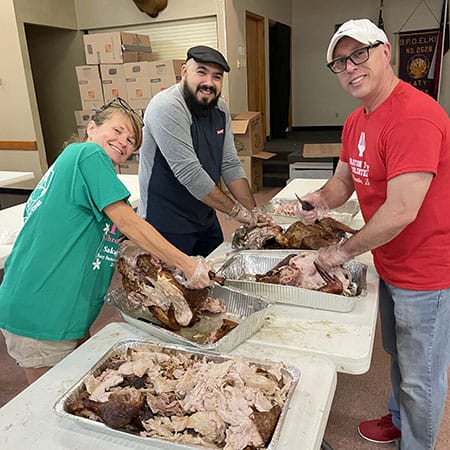
Tim (right) spearheads Operation Turkey Houston, an initiative that feeds 11,300 people on Thanksgiving.
From there, he became progressively more involved with veteran support organizations. It was a period when many were appearing, but people didn’t know where they were or how to access them. So, with $1.6 million from the governor of Texas, Tim co-founded TexVet to connect vets with resources.
“You could type your county, and it would show you which resources were available–financial, spiritual or physical. If you were caught in the red tape in the VA and other organizations couldn’t-help you, these organizations would,” he says.
He does the same with Jay Coppock, CEO of SERVE, after meeting at an event 10 years ago. Together, they help catch veterans who fall through the cracks.
“There are over 45,000 nonprofits registered with the IRS for veterans alone.” Jay explains. “There are so many of us in this space, we don’t even know the others exist. By seeking each other out and collaborating, it narrows it down.”
Sometimes, all it takes is someone reaching out to inquire about services or donations. This is Tim’s forte.
“He’s very outgoing. He’s not afraid to be told, no,” Jay notes, praising Tim’s persistence and ability to make things happen. “And he’s very good about thanking people. I go to an event, and when I leave, I get a text or call saying thank you for coming. That makes people want to help him, because he’s truly appreciative.”
Tim serves on the board of SERVE, and Jay returns the favor with an organization Tim founded with his daughter Amber, Stay Tuned for Vets. It’s designed to promote engagement between veterans as well as between them and the community. It’s also meant to be fun.
“We wanted to teach people that life is beautiful. It can be creative,” Tim says.
They offer arts-based mental health and wellness programs like painting, equine therapy and acting classes. After being convinced to try a dance class, one Vietnam vet had such a great time, he signed up for private classes. A year and a half later, he and his wife are doing competitions. He credits Stay Tuned for Vets for igniting his passion for dance as well as reconnecting with his wife.
As CEO, Tim has worked hard to build relationships with the 550 veteran service organizations they collaborate with and often attends other groups’ events to assist and cheer them on. He especially enjoys working with his daughter and training other leaders across his organizations, taking pride in their success.
Another issue Tim tackles is the transition to civilian life. Sometimes that means helping translate skills for a nonmilitary resume. Other times, it’s working with employers.
“They want to see you as an individual leader. And that’s a struggle for some of our military members, because they were trained over the last four to 24 years that it was a shared responsibility with shared accolades,” he explains of job search competition.
At Houston’s 2025 Our Community Salutes event honoring young adults entering military service, Tim (right) serves as the Master of Ceremonies with 147 enlisted soon-to-be high school graduates in attendance.
In 2024 alone, Tim also volunteered at multiple veteran mobile food banks, helping feed more than 2,000 families experiencing food insecurity. At Combined Arms, he coordinates drive-thru distributions that support 1,000+ veterans and families each month and provides more than 11,000 meals during Thanksgiving with Operation Turkey.
The list of places Tim volunteers is lengthy, but Killeem Police Department Law Enforcement Assistance Fund, founded in honor of his father, is close to his heart. Tim has facilitated the donation of over $1.5 million in emergency support to officers and their families in times of injury, illness or loss. And he spends 10 hours a month fundraising and doing outreach.
Tim has even adopted former service dog Colton with whom he travels the country teaching companies the legalities and social implications of having such animals and how they improve veterans’ lives. Even in Colton’s retirement, they’re a popular duo, making appearances at community events.
“He truly cares,” Jay reiterates. “He knows what it’s like to be in combat. He knows what it’s like to be with other veterans, and he’s seen them struggle.”
With empathy and openness, Tim is continuing his family legacy of saving lives and building community. The path to a happy life is never without challenges. Sometimes, overcoming them requires a helping hand. And Tim Stroud has two.
Meet Daily Point of Light Award honoree Anoushka Bhatia. Read her story, and nominate an outstanding volunteer or family as a Daily Point of Light.
Anoushka Bhatia, a 17-year-old rising high school senior, naturally builds up the people around her. She loves to crochet and do crafts, finding joy making individualized birthday gifts and seeing recipients happy. As a child who needed something to fidget with origami was a particularly good fit. Her passion for helping others extends to animals as well, spending volunteer hours with multiple local pet shelters.
She also loves to read, and in 2022, Anoushka joined The LiTEArary Society as chief creative officer (CCO) on their mission to end book deserts for children in Head Start, a federally funded preschool program for children living below the poverty line. The youth-led organization has donated over $1M worth of new books to more than 91,000 preschool children in all 50 states. Anoushka has enhanced reading comprehension in the program by creating hand-made, engaging craft kits to accompany each book that goes out to local events or Head Start locations from Hawaii to Maine—around 2,300 since she started. With 22,000 members worldwide, people have taken note of its success.
James Dean, author of the beloved children’s series Pete the Cat, has noticed as well. His positive comments on the group’s social media photos of kids doing Anoushka’s crafts—many of which revolve around his books—are a nod of recognition that won’t soon be forgotten.
What inspires you to volunteer?
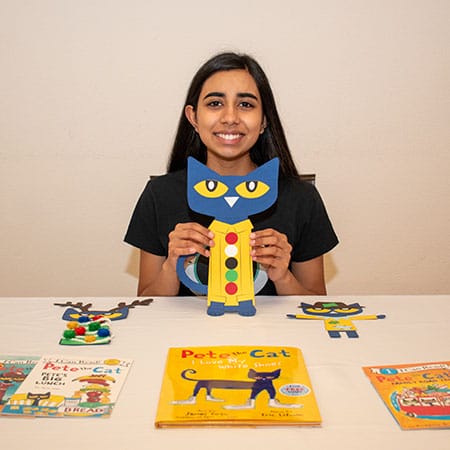
Chief creative officer of LiTEArary, Anoushka Bhatia, holds up a Pete the Cat sample craft which was sent along with the Pete the Cat books and craft kits to Head Start programs across the US.
I have a poster with a Brian Andreas quote that says, “If we fail this time, it will be a failure of imagination. And then she placed the world gently in the palm of my hand.” That suggests that our biggest obstacle isn’t the lack of opportunity but the lack of creativity.
Also, my family is from India. When I would visit as a kid, I’d sit with my grandma reading picture books, and a couple of times I saw endangered sarus cranes fly by, a symbol of freedom. I started folding paper cranes, and years later, when I became the CCO of the LiTEArary Society, I drew from that experience and childhood pastime to incorporate book-themed crafts into the organization.
What inspired you to get started with this initiative?
I became involved as a rising freshman, when I came across a TED Talk by Rania Zuri, our founder and CEO, talking about the book deserts that exist across the US. In my area, we get access to books and libraries from a young age. I couldn’t imagine a world without reading.
Tell us about your volunteer role with The LiTEArary Society.
During the school year, I spend 30 to 40 a month preparing crafts and organizing reading circles and craft workshops at local Head Start locations. During the summer, I can spend more time.
At events, I read a designated book, for example, Pete the Cat: I Love my White Shoes. Then, we pass out materials and help them put together the craft. I make an example the day before, so I can show them how it will look. Since they’re young—ages 3 to 5—I cut out templates of Pete the Cat. Then, I cut out eyes, noses, whiskers and maybe some shoes, depending on what we’re reading. Afterwards, I surprise them with their own book.
Many kids speak Spanish at their schools and at home. If they don’t understand the Instructions in English, I can help in Spanish. It eliminates the language barrier.
Where did you learn Spanish?
I started learning in seventh grade at school and finished AP Spanish last year. Even when I was a kid, I noticed people of all ages unable to speak English. For me, it’s always been about helping people, wherever I am. A year ago, I was at the DMV to register for my permit, and I assisted an older Spanish-speaker in line. It made me feel great.
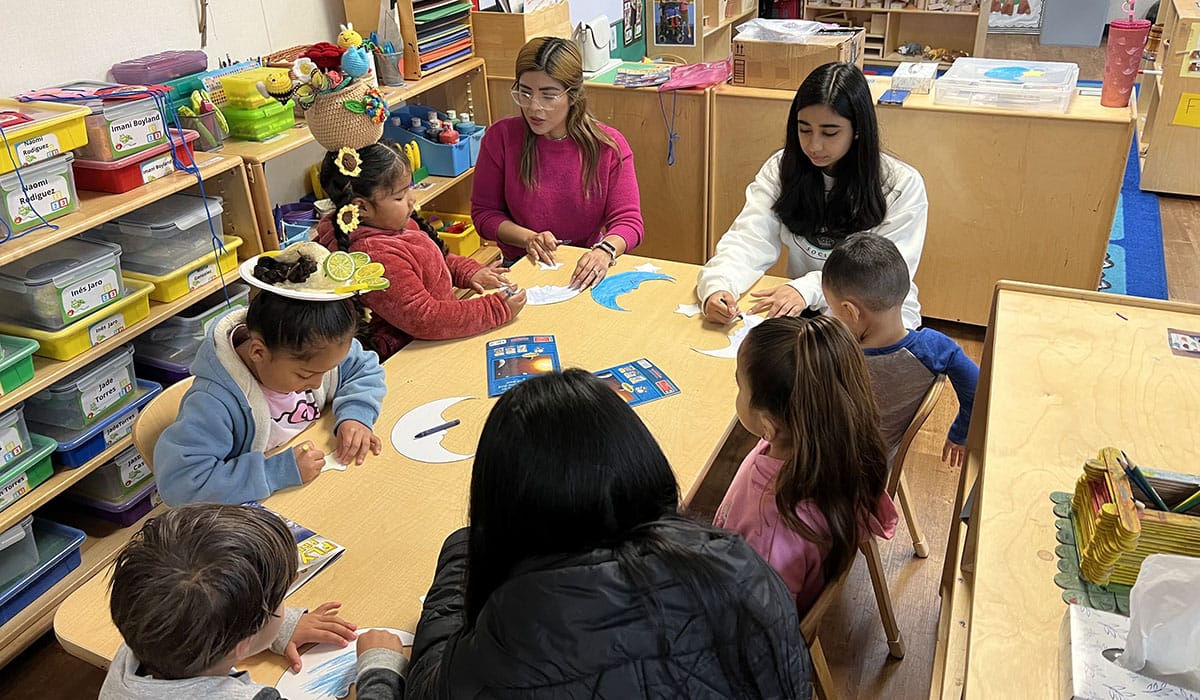
Anoushka (back right) helps children decorate their Moon and Star crafts to correspond with the “Fly Guy Presents: Space” book.
What’s been the most rewarding part of your work?
I enjoy working with kids. They would be happy if I just read to them, but giving them books is one of the highlights. They’re so happy and often start reading right away. It’s rewarding to see how thankful they are. I can see how much an hour or two of my time means to them.
I believe that all of these kids have the potential to become great writers and authors. We might never have known, but this experience could change them. The book I read to them may be their first story time, and it’s showing them that books are amazing sources of education and fun. Afterwards, a lot of the kids give me hugs. Some of them tell me what they’re going to do with the crafts. One told me they were going to read their new book to Pete the Cat before bed.
When the children decorate the origami cranes I make for them, they dream up stories about where their cranes will fly. At one event, a child named Jenny said her crane would go to Hollywood and another said that his would battle Godzilla. It reminds me why I do this. We aren’t just making crafts but memories, rituals and relationships with books. Every child deserves the chance to imagine, dream and be inspired—and sometimes, all it takes is a story, a craft and someone who believes in them.
What do you want people to learn from your story?
Something as simple as a book can light up a child’s world. Sometimes we don’t recognize how much books mean to us until we engage with people who don’t have them. It’s a privilege to have access.
I encourage people to join the LiTEArary Society to help us end as many book deserts as possible. Every time I’ve read to children and watched them connect with a story, I’ve seen how much it means to them and how much they learn. What is a small moment in my eyes can be a big moment for a child; it could be even life-changing.
While some people may see age as an obstacle, Anjali Sinha saw it as an opportunity.
As a freshman in high school, Anjali became aware of how a significant amount of clothing and books end up in landfills. Hoping to do whatever she could to help mitigate the devastating effects on the environment, Anjali formed Kids 4 Earth, a youth-led nonprofit that inspires students to take action against climate change. She started by running clothing drives, collecting gently used items that would otherwise end up in the trash. Knowing that people are struggling to find suitable clothing, Anjali had the idea to redistribute the items to those in need. Kids 4 Earth hosts a ReStyle Boutique, which provides free clothing to families in need, and books that are distributed to children who are less likely to have reading material at home. Not only does the work of Kids 4 Earth lessen greenhouse gas emissions and slow global warming, but it also provides for people who could use a little bit of help.
Anjali dedicates over 30 hours per month to her work with Kids 4 Earth. Whether she’s communicating with local organizations to coordinate partnerships or working with chapter leaders, her mission to make the planet a better place for those who come after her is a powerful one. In just three years, her impact has been tremendous. The organization has collected and distributed over 9,000 pounds of clothing and over 1,000 books.
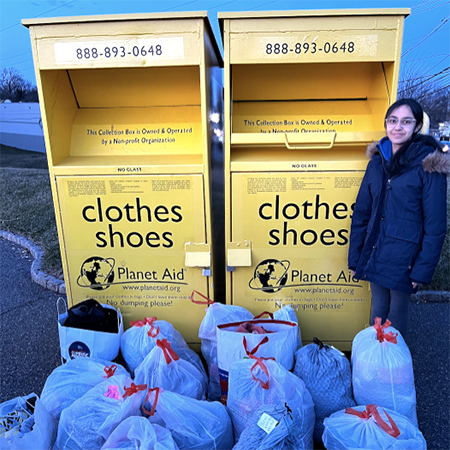
ANJALI SINHA, FOUNDER OF KIDS 4 EARTH, STANDS NEXT TO CLOTHING WHICH WILL BE DONATED TO PLANET AID TO BE DISTRIBUTED AROUND THE WORLD. /COURTESY ANJALI SINHA
Beyond the statistics, Anjali has also made a tremendous difference in her mission to inspire fellow young people. One of her greatest long-term goals is to expand the organization even further. While she’s already expanded to other chapters in different towns, states and even countries, she wants to grow the chapters and inspire other youth to make a difference. Anjali wants to show young people that just because an action is small, that doesn’t mean it won’t make a difference. Anjali’s academic future is also likely to be informed by her tremendous volunteer work. With college coming around the bend, Anjali hopes to study something in the same realm, like environmental science or public policy. By helping her community be a little bit more sustainable, Anjali has worked to build a better planet. The fact that she’s done it all before she’s turned 18 is a testament to the incredible power that young people can have through volunteerism.
What inspired you to get started with this initiative?
I started it three years ago, in my freshman year of high school. When I went to my friend’s house, I saw that her closet was overflowing with clothes. When I asked her about it, she told me that she doesn’t wear them and she’s planning to throw them out, even though they were all in pretty good condition. I started to learn more about clothing waste and fast fashion, and I realized that so much clothing in my community ends up in landfills. After doing some research, I learned that 82 million tons of clothing end up in landfills every year. At the same time, so many people go without clothing and are really in need. That’s what inspired me to fix two problems with the solution of running clothing drives and book drives to help provide items to people in need, while also diverting the items from landfills.
Tell us about your volunteer role with Kids 4 Earth.
We initially started with clothing drives, setting up donation bins at schools, libraries, and churches. We collected a lot of gently used clothing and distributed that to places with people in need, whether that’s a shelter or another organization that distributes to people in different countries. We started doing the same thing with books, and I realized books are very much in need in my town. A lot of schools have students who don’t have books at home. We partnered with another organization called Book Smiles, and they’ve helped us distribute books to local schools. We’ve even done free book fairs, where students can take books on their own.
What’s been the most rewarding part of your work?
The most rewarding part of my work is probably interacting with other people, especially the ones that we help through Kids 4 Earth. For example, one of our initiatives is called the re-style boutique. It’s a clothing swap, where we have clothing racks and tables set up outside a school or a grocery store. We put out gently used clothes, and people can bring in their items and exchange them for other clothes. I think that’s one of my favorite parts because you see so many adults’ faces light up. Even kids, when they get something new, like exchanging an old sweater for a new dress. It helps to see that we are making a difference in our towns by providing things that people need.
What have you learned through your experiences as a volunteer?
I’ve learned that it’s very important to connect with people. When I started Kids 4 Earth, I was a little shy, and it was difficult for me to step out of my comfort zone. However, I realized that if I wanted to spread my message and teach others how important the environment is, it’s going to require me to speak up and talk. That message of connection has been essential in my journey with Kids 4 Earth, where I talk to other adults and hold educational workshops with adults and kids. I think a lot of people don’t realize what a big impact clothing waste has, or books have, in the landfills, and teaching them is very important to me.
Tell us about future partnerships, programs or events that you are excited about.
We’ve had a couple of past partnerships, and I’m very excited to continue those. Specifically, we recently partnered with a local church that sends items in need to the Dominican Republic. I was talking to them recently, and they need certain items, like baby clothes and light summer clothes. We’re actually partnering with them to give a lot of our gently used items, and they’re going to be shipping out in the fall, which is very exciting.
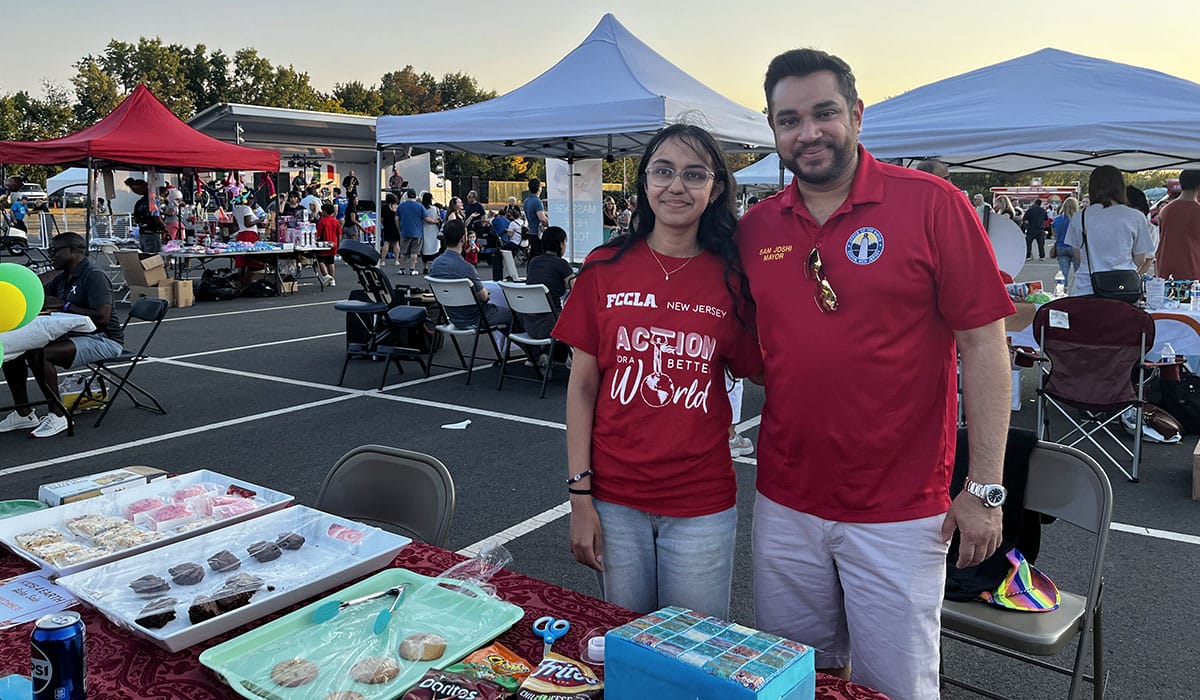
KIDS 4 EARTH FOUNDER ANJALI SINHA (LEFT) SMILES ALONGSIDE EDISON TOWNSHIP MAYOR SAM JOSHI AT THE TOWN’S ITALIAN FESTIVAL, WHERE KIDS 4 EARTH HOSTED A TABLE TO RAISE FUNDS FOR CLOTHING SWAPS AND EDUCATIONAL PRESENTATIONS. /COURTESY ANJALI SINHA
Why is it important for others to get involved with causes they care about?
We gain perspective. For me, volunteering helped me see how other students and kids my age don’t have the same books or warm clothes that I have. Through volunteer work, we can see how simple acts of kindness and generosity can change someone’s life. At the same time, it also builds our confidence and empathy. As a young person, I used to feel like maybe someone should fix the problems I saw. Over the past few years, and through volunteering with Kids 4 Earth, I think that I can help fix these problems. I can make a difference.
Do you have any advice for people who want to start volunteering?
Pick an issue or something you deeply care about, because that’s the way that your actions are going to have the biggest difference. For me, what matters is nature and the environment, because I’ve spent a lot of time outside, and it’s something that I deeply care about. If you feel afraid to make that first step, join an existing organization that’s related to whatever topic you care about. That way, you’re with other volunteers. People are always here to guide you and help you, so you should never be afraid to make that positive difference.
What do you want people to learn from your story?
I think people can learn that very small actions can have a big impact. For Kids 4 Earth, our main goal when I first started was to help our planet. If I looked at it from the beginning, I didn’t think that running clothing drives could have a difference in carbon emissions or global warming. But when we look at it from a different perspective, we see that any small action does have an impact, including me saving 100 pounds of clothes from the trash. All of those small actions add up, and eventually they do make a difference. We shouldn’t be afraid that our small actions won’t make a difference. We should always try and put some type of effort in.
VOLUNTEER ENCOURAGES YOUTH MENTAL HEALTH AT NO COST
Meet Daily Point of Light Award honoree William Mount. Read his story, and nominate an outstanding volunteer or family as a Daily Point of Light.
William Mount turned his struggle into a triumph. A lifelong stutterer, William pursued speech therapy starting at age 3 to manage and navigate his speech issues. Always inspired by his mother’s philanthropic nature, William was just a child when he decided to form an organization to help others afford speech therapy. But as he entered high school, William began to experience extreme bullying, sending him into a mental crisis. With the help of talk therapy, William was able to regain stability in his life.
At the recommendation of his lifelong pediatrician, William decided to widen his organization’s focus to mental health and speech therapy, due to the legions of struggling young people in the Virginia area. He established Free2Talk, an organization that provides financial assistance to Virginia kids and teens who are unable to afford therapy. For as many as 16 sessions, the organization pays up to 80% of the costs of therapy, knocking down many of the access and affordability barriers that prevent people from pursuing mental health treatment.
William’s dedication to making Free2Talk a functioning organization since its 2022 launch has been outstanding. As a minor, he couldn’t contact patients or handle their information. However, he took every opportunity to serve as a representative for the organization, meeting with the trusted team of trained providers who treat each young person and representing the organization at public events. From every website post or email answered behind the scenes, William worked to create an environment that could help young people. As a result, he has helped provide over 450 hours of therapy.
William recently graduated from high school and is heading to the University of Virginia in the fall. He’s already been working with the school’s clinical psychology department to spread the organization’s impact to the Charlottesville area. When he hits the campus this fall, he plans to turn Free2Talk into a student organization to bolster outreach opportunities. He hopes to create a passionate network of students who are willing to expand the organization into something even bigger in the future. William’s determination to triumph over a very challenging situation and turn it into an opportunity to help others is an inspiring demonstration of how .
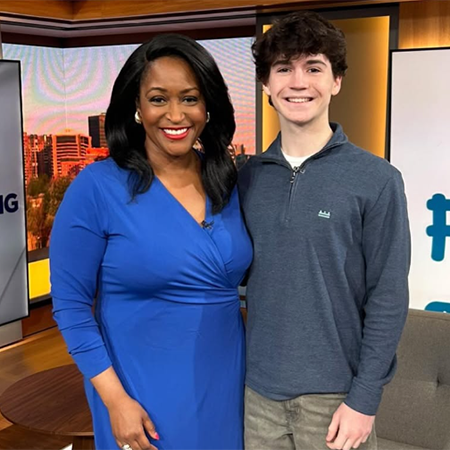
FREE2TALK FOUNDER WILLIAM MOUNT (RIGHT) CHATS WITH FOX5DC ANCHOR MAUREEN UMEH AFTER THEIR ON-AIR INTERVIEW DISCUSSING MENTAL HEALTH CHALLENGES. /COURTESY WILLIAM MOUNT
What inspired you to get started with this initiative?
I’ve been through speech therapy for years. I started when I was 3, and in 2022, I had the idea to start a nonprofit inspired by my mom, with a foundation being a speech therapy subsidizer for Virginia kids and teens who couldn’t afford speech therapy. But as I turned 14 and went through my freshman year, I experienced some pretty extreme bullying. I was going through a mental crisis, and I went and had therapy for several months. I believe that it helped save my life in the end. I had my nonprofit that was tabled because of those struggles that I had, and I didn’t know what to do with it. I met with my pediatrician, and she recommended that I turn it into an organization that does mental health and speech therapy due to the youth mental health crisis.
What inspires you to volunteer?
I’d say it’s a multifaceted reason, but the main one is feeling like I can create a difference in my area, and especially my state. Having those resources available to me and not using them for the greater good would make me feel like I wasn’t doing the best I could to be a citizen. Also, just having the ability to help people is a fulfilling feeling, especially helping those who have gone through the same experiences as me, but didn’t have the resources. Allowing these kids and teens to have access to the resources that helped save my life is both fulfilling but also humbling, because there’s such a large percentage of kids in this country and state who don’t have that access.
Tell us about your volunteer role with Free2Talk.
Before I turned 18, I was practically in charge of everything that wasn’t related to health information or direct patient emailing. I couldn’t reach out to patients because they were kids as well. What I did was a long list on the media side of things, like editing videos, learning how to create Canva art for Instagram posts, working through emails and scheduling Zooms. Our providers are largely very busy, and they have a long list of emails and patients they have to work with. I was in charge of networking with them, working through their schedules and meeting with them to discuss agreements for our collaboration and payment methods. Another big part of what I do is participate in events to spread awareness, like tabling at local events, partnering with local organizations and fundraising.
What’s been the most rewarding part of your work?
Reading patient parent testimonials about how Free2Talk changes the lives of their kids for the better. I received an email about a year ago from a mother whose kid received Free2Talk subsidization, and she said that without Free2Talk, she didn’t necessarily know if her child would have survived this difficult period. We were able to pay for four months of therapy for him, which was around 16 sessions. That period is usually enough to create a baseline for the patient. We allowed this child to regain his mental health. Just knowing that I helped this person regain a balance in their life is a fulfilling feeling that I wouldn’t trade for the world.
What have you learned through your experiences as a volunteer?
How important it is to have resources that are equally accessible for everyone. Therapy is one of those practices that’s, by and large, accessible only for those who have enough money for it. But millions of kids need therapy to either survive or create positive change in their lives. Learning how important it is to create equity in a space like this has built a vision of the future for what I want to do, and that involves community service and grassroots organizing. As I’ve learned through this, things with the greatest impact often come from just an idea in your head. Learning how much of a difference I can make just from starting a nonprofit on my computer has shown me that work like this is crucial to our society.
Why is it important for others to get involved with causes they care about?
Doing something bigger than yourself provides an important perspective on your privileges as a human being, especially in an area like Arlington, which is very privileged due to our location and opportunities. Getting involved creates a humbling atmosphere where you’re capable of empathizing with others and fostering an environment where you can believe that you can make a difference. There are a lot of people who believe that one person isn’t necessarily enough to create change, but through community service, I’ve learned that’s not the case.
Any advice for people who want to start volunteering?
The best piece of advice that I could give is to just do it. There are so many volunteering opportunities. A lot of them don’t have enough volunteers because of the time commitment or the difficulties of the work, or the lack of consistency with hours. I’d say just to do it, because it’s better to volunteer and not be sure of what you’re doing than not volunteer at all. Eventually, you’ll find the place that works for you. I found my niche in volunteering. It just takes time and a degree of being intrepid enough to be willing to volunteer.
What do you want people to learn from your story?
I want them to learn that if they’re a kid or teen, it’s possible to create change at a local level. You may not believe that you have that power because of your youth or because of your socioeconomic standing, but there are tons of resources available for you to help create and make a difference. It’s just a matter of seeking them out and having the willingness to work hard enough to create something. It’s very possible, it just takes time and energy, regardless of your age.
Cultivating Curiosity as He Brings Balboa Park’s Gardens to Life
Meet Daily Point of Light Award honoree Jim Davis. Read his story, and nominate an outstanding volunteer or family as a Daily Point of Light.
Jim Davis, a volunteer with Forever Balboa Park, is a walking encyclopedia of plant life and a welcoming presence for thousands of people. Born on a farm in Arkansas and later earning his graduate degree in St. Louis, Jim Davis has spent a lifetime rooted in service. From assisting the Red Cross during the Missouri River flooding in 1993 to volunteering through his church, tutoring students in reading and currently serving at a food pantry, Jim’s commitment to community runs deep. But since 2022, his devotion has been primarily to Balboa Park.
Jim has dedicated his time to multiple volunteer programs at the park, serving as a rose garden steward, garden steward and park ambassador. His commitment is most visible inside the iconic Botanical Building, where he enthusiastically greets and educates guests from around the world. With every shift, Jim interacts with countless visitors, offering insightful tours of the lush displays. His deep knowledge of plant life isn’t accidental; it’s the result of his own study and memorization. Jim has made it a personal mission to learn the most fascinating facts about the garden’s rarest and most iconic species, especially their unique adaptations. His tours not only entertain but also deepen public appreciation for the biodiversity nestled in the heart of San Diego.
As an added benefit, Jim plays an active role in promoting environmental awareness and sustainability. Through his casual conversations and informative tours, he connects guests to the natural world and encourages them to think critically about conservation. His approachable demeanor and genuine passion make learning feel like a friendly chat rather than a formal lecture, creating a memorable experience for park visitors of all ages. Whether tending roses or greeting newcomers to Balboa Park, Jim brings a contagious enthusiasm and heartfelt dedication to every task. His ability to transform a stroll through the garden into a rich, educational journey makes him an invaluable part of the Forever Balboa Park team.
Tell us about your volunteer role.
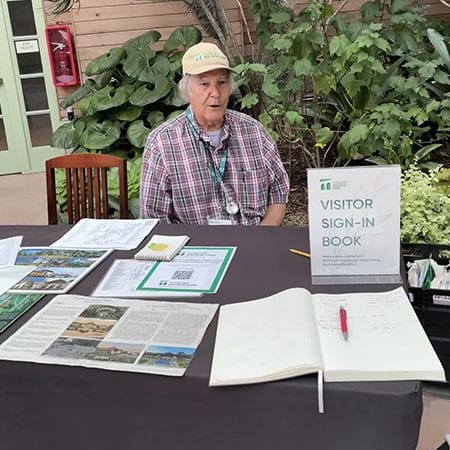
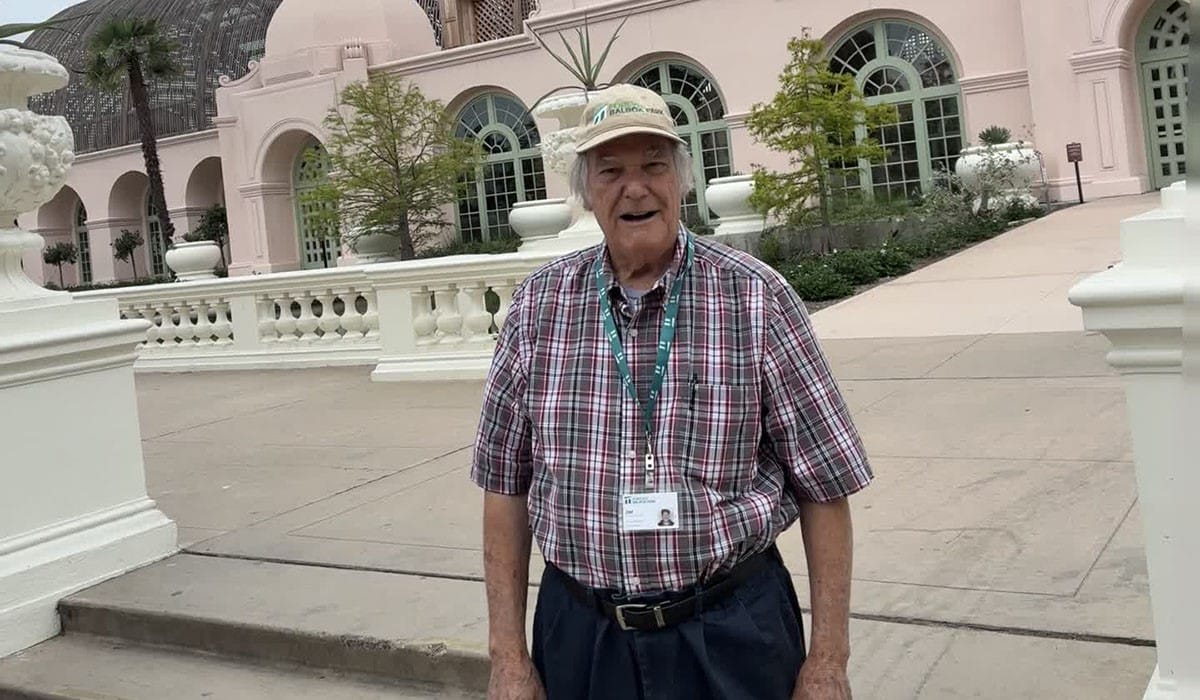
Jim at the Botanical Building Information Desk.
I started out volunteering in the rose garden. We had roses at home and I didn’t really know much about how to care for roses. My daughter suggested I volunteer at Balboa Park and that’s what I did. One day a week I started volunteering, learned a lot about roses, met a lot of great people and made really good friends. I also got to take some really great photos.
Then, the Botanical Building, which was originally built in 1915, reached a state of deterioration. About three years ago, there was an effort made to begin refurbishing and rebuilding it. So for two years, it was under construction. It reopened on December 6, 2024, and there was a request for volunteers to come over and help with the reopening. I agreed, and then I got really fascinated in this building, which houses tropical plants from all over the world.
I’m naturally pretty inquisitive, and I started trying to find all I could about these plants online. Some of them are very rare. Some of them are unusual. I found that I really enjoyed approaching people, sometimes multiple thousands of people who come through the park, and showing them the plants in the building. Some of the plants don’t look particularly notable, but I enjoy telling people the stories behind them.
Why is access to nature, specifically flora, so important?
There’s something about us humans – I guess it’s an instinct – that makes us very much interested in our environment. We’re simply interested in the plants and animals in the environment we live in. We recognize – perhaps not even in words or in conscious thought – that we ourselves have a lot in common with the natural world around us.
We can see and feel and know that we are, ourselves, natural beings.
What have you learned through your experiences volunteering?
Of course, I learned more about how to take care of roses! I learned a lot more about tropical plants from around the world. But I also learned that I could do more than I first thought I could.
By striking up these conversations and talking to people in the Botanical Building, I’ve also learned that about 80% of the people are not from San Diego at all. They’re from everywhere, literally everywhere. Europe and Canada and Australia, India and Philippines and Japan. And I learned that most people are actually very friendly and nice and good to be around. I don’t see people who come to Balboa Park as strangers anymore.
What’s been the most rewarding part of your work?
The memories. Every day when I go to Balboa Park, I come back with things I remember. I mostly interact with people for a very brief period of time – anywhere from saying a couple of sentences to each other to walking around for about half an hour. And after that, we’ll never see each other again. But I can still vividly remember many of the people I’ve met. And those memories are very, very good for me.
Volunteering is good for my health, too. It involves exercise, more than I’d get at home. I have to stoop over, sometimes carry buckets, walk a lot. And when we’re doing something we enjoy, meeting and interacting with nature and with people, it makes us feel better about ourselves. I really think doctors would say it’s very good for our health.
Jim stands outside the Botanical Building, a place of volunteering and of curiosity.
Why is it important for others to get involved with causes they care about?
The instinct to help is why I do volunteer work. Humans tend to have an instinct to help each other. Doing something for the benefit of someone else – especially for the benefit of someone you don’t even know, someone who may not be kin, who may not be in your same group or community – spending your time and effort helping them is really good for you. And we need to do that, not just be ready and willing, but actually do it. Volunteering makes me a better person. I find that it’s really rewarding. I don’t get any material benefit from it, but there’s a very real reward. It’s good for my soul.
Any advice for people who want to start volunteering?
I don’t like to tell anyone what to do, but it’s been my experience that if you volunteer, it turns out to be more than you expected it to be. Find something to volunteer with that you enjoy. That’s important. Maybe you want to do something where you talk to people, or perhaps you’d rather do something behind the scenes. Think it through and try it out.
The important thing is finding what fits your skills and personality, as well as your interests. That’s the thing about volunteer work: unlike a job, there’s a lot of choice. You can choose what to do based on your passion. And remember, above all, that volunteering should be done with the purpose of benefiting others.
Making Waves on the World Stage of Marine Conservation
Meet Daily Point of Light Award honoree Sabine Castro. Read her story, and nominate an outstanding volunteer or family as a Daily Point of Light.
At just 16 years old, Sabine Castro is already making a global impact in the world of marine conservation. Her journey began at the Central Park Zoo, where she volunteered over 200 hours as a Discovery Guide through the Wildlife Conservation Society. There, she educated thousands of visitors—particularly children—on wildlife and the importance of environmental preservation. This early exposure to public-facing conservation work laid the groundwork for her next steps: taking action beyond the zoo and into the ocean.
Motivated by her experiences and growing knowledge, Sabine became an ocean ambassador with the Manta Trust and a World Water Hub ambassador. These roles challenged her to design a marine conservation initiative, leading to the founding of Dolphin Defenders. What started as a campaign to raise awareness about underwater noise pollution quickly evolved into a youth-powered nonprofit that has reached over 60,000 people around the world.
“Our goal was to break down the barriers that hold youth back from having their voices heard in marine conservation, specifically on international forums,” Sabine says. “I founded the organization, at first, to protect dolphins. But then it became a global movement to amplify youth voices on the world stage. I’m grateful that I got the opportunity to do just that at the UN a couple of weeks ago.”
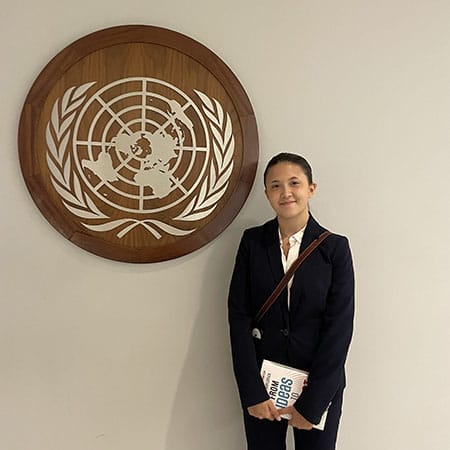
Sabine in front of the UN insignia at the UN Headquarters in New York City.
Indeed, Sabine had the incredible opportunity to meet with delegates from all over the world at the UN Headquarters in New York City. They talked marine conservation from various geographical perspectives, as well as discussed some of the topics on the agenda for the 2026 United Nations Water Conference.
Under Sabine’s leadership, Dolphin Defenders has grown into a nearly-100-member international organization that champions education, empowerment and advocacy. The nonprofit has hosted events such as youth summits, educational campaigns and contests like Echoes of the Deep, a creative writing competition endorsed by the United Nations Department of Economic and Social Development. Through these platforms, young people are given space to discuss environmental issues and propose real-world solutions that are presented to advisory councils like the one at NOAA’s Sanctuary Advisory Council.
To deepen the organization’s impact, Sabine launched several key initiatives. The Ambassador Program equips youth with tools and training to lead conservation efforts in their own communities. Mission Manta focuses on marine biodiversity education, while BLUEPrint is a bold, global policy effort working toward a youth-drafted Marine Bill of Rights. Each program is designed to educate and inspire action, making marine science accessible and advocacy approachable for young changemakers.
Notably, Sabine’s reach doesn’t stop at the shoreline. “Inland communities are integral because they have the water that feed into our bays, our rivers and inevitably to our oceans,” she explains. “That’s actually where a lot of pollution comes from. There are factories and other facilities on the water that leech chemicals and other waste into the water. Spreading awareness to these facilities and communities, preventing pollution and encouraging cleanups in inland communities benefits all of us.”
Dolphin Defenders has expanded into inland and coastal regions of the Global South, even establishing youth hubs in Rwanda, Ghana and Gambia. The goal is clear: embed environmental responsibility early by integrating education with empowerment, regardless of geography.
“We’re really trying to focus on community engagement, so we’ve tasked our ambassadors to do some kind of water cleanup,” Sabine shares. “In the next couple of months, we’re looking to complete at least 10 beach cleanups across the areas we’re affiliated with. We have three hubs in Africa and we want them to have as much reach as possible. Beach cleanups and river cleanups are so crucial in our efforts.”
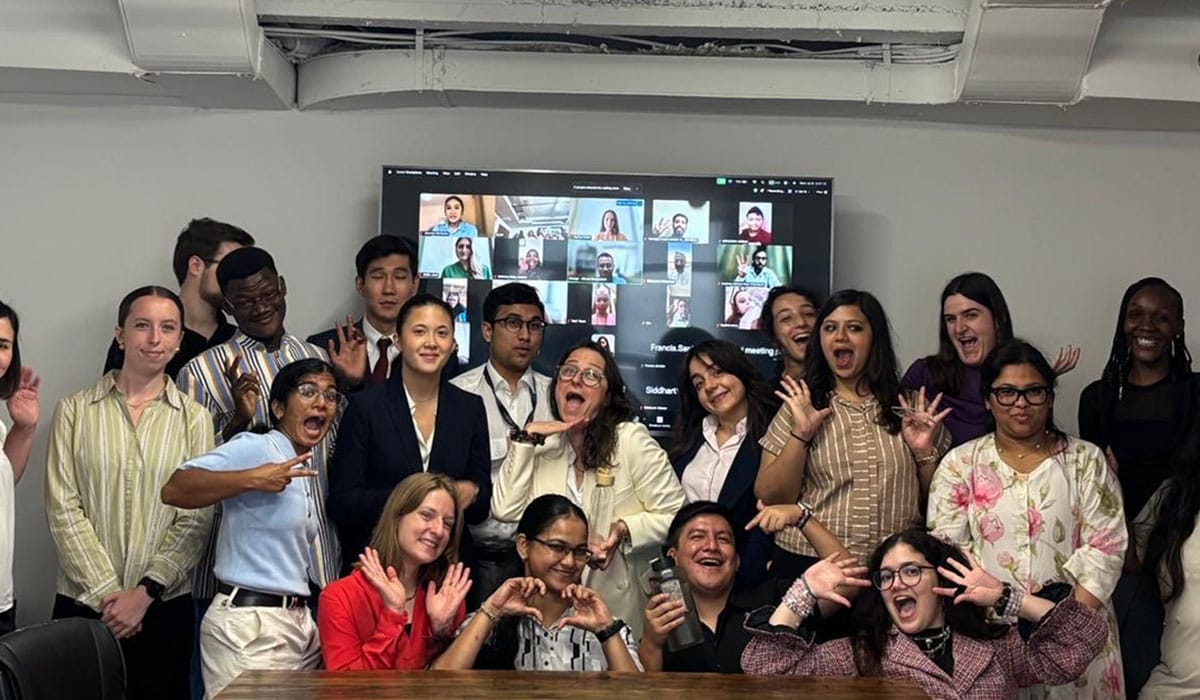
Sabine with MGCY in advance of the UN Water Conference Multi-Stakeholder Meeting.
Outside of Dolphin Defenders, Sabine is also the founder of SEA Blue Labs, a youth-led incubator designed to merge environmental awareness with entrepreneurship. This program supports students in developing scalable, socially responsible ventures that address climate challenges. Still in its early stages, SEA Blue Labs already has a team of 20, united by the belief that the best solutions come from those who care—and dare—to create.
“In my opinion, youth voices are vital,” Sabine reflects. “The way you create change, especially in social movements, is through education. And that inherently means getting youth involved. We want people to grow up being conscious of the responsibilities they have to the environment, to conservation, to civic engagement. It’s so important to engage with that now rather than waiting until later, so that you can go through life knowing that being involved is a core part of the responsibilities of life.”
Even as she manages two growing organizations, Sabine remains active in hands-on education through her continued work at the Central Park Zoo. Her 200+ hours there have further solidified her belief that systemic environmental change begins with informed communities. By turning complex science into stories that engage and inspire, Sabine ensures that conservation isn’t just a cause, but a conversation.
Meet Daily Point of Light Award honoree Evan Wang. Read his story, and nominate an outstanding volunteer or family as a Daily Point of Light.
In 2021, when the pandemic sent the world into lockdown, 18-year-old Evan Wang got serious about writing. It’s also the year he helped build the Montgomery County Youth Poet Laureate Program where he currently serves as the program director. His advocacy to increase engagement in and accessibility to the arts has led him to the Biden White House, NPR and TEDx, but it has also created change on a local level. He reaches out to those who don’t have a platform or who might be hesitant to share their art and creates opportunities for both artists and the community that surrounds them. He teaches his craft, his love for it contagious. And he works with the county library system, government and nonprofits to continue providing ways for aspiring writers to thrive.
Evan has since been named the National Youth Poet Laureate and serves as the only junior board member at the Indian Valley Arts Foundation and as the editor-in-chief for the Hominem Journal, an international arts publication that highlights young creatives. His fundraising efforts have resulted in $40,000 for arts programming in Montgomery County. And his literacy initiatives have reached thousands.
Outside of volunteering, Evan is on a mission to make a career in research and development in the pharmaceutical and public health sectors. This fall, his next adventure begins at Harvard University, where he will be studying biology and creative writing.
Evan attends the National Youth Poet Laureate Commencement Ceremony./Courtesy Nicholas Nichols
What inspires you to volunteer?
It all began in quarantine, when I felt confined to my room. I was just entering high school and wanted to challenge myself to branch out, especially because everything was virtual and felt isolating. I got involved with Planned Parenthood as a national volunteer leader working on vaccine accessibility and addressing misinformation. That was my first contact with volunteer work. I met many other wonderful volunteers, and by seeing my impact, I was also seeing what matters to me.
I’ve created this space for writing for young writers, because my county doesn’t offer arts programming or funding. To see them meet, create art and be inspired by each other… That’s why I continue to do it.
What inspired you to get started with this initiative?
That was the year I began to take poetry seriously, and Amanda Gorman read her poem at the presidential inauguration. I found out what the position of a Youth Poet Laureate was, and I wanted to have that opportunity to step on stages and read my work. I worked with my teacher to see if there was a program in my county, but we only had one for adults.
In the fall, I attended an open mic hosted by the Poet Laureate of the time and I suggested starting a youth program to the program director. It took about a year of presenting to arts foundations and boards, setting guidelines, and deciding whether to be the director or to be considered for the Youth Poet Laureate position. I decided to throw my name in the ring for the latter and when it launched, I was named honorary Youth Poet Laureate of the county.
Tell us about your volunteer roles with Montgomery County Youth Poet Laureate Program, the Valley Arts Foundation, the Hominum Journal and your advocacy for the arts.
Now, as program director, I manage the Poet Laureate’s appearances, bookings and advocacy initiatives. I find local and national organizations to collaborate and host events with. I lead writing workshops and open mics for local writers. When I was a Youth Poet Laureate myself, I organized over 14 writing workshops and open mics at local libraries. I did a countywide library tour. I spoke at universities and elementary schools to motivate people to engage with the literary arts.
Within my county, I have multiple initiatives that raise money for arts programming. One of these is Concert Sundaes. We host a concert at a huge park and raise thousands of dollars from concessions. I also do a lot of administrative work for the program–create designs, maintain the website, manage the social media accounts and more.
The Indian Valley Arts Foundation hosts various initiatives, like building murals and sponsoring Concert Sundaes. As a junior board member, I regulate the budget for the Montgomery County Youth Poet Laureate Program, because it’s nestled under the foundation. I also support a scholarship initiative for high schoolers engaged with the arts; they pair an established poet to a student, and I help regulate that pairing.
At the Hominum Journal, we don’t publish solely poets and writers; we also highlight artists and playwrights. We’ve reached over 100,000 readers in a year, and I manage an editorial staff of 26.
What’s been the most rewarding part of your work?
I was the first poet featured at a local arts festival. Since then, they’ve been inviting poets back every year. My county also does a pride flag raising ceremony and I was, again, the first poet featured. The reading was so successful that in every subsequent year, they’ve invited a queer poet back. That lasting impact is so important to me. It’s opening the door for people after me. And, with my work with the Montgomery County Youth Poet Laureate Program, seeing how many people show up to readings is inspiring.
What have you learned through your experiences as a volunteer?
I have to remind myself to stay ambitious, because poetry and the arts are inherently adult-dominated industries. There are going to be a lot of people telling you no. But if I wasn’t ambitious, I wouldn’t be here today.
What do you want people to learn from your story?
Even if you come from a community where there aren’t a lot of artists or opportunities, you can make a future for yourself. It takes a lot of work, and there won’t necessarily be large organizational support behind you, but the community will support you as you support it. And never expect an audience for your work. Once you have that in your mind, every opportunity to showcase your work is a beautiful experience.
Meet the Teen Empowering Seniors in a Digital World
Meet Daily Point of Light Award honoree Tejasvi Manoj. Read her story, and nominate an outstanding volunteer or family as a Daily Point of Light.
Tejasvi Manoj, a 16-year-old high school student, has taken a personal experience and transformed it into a movement to protect older adults online. After witnessing her grandfather nearly fall victim to a digital scam, Tejasvi founded Shield Seniors, a multi-pronged initiative aimed at helping seniors stay safe and confident in the digital age. With cybercrime costing older Americans billions each year, her mission is deeply rooted in both compassion and urgency.
Shield Seniors operates on three core pillars. The first is a user-friendly AI-powered app Tejasvi developed herself, designed to help seniors quickly identify suspicious emails, messages and websites. The app includes a virtual assistant and simple tools tailored specifically for users who may not be tech-savvy. Recognized with an Honorable Mention in the Congressional App Challenge, the app is currently expanding to Android platforms to reach even more users.
The second component of Tejasvi’s work involves spreading awareness through public education and media. From speaking at TEDx Plano to receiving recognition from city leaders in Plano and Frisco, she’s made it a priority to make cybersecurity a mainstream issue for older adults. Through interviews, articles and public proclamations, Tejasvi has reached thousands with her message of digital empowerment.
While working in digital spaces, what makes Tejasvi’s approach especially impactful is her direct engagement with the community. She conducts in-person workshops and one-on-one coaching sessions at senior centers, ensuring her digital safety efforts are not just theoretical but personal. These moments of connection allow her to witness firsthand the increased confidence and independence being fostered in the senior community.
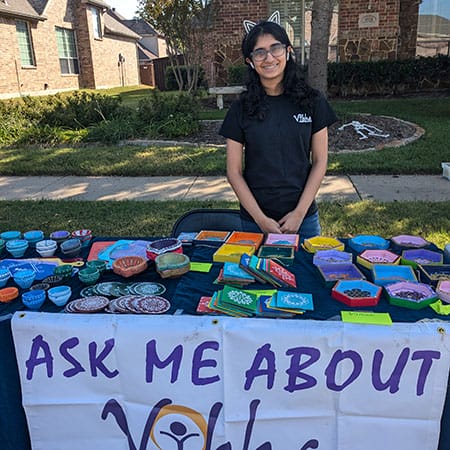
Beyond Shield Seniors, Tejasvi devotes 15–20 hours each month volunteering with other impactful organizations. From tutoring Bhutanese refugee students through Vibha, to serving on the North Texas Food Bank Young Advocates Council, to working toward an Eagle Scout rank, her service is far-reaching and multi-dimensional. Read on to find out more about what inspires her.
Tell us about your volunteer role with Shield Seniors.
Tejasvi raising funds for education of underserved children through handmade crafts as a proud Vibha volunteer.
I’m the founder of Shield Seniors, an initiative I started to help older adults feel safer, more confident and better protected in the digital world. What began as a personal mission has grown into a comprehensive program that combines technology, education and community outreach to fight cybercrime targeting seniors.
I built an AI-powered web application that helps seniors identify scams in real time. I also lead in-person workshops at senior centers where I teach older adults how to recognize threats, use technology more comfortably and protect themselves online. To reach an even broader audience, I’ve taken the message to the media, through interviews, podcasts and articles, to make sure that cybersecurity awareness becomes a national conversation that includes seniors.
From local news to national platforms like TEDx and NBC, I’ve worked to make the digital world a little safer, one story at a time. My goal isn’t just to help seniors avoid scams — it’s to empower them to use technology with confidence, to stay connected, and to live more independently in a digital age.
Why is this issue so important to you?
This mission is deeply personal to me. Early last year, my 85-year-old grandfather was nearly scammed online. I still remember how shaken and anxious he was. It wasn’t just about losing money; it was the fear, the confusion and the loss of trust that really stayed with him. That moment opened my eyes to how unprepared many seniors are to deal with online threats. It made me realize that my grandfather wasn’t alone — millions of older adults face similar risks every day. I knew I couldn’t just stand by. I had to do something to protect them and give them the knowledge they need to feel safe and confident in a world that’s increasingly digital.
Tell us about what inspired you to start Shield Seniors after that experience.
My grandfather’s experience was a wake-up call. After he was nearly scammed online, I started digging deeper and was shocked to learn that older adults lose over $3.4 billion every year to cybercrime. The more I researched, the more I realized how widespread — and overlooked — this problem is. I discovered that most older adults don’t have access to real-time tools to help them spot scams, and there’s very little training or support tailored specifically for their needs.
That realization hit me hard. I wanted to turn my concern into action, not just for my grandfather, but for every older adult facing the same risks. That’s when I decided to create Shield Seniors to close that gap, raise awareness and empower older adults to navigate the digital world with confidence and security.
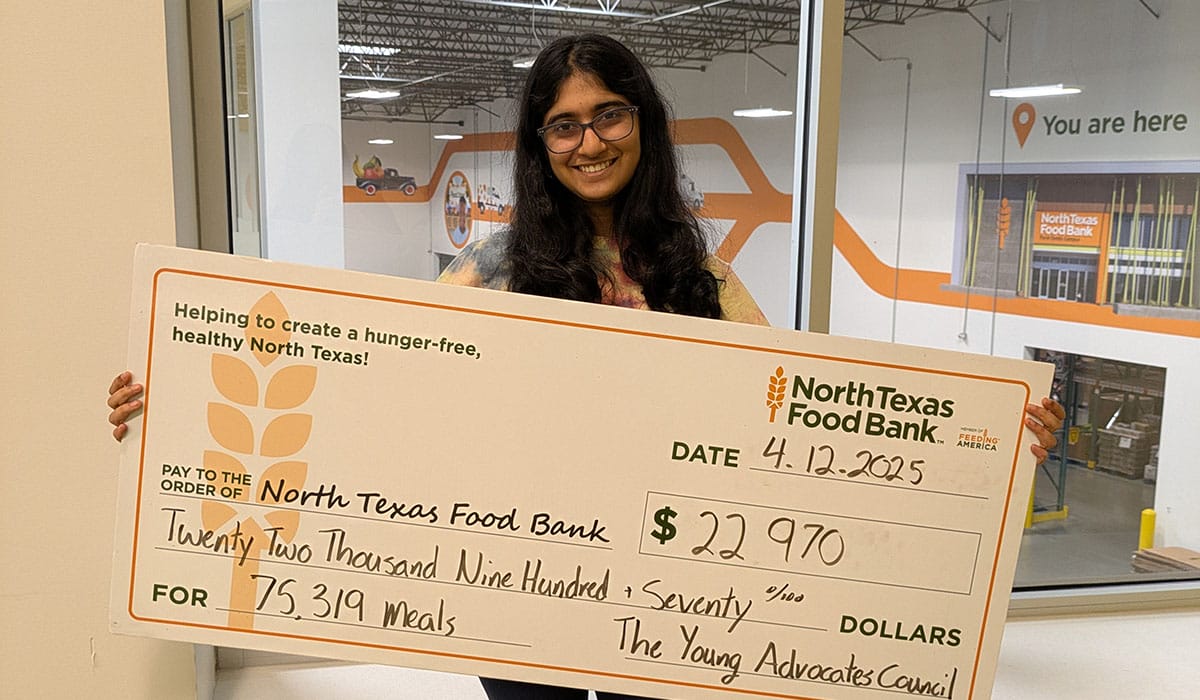
Tejasvi is proud to support the North Texas Food Bank with her team by collecting a donation that helped provide over 75,000 meals to the community.
What are some of the other causes and organizations you volunteer with?
I volunteer with several organizations that focus on community service, education and support. Some of the organizations I work with include Vibha, where I tutor Bhutanese refugee students and lead fundraising efforts. I also volunteer with the North Texas Food Bank, where I served as secretary on the Young Advocates Council, helping to raise awareness and resources for hunger relief. I also volunteer with TangoTab, where I assist in packing meals for families facing food insecurity.
In Scouting America, I’m working toward earning my Eagle Scout rank through leadership roles and community projects. Additionally, I’m involved with the Mark Cuban Foundation AI Bootcamp, serving as an AI student ambassador, helping other teens learn about artificial intelligence. For my dedication to community service, I’ve been honored with the U.S. Congressional Award Gold Certificate and the Presidential Gold Volunteer Service Award.
What’s been the most rewarding part of your work?
It’s been incredibly rewarding to see the actual impact of my work. Knowing that I’m doing something that actually helps people brings me so much joy. It has helped me develop new skills and gain a broader perspective on social issues. I’ve become a better communicator and gained a deeper understanding of the challenges others face. That mix of impact and personal growth is what makes this journey so rewarding.
What have you learned through your experiences volunteering?
Volunteering has helped me realize that even small actions can create meaningful change. Through all my work, I’ve become more empathic and have learned the importance of listening carefully. I have also gained experience working with people of all ages and backgrounds, and I’ve learned how to turn an idea into something that truly impacts others.
Why is it important for others to get involved with causes they care about?
I think that everyone has the power to make a difference in the world if they just put in a bit of effort and time. Sometimes it only takes a single person to make a difference in someone else’s life. Your passion can inspire other people to pursue their own passions as well, and it can help you grow as a person and help your community flourish.
Any advice for people who want to start volunteering.
I would recommend just starting volunteering with something you really care about. It doesn’t have to be huge. Even helping one person can make a huge difference! You can talk to local nonprofits or community centers to figure out how to get involved. And don’t be afraid to start your own project! Your voice and actions matter and truly can make a difference.