Creating Connection With Spark the Change Colorado and Samen voor Eindoven
A global movement for good requires the power of volunteerism, service and civic engagement. And that’s exactly what Points of Light Global Network affiliate
is on a mission to do: spark change and inspire a movement of good, leading to a world with stronger, more resilient, equitable and connected communities through the power of volunteerism.
Spark the Change provides direct services and volunteer programs, as well as resources, training and support for organizations and community leaders. Kelly Groen, director of Spark the Change’s Mental Wellness Program, talked to us about their unique mental health initiative.
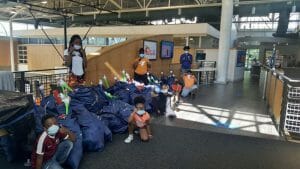
Spark the Change Colorado volunteers put in the work needed to convert the Denver Coliseum into a women’s shelter at the start of the COVID-19 pandemic.
“Our mission for the Mental Wellness Program is to connect licensed and insured mental health professionals who volunteer their time and expertise to low-income Coloradans in need of counseling,” she said. “First, we connect volunteer private practitioners to pro bono clients through our private practice referral line. Second, we operate a host site model, where we place a volunteer professional at an established host site, such as a school, shelter or nonprofit, to provide mental health support to clients and staff at the site.”
Most often, barriers to mental health are financial or related to accessibility within traditional avenues. Spark the Change’s clients are often unable to afford treatment due to being uninsured or being unable to afford deductibles or copays. Many clients are also unable to find an appropriate or available clinician through other avenues of care.
“Through our host site model, we’re also able to lend support to the clients being served by other leaders of service in our communities,” says Kelly. “We form partnerships with schools, shelters and service nonprofits across the state, working in tandem to find a volunteer who can meet the unique needs of their population. Volunteers are placed within these organizations free of charge, to better support the mental health needs of clients and staff. We provide services to individuals, couples, families and groups, and our volunteers serve clients of all ages.”
From helping with issues like anxiety and depression to stress management, grief, loss, family issues and coping with life changes, Spark the Change’s Mental Wellness Program is making mental health a priority — in a time when these types of issues are front and center.
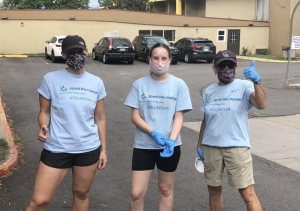
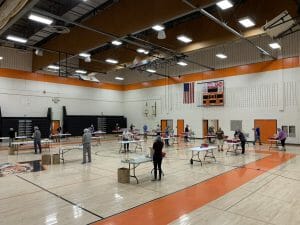
Spark the Change Colorado partners with Harvest Pack to provide days of service, packing hundreds of meals for those in need. Events have been transformed to accommodate social distancing, PPE and all health and safety protocols so volunteers can feel safe while giving back.
in Eindhoven, Netherlands, is the bridge between companies, social organizations and the local government to work toward a more cohesive and inclusive society. Samen voor Eindoven means “Together for Eindhoven” and the organization works to design and implement corporate volunteer programs.
“Corporate volunteers embrace our values and are committed to making a vital contribution to our local community. By using their professional skills and talents for community organizations, corporate volunteers themselves experience more meaning and job satisfaction,” says Esther Hofstede, founder and director of Samen voor Eindoven.
Through the use of smart technology, Samen voor Eindoven is able to mobilize corporate volunteers through a digital platform, maximizing efficiency, impact and flexibility. Social volunteers can enroll in recurring calendar programs and skill-based programs.
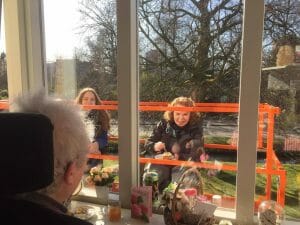
Corporate volunteers engage with initiatives like donating “wishtrees” to almost all 23 nursing homes in Eindhoven, creating a website for Eindhoven residents with foreign roots, making video calls to people who are currently unable to go outside and publishing a “feel good newsletter” with only positive news, sent to elderly residents of nursing homes.
More than 10,000 vulnerable people in Eindhoven were provided with vitamin A during the pandemic, which included providing company over a socially distanced meal.
“It turns out that when you really put corporate volunteers in touch with groups in need, there is more understanding and the gap between the groups is reduced,” Esther says. She encourages increased corporate volunteering, which she calls “a win-win: impact for the beneficiaries and volunteers, substance for the Corporate Social Responsibility policy of companies, and a more attractive workplace for involved employees.”
Kelly Groen at Spark the Change Colorado encourages volunteers to get involved: “While there are countless ways to make an impact, including mindful recognition of your individual purchase power and using your voice and vote to make a difference, volunteerism will always be a necessary cornerstone of civic engagement. There are a multitude of benefits to volunteerism, both to the community being served and the individual serving. There is no comparison to the feeling you get from giving your time and talents to improve the lives of other members in your community.”
Special Olympics Florida, with the Support of Volunteers, Offers Sports and Socialization Opportunities for Children and Adults with Intellectual Disabilities
With more than 21 million residents, the state of Florida is the third most populous in the nation. It’s also one of the most diverse states, with large proportions of indigenous people, Asian, Black, Hispanic and European residents.
Special Olympics Florida is making sure that inclusion and opportunities extend to another group of Floridians – a group that spans all ethnic groups – those with intellectual disabilities. Those efforts continued through the past year’s coronavirus pandemic, when Special Olympics Florida launched a health and wellness program that reached participants virtually.
Special Olympics Florida serves close to 60,000 children and adults with intellectual disabilities, who are given the opportunity to play and compete in various sports, from baseball, basketball, swimming and flag football to bocce, bowling, skiing, speed skating and even surfing.
Because participants have special needs, Special Olympics works hard to provide plentiful coaches and others who teach, cheer and support the athletes to ensure their success.
That’s where dedicated volunteers make all the difference.
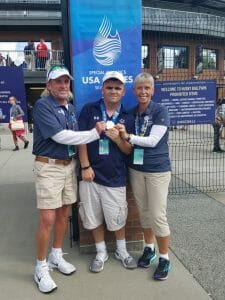
Michael and Nancy Howard, coaches with Special Olympics Florida, accompanied Frankie Jaruszewski to the Special Olympics National Games in Seattle in 2018, where he won a gold medal in bowling.
Nancy and Michael Howard, who live in Palm Beach County, have volunteered their time as Special Olympics coaches for 12 years, and they don’t plan to stop anytime soon. Unlike many coaches, the Howards are not the parents of a Special Olympics athlete. Nancy is a special education teacher at a school that decided to create a Special Olympics team. “Team Howard” participates in bowling, basketball, track, surfing, softball and has started open-water swimming.
Michael, a recently retired inspector for Palm Beach County, has been volunteering alongside his wife.
“If you spend about 15 minutes with these kids, you’re hooked, and that’s what happened to me,” says Michael. “It’s a lot of work, but when you see these kids’ faces, it’s worth it.”
The work is considerable. The Howards arrange and run all practices. If athletes don’t have a ride, they pick them up and take them home afterward. If they lack the proper clothing or equipment, the couple finds a way to provide them. The Howards also strive to schedule extra time for the athletes to socialize with one another, as well as time for their parents to socialize.
The couple even travels, at their own expense, to out-of-town regional, state and even national competitions, a gesture that means everything to athletes whose own parents cannot attend.
Nancy agrees that the volunteer work is gratifying. “Maybe an athlete couldn’t dribble last year, but this year, they can dribble and maybe even make a basket or two. It’s not about the sport in most cases; it’s about the relationships they build with one another,” she said. “It also gives the parents some respite – they know their children are taken care of by us.”
Although the COVID-19 pandemic added even more tasks, such as taking temperatures and extra measures to ensure social distancing at both indoor and outdoor activities, the Howards took it in stride.
“We can’t imagine not doing this,” said Nancy, “People talk about moving away when they retire – we can’t. If we left, these kids would lose out on their Special Olympics team, because I don’t know who would step up to take our place.”
Logan Alvarez, on the other hand, is a volunteer at the very beginning of his adult life and career.
Logan is just 18, but he’s been volunteering with Special Olympics Florida in Miami-Dade County since he was only 7.
“My mom is a teacher and she coached a Special Olympics team,” says Logan. “I would attend state games and local games and I would hand out lunches and help in any way I could. When I got to high school, I trained as a Unified Special Olympics team, where athletes with and without disabilities play on teams together. Logan also helped host basketball and softball skills training events for Special Olympics participants.
“I believe that the world needs a lot more inclusion,” says Logan, who is now a freshman at Florida International University, studying political science and pre-law. “I want to become an ambassador for Special Olympics.”
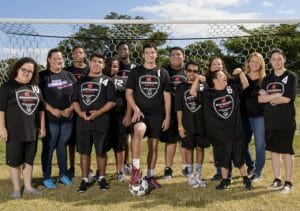
Logan Alvarez (center, with foot on soccer ball) poses with triumphant Special Olympics soccer players in fall 2019, after Miami Southridge Senior High School was named an ESPN Top 5 Unified National Banner School.
Logan, who is not disabled, and in fact was a stand-out high school football player and class president, is highly aware of how difficult acceptance can be for those who with special needs. It’s what makes him passionate about what he calls the “race for inclusion.”
“Just seeing how happy the (Special Olympics) athletes get and seeing them being included is worth everything to me,” says Logan. “In society, you see how left out they are.”
COVID-19 prompts new programs
Special Olympics Florida stepped up throughout the state after the COVID-19 pandemic forced in-person sports programs to be temporarily suspended by hosting multiple virtual programs that encouraged athletes to remain healthy and fit.
At least eight separate programs succeeded in conducting more than 4,900 virtual screenings across all Healthy Athletes disciplines, according to Jim Stratton, communications director for Special Olympics Florida.
For example, a series of videos called “Fit 5 Like a Pro” features both Special Olympics and professional athletes, who encourage viewers to exercise five times per week, eat five fruits and vegetables daily, and drink five glasses of water a day.
“We piloted a virtual screening program for Special Olympics International, using Zoom to connect athletes with medical professionals who answered questions and discussed any health concerns the athlete had,” said Stratton. “We used social media and Zoom to conduct weekly emotional wellness sessions, organize fitness challenges, offer nutrition tips, share healthy recipes, and play games. The sessions provided valuable information but, just as importantly, helped our athletes and their families feel connected during a time when many were limiting their social contacts.”
Service Enterprise Program Equips Volunteer Leaders throughout COVID-19 Pandemic
The COVID-19 pandemic created unknowns for individuals and organizations around the globe. Early on, the realization that human connection was essential became widespread, and organization leaders began to reimagine what volunteer service looked like in a global crisis.
Mark Storrey, chief executive officer of the Haven Humane Society in Redding, California, has been with the animal shelter for eight years. After 20 years in the Air Force, Storrey transitioned to helping animals find their forever homes with his family and four dogs.
The Haven Humane society has past experience in adapting to crisis, like the California Carr Fire. In times of crises, it’s rewarding to be able to help the community because it’s like an extended family, Mark said.
The shelter shut down when the COVID-19 pandemic began — but when it shelters more than 300 animals, people can’t just walk away.
It operated with a skeleton crew and a limited number of volunteers. Staff began to post photos and videos of the animals on their volunteer Facebook page to keep volunteers engaged — and the response was overwhelmingly positive.
“I think it really brought us together, even though we were apart, and it kept volunteers invested. As soon as we opened back up, it was like the volunteer floodgates lifted,” Storrey said.
More than two thousand miles across the U.S., United Way of East Central Iowa continued to unite the caring power of communities to invest in effective solutions that improve people’s lives — even in the middle of a pandemic.
Kayla Paulson serves as a retired and senior volunteer program director and volunteer engagement capacity builder at UWECI.
“The organization is really about helping people help people — we are that connector and that force that can help mobilize and deploy people,” Paulson said.
UWECI acted as an emergency volunteer center in the pandemic and let volunteers step in and step up where they were uniquely qualified. It partnered with Iowa Habitat for Humanity and leveraged their AmeriCorps members for disaster response efforts.
Both organizations are a part of the Points of Light Service Enterprise program, which is designed to help organizations leverage volunteers to achieve maximum operational efficiency and greater social impact. Due to the skills gained in becoming a certified Service Enterprise, a stronger foundation was in place for the transition needed to keep volunteers safe and engaged during the pandemic.
“Through the training we received from Points of Light, I think we made a lot of really positive changes,” Storrey said. “We’ve laid the groundwork to grow, and once we can actually socialize again, I think we’ll be able to start realizing even more potential,” he added.
Storrey expected to learn about recruiting and engaging volunteers during the program, but was pleasantly surprised to realize additional deficiencies and training opportunities. Shortly after, the Haven Humane staff started to make training videos for volunteers and future staff onboarding.
“I think that it really highlighted that we can take skills-based volunteers and we can really work with them by integrating them into the org chart and getting them more involved in the organization as a whole. I think it’s made us a much stronger team,” Storrey said.
“I want to thank Points of lIght for having the program. I wasn’t sure what to expect, but it exceeded all my expectations and I think that our organization is a better organization because of it,” he added.
Volunteers have a variety of opportunities to get involved at the Haven Humane Society. From dog walking, cat socializing, assisting with the veterinary hospital and fundraising, volunteers are critical to the shelter, Storrey said, even the volunteers who show up and are allergic to the animals.
UWECI is a Service Enterprise Hub — an important partner in Points of Light’s capacity-building efforts — and helped other organizations in Iowa get certified and recertified as a Service Enterprise during the pandemic.
Due to UWECI’s leadership and hard work, other nonprofits like the Catherine McAuley Center — a shelter that provides supportive and educational services to immigrants, refugees and women in Iowa — had the volunteer infrastructure and network needed to adapt when food pantries shut down.
“If they didn’t already have those pieces in place, and they didn’t already invest the time and staff training, they wouldn’t have been able to switch and quickly adapt,” Paulson said.
“I really love being able to watch our volunteers be the best version of themselves,” Paulson said. “So whether it’s the Service Enterprise and building the capacity of our nonprofits to better leverage volunteers or being able to respond as we continue to have disasters — I want to help my volunteers see that they have transferable skills that they have built up over a lifetime,” she added.
Exciting things are on the horizon for both organizations.
The Haven Humane Society will host its annual Putt for Paws golf tournament in July 2021 to raise funds and promote animals available for adoption. It will be named after Daniel Zanine, the organization’s former chief financial officer, who passed away from the coronavirus the day before Thanksgiving in 2020.
UWECI plans to celebrate volunteers during its Time for Art: A Celebration of Volunteers event in April 2021. Participants can virtually celebrate and bid on art from upcoming artists in Eastern Iowa. Its annual Day of Caring will take place in May 2021.
“With volunteering, you can see immediate rewards. You can get positive reinforcement within a couple days — So that’s why I hope everybody gives back and everybody chooses to find a space that they can help others,” Paulson said.
Environmental Responsibility and Individual Impact with HandsOn Bay Area and TriesteAltruista
As residents of this planet, we’re all responsible for taking care of the earth. We can contribute on an individual level — through recycling, garbage clean-ups, and donating to related organizations — and on a larger scale, like through driving environmental policy changes.
Environmental activism is a pillar issue for many nonprofit organizations. One of the ways
, a Points of Light Global Network affiliate, helps in this area is by empowering individuals to care for their physical environment through volunteering.
HandsOn Bay Area’s mission statement is “People Helping People™.” What that means in practice is that the nonprofit organizes and manages people power to make the community stronger, safer and more fair. This happens in deep partnership with over 300 nonprofits, schools and parks and with individual volunteers.
“Through our network of nonprofits we serve every issue area important to the community,” Lou Reda, executive director at HandsOn Bay Area, told us. “We have volunteers serving less resourced populations around hunger relief, education and job readiness. We have volunteers serving the needs of people who have disabilities. We have volunteers serving the needs of folks who are homebound and isolated. We have volunteers serving to help reverse the damage that has been done to the environment and much more!”
According to Lou, the secret sauce to volunteering is that the volunteer receives just as much benefit as the people being served. Volunteering makes individuals feel like they are part of the intricate fabric that binds a community together and makes it healthy.
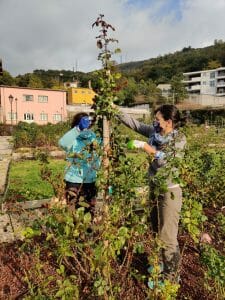
Volunteers prune roses to promote the growth of new flowers.
Across the pond,
, another Points of Light Global Network affiliate, is helping promote volunteering and the spread of altruism and solidarity in Italy. The nonprofit aims to mobilize large numbers of citizens in voluntary initiatives within their reach to respond to the needs of the city of Trieste.
For this reason, TristeAltruista not only guides aspiring volunteers in finding the project that suits them best, but also helps its partner organizations in finding volunteers with the right characteristics to achieve, and if possible, expand their goals. As Trieste is a coastal city, a large part of their work is cleaning up the shoreline. Every year they hold a “Cicca Day” to collect and dispose of cigarette butts on the beach.
TriesteAltruista helps individuals practice their natural “altruism.” For example, beginning in 2018 TriesteAltruista partnered with area organizations to launch the environmental and neighborhood volunteer project “PonzianAltruista.” This project’s aim was to tidy up and care for an abandoned green area inside the suburb of Ponziana, while directly involving the inhabitants.
This district exists in an area with as many as 34% of families made up of elderly women living alone. There is high socio-economic hardship, strong presence of multi-problematic subjects and deterioration of the common spaces. To date, more than 100 volunteers have participated in the project and the project managers who supervise and coordinate volunteers are inhabitants of the neighborhood. About 20 non-profit organizations have contributed with aggregation activities and the resulting gardens will be used by the neighborhood elementary schools horticulture courses, too.
Federico Bonfanti, president at TriesteAltruista, believes that volunteering is part of a civically engaged life in that it concretely immerses individuals in the various needs of their community. “Without volunteering, and therefore direct experience, issues remain a little too theoretical and individuals lack experiential awareness of the city’s reality,” he said.
Andino Castellano, vice-president and founder at TriesteAltruista, encourages volunteers to get involved and be aware that their actions will improve the lives of others and their environment: “A volunteer gesture costs little but is worth a lot, especially if it becomes a lifestyle. You can be an active rather than passive witness of this change.”
HandsOn Bay Area’s Lou Reda says, “For people who want to volunteer I say, don’t hold back. There is a tendency towards perfectionism that gets in the way of service. Just jump in and do what is needed now, regardless of whether you think you are the right person for the role or not. If you are there and you can help then you are the right person.”
Connect with HandsOn Bay Area on
Teens Encourage Youth to be the Driving Force in Reducing Single Use Plastic
17-year-old Amy Meek has always had a connection with nature, as she grew up in Nottingham, England. She remembers spending a lot of time with her sister Ella and her parents as they took family hiking trips and went on outdoor adventures. Eventually, her connection with the environment turned into a powerful youth movement to protect what she holds so close to her heart.
The Meek sisters couldn’t wait for someone else to do the work of protecting the environment because they believed that there was no guarantee that action would be taken — and that’s when Amy and Ella Meek brought Kids Against Plastic to life in 2016.
The Meek sisters took particular interest in plastic after learning about the UN Sustainable Development Goals, and one in particular had a vision of preventing the damage of plastic pollution — goal number 14: Life Below Water.
Their mission for Kids Against Plastic centers on reducing single use plastic consumption and encouraging individuals, schools and businesses to be more discerning when it comes to the damage that single use plastic can do. Single use plastic is essentially plastic that is used once and then thrown away and cannot be recycled. It ends up on landfills, and is commonly found in the ocean and around the animals that call it home.
Amy believes that the urgency in reducing single use plastic lies in the belief that it’s already proven to damage the environment and sea mammals — and that it will directly affect the future generations of our planet.
“If we don’t take action now to reduce plastic usage, it’s going to be something that we are forced to clean up for hundreds of years,” Amy said. “It’s not going away anytime soon and it looks like young people are going to be left with this massive environmental crisis that we’re going to have to fix despite not being the predominant cause of it,” she added.
First, Amy and Ella marched into a local café with plastic clipboards in hand and educated the staff on ways they could reduce their single use plastic. They continued this outreach in other cafes near Nottingham, and eventually began outreach in schools and other businesses.
Amy created the organization’s Plastic Clever Schools Initiative because she understands that reducing plastic can be initially intimidating, expensive and time consuming. The program is all about making small steps that eventually have a huge impact. These steps include using the main forms of plastic: plastic bottles, cups, lids, straws and bags.
The program has gathered more than 1,000 schools that have partnered with the sisters in making reusable items the new norm. She’s even spoken to the business manager at her own school about reducing plastic usage by supporting reusable lunch boxes, refillable canteens and wooden cutlery.
Amy also wants to see the organization and its volunteers pick up at least 100,000 pieces of plastic litter — one for every sea animal killed by plastic in the oceans every year. They’ve almost hit their goal with 90,000 pieces of litter picked so far.
Although Kids Against Plastic is based in the United Kingdom, Amy designed the organization’s educational resources to be adaptable anywhere around the globe. She believes in cleaning up the community you live in first before pointing fingers at others, and that everyone has a part to play in the global movement of protecting the environment.
Another important component of Kids Against Plastic is young people. Amy is dedicated to encouraging youth around the world to stand up for what they’re passionate about and stand firm in what they believe in. She’s seen youth involvement continue to grow, and the organization’s Kids Against Plastic Club — an initiative that encourages children to become active against plastic pollution— has reached 100 members.
A source of motivation for Amy and her sister lies in the fact that they no longer have to start educational conversations by telling people why plastic is harmful. They’ve seen attitudes towards plastic, environmentalism and litter have shifted on a global scale since 2016.
They also make it incredibly easy for schools and organizations to find educational resources on reducing plastic usage.
She was mostly at home with her family during the early months of the COVID-19 pandemic and turned a difficult season into an opportunity of growth by digitizing most of Kids Against Plastic’s work. The organization hosted workshops and Zoom conversations online — something Meek had no prior experience in. It’s also been a season of true reflection for Meek.
“It gave us a chance to sit down and think about how we could improve the outreach that we do and how we could better support the young people we work with,” Amy said. “It’s been really great to see something positive come out of this.”
As Amy approaches the end of her secondary education in England, she has dreams of becoming an environmental campaigner or activist. She also finds herself to be more and more passionate about youth engagement.
“It’s not just the environment issues, but also the power that young people have when they stand up to make a difference — no matter what issue it is,” Amy said.
Delivering Hope
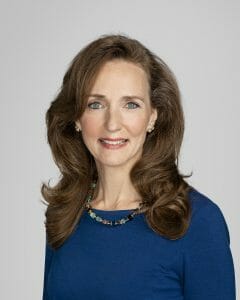
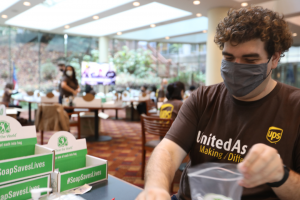
Laura Lane, UPS Chief Corporate Affairs, Communications and Sustainability Officer
In spite of the challenges brought on by the COVID-19 pandemic, I remain optimistic. In these mettle-testing times, the generosity of the human spirit has remained strong. Even amid social distancing, we’re still finding ways to connect with each other and help communities around the world.
These moments of shared humanity provide an important lesson:
We need one another
. We cannot allow this pandemic to create divisions among us —
we are stronger together when united in purpose
.
Collective Momentum
Even before the pandemic, there was a critical need for community engagement. But now with the virus taking its toll on economies around the world, the number of people in need has skyrocketed.
inspires us to action at a time when collective momentum for volunteerism has never been more critical.
In my role as UPS Chief Corporate Affairs, Communications and Sustainability Officer, I have seen how our half-million UPSers have risen to address our world’s most daunting challenges during the past year. That UPS mindset for engagement is reflected in our purpose statement:
Moving Our World Forward by Delivering What Matters.
To us, giving means more than just writing a check — it means combining our skills, passions and time with our logistics expertise, transportation assets and NGO partnerships to make a measurable difference in our world.
And delivering hope for people and our planet means setting ambitious goals for engagement where it matters most. We already met our goal of providing more than 20 million volunteer hours a year ahead of schedule.
In response to some of the past year’s social unrest, we took on a new commitment to advance equity and justice by dedicating more than 1 million more volunteer hours toward Black and underserved communities.
And in our effort to address climate change, we also set a new goal of planting more than 50 million trees by 2030, including the 15 million we already planted. We know the world is counting on us to deliver what matters, which is why UPS will continue to drive meaningful change wherever we can.
Driving Meaningful Change
As essential workers throughout this pandemic, UPSers have delivered everyday essentials and critical PPE; we have helped businesses reinvent their supply chain strategies; and now, maybe most importantly, we are delivering lifesaving vaccines around the world to help defeat this virus.
Service is in our name, and we will continue to serve in every way we can. So, as we celebrate Points of Light’s Global Volunteer Month, we hope our incredible UPSers help give everyone good reason to be optimistic about our future because we know delivering what matters means delivering hope.
Commonwealth Point of Light Spreads Essential Supplies in the Gem of Africa
she knew it would eventually be adaptive to meet the evolving needs of her village. She started off collecting and distributing shoes to young people in the remote villages of Botswana, but in time, Madibana realized that she could help create bridges between her community and essential items like sanitation pads and hand sanitizer — especially during the COVID-19 pandemic.
Madibana returned to Botswana, known as the Gem of Africa, in 2012 after finishing her master’s degree on scholarship in media and communications in England. As part of her scholarship, Madibana committed two years after her studies to her choice of community service. She took community service to the next level by creating the Nayang Association, and hopes to turn it into a full social enterprise.
“This charity is my baby,” Madibana said. “We still have villages where lacking shoes is very rampant — kids literally travel to school without shoes and we’re talking about a country that is like a semi-arid desert.” she added.
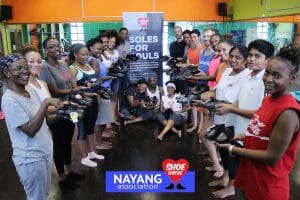
The Nayang Association’s Soles for Souls program has collected and distributed more than 6,000 pairs of shoes for kids and students in remote villages of Botswana.
Remote students commonly walk miles back and forth to school in broken shoes or barefoot, even in the winter months, to make it to class every day. To meet this need for suitable footwear, Madibana created one of the main Nayang Association’s programs, Soles for Souls, and has collected more than 6,000 pairs of shoes for kids and students.
While building relationships with teachers of partnering schools, Madibana realized that teenage girls can miss around 50 days of school every year if they don’t have proper sanitation pads. This unmet issue became something she wanted to be a part of solving, and the Nayang Association has distributed more than 10,000 pads to girls in need since 2015.
Before Madibana began her work, it was common for teachers to spend their own money on resources like shoes and pads for their students.
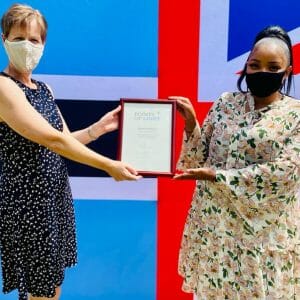
Her spirit of community service has not gone unrecognized. The Prime Minister of the United Kingdom awarded Madibana with a
for her service and dedication to being a global leader of transformative change.
The Nayang Association operated throughout the COVID-19 pandemic, but the charity followed CDC guidelines and were unable to guarantee the right sized shoes for students without fitting them in person before sending pairs out for distribution. However, the charity quickly began incorporating purchased and donated hand sanitizers with their shoes to children and their families to help reduce the spread of the virus.
The Prime Minister of the United Kingdom awarded Madibana with a Commonwealth Point of Light award for her service and dedication to being a global leader of transformative change.
Shoe donation is a continuous need that will always need champions of service like Madibana since a child’s shoe size can change in the matter of months. Most of the shoes of Soles for Souls are donated from individuals and companies, with the charity filling in any gaps if any child still needs a pair of shoes.
Madibana is excited about the charity’s upcoming branded shoe launch which involves various members of her village through the design, construction and manufacturing phases. It’s been a dream of hers for nearly three years since the charity frequently purchases ready-made shoes from countries like South Africa and Zimbabwe. The Nayang Association team is looking forward to creating sources of employment and working with local artists, Madibana said.
The charity has also been constructing ablution blocks — buildings that house private showers and toilets — for children in the villages it serves.
“My thing has always been to tell people that you don’t have to be rich in order to make a difference. Find out what a local charity is doing, especially if it’s close to your heart,” Madibana said.
Tackling Poverty and Inequality With HandsOn Northwest North Carolina and HandsOn Mexico
Serving those who are living through poverty or inequality has long been a focus of the volunteer sector. Many nonprofits concentrate their efforts on getting resources to those in poverty and working to build a more equitable world for those bearing the brunt of discriminatory, unjust or incomplete systems.
A Project Lighthouse volunteer delivers donated items to a local food pantry.
(HandsOn NWNC), a Points of Light Global Network affiliate, mobilizes people and organizations that inspire community change. Working with approximately 500 different nonprofits in a six-county area, HandsOn NWNC provides organizations with a wide variety of services that help them meet the challenge of their missions in the most effective and efficient way possible.
This includes offering leadership and professional development opportunities to staff and volunteers at all levels of the organization, as well as engaging and mobilizing approximately 5,000 volunteers a year in service across the network.
Amy Lytle, executive director at HandsOn NWNC, says, “We work with
everyone
; there is no age requirement to serve! We work with organizations large and small, and our network reaches out beyond our smaller-sized city to some of the more rural counties that surround Winston-Salem, NC. We work with companies, the school system, civic and religious groups. In terms of the organizations in our network, the vast majority of them are smaller or mid-sized, many of which serve a variety of marginalized communities and/or are led by people of color.”
Amy and the team at HandsOn NWNC are focused on building racial equity in volunteering in particular. At the end of 2020, they launched an ED Roundtable for organizations led by people of color. This self-directed and organized group is currently led by a participant volunteer leader, who is the founder of a small nonprofit that focuses on health, wellness and access to healthy food in her neighborhood.
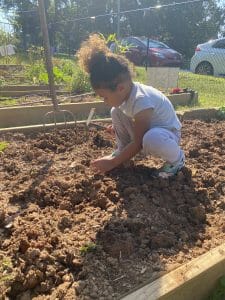
Kelees, a 3-year-old volunteer, helps out at the Kimberley Park Community Garden.
With support from the Starbucks Foundation and Points of Light, the Roundtable is just one way that HandsOn NWNC tries to support smaller, grassroots organizations and increase racial equity within both the local nonprofit sector as well as the community.
From larger efforts like the Roundtable to local efforts with individuals, HandsOn NWNC is making an impact in the fight against poverty and inequality. Take Rosa Johnson, for example, one of the volunteer leaders that HandsOn NWNC works with. Rosa has single-handedly created a small urban community garden across the street from a local Title 1 school. Over the past year, HandsOn NWNC has formed a relationship with Rosa and has come alongside her to help mobilize additional resources — including donations and volunteers — to help make the garden more sustainable.
Amy Lytle says, “Service has the power to unite people across differences and increase social capital; it builds empathy and can inform other forms of civic engagement, such as voting and public policy advocacy. Service can transform individual lives while also working to change systemic issues.”
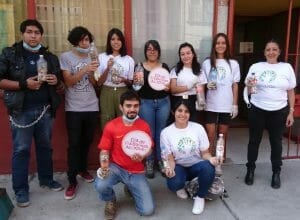
A group of young people, members of an NGO partner and an international volunteer accepted the challenge to collect cigarette butts in order to reduce water pollution and to prevent drains from clogging.
, exists to inspire, motivate and support people interested in investing their time to improve the quality of life for disadvantaged people, animals and the environment. By connecting people with organizations related to their interests and skills and promoting programs, events and campaigns to highlight what people are doing for their communities, they uplift and inspire others to get involved.
Blanca Ramírez, acting executive director at HandsOn Mexico, shares a few notable projects. “Recently we worked in conjunction with the YMCA to support a group that lives in a rural area of the city called Ajusco. In this particular neighborhood, it is fairly common to find young people using drugs or who are part of criminal groups. The YMCA decided to build a community center to provide more options for the local youth and their families to spend their free time. We contributed to projects such as restoring the community center, building a garden and creating a soccer field. The community center also provides leadership development services, activities and workshops to guide people in how to start their own business.”
HandsOn Mexico is working to tackle poverty in creative ways, too. The nonprofit works with a community organization in Xochimilco, initially collaborating with the Umbral Axochiatl organization to clean the canals and remove plastic waste. The villagers welcomed the volunteers and encouraged them to continue caring for the area. The objective, in addition to maintaining a clean natural space to create the right environmental characteristics to revive the axolotl, a native animal, is for the inhabitants to return to work their lands in a sustainable way. This involves using the natural resources that the area offers, resuming ancestral techniques and inviting scientists to implement best practices that allow obtaining organic products and recovering some native crops that were being lost.
HandsOn Mexico worked with a corporate group to clean the canals in Xochimilco.
Thus, the Xochimilco inhabitants became small businesspeople, forming a group called “Grupo Tlacuache.” This project created an interdependent cycle in which the environment is conserved through the sustainable commercialization of the natural resources of the area and the economic income for the families in the area is improved.
Blanca Ramírez advises people to “include time in your schedule for volunteering at least once per month. It’s worth spending time on a cause you care about. Every other activity you do in your life will be more meaningful if you volunteer often.” And to other nonprofit leaders, she says, “Remember that your work is impacting more lives than you imagine. Your effort is inspiring others and changing lives. That donation, that activity you organized where people met new friends living in different circumstances than theirs, is making a difference in the beneficiaries’ lives as well as in the volunteers’ lives.”
HandsOn NWNC’s Amy Lytle also has words of encouragement for volunteers and nonprofit leaders: “If you’re interested in volunteering, JUST DO IT! There are so many ways to get involved, no matter your passions, your skill set or your time limitations. There is a project or an opportunity out there for you. For nonprofit leaders — YOU’RE DOING GREAT! You’ve just reached the one year mark of working through the front-lines of a global pandemic. Whatever you’re doing, it is enough. Be kind to yourself, provide grace to others, and ask for help when you need it. You owe it to your mission and your stakeholders to not burn yourself out trying to accomplish the impossible.”
Three Things the Pandemic Revealed About Employee Volunteerism
It’s been exactly 13 months and one week since the World Health Organization declared COVID-19 a global pandemic. So much of the world and our daily activities stopped or, to use the latest term in ”corporate buzzword bingo,” pivoted to fit within the latest health and safety guidelines and the new realities of so many working from home.
As we celebrate the second annual
, we ask two questions: what has the global health crisis illuminated about employee volunteerism and where should we go from here? Simply put, the pandemic has forced the rapid evolution of the field and has expanded what we do, how we do it and who we do it for.
What we do
Not since the early 2000s, which gave rise to enterprise-wide “days of service,” has there been such a remarkable change in the way companies meet the needs of communities while continuing to build their internal culture of service. Corporate social impact strategies increasingly include nontraditional volunteerism like informal acts of kindness for neighbors and strangers, employees expressing their voice by attending a march, listening and learning about deep-rooted community issues and the push for voting access. And why not? Serving others aligned with a 501(c)3 nonprofit partner isn’t the only way we build community. While having a trusted partner is important when it comes to liability issues and impact reporting, perhaps the old school way of volunteering has discounted the ways local communities have solved problems for decades.
Attention is now focused on developing new norms and standards, tracking and measuring the impact of informal volunteering and civic involvement. Inputs and outputs might remain similar to traditional volunteerism but standards and frameworks for measuring outcomes is evolving to include these new ways of engagement.
How we do it
New ways to serve and measure have certainly leaned heavily on technology to support the transition. CSR leaders quickly integrated virtual volunteering into their strategy and infrastructure. Engaging remote employees, who previously were often afterthoughts when developing large-scale, market-based, in-person service events, became the focal point. While not a new volunteer concept, many more companies have incorporated the use of technology to create connection and community, even doubling-down on skills-based volunteering to help partners turn in-person opportunities into virtual solutions. At the same time, nonprofit partners have had to make significant shifts to their volunteer operations to adapt their need for volunteers to the digital environment.
Because there will be more remote employees who either rarely or never come into the office, we’ll need to continue finding creative ways to symbolically bring them together to continue building a values-based culture. At the same time, we must realize that supply-heavy projects that also require shipping can put quite a strain on budgets, not to mention the “Zoom fatigue” that occurs when virtual service is added to an already long day of virtual meetings. Family integration will also be important for these employees as work and life continue to blend.
And will these activities – whether remote or virtual – still strengthen our bonds to each other, to the community and to the company the same way they do through in-person service? It is a moment of growth and expansion and for new proof points for social impact investment.
Who we do it for
As community needs increased during the pandemic, a host of inequities were exposed. Those most vulnerable in our society were much harder hit by the virus, being statistically more likely to get sick and lose their jobs, their homes and their businesses. The pandemic led to all-time highs in poverty, food insecurity, evictions and mental health challenges. Small businesses took a massive direct hit. Women left the workforce in droves to help with family needs while many BIPOC community members worked the hard, necessary jobs that couldn’t shut down or be done remotely. Students transitioned to distance learning and the digital divide was highlighted as more and more households needed computers and reliable internet services. No doubt this digital divide, along with an incredibly difficult environment for learning, will disrupt the future talent pipeline. The realities and impacts of systemic racism and social injustice called us all to a new moment of consciousness and a new responsibility for change leadership.
In the midst of fragile public trust, companies must continue to step up, not just by issuing public statements of support but by integrating equity into their existing business practices in authentic ways. CSR leaders will need to reinforce the mantra of “serving with, not for,” expanding employees’ world view and deepening opportunities for personal growth and change. The powerful opportunity to align equity solutions with employee civic engagement will require testing of strategies and sharing of outcomes to deliver new definitions of best practices. Employee civic engagement is a strong bridge between solving equity issues and developing collective empathy and it can help to build more just and equitable communities and community leaders.
We’ve come a long way since last year and we continue to witness powerful changes inside our companies, in our communities and within our daily lives that will define a ‘next normal.’
Laureus Uses Sport to Serve Youth, Bridge Divides and Bring Communities Together
In Atlanta, Ga., youth in underserved neighborhoods just blocks from where the Atlanta Hawks basketball team plays can learn about the sport while being mentored in healthy lifestyles, exercise and social skills, thanks to a local program called Hoops University.
In Kenya, Africa, an initiative called Boxgirls teaches girls and young women up to age 23 the sport of boxing – giving them self-defense skills as well as a feeling of empowerment to succeed in a male-dominated society.
Both initiatives are among more than 200 sport-related programs in 40 nations that receive funding through Laureus Sport for Good, a global charity that works to address violence and discrimination affecting disadvantaged youth. Laureus Sport for Good was founded under the patronage of the late Nelson Mandela, president of South Africa from 1991-’97, and a lifelong philanthropist and activist against racism.
“Globally, we’re working to tackle violence, discrimination and disadvantage through the power of sport,” says Adam Fraser, Chief Executive of Laureus globally. “Programs in South Africa use surfing to provide mental health therapy sessions for kids with trauma; programs in favelas in Brazil are using soccer to bridge the divide between different gangs,” said Fraser. “It runs the gamut in terms of sports being used and problems being addressed. We’re trying to support local community grassroots organizations to empower them.”
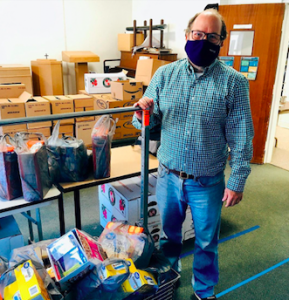
Laureus Sport for Good Atlanta has collected $25,000 worth of high-quality sports clothing and equipment to be distributed to disadvantaged kids to encourage healthy sports activities during the 2020 pandemic. Volunteers spent days sorting, packaging and delivering the special “summer kits.”
Regardless of the sport or location, Sport for Good programs rely on dedicated volunteers.
Many volunteers have personally experienced the benefits of playing sports as a child or teen and are now using the organizational and leadership skills they’ve honed as adults to bring sports opportunities to disadvantaged youth.
For example, Tarin Berry has a career as director of operations at the metro Atlanta YMCA. As a volunteer member of
, which includes 10 other passionate community leaders working to solve local challenges collaboratively, Tarin helps to match community youth programs with high-powered supporters in the form of corporate executives or professional sports teams.
“I’ve developed professional relationships with all of the professional sports teams in Atlanta for the Y, and I’ve continued those relationships, so when it came to do the (volunteer) work with Laureus, it was such an easy fit and so easy to pick up the phone and call on them for resources,” said Tarin. “A lot of what I bring to the table is project management and keeping things on task.”
Even though Tarin is also a busy mother of four, she volunteers for Laureus because sports made “a huge difference” in her own life. She grew up in a family that moved across the country often. “Sports was the one constant,” she says. “I could go anywhere and pick up a softball and fit in. I was never amazing in sports, but it gives kids confidence, the ability to work with a team and a sense of achievement. I can’t even imagine where I would be, even in my professional life, if I had not had the experience of playing sports while growing up.”
La’Teef Pyles and participants in Hoops University, a community group he runs in downtown Atlanta which is supported by Laureus Sport for Good.
On the other hand, La’Teef Pyles, who serves on the same leadership council, is more hands-on when it comes to helping kids play sports. He leads one of those grassroots neighborhood groups for underserved youth that is now receiving financial support from Laureus Sport for Good.
A barber by profession, La’Teef lives and operates his business in downtown Atlanta. He started Hoops University to teach local kids to play basketball, while working in lessons about healthy living.
La’Teef said he’s grateful for diverse training in coaching, mental health and fitness that Laureus Sport for Good has funded.
“I’m obsessed with basketball – I would teach anybody,” says La’Teef. But he’s especially proud to be called “Coach” by kids in the immediate neighborhood, which reminds him of the South Side Chicago area where he grew up. His parents wanted to be sure he had good influences in his life, and he strives to be that good influence for others.
Adapting to the pandemic
When the 2020 pandemic kept basketball participants from gathering at a neighborhood park, La’Teef installed a basketball hoop in his own backyard, where kids can practice in a socially distanced manner. They also get to see La’Teef in his barber shop, meeting more role models among his customers.
“These guys come by here, they subconsciously see a man of color conducting business, responsibly supporting his family and giving back to the community,” said La’Teef.
Meanwhile, Tarin Berry used her connections during the pandemic to help Laureus Sport for Good put together special gift packages of high-quality sports equipment and clothing that were distributed to disadvantaged families along with food donations so that kids could stay physically active, despite the disruption in normal athletics.
Promoting safety beyond COVID-19
Emily Kasiyoki participates in a national boxing competition.
In Kenya, volunteering led to a paid job at Boxgirls for Cynthia Coredo, who has worked with the organization since 2008. She had experience working with computers and wanted to share her skills for a good cause. She now manages fundraising for the program.
Boxgirls was created when two girls asked to participate in boxing lessons offered by a local boxing coach, Analo Anjere, popularly known as Priest, who was teaching kids in the Kariobangi district of Nairobi, Kenya’s capital and largest city.
Today, Boxgirls also serves girls in rural areas as well as in the city. Currently, about 2,655 girls are enrolled, and the program has an 80 percent retainment rate.
“We use boxing as the entry point to really advocate for girls’ empowerment,” said Cynthia. “We believe it’s very important to be change agents to give girls and young women a voice.” In a society where physical and sexual violence against women has become a national crisis, Cynthia says it’s important to emphasize the ideology that women deserve an equal chance at an education and have a right to a safe life. In addition to learning boxing and participating in tournaments, girls are given leadership mentoring, reproductive education and practice in running a small business, for example, the group makes and sells handbags.
Volunteers work with the girls, but also reach out to parents and schools, to raise enthusiasm for helping the girls to succeed and encouraging them to stay in school and also participate in the Boxgirls training sessions. “We use them as a point of contact in the schools,” said Cynthia.
At least one girl who went through the Boxgirls training has been so inspired that she is now volunteering as a mentor to other Boxgirls participants, encouraging the next generation to become adult leaders and coaches in the program.
To learn more about Laureus Sport for Good, visit