Virtual Volunteering: How 2 Companies Shifted Their Days of Service Online Amidst the Pandemic
Like many other aspects of our lives, employee civic engagement – mainly traditional employee volunteering – has been considerably affected by recent global events. Restrictions imposed to protect the health and safety of communities worldwide have forced well-planned company-wide galvanizing moments of service to be either postponed or canceled.
Despite the complete upheaval to everyone’s daily life, Points of Light corporate partners have responded to the initial outbreak of the COVID-19 crisis, provided emergency relief and adapted to a new working environment. We are proud to tell the stories of some of our long-standing corporate partners that have built on the sense of community, history of supporting one another through the crisis and provided opportunities for their employees to be part of something bigger through their annual days and weeks of service.
The Vertex Day of Service has been an annual tradition for Vertex employees for the past 12 years. Vertex moved forward with their Day of Service celebration this year, making a few key changes to ensure safety and provide employees with a variety of ways to get involved:
Expanded the time for employees to get involved. Instead of reserving a day for community engagement, Vertex employees could take some time and engage in activities during the week of Sept. 28 to Oct. 2, 2020.
Expanded the range of volunteer opportunities. Vertex curated and offered remote, virtual or outdoor activities for employees in partnership with several different nonprofit partners.
Vertex partnered with Points of Light and our Global Network of innovative volunteer-mobilizing organizations to create custom remote and virtual employee volunteering opportunities in eight countries. Through the joint effort, we mobilized 195 volunteers that were engaged in 18 different volunteer activities, interacting with 23 local nonprofit organizations. Volunteer opportunities for Vertex employees included:
An online career day with students from a high school in Warsaw, Poland. Vertex volunteers reviewed the high school students’ resumes, provided feedback, discussed career pathways and participated in a job interview simulation exercise.
An at-home activity in Rome, Italy, where volunteers spent time assembling creative objects to help two local nonprofits support their programs and activities.
An at-home kit-building activity in Sao Paulo, Brazil, where volunteers put together supply kits to donate to 250 children.
“While our Day of Service may have looked a little different this year, we knew our employees were committed to supporting our community partners more than ever,” said Amy Seto, Vertex Pharmaceuticals. “Working with Points of Light and their local affiliates allowed us to expand our ideas of service while giving back to those most in need.”
One day each year, Casey Wasserman invites Wasserman employees and athletes to volunteer during the annual Wasserman Serve Day hosted by the Wasserman Foundation. With this year marking the 10
th
anniversary celebration of Serve Day, Wasserman company and the Wasserman Foundation especially wanted to show employees that the spirit of kindness, generosity and community involvement is more needed than ever.
Points of Light Global Network affiliates organized remote and virtual employee volunteering opportunities for Wasserman offices in nine cities across five countries. On Oct. 1, 2020, more than 550 Wasserman employees joined a variety of volunteer activities that included:
Writing articles, creating games and trivia quizzes, and putting together a printed newspaper that was distributed to more than 5,000 seniors in residential care centers across the Netherlands.
Assembling art-supply kits and creating simple, personalized art for youth served by a local nonprofit in Portland, Oregon.
Creating educational videos for children, encouraging them to learn and look into STEM subjects in London.
“The Wasserman Foundation was thrilled to partner with Points of Light to host the 10
th
annual Wasserman Serve Day,” said Cassidy Carol, Wasserman Foundation. “Points of Light went above and beyond to ensure that our first ever virtual events ran smoothly and were still fun and engaging for the volunteers. Their vast network of nonprofit partners around the world allowed us to curate impactful projects in 9 cities across 5 countries.”
The CSR leaders from these companies had the inspiration and courage to think more creatively about enabling their fellow employees to be involved fully and flourish. By continuing to coordinate company-wide days of service, they met the expectations of addressing current pressing community needs while harnessing employees’ passion for serving.
Points of Light remains committed to working alongside community-focused companies and corporate social responsibility leaders in this challenging work. From employee activation to consulting custom programming, we are here to make your ideas a reality. To learn more,
What the 2020 Civic Engagement Research Reveals for Businesses
“What’s next?”
How many times have you asked yourself that question since March? Planning for social and civic engagement has become an art of “if-then” scenarios as companies and their employees, nonprofits, and communities respond to the pandemic and the mental health and economic damage it continues to create for so many people in neighborhoods around the world.
What if the answer to “what’s next” was hope and action?
Perhaps we see a glimmer of that already. People are helping each other – whether it’s marching for racial justice, showing up to food banks and food pantries, helping to bring internet connectivity to communities and gathering laptops for at-home learning, or making masks and
to give to those in need.
To better understand the future of civic life and identify a path forward for businesses, nonprofits, and individuals, Points of Light and partners Carol Cone and Hart Research conducted a study, with generous support from AT&T, surveying adults in the United States about their attitudes, behaviors, barriers and motivations for civic engagement. In September 2020, Points of Light shared the results in a new report entitled “
.” This research offers the most current and comprehensive look into the state of civic engagement today, a universal desire to do more in the future, and how we can help convert good intentions into positive action.
How will businesses step up?
The research reveals the potential of this global health crisis to serve as a catalyst for a new era of civic engagement. It’s an era where businesses like yours are expected to lead and serve in partnership with nonprofits and communities. Your Gen Z employees come with expectations for engagement and social action that is outpacing any living generation.
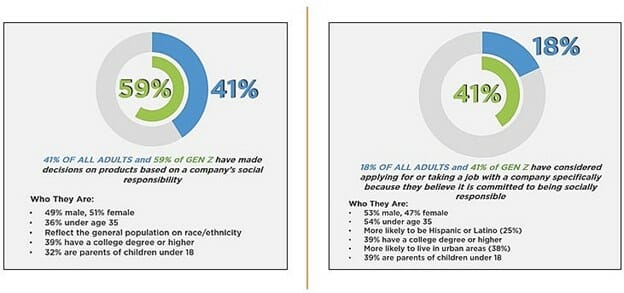
Business, organizations, and governments must prepare to meet this generation’s high expectations for social responsibility. Not only is Gen Z the most likely to have decided about purchasing a product based on a company’s social responsibility, but they are also most likely to consider a company’s social responsibility when applying for or accepting jobs. Businesses stand to lose both customers and talent without robust civic engagement and social responsibility.
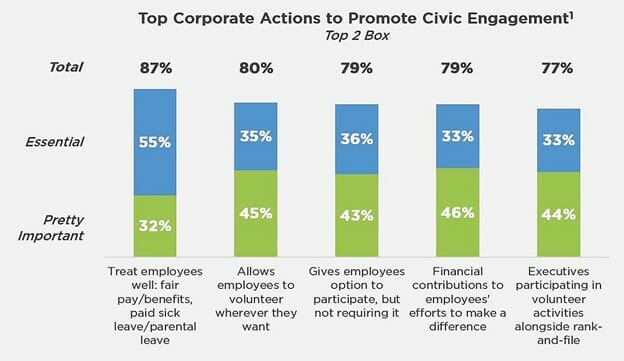
But, what does robust corporate civic engagement and social responsibility look like? In today’s age of corporate social justice, employee welfare and empowerment are top priorities as presented in the chart below. Providing opportunities for interested employees to volunteer in their communities, perhaps alongside top executives, and offering matches to employees’ donations of time and money are also important actions for any company that wants to promote civic engagement while also attracting and retaining talent and developing strong, positive relationships with their customers.
For 20 years, Edelman, a global communications firm, has studied the dynamic shifts in trust in the four major societal institutions: government, business, media and NGOs. The
indicates that 68% of respondents agree that companies can take actions that both increase profits and improve conditions where they operate. There is no longer any doubt that doing good can help a company do well – and this “if-then” statement is a clarion call to all business leaders.
4 Ways to Make Volunteering More Inclusive for All Abilities
Throughout October, we recognize the opportunity for all people in all walks of life to give back. This month is Disability Employment Awareness Month, and also recognizes Invisible Disabilities Week, so there is no better time to highlight how every person should have the opportunity to use their talents to volunteer.
Small and strategic changes to how programs are run can produce substantial positive impacts for organizations, volunteers, and the people they aim to serve. Organizations can significantly benefit from hearing new ideas and solutions from fresh perspectives, understanding challenges faced by other individuals, and increasing confidence in the community by showing an accurate representation of themselves. Moreover, diversity in volunteers will inevitably make a program more sustainable with a significantly broader pool of potential volunteers. By being more inclusive, every person can have the opportunity to give back and allow their unique talents and abilities to shine.
Having an inclusive volunteering program may also better reflect a demographic that an organization is hoping to serve, which will provide more insight into the program’s needs, actions, and aims. There is a
, which provides support and advice for voluntary and charity organizations, found that individuals with different abilities and those needing extra assistance are 7% less likely to volunteer than people with no disability. Unfortunately, many people who require additional support are excluded from contributing to volunteer efforts because of a lack of opportunity and access barriers. Ask yourself what barriers your organization faces – is the volunteer space handicap accessible? Does the project require full mobility or sensory input? Then ask yourself and your team how you can solve them.
Offer mentorship support
The individualized needs of people with different abilities may be easier to tackle by providing a dedicated point of contact within the volunteer organization. This mentor can provide support from the recruitment stage through the induction process and be available for regular check-ins on an on-going basis. By nurturing open dialogue between a mentor and volunteer, any specific additional needs that may arise can be more quickly overcome in confidence with the least amount of bureaucracy.
Focus on the individual
There is a lack of publicly available information regarding what support people with different abilities require to volunteer. However, every person’s abilities are unique, and as such, there cannot be a one-size-fits-all method for engagement and facilitation of more inclusive volunteer programs. By embracing a person-centered attitude and helping remove the barriers faced by each person involved, it is easier to move forward in a positive direction and adjust where needed.
Prioritize investing in inclusivity
There are a variety of benefits that inclusive volunteering can have for the organization, the volunteer and the community. Volunteer organizations need to
so that the skills, resources, time, and experience is available to provide people with additional needs the opportunity to volunteer. Being a functional, inclusive volunteer program is easily attainable if all organization levels are committed to it.
There’s Still Time to Get Involved on Election Day
Civic Alliance x Points of Light Election Day of Service Toolkit
At Points of Light, we join our friends and partners at
in the shared belief that every individual should be able to live their most civically engaged life, and voting is a main component of that. In fact, in Points of Light’s recent civic engagement research, 78% of respondents said post COVID-19, voting will be more important than ever.
But with less than a month to the election, many are wondering if there are still times to get involved. Good news – in addition to actually voting, there are still ways you can engage and help get others involved.
Below find individual and community-oriented volunteer opportunities as well as volunteer opportunities with local, nonpartisan nonprofits.
is recruiting poll workers to ensure a safe, fair election for all voters. They are focused on recruiting healthy, low-risk candidates to ensure that those workers most susceptible to the coronavirus are given the space to take care of their health, while still keeping polling sites open and available for efficient in-person voting.
There are many kinds of jobs for poll workers to do, including helping voters maintain physical distance in lines, wiping down machines and equipment, and helping voters check in, understand their ballots, and cast their vote. With absentee and mail voting, poll workers also help open and count mailed ballots. Some jurisdictions may already be filled, but you can reach out and find out where there is a need.
is currently recruiting volunteers in a number of states across the country to help voters in 2020. Election Protection – led by the Lawyers’ Committee for Civil Rights Under Law – is the nation’s largest nonpartisan voter protection coalition.
Through the 866-OUR-VOTE hotline and their voter assistance field program, Election Protection helps ensure eligible voters are able to participate in our democracy while collecting data for meaningful reform so that elections are free, fair, and accessible.
letter-writing program is currently targeted towards voters in Florida, Georgia and Wisconsin who are likely to have voter ID and voting-related questions. Volunteers are provided scripts, voter lists and a VoteRiders’ letterhead template. Current plans also include a fun and productive Zoom letter-writing party co-hosted by the “Hamilton” cast & crew, along with numerous independent letter-writing parties.
is running a robust nonpartisan peer-to-peer texting program that will help voters register and make a plan to vote. The texting takes place during 2-hour evening sessions. Volunteers can sign up for existing sessions or, if there is interest within a company, HeadCount can set up a specially scheduled session for the team.
Volunteers are needed to participate in a mix of different types of phone-banking, such as: calling voters who have indicated they are, or may be, in need of voter ID assistance; calling voters likely to have voting questions calling organizations that may be interested in using
Individual and community-oriented volunteer opportunities
Babysitting
Offer to babysit the little ones at home if your family member or friend needs the support to vote or would like to volunteer as a poll worker during early vote or onElection Day. By babysitting, you are making it possible for a parent to participate by voting and/or serving this year!
Dog walking
If your friend or neighbor is volunteering as a poll worker this election season, they might be working long hours from opening to closing. Consider dog walking for poll workers — or also a voter on Election Day waiting in a long line!
Host a bake sale to raise funds
Love to bake? Host a classic bake sale (or socially distanced lemonade stand!) to raise funds for the nonprofit organization of your choice or for a candidate or campaign you’d like to see win the election! This year it is important to individually wrap your items.
Bring supplies to the long lines
Long lines are to be expected on Election Day this year. Consider bringing masks and hand sanitizers to encourage everyone’s health and safety. Bring water bottles or individually packaged snacks to your local polling location and serve voters waiting in line! Have a skill? Consider sharing it at the polls – dance, play guitar, do yoyo tricks.
Pizza to the Polls
We could also encourage people to report long voting lines through
Some counties only have one dropbox, and/or a polling location may be a bit further this year. If you are healthy and able, offer to drive a family member or neighbor to vote. Remember, many states offer early voting, so you may not have to wait until November 3 to do this good deed!
Keep friends informed with social media
Early voting locations/hours, election day voting locations/hours, and ballot dropoff locations vary from state to state and county to county. Share
to help neighbors print voting materials in states where needed and boost voter registration. The Voter Help Map calls on Nextdoor members who own a home printer to add themselves to the map with an offer to print voting materials for others.
Take time off from work
Talk to your employer early if you need to ask for time off or schedule flexibility to vote early or on election day. Many employers as part of the
campaign have committed time off for their employees to vote.
Witness ballots
There are still several states that require absentee ballot voters to have a witness participate. Often a witness may be asked to give their name or signature on a voter’s ballot. Offer to be a witness so that your neighbor can successfully submit their ballot according to your state laws.
5 More Reasons Why You Should Present at the 2021 Points of Light Conference
Alissa May
Does the word “conference” carry a very different meaning for you now? I know it does for me in this new paradigm that we are all naviga
ting — our pandemic multi-layered crises world.
Though our world looks different, the conference, and sharing knowledge and ideas, feels more important than ever given our collective uncertainty, separation and isolation. T
his year’s hybrid event will include both in person and virtual experiences, but at t
he heart of the Points of Light Conference is the idea that people with purpose come together to multiply their impact across the world.
Here are fiv
e reasons why we should all consider presenting at the 2021 Points of Light Conference, taking place July 14-16, 2021, virtually and in person, with live sessions occurring at Disney’s Coronado Springs Resort in Orlando, Florida.
Kick down and lift up.
For those of us that have been around for a bit, we tend to accumulate knowledge and forget to share it with others. Presenting is a wonderful opportunity to reflect on best practices and partnerships and
kick it down
to those that are earlier in their career, in a different industry, looking to transition, or just plain curious. This is also an opportunity to
lift others up
and present alongside our community partners who truly appreciate the opportunity for increased visibility for their amazing work and programming. At the 2019 Points of Light Conference held in St. Paul, I presented in partnership with the wonderful
on high impact virtual volunteering. Who could have even known the relevance of this type of work back then?! HOT has experienced exponential growth since then, and sharing a platform with others enables growth and reach that you couldn’t even imagine.
Flex ever-important presentation skills.
Raise your hand if you’ve asked yourself over the past 500 months in quarantine, how am I showing up in my presentations on my webcam? You certainly wouldn’t be the first. Granted, engaging audiences in person and virtually have their unique challenges and solutions. That aside, in the world of social impact you have to be able to tell a compelling story and sell your position whether it is in front of a webcam or on the main stage in front of hundreds. We must
flex our presentation skills
often and presenting at a conference is a great way to force that and build those strong muscles.
Hone your craft.
You will have many eyes looking to you as the subject matter expert, hungry to learn from your experience. This is a time to reflect on your work and bring into focus the best practices you’ve picked up along the way. You’d be amazed when you are forced to fill in that presenter application (due October 16, by the way), how much you have to
hone your craft
and shape your content while critically analyzing the pieces that will be most relevant to others.
Learn…period.
Having presented for two years, I
always
learn something new. Whether it is something about myself, my work or the industry, there is always a kernel or seven that I gain. If you are looking to grow, presenting is one of the best ways to make that happen. We are all grappling with subject areas that are extremely sensitive and difficult right now. Tackle one head on and the learning and growth will follow.
Exercise your EQ.
I’ve found that presenting helps me to
exercise my EQ.
EQ includes recognizing your strengths and weaknesses and having self-confidence. EQ also encompasses social awareness – you have empathy. You can understand the emotions, needs and concerns of your audience and pick up on emotional cues. Just like flexing your presentation skill muscle, this is another hard to reach muscle that doesn’t get enough work for me. With tiny square picture thumbnails in the virtual space or attendees shifting in their seats and checking their phones in person, presenting offers you the opportunity to look for those cues, have empathy, course correct and recapture the energy in the “room.”
I hope you will consider joining me in submitting your application to present for this year’s conference, and in the process, experience one, two or all five of the above.
Alissa May is Senior Manager, Employee Volunteerism at Salesforce,
Civic Engagement: What We Know, What We’re Learning, and What Comes Next
A few months ago, I was invited to listen to an online conversation between two professionals entitled “What I’m Learning.” The panelists were captivating, but it was the title of the discussion that caught my attention. During this global pandemic and time-out of our regular routines, we are all learning more about ourselves, each other, and the world around us.
Perhaps the quote by American poet Maya Angelou, “I did then what I knew how to do. Now that I know better, I do better,” perfectly captures the essence of learning, reflection, and action.
At Points of Light, we believe the most powerful force of change in our world is the individual. One who is informed, inspired, and equipped to take action.
So when Points of Light and our partners
conducted a study this spring, with generous support from AT&T, aimed at understanding Americans’ attitudes, behaviors, barriers and motivations around civic engagement, I was delighted and encouraged by the data.
looks at the current state of civic engagement, reveals a universal desire to do more, and sheds light on how we can convert good intentions into positive action. Here’s a glimpse of what we found:
Civic Life Will Become More Important Than Ever
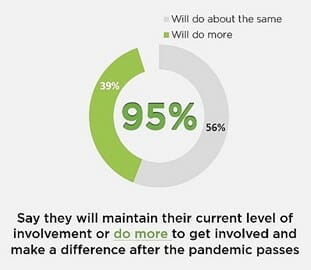
We surveyed more than 1400 adults of every generation from the silent generation to Gen Z. We heard that after the pandemic passes, 95% of respondents said they will maintain their current level of involvement or do more to get involved and make a difference. More than three-quarters (78%) cited voting as an important action they intend to take; 75% said they would donate to nonprofits; 73% said they’d volunteer; and 60% said they intended to contact government leaders or advocacy groups.
Further, 82% of respondents said they believe we must all get involved to rebuild our communities and country, with 66% saying that the coronavirus will have a long-lasting, positive impact on our collective consideration for others and our willingness to get involved in making a difference.
My favorite part: Half of all Gen Z respondents (loosely defined as those born in the late 1990s and afterward) said they will do more to get involved after the pandemic than they did before; and this cohort already reported the highest levels of civic engagement across any other age group.
Gen Z Isn’t Going to Accept What We’re Handing Them
Speaking of Gen Z, this is a generation that simply isn’t going to accept the world as it is today. As is evident from the research, they are an active, action-oriented group. Nearly 40% of Gen Z respondents reported participating in five or more civic engagement activities in the last year – and this was in May – before the killing of George Floyd and the demonstrations against police brutality and systemic racism in this country.
What this shows us is that the open questions that we’ve let linger as a society – on race, social justice, the environment, and mental health – are questions that they will not allow to persist any longer. This generation sees societal change as a team sport, and they’re participating in greater numbers and with greater frequency than any other demographic.
They also expect action from the companies with which they do business. While 41% of all adults say they have made purchase decisions based on a company’s social responsibility, nearly 60% of Gen Z respondents have, and they know that the enormous purchase power they yield (
) is an asset that they can use to affect change.
The generation coming of age right now is not a “wait and see” generation; they’re a “let’s get it done” one. They don’t wait for hierarchies; they start where they are with what they have. They’ve witnessed a reckoning in their country – and they’re proving they’re a force to be reckoned with.
Community Is Queen
Our research also revealed that more than half (55%) of people say they want to focus on issues impacting their communities. People crave local opportunities that let them interact with those who are benefitting – safely, of course, given the pandemic. This aligns with the recent
study, which reported that 64% of respondents believe that the pandemic “will lead to changes for the better in how we live, work and treat each other as people.”
Let’s hope so.
In the last year, 28% of respondents reported volunteering, yet an additional 32% said that while they had not volunteered in the last year, they were interested in doing so. That’s 60% of all respondents interested in getting involved in their communities in some fashion.
Imagine if it actually happens.
All of these indicators provide clarity that civic engagement is becoming more important than ever, Gen Z is changing the game, and there is a hyper-local focus on service. It shows us that people are more aware that the actions they take have enormous power to affect change.
It seems that even now, Maya Angelou’s words above can apply to all of us and our engagement in civic life. Each of us has power and light within us – let’s use it for good.
Natalye Paquin was the president and chief executive officer of Points of Light from 2017–2022.
She is a visionary and results-oriented leader, with more than 20 years of experience providing strategic, operations and fiscal leadership in the nonprofit and public sectors.
5 Reasons Why You Should Present at the 2021 Points of Light Conference
Sue Carter Kahl
It’s that time of year—school is (sort of) back in session, pumpkin muffins are popping up everywhere, and Points of Light is seeking presenters for the 2021 Points of Light Conference, scheduled for July 14-16. This year’s hybrid event will include in person and virtual experiences, with live sessions occurring at Disney’s Coronado Springs Resort in Orlando, Florida, and online sessions for a virtual audience. As a past presenter, I am sharing a few reasons why I am submitting a proposal this year, and why you should, too.
You (and I) have something to say.
Sometimes I question what I can add to the conversation on volunteerism. What’s so special about my voice among a lineup of “experts”? Yet that is the beauty of our field: individuals who take our experiences and observations about community engagement—and translate it into insight, solutions and hope. No one else can deliver the message that is yours or mine to share. If we don’t share it, no one will.
Someone needs to hear what we have to say.
Have you ever been to a conference session where the presenter said something that lit you up, made you want to shout (or tweet) “yes!” to their message because it was so on target, or left you feeling deeply seen? That is the power of connecting the right message with the right audience. Someone is waiting to hear that message from you.
Presenting helps create meaning of our work.
I’m a Crock-pot in an Instant Pot world. I have to marinate in ideas to sort out what I know and what is still emerging. Crafting a presentation allows me to be in crock-pot mode and explore the rich stew that comes from simmering in this bit of research or that meaningful project. It also challenges me to figure out how to share what I am learning so others can apply and learn from it, too.
Co-creating enriches your thinking.
I’m an introvert who loves to noodle through problems on my own. Yet, there is no denying that my ideas and practices improve when I work through them in community. Points of Light Conference attendees are smart and engaging collaborators. The participants in each session I have facilitated have helped me clarify and refine my work. Our field is all about engagement—this is a chance to walk our talk about connecting with others to co-create a better future for us all.
Effecting positive change is a team effort.
My vision is to help leaders see volunteerism as a powerful strategy to advance their missions and engage their communities. I know this vision is possible when we frame and invest in service in meaningful ways. However, there is only so much I can do on my own. Presenting at the Points of Light Conference allows me to add my voice to a larger movement, meet co-conspirators for the common good, and join efforts with others who are committed to our communities.
I’m looking forward to attending next year’s conference and hearing the message that only you can share.
Sue Carter Kahl is president of Sue Carter Kahl Consulting, and a past Points of Light Conference presenter.
Co-Authored by Interns 4-Good and Volunteer New York!
It has never been easier than right now to find an engaging and meaningful volunteer opportunity – especially if you’re able to volunteer remotely.
Around the world as nonprofit organizations look for ways to adapt and continue to make a difference in a post COVID-19 reality, they have increasingly been turning to technology to deliver their mission and connect with volunteers using innovative and creative solutions. At Volunteer New York!, a regional volunteer connector organization serving the suburban counties just north of New York City, there has been a 92% increase in volunteer signups since March 2020. When compared to the same time period last year, people have been raising their hands to help now more than ever!
“Several of the opportunities for literacy and tutoring programs that were listed on our website have been so popular that we had to be taken down within days of posting due to so many requests to volunteer,” said Katie Pfiefer, senior director of programs, Volunteer New York!
Since September is National Literacy Month, here are a few examples of nonprofits offering unique remote volunteering opportunities to be mentors, tutors, and readers that we hope might inspire you:
The Pajama Program: a national organization with multiple chapters whose mission is to promote and support health sleep and bedtime routines for children, has come up with ability to let volunteers host Virtual Reading Parties for Kids as a way to spark the imagination of children and bring communities together during COVID-19.
Quarantine Tutors: an organization founded by students for students as a result of this pandemic after they saw a need to help those who were experiencing challenges with remote e-learning. Their opportunity for volunteers (who face a stringent screening process) to become Virtual Tutors relies on using Zoom, FaceTime or Google Meet.
Another great example of how established nonprofits are adapting is the organization JCY-Westchester Community Partners. They have come up with a specialized eTutor Program specifically to match volunteer mentors to help students with their assignments remotely.
One standout organization that is leading the way to advance opportunity and education for teens while embracing technology is Interns 4-Good, which was founded by a Westchester high school student, Ellie Zimmerman. Check out what this innovative organization is up to in Ellie’s own words:
Interns 4-Good is a 501(3)(c) organization that connects teens with remote, skill-based internship opportunities at nonprofit organizations. Initially, I created the organization to allow high schoolers to utilize their skills and build their resumes while providing nonprofits with much-needed support. The nonprofits we work with serve causes ranging from health care to the education system. In response to COVID-19, Interns 4-Good mobilized its network of talented volunteers to help students in underserved communities with the transition to online learning. We set up a Zoom hotline to support teachers in navigating unfamiliar technology. Our volunteers also began tutoring lower and middle school students. When summer rolled around, we shifted gears to create fun summer enrichment programs and a virtual camp. To date, over 600 students have benefited from these services.
However, there are many students who do not have access to the technology needed for online learning. During this critical developmental time in many students’ learning careers, there is an immediate need for help. There are hundreds of students in need of electronic devices in order to benefit from our tutoring services and, more importantly, to participate in online learning.
Thanks to a grant from Points of Light, Interns 4-Good is planning to purchase refurbished tablets for these students. Our membership with TechSoup, a nonprofit technology marketplace, will allow us to obtain these tablets at discounted rates as low as $20. After securing the tablets, we will then follow up with a tutor to provide free homework help throughout the school year.
With thanks to resilient nonprofits and the amazing leadership of young changemakers like Ellie, there are more opportunities to make a difference with your time from the safety of your home. And there has never been a more important time than now to get off the sidelines and get started. To find volunteer opportunities near you, visit pointsoflight.org/volunteer to search the listings of hundreds of volunteer connector organizations around the globe!
A Global Youth Movement: Taking Action to Change the World
This is the second blog of a two-part series featuring Daily Point of Light honorees Shreyaa and Esha Venkat of Ashburn, Virginia, US and UK Point of Light Award honorees Amy and Ella Meek, of England, in a discussion around youth activism.
These incredible young women all speak at our 2020 Youth Summit, which inspires youth ages 13-18 to continue improving their communities and giving back. Register now to join us on Aug. 19.
As young people, you’ve all used school as a basis for your programs and also a place for support. Tell us more about that.
Amy and Ella:
Getting your school involved is also a great way to build support for your cause or campaign. At school, in normal times at least, you have easy access to a large number of young people your age to get on board. Plus, you’ll often find that your teachers are more than happy to help you with your mission, so doing talks to your tutor group (or homeroom) is a good way to develop your skills and get more confident speaking to an audience.
More often than not, you may find that the issue you’re passionate about tackling relates directly to your school as well. For example, our school used a lot of plastic in the canteen (such as plastic bottled water, and plastic cutlery). Schools aren’t small, and 1000+ students using, for example, a plastic fork every day for lunch can quickly add up, and so swapping these out for reusable cutlery can have a large positive impact. So, working with your school on the issue you’re campaigning against (be it plastic pollution, food waste, or period poverty) can help you make a big positive difference in a relatively short period of time.
Shreyaa and Esha:
Inclusive, good-quality education is the foundation for dynamic and equitable societies. After witnessing the transformative effects of continued education in our own community, we set our sights on providing quality education and leadership & mentoring services for vulnerable students worldwide through NEST Tutors, our free virtual tutoring program, and NEST Inspires, our leadership program! We’ve impacted kids in 32+ schools and have over 250 high school and college mentors. Also, we’ve donated 10,000+ books to underprivileged kids worldwide! By forging global partnerships with organizations in Zambia, India, and Vietnam, we help underprivileged students achieve academic success while contributing to the Sustainable Development Goals.
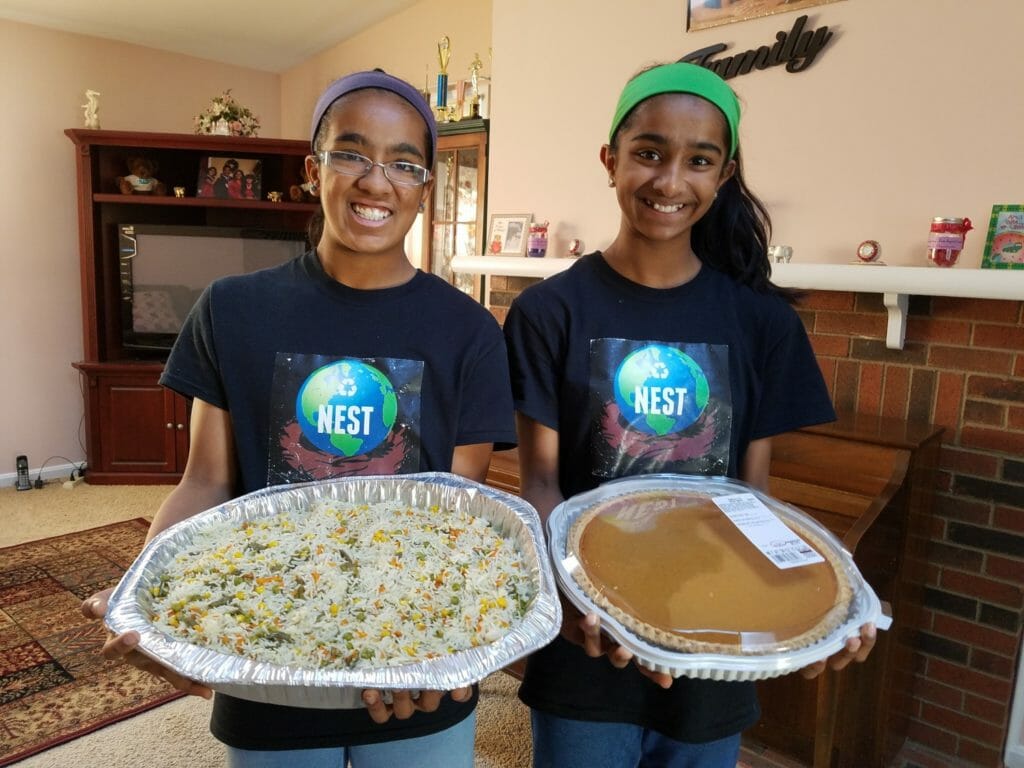
Shreyaa and Esha Venkat preparing meals for delivery in 2019.
How do maintain financial support for your organizations to continue running?
Amy and Ella:
If you’re looking to grow your campaign onto an even larger scale, financial support can be really useful. There are lots of grants available for youth-led organisations, but they’re certainly competitive. If you are keen to apply for some, make sure you have a clear focus of what you’d like to achieve with the funding you get – the more specific, the better. Also make sure you have targets in place for the future, as the last thing organisations or people offering funding is to see the impact fizzle out once the funding has stopped – they like longevity and for campaigns to become self-sustaining.
We’d definitely recommend getting your parents or carers to help you with this where possible – any extra experience with money and budgeting can be helpful, and some grants are only open to those 18+.
Shreyaa and Esha:
In the beginning, the biggest barrier NEST4US has faced has been getting adequate financial resources. Since we’re a teen-led organization, we were self-funding and relying on in-kind donations, community support, and mini-grants from local business partners to run our programs efficiently. As we developed NEST4US, we began receiving tremendous financial support, partnerships, and networking opportunities from corporate businesses and other organizations. We believe strongly in the power of collaboration and are continually forging partnerships with other nonprofits to find new and innovative ways to help those in need.
What are some final thoughts you have for youth who want to get involved?
Amy and Ella:
Don’t give up. Your cause is worth fighting for.
Shreyaa and Esha:
Finding a cause you’re passionate about helping and then spreading awareness about it is the first step towards getting more involved in your community. According to us, EVERYONE has the power to make a difference!
A Global Youth Movement: How Small Ideas Can Spark Big Change
This is the first blog of a two-part series featuring Daily Point of Light honorees Shreyaa and Esha Venkat of Ashburn, Virginia, US and UK Point of Light Award honorees Amy and Ella Meek, of England, in a discussion around youth activism.
These incredible young women all speak at our 2020 Youth Summit, which inspires youth ages 13-18 to continue improving their communities and giving back. Register now to join us on Aug. 19.
Tell us how you got started.
Shreyaa and Esha
: We started out volunteering together – helping at school, the library, and community events. However, we really wanted to get our friends and community involved, so we formed NEST4US, a nonprofit that provides volunteer solutions to the community to make the world better through kindness.
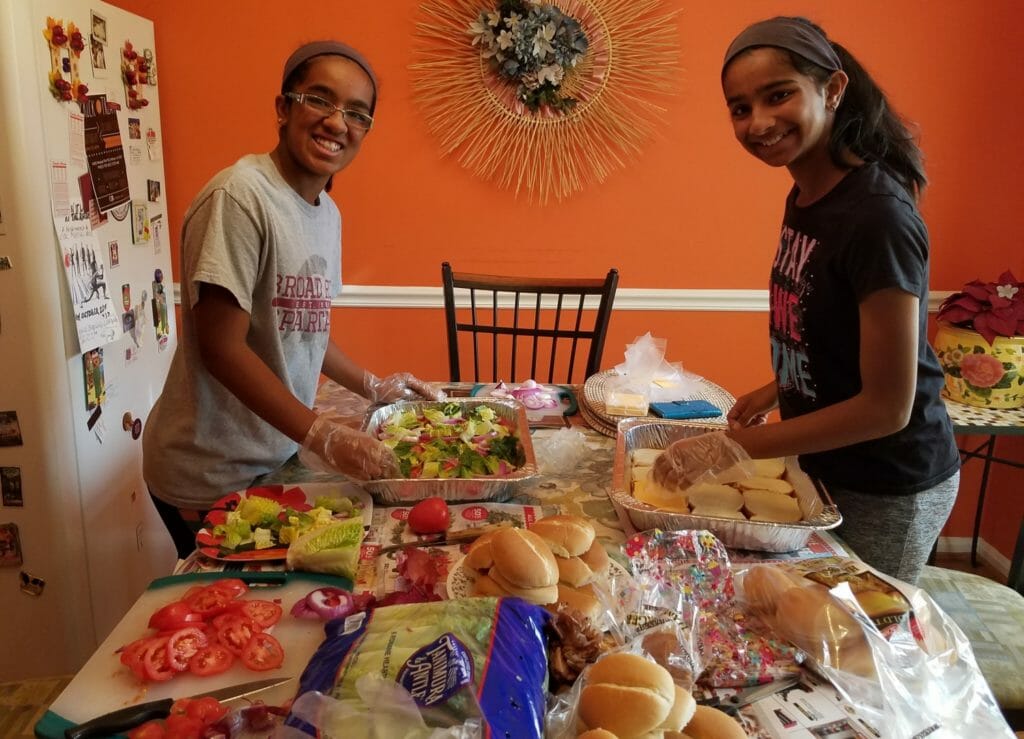
Shreyaa (left) and Esha (right) Venkat prepare food to bring to a local shelter.
Amy and Ella
: We first started our charity, Kids Against Plastic, back in 2016 as a youth social action campaign after studying the UN’s Sustainable Development Goals and discovering the devastating impact that human’s use of disposable plastic is having on the environment. This was a few years back, and plastic pollution was far from the well-publicized issue it is today.
Amy and Ella Meek, founders of Kids Against Plastic.
Once you had your idea in mind, what were the next steps you took? How did you know where to start?
Shreyaa and Esha
: Initially, we noticed three key issues in our community that we wanted to tackle—food insecurity, the lack of volunteering with a passion, and diversity and inclusion. When we started volunteering, we noticed so many homeless people who didn’t have access to food. We also noticed that so much food goes to waste daily in our community. So, homeless people and food waste. We put two and two together and decided that our first program, NEST Nurtures, should focus on reducing food waste and feeding the hungry.
Amy and Ella
: One of the hardest parts about campaigning is certainly getting started, as the issues facing our world can feel so immense that it’s hard to know where to start. When we first started taking action with Kids Against Plastic, we began litter picking. We set ourselves the rather ambitious goal of picking up 100,000 pieces of plastic litter (one for every sea mammal allegedly killed by plastic in the oceans every year), grabbed some litter pickers and bags, and got to work. It allowed us to do something immediate instead of putting off action until the future, while still having a positive impact on the environment we were in.
What were some of the initial challenges you faced?
Shreyaa and Esha
: After we established NEST4US, we began to witness discrimination based on age, as many organizations doubted the ability of youth to make a true difference in the community. After all, we were only 13 and 10 years old, how could we make an impact? Also, most people do community service solely for hours or other incentives, which we believe defeats the purpose.
Amy and Ella
: When we first founded Kids Against Plastic, we set ourselves the target of getting plastic bottled water off UK supermarket shelves. After resistance from supermarkets, we realised that we needed to change our focus to driving consumer demand for more eco-friendly alternatives before trying to change large corporations. It’s important to bear in mind that you will get pushbacks like this when getting involved in youth activism, especially at the start of your work. Activism is a lot of trial and error, and a plan can and will fall into place as you progress and mature. The key thing to remember is to stay passionate, stay motivated and to start.
How did you start getting others involved in your work?
Amy and Ella
: We found that the best way to engage people with your cause is to give them a simple thing that they can do to get involved – a tangible action that they can take to make a difference. You see, often, people do care or empathise with the issue that you’re passionate about tackling, but it can be hard for them to know where to go or what to do to help.
For us, with our charity Kids Against Plastic, we helped people get involved through our Plastic Clever scheme. With so many products we all by and use daily wrapped in plastic, it’s hard for people to see how they can consume less plastic and make a difference, never mind become the virtually impossible and impractical ‘plastic free’. So, through the Plastic Clever initiative, we encourage people to take that first step to reduce their usage of plastic by stopping their use of four main items: plastic cups and lids, straws, bottles, and bags.
Shreyaa and Esha
: We decided to provide a variety of programs that allow people of all ages to give back by doing something that interests them. Through social media platforms, we serve as advocates for positive change in the community and promote diversity and inclusion by welcoming people of all backgrounds to our volunteer family. In just four years, NEST4US has grown from a small project to an impactful organization with over 1,000 volunteers, ranging from ages 4-70.
In part two of the series, Shreyaa, Esha, Amy and Ella will share how they sustain their work, places for support, and other thoughts for youth to get involved.