The following is an excerpt of “The Civic 50: Best Practices in Corporate Community Engagement,” by Yvonne Siu Turner, senior manager of corporate resources and programs at Points of Light, published byThe Conference Board. You can read the full version here.
Data from The Civic 50 – a Points of Light initiative that recognizes the 50 most community-minded companies in the nation – suggest we’re living in a world in which companies increasingly play a positive role in meeting community needs, through the power of their people and the power of their financial contributions.
Four strengths of The Civic 50, presented below, suggest companies are expanding and deepening their involvement in their communities by strategically integrating community engagement into their business strategies.
HP, for example, has data showing that employees who participate in community engagement efforts have 13 percent higher morale than those who don’t participate. Similarly, Hasbro’s employee survey revealed that the second-most referenced reason employees “love working at Hasbro” is the community engagement program, behind “year-round half-day Fridays.”
Companies and communities find value in skills-based volunteering
Skills-based volunteering continues to grow at Civic 50 companies, and, on average, one out of every five employee volunteer hours at Civic 50 companies is skills-based. Moreover, approximately 50 percent of companies offered pro bono service opportunities in 2013.
Skills-based volunteering provides communities with valuable, specialized support that can provide five times greater value than traditional volunteering, according to True Impact and the Bureau of Labor Statistics.
Two-thirds of Raytheon’s employees are engineers who use their skills to support communities through mentoring programs, including Stand & Deliver, Math Nights, and LASER – part of a nationwide effort to connect students with some of the world’s foremost engineers and business leaders.
Companies raise their voice to advance social change
Just over 80 percent of Civic 50 companies have taken a national leadership position on a social issue like ending hunger, texting and driving, and strengthening STEM (science, technology, engineering and math) education. Many companies invest in issues related to their own operations and are, therefore, often in a unique position to contribute lasting solutions.
Through the provision of health care solutions to the U.S. population, Aetna has significant experience with the effects of inequality in health care and has subsequently taken a leadership role in addressing these inequalities.
In 2002, for example, Aetna developed a policy on genetic testing and nondiscrimination that became the model for the industry.
In 2008, it worked with legislators to help pass a more meaningful mental-health parity law that allows for better coordination of coverage for physical and mental health care services. Aetna was an active voice throughout the health care reform debate of 2009 and 2010.
Purpose is aligned with profit
Research shows that solid business performance often accrues to companies that engage with their community.
For example, Harvard Business School found that companies with more community engagement practices significantly outperform their counterparts over the long-term, in terms of both stock market and accounting performance.
And market research has revealed that 56 percent of Americans will travel an extra 10 minutes out of their way to purchase a product that supports a cause they care about and that 71 percent are willing to pay more for that product.
More than 80 percent of Civic 50 companies integrate their community engagement into at least one of three business areas: marketing, skill development, and diversity and inclusion.
Whether they’re in the communications, technology or materials sector, Civic 50 companies have increased the impact of their community engagement by deepening the involvement of their employees, business units and other aspects of their operations.
Civic 50 companies are building and sustaining vibrant communities and tackling social challenges with greater seriousness than ever.
Prepare Your Family for Disaster and You Could Win a Prize
Disasters affect every community. Are you Good & Ready should something happen to yours?
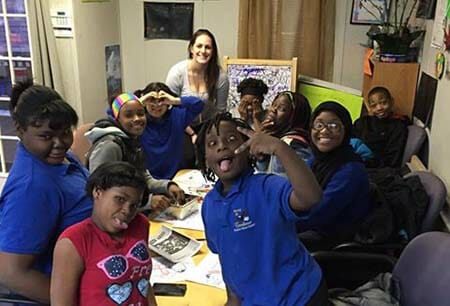
Young participants of a winter safety/home fire preparedness workshop ham it up for the camera at Ironbound Community Corporation Family Success Center in Newark, N.J.
Make a commitment to yourself and those you care about – pledge to be prepared. Let us know what you plan to do to get prepared, and share your pledge with others, encouraging them to take action, too.
Good & Ready, a Points of Light program, offers a host of resources that can help you get started. Here are some ideas:
Connect with local alerts and warning. There are several apps that provide weather notifications and emergency alerts. The American Red Cross has a series of apps for mobile devices that are hazards specific and provide real time updates during a disaster. To see what Red Cross apps are available for hazards specific to your area, visit www.redcross.org.
You’ll find the Good & Ready pledge form here. Good & Ready, a Points of Light program, offers a host of resources for getting prepared for disasters and emergencies.
If you take the pledge in April, you’ll automatically be entered in drawings for prizes. Daily winners each will receive a $5 Target gift card. Weekly winners each will receive a hand-cranked flashlight radio. All who pledge in April will be eligible for one of five LG Nexus 5 phones.
. Representatives from 60 of the nation’s largest companies gathered to share lessons from and leadership of the corporate volunteer service movement.
The topics and issues discussed ranged from how to expand global volunteerism to increasing the impact of service projects that can be done in a single day. Over a meal we call
more than 100 corporate social responsibility professionals talked about how to increase racial and cultural understanding and promote unity.
Starbucks – a leader of the Corporate Service Council since its founding 10 years ago – was never far from anyone’s mind. When dealing with the toughest social problems, has the risk of doing anything become too great?
The final speaker of the meeting may have provided the answer. Harvard social scientist
– shared his research on the growing inequality of opportunity for America’s poorest children.
When it comes to college completion, one of the most important markers of success and opportunity, Putnam told us the class gap is steadily expanding. Eighty percent of kids in the highest income quartile will graduate from college, compared to 10 percent of kids from the lowest quartile. High school students who are involved in extracurricular activities are 400 percent more likely go to college than those who aren’t.
Yet American high schools with affluent students offer twice as many team sports as high-poverty schools, and more than twice as many non-sports activities like band and chess club. With many schools charging families for extracurricular activities, placing them out of reach for the students who need them most, we should not be surprised by the outcome.
Children growing up in poverty today are increasingly isolated by what Putnam called “the savvy gap.” Better educated and wealthy Americans have wider and deeper social networks that help kids navigate school choices, college admissions, employment and even health issues. And while most well-off children place their trust in adults, six out of seven poor kids do not.
As Putnam spoke, using statistics and stories to show that the American dream is slipping increasingly out of reach for kids from low-income families, I thought back to #RaceTogether.
As with the critical and complex issue of race relations, standing on the sidelines while our kids are being hurt by everything from the cost of extracurriculars to the lack of mentors to the scourge of racism is simply not an option. All of us – individuals, companies and communities – need to be
more
engaged in the future of our kids and country, not less.
Thank you, Starbucks, for doing something and paying the price. The cost of doing nothing is far too high, for us and for our kids. And if Starbucks wants to continue a national conversation, count me in.
Starting Young – Middle School Students Become Seasoned Volunteers
are growing quiet. However, three students aren’t part of the stampede of their peers racing for the exits.
They’re in a classroom on the second floor, making phone calls to local business owners to enlist help in putting on a pancake breakfast for families staying at the
.
These are the students of United Way for Greater Austin’s Volunteer Project Leaders (VPL) program, and this isn’t their first rodeo.
The kids in the VPL program at Webb have been conducting volunteer projects to help out around their community since the program’s inception four years ago.
They’ve organized and led campus cleanups, campaigns to gather thank-you notes for school librarians, community needs assessments, and a host of other initiatives designed to encourage their classmates and neighbors to give back to their community.
While the idea of middle school students dedicating so much of their free time to philanthropic projects may seem extraordinary to many, it’s a no-brainer to the VPL kids.
“What would you do if you just saw someone throwing trash around your neighborhood?” says LaDascious, an eighth grader who’s been a part of the program since he arrived at Webb Middle School.
He’s just left a voicemail for a manager at
, a frequent United Way of Greater Austin collaborator, asking for pancake mix donations and any helping hands they could provide.
Kids in the program get many opportunities to practice this sort of outreach, helping them to develop a set of communication and leadership skills that will be useful to them throughout their lives.
LaDascious believes being part of this group has taught him to think about people other than himself. According to Nikki Krueger, United Way of Greater Austin’s director of volunteer engagement, who oversees the program, that’s exactly the point.
Krueger believes that by providing students with the tools they need to create positive change in their communities at an early age, they’re instilling a “philanthropic gene” that will last a lifetime – and it seems to be working.
Kids at each of the three VPL programs LaDascious’ sentiments. Chrishana, another program participant, said because of the program, she now “look[s] at the world with a different viewpoint.” Her classmate, Jaylon, agreed, stating, “It has taught me how to be a better person.”
In total, the three chapters have empowered about 150 students to better both themselves and their communities. That’s a lot of young philanthropists, and
.
It’s now 4:30 p.m. at Webb Middle School, and after a long day of classes the kids have hit their limit. They sprint out of the room and down the stairs with that boundless, restless energy unique to middle school students.
It’s an energy they bring to everything they do – including volunteering – and, thanks to the VPL program, it’s an energy that’s helping make Austin greater.
A grumbling stomach. Headache. Hard time paying attention and focusing. Low energy and motivation. Poor academic performance.
This is hunger. Hunger is here, and it is hurting children.
Childhood hunger is a pressing concern in this country and around the world. In the U.S. alone, nearly 17 million kids are at risk of hunger, which is more than the populations of New York City, Los Angeles, and Chicago combined.
This is unacceptable. If our nation’s next generation is going to bed with empty stomachs, then what does mean for our future? The world’s future?
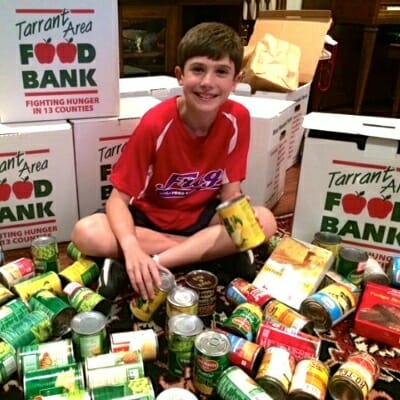
This is how I got involved and what I am doing to make my mark on hunger through service. When I was 7, I founded Friends Reaching Our Goals, FROGs. It’s a kid-run service organization with the mission of inspiring youth to make a positive difference in their community.
Our motto is: “Having Fun While Helping Others.” We design fun events to get kids involved in fighting hunger. These activities range from lemonade stands to laser tag parties to enormous baseball tournaments.
In order to participate in these fun events, kids make a monetary or food donation, which go to the local food bank. The kids have fun while helping others. They learn that there are children just like them in their community that don’t have enough food.
Our mission is to spread the message that hunger doesn’t discriminate. Hunger affects kids of every race, religion and education level.
Kids who are hungry are more likely to become sick, less likely to become productive citizens. Kids who do not have enough nutritious food don’t focus well in school, and their grades can stumble. Proper nutrition is critical to the physical and mental development of a child. It is critical to the future of the child and to the future of our nation.
This is what I am doing, but my challenge is for anyone reading this to step up to the plate and take action. It is simple to make an impact. All you need to do is: See a need, make a plan and change the world! In other words, look for a need or problem and then put your talent and efforts towards making an impact.
Over the last four years, FROGs has provided over 175,000 meals to the hungry, helped pack 50,000 backpacks with food for hungry kids and helped distribute meals to over 10,000 families through the mobile food pantry. Of all FROGs accomplishments, I am most proud of encouraging over 1,000 kids to join the fight against hunger.
Fighting hunger has affected my life and has inspired me to put an end to hunger. FROGs is fighting hunger this spring by participating in the generationOn Make Your Mark on Hunger youth service campaign. For every youth engaged in service March 15 through April 30, The ConAgra Foods Foundation will donate the monetary equivalent of one meal to Feeding America, up to 20,000 meals!
If we all pitch in just a little bit, we can destroy hunger for our country, for our world… for our future.
We all have the ability to make a mark on hunger. Join us! No matter how tall or how small you are, you can make a big difference!
Join Us Online to Learn the Best Ways to Serve After a Disaster
Have you ever wanted to help after a disaster? There are many ways to get involved – whether you have just one day to volunteer or can commit to a longer stint of service.
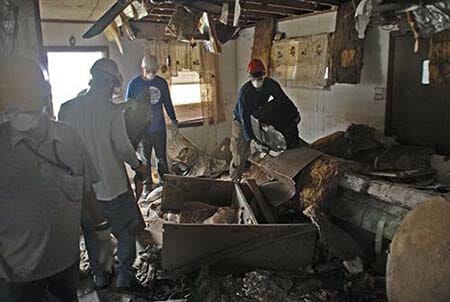
Volunteers remove debris from a house in New Orleans after Hurricane Katrina. (FEMA photo)
In 2005, Hurricane Katrina devastated coastal towns throughout the United States and caused mass evacuations. After the cameras left, residents were still picking up the pieces and reorganizing their lives.
In 2007, Cameron Lewis supported long-term recovery efforts by joining AmeriCorps NCCC (National Civilian Community Corps) for a 10-month term of service. During that time he traveled throughout the Gulf Coast region to support local recovery groups, rebuilding homes and providing education through the Red Cross Masters of Disaster program.
“This experience taught me the importance of becoming affiliated with an organization after a disaster and working through coordinated channels to rebuild communities,” said Lewis, now a program manager for disaster response and recovery at Points of Light.
Join us Tuesday, March 17, from 11 a.m. to noon Eastern, for a special discussion on Twitter about disaster volunteerism: #GoodandReady: Disaster Response and Recovery. Points of Light, HandsOn Network and national partners will answer your questions and share professional volunteer tips.
Follow along at #goodandready. Encourage your friends and families to join the conversation by sharing this message: “I’m joining #goodandready 3/17 at 11am ET to learn more about supporting disaster volunteer programs and so should you!” We look forward to chatting with you.
Giving Women Entrepreneurs a Place to Refine and Expand Their Civic-Minded Ideas
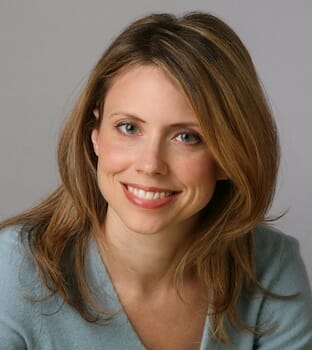
While serving as executive director of the NASCAR Foundation, Sandy Marshall noticed a worrying trend for girls. They are consistently left out of opportunities in science, technology, engineering and math, though emphasis within schools in these areas is growing.
Sandy Marshall
Recent research backs her observations. According to the
. Through summer camps, one-day programs and mentoring and volunteer opportunities for women and girls, Marshall is bringing like-minded girls together for education, mentoring and encouragement.
Just like she got from the Points of Light Civic Accelerator.
Since 2012, the Civic Accelerator has supported and invested in innovative, civic-minded social entrepreneurs, providing a rich curriculum in lean start-up methods, networking opportunities, as well as mentoring and coaching. The boot-camp-style program gives these leaders a place to test ideas in the early stages of their nonprofit or for-profit ventures, get sage advice from a range of experts, and recruit potential partners, investors and clients.
From the beginning, the
has been there – a founding sponsor of the accelerator and its largest, having invested $1.8 million in the program with PwC executives also participating on the Advisory Panel and selection committee for the cohorts, reviewing cohort applications, acting as mentors and coaches to some of the entrepreneurs and as faculty to the program.
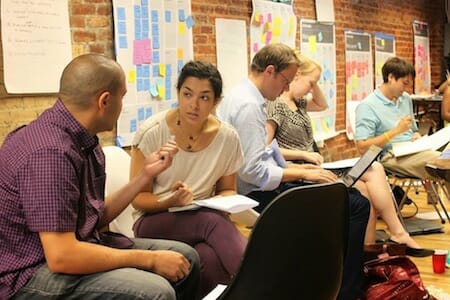
Laura Weidman-Powers, center, CEO and co-founder of Code2040, participates in a session of the Civic Accelerator.
– which honors women entrepreneurs globally, the Foundation deepened its commitment to the Civic Accelerator and to female entrepreneurship. That day at the United Nations, Shannon Schuyler, Principal and Corporate Responsibility leader at PwC and President of the PwC Charitable Foundation, and Ayesha Khanna, President of the Civic Accelerator, announced that the spring 2015 cohort of the Civic Accelerator would focus on women and girls.
The question posed to potential participants: How might we create greater opportunities for women and girls to succeed in today’s economy?
“We want to support entrepreneurs – most of whom will likely be women – who are leading breakthrough solutions to better enable women and girls to fully and successfully participate in our global economy,” Khanna said.
By design, the Civic Accelerator was created to attract and support diverse entrepreneurs, including women and minorities, as well as founders from various places, backgrounds and sectors. Out of 61 participating ventures since 2012, nearly half were founded by women. Half of the $500,000 awarded to date to accelerator graduates went to ventures founded or co-founded by women.
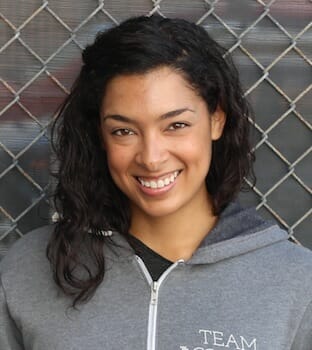
Laura Weidman-Powers
While more women are starting businesses at younger ages, more than 87 percent of top management posts in American companies are held by men, Schuyler said. By helping to support a community for these women leaders, Schuyler hopes to encourage even more women to step onto the entrepreneurial path.
“It is immensely important that women are not only given opportunities to lead social ventures, but that they understand that they have a very important seat at the table in solving the problems plaguing our world,” said Schuyler. “The business community has an extremely important role to play in helping pave pathways for women to embrace their innovative spirits.”
shares that sentiment. The San Francisco-based nonprofit works to increase the representation of African-Americans and Latinos in the technology sector through its fellowships for college- and graduate-level students and other programs.
The organization’s CEO and co-founder, Laura Weidman-Powers, said the Civic Accelerator connected her “with an inspiring group of fellow social entrepreneurs in a scenario where we weren’t just socializing or supporting one another but actively working to improve each other’s ventures.”
Weidman-Powers added, “It was an amazing opportunity to get honest feedback from smart folks who know that just because you don’t have something figured out now doesn’t mean you won’t down the line and who are willing to help you grow.”
Since launching Code2040, Weidman-Powers has appeared in
and on NPR. More than 1,000 students have applied to become CODE2040 fellows, and more than 200 companies have expressed interest in hosting fellows for summer internships.
For Marshall, the Project Scientist founder, participating in the accelerator brought new ideas, validation and some much needed “building dollars” during the early stages of the nonprofit, based in Charlotte, N.C.
“It was a lot of work,” Marshall said. Participation included three weeklong stints in various cities over three months, with intensive work sessions. Marshall brought a team member to each session to benefit from the experience.
“It certainly gave us some confidence, but then some days, we lost all that confidence depending on the exercise,” she said. “Those days, we were able to poke some holes in our model. We left (as) a stronger organization.”
The work paid off. Project Scientist won one of the accelerator’s $50,000 investments.
Marshall said she’s glad the accelerator is working to advance more women’s ventures like her own.
“I think it’s a great focus and a hot topic right now,” she said. “Any organization that’s working toward improving the lives of girls and women I want to see succeed.”
The campaign challenges kids and teens to take action to address the issue of hunger in the U.S. through meaningful hands-on service in their communities. For every youth engaged in service through April 30, the ConAgra Foods Foundation will donate the monetary equivalent of one meal to Feeding America – up to 10,000 meals.*
The goal is to engage 10,000 youth volunteers in service to their community.
Here’s how to get involved:
Sign up on the generationOn website. Kids and teens can sign up on their own, or teachers, administrators, parents or youth workers can sign up their groups, organizations or students to take part.
After signing up, youths are asked to complete a volunteer service project addressing the issue of hunger.
To inspire others, kids can share their stories.
By signing up, you and your kids will receive access to project guides, media tools, reflection activities and lesson plans, all designed to support youth in learning about – and taking action to address – the issue of child hunger in the United States.
* For each youth engaged in service recorded on www.generationon.org/hunger from March 15, 2015 through April 30, 2015, the ConAgra Foods Foundation will donate 10 cents, the cost for Feeding America to provide one meal through its network of local food banks. Maximum donation of 10,000 meals ($1,000). Valid in the U.S. only.
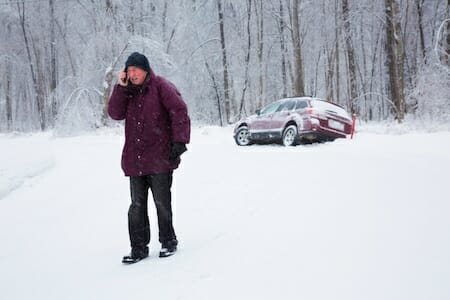
Don’t Get Stuck in the Cold – Get Good & Ready
Would you be prepared if your car got stuck in the snow in the middle of nowhere? If your power got knocked out in the freezing cold, would you know what to do?
Record-low temperatures and snowstorms have punished many parts of the country. It’s a good time to start thinking about how to prepare your family in case of emergency or disaster.
For help, check out Good & Ready, which offers a host of resources that will help you:
Create a family emergency plan
Assemble an emergency preparedness kit
Find local emergency preparedness training
If you want to help others get prepared, Good & Ready suggests ways to lead a preparedness project at your local volunteer center.
Feel inspired? Join the nearly 40,000 people who have taken the Good & Ready pledge to get prepared – and get started!
This post is by Tyler Wright, who served in the U.S. Navy from 2008 – 2013 as a hospital corpsman. Wright assisted in manufacturing craniofacial prosthetics for wounded warriors and cancer survivors. After the Navy, Wright became an AmeriCorps VISTA member with the nonprofit Student Veterans of America in Washington, D.C., where he was subsequently hired as senior regional outreach director.
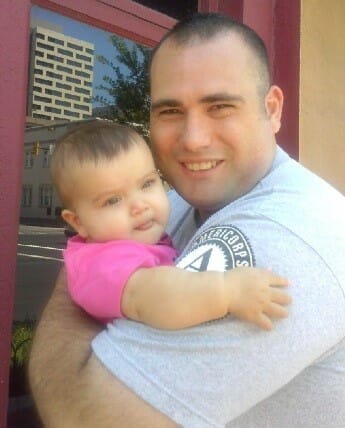
Proudly wearing an AmeriCorps VISTA T-shirt, Tyler Wright hugs a potential future AmeriCorps member, his daughter.
I was a hospitalman apprentice in the Navy when Hospital Corpsman Second Class Petty Officer Waite asked me a significant, life-changing question: “Are you in college?”
I paused for a moment, and then replied most ambivalently “No, not yet.” This vacant response was immediately met with a steadfast stare and retort that I remember clearly, “What are you waiting for?”
He added, “Use Navy tuition assistance or lose it. Your choice.” I had acquired a mere three community college credits before I joined the Navy, with a distant hope to one day obtain a college degree.
Fast forward four years later, and I am hanging up my uniform for the last time, leaving the Navy behind as a hospital corpsman third class petty officer. Five years of leadership experience and complex medical expertise trailed behind me, yet I was genuinely nervous about the transition.
I also entered the “real world,” as we called it, with a bachelor of science in health care management, a master of science in administration, numerous allied health certifications and all but one course completed toward a graduate certificate program. I put in long hours with the Navy and went to school in the evenings and weekends, leaving me little time for luxuries. When I couldn’t tap into tuition assistance, I paid out of pocket.
I also understood that while I had worked very hard in the service, I was also extremely lucky to be in a command that encouraged professional development opportunities; not all military orders allowed for academic enrichment. I felt obliged, and dare I say even some guilt, to give back to brothers and sisters in arms who were less fortunate.
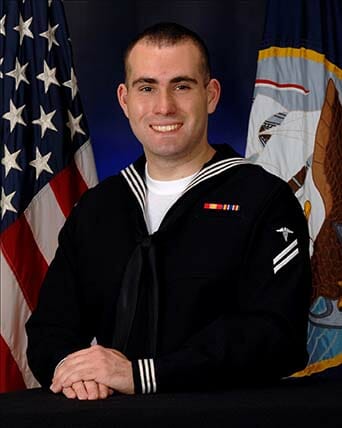
Tyler Wright, in his Navy days
I became an AmeriCorps VISTA member serving the nonprofit organization Student Veterans of America (SVA).
AmeriCorps VISTA and SVA made it possible for me to pursue my dream, albeit grandiose, of ensuring that every single veteran coming behind me would be taken care of on campus and guided in the right direction. I would be the guy that could navigate them through the G.I. Bill, CLEP exams, graduate admissions, apprenticeships, service school credit transfers – you name it.
Not only did I work one-on-one with veterans and their families, but I also built capacity within the ever-expanding network of SVA chapters established on over 1,000 campuses across the nation. They brought me veterans and gave me the tools to change lives, possibly even saving a few in the process.
After successfully completing my year of AmeriCorps VISTA service, I was hired by my host organization as senior regional outreach director. I have a seat at the table among pioneers crafting and executing the next natural phase of the SVA legacy – literally making history. I also oversee a number of VISTA members with diverse and unrivaled talent.
My U.S Navy-to-AmeriCorps VISTA story is just one of countless in the veteran community that follows such a pipeline of national service to success.
Now I’m thinking about going back for my doctorate. Many thanks go out to Hospital Corpsman Second Class Petty Waite, wherever he is serving today, for being the mentor that I needed at the time.