Can an Old Fashioned Day of Service Strengthen Post-pandemic Connections?
The collective global experience of the COVID-19 pandemic has changed the world in many ways. The shift to remote work has revolutionized the workplace, with positive outcomes such as reduced commuting times and increased flexibility. On the flip side, it has resulted in isolation of workers from colleagues, a depleted sense of belonging and sometimes struggles with mental and physical health. These disruptions to workplace relationships, as well as volunteering, have kept us apart, separating us from our communities and each other.
Workplaces around the world are seeking strategies to build post-pandemic culture and reset toward a future vision. As a civic engagement leader, it got me to thinking, can an old-fashioned day, week or month of service hosted by businesses around the world spur a culture comeback and reconnect colleagues and communities?
The answer is
yes.
At Points of Light, we live by this principle every day, and it’s a clear affirmation of everything
In a recent conversation, a Points of Light corporate partner reflected that, “Volunteering used to be a way to get people out of the office. But now, perhaps, it’s a way to get people back in.”
Focusing on greater purpose, both individually and for your company, can boost your mood, improve work performance and help rebuild a values-based culture. Bea Boccalandro’s,
are both fun and meaningful tools for exploring how you can build purpose. purpose.
There are countless ways to help your community — a host of issues just waiting for a willing pool of volunteers to help solve. Throughout the pandemic, communities have struggled
have increased and spread from cities to suburbs. Volumes of residential waste and recycling have placed increased demand on city workers and infrastructure. There’s no denying the increase in plastics and cardboard usage as ordering-in and home delivery have thwarted our reduce, reuse, recycle goals. School districts and parks need a helping hand to refresh and revitalize their public spaces.
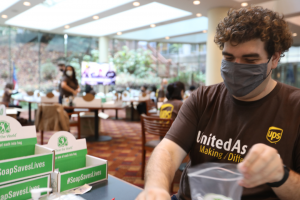
Can your company build a day of service into its return to work plan? The classic example of a clean-up day provides much-needed extra hands to tackle a real need. It also engages colleagues, captures the health benefits of people being outside and introduces everyone to neighborhoods and communities for ongoing learning and action.
Perhaps there is a hybrid volunteer model that matches your company’s hybrid return to work.
showed that all students are behind in reading and math, and students in majority-Black schools are now 12 months behind their peers in majority-white schools. Programs like
are responding to those challenges with new initiatives that engage employees as mentors and coaches and use aligned talent and capabilities to bring programs that close the gap both in-person and online. A great volunteering experience can address important community needs, inspire your employees and support your company’s comeback strategy, but how do you make it great? Points of Light recommends working at the intersection of good for community, good for employees and good for your brand:
Focus on Company Values: What aligns with the authentic products, services and values of your brand? Who are your customers? What community needs align with these attributes? Company values demonstrated by volunteering in support of a community need offer the greatest opportunity to instill refreshed purpose and strengthen culture. These efforts can start in the virtual world as listening and learning efforts that prepare employees to be better leaders and citizens when in-person volunteering returns to your company. Many companies are expanding their employee engagement and volunteering programs to include training that serves a social purpose or benefit. Examples include providing opportunities for employees to learn sign language or take disaster training courses through the American Red Cross. Are the uncertainty, delay and hybrid variations challenging your planning? Some companies have had great success with projects like “virtual” cleanups, where employees coordinated and tracked cleanup efforts in their local areas.
Listen to Your Employees: Employees are citizens first. Are they raising community needs? How can you support them as change agents to tackle the challenges they identify? Consider offering volunteer time off and matching grants for volunteer time. Can you help organize teams of colleagues for a day of service? Can you bring leadership together with employees hired in the last two years for a litter pick up or schoolyard refresh?
Identify Your Strongest Assets: Can a day of service launch a place-based commitment for your organization? Perhaps a schoolyard update introduces your company to a school and community that might welcome mentors, advisors and coaches for students and faculty. Are there career learning experiences that your company could offer? Can leaders build relationships that expand the networks of nonprofit leaders to help them better connect to media, mentors and money?
Board training and matching programs present an impactful and scalable opportunity to engage employees. Not only can companies track and set targets for employee board service,
but
these programs can also support the organization’s DEI initiatives to increase minority board representation and expand support for racial equity-focused organizations. Check out organizations like
No matter where you chose to start, now is the time to build service into your comeback plans.
Points of Light supports companies of all sizes that are interested in building and growing their civic engagement programs. You can access tools and resources to help you get started at
for program design consulting and engagement solutions.
Finding Purpose by Donating: An Interview with Blake Canterbury
Blake Canterbury is a social entrepreneur dedicated to good and the Founder of Purposity. Blake founded his first company based on social media in 2009: beremedy. It was named one of the “3 reasons we’re still tweeting” by CNN and one of the leading organizations in bringing aid to Haiti after the major earthquake. Blake has worked for agencies and major brands launching national TV campaigns and mobile apps. His work has been featured in media outlets and publications internationally.In addition to leading Purposity, he also currently sits on Compassion International’s Board of Directors.
Purposity is building the future of generosity and comes from the core belief that humanity finds purpose through generosity. Visit www.purposity.com to learn more and download from the App Store or Google Play.
Why did you create Purposity?
Most people are “pursuing happiness” in life. However, the way most are going about it is all wrong. We believe there’s a way to live that leads to true, sustained happiness. And that’s living generously. So creating Purposity was really about inviting people into a journey towards a life that they ultimately would like to live.
Our name comes from a marriage of “purpose” and “generosity.” We believe that purpose is actually rooted in generosity. We believe that identifying your purpose in life should be the precursor to everything else you do. But we see that many people don’t pursue their purpose until much later in life. We actually think this should be pursued before things like personality tests or strength finders. Once you’ve identified your purpose, it becomes the lens through which you can say “yes” to great decisions and say “no” to good decisions. It becomes your motivation every day when you wake up. Absence of purpose is why many people often feel stuck and unclear – and then begin to search for meaning.
The theory behind Purposity is that if people had a way to live generously that was more fun, easy and transparent, millions of people would begin doing so… or living more generously than they currently are.
As we looked at generosity today, we found that for most people their ways to live generously tended to be traditional methods that have been around forever. We thought that if we could use great technology and build a lifestyle brand, we could reimagine what generosity looks like for our generation. And we could invite millions of people to find purpose.
How can someone be a responsible and impactful donor?
The answer to a problem is always “easy” from a distance. But the closer you get, the messier it becomes. It’s why it takes deep work, experts in the space and good data around outcomes to understand how to address issues in local communities.
The sooner we can assume less about what people need and want, and find out what they actually need and want, the more responsible we can be. We can be better donors when people have a say in what they need.
Another key to donating responsibly is keeping the dignity of the other human being intact. It is keeping in mind that you are enabling a human being. And not reducing it to a transaction. If you can do that, it will immediately bring clarity to the situation.
Purposity was designed with both of these things in mind. Each need on our platform was identified by a school or nonprofit professional that is working directly and deeply with the individuals being served. Needs are identified with direct input from the recipient, so they’re not receiving hand-me-downs or surplus items. We’re honoring their dignity when they can provide inputs on what they’d want. With each need, we are also sharing an individual’s story, so our users understand who they are, their situation and how a particular item will help them toward a more sustainable situation.
Some people may wonder how making a small donation or supporting just one person can be meaningful. Can you share a story that demonstrates this type of impact?
Look, every step helps. For somebody needing support, every piece of the puzzle gives hope.
Here’s one example. There was a family who was unhoused, and the mom and dad had had two children while they were living on the streets. They were connected with an organization who worked with the parents to help them get jobs. The parents saved money and were able to buy their first home. We were able to help outfit their home – from silverware to pots and pans to a set of bunk beds for their two boys.
We actually got to be part of delivering the items, which is rare. And we helped install the bunk beds. We kept the boys outside until the beds were ready. When they ran inside, they saw the first beds that they could ever call their own, and instead of jumping on them like you’d imagine in a movie, they came running over and gave a total stranger a hug.
Whether the impact is a bed or a pair of shoes or formula for a newborn baby, there’s no answer I can give in an interview that can share the depth of impact that one single item can have on another person’s life.
What is your vision for where donating is going?
Our vision is one of neighbors helping neighbors. We believe that people would help their neighbor if they knew they had a need. When I was growing up, if we didn’t have an egg or a bag of sugar to bake cookies, we’d ask our neighbor and they’d give it to us. It was natural. We believe that if we invite people into a simple way of doing this – rooted in trust and transparency – it’ll scale in local communities. It’ll scale nationally. It’ll scale globally. And millions of people will be helping their neighbors. They’ll be living generously. And we will have democratized philanthropy. So much so that people may no longer call it philanthropy or donating. It’ll no longer be a philanthropic act. It’ll simply be a natural way of living.
Purposity connects requests for donations to potential donors in a community. How is technology changing the way people donate? Is this the future of donating?
Yes, this is the future of donating. Technology is just enabling new ways to be generous. It has the potential to make donating more fun and more transparent, and the data that comes with technology has the potential to make it more effective.
In Purposity’s model, when you buy a pair of shoes for a child, you get a notification in real time letting you know the shoes have been delivered. When we do this, it helps build trust with the donor and it’s fun! This in turn inspires donors to donate more and volunteer more, and more deeply invest in organizations.
Technology enables the kind of transparency that’s always been hoped for in the space and transparency should build trust. The more trust a donor has in the organizations and in the folks they support, the more reasons the donor has to give to and through the organizations that support all aspects of the individuals and communities they are serving.
We’re on the forefront of what technology is going to be able to do for giving. We’re building new ways for people to live generously that have never been done and we can’t wait to release them to the world. We believe that those organizations that adopt it early will be better positioned to stay ahead of the curve as the sector continues to evolve.
What is your ultimate goal for people who engage with Purposity?
Really, it’s that people would pursue their next selfless act. Culture tells us that we can buy our way to happiness, and the more we live this way… buy this thing, dress this way… we’ll be happy. But when you think about life from the end of life and what really matters, it’s what you did for others that comes through. The sooner we can invite people to understand this and for it to become a lifestyle, the quicker everybody’s life will be better.
Laura Lane, UPS Chief Corporate Affairs, Communications and Sustainability Officer
In spite of the challenges brought on by the COVID-19 pandemic, I remain optimistic. In these mettle-testing times, the generosity of the human spirit has remained strong. Even amid social distancing, we’re still finding ways to connect with each other and help communities around the world.
These moments of shared humanity provide an important lesson:
We need one another
. We cannot allow this pandemic to create divisions among us —
we are stronger together when united in purpose
.
Collective Momentum
Even before the pandemic, there was a critical need for community engagement. But now with the virus taking its toll on economies around the world, the number of people in need has skyrocketed.
inspires us to action at a time when collective momentum for volunteerism has never been more critical.
In my role as UPS Chief Corporate Affairs, Communications and Sustainability Officer, I have seen how our half-million UPSers have risen to address our world’s most daunting challenges during the past year. That UPS mindset for engagement is reflected in our purpose statement:
Moving Our World Forward by Delivering What Matters.
To us, giving means more than just writing a check — it means combining our skills, passions and time with our logistics expertise, transportation assets and NGO partnerships to make a measurable difference in our world.
And delivering hope for people and our planet means setting ambitious goals for engagement where it matters most. We already met our goal of providing more than 20 million volunteer hours a year ahead of schedule.
In response to some of the past year’s social unrest, we took on a new commitment to advance equity and justice by dedicating more than 1 million more volunteer hours toward Black and underserved communities.
And in our effort to address climate change, we also set a new goal of planting more than 50 million trees by 2030, including the 15 million we already planted. We know the world is counting on us to deliver what matters, which is why UPS will continue to drive meaningful change wherever we can.
Driving Meaningful Change
As essential workers throughout this pandemic, UPSers have delivered everyday essentials and critical PPE; we have helped businesses reinvent their supply chain strategies; and now, maybe most importantly, we are delivering lifesaving vaccines around the world to help defeat this virus.
Service is in our name, and we will continue to serve in every way we can. So, as we celebrate Points of Light’s Global Volunteer Month, we hope our incredible UPSers help give everyone good reason to be optimistic about our future because we know delivering what matters means delivering hope.
Fidelity Investments: A Decade-Long Partnership with Points of Light
For more than a decade, Fidelity Investments has partnered with Points of Light and their
affiliates across the country to revitalize school learning environments with the goal of supporting students in achieving academic success. Through our School Transformation Day project, employee-volunteers roll up their sleeves for school beautification projects, from painting walls to building outdoor classrooms. This annual event has become a favorite of employees, attracting more than 20,000 Fidelity volunteers in the last 10 years.
This year, due to COVID-19, our decade-long, beloved School Transformation Day was at risk of cancellation. But at Fidelity, we believe that long-term change and success comes through collaboration, listening and adapting to the needs of our communities. And that is exactly what we did. Throughout the regions, our community relations team worked closely with local Points of Light affiliates to understand our community partner’s top needs and priorities during the 2020-2021 school year, mid-pandemic. We also engaged our passionate colleagues across the country to gauge their interest in completing community projects from home, with their families.
New York-New Jersey Season of Transformation
“Despite the unusual nature of 2020, we saw that our employees, while working in a virtual environment, were even more enthusiastic about supporting community,” said Heidi Siegal, vice president, community relations at Fidelity Investments. “Our people are our greatest asset.”
As a result, we pivoted School Transformation Day to a fully virtual, experience reflecting the unique needs and difficult challenges of each community. Our community relations team consistently heard three themes: COVID-19 safety needs, support of virtual learning and addressing the digital divide.
Fidelity assisted schools and nonprofits with replenishing the resources utilized throughout the crisis to meet the ongoing needs of students including COVID-19 safety kits, face shields, contactless thermometers and touchless water fountains.
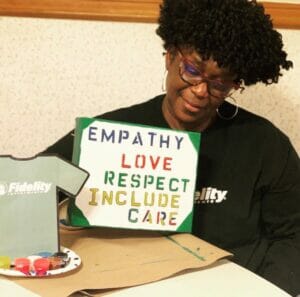
Employee volunteers focused on the social and emotional support of students. Working at home with their families, volunteers created mindfulness kits and recorded guided meditations and beginning yoga videos for students as part of one school’s new self-regulation room sponsored by Fidelity. Volunteers also created inspirational canvas art to hang in hallways, garden kits for students to build their own gardens at home, classroom safety signs, reading corners to promote literacy and even tie-dyed t-shirts for the students.
Additionally, volunteers placed over 380 Amazon Wish List orders which provided schools with more than 4,000 individual supplies including notebooks, folders, paper and snacks.
A mom and daughter create a mural together in Texas.
Through our community partners we learned that the pandemic exacerbated educational inequalities among students, and none more critical than the lack of access to technology for Black and Brown students. In response, Fidelity committed to providing technology resources for educators and students to effectively engage in remote learning. Students in schools where Fidelity has a presence received equipment needed for virtual learning including iPads®, Chromebooks™, earbuds with mics and lap desks. Many teachers also received a second monitor to enhance their online teaching experience. Additionally, community partners like the Boys & Girls Clubs, which throughout the pandemic have become centers of education by extending their hours to support virtual learning, were supported with enhanced Wi-Fi and additional equipment.
Community and school partners were also supported through a series of grants made in each region. The grant funding was used at the discretion of the recipients to purchase safety and cleaning equipment needed to combat COVID-19, technology for students and teachers, virtual curriculum and more.
“Our strong partnership with Points of Light and the commitment of our employee volunteers make it possible for Fidelity to continue impacting communities,” said Siegal.
The 2020 annual School Transformation Day involved more than 620 employee volunteers and their families virtually connecting with 14 schools and organizations across the country impacting more than 28,000 students and nearly 500 teachers.
Continue the Learning: Business with Purpose Themes from the 2020 Points of Light Conference Online Experience
There is a great energy, a spirit of optimism and a sense of renewal when thousands of people convene with the same purpose. During the Points of Light Conference, leaders from the corporate and social sectors gathered for fellowship, education and inspiration. Although, this year, we “gathered” around our computers for the first ever online experience.
Business with Purpose workshops, designed specifically for professionals responsible for engaging their fellow employees in their communities, explored how companies are leading with their values and collaborating with nonprofits and other stakeholders to bring their resources, time, talent and voice to bear to be a powerful force for good – especially now.
Four themes emerged throughout the three-days of learning:
1) Going Digital. Due to COVID-19, many leaders are quickly adopting digital solutions for their employee engagement needs. With more employees working remotely, virtual volunteering becomes a way to continue their involvement in social issues. However, all nonprofits are ready to accept virtual volunteers and provide them a meaningful experience.
Virtual volunteering may also be harder to track, which can impact your ability to report results to leadership. No matter how you’re engaging employees in their communities at this time, a digital platform that helps you manage, communicate and track results is a cornerstone of a successful social impact strategy.
2) Setting Strategic Intentions. Several workshops elevated the need to be planful with your engagement programs. Whether they provided a straight-forward framework to follow or showcased the intentional planning that goes into programs once strategy is developed, attendees walked away with a deeper understanding of a company’s journey from “scatter-shot to strategic.”
Two workshops flipped the strategy conversation on its head and demonstrated how employee volunteer engagement can be used as a strategy itself to bring together disparate corporate cultures and ensure the well-being of your workforce. All very important proof points to share with company leadership as they look for solutions to these internal challenges or when you are advocating for more resources.
3) Uplifting Cross-sector Collaboration. Without strong collaboration, your giving and volunteering efforts may not elicit shared value. We heard from two organizations that have built deeply aligned partnerships for program design and delivery while working to solve complex global challenges.
It is, in fact, these strong collaborations that have enabled many organizations to pivot during the pandemic. Starting from a place of shared understanding while also acknowledging and appreciating similarities and differences will feed collaboration and ensure mutually beneficial outcomes.
4) Leading Through Crisis: Unprecedented times bring unprecedented opportunities. In a world facing natural and human-made disasters to the current health and social justice crises, how should a company respond? How can they balance their annual commitments with pressing community needs as they spontaneously arise? And, how can they support the increase in employee activism and shift in consumer expectations due to these crises?
It’s imperative for businesses to plan for the unexpected. Workshops provided tips that resonate broadly no matter the type of crisis you might face such as leaving some room in your budget for emergencies, tapping into partners’ expertise, refraining from knee-jerk reactions and diverting all resources to one need, and having a ready of inventory of upcoming priorities so you can quickly make decisions. And, of course, communicating transparently and acting authentically are true when balancing emergent needs and when those needs give rise to powerful voices internal and external to your company.
We invite you to check out recordings from all of our 2020 Business with Purpose workshops and connect to research, learn frameworks, and discover new ideas to inspire and renew your efforts to accelerate the impact of your company’s social impact strategy. These recordings are available on Points of Light’s newest digital platform, the Community for Employee Civic Engagement. Through CECE, you’ll be able to ask questions and get answers from experts, as well as stay up to date with the latest industry news and explore ideas central to maximizing the impact of corporate social responsibility.
For unlimited access to everything CECE has to offer, sign up for a complimentary 14-day trial.
Service is a Way of Life for UPS Executive Nick Costides
, service has been a way of life, his entire life.
Growing up as the son of an immigrant father in Brooklyn, New York, he recalls how his mother took care of everyone around her. The whole neighborhood was that way, he says. “Doors were always open. If someone was laid off, people showed up with food. Everyone helped each other out. Because everyone was just trying to survive.” Nick says he didn’t really know what “volunteering” meant. It was just what you did. It was a way of life.
Nick’s dad was working a minimum-wage job when he became disabled with multiple sclerosis. Nick was just eight years old. The responsibility of caring for the family fell to his mom. His mother and her friends made sure Nick never felt as if he was going without. “We didn’t have much, but nobody did,” he remembers. Nick says his mother worked hard to provide for the family, and in tough times showed kindness. “My mother would give the shirt off her back to help anyone,” he said, and that gave him the foundation from which to learn, to excel, and to give back.
Today, Nick has certainly built on that foundation, serving as the President of Information Technology at UPS, the world’s largest package delivery company. You can feel a sense of service and concern for others in the way he talks about his work. Nick says, “I have the privilege of leading a team of the best IT professionals in the world. Together, we build innovative, industry-leading technologies that power our customers’ supply chains.”
Photo of Nick’s Mother | Photo provided by Nick Costides
Despite his leadership role and demanding job at UPS, just as his mother instilled in him, Nick always finds time to give back. After relocating from his native New York to Atlanta for UPS several years ago, Nick’s wife began volunteering for an organization and learned they were having funding challenges. She joined their board and together, she and Nick led a financial turnaround of the organization. As part of that effort, they used a Points of Light Global Network affiliate, Hands on Atlanta, to help coordinate volunteer efforts. A few years later, Nick was asked to join Hands on Atlanta’s board and in that role, he interacted with the team at Points of Light often. Eventually, Nick was asked and honored to join the Points of Light board.
“The Points of Light mission really resonates with me, and it’s very important,” Nick says. “Points of Light
inspires and engages individuals into service – anywhere in the world. Their impact is felt by the individuals who receive service through Points of Light and its partners; they help nonprofits in terms of capacity and management, and can make these organizations feel larger than they are; and just think about how many communities are being served by Points of Light and their affiliates. They provide the processes, the infrastructure, and more – and that can turn anyone into a point of light.”
At Points of Light, Nick has worn many hats, including on the Financial Investment Committee, as the Chair of the newly created Technology Committee, and working to support strategies related to data management and innovation that can change the way nonprofits interact digitally. Nick’s a resource for Points of Light operationally as well as on our board of directors as an advisor. He says being able to provide that kind of multidimensional support, beyond just going to board meetings, is what he loves about his role with us.
“When you think about Points of Light and its impact, especially around their concept of the civic circle, I look at it as an anchor point that depicts that there’s many ways to be a point of light,” Nick says. “It’s akin to the golden rule. There are so many ways to do good. It starts with the decisions you make and the causes you lean into. It truly is the way you live your life. The people who want to do good or create change don’t assign themselves labels; they just do it. It’s all about how you express yourself each and every day.”
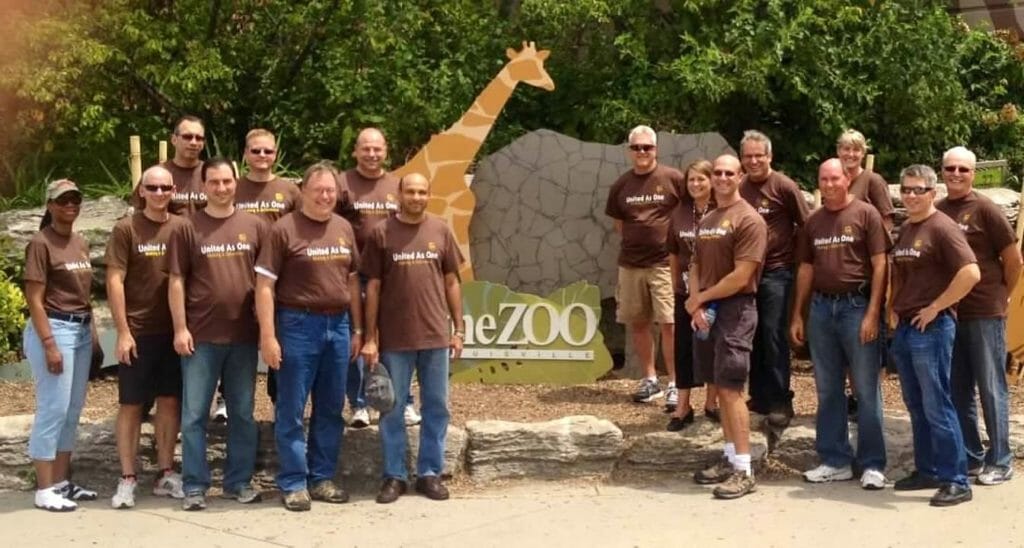
Nick Costides (back row, third from left) and UPS Volunteers at the Louisville Zoo.
When he’s not at UPS or working with Points of Light, Nick and his wife support multiple animal rights, welfare, and health organizations, including having previously served on the board of the Louisville Zoo and the Kentucky Humane Society. Nick is still an advisor to Hands on Atlanta and an advisor to a nonprofit called ToolBank, which provides tools like shovels and picks for volunteer projects. Working with them and with the UPS Foundation, Nick helped to coordinate and create a mobile warehouse of tools, so that the tools could easily be moved to markets when disasters hit.
To those looking to get involved in their communities and make a difference, Nick’s advice is simple. He says, “You just have to find a cause that resonates with you. Just get out there. If you help in even a small way, it can really make a difference in the lives of others. Whether you can help with marketing, swing a hammer, or tutor a student, it makes a difference. There’s no downside. And everybody benefits.”
Stronger, Safer, Better Together
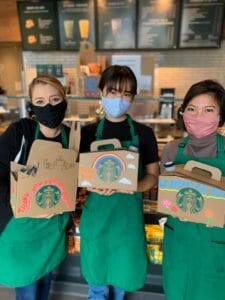
The stories we’ve heard about our Points of Light corporate partners and their response to the COVID-19 crisis continue to inspire and amaze us. One such partner is Starbucks. With a long track record of taking care of our environment, we’d intended to highlight
blog series. However, given the current situation, a more fitting way to recognize the company’s commitment to the planet is to talk about the things the company is doing as our world – together – confronts the coronavirus pandemic.
As the crisis in the U.S. continues to unfold, Starbucks is serving communities in ways that demonstrate the very best of its company and its people.
They are caring for each other. Starbucks partners (employees) are the foundation of Starbucks fundamental Mission to inspire and nurture the human spirit. They have led through this crisis by caring for each other, including providing emergency benefits such as catastrophe pay for those who are not working, introducing Starbucks Service Pay for those who are, providing mental health benefits and offering backup childcare through Care@Work.
Credit: Starbucks
They are nurturing first-responders and nurturing spirits. Daily, first-responders and other front-line personnel can receive a free hot or iced coffee in Starbucks stores through May 31. It’s a small gesture on a grand scale; and it’s kindness and warmth when we need it most. Over 1M cups have already been given to those serving our communities! The Starbucks Foundation has also provided a grant toOperation Gratitude to deliver 50,000 care packages and handwritten letters to first responders and health care workers. You can join in to write letters at https://www.operationgratitude.com/starbucks/. On its Good Things are Happening blog, the company has chronicled ways its partners (employees) are doing incredible things to spark joy and help others. In Cleveland, Ohio partners threw a “prom” for a colleague whose prom was cancelled. In Barboursville, West Virginia a Starbucks partner took in a regular customer’s dog when her owner got sick. In Beverly, Massachusetts, partners converted empty café space into a mask-sewing station. And there are countless stories like this from across the company.
They are supporting their neighborhoods. For example, in Philadelphia, The Starbucks Foundation is doing some important work to help slow the spread of COVID-19. We all know that handwashing is the most effective way to prevent becoming sick. But for homeless men and women, that’s not as easy as walking down the hall to the washroom. So, together with Broad Street Ministries, the foundation has set-up 12 handwashing stations throughout the city. The stations are stocked with 40 gallons of water, soap and paper towels and are operated with a foot pump. They’re refilled once or twice per week. It’s estimated that the stations are being used by more than 2,000 people every day and are having an impact on slowing the spread of the virus in the city. In addition, The Starbucks Foundation has donated $500,000 to support U.S. front-line responders with equal donations to Direct Relief to support the delivery of personal protective equipment and essential medical items
They are mobilizing resources and supplies. In total, The Starbucks Foundation has donated more than $5.5 million dollars to nonprofit partners who are providing critical aid to vulnerable communities and supporting front-line responders. These funds address everything from the initial and immediate response to the crisis, to hunger relief efforts – including a partnership with Feeding America to support local foodbanks. Since closing its cafes in mid-March, Starbucks donated more than 700,000 meals, 62,000 gallons of milk, and 1 million cans of Teavana Craft Iced Teas throughout the U.S. and Canada. And counting.
Credit: Starbucks
They are living out its social impact priorities. Even amid the pandemic, Starbucks continues important work to support veterans, access to higher education, equity and inclusion, and the environment. Like Points of Light and so many other organizations, Starbucks recognizes that while our collective attention is on the current crisis, needs in other areas continue. Just this week, in celebration of Earth Day, the company reiterated its commitment to sustainable coffee by highlighting the men and women who produce it.
During the crisis and our planet’s continued response to it, Cameron Melcher, a Starbucks partner since 2008 and a manager for the last two years, put things into perfect perspective. He runs a high-volume, 24-hour store in Manassas, Virginia that often caters to customers working overnight or in critical roles – people like doctors, policemen, firemen or delivery drivers. He said
“With all the quarantines and social distancing, humanity is feeling some serious disconnect right now. I think it’s important that we can be there for our community and maybe even look at our role a little differently – as essential personnel – because of what we are doing and who we are serving.”
He’s right. What Cameron and his co-workers are doing isn’t “service” or volunteering in the way we typically think about them – his story and each of these stories are absolutely about serving communities and one another.
And we think that’s pretty awesome.
To learn more about Global Volunteer Month, and to find information on how you can make a difference and be a #LocalLight in your community, please visit:
, we did not imagine the world as it is today. We could not have foreseen the way in which our world would change or the ways in which
service,
or
communities
, or
neighbors
would take on whole new meanings.
Throughout Global Volunteer Month, we’d planned to recognize volunteers around the world and the positive impact they’re having in their communities and beyond. Today, as the coronavirus pandemic continues around the world, that mission seems even more important than ever.
Of course, we have some tremendous corporate partners at Points of Light who help communities as well. These organizations are using their enterprises, their resources and their employees to do good, and we’ll be shining a light on them as well this month.
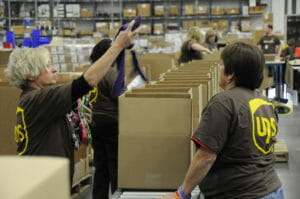
One such company that immediately comes to mind is UPS, our Global Volunteer Month Supporting Partner. This massive, global organization is using its size and scale – every day – to make a real difference in local communities.
This week’s Global Volunteer Month theme is Human and Civil Rights, and UPS has been a consistent and compelling leader in this area.
For example, we often think of humanitarian aid in the context of political conflicts or famine, but it also encompasses disaster relief. In these situations, the ability to move desperately needed supplies into an area quickly and efficiently – often with little notice – is key. It’s all about logistics. For UPS, logistics happens every day, all day. As the world winds its way through the uncharted waters of a global pandemic, UPS’s role has become even more clear: the company is delivering life and hope.
UPSers believe that in order to have strong, productive communities, we must first have safe communities. (We agree!) That’s why – for disaster preparedness as well as relief and recovery efforts – UPS and The UPS Foundation provide significant financial and in-kind contributions to help support organizations such as the American Red Cross, Salvation Army, World Food Program, UNICEF, CARE and United Nations High Commissioner for Refugees. As the coronavirus pandemic continues, UPS is delivering urgently needed materials through its global relief network and using its logistics expertise to help customers who are pivoting their businesses to join the fight.
Credit: UPS
Incredible.
But what about when there’s not a crisis? The company’s commitment to human rights is just as strong and steadfast. Consider this: Every day the company delivers more than just packages; they deliver solutions that help facilitate commerce, build businesses and strengthen communities. Just by doing what it does millions of times in millions of places every day, UPS supports trade and innovation, which helps businesses thrive and helps working men and women gain access to economic opportunity. This type of free, fair and open trade creates an environment where human rights can be protected and advanced. This commitment also extends to UPS’s philanthropy, which is based on the knowledge that our differences make us stronger. To bring this to life, The UPS Foundation supports human and civil rights-centered programs to empower individuals and help safeguard communities of all kinds. UPS’s respect for and work in support of these rights makes them a proud supporter of the United Nations Guiding Principles on Business and Human Rights and a leader on these issues within corporate America.
We have so many great examples of corporations doing wonderful things in their communities. We look forward to highlighting even more of these organizations throughout Global Volunteer Month!
To learn more about Global Volunteer Month, and to find information on how you can make a difference and be a #LocalLight in your community, please visit:
Yes or No: Will your business support the 2020 Census?
It’s a simple, yet incredibly important and urgent question every business must ask itself.
We wanted to share the below resources and information not to raise awareness, but to drive action from the business community, whether you are a Fortune 500 company or local business committed to serving your community. Every action, no matter how small, can have an impact.
For many reasons including the following, we call upon the business community to support the 2020 Census:
Businesses make data-driven strategic and operational decisions that require an accurate Census count
Your employees, customers and their communities may be largely impacted by the $900 billion in federal spending allocated based on Census data (view this infographic to see how 9 million children from low-income families will be impacted)
If there is an undercount, businesses will be asked to cover the funding gap to support nonprofits and the communities they serve (a 1percent undercount can cost a state millions of dollars)
Most important,it’s the right thing to do. An accurate Census is good for business, our communities and our country
Below are business and state-specific resources from
plan their outreach efforts to support the 2020 Census
:
Mid-March – April 2020: This is a critical time for business to help with the effort around the count, because households will now be able to complete their census forms. Beginning in mid-March, households will receive census information inviting them to complete their questionnaires. These will be sent by mail or delivered by a census worker in some rural and all remote areas. Messages to employees, customers, and the public should explain why the census is important for their communities and encourage them to complete their questionnaires.
April 1, 2020 (Census Day): This is neither the beginning of the Census nor the deadline, but, instead, a day that is designated to promote the census around the country. Companies can help by participating in local Census events, posting messages on social media, and communicating with employees, among a range of other strategies.
May 2020: By this time, residents would have had several weeks to complete their forms, so if they have not yet self-responded, a census worker will visit their home to help them complete the questionnaire in person. Households, though, can still self–respond at any time — encouraging their participation is still important.
Summer 2020: Census wraps up.
By December 31, 2020: Congressional reapportionment determined; state population totals sent to the president.
On January 1, 2021 how will your business be able to respond to the question, “yes or no, did your business support the 2020 Census?”
If your business is not planning to do anything, ask why not? And if they are, ask what other businesses and organizations they can bring along from their ecosystem to amplify this critical work.
Where Companies Need to Lead: Trust, Metrics, Social Change
With every milestone anniversary comes the impulse to reconnect with the older versions of plans and events, ground the current views to the past and strengthen the future mandate. In 2020 Points of Light marks the 15
anniversary.
Just last week in New York, at the home of our host AT&T/WarnerMedia, we celebrated with over 100 council members and guests at our annual meeting of members. It was amazing to see how far we have come – from a small office of President George H.W. Bush to a global organization working with hundreds of nonprofits and corporations across 37 countries.
As our council members gathered together, everyone was buzzing with what this new decade could hold for the future of social impact.
Couple that with the news from the recent World Economic Forum in Davos, with international brands and their leaders articulating a renewed understanding of the multiple stakeholders, including planet earth, whose needs must be addressed to truly have sustainable business value. The days of volunteerism as t-shirts and a few hours with paintbrushes are long gone. Business is leaning in with all assets to redefine the responsibility of the private sector.
This year’s
that the ESG, CSR, Citizenship and Employee Engagement leaders in the room are squarely at the center of that change. As the primary connectors of their brands and employees to communities and social challenges, they are being called upon to deliver on the awakening of business to its expanded role.
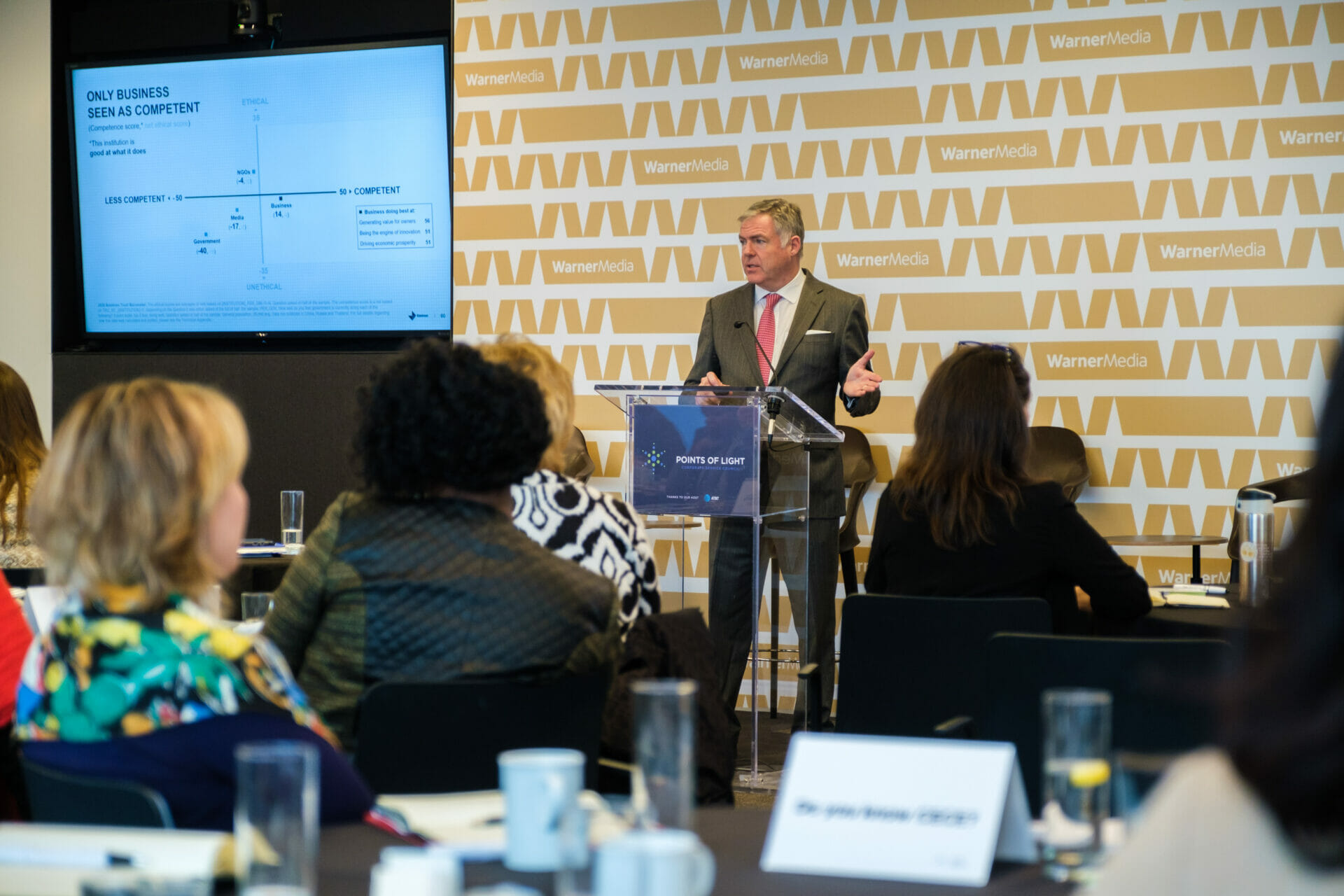
The mandate for this change is pushed and shaped each year by the tremendous work of the Edelman Trust Barometer, the annual measure of the individual’s expectations on business, government, nonprofits and the media. We were incredibly grateful to welcome Matt Harrington, President and COO of Edelman who shared the key insights from
. He shared the framework for what would become the synthesizing message for the summit:
Matthew Harrington, president and COO, Edelman presents 2020 Trust Barometer.
Trust has to be earned through ethical action, partnership across sectors and realized commitments. Employees, customers and communities expect that CEOs will lead social issues and are ready to take change into their own hands when they sense a lack of authenticity and action.
Measuring and reporting on the value of this social purpose mandate, putting the “S” in ESG, was another significant theme addressed in the meeting, with a panel including: Catherine Blades, Aflac Senior Vice President, Chief ESG and Communications Officer; Jason Leiker, AT&T Associate Vice President, Corporate Social Responsibility; and Marc Siegel, EY partner in the Financial Accounting Advisory Services (FAAS), Sustainability Accounting Standards Board Sector Chair for Resource Transformation. A leading take away for businesses?:
As stakeholders and shareholders turn their attention to how companies deliver on social goals and commitments, articulating what metrics represent in the work of the company and the value to shareholders is an increasingly complex topic.
Defining common metrics that can be reported within industries and across sectors and retaining the authentic value of a company’s own purpose story for a broader audience of internal and external stakeholders are just some of the metrics companies seek to understand.
We look forward to continuing to provide information and opportunities for engagement through our Council and partners like CECP.
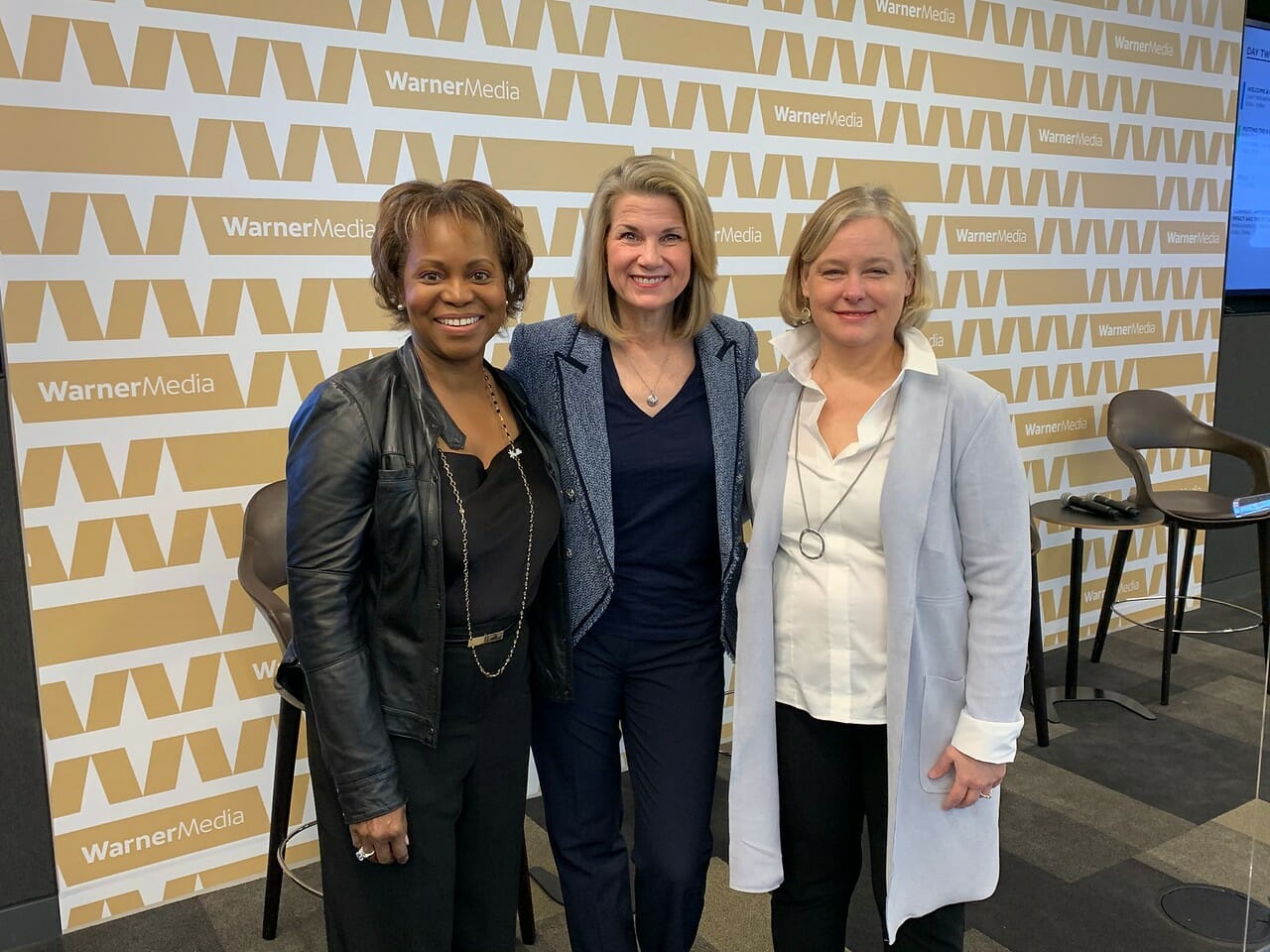
Points of Light President & CEO Natalye Paquin (left) and Chief Civic Innovation Officer Jenny Lawson (right) welcome new Corporate Service Council Chair, Charlene Lake, AT&T (center).
A chance to test the power of business to lead social change and address challenges was called into action by Don Lowery, Nielsen Senior Vice President, Community Engagement, who shared updates and materials from their newly announced TrueCount initiative. He urged leaders to
share information and materials with their employees to participate in the upcoming 2020 Census against fears of a significant undercount.
A representative census count is essential to providing resources, a voice and a representation for communities. You can find here census partner materials, promotional content and
to make sure your company is stepping up to this challenge.
As we create a world in which every person and every business has the power to create a world where it is impossible to sit on the sidelines of change, we look forward to working with you to help you and your company mobilize.
They say “be careful what you wish for”, but we think it’s time to be care-full.
This is the moment we have been waiting for.
Jennifer Lawson is the Chief Civic Innovation Officer at Points of Light. She leads forward-thinking initiatives, partnerships and campaigns with leading brands to advance social change in the corporate sector.