Celebrating a Decade of Powering Volunteer Service and Accelerating Social Change
From global community days and home-builds to civic hackathons, companies have an immense power to mobilize and inspire their employees to achieve social change through service.
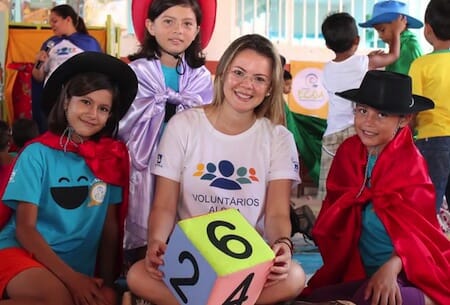
Alcoa’s employee volunteers serve nearly 2,000 nonprofit organizations every year during its signature month of service.
This year, we celebrate the 10th anniversary of the
, the premier global platform for mobilizing, equipping and inspiring high-impact volunteering. For the past decade, Council members have been trailblazers in turning their bottom lines into the front lines for social change.
To celebrate this anniversary, Points of Light has collected videos that share the inspiring role that service plays in companies and communities around the world. The new
features multiple messages from Council members reflecting on the power of volunteering.
Companies featured in the videos include Alcoa, Altria, Citi, Edelman, PepsiCo, Pfizer and Southwest. The challenges of our time – from poverty and hunger to inequality and education – are increasingly requiring large-scale and multi-sector responses. Council members are stepping up to this challenge by lending their most precious assets – their time and talent – to be transformative drivers of social change.
Service is still at the heart of the Corporate Service Council. Its learning communities and gatherings spark innovative thinking and inspire companies and employees to volunteer in ways that deliver transformative and lasting value.
Celebrate with us and visit our
to hear about 10 amazing years of powering corporate service.
To Thrive, Your Company Needs a Soul – Find It in Volunteer Service
This month we’re celebrating the 10th anniversary of Points of Light’s Corporate Service Council, an elite platform for mobilizing, equipping and inspiring high-impact volunteering. Every week leading to our Conference on Volunteering and Service in Houston, Oct. 19-21, we will add a video to our YouTube channel or a post to this blog. Today Stewart Whitney, president of Timberland, a Corporate Service Council member, explains how his company inspires its employees to become “agents of service.”
Stewart Whitney
In my 25-plus-year career, one thing has become abundantly clear to me. Companies with an engaged employee base are the companies that tend to thrive. Of course, you need a sound business model and products that consumers demand, but that’s not enough.
Your company needs a soul.
Here at Timberland, where I’ve had the pleasure of working for 15 years, we have a deep heritage focused on environmental and social justice. We’re also fortunate to have a truly impassioned and engaged employee community. To better serve this community, we launched the Path of Service program in 1992 to engage employees, business partners and consumers in service to others.
We started by offering employees up to 16 paid hours each year to serve in their communities; a few years later, given the overwhelming response, we increased that number to 40 hours.
We have one simple goal when it comes to service: equip employees with direct experiences to make a difference and hope that, in turn, they become proactive agents of service beyond their years with our organization.
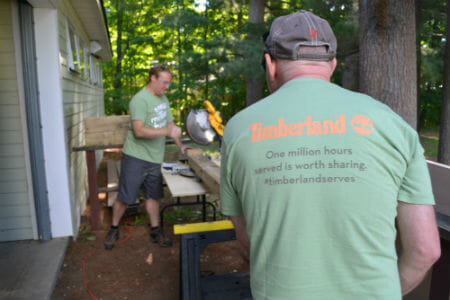
Timberland volunteers help make improvements a New Hampshire park, as part of the company’s Serv-a-palooza.
I am proud to say that in 2014, 78 percent of Timberland employees served more than 72,000 hours in some 100 locations in 19 countries, reflecting a 10.3 percent increase in hours served from 2013. This growth contributed to a major milestone: reaching 1 million hours served, largely through our two companywide service days – Earth Day in the spring and Serv-a-palooza in the fall.
Both events were organized by employees worldwide through Timberland’s Global Stewards program. Launched 10 years ago, Global Stewards solved a common problem – how to scale corporate social responsibility (CSR) efforts nationally or globally when your CSR team is based in in the U.S. (Ours is in New Hampshire.)
Through this program, a network of passionate employees volunteer, above and beyond their regular job responsibilities, for a two-year term to drive engagement agendas in their locations. Timberland relies upon and supports the Stewards to plan events and initiatives that translate and bring to life CSR programs and messages in their countries’ languages and cultural traditions.
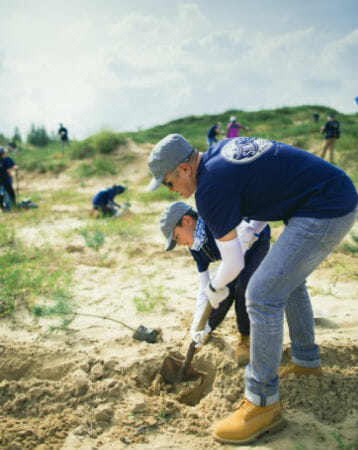
Timberland’s reforestation project in China’s Horqin Desert has planted enough trees to fill the equivalent of 1,200 football fields.
And they often come up with creative solutions, like Stewards at our factory in the Dominican Republic riding the morning buses with factory workers – who don’t have access to email – to get them engaged in service.
For a program to succeed, it’s critical to have this level of involvement. We are constantly gathering feedback from employees and consulting our Global Stewards to shape future initiatives and activities. Employees regularly suggest community partners and service locations, volunteer to lead projects and collaborate on ideas for how the business can be more environmentally responsible.
Just recently, we planted our 2 millionth tree in the Horqin Desert in China. This major initiative, today a key piece of Timberland’s global commitment to tree planting, started back in 2001 with an idea from a single employee who was concerned about deforestation in her region.
At Timberland, we take good ideas seriously and by listening to and harnessing the passion of our employees around the globe we are able to work toward making a lasting difference.
Through years of research and experience, we have found that service is a key factor in employee job satisfaction, leadership development and also an integral part of drawing great talent to the company. Employees really value the opportunity to become leaders in the workplace, gain new skills and receive visibility in their community while doing important work.
Because of our own experience in employee engagement, we welcome the opportunity to support other businesses and organizations looking to engage in their communities for the greater good. We recently relaunched our Service Toolkit, which provides information and tools for developing and executing meaningful service events for 25 to 1,000-plus volunteers.
In our view, there is no room for competition when it comes to giving back.
Enhancing Corporate Volunteerism to Strengthen Communities
We are excited to kick off our 10th anniversary celebration of Points of Light’s Corporate Service Council, an elite platform for mobilizing, equipping and inspiring high-impact volunteering. Every week in the run-up to our Conference on Volunteering and Service in October, we will add a video to our YouTube channel or a post to this blog. We invite you to join in the celebration and read this post by Kerry Sullivan, president of Bank of America’s Charitable Foundation and chair of the Corporate Service Council.
Kerry Sullivan
It’s hard to believe that Points of Light is already celebrating its 25th anniversary and, with it, 25 years of mobilizing volunteerism across the globe.
That commitment to creating social action that brings change to communities has resonated with countless volunteers, nonprofits and companies. As the chair of Points of Light’s Corporate Service Council, the organization’s impact is something I’ve been delighted to be a part of.
For many years, volunteerism has been a key component of Bank of America’s efforts to strengthen and support local communities. Our employees bring a huge passion for making a difference to the people and communities we serve, and are the ones who make it possible for us to deliver on our mission to make financial lives better.
This passion is something I’ve seen up close through our employee volunteer work, and from lines of business leaders, with 2 million volunteer hours recorded last year alone among Bank of America employees.
The Corporate Service Council has enabled us to grow our efforts and empower our employees to do more, especially in economically disadvantaged communities. In particular, the Council’s regional meetings and expert hotlines have sparked new thinking on how to inspire our volunteers and work with our partners in a way that delivers lasting value.
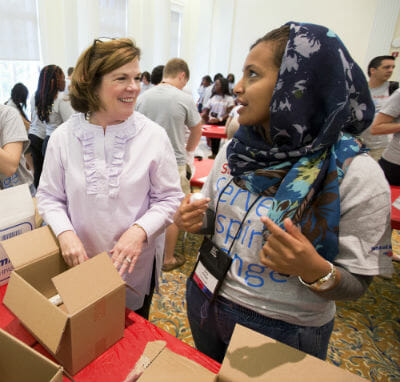
Kerry Sullivan, left, chair of the Corporate Service Council, volunteers at a service event at Points of Light’s Conference on Volunteering and Service.
We’ve changed the dialogue with our nonprofit partners and have really looked to marry the passion of our employees with their needs. This has really enhanced the volunteer experience and the value to the community.
On a personal level, the executive networking and learning seminars have offered me a chance to work with corporate citizenship executives from dozens of the world’s leading companies, sharing best practices and working with a wide network full of fresh ideas and experience.
To me, the most gratifying part of the Corporate Service Council is that the conversations are elevated beyond the nuts and bolts of employee volunteerism and really focus on the collective impact we can have in communities, whether engaged in financial coaching or mentoring, working at a food pantry, volunteering for park cleanups or helping with a home build. The results of our collective work are part of the solution.
The Council underscores the idea that pairing the right resources with the right people can have a substantial impact. Through this platform and other initiatives, Points of Light has helped make huge inroads over the past 25 years to encourage the very type of partnership and collaboration that makes a real difference to the challenges our communities face.
As the importance of corporate volunteerism continues to grow in the next 25 years, I’m excited to see what Points of Light will achieve.
The Points of Light Corporate Service Council is the premier global platform for advancing corporate volunteerism. Since its inception in 2005, the Council has convened an elite group of companies to leverage the power of corporate volunteerism to create change in communities. Council members include more than 75 of the world’s largest and most successful companies. To learn more, click here or contact [email protected]. Many thanks to Edelman for pro bono support of the Council’s 10-year anniversary campaign.
The Cost of Doing Nothing
This post is by Tracy Hoover, Points of Light’s CEO.
Employees have stopped writing #RaceTogether on cups at
. Representatives from 60 of the nation’s largest companies gathered to share lessons from and leadership of the corporate volunteer service movement.
The topics and issues discussed ranged from how to expand global volunteerism to increasing the impact of service projects that can be done in a single day. Over a meal we call
more than 100 corporate social responsibility professionals talked about how to increase racial and cultural understanding and promote unity.
Starbucks – a leader of the Corporate Service Council since its founding 10 years ago – was never far from anyone’s mind. When dealing with the toughest social problems, has the risk of doing anything become too great?
The final speaker of the meeting may have provided the answer. Harvard social scientist
– shared his research on the growing inequality of opportunity for America’s poorest children.
When it comes to college completion, one of the most important markers of success and opportunity, Putnam told us the class gap is steadily expanding. Eighty percent of kids in the highest income quartile will graduate from college, compared to 10 percent of kids from the lowest quartile. High school students who are involved in extracurricular activities are 400 percent more likely go to college than those who aren’t.
Yet American high schools with affluent students offer twice as many team sports as high-poverty schools, and more than twice as many non-sports activities like band and chess club. With many schools charging families for extracurricular activities, placing them out of reach for the students who need them most, we should not be surprised by the outcome.
Children growing up in poverty today are increasingly isolated by what Putnam called “the savvy gap.” Better educated and wealthy Americans have wider and deeper social networks that help kids navigate school choices, college admissions, employment and even health issues. And while most well-off children place their trust in adults, six out of seven poor kids do not.
As Putnam spoke, using statistics and stories to show that the American dream is slipping increasingly out of reach for kids from low-income families, I thought back to #RaceTogether.
As with the critical and complex issue of race relations, standing on the sidelines while our kids are being hurt by everything from the cost of extracurriculars to the lack of mentors to the scourge of racism is simply not an option. All of us – individuals, companies and communities – need to be
more
engaged in the future of our kids and country, not less.
Thank you, Starbucks, for doing something and paying the price. The cost of doing nothing is far too high, for us and for our kids. And if Starbucks wants to continue a national conversation, count me in.