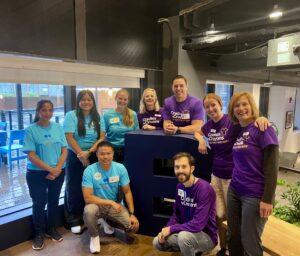
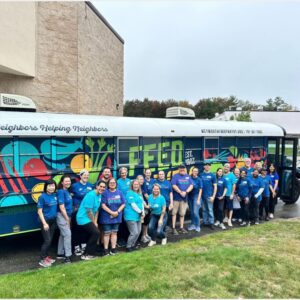
, impact is built on a 15-year promise to “show up, give back and repeat.” This mindset is exactly what has defined their signature Service Day initiative for the last 15 years.
What started in 2011 as an employee-driven effort to translate a corporate mission into hands-on impact has blossomed into one of the nation’s most recognized corporate volunteer programs. Today, Blue Cross doesn’t just participate in community service; they set the standard for what a high-impact employee volunteering program looks like.
Engagement By the Numbers
82% Volunteer Rate: While the national corporate average hovers around 20%, Blue Cross consistently sees more than four times that engagement.
$12 Million Invested: Since its inception, the program has driven massive community investment through direct labor and financial contributions.
45,000 Acts of Service: From packing kits to virtual consulting, the scale of impact is immense and the cause areas diverse.
This is a culture that prioritizes frontline employee engagement and has seen results in action. Through the BlueCrew Leadership Council, more than100 colleagues participate in year-round civic leadership development, ensuring that when Service Day arrives, the projects are led by passionate, trained internal stakeholders.
Trust-Based Philanthropy in Action
At the heart of Blue Cross’s strategy is a commitment to trust-based philanthropy. This means moving away from traditional charity and toward long-term, mutually beneficial partnerships where nonprofit voices lead the way. For example, their 15-year partnership with
has resulted in over 135,000 essential kits for children.
“Through critical funding and volunteer support, Blue Cross fuels our mission to ensure that children in our community have the basic essentials they need to thrive at home and in school—including warm winter coats and backpacks.”
— Alicia Kabir, executive director of Cradles to Crayons Massachusetts
, Blue Cross ensures its efforts contribute to truly sustainable communities. Rather than imposing a pre-set agenda, this approach allows nonprofits to define their own metrics for success, ensuring that volunteer hours and resources are directed toward the most urgent local needs, like food insecurity or youth mentorship.
Innovation and Inclusivity
As the landscape of volunteering has changed, Blue Cross has changed with it. To ensure every employee can “show up,” they’ve pioneered a hybrid volunteering model. Whether it’s community-based work, in-office building projects or virtual, skills-based volunteering, the program is designed to be inclusive of geography, mobility and schedule.
As Blue Cross celebrates its 15th anniversary of Service Day, the theme remains: Show Up. Give Back. Repeat. The future holds even deeper integration of digital service and an expanded geographic reach, maintaining their status as a national leader in the healthcare sector and a perennial honoree on
Success stories like Blue Cross Blue Shield of Massachusetts don’t happen in a vacuum. They’re fueled by a network of peers and resources that help CSR leaders navigate the complexities of modern social impact.
If your company is looking to build a program with this kind of longevity and impact, consider the
l, which provides the tools, research and peer-to-peer connections necessary to turn something like a single day of service into a year-round engine for change.
Ask a CSR Friend: Building a Culture of Service by Keeping Volunteering Going Year-Round
Looking for CSR advice?
Hear from our experts right here in our Ask a CSR Friend monthly column.
Whether you’re a novice or a seasoned pro, we know collaboration is key to creating vibrant workplaces where employees are equipped to contribute to the communities and causes they care about. So, when you need a trusted advisor to lean on, rely on Points of Light to be Your CSR Friend. Each month, our experts share their wisdom and wit to address a specific but often universal challenge related to your work as a corporate social impact practitioner.
Have questions about employee community engagement? Submit your question and it may be featured in a future blog post.
Dear CSR Friend,
Every year, interest and engagement for employee volunteering spikes around Giving Tuesday and runs through the holidays. Then, it drops off fast in January. We go from full calendars, an inbox full of team volunteer photos, and a ton of enthusiasm to…crickets!
I know our nonprofit partners need consistent, reliable support all year long (and frankly, so do the communities they serve). But it’s hard to maintain momentum when employees feel busy, stretched, and “tapped out” after year-end.
How can I keep volunteering from constantly being seen as a seasonal campaign, and instead build a culture of service that employees talk about, celebrate and sustain throughout the year?
Signed,
Seasonal in St. Louis
Dear Seasonal in St. Louis,
The end of the year is full of “service moments” and the start of the year is full of “service gaps.” And yet, the Giving Tuesday surge is proof that people want to show up when the invitation is clear and the energy is contagious. In 2025, Benevity
also showed growth in participation — including millions of people who volunteered.
[interrupter id=”1″]
The opportunity for CSR leaders is to treat Giving Tuesday as a spark, not the whole fire. Culture is what keeps it burning: visibility, recognition, storytelling, and an easy on-ramp for employees to keep showing up in ways that fit their lives.
The Bottom Line: Four Ways to Keep Volunteer Engagement Going Year-Round
1. Make Service Visible
If service only shows up in December recaps, employees will subconsciously categorize it as a “holiday thing.” Photos (and short captions) help service feel social, real and repeatable, and they reinforce that volunteering is part of your company’s identity year-round.
Create a monthly “Moments of Service” collage for internal channels (not just the holiday newsletter).
Add a simple prompt: “What did you do, who did it help, and what stuck with you?”
Invite team leaders to repost and tag their teams to normalize participation.
2. Reward and Recognize Behaviors You Want Repeated
Recognition isn’t fluff, it’s a retention strategy. When employees see that service is noticed and valued, they’re more likely to make time for it again.
Add a recurring “Volunteer Shout-Out” in all-hands meetings or internal newsletters.
Recognize different types of contribution: first-timers, team captains, skills-based volunteers, and behind-the-scenes organizers.
Celebrate informal helping too (mentoring, meal trains, neighborhood support) so people see service as bigger than one event.
3. Move from Hours to Meaning
If you want year-round participation, you need year-round meaning. Stories help employees connect effort to impact and they help peers picture themselves doing the same.
Use a simple three-question story capture: What did you do? Who benefited? What changed (for them or for you)?
Rotate formats so it stays fresh: short quotes, quick videos, a “story of the month,” or an internal “impact wall.”
Give teams permission to be honest: it’s okay to get something out of volunteering (connection, pride, perspective).
4. Make January a Launchpad, Not a Drop-Off
One of the best ways to avoid the January slump is to plan your year like a playlist, not a single hit song. Build a steady rhythm with multiple entry points and set expectations so people can participate without burning out.
Create a 12-month “menu” of opportunities: recurring shifts, pop-up projects, and skills-based options.
Offer a “choose your cadence” approach (1 hour/month, 1 project/quarter, or 1 team day/year).
Provide a variety of experiences by varying causes and formats to keep energy high and prevent burnout.
Schedule a January re-entry moment: a New Year of Service kickoff with easy sign-ups and clear next steps.
If Giving Tuesday shows what’s possible when the world “lights up,” year-round culture is what keeps the lights on. Make service visible, celebrate it often, tell the impact stories, and plan a steady cadence that fits your employee’s lives year-round. That’s how volunteering becomes a habit and not just a season.
Until next time,
Your
®, an initiative of Points of Light, comes in, supporting corporate social responsibility teams through trusted benchmarking, measurement of key metrics, and connection to other leading CSR teams.
Now in its 14th year,
The Civic 50 recognizes the 50 most community-minded companies in the United States
, setting the standard for what high-quality corporate social impact really looks like. More than an award, it’s a roadmap, a measurement tool, and an annual pulse check for companies that want to lead with purpose.
If you’ve been debating whether to take the survey this year, this list might make the decision much easier.
1. Get Unmatched CSR Benchmarking to Strengthen Your Social Impact Strategy
Keyword focus: CSR benchmarking, corporate social impact strategy
One of the biggest challenges CSR leaders face is proving what’s working and identifying what’s not. Every company that completes
The Civic 50 survey receives a complimentary benchmarking scorecard
, offering a clear picture of how your programs compare to other purpose-driven companies.
With the latest updates, this year’s scorecard goes deeper than ever, helping CSR teams:
Identify gaps and growth opportunities
Strengthen employee volunteering and community engagement strategies
Set informed priorities for the year ahead
Demonstrate ROI to executives and stakeholders
Whether you’re refining a mature social impact program or building structure into a growing one, the benchmarking insights serve as a powerful planning and evaluation tool.
2. A Streamlined, More Actionable Survey Experience
CSR leaders don’t exactly have extra hours in their week and this survey gets that. The newly redesigned Civic 50 survey includes
simplified questions focused on practical, actionable insights
across employee volunteering, giving, and community engagement.
The streamlined approach gives you:
A faster completion experience
Questions aligned with the work CSR teams actually manage
Data you can turn into immediate improvements
It’s not a heavy lift and the return on that investment of time is significant.
3. Gain Access to Expanded Recognition Opportunities
Even if your company doesn’t land in the top 50 (yet!), participating gives you access to
more than 10 newly added award categories
. These spotlight innovative programs, exceptional CSR leaders, and standout impact practices across the sector.
This means companies at any stage of their journey can be recognized for excellence in corporate citizenship, even if they are not a The Civic 50 honoree.
Recognition matters. It improves visibility, boosts employer brand reputation, and reinforces your company’s commitment to community impact.
4. Elevate Your Company’s Purpose Narrative with Stakeholders
When companies participate in The Civic 50, they’re signaling something important:
We take our role in the community seriously.
For senior leaders, communications teams, and external stakeholders, the survey becomes a platform to:
Demonstrate company-wide commitment to social and community issues
Showcase leadership in corporate social impact
Strengthen trust with investors, employees, partners, and consumers
The Civic 50 is widely recognized across the corporate and nonprofit sectors, appearing on this list, or even participating in the process, strengthens your credibility as a purpose-driven brand.
5. Empower HR to Attract and Retain Purpose-Driven Talent
Employee expectations have shifted. Workers, especially younger professionals, want to be part of organizations that live their values. Participation in The Civic 50 helps HR teams:
Highlight authentic social impact programs during recruitment
Drive employee pride in the company
Increase engagement through meaningful volunteering and giving opportunities
Quantify and communicate the value of purpose at work
CSR and HR are increasingly interconnected. The survey’s insights support both teams in building a workplace where employees feel connected to something bigger.
6. Celebrate and Validate the Work Your Employees Already Do
CSR work is often behind the scenes, powered by internal champions who don’t ask for the spotlight. Participating in The Civic 50 is a moment to celebrate their contributions—whether through volunteering, community partnerships, or innovative impact projects.
Employees love seeing their company recognized for doing good. It reinforces their efforts, builds community pride, and strengthens long-term engagement.
7. It’s Free, Confidential, and Comes With Real Value…Plus a Conference Bonus
A rare combination in the CSR world: there is no cost to participate.
Here’s what you get simply for completing the survey:
A complimentary benchmarking scorecard
Eligibility for all awards (not just the top 50)
A confidential evaluation—only honorees are publicly named
Understand how leading organizations build impactful programs
Gain recognition for social impact work
Strengthen their employer brand and stakeholder trust
Whether you’re a Fortune 500 company or a rapidly growing organization, the survey is built to meet you where you are.
Final Thoughts: The Civic 50 Is More Than Recognition. It’s a Strategic Advantage
CSR leaders often juggle competing priorities, limited budgets, and soaring expectations.
The Civic 50 survey offers a clear, practical way to evaluate your impact, benchmark against national leaders, and showcase meaningful work happening across your company.
If your team is committed to deeper impact, smarter strategy, and stronger community engagement,
Ask a CSR Friend: Capturing Employee Volunteer Hours for CRA (Community Reinvestment Act) Compliance
Looking for CSR advice?
Hear from our experts right here in our Ask a CSR Friend monthly column.
Whether you’re a novice or a seasoned pro, we know collaboration is key to creating vibrant workplaces where employees are equipped to contribute to the communities and causes they care about. So, when you need a trusted advisor to lean on, rely on Points of Light to be Your CSR Friend. Each month, our experts share their wisdom and wit to address a specific but often universal challenge related to your work as a corporate social impact practitioner.
Have questions about employee community engagement? Submit your question and it may be featured in a future blog post.
Dear CSR Friend,
I recently started a new job leading the employee volunteer program at a regional bank and am starting to learn all about the Community Reinvestment Act (CRA). The organization has a proud history of service and engagement in the local community; however, we don’t have a consistent system for tracking employee volunteer efforts. Our compliance team has been requesting more data in preparation for our CRA exam and while I want to make sure we’re capturing and reporting all the right information, I’m not sure where to start. What do I need to know to ensure our volunteer efforts qualify and are tracked appropriately to meet the CRA “service” test?
Curious in Cleveland
Dear Curious,
First, some good news is that CRA compliance and community engagement aren’t at odds. The same volunteer hours that uplift local communities can also help your institution demonstrate measurable impact to regulators.
[interrupter id=”1″]
Also, you’re not alone in figuring this out. In fact, Benevity’s
32% of large enterprises are focused on volunteering that counts toward regulatory requirements
. Many financial institutions recognize that employee volunteer programs can directly support CRA objectives, but they often struggle to connect the dots between community impact work and compliance. So, let’s break down what you need to know, step-by-step.
What exactly is the Community Reinvestment Act?
The Community Reinvestment Act (CRA), enacted in the US in 1977, encourages financial institutions to meet the credit and service needs of the communities they serve, particularly low- and moderate-income (LMI) neighborhoods. The regulations were updated in 2023 to reflect changes in how financial institutions engage communities, including recognition of digital delivery channels and more detailed guidance on community development services. These updates reinforce the importance of documenting how volunteer activities support community development, especially when tied to financial capability or economic inclusion.
As the
Since regulators review several factors related to the community development services a financial institution provides, it’s important to focus on tracking volunteer activities to:
Document your institution’s commitment to community development
Identify how service aligns with your CRA assessment areas
Strengthen your CRA narrative with quantifiable, verified activity data
Connect your CRA performance with your broader CSR or ESG goals
Even beyond compliance, strong tracking practices let you celebrate your employees’ impact, measure engagement, and share stories that resonate with stakeholders.
Here’s one of the biggest lessons I’ve learned:
capture everything first, evaluate later
. Institutions can miss CRA credit opportunities simply because they don’t collect complete data. While not every volunteer activity qualifies, collecting all volunteer hours ensures you can later analyze and categorize them correctly.
Encourage employees to log all service, including:
Board or committee service for community organizations
Virtual or hybrid volunteering opportunities
When logging time, ask employees to record:
Organization name and mission
Type of activity and skills used
Location or community served
Hours volunteered
How do I analyze volunteer activities?
Use a CRA lens when evaluating activities:
Does it primarily benefit LMI individuals or communities?
Is it tied to financial capability, community development, or economic empowerment?
Can we document the location, beneficiaries, and skills used?
Your CRA or CSR team can then review submissions to determine which qualify under CRA standards. Over time, this approach builds a rich dataset that supports both compliance and storytelling.
You don’t have to reinvent the wheel! If you’re partnering with a CSR platform provider, connect with them to learn more about their tracking capabilities, as they’ve likely had experience working with other financial industry clients that are focused on CRA compliance.
And don’t forget to partner early with your compliance team. When they understand your volunteer programs and you understand their reporting needs, CRA documentation becomes a shared win, not a last-minute scramble.
What’s the bottom line?
Tracking volunteer hours for CRA compliance isn’t just a regulatory exercise; it’s your chance to show how your employees’ time and talent drive community progress. By clearly defining what qualifies, capturing all service, and keeping consistent data, you’ll strengthen both your CRA performance and your culture of service.
Until next time,
Your
Ask a CSR Friend: Responding to Food Insecurity and Volunteer Shortages — How Employees Can Make an Impact
Looking for CSR advice?
Hear from our experts right here in our Ask a CSR Friend monthly column.
Whether you’re a novice or a seasoned pro, we know collaboration is key to creating vibrant workplaces where employees are equipped to contribute to the communities and causes they care about. So, when you need a trusted advisor to lean on, rely on Points of Light to be Your CSR Friend. Each month, our experts share their wisdom and wit to address a specific but often universal challenge related to your work as a corporate social impact practitioner.
Have questions about employee community engagement? Submit your question and it may be featured in a future blog post.
Dear CSR Friend,
Lately, I’ve noticed a lot of headlines about rising food insecurity, especially as the recent government shutdown has impacted federal workers and families across the country. At the same time, I’m seeing more stories about food pantries struggling to find volunteers. It seems like the need is increasing, but the number of people available to help is shrinking.
As someone who helps lead employee engagement efforts at my company, I’m wondering: How can we best support our employees who care deeply about hunger issues, while also helping our communities facing these challenges? What’s the most meaningful way to take action when so many people are stretched thin?
— Concerned About Community in College Park
Dear Concerned About Community,
You’re not imagining it, food insecurity is rising, and volunteer shortages are compounding the challenge. Across the country, local news stories and nonprofit leaders are sounding the alarm: demand at food banks is up, donations are stretched thin, and volunteer rosters are shrinking.
[interrupter id=”1″]
Many long-time food pantry volunteers are aging out, while younger people — juggling rising living costs and demanding schedules — are gravitating toward one-time, event-based opportunities. According to a
, about 20% of all volunteers contribute through a mix of online and in-person service, reflecting both a shift in how people serve and the strain organizations are feeling.
As
, “We’re an overwhelmed and overworked society. The rising costs of everything, and in particular the cost of housing, means that people have to work more.” That reality has reshaped how people show up to serve — and how companies can support them.
This moment offers a powerful opportunity for CSR and employee engagement leaders to step up. The holidays often spark an interest in volunteering, but the growing need and changing volunteer dynamics make now a critical time to connect purpose to action.
The Bottom Line: Four Ways Employees Can Take Action
As food insecurity rises across the country, this is an important moment to help employees take meaningful action. Here are four tangible ways they can make a difference.
1. Volunteer — Every Hour Makes a Difference
Food pantries and meal programs are seeing shortages in volunteers just as demand increases. Encourage your employees to get involved — even if only for a few hours. Flexible, event-based volunteering fits today’s busy lives, and employers can help by:
Offer volunteer time off (VTO) so employees can volunteer to support food insecurity on their own schedules.
Host on-site service projects like food packing or sorting events.
Partner with local food banks for group volunteer days.
Every hour matters. Even short-term engagements can make a big difference in keeping shelves stocked and meals delivered.
2. Donate Food — Thoughtfully and Respectfully
In addition to time and money, food donations remain a vital source of support for community pantries. When encouraging employees to participate in food drives or drop-off events, remind them to donate food they themselves would want to eat — not just items collecting dust in the back of the pantry.
Respectful giving means choosing nutritious, high-demand staples (like canned proteins, pasta, rice, peanut butter, and shelf-stable fruits and vegetables) and avoiding expired or overly niche foods. You might even consider sharing a “most-needed items” list from your local food bank to make donating easier and more intentional.
3. Give — and Make Every Dollar Go Further
When time is limited, financial support can be just as impactful. Encourage employees to donate and leverage matching gifts or payroll deductions to multiply their contributions. Many employees don’t realize their company already offers these programs — a well-timed reminder or spotlight can dramatically increase participation.
Consider highlighting trusted partners like
, which connects donors directly to local food banks.
4. Share Resources — Because Hunger May Be Closer Than You Think
Food insecurity doesn’t only affect the broader community, it can impact our coworkers, neighbors, and friends. Normalizing conversations about food access is a powerful form of support.
Encourage employees to share and use resources like:
FoodFinder.us: An online map connecting people to free food programs in their area
Promoting these tools internally can help ensure that anyone in need, even within your own organization, knows where to turn.
Meeting the Moment
As CSR and employee engagement professionals, we’re uniquely positioned to help employees act on what they care about most. The challenges of today, from economic stress to volunteer shortages, require flexibility, creativity and compassion.
By encouraging volunteerism, promoting thoughtful food donations, amplifying giving programs, and sharing essential resources, your company can help employees make a meaningful impact right now, for themselves, their colleagues, and their communities.
Until next time,
Your
Ask a CSR Friend: Leveraging the Employee Engagement Survey to Support Your Employee Volunteer Program
Looking for CSR advice?
Hear from our experts right here in our Ask a CSR Friend monthly column.
Whether you’re a novice or a seasoned pro, we know collaboration is key to creating vibrant workplaces where employees are equipped to contribute to the communities and causes they care about. So, when you need a trusted advisor to lean on, rely on Points of Light to be Your CSR Friend. Each month, our experts share their wisdom and wit to address a specific but often universal challenge related to your work as a corporate social impact practitioner.
Have questions about employee community engagement? Submit your question and it may be featured in a future blog post.
Dear CSR Friend,
Help! After years of asking for space in the annual employee engagement survey, I’ve finally been given a chance to include a question or two on volunteering. However, now I find myself unsure about what to ask and how to ask it to gather the most valuable insights. How can I make the most of this long-awaited opportunity?
Survey-ready in San Antonio
Dear Survey-ready in San Antonio,
First, take a moment to celebrate your achievement — securing a spot in the employee engagement survey is no small victory! You’ve opened a new channel for elevating the role of volunteering at your company. Now the challenge is making those precious survey questions work hard for you.
The key is to start with your strategy – begin by clarifying what insights will be most beneficial for your CSR initiatives and your organization. Are you aiming to understand the impact of volunteering on employee engagement, wellbeing, company culture, or professional development? Pinpointing your goals will help you tailor your questions for actionable results. Here are some sample questions for key areas to consider:
Fostering Belonging
To what extent does volunteering with [INSERT COMPANY NAME HERE] help you build new or deeper relationships with your colleagues?
Supporting Wellbeing
If at all, how much does volunteering help reduce your stress / improve your mood / strengthen your sense of purpose working at [INSERT COMPANY NAME HERE]?
Tip: Choose one option or separate into multiple questions to better isolate the responses.
Strengthening Company Culture
Do you believe [INSERT COMPANY NAME HERE]’s volunteer experiences play a meaningful role in shaping and strengthening our company culture?
Promoting Personal or Professional Growth
To what extent did participating in this volunteer project help you develop or improve any personal/professional skills?
Tip: Choose one option or separate into multiple questions to better isolate the responses.
Increasing Workplace Satisfaction
If at all, how does volunteering affect your sense of pride in working at [INSERT COMPANY NAME HERE]?
Next, it’s important to frame the questions in the best possible way to get usable data. Phrases like “If at all…” or “To what extent…” may seem small, but they can help shape the quality of data returned by encouraging honest, nuanced feedback and avoiding forcing participants into binary positive/negative responses. Watch out for double-barreled questions – avoid combining multiple topics in a single question; instead, split them to clarify what respondents are addressing.
Don’t forget that while inclusion in the annual survey is a significant opportunity, it shouldn’t be the only method for gathering feedback. Consider these additional strategies:
Post-Event Volunteer Surveys: Implement or update surveys following volunteer events to capture immediate feedback.
Pulse Surveys: Use company-wide chat platforms like Slack or Teams for quick, focused polls.
Giving & Volunteering Platforms: Leverage tools such as Benevity or YourCause to integrate feedback mechanisms directly into your volunteer programs.
Your survey space is precious real estate. By thoughtfully designing survey questions anchored in business priorities, framing them clearly, and diversifying your feedback methods, you’ll gain richer insights into the value and impact of volunteering at your company. This data can help you advocate for continued investment in CSR initiatives, demonstrate the benefits of your programs to leadership, and ultimately cultivate a more engaged, fulfilled workforce.
Good luck with your survey, and congratulations again on taking this important step toward amplifying the voice of volunteers at your workplace!
Until next time,
Your
, this roundup highlights new and emerging research and trends shaping the nonprofit sector. We hope these insights help you champion volunteering in your community.
A new study indicates that attending live, in-person events—especially recurring ones with friends—can enhance social connections and reduce loneliness. Active involvement (conversation, hands-on activities) was key to feeling more connected. While effects diminish after a day, consistent in-person gatherings like volunteer activities may sustain benefits. Useful implications for volunteer managers weighing in-person vs. virtual engagement. The team also created a toolkit,
Using Global Flourishing Study data (200,000+ people, 22 countries), researchers found education and religious service attendance consistently predict formal volunteering, while age, marital and immigration status matter less. Gender and employment type also shape participation. Findings point to reducing barriers and expanding access.
Among 8,000+ adults near retirement, about one in five volunteered and a similar share provided informal care. Retirees, part-time workers, women and those with good health/financial security were more likely to volunteer; full-time work reduced participation.
Study of “super volunteers” identified three types—ideal workers, supporting actors and thrill seekers—each navigating freedom differently. Autonomy can both enable and undermine meaningful work, suggesting managers tailor roles and supervision.
Volunteers driven by intrinsic motivations showed significantly higher psychological well-being than those motivated by external rewards, reinforcing the value of purpose-aligned roles.
Corporate volunteering strengthens communities and boosts employee skills, satisfaction and cohesion, aiding talent attraction and brand reputation. Authors call for standardized metrics to better assess social impact.
They complement each other: people engaged in one often engage in the other. Income predicts both forms more than time availability; formal volunteering is more sensitive to resource fluctuations.
Trust in authorities and expectations of reciprocity increase disaster volunteering. Other-focused values predict more frequent helping, offering cues for effective engagement strategies.
Ask a CSR Friend: Engaging Remote and Hybrid Employees in Meaningful Service
Looking for CSR advice?
Hear from our experts right here in our Ask a CSR Friend monthly column.
Whether you’re a novice or a seasoned pro, we know collaboration is key to creating vibrant workplaces where employees are equipped to contribute to the communities and causes they care about. So, when you need a trusted advisor to lean on, rely on Points of Light to be Your CSR Friend. Each month, our experts share their wisdom and wit to address a specific but often universal challenge related to your work as a corporate social impact practitioner.
Have questions about employee community engagement? Submit your question and it may be featured in a future blog post.
Dear CSR Friend,
While I personally love the flexibility of my hybrid work situation and that our company continues to support remote and hybrid opportunities for our team members, I’ve seen a noticeable decrease in volunteer participation. With varying schedules across time zones and roles no longer having a central meeting place in a large, corporate office, it’s been a struggle to engage our workforce in meaningful volunteer opportunities. The Zoom fatigue is real and I’m running out of ideas that aren’t solo activities. What would you suggest to help engage a dispersed team?
Struggling in Seattle
Dear Struggling in Seattle,
At the risk of sounding cliché…the struggle is real!
For many of us the rise of remote and hybrid work models became increasingly prevalent following the COVID-19 pandemic, however, they’ve been in existence for many years prior. NASA engineer Jack Nilles known as the “father of telecommuting” first initiated this concept in the 1970s with early corporate experiments following in the 80s and 90s becoming more formalized as the internet enabled hybrid opportunities beyond just large corporations.
Today, while many large companies have enacted return-to-office mandates, U.S. work locations have
. However, when done effectively, these sessions can help employees feel more connected to the organization’s culture, increase team collaboration, foster working relationships, and promote cross-functional communication and collaboration.
So, where can you start?
1. Understand Operational Realities
Design volunteer initiatives that recognize the diverse schedules and responsibilities across your workforce. For teams spanning multiple time zones, consider extending volunteer opportunities over several days or even an entire week. This flexibility maximizes participation and ensures that everyone, regardless of location, can engage meaningfully.
, flex time, and company-wide service days are available to all employees, whether remote, hybrid, or on-site. By extending these benefits universally, you foster a culture of inclusion and demonstrate that every team member’s contribution is valued.
3. Empower Local Champions
Cultivate a network of volunteer ambassadors who can share information, motivate participation, and coordinate grassroots efforts tailored to their local communities. This is also a great opportunity to engage your ERGs to help reach employees across roles.
4. Offer a Variety of Options
Diversify your volunteer opportunities to accommodate different interests and working styles:
Virtual, skills-based volunteering such as translating materials, designing websites, or handling data entry.
Asynchronous projects like writing letters or recording audio versions of children’s books, allowing employees to participate on their own schedule.
Hybrid events that blend live, in-person activities with virtual components, ensuring everyone can join in regardless of location.
Pro tip: Hold a joint kick-off all together and then separate the virtual group into their own “breakout room.” Assign a dedicated facilitator for each “room” – virtual and in-person.
At-home, hands-on activities that can be completed individually or with family members.
On-site activities held during company gatherings or in-person meetings.
When in doubt, ask your employees what activities and cause areas they might be interested in to help generate buy-in.
5. Solicit and Act on Feedback
Establish regular feedback channels that encourage employees to share their experiences, suggestions, and concerns. Use this input to continuously refine your programs, demonstrating your commitment to building trust and meeting the evolving needs of all employee groups.
Ultimately there’s no magic fix for virtual fatigue. Instead of chasing a one-size-fits-all solution, try approaching it like a good CSR strategy: from multiple angles. Tackling the problem from a few directions gives you the best shot at real participation—and a more energized, connected crew.
Until next time,
Your
Ask a CSR Friend: Building an Effective Employee Volunteer Program Framework
Looking for CSR advice?
Hear from our experts right here in our Ask a CSR Friend monthly column.
Whether you’re a novice or a seasoned pro, we know collaboration is key to creating vibrant workplaces where employees are equipped to contribute to the communities and causes they care about. So, when you need a trusted advisor to lean on, rely on Points of Light to be Your CSR Friend. Each month, our experts share their wisdom and wit to address a specific but often universal challenge related to your work as a corporate social impact practitioner.
Have questions about employee community engagement? Submit your question and it may be featured in a future blog post.
Dear CSR Friend,
I’ve previously worked at companies with well-established employee volunteer programs but just started an exciting new role at a company looking to create an employee volunteer program and have no idea where to begin! How can I develop something people want to be a part of and aren’t just checking the box because their leader “voluntold” them for something? How can I build a program that supports both the company and the community? What are the nice to haves versus the need to haves?
Wondering Where to Start in West Allis
Dear Wondering Where to Start,
First, let’s take a deep breath and remember all those well-established employee volunteer programs out there had to start somewhere! They weren’t all successful right away and it most likely took them years to get to where they are now –
years
of learning, adapting and growing.
Next, let’s start with a few key building blocks to get you on your path towards a successful Employee Volunteer Program (EVP) framework – Listen. Learn. Lead.
BUILDING BLOCK #1: LISTEN
To develop a truly successful EVP, you’ll need to listen and gather feedback from your key stakeholders to build a program that supports business purpose and priorities, is aligned with organizational values and core competencies, addresses employee motivations, and delivers on community needs (as communicated by the community!).
Conduct a listening tour across the company and have conversations with both supporters and detractors to get a full picture of what YOUR specific company needs and build ownership and buy-in as you develop solutions. This could look like focus groups, employee surveys, one-on-one conversations, as well as reviewing existing internal policies and related programs.
Consider a landscape assessment where you can listen for learnings from your peers & competitors and evaluate what they are doing that might work for your program and what you can leave behind that doesn’t suit your needs.
Engage nonprofit partners to understand their needs and co-create an employee engagement program that aligns company resources with community-driven goals.
BUILDING BLOCK #2: LEARN
Once you’ve gathered and analyzed all those inputs, start building your program with an eye towards continuous improvement. Don’t be afraid to try things out – pilot new ideas, learn what works and doesn’t, adjust accordingly and try again!
Outline clear goals and objectives for your EVP framework so you can measure where you’re successful and learn where there’s opportunity to grow along the way.
Define your program offerings – you don’t have to launch with everything but clearly define what you will launch with and then add on as needed/as you grow.
Create clear and concise guidelines alongside eligibility criteria, with a focus on removing barriers for employees to volunteer. Creating an accessible program that understands cultural context, local priorities and varying role responsibilities will be needed to scale your program and meet employees where they are.
Determine process & system needs to reduce friction and enhance engagement for your employees.
How will your employees find & sign up for volunteer opportunities?
What will you need to track & measure impact of your volunteer program?
What kind of training and orientation will you provide?
Establish a communication strategy that will support your EVP as a visible and celebrated element of your company culture. Develop resources to educate and equip middle management.
Pilot, test, adjust and repeat. Leverage insights from successes and challenges to drive continuous improvement. Allow ongoing space for adaptability as business needs change, new generations join the workforce, community priorities evolve, etc.
Establish mechanisms to monitor and assess program performance. Collect quantitative data (e.g., hours volunteered, projects completed) and qualitative feedback (e.g., employee testimonials, community partner input). Regularly analyze results to identify strengths, address challenges, and refine your strategy. Share impact reports with stakeholders to demonstrate value and accountability.
BUILDING BLOCK #3: LEAD
Once you’ve established an EVP framework that works for your company, engages your employees and supports your community, share what you’ve learned and help lead others in the field!
Establish impactful measurement practices that go beyond inputs and outputs and use that data for responsible and ethical storytelling.
Highlight how volunteering helps employees build skills, expand networks, and find personal fulfillment, reinforcing both individual and organizational benefits.
Continue to advocate for the inclusion of community voice in your programs and commit to trust-based, responsive and transparent relationships with your nonprofit partners. Monitor emerging community needs and adapt your program to evolving challenges.
Educate your employees on why civic engagement matters and all the ways they can get involved in their communities whether at work or on their own.
Developing an effective EVP framework is both an art and a science. It is not a one-size-fits-all effort. It requires careful listening, thoughtful planning, willingness to iterate, an understanding of what inspires your employees, and a commitment to sustained, meaningful action. With a clear strategy, strong leadership support, and a culture that celebrates giving back, organizations can create powerful change—fostering connection, developing talent, and leaving a lasting legacy in the communities they serve.
Whether you are starting from scratch or revamping an existing program, these building blocks can help you establish an EVP that is impactful, inclusive and aligned with your company’s purpose. Now is the time to harness your organization’s collective energy to create change through volunteering and civic engagement.
Until next time,
Your
Ask a CSR Friend: Designing a Multigenerational Volunteer Strategy
Looking for CSR advice?
Hear from our experts right here in our Ask a CSR Friend monthly column.
Whether you’re a novice or a seasoned pro, we know collaboration is key to creating vibrant workplaces where employees are equipped to contribute to the communities and causes they care about. So, when you need a trusted advisor to lean on, rely on Points of Light to be Your CSR Friend. Each month, our experts share their wisdom and wit to address a specific but often universal challenge related to your work as a corporate social impact practitioner.
Have questions about employee community engagement? Submit your question and it may be featured in a future blog post.
Dear CSR Friend,
We have five generations represented in our workforce from Gen Z to a handful of retired employees who are still involved. I’m finding it increasingly hard to design a volunteer initiative that resonates across the board. What excites and energizes younger employees seems to barely move the needle with more tenured, mature staff. Do you have advice on how to build a multigenerational employee volunteer strategy that meets the majority of needs and expectations?
Signed,
Juggling Generations in Jacksonville
Dear Juggling,
There’s a joke that goes, “Five generations showed up to a company volunteer project: one brought a clipboard, one brought snacks, one brought caffeine, one brought a gratitude journal and one brought a ring light. Guess who’s already gone viral?”
Sure, this AI-generated joke is groan-worthy, but it’s also representative of an existing workplace reality. For the first time in history, five generations are clocking in side by side, each with distinct values, communication styles and ideas about what it means to contribute to something bigger than themselves. However, according to
, Changing Our World’s 2024 report, two-thirds of employees across all generations want companies to commit to long-term social impact using their unique skills and expertise to address community issues.
For corporate social impact leaders, the key isn’t to build five separate programs. It’s to design an adaptable, inclusive strategy that lets people connect with purpose in their own way. The real magic happens when we stop designing for assumed generational preferences and start co-creating with employees by listening to their lived experiences, motivations, barriers and the causes that matter most to them. How do you do that, you ask?
START HERE: LISTEN BEFORE YOU BUILD
Don’t rely solely on articles or studies (even this one!) to guess what each generation wants. Ask your people directly. Yes, trends can guide you, but people are people first. Generational labels only go so far. The best thing you can do is lead with curiosity, not assumptions. Just as in community development, effective solutions start with the voices of those they’re meant to support.
Before you design, ask:
What inspires you to volunteer?
What causes or experiences feel most meaningful?
What would make volunteering more rewarding and more accessible?
Use pulse surveys, focus groups or even casual “coffee & conversation” chats. And invite retired employees, too. They often have the time, wisdom and desire to contribute, but rarely get asked. This isn’t just about inclusion; it’s about relevance. Even the most beautifully branded initiative will flop if it doesn’t reflect the real needs, real schedules and real values of the employees it was designed for.
A QUICK GENERATIONAL TOUR
Here’s what we do know about the generations and what they value:
Silent Generation (Born before 1946): The Legacy-Driven Volunteers
Many see service as a civic duty, not a workplace perk. They value:
Long-term, high-impact commitments
Clarity, formality and respect
Opportunities to meaningfully share their expertise
Silent Generation Tip:
Offer mentorship programs, board roles and strategic projects. And yes, handwritten thank-you notes go a long way.
Boomers (Born 1946–1964): The “I Show Up” Generation
Boomers often lead by example. Although slower to adopt tech solutions, they have a strong sense of civic responsibility and are often your most consistent volunteers. They’re ready to roll up their sleeves and make a visible difference. They value:
Hands-on projects with tangible outcomes
Team-based service
Recognition for their efforts
Boomer Tip:
Offer in-person events like packing meals or sorting donations. Consider inviting retirees to serve as “volunteer mentors” for younger employees.
Gen X (Born 1965–1980): Your Pragmatic Problem-Solvers
Independent and often managing work, kids and aging parents, Gen X values efficiency. They won’t waste time, but they will show up for what matters. They value:
Skills-based, longer-term but flexible opportunities
Independence and impact
Family-friendly options
Gen X Tip:
Think pro bono consulting, project-based volunteering or virtual options that respect their packed calendars. Give them tools and the opportunity to include their families; they love a teachable moment.
Millennials (Born 1981–1996): The Purpose-Driven Planners
Millennials want alignment. They want to see your company walk the talk, and they want a seat at the table while it happens. They value:
Mission-driven opportunities that lead to personal development
Leadership and co-creation
Transparency and results
Millennial Tip:
Invite them to co-lead programs, build partnerships and drive innovation. Share outcomes openly. They want to see the “why” and the “what happened.” Many are also juggling familial responsibilities, so microvolunteering efforts appeal to them.
Gen Z (Born 1997–2012): The Activist Newcomers
Values-led and bold, Gen Z isn’t interested in performative gestures. They want action and impact, and they want it fast. They value:
Authenticity
Digital-first, creative approaches
A voice in shaping efforts
Gen Z Tip:
Support advocacy-focused volunteering, employee-led campaigns and social-friendly storytelling. Gen Z doesn’t just want to serve; they want to mobilize. Give them the mic and then get out of the way.
A CHECKLIST FOR MULTIGENERATIONAL ENGAGEMENT
Building an employee volunteer strategy that spans generations doesn’t mean pleasing everyone; it means making space for everyone. Here’s how:
Ask before you assume. Don’t build for Gen Z based on a LinkedIn post; ask a Gen Zer.
Offer multiple entry points. Include virtual, in-person, one-time, long-term, traditional, skills-based, on-and off-site and family-friendly options.
Center co-creation. Form mentor matches, intergenerational councils or annual planning teams. Your best ideas might come from the people least like you.
Celebrate all styles of service. Whether someone logs 100 hours on a nonprofit board or delivers one powerful workshop for nonprofit HR leaders, highlight their impact equally.
Communicate impact in many ways. Some want charts in email form. Some want a good story during an all-staff meeting. Use both.
Include retirees. Keep the door open for those who have left the building, but not the mission.
Stay curious. Gen Alpha isn’t here yet, but they’re coming. Keep listening and adapting, because the future of your workforce is already taking shape.
FINAL THOUGHTS: BUILD WITH, NOT FOR
When people of all ages feel seen, heard and invited to lead with purpose, something powerful happens: generational gaps shrink and workplace culture deepens. You don’t need a PhD in generational theory to get this right. You need meaningful questions, genuine curiosity and a willingness to build with—not just for—your employees.
Let your strategy be rooted in long-term vision and flexible enough to reflect how each generation defines impact. Your people will meet you there.
Until next time,
Your