White House Gathering Explores Ways Pro Bono Volunteers Strengthen Nonprofits
Engineers, marketers, software developers and other highly skilled professionals are lending their know-how as pro bono volunteers to help nonprofits achieve their missions – with the blessing of the companies that employ them.
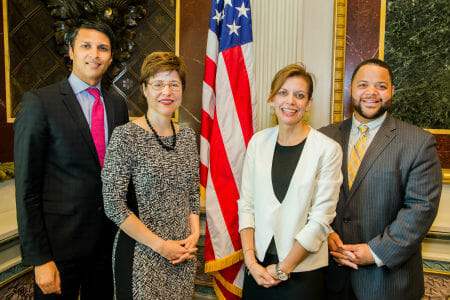
From left: Asim Mishra, chief of staff, Corporation for National and Community Service; Melissa Rogers, special assistant to the president and director, White House Office of Faith-Based and Neighborhood Partnerships; Tracy Hoover, CEO, Points of Light; Michael Smith, special assistant to the president and senior director of cabinet affairs for the My Brother’s Keeper Initiative (Photo courtesy JPG Photography)
Showcasing the growth and strength of the pro bono movement, companies in attendance – the vanguards of pro bono – shared new tools and partnerships that help nonprofits advance their work and create more sustainable change.
“Today, let’s start building a new normal in pro bono service,” Points of Light CEO Tracy Hoover told the guests. “Let’s build a model that addresses the reality of scarce resources, limited time and increased needs that so many nonprofits feel.”
Hoover added that pro bono leaders “are improving this pro bono ecosystem by building resources that allow nonprofits to better leverage pro bono service.”
Senior leaders from several companies introduced new resources and programs designed to strengthen nonprofits, including:
Value Exchange – Based on years of researching, advising and developing high-quality, public-private partnerships, Deloitte has developed the Value Exchange tool – a simple framework for articulating the kinds of value that a nonprofit offers for-profit partners and what the nonprofit expects in return.
HP Advising – Through this service, nonprofits are matched online with HP employee volunteers who provide advice in particular areas – based on expertise – including branding, IT, business planning, managing staff, recruiting volunteers and other key business areas.
IBM Impact Grants – These grants provide consulting expertise and software designed to support education and nonprofit organizations through an array of capacity-building offerings, including strategic growth advising, business analytics support and security.
For more about skills-based and pro bono service, visit A Billion + Change.
The Strengths of Community-Minded Companies
The following is an excerpt of “The Civic 50: Best Practices in Corporate Community Engagement,” by Yvonne Siu Turner, senior manager of corporate resources and programs at Points of Light, published byThe Conference Board. You can read the full version here.
Data from The Civic 50 – a Points of Light initiative that recognizes the 50 most community-minded companies in the nation – suggest we’re living in a world in which companies increasingly play a positive role in meeting community needs, through the power of their people and the power of their financial contributions.
Four strengths of The Civic 50, presented below, suggest companies are expanding and deepening their involvement in their communities by strategically integrating community engagement into their business strategies.
HP, for example, has data showing that employees who participate in community engagement efforts have 13 percent higher morale than those who don’t participate. Similarly, Hasbro’s employee survey revealed that the second-most referenced reason employees “love working at Hasbro” is the community engagement program, behind “year-round half-day Fridays.”
Companies and communities find value in skills-based volunteering
Skills-based volunteering continues to grow at Civic 50 companies, and, on average, one out of every five employee volunteer hours at Civic 50 companies is skills-based. Moreover, approximately 50 percent of companies offered pro bono service opportunities in 2013.
Skills-based volunteering provides communities with valuable, specialized support that can provide five times greater value than traditional volunteering, according to True Impact and the Bureau of Labor Statistics.
Two-thirds of Raytheon’s employees are engineers who use their skills to support communities through mentoring programs, including Stand & Deliver, Math Nights, and LASER – part of a nationwide effort to connect students with some of the world’s foremost engineers and business leaders.
Companies raise their voice to advance social change
Just over 80 percent of Civic 50 companies have taken a national leadership position on a social issue like ending hunger, texting and driving, and strengthening STEM (science, technology, engineering and math) education. Many companies invest in issues related to their own operations and are, therefore, often in a unique position to contribute lasting solutions.
Through the provision of health care solutions to the U.S. population, Aetna has significant experience with the effects of inequality in health care and has subsequently taken a leadership role in addressing these inequalities.
In 2002, for example, Aetna developed a policy on genetic testing and nondiscrimination that became the model for the industry.
In 2008, it worked with legislators to help pass a more meaningful mental-health parity law that allows for better coordination of coverage for physical and mental health care services. Aetna was an active voice throughout the health care reform debate of 2009 and 2010.
Purpose is aligned with profit
Research shows that solid business performance often accrues to companies that engage with their community.
For example, Harvard Business School found that companies with more community engagement practices significantly outperform their counterparts over the long-term, in terms of both stock market and accounting performance.
And market research has revealed that 56 percent of Americans will travel an extra 10 minutes out of their way to purchase a product that supports a cause they care about and that 71 percent are willing to pay more for that product.
More than 80 percent of Civic 50 companies integrate their community engagement into at least one of three business areas: marketing, skill development, and diversity and inclusion.
Whether they’re in the communications, technology or materials sector, Civic 50 companies have increased the impact of their community engagement by deepening the involvement of their employees, business units and other aspects of their operations.
Civic 50 companies are building and sustaining vibrant communities and tackling social challenges with greater seriousness than ever.
The Cost of Doing Nothing
This post is by Tracy Hoover, Points of Light’s CEO.
Employees have stopped writing #RaceTogether on cups at
. Representatives from 60 of the nation’s largest companies gathered to share lessons from and leadership of the corporate volunteer service movement.
The topics and issues discussed ranged from how to expand global volunteerism to increasing the impact of service projects that can be done in a single day. Over a meal we call
more than 100 corporate social responsibility professionals talked about how to increase racial and cultural understanding and promote unity.
Starbucks – a leader of the Corporate Service Council since its founding 10 years ago – was never far from anyone’s mind. When dealing with the toughest social problems, has the risk of doing anything become too great?
The final speaker of the meeting may have provided the answer. Harvard social scientist
– shared his research on the growing inequality of opportunity for America’s poorest children.
When it comes to college completion, one of the most important markers of success and opportunity, Putnam told us the class gap is steadily expanding. Eighty percent of kids in the highest income quartile will graduate from college, compared to 10 percent of kids from the lowest quartile. High school students who are involved in extracurricular activities are 400 percent more likely go to college than those who aren’t.
Yet American high schools with affluent students offer twice as many team sports as high-poverty schools, and more than twice as many non-sports activities like band and chess club. With many schools charging families for extracurricular activities, placing them out of reach for the students who need them most, we should not be surprised by the outcome.
Children growing up in poverty today are increasingly isolated by what Putnam called “the savvy gap.” Better educated and wealthy Americans have wider and deeper social networks that help kids navigate school choices, college admissions, employment and even health issues. And while most well-off children place their trust in adults, six out of seven poor kids do not.
As Putnam spoke, using statistics and stories to show that the American dream is slipping increasingly out of reach for kids from low-income families, I thought back to #RaceTogether.
As with the critical and complex issue of race relations, standing on the sidelines while our kids are being hurt by everything from the cost of extracurriculars to the lack of mentors to the scourge of racism is simply not an option. All of us – individuals, companies and communities – need to be
more
engaged in the future of our kids and country, not less.
Thank you, Starbucks, for doing something and paying the price. The cost of doing nothing is far too high, for us and for our kids. And if Starbucks wants to continue a national conversation, count me in.
Giving Women Entrepreneurs a Place to Refine and Expand Their Civic-Minded Ideas
While serving as executive director of the NASCAR Foundation, Sandy Marshall noticed a worrying trend for girls. They are consistently left out of opportunities in science, technology, engineering and math, though emphasis within schools in these areas is growing.
Sandy Marshall
Recent research backs her observations. According to the
. Through summer camps, one-day programs and mentoring and volunteer opportunities for women and girls, Marshall is bringing like-minded girls together for education, mentoring and encouragement.
Just like she got from the Points of Light Civic Accelerator.
Since 2012, the Civic Accelerator has supported and invested in innovative, civic-minded social entrepreneurs, providing a rich curriculum in lean start-up methods, networking opportunities, as well as mentoring and coaching. The boot-camp-style program gives these leaders a place to test ideas in the early stages of their nonprofit or for-profit ventures, get sage advice from a range of experts, and recruit potential partners, investors and clients.
From the beginning, the
has been there – a founding sponsor of the accelerator and its largest, having invested $1.8 million in the program with PwC executives also participating on the Advisory Panel and selection committee for the cohorts, reviewing cohort applications, acting as mentors and coaches to some of the entrepreneurs and as faculty to the program.
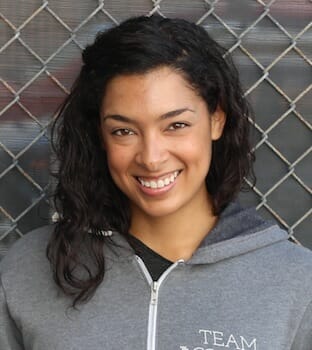
Laura Weidman-Powers, center, CEO and co-founder of Code2040, participates in a session of the Civic Accelerator.
– which honors women entrepreneurs globally, the Foundation deepened its commitment to the Civic Accelerator and to female entrepreneurship. That day at the United Nations, Shannon Schuyler, Principal and Corporate Responsibility leader at PwC and President of the PwC Charitable Foundation, and Ayesha Khanna, President of the Civic Accelerator, announced that the spring 2015 cohort of the Civic Accelerator would focus on women and girls.
The question posed to potential participants: How might we create greater opportunities for women and girls to succeed in today’s economy?
“We want to support entrepreneurs – most of whom will likely be women – who are leading breakthrough solutions to better enable women and girls to fully and successfully participate in our global economy,” Khanna said.
By design, the Civic Accelerator was created to attract and support diverse entrepreneurs, including women and minorities, as well as founders from various places, backgrounds and sectors. Out of 61 participating ventures since 2012, nearly half were founded by women. Half of the $500,000 awarded to date to accelerator graduates went to ventures founded or co-founded by women.
Laura Weidman-Powers
While more women are starting businesses at younger ages, more than 87 percent of top management posts in American companies are held by men, Schuyler said. By helping to support a community for these women leaders, Schuyler hopes to encourage even more women to step onto the entrepreneurial path.
“It is immensely important that women are not only given opportunities to lead social ventures, but that they understand that they have a very important seat at the table in solving the problems plaguing our world,” said Schuyler. “The business community has an extremely important role to play in helping pave pathways for women to embrace their innovative spirits.”
shares that sentiment. The San Francisco-based nonprofit works to increase the representation of African-Americans and Latinos in the technology sector through its fellowships for college- and graduate-level students and other programs.
The organization’s CEO and co-founder, Laura Weidman-Powers, said the Civic Accelerator connected her “with an inspiring group of fellow social entrepreneurs in a scenario where we weren’t just socializing or supporting one another but actively working to improve each other’s ventures.”
Weidman-Powers added, “It was an amazing opportunity to get honest feedback from smart folks who know that just because you don’t have something figured out now doesn’t mean you won’t down the line and who are willing to help you grow.”
Since launching Code2040, Weidman-Powers has appeared in
and on NPR. More than 1,000 students have applied to become CODE2040 fellows, and more than 200 companies have expressed interest in hosting fellows for summer internships.
For Marshall, the Project Scientist founder, participating in the accelerator brought new ideas, validation and some much needed “building dollars” during the early stages of the nonprofit, based in Charlotte, N.C.
“It was a lot of work,” Marshall said. Participation included three weeklong stints in various cities over three months, with intensive work sessions. Marshall brought a team member to each session to benefit from the experience.
“It certainly gave us some confidence, but then some days, we lost all that confidence depending on the exercise,” she said. “Those days, we were able to poke some holes in our model. We left (as) a stronger organization.”
The work paid off. Project Scientist won one of the accelerator’s $50,000 investments.
Marshall said she’s glad the accelerator is working to advance more women’s ventures like her own.
“I think it’s a great focus and a hot topic right now,” she said. “Any organization that’s working toward improving the lives of girls and women I want to see succeed.”
Answer a Call for Kindness for a Chance to Receive a $500 Grant
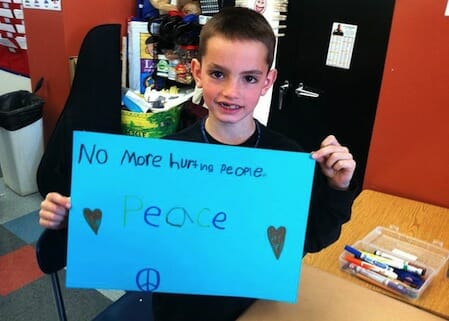
Days after the Boston Marathon bombing, a photo of 8-year-old Martin Richard holding a handmade poster that read, “No more hurting people – Peace” circulated the Internet and was shared by media outlets worldwide. The boy, who was killed when the second of two bombs exploded near the finish line, believed in a more peaceful world.
Martin Richard holds up a sign he made that reads, “No more hurting people. Peace.”
Young people ages 5 to 18 submit ideas for service projects that promote peace and kindness and create positive change in their schools and communities.
The program will award $500 grants to the top 30 replicable project ideas. Projects will be conducted in April and May.
Submissions must be made by this Friday, Feb. 13, through the generationOn website.
Ten projects will be developed into official Martin Richard Bridge Builder project guides, created to inspire other kids and teens to take action. Three projects will be turned into public service announcements to amplify the message of peace and inspire others to create and spread kindness worldwide.
“By encouraging kids to pay attention to what is happening around them, we can help shape attitudes of tolerance and kindness,” said Denise Richard, Martin’s mother. “We try to teach our own kids that they are not too young to lead by example – something that at age 8, Martin seemed to understand well.”
For more information on how to submit service projects to The Martin Richard Bridge Builders Grant Program, please visit generationOn.org.
Fidelity’s School Transformation Days Breathe New Life Into Schools
Nicky Niewinski’s school was built in 1961 and looked like it.
With about 83 percent of her students qualifying for free or reduced-cost lunch, Niewinski worried the dated appearance could be sending the wrong message.
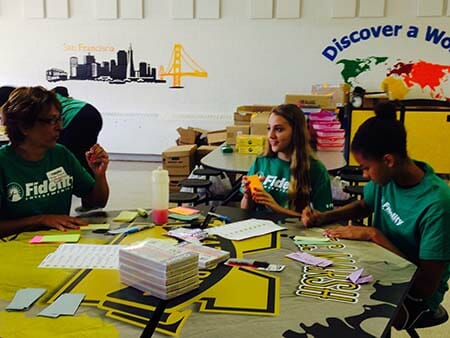
Fidelity employees and Marsh Preparatory School students put together financial literacy kits at the Dallas school during its School Transformation Day.
“I believe that perceptions influence behavior,” said Niewinski, principal of Marsh Preparatory School in Dallas. “One of the things I have wanted to do here – with help – was change the appearance of the building on the inside.”
Fortunately, help wasn’t far away.
Since 2010, Fidelity Investments, one of the world’s largest providers of financial services, has partnered with HandsOn Network by engaging thousands of employees, families and friends via Fidelity Cares – the company’s employee volunteer program, which, among other things, strives to revitalize the learning environments for students in need.
The mission of Fidelity Cares is to support a solid education foundation and reinforce or, in many cases, introduce financial education principles. This is often achieved through the projects implemented, whether creating financial literacy kits, hosting a STEM (Science Technology Engineering and Math) fair or designing or constructing a bucolic reading garden.
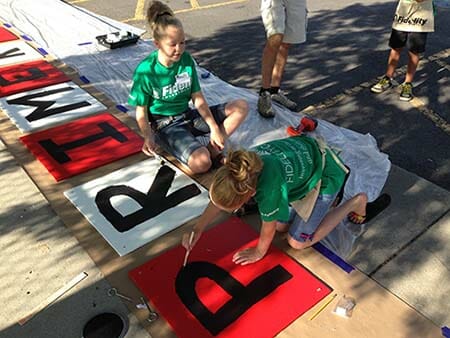
With help from Fidelity employees, students paint boards for a sign during School Transformation Day at Jackson Elementary School in Salt Lake City.
Affiliates of Points of Light’s HandsOn Network organize School Transformation Days, developing and managing the volunteer tasks and logistics for each daylong project. School Transformation Day has taken place at 23 schools across the country, reaching an estimated 35,000 students.
Nationwide, 81 percent of students graduate from high school with a regular high school diploma and more than 7,000 students drop out of school every day, according to the U.S. Department of Education. Nearly half of dropouts occur in the ninth grade.
School Transformation Day projects are identified through collaboration with a number of relevant stakeholders, such as school administrators, teachers, students, parents, civic leaders, Fidelity employees and HandsOn Network staffers. Projects are designed to enhance the learning environment, reinforce college messaging, support school needs, and encourage and inspire students.
School Transformation Days have become Fidelity’s largest annual employee volunteer effort.
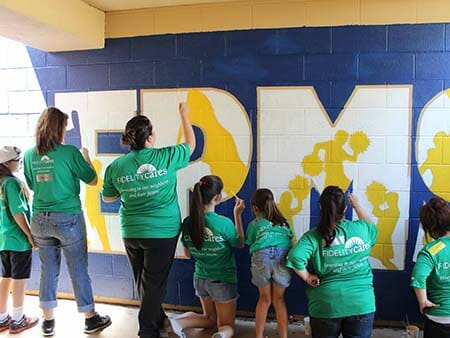
Fidelity volunteers and Ernie Pyle Middle School students paint a mural at the Albuquerque, N.M., school during its School Transformation Day.
“School Transformation Days are one of our most popular volunteer events, engaging thousands of employees to help thousands of students year after year.” said Gary Blank, senior vice president of regional public affairs and community relations. “There’s no other event like it where our employees can join together in such large groups and make an impact for students that they can see and feel at the end of the effort.”
Since its launch, the Fidelity Cares program has received positive feedback and praise from Fidelity employees, students, teachers, HandsOn Network affiliates and partners, along with recognition from local, state and national elected officials.
John Chickering has volunteered as both a participant and a leader for School Transformation Day since the project’s inception at two Rhode Island public schools in Providence and Pawtucket. His volunteer tasks have included building cabinetry, painting, assembling benches, removing safety hazards and even scraping bubble gum off the underside of classroom tables.
Volunteering “is just in my DNA,” said Chickering, who also participates in regular service projects through his church and with his family.
He’s drawn fulfillment from hearing teachers and principals talk about how valued the work has been by students. He has also enjoyed watching coworkers come together around their projects.
“Part of it is a chance to reinforce the working bonds I have with people that I have already established and the other is to build new connections,” he said. “There’s a personal development aspect to this.”
For Fidelity, proof of its popularity has been in the growing number of volunteers. Niewinski counted 100 volunteers at Marsh in 2013 and 250 volunteers last summer. They painted classrooms, offices and hallways and built outdoor benches around trees. Some Fidelity employees partnered with student volunteers to put together 1,200 financial literacy kits containing information such as how to start saving money and how to calculate interest.
School Transformation Days have done so well at Marsh, it has led to other projects. Fidelity has also invested in a new Lego robotics program at Marsh, supplying funding to help the school buy equipment.
“I don’t believe that would have happened had it had not been for School Transformation Days,” Niewinski said.
Nominate a Young Leader for the Hasbro Community Action Hero Award
You are never too young to start giving back to your community. Service has no age requirement and entrepreneurship in the digital age can start as young as kindergarten. We’re looking for volunteers who – even at a young age – are leading, organizing and inspiring others to serve.
Hasbro Community Action Hero Ethan Cruikshank, left, gives a guitar lesson to a Music to My Ears student.
, the award recognizes kids and teens from diverse backgrounds across the nation who give back in impassioned ways. By celebrating 10 young people for their extraordinary community service and volunteer activities, the award extends the inspiration of young leaders past their own communities.
Last year’s winners included heroes who acted when their communities needed them.
Upon learning of budget cuts at his local school that threatened the music program, Ethan Cruikshank of Mechanicsville, Va., started
. The all-volunteer organization led by middle and high school students provides weekly music lessons to elementary school children. More than 100 children have received the free lessons since Music to My Ears began in 2009, and the group has expanded to other states.
While spending time with family in northern India for her birthday, Neha Gupta of Yardley, Pa., visited a local orphanage. She saw the need for immunizations, books and more, so she founded
. Since its launch in 2009, Neha and the organization have raised more than $1 million dollars and touched the lives of more than 25,000 orphaned and disadvantaged children.
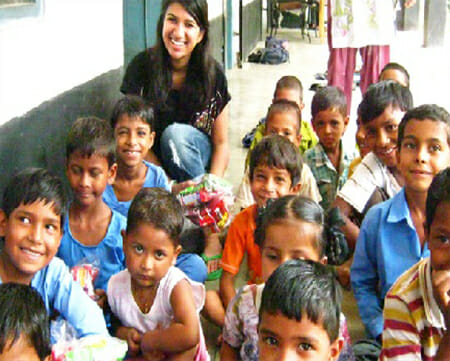
Hasbro Community Action Hero Neha Gupta visits an orphanage in India.
.
The tradition of honoring outstanding young volunteers continues with the 2015 Hasbro Community Action Hero Awards. Each winner receives a $1,000 education scholarship and a $500 grant to a nonprofit of his or her choice.
Here’s how it works:
Nominate a young leader aged 5 to 18 on the generationOn website. (Nominees must be enrolled in school, be U.S. residents and be available to travel April 16 – 19, 2015, for a special, expense-paid event in Los Angeles.)
Nominations must be received by Feb. 13, 5 p.m. Eastern.
Nominators must be 13 or older.
Staff phone interviews may be requested of nominees and their parents or guardians.
Nominators will be notified of the status of their nominees on or around Feb. 26.
For more information regarding eligibility, visit the
Youth Turn Messages of Joy and Peace Into Action That Serves Others
Teaching children about giving requires some time and creativity, especially in communities where that may be all children have to give.
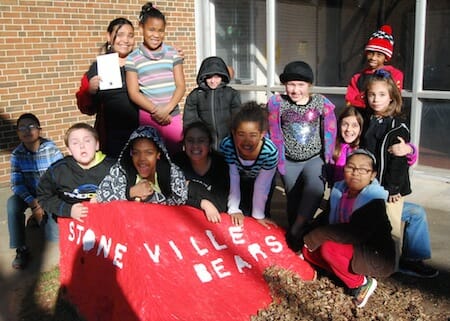
Members of the Stoneville Elementary School Kids Care Club show their school spirit with the “spirit rock” they painted.
Teachers at Stoneville Elementary School in North Carolina knew many of their students would be lucky to get their own gifts this past holiday season.
“Our school is located in a rural, low-income area of Rockingham County,” said music teacher Renee Halpin. “Asking students to bring in money to donate for any service project would place a strain on many of the families in our school community.”
At Stoneville Elementary, Halpin sponsors the Kids Care Club, an afterschool program that is dedicated to community service and is part of the generationOn Clubs network. When looking for a holiday service project, she came across The Joy Maker Challenge website created by generationOn, the youth service division of Points of Light.
“The challenge gave us the perfect means to donate new toys to needy children by using the two resources we can afford – time and talent,” she said. “To hear them verbalize their wishes to bring joy to children who are experiencing some of the same hardships they are or have experienced was truly amazing. It was also refreshing to see how they transformed from ‘I want’ to ‘I want to give.'”
That’s what The Joy Maker Challenge is all about.
Members of the South Range Elementary Kids Care Club make holiday cards for a nursing home during the Joy Maker Challenge.
Organized by generationOn, with generous support from Hasbro, Inc., The Joy Maker Challenge is a month-long effort that turns acts of youth service into presents for children in need.
For the 2014 challenge, Hasbro pledged to donate a toy or game to Toys for Tots – which distributes holiday gifts to children whose families can’t afford them – for each action taken by a child or teen to help others. That pledge amounted to donations worth $1 million.
During the 2014 holiday season, more than 128,000 students from kindergarten through 12th grade participated in service projects across the country. Projects ranged from participating in food drives, literacy campaigns or community cleanup projects to making holiday crafts for the elderly.
Some projects directly benefited kids within the participating communities. At Tanglewood Elementary School in Fort Worth, Texas, the entire student body and staff collected gift cards, funds, clothing and a Christmas tree on behalf of two classmates who lost their home and possessions in a fire.
“The stories of youth in action were remarkable,” said Karen Davis, Hasbro’s senior vice president of global philanthropy and social impact. “The inspiration from these young leaders brings the joy of the holiday season to life.”
In addition to the donations to Toys for Tots, Hasbro gave $250 grants to 20 participating schools, chosen at random, to support continued youth service in their communities.
Martin Richard, the 8-year-old killed during the Boston Marathon bombing, holds up a sign he made that reads, “No more hurting people. Peace.”
A randomly selected, grand prize-winning school, South Range Elementary in Derry, N.H., received $10,000 worth of toys and games that it donated to the Salvation Army, as well as a $1,000 grant to support the school’s engagement in volunteer programming and a special celebration party.
In Derry, members of South Range Elementary’s Kids Care Club hosted a number of projects over the holiday season. In early December, the children made several fleece blankets, which were distributed to the town’s Community Fund and given to citizens in need. The students also made several handmade holiday cards for a local nursing home.
“It turned out to be really nice just watching the kids working so hard,” said Kyle Sachs, a librarian and sponsor of the Kids Care Club at South Range.
After they were announced as the grand-prize winner of the Joy Maker Challenge, members of the Kids Care Club went to the Salvation Army to pack gift bags with toys donated from Hasbro.
Sachs said she’ll never forget the reaction of one 9-year-old girl at the site of stacks and stacks of boxes of donated toys.
“We were just walking, and we saw all these toys and boxes and she just said, ‘I’m just so excited! We’re helping so many kids!’” Sachs said. “She was so excited to see all this even though she wasn’t getting anything material out of it.”
Supporting The Joy Maker Challenge is just one way Hasbro has enhanced generationOn’s work to ignite the power of kids and teens to make their mark on the world. As a founding partner and lead investor in generationOn, Hasbro supports expanding generationOn youth volunteer service clubs nationwide; developing tools and resources for teachers, families and nonprofits; and running campaigns and programs focused on youth service. One such program – the Hasbro Community Action Hero Award – recognizes young people as volunteer leaders and social entrepreneurs.
In 2015, Hasbro is building upon its commitment to youth service through a new campaign with generationOn. The Martin Richard Bridge Builder grant program will award $500 grants to support 30 young leaders who will promote peace and kindness in their communities.
The program is named in memory of 8-year-old Martin Richard, who was killed in the Boston Marathon bombing on April 15, 2013. Martin was known in his community for his compassion and peace-building skills on the playground, in his neighborhood and at school.
Martin’s parents, Denise and Bill Richard, formed the Martin Richard Foundation in 2014 to honor their son’s memory and message of peace. The foundation is collaborating with generationOn and the Hasbro Children’s Fund on this effort.
“By encouraging kids to pay attention to what is happening around them, we can help shape attitudes of tolerance and kindness,” said Denise Richard. “We try to teach our own kids that they are not too young to lead by example.”
Ten projects will be developed into project guides and three of the best submissions will be turned into public service announcements – to inspire other kids and teens to take action.
“Martin recognized at a very young age the importance of teaching people kindness and togetherness,” said Davis. “We are able to honor Martin’s impactful message and help our youth create positive change nationwide, at a time when we need it most.”
It’s O.K. to Profit From Community Engagement
In December, Points of Light and Bloomberg LP released the 2014 Civic 50—a list of the most community-minded companies in the country. The Civic 50 sets a national standard for good corporate citizenship, honoring companies that are effectively lending their time, talent and resources to improve the communities where they do business.
John Peloza, an academic panelist for The Civic 50, and associate professor of marketing at the College of Business and Economics at the University of Kentucky kicks off the five-part blog series that will examine key trends and highlights released in our first comprehensive report, The Civic 50: A Roadmap for Corporate Community Engagement.
John Peloza
As a contributor on the academic panel that helped shape The Civic 50 survey, I waited for the 2014 results with great excitement. Now that the report is out, complete with profiles of the companies within this elite group, I predict two important changes will take place. Consumers will make the first change, and companies not on the list will make the second.
First, consumers who want to reward community-minded firms now have information they can use. The companies on the Civic 50 list deserve this recognition and subsequent support.
In the past, consumers’ perceptions of community engagement haven’t always aligned with reality. In an insightful report, Tenet Partners found extreme misalignment between what companies actually do and what people think they do. In some cases, companies that are very civic minded are perceived as being average, or even below average, on this dimension. And vice versa. The Civic 50 is an important data point to externally validate these companies’ efforts. I expect that, equipped with this validation, consumers will vote with their pocketbooks.
Second, I expect companies not on the Civic 50 list will work to emulate the firms that are on it, possibly because they see a clear connection between community-mindedness and the bottom line. And that’s a good thing!
The beauty of The Civic 50 is that it’s not simply a list of who is giving the most. Those lists are out there and, quite frankly, don’t do much to offer guidance to managers who invest in community engagement or the consumers who wish to support them.
Instead, the Civic 50 rates companies highly when they integrate community engagement with the business of the firm, institutionalize it with policies and incentives, and perhaps most important, carefully evaluate its impact.
I think many companies are reluctant to tie community engagement to the bottom line for fear of being seen as exploitative. Based on my own research and that of many others who study community engagement, they shouldn’t worry. Most people acknowledge that benefits to the firm should be part of the expectation from community engagement.
In fact, a 2012 study found that 76 percent of people believe “it is okay for brands to support good causes and make money at the same time,” up from 57 percent in 2008.
The companies on The Civic 50 list take steps to ensure the positive impacts they enjoy are more than just public relations from cash donations.
Companies like AT&T, with its “It Can Wait” campaign to stop texting-while-driving, are building their own platforms for community engagement, with their employees at the center of their efforts. This suggests a meaningful difference in the way these firms view community engagement and checkbook philanthropy. Programs like this provide a benefit to the community, employees and the bottom line.
And that’s the way business should be done.
To learn more about highlights and best practices from the 2014 Civic 50, download our webinar recording from the Dec. 17 event.
TIME Magazine Honors ‘A Ragged Army of Volunteers’ That Needs Your Help – 3 Quick Ways to Support The Ebola Fighters
This post is by Tracy Hoover, Points of Light’s president.
It’s not often that TIME magazine names volunteers as its Persons of the Year.
In this series of covers, TIME magazine collectively named volunteers fighting Ebola as its Person of the Year.
But last week, TIME honored the “ragged army of volunteers and near volunteers” – doctors, nurses, public health workers, and those who helped transport the sick and bury the dead – who risked their lives to save others.
“The rest of the world can sleep at night because a group of men and women are willing to stand and fight,” TIME writes. “For tireless acts of courage and mercy, for buying the world time to boost its defenses, for risking, for persisting, for sacrificing and saving, the Ebola fighters are TIME’s 2014 Person of the Year.”
If you’ve ever doubted that a small group of dedicated individuals can change – in this case, save – the world, I encourage you to read TIME’s story about the Ebola fighters and then do something to support their efforts.
You can:
Learn more about Ebola so you can fight misinformation and stigma. Read the Centers for Disease Control and Prevention’s “Ten things you really need to know about Ebola” and spread the facts.
Join World Community Grid volunteers and donate your spare computing power to help researchers find effective Ebola treatments.
Earlier this month, senior leaders from government, nonprofits and some of the world’s largest corporations came together in Washington, D.C., to coordinate efforts to fight Ebola.
One last thing we can all do this holiday season: Thank the extraordinary points of light in our own lives by making a call or sending a note, a tweet or a nomination for the Daily Point of Light Award.
In times of worldwide crisis and times of everyday stress, our actions to help others matter. Every single one.