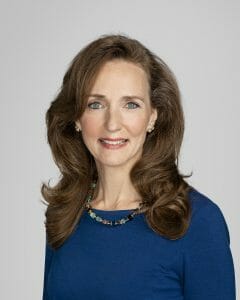
Laura Lane, UPS Chief Corporate Affairs, Communications and Sustainability Officer
In spite of the challenges brought on by the COVID-19 pandemic, I remain optimistic. In these mettle-testing times, the generosity of the human spirit has remained strong. Even amid social distancing, we’re still finding ways to connect with each other and help communities around the world.
These moments of shared humanity provide an important lesson:
We need one another
. We cannot allow this pandemic to create divisions among us —
we are stronger together when united in purpose
.
Collective Momentum
Even before the pandemic, there was a critical need for community engagement. But now with the virus taking its toll on economies around the world, the number of people in need has skyrocketed.
inspires us to action at a time when collective momentum for volunteerism has never been more critical.
In my role as UPS Chief Corporate Affairs, Communications and Sustainability Officer, I have seen how our half-million UPSers have risen to address our world’s most daunting challenges during the past year. That UPS mindset for engagement is reflected in our purpose statement:
Moving Our World Forward by Delivering What Matters.
To us, giving means more than just writing a check — it means combining our skills, passions and time with our logistics expertise, transportation assets and NGO partnerships to make a measurable difference in our world.
And delivering hope for people and our planet means setting ambitious goals for engagement where it matters most. We already met our goal of providing more than 20 million volunteer hours a year ahead of schedule.
In response to some of the past year’s social unrest, we took on a new commitment to advance equity and justice by dedicating more than 1 million more volunteer hours toward Black and underserved communities.
And in our effort to address climate change, we also set a new goal of planting more than 50 million trees by 2030, including the 15 million we already planted. We know the world is counting on us to deliver what matters, which is why UPS will continue to drive meaningful change wherever we can.
Driving Meaningful Change
As essential workers throughout this pandemic, UPSers have delivered everyday essentials and critical PPE; we have helped businesses reinvent their supply chain strategies; and now, maybe most importantly, we are delivering lifesaving vaccines around the world to help defeat this virus.
Service is in our name, and we will continue to serve in every way we can. So, as we celebrate Points of Light’s Global Volunteer Month, we hope our incredible UPSers help give everyone good reason to be optimistic about our future because we know delivering what matters means delivering hope.
Commonwealth Point of Light Spreads Essential Supplies in the Gem of Africa
she knew it would eventually be adaptive to meet the evolving needs of her village. She started off collecting and distributing shoes to young people in the remote villages of Botswana, but in time, Madibana realized that she could help create bridges between her community and essential items like sanitation pads and hand sanitizer — especially during the COVID-19 pandemic.
Madibana returned to Botswana, known as the Gem of Africa, in 2012 after finishing her master’s degree on scholarship in media and communications in England. As part of her scholarship, Madibana committed two years after her studies to her choice of community service. She took community service to the next level by creating the Nayang Association, and hopes to turn it into a full social enterprise.
“This charity is my baby,” Madibana said. “We still have villages where lacking shoes is very rampant — kids literally travel to school without shoes and we’re talking about a country that is like a semi-arid desert.” she added.
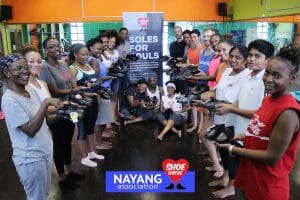
The Nayang Association’s Soles for Souls program has collected and distributed more than 6,000 pairs of shoes for kids and students in remote villages of Botswana.
Remote students commonly walk miles back and forth to school in broken shoes or barefoot, even in the winter months, to make it to class every day. To meet this need for suitable footwear, Madibana created one of the main Nayang Association’s programs, Soles for Souls, and has collected more than 6,000 pairs of shoes for kids and students.
While building relationships with teachers of partnering schools, Madibana realized that teenage girls can miss around 50 days of school every year if they don’t have proper sanitation pads. This unmet issue became something she wanted to be a part of solving, and the Nayang Association has distributed more than 10,000 pads to girls in need since 2015.
Before Madibana began her work, it was common for teachers to spend their own money on resources like shoes and pads for their students.
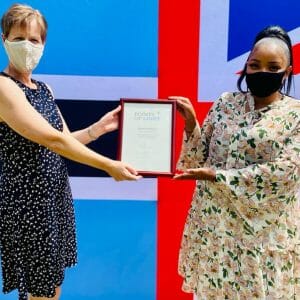
Her spirit of community service has not gone unrecognized. The Prime Minister of the United Kingdom awarded Madibana with a
for her service and dedication to being a global leader of transformative change.
The Nayang Association operated throughout the COVID-19 pandemic, but the charity followed CDC guidelines and were unable to guarantee the right sized shoes for students without fitting them in person before sending pairs out for distribution. However, the charity quickly began incorporating purchased and donated hand sanitizers with their shoes to children and their families to help reduce the spread of the virus.
The Prime Minister of the United Kingdom awarded Madibana with a Commonwealth Point of Light award for her service and dedication to being a global leader of transformative change.
Shoe donation is a continuous need that will always need champions of service like Madibana since a child’s shoe size can change in the matter of months. Most of the shoes of Soles for Souls are donated from individuals and companies, with the charity filling in any gaps if any child still needs a pair of shoes.
Madibana is excited about the charity’s upcoming branded shoe launch which involves various members of her village through the design, construction and manufacturing phases. It’s been a dream of hers for nearly three years since the charity frequently purchases ready-made shoes from countries like South Africa and Zimbabwe. The Nayang Association team is looking forward to creating sources of employment and working with local artists, Madibana said.
The charity has also been constructing ablution blocks — buildings that house private showers and toilets — for children in the villages it serves.
“My thing has always been to tell people that you don’t have to be rich in order to make a difference. Find out what a local charity is doing, especially if it’s close to your heart,” Madibana said.
Tackling Poverty and Inequality With HandsOn Northwest North Carolina and HandsOn Mexico
Serving those who are living through poverty or inequality has long been a focus of the volunteer sector. Many nonprofits concentrate their efforts on getting resources to those in poverty and working to build a more equitable world for those bearing the brunt of discriminatory, unjust or incomplete systems.
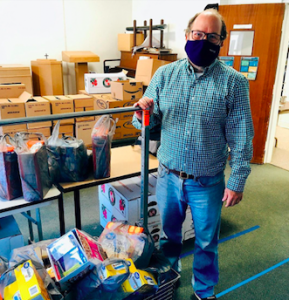
A Project Lighthouse volunteer delivers donated items to a local food pantry.
(HandsOn NWNC), a Points of Light Global Network affiliate, mobilizes people and organizations that inspire community change. Working with approximately 500 different nonprofits in a six-county area, HandsOn NWNC provides organizations with a wide variety of services that help them meet the challenge of their missions in the most effective and efficient way possible.
This includes offering leadership and professional development opportunities to staff and volunteers at all levels of the organization, as well as engaging and mobilizing approximately 5,000 volunteers a year in service across the network.
Amy Lytle, executive director at HandsOn NWNC, says, “We work with
everyone
; there is no age requirement to serve! We work with organizations large and small, and our network reaches out beyond our smaller-sized city to some of the more rural counties that surround Winston-Salem, NC. We work with companies, the school system, civic and religious groups. In terms of the organizations in our network, the vast majority of them are smaller or mid-sized, many of which serve a variety of marginalized communities and/or are led by people of color.”
Amy and the team at HandsOn NWNC are focused on building racial equity in volunteering in particular. At the end of 2020, they launched an ED Roundtable for organizations led by people of color. This self-directed and organized group is currently led by a participant volunteer leader, who is the founder of a small nonprofit that focuses on health, wellness and access to healthy food in her neighborhood.
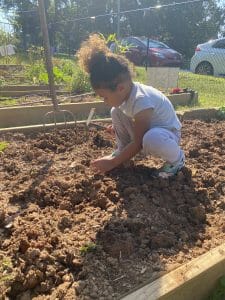
Kelees, a 3-year-old volunteer, helps out at the Kimberley Park Community Garden.
With support from the Starbucks Foundation and Points of Light, the Roundtable is just one way that HandsOn NWNC tries to support smaller, grassroots organizations and increase racial equity within both the local nonprofit sector as well as the community.
From larger efforts like the Roundtable to local efforts with individuals, HandsOn NWNC is making an impact in the fight against poverty and inequality. Take Rosa Johnson, for example, one of the volunteer leaders that HandsOn NWNC works with. Rosa has single-handedly created a small urban community garden across the street from a local Title 1 school. Over the past year, HandsOn NWNC has formed a relationship with Rosa and has come alongside her to help mobilize additional resources — including donations and volunteers — to help make the garden more sustainable.
Amy Lytle says, “Service has the power to unite people across differences and increase social capital; it builds empathy and can inform other forms of civic engagement, such as voting and public policy advocacy. Service can transform individual lives while also working to change systemic issues.”
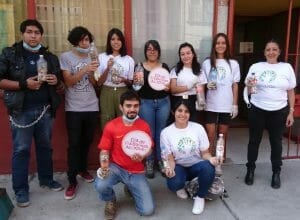
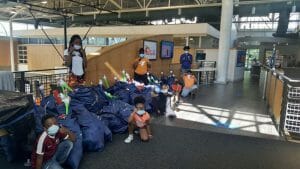
A group of young people, members of an NGO partner and an international volunteer accepted the challenge to collect cigarette butts in order to reduce water pollution and to prevent drains from clogging.
, exists to inspire, motivate and support people interested in investing their time to improve the quality of life for disadvantaged people, animals and the environment. By connecting people with organizations related to their interests and skills and promoting programs, events and campaigns to highlight what people are doing for their communities, they uplift and inspire others to get involved.
Blanca Ramírez, acting executive director at HandsOn Mexico, shares a few notable projects. “Recently we worked in conjunction with the YMCA to support a group that lives in a rural area of the city called Ajusco. In this particular neighborhood, it is fairly common to find young people using drugs or who are part of criminal groups. The YMCA decided to build a community center to provide more options for the local youth and their families to spend their free time. We contributed to projects such as restoring the community center, building a garden and creating a soccer field. The community center also provides leadership development services, activities and workshops to guide people in how to start their own business.”
HandsOn Mexico is working to tackle poverty in creative ways, too. The nonprofit works with a community organization in Xochimilco, initially collaborating with the Umbral Axochiatl organization to clean the canals and remove plastic waste. The villagers welcomed the volunteers and encouraged them to continue caring for the area. The objective, in addition to maintaining a clean natural space to create the right environmental characteristics to revive the axolotl, a native animal, is for the inhabitants to return to work their lands in a sustainable way. This involves using the natural resources that the area offers, resuming ancestral techniques and inviting scientists to implement best practices that allow obtaining organic products and recovering some native crops that were being lost.
HandsOn Mexico worked with a corporate group to clean the canals in Xochimilco.
Thus, the Xochimilco inhabitants became small businesspeople, forming a group called “Grupo Tlacuache.” This project created an interdependent cycle in which the environment is conserved through the sustainable commercialization of the natural resources of the area and the economic income for the families in the area is improved.
Blanca Ramírez advises people to “include time in your schedule for volunteering at least once per month. It’s worth spending time on a cause you care about. Every other activity you do in your life will be more meaningful if you volunteer often.” And to other nonprofit leaders, she says, “Remember that your work is impacting more lives than you imagine. Your effort is inspiring others and changing lives. That donation, that activity you organized where people met new friends living in different circumstances than theirs, is making a difference in the beneficiaries’ lives as well as in the volunteers’ lives.”
HandsOn NWNC’s Amy Lytle also has words of encouragement for volunteers and nonprofit leaders: “If you’re interested in volunteering, JUST DO IT! There are so many ways to get involved, no matter your passions, your skill set or your time limitations. There is a project or an opportunity out there for you. For nonprofit leaders — YOU’RE DOING GREAT! You’ve just reached the one year mark of working through the front-lines of a global pandemic. Whatever you’re doing, it is enough. Be kind to yourself, provide grace to others, and ask for help when you need it. You owe it to your mission and your stakeholders to not burn yourself out trying to accomplish the impossible.”
Laureus Uses Sport to Serve Youth, Bridge Divides and Bring Communities Together
In Atlanta, Ga., youth in underserved neighborhoods just blocks from where the Atlanta Hawks basketball team plays can learn about the sport while being mentored in healthy lifestyles, exercise and social skills, thanks to a local program called Hoops University.
In Kenya, Africa, an initiative called Boxgirls teaches girls and young women up to age 23 the sport of boxing – giving them self-defense skills as well as a feeling of empowerment to succeed in a male-dominated society.
Both initiatives are among more than 200 sport-related programs in 40 nations that receive funding through Laureus Sport for Good, a global charity that works to address violence and discrimination affecting disadvantaged youth. Laureus Sport for Good was founded under the patronage of the late Nelson Mandela, president of South Africa from 1991-’97, and a lifelong philanthropist and activist against racism.
“Globally, we’re working to tackle violence, discrimination and disadvantage through the power of sport,” says Adam Fraser, Chief Executive of Laureus globally. “Programs in South Africa use surfing to provide mental health therapy sessions for kids with trauma; programs in favelas in Brazil are using soccer to bridge the divide between different gangs,” said Fraser. “It runs the gamut in terms of sports being used and problems being addressed. We’re trying to support local community grassroots organizations to empower them.”
Laureus Sport for Good Atlanta has collected $25,000 worth of high-quality sports clothing and equipment to be distributed to disadvantaged kids to encourage healthy sports activities during the 2020 pandemic. Volunteers spent days sorting, packaging and delivering the special “summer kits.”
Regardless of the sport or location, Sport for Good programs rely on dedicated volunteers.
Many volunteers have personally experienced the benefits of playing sports as a child or teen and are now using the organizational and leadership skills they’ve honed as adults to bring sports opportunities to disadvantaged youth.
For example, Tarin Berry has a career as director of operations at the metro Atlanta YMCA. As a volunteer member of
, which includes 10 other passionate community leaders working to solve local challenges collaboratively, Tarin helps to match community youth programs with high-powered supporters in the form of corporate executives or professional sports teams.
“I’ve developed professional relationships with all of the professional sports teams in Atlanta for the Y, and I’ve continued those relationships, so when it came to do the (volunteer) work with Laureus, it was such an easy fit and so easy to pick up the phone and call on them for resources,” said Tarin. “A lot of what I bring to the table is project management and keeping things on task.”
Even though Tarin is also a busy mother of four, she volunteers for Laureus because sports made “a huge difference” in her own life. She grew up in a family that moved across the country often. “Sports was the one constant,” she says. “I could go anywhere and pick up a softball and fit in. I was never amazing in sports, but it gives kids confidence, the ability to work with a team and a sense of achievement. I can’t even imagine where I would be, even in my professional life, if I had not had the experience of playing sports while growing up.”
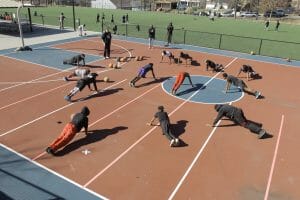
La’Teef Pyles and participants in Hoops University, a community group he runs in downtown Atlanta which is supported by Laureus Sport for Good.
On the other hand, La’Teef Pyles, who serves on the same leadership council, is more hands-on when it comes to helping kids play sports. He leads one of those grassroots neighborhood groups for underserved youth that is now receiving financial support from Laureus Sport for Good.
A barber by profession, La’Teef lives and operates his business in downtown Atlanta. He started Hoops University to teach local kids to play basketball, while working in lessons about healthy living.
La’Teef said he’s grateful for diverse training in coaching, mental health and fitness that Laureus Sport for Good has funded.
“I’m obsessed with basketball – I would teach anybody,” says La’Teef. But he’s especially proud to be called “Coach” by kids in the immediate neighborhood, which reminds him of the South Side Chicago area where he grew up. His parents wanted to be sure he had good influences in his life, and he strives to be that good influence for others.
Adapting to the pandemic
When the 2020 pandemic kept basketball participants from gathering at a neighborhood park, La’Teef installed a basketball hoop in his own backyard, where kids can practice in a socially distanced manner. They also get to see La’Teef in his barber shop, meeting more role models among his customers.
“These guys come by here, they subconsciously see a man of color conducting business, responsibly supporting his family and giving back to the community,” said La’Teef.
Meanwhile, Tarin Berry used her connections during the pandemic to help Laureus Sport for Good put together special gift packages of high-quality sports equipment and clothing that were distributed to disadvantaged families along with food donations so that kids could stay physically active, despite the disruption in normal athletics.
Promoting safety beyond COVID-19
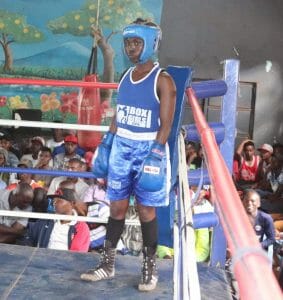
Emily Kasiyoki participates in a national boxing competition.
In Kenya, volunteering led to a paid job at Boxgirls for Cynthia Coredo, who has worked with the organization since 2008. She had experience working with computers and wanted to share her skills for a good cause. She now manages fundraising for the program.
Boxgirls was created when two girls asked to participate in boxing lessons offered by a local boxing coach, Analo Anjere, popularly known as Priest, who was teaching kids in the Kariobangi district of Nairobi, Kenya’s capital and largest city.
Today, Boxgirls also serves girls in rural areas as well as in the city. Currently, about 2,655 girls are enrolled, and the program has an 80 percent retainment rate.
“We use boxing as the entry point to really advocate for girls’ empowerment,” said Cynthia. “We believe it’s very important to be change agents to give girls and young women a voice.” In a society where physical and sexual violence against women has become a national crisis, Cynthia says it’s important to emphasize the ideology that women deserve an equal chance at an education and have a right to a safe life. In addition to learning boxing and participating in tournaments, girls are given leadership mentoring, reproductive education and practice in running a small business, for example, the group makes and sells handbags.
Volunteers work with the girls, but also reach out to parents and schools, to raise enthusiasm for helping the girls to succeed and encouraging them to stay in school and also participate in the Boxgirls training sessions. “We use them as a point of contact in the schools,” said Cynthia.
At least one girl who went through the Boxgirls training has been so inspired that she is now volunteering as a mentor to other Boxgirls participants, encouraging the next generation to become adult leaders and coaches in the program.
To learn more about Laureus Sport for Good, visit
How Doing Good Deeds Year-Round Can Begin with Good Deeds Day
The mission of Good Deeds Day transcends the day itself. Dedicating time to volunteerism and helping others can be year-round, even for the Good Deeds Day team, who’ve seen its mission become a ripple effect of good for thousands of volunteers.
Good Deeds Day is an organization and annual event where volunteers from around the world dedicate a day to volunteering and helping others and is built upon the idea that every individual can do something to improve the lives of others. Essentially, it’s a global movement of doing good that helps its partners — companies and nonprofit organizations — create positive change. Plus, the organization helps connect volunteers to the causes they care about any day of the year.
This year’s Good Deeds Day will take place on April 11, 2021. In order to make the day accessible to anyone around the world, it’s hybrid approach is designed to allow anyone to participate in events either in person or virtually. Participants can easily send an Ecard to an individual, organization or cause they care about if they are unable to volunteer outside.
Traditionally, thousands of people go out and volunteer and partner with hands-on community initiatives on Good Deeds Day, which features a diverse range of projects, entertainment and food vendors for participants.
The 2020 Good Deeds day undertook a major shift because of the COVID-19 pandemic and its events were held virtually. The focus became doing good from home. Yet, the organization didn’t view the pandemic as a roadblock. It began to shift its messaging to encourage partners to continue their important work to creatively address the issues communities were facing around the world — like food shortages, medical supply scarcity and hardships caused by job loss.
Originally based in Israel in 2011, Good Deeds Day spread by word of mouth to other countries after a few years of operation and became global in 2011.
“I think maybe part of its growth was through Jewish communities, because in Judaism, we have a concept of Tikkun Olam, which means to repair the world. It’s about being a positive change, and we should work on making the world a better place,” said Hannah Wojno, the director of International Good Deeds Day
Wojno moved to Israel nine years ago when the organization and movement was on the brink of becoming global and has always been involved in community initiatives from a young age.
“Good Deeds Day strives to create a positive, sustainable long term impact in the world,” she added. “It helps individuals around the world see themselves as positive change makers who treat people with kindness.”
Good Deeds Day is the pinnacle of doing good year round, but it was also a result of a relentless effort to understand how to maximize the volunteer skills of its global community.
In order to understand the communities that it works in, the organization’s team conducted two surveys on volunteering. They found that people just don’t know how to do good and what organizations would accept them as volunteers. Additionally, people felt that they didn’t have the time to commit to the causes they cared about. As a result, Good Deeds Day is designed to remove the barriers to volunteering and gives people a taste of what it feels like to be a part of something bigger than themselves.
The Good Deeds Day movement can teach anyone that every individual has the power to make a difference and one cause can light a volunteerism spark in someone to do the same for their fellow neighbor. It’s a good teaser and taste of what they can do year round, according to Wojno, and it exploded around the world.
One of Good Deed Days recent accomplishments was Good Stock, the largest global conference of doing good. The virtual conference featured keynote speakers of educators, nonprofit professionals, volunteers, government officials and other leaders from around the world who dove into key topics like leading change through volunteering, being good in business and the sustainable development goals.
Good Deeds Day was able to bring more than 2500 participants together from over 93 countries around the world for Good Stock.
“The most rewarding part of the work is seeing our partners — which are small organizations around the world that don’t have a lot of resources make a significant positive difference in their communities,” Wojno said.
“I believe this is how we create a better world through regular people doing just normal positive things and treating each other really well,” she added.
Fidelity Continues to Deepen their Commitment in the Communities they Serve
Last year has been unlike any year in recent times. As we tackled a global pandemic, we also were confronting issues of social justice and racial equity. As employers operating in this “new normal,” we should all be asking ourselves, “What does corporate volunteerism look like in 2021? How do you continue to create authentic community engagement?”
The importance of corporate social responsibility has grown over the last several years. Consumers increasingly value companies not just by what they produce, but how responsibly they operate as a business.
At Fidelity Investments, we paused to take a deeper look at our community relations efforts and listen to our nonprofit partners. Our goal was to focus on better aligning our community relations efforts with our expanding focus on diversity and inclusion.
“We are deepening our commitment to supporting racial equity across all of our programming and partnerships, and finding new ways to understand and support the underlying issues that underrepresented and underserved communities are facing”, said Teresa Pelletier, Vice President of Community Relations.
For a decade, Fidelity volunteers have helped beautify school campuses in regions where Fidelity has a large employee presence by painting classrooms and building outdoor seating. While the work we’ve done at schools has been a tremendous help to our partners over the years, we will begin to look even deeper into the issues that the students in our communities’ face. In partnership with Points of Light, we have evolved our School Transformation Day programming to a Season of Transformation for 2021.
The Season of Transformation will focus on “listening, responding and reflecting.” Our Points of Light Global Network affiliates will convene nonprofits in the communities and Fidelity associates for Listen and Learn sessions. The goal is to help Fidelity associates better understand the systemic issues affecting students and local communities and the challenges within the education sector and get connected with the ecosystem of community partners supporting students and their families.
Fidelity volunteers, working with Points of Light, will respond by designing meaningful and impactful virtual or at-home projects and programming to supply local schools with much needed resources.
Lastly, once the programming has been completed, Points of Light Global Network affiliates will help our volunteers reflect on the impact of their collective efforts and understand how they can act in their communities to support sustainable change.
By focusing and better understanding the needs of underserved communities, while adapting to a virtual environment, we are continuing our focus of supporting the communities where we live, work, learn and serve.
Civil Rights in the Nonprofit Sector With HandsOn Greater Richmond and CAF Southern Africa
While human and civil rights have been issues at the forefront of society for generations, they’ve increasingly gained traction over the past hundred years or so. And in the past several years, with more viral footage of racial injustices, it’s become a prominent issue that can no longer be denied. With a focus on promoting equity and fighting discrimination, many nonprofits are leading the charge in a more just society.
, a Points of Light Global Network affiliate and the volunteer center program of the Community Foundation for a greater Richmond, is actively striving to offer equitable experiences and continue to improve their internal processes.
The nonprofit partners with individuals, families and organizations to make giving easy and effective, strengthens nonprofit organizations through grants, training, volunteer mobilization and other supports, provides leadership and insight to important community issues and promotes a culture of philanthropy and service. HandsOn Greater Richmond helps people find their civic path, supporting them in finding out how they can use their time and money.
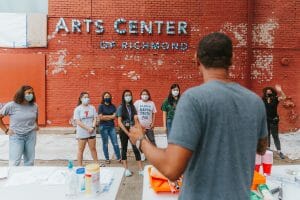
Muralist Hamilton Glass speaks with community volunteers before they work together on one of the 17 murals created in summer of 2020 in response to conversations around racial justice in Richmond, VA.
“Our work is to build mutually beneficial relationships,” said Vanessa Diamond, senior vice president, Civic Innovations. “Our job is to effectively educate, engage and inform people who are interested in a certain topic area. To do this shifts the power dynamics so that we’re volunteering
with
community, not just
to
community.”
Their goal is for community members to be informed and educated about the region as well as their own knowledge and motives, before helping, honoring the lived experiences of the populations in the region.
, HandsOn Greater Richmond helps civically-minded individuals to more strategically direct their energy, aligning their passions, skills and talents with an issue their community needs.
as a framework for all of their initiatives and decision-making. “The RVA Engage Vision and Guiding Principles were developed in 2019 through a collaboration of community engagement professionals in the nonprofit, corporate and educational sectors,” Vanessa explained. “They were shared at the 2019 Civic Impact Summit and continue to serve as a foundation for many conversations throughout the region.”
Another Points of Light Global Network affiliate partner,
, is a civil society infrastructure organization acting as an intermediary at the intersection between philanthropy and civil society. CAFSA’s primary reason for being is to grow and champion charitable giving in order to support a vibrant and resilient civil society, which is one of the core pillars of South Africa’s young democracy.
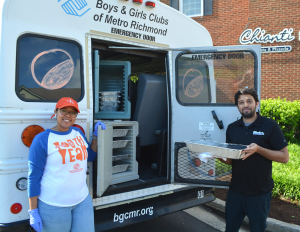
HandsOn Greater Richmond volunteers assist with food delivery to students.
As an intermediary, CAFSA is well-placed to understand the needs of both its corporate and nonprofit clients. CAFSA is both a purpose and a knowledge-driven business, and so all their consulting and advisory work with corporate clients is based on evidenced-based research. CAF produces the annual
, which measures generosity behaviors, such as donating money, time and goods to those in need. The WGI also tracks giving trends across the globe and enables CAFSA to monitor these generosity behaviors closely.
CAFSA is cause-neutral, which means the organization leaves no good cause behind. The organization focuses its interventions on the groups and communities who are most marginalised in society.
Gill Bates, CAFSA’s CEO, shared, “After the apartheid era ended, the country was liberated from an inhumane regime which systematically excluded people of color from the economy, employment, quality education, housing and healthcare. In spite of this hard-won political liberation, South Africa continues to struggle with the apartheid inheritance of poverty, inequality and unemployment. While South Africa is now a constitutional democracy and is regarded as a middle income country, the nation continues to have one of the highest ratios of income inequality in the world.”
CAFSA’s nonprofit partners work across all sectors, including but not limited to child welfare, care of the elderly and those with disabilities, women’s rights groups, education, literacy crisis intervention, environmental activism, youth development, entrepreneurship, social justice and alleviation of poverty and hunger.
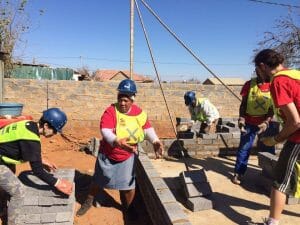
The CAFSA team got involved with a Habitat for Humanity Build in Orange Farm in Gauteng.
“Volunteering in South Africa is ingrained in the fabric of the country’s philosophy of Ubuntu, which, loosely translated means ‘a person is a person because of other people.’ In other words, I am because you are. This speaks to our humanity as a people,” Gill shared. “Another African proverb expresses similar sentiments and says, ‘If you want to go fast, go alone. If you want far, go together.’ Volunteering is a critical component of a civically engaged life, particularly in South Africa. Civil society and the nonprofit sectors are critical components of South Africa’s young democracy and continue to hold the government, the corporate sector and itself accountable.”
Serendipitously, HandsOn Greater Richmond’s Vanessa Diamond shared that she’s been using her voice since childhood thanks to parents who were activists in anti-arparthied South Africa. She encourages anyone looking to lead a more civically engaged life to find an issue important to them and then get educated on the solutions before jumping in.
“Really explore to determine what kind of organization you want to be contributing your time, effort, money and voice to,” Vanessa says. “If you’re really inspired or really angry about something that’s happening, that will ensure you have the passion to actively be a part of the solution. You have what it takes to make the difference. We often think someone else will do it, but it’s up to all of us to be the solution.”
HandsOn Suburban Chicago and HandsOn Tokyo Shape the Future by Impacting Youth
If you want to see some of the biggest and most challenging issues facing the United States today, look no further than the classroom. The education system in America is a microcosm of today’s most pressing national and global concerns — including discrimination, violence, and income inequality.
And while the effects of these hot-button issues can be witnessed acutely at the classroom level, this is also the environment where some of the greatest impacts can be made. Educators reach future generations at their most impressionable ages and have the ability to positively influence them in ways that can last a lifetime.
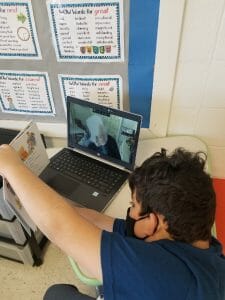
AmeriCorps Seniors RSVP volunteer Julian Schreiber spends his lunch hour reading with his Timber Ridge School student over a video call.
, a Points of Light Global Network affiliate and nonprofit dedicated to improving the quality of life in its surrounding communities.
By connecting people to enriching volunteer experiences, HandsOn Suburban Chicago engages more than 5,000 individuals annually in service. The organization harnesses the power of volunteerism to enable vulnerable populations to age in their homes and improve the socialization and well-being of seniors. But a large part of their mission is a focus on the education system in
northern DuPage and northern Cook Counties, IL
.
Chris Swope Cholewa, executive director, and Jess Park, director of School Programs, oversee initiatives that benefit low-income, first-generation students of color — many of whom are limited English proficient and require special education services to bolster their academic, emotional, and social development.
“In 2017, 42% percent of the middle school students that HandsOn Suburban Chicago served achieved satisfactory grades,” they said. “That percentage, which has been steadily climbing over the years, reached 94% last school year. In SY 2019-20, 99% of middle school students also demonstrated satisfactory school attendance and 94% met Illinois Social and Emotional Learning standards.”
These soaring improvements are due in part to HandsOn Suburban Chicago’s
, founded in 2010 with Community Consolidated School District 21. CHiL is an evidence-based afterschool program designed to prevent gang recruitment and offer homework assistance and social and emotional learning activities to high-needs middle school students in Wheeling Township.
“CHiL helps students like Brian — a low-income, English language learner in grade 7,” Chris and Jess shared. “The language barrier he frequently encountered at school chipped away not only at his performance but also his self-esteem.”
After completing a year of CHiL, Brian’s teacher sent this email: “Huge improvement in grades, confidence and participation in class for Brian, he received an A- in math for T2 (second trimester) and was so proud of himself! Thank you for all you do and all your efforts with this program!”
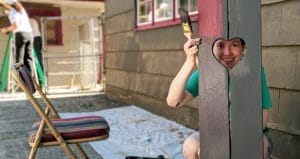
A Community Paint-A-Thon volunteer takes a break to pose for the perfect shot.
HandsOn Suburban Chicago’s volunteer-based school programs prepare more than 1,000 high-needs youth annually to succeed both in and out of the classroom. In 2015, the nonprofit launched
, which provides in-school tutoring and mentoring for low-income elementary school students in Des Plaines, Elk Grove Village, Palatine, and Mount Prospect.
The organization also engages area middle schools and high schools in a variety of service learning opportunities that include
academic lessons
, hands-on projects, and days of service in the community. For instance,
is a partnership between HandsOn Suburban Chicago, Catholic Charities and Habitat for Humanity of Northern Fox Valley. Since 1988, the Paint-a-thon has painted over 850 homes for seniors, veterans, and individuals with disabilities.
has been hard at work providing meaningful bilingual volunteer opportunities to foster volunteerism and develop leaders to serve the needs of their community. The nonprofit equips individuals, companies and community partners with volunteer opportunities, it also inspires and mobilizes youth to
While HandsOn Tokyo serves many populations in Japan — including the elderly, those with special needs and communities impacted by natural disasters — one of their primary focus areas is delivering interactive and educational activities to help underprivileged children in
children’s homes
to gain important life skills.
The children living in these homes come from complicated backgrounds, often experiencing domestic violence or poverty, and are usually suffering from social withdrawal. They’re often not very expressive or active and are used to having external support from volunteers. HandsOn Tokyo gives these children an opportunity to volunteer themselves, experiencing the impact that comes with supporting others.
This helps build crucial self confidence in the children from a young age. Motoko Kawaguchi, executive director at HandsOn Tokyo, shared a touching story about a high school girl who participated in a Tohoku volunteering trip. She was known to be socially withdrawn and seldomly expressed her emotions or ambition for the future.
“During the trip, she discovered that she really enjoyed farming and being in nature,” Motoko shared. “Later she sought an internship on a farm, and has also become more expressive and outgoing.”
Tohoku Volunteering with Children’s Homes.
Almost all of the children who reported back after this trip said they felt a sense of accomplishment and pride in being “appreciated by others.” Many want to volunteer again and have encouraged others in their group homes to volunteer in the future. These volunteer trips are also an important opportunity for the children’s caretakers to better understand each child’s fullest potential.
HandsOn Tokyo has done outstanding work over the past several years, impacting the lives of 19,867 recipients in 2019 and 16,222 lives in 2020, even amidst the COVID-19 pandemic when the nonprofit was forced to shut down in-person volunteering.
Motoko encourages those considering volunteering to jump in without hesitation. “If there’s any particular cause or group that works with the issues that you feel strongly about, without a second thought try volunteering with them,” he said. “You will not only make an impact in the community but it is very likely that you’ll benefit even more in return.”
“Volunteering is the ‘engaged’ component of a civically engaged life. By investing time and labor into improving the quality of life in a community, volunteers acknowledge that the well-being of every individual is integral to the well-being of society as a whole,” said
Jess Park of HandsOn Suburban Chicago. “
Volunteerism thus begets a more complete understanding of how social issues arose, the role social institutions play, the responsibilities of citizenship and what it takes to inspire change.”
Employee Volunteerism and the Impact of Purposeful Partnerships
Companies have a unique and critical role to play as partners in fostering a thriving society. As both business and civic leaders, companies are responsible for serving the diverse needs of employees, customers, community partners, investors and neighbors. At their best, they share their resources and act as trusted counsel, collaborators and problem solvers. Employee volunteerism is an integral component of this equation.
Every company is born out of an idea to provide a product or service to meet a human need. As an energy company, Phillips 66 makes products people use every day – our fuels and products are an essential part of connecting, feeding, clothing and caring for the world’s growing population. We are in business with one enduring purpose: to provide energy and improve lives.
How does our company live its purpose to better society? We create purposeful partnerships – with our employees, nonprofit organizations, academia and community leaders. Together, we openly share the best of our resources, and collaborate to solve society’s greatest challenges. Our partnerships in local communities go well beyond philanthropic giving and product donations.
At Phillips 66, we seek to build purposeful social impact partnerships in multiple ways. We:
Provide community organizations with funds to meet strategic, changing and urgent needs.
Provide people power – from skilled volunteerism and leadership to simple acts of volunteer service.
Share intellectual capital and expertise.
Utilize company resources, facilities and equipment.
Help partners expand their relationships and networks.
One example of a purposeful partnership in action is our Phillips 66 multitiered collaboration with the American Red Cross. Through this partnership that we view as a “gold standard” we:
Dedicate an executive to serve on the Houston Red Cross Board of Directors.
Provide significant, annual, financial contributions to support natural disaster preparedness and response efforts.
Volunteer our time by donating blood, serving meals and building hygiene kits for those in need.
And at the onset of COVID-19, our Phillips 66 board member and the Houston Red Cross CEO initiated weekly calls to discuss best practices and learnings from the Phillips 66 Health, Safety and Environment team, which the Red Cross used to help safely open its facility as a dedicated location for blood and plasma drives.
Like many companies, Phillips 66 was eager to step up and offer its resources to help relieve the burdens of the pandemic. We shifted our involvement to meet the greatest and immediate needs of our partners. In support of the Barbara Bush Houston Literacy Foundation, we reallocated funds to include book donations as part of meal distributions in public schools and to transform educational summer camps to virtual learning opportunities. In communities around the country, we also donated personal protective equipment, sewed masks and made face shields with 3-D printers to distribute to community members, worked with a local food bank to redesign the food service model to meet COVID-19 safety standards, and significantly increased our social impact investment.
We have created a powerful model for change by working with a shared purpose and in partnership with community organizations. As we celebrate
this April, it’s a good time to consider how we can be most effective in sharing our collective talents, resources and time.
This month, alongside Points of Light, Phillips 66 is proud to mobilize a global call to volunteerism. Let’s connect with our neighbors, empower community partners and engage citizens to join in service.
An Environment of Service, During and Despite COVID-19
Our environment is a precious gift – one that we have both received from generations prior and one that we will give to those who come after us. And while our environment is a gift, it belongs to none of us individually and to all of us collectively at the same time.
We’ve been reminded of how “shared” our world is throughout the global COVID-19 pandemic.
During
we regularly highlighted Points of Light corporate partners who are demonstrating – and in today’s times, redefining – service.
For this post, we’d intended to highlight the ways
and its resources, using their global footprint to reduce their environmental one. Given the spread of the pandemic, it’s important to instead look at how the company is using its reach to help slow the spread of the virus, and to help communities come out stronger on the other side.
Credit: The Coca-Cola Company
As grocery store workers are considered essential personnel, the company is going to great lengths to ensure its products – including critical items like bottled water and electrolyte-rich beverages – are not only available but are safely delivered to stores.
Coca-Cola is headquartered in Atlanta, just like we are at Points of Light. Incredibly, the company partnered with local university, Georgia Tech, to
for medical professionals. University engineers and others across Atlanta worked to design and manufacture protective gear using lasers and 3D printers. Coca-Cola donated 6,000 pounds of plastic, which will be used to make the masks.
Amazing.
Additionally, the company’s philanthropic arm, The Coca-Cola Foundation, has made financial contributions around the world, supporting relief efforts in China, Italy, the United States and Canada. The company is redirecting a large portion of the money it would otherwise have spent on advertising and marketing toward community relief programs, medical supplies and equipment – that’s in the short-term, for the long-term it’s making plans as to how to support a recovery and return to normal operations in the areas that are most impacted by the pandemic. Together, in conjunction with other relief efforts in development, brings Coca-Cola’s support for communities impacted by COVID-19 to more than $120 million … and counting.
Communities are stronger when we all play our part – and that’s true of the corporate partners in communities everywhere. There’s perhaps no corporate entity as “everywhere” as Coca-Cola and it’s wonderful to see their leadership and service – right when they’re needed most.
To learn more about Points of Light and Global Volunteer Month, please visit: