ServiceWorks: Putting Opportunity Youth on the Pathway to Progress
This post is by Delores Morton, Points of Light’s president of programs.
Across America, more than 5.5 million youth are disconnected from college and careers. That’s a jobless rate in excess of 15 percent for inner-city 16- to 24-year-olds. Having that many young people out of school and not working is not just devastating to those displaced youth and their future, but it’s a long-term hindrance to the economic development of the communities in which they live.
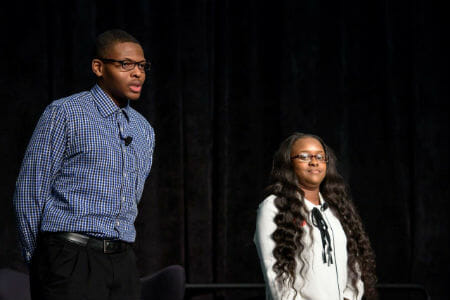
ServiceWorks graduates Nathaniel Scott, left, and Daquana Warren speak at the Conference on Volunteering and Service.
It’s a challenge that needs public-private partnerships combining resources and expertise. It’s a problem that needs nonprofits and government agencies providing solutions that benefit these young people and their neighborhoods and across the country. Indeed, it’s an opportunity for a program like ServiceWorks to help unlock the American dream for so many who may not believe they have a chance.
Thanks to the forward-thinking and valuable partnership of the Citi Foundation, the hard work and dedication of the AmeriCorps VISTAs on the frontline of our success, and the local agencies joining us in advancing this cause from their respective spheres of influence, we’re now in the second of a three-year effort to civically engage 25,000 youth.
And I’m thrilled to say ServiceWorks is already being recognized on the national level as a leading program for civic innovation and problem solving. Atlantic Media (publishers of The Atlantic and National Journal magazines) has named ServiceWorks as a finalist for a Renewal Award, putting this Points of Light program among the nation’s best at working toward long-term economic development.
To that end, I’d like to personally encourage all of our program partners, participants, volunteers and supporters – along with your networks – to please vote for ServiceWorks to be declared one of the six winners of this prestigious award by Nov. 2.
Scheduled for official launch in early 2016, this three-course, web-based training allows “opportunity youth” – young people ages 16 to 24 who are not in school or employed – to start their own journeys toward self-discovery, community service project planning and the development of the leadership skills needed for college and career success. It’s free and easy for organizations to implement. And our goal is to reach at least 7,000 young people all over the country through this online curriculum.
The conference also provided a chance to hear directly from Service Scholars, participants of the program. Dallas Service Scholars Daquana Warren and Nathaniel Scott (shown above) shared the impact ServiceWorks has had on their personal development. At a session on advancing youth opportunity, they proudly spoke of how they’re now better prepared for college and more ready to lead effectively in a professional environment.
As inspiring as this progress is, we still have a lot of work to do. We want to expand our number of ServiceWorks partners. We want at least 13,000 more youth choosing to grow personally and professionally by serving their community. We need more volunteers as success coaches helping change the lives of the young people for whom ServiceWorks may be their last, best opportunity.
Working on ServiceWorks is a professional high point in my career and I’m proud to show you more about it with this video.
The end to a challenge of this scale begins with an individual recognizing his or her power to do something about it. So I invite you to be a part of a movement to end persistent youth unemployment – as a partner organization, a volunteer or a Service Scholar.
Get ready to welcome new AmeriCorps members! Today marks the launch of #AmeriDay, a monthlong celebration honoring the start of AmeriCorps service across the county. Check out three ways to get involved today:
1. Come to a virtual resume review.AmeriCorps Alums, a Points of Light enterprise, is celebrating the start of this AmeriCorps year by hosting a Virtual Resume Review today (click here to get one of our last tickets). We want to make sure that when this newest AmeriCorps class graduates, members already have the tips they need to help their resumes get to top of a hiring manager’s desk. This resume review is made possible by Deloitte volunteers, and we are excited to offer this opportunity to all current AmeriCorps members and alums.
2. Join us in celebrating those who serve.Click here to tweet a message! AmeriCorps members just starting their service need to hear from us that their service is powerful and that they are part of a national service movement.
3. Update your Facebook profile with an AmeriCorps picture! In case you missed it, Ameri-Pride is taking over Facebook. Save the AmeriCorps logo, add it as your profile picture today, and tell your friends why you’re a proud alum!
For more ways to connect to AmeriCorps members, alums, and career support throughout this year, be sure you register with us for the latest updates. Click here to get connected!
This post is by Mary Bruce, co-executive director of AmeriCorps Alums, a Points of Light enterprise and the only national network that connects the nearly 1 million AmeriCorps alumni.
Mary Bruce
Recently, LeanIn.Org and McKinsey & Co. released “Women in the Workplace 2015,” a comprehensive study of the state of women in corporate America. Lean In founder Sheryl Sandberg writes, “Using the talents of our full population is critical.” And the new study shows we are not.
For example, while a majority of companies surveyed offer career development and flexibility programs like extended leave or reduced schedules, few employees take advantage of them. As a result, women remain underrepresented at every corporate level – and especially in the C-suite.
What are the consequences of this underrepresentation? Simply put, Sandberg explains, “When women get stuck, corporate America gets stuck.” She continues, “There is a wealth of evidence that diversity helps teams and organizations perform better in terms of innovation, creativity, revenue and profits.”
Making matters worse? Workforce data in the nonprofit sector is so opaque there’s much we don’t know. Questions asked in the “Women in the Workplace 2015” (e.g. if career development and flexibility programs are offered) aren’t asked of nonprofits.
And when they are asked, it’s infrequently. For example, the oft-cited CommonGood Careers report on Nonprofit Diversity shined a critical light on challenges of diversity and equity in the sector, but hasn’t been updated since 2008.
While “Women in the Workplace 2015” shows that corporate America is stuck, the nonprofit sector can’t see – and rarely get funds for – what’s sticky. In fact, the 20-year (1992 – 2011) annual average of investments in nonprofit talent by the thousand largest U.S. foundations was just 1.24 percent of total grant dollars.
Sandberg says, “Using the talents of our full population is critical to our economic growth, corporate productivity and individual happiness.” Alums know it’s more than that: It’s also critical to making communities safer, stronger and healthier.
Sitting in the grass, against the backdrop of the Washington Monument, Army veteran Mary Tobin had a bunch of 9-year-olds’ full attention. In ways they could understand, she talked about the heroes of 9/11, such as the airline passengers who diverted one of the planes set to be part of the attack.
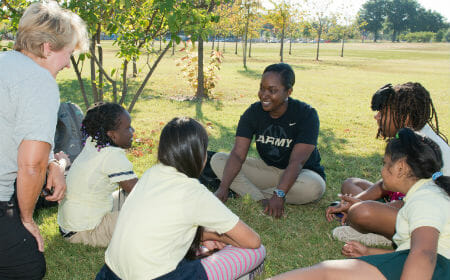
Veteran Mary Tobin, center, tells her story of service to Washington, D.C., students, as Wendy Spencer, left, CEO of the Corporation for National and Community Service, listens.
“They were just ordinary Americans, living their lives, like you live your life – going to recess, going to lunch,” she said, as the children giggled. “They heard some bad stuff had happened and they decided to stop the bad guys to keep more people from getting hurt.”
Tobin, who was injured while on patrol in Iraq, shared her story of service with the children today as part Points of Light’s national 9/11 Day of Service and Remembrance event in Washington, D.C., which brought together veterans and school children to benefit children of military families.
“It’s important that we pledge never to forget those who lost their lives,” Spencer told the group of 8- and 9-year-olds from Harriet Tubman Elementary School in Washington, D.C., adding that it’s also important to remember the family members left behind. “It’s an important part of history that you’re learning now.”
Esther, a 9-year-old student at Harriet Tubman Elementary School in Washington, D.C., writes in a book she is making for a child in a military family.
The children split into groups, which each paired with one of the veterans on hand to share their stories of service. Sacrifice and heroism were predominant themes.
“Do you have someone special in your life who is a hero to you?” asked Army veteran Marten D. Wallace Sr. of his group. “My heroes are those in the military who defend and serve our country. Heroes come in many forms.”
“And sizes!” added 9-year-old Esther, excitedly raising her hand.
The veterans talked about what brought them to the military and why it’s important to serve others, especially those in their communities. The kids asked about military training, marveled over world travel and even proposed an unorthodox style of combat in Iraq. “You could fight like ninjas,” 8-year-old Ginika told Tobin, who smiled at the suggestion.
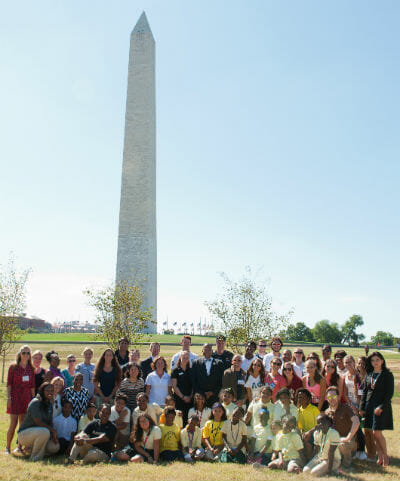
Veterans, students and volunteers gather after the 9/11 Day service project in front of the Washington Monument.
“One time there was a woman who was in a war and who could not see her family,” wrote a student named Ariona, about Marine veteran Maggie Sexton. “But she still worked very hard.”
The books Ariona and her schoolmates made will be given as gifts to the children of military families – young people who often face particular struggles as a result of having parents deployed overseas.
Janaia DeShields, vice president for military initiatives at Points of Light, said the project brought different generations together to not only commemorate 9/11 but to teach the next generation about what it means to serve.
“We hope to inspire a legacy of service in the next generation of leaders,” she said. “Sept. 11 will always be part of our history – how we recognize it is up to them.”
It’s not too late to serve in honor of 9/11 Day. Events are happening over the weekend. Go to AllforGood.org to find an event near you.
For 9/11 Day, a Message from a Marine About What it Means to Serve
Today we share the story of Marine Staff Sgt. Maggie Sexton, who will be joining us in Washington, D.C., for the 9/11 Day of Service and Remembrance. On the grounds of the Washington Monument, she will be talking to local schoolchildren about what it means to serve. Find ways to serve on 9/11 Day and through the weekend at AllforGood.org.
Maggie Sexton
I signed up to join the Marine Corps not long after the events of 9/11, right after I finished high school.
I joined for reasons similar to other young Marines at that time: I wanted to serve my country and join the response following the 9/11 attacks, and I wanted to challenge myself and find out what I was made of.
For my first four-year enlistment I was a nuclear, biological and chemical defense specialist. Then I spent another enlistment guarding American embassies in Beijing and Berlin and teaching new embassy Marine security guards. I ended up serving eight and a half years, in locations from Japan and China, to Iraq and Germany, and here in the U.S. from California to Virginia.
Have you noticed that the word “serve” is used a lot when people are talking about being in the military? We’re service members; we serve our country; I served for eight and a half years…
What does it mean to serve and why do we consider that such an important aspect of our military? To serve is to elevate the needs of others over your own – to sacrifice your own desires and goals and needs to something greater. And sacrifice takes a lot of forms in the military.
It means not having the option of quitting, no matter how much you want to. It meant living on the military base with other Marines instead of having my own house. It meant not being able to go home and see my parents and brothers for Thanksgiving or Christmas – though I did get to visit them at other times. It meant going to war.
When I deployed to Iraq there were a lot of military moms and dads. Sacrifice meant that they had to leave their children for six months to a year at a time, and I saw just how heartbreaking and difficult that was for them.
Many service members’ sacrifice included being injured or killed in the line of duty.
All of that hardship and loss is also a huge sacrifice for our families – our parents, siblings, partners and children – even though they weren’t the ones who joined the military or signed up for that sacrifice.
I said that I joined the Marines to serve, but also to challenge myself and see what I was made of. From boot camp, to my three combat deployments in Iraq, to my experience guarding American embassies around the world, I did learn what I was made of: pretty tough stuff.
In addition to learning to run and march and do pull ups and shoot a rifle, I learned assertiveness; I learned how to keep a cool head in stressful or dangerous situations, I learned how to lead and take responsibility for the Marines around me, and I learned to always give my best effort and never think of quitting as an option. Most importantly – I learned what it means to serve.
The skills and perspectives I learned as a Marine served me well during my Marine Corps career and they continue to serve me as a veteran and civilian. I now live in Washington, D.C., where I finished college after I left the Marine Corps, and where I now work to improve the health, well-being, rights and opportunities of women in other parts of the world.
And I know a lot of other Marines who have left military service but are continuing to serve their world, and country and communities in many different ways.
I hope that my story expands your perception of Marines, soldiers, sailors and “airmen” (P.S. – they aren’t just men, either!) and will help you to think about the diverse roles that service members and veterans play within your community.
Reclaim the Legacy of 9/11 Through Volunteer Service
Across the country on Sept. 11, millions of Americans will perform good deeds to help others and reclaim the legacy of what happened on that day 14 years ago.
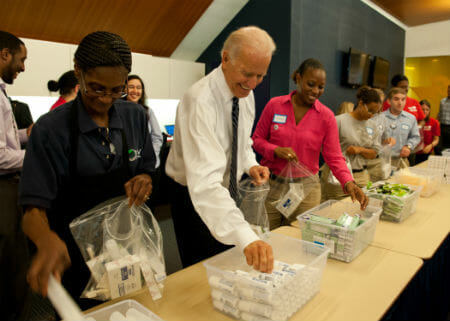
Vice President Joe Biden joins volunteers at George Washington University to assemble hygiene kits during 9/11 Day last year.
Will you join them?
You can find volunteer projects near you by visiting AllforGood.org and searching the term “9/11.” Projects are happening on Sept. 11 and through the weekend.
“In powerful and heartfelt ways – through volunteer service – Americans are rekindling the spirit of unity that arose just after 9/11,” says Delores Morton, president of programs at Points of Light. “Service draws us closer to each other as we honor the victims and heroes of that day.”
If you’re in the Washington, D.C., area, join us for our national 9/11 Day of Service and Remembrance event, from 8:30 to 11:30 a.m., on the grounds of the Washington Monument.
During that event, war veterans will tell their stories of service to public school students. Working with volunteers, the students will document the veterans’ stories to create books that will be given as gifts to the children of military families – young people who often face particular struggles as a result of having parents deployed overseas. The handmade books will serve as reminders of the strength and resilience of the men and women in the armed forces.
Sept. 11 was designated a National Day of Service and Remembrance by the 2009 Kennedy Serve America Act. The Corporation for National and Community Service leads the annual event, working with MyGoodDeed and hundreds of nonprofit groups, faith-based organizations, and schools and businesses nationwide.
How are you serving on 9/11 Day? Share your story with us on Twitter or Facebook, or by sending us an email at [email protected].
Honor Service on 9/11 by Hosting a Volunteer Service Project
Sept. 11 marks a day to commemorate tragedy and triumph, recognize heroism and sacrifice, and inspire volunteer service that makes a difference in communities.
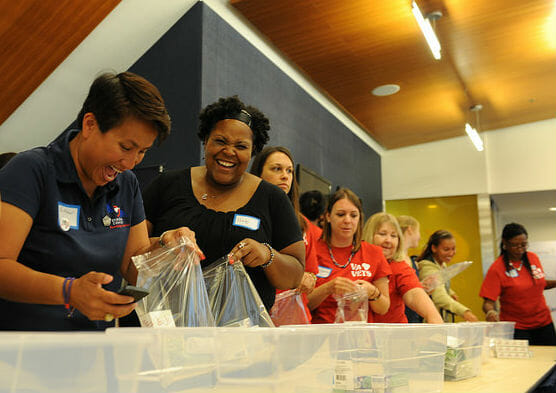
Volunteers share a lighthearted moment while assembling hygiene kits during last year’s 9/11 Day of Service.
This year, Points of Light’s Military Initiatives is inviting organizations to join a national service movement in cities across the country by hosting “Honoring Service” projects on the 9/11 Day of Service and Remembrance. To support this effort, Points of Light will provide mini-grants of $1,500 – $4,000 to 20 organizations.
Applications must be submitted by Aug. 6 at 8 p.m. Eastern to [email protected]. For more information, review the project overview, FAQ and host site application here.
Father’s Day Gets Me Thinking About How My Daughter Inherited My Passion for Volunteering
This post is by Matthew Little, who says his service in AmeriCorps two decades ago shaped not only the way he looks at the world, but who he is as a father.
Matthew Little, center, with his father, Steve, and daughter, Maggie
Since she was 3, my daughter Maggie has happily volunteered to collect items for children in need. She gives of herself to reach out to others who are hurting and keeps my wife and me honest when we don’t live up to our own ideals. She has donated her toys (even some baby dolls) and raised funds to support those who have nothing.
As I think about Father’s Day, I’m reminded of how much my daughter still reaps the benefits of my year of service in AmeriCorps – despite being born years after I joined AmeriCorps’ first class, in 1994.
I recognize and celebrate all that Maggie – now 5 – does for others. Thanks to AmeriCorps, I came to realize that even as a small child she could give so much, if only she were provided the opportunities.
The opportunities I see my daughter given all began because of a decision I made at 18. After high school, I dreamed of going to college. Unfortunately, I had no way to make that dream a reality.
I came from a family with few financial resources, but an abiding belief that I would go to college and a strong sense of responsibility to help others in need. While we had no treasure, we gave our time freely.
You could find my father assisting those who came to the public library where he worked, and they would leave with food from his own lunch or a path to get the help they needed. My mother was actively engaged where we lived, too, and stepped up to lead a Cub Scout pack when no one else would, becoming the only female pack leader in Tennessee.
Matthew Little and his daughter, Maggie, participate in an event benefiting an Alabama center for grieving children and families.
Soon after graduating high school, I heard about a new program called AmeriCorps and about City Year, a nonprofit that deploys AmeriCorps members to schools to help students succeed. With my ingrained sense of service and the chance AmeriCorps would give me to fund college, it was an easy choice to join City Year’s team as an AmeriCorps member.
Early in my term of service, City Year hosted its annual Serve-a-Thon, and I was lucky to have my mother and 7-year-old brother, Bentley, join me for the event. I watched that 7-year-old pull weeds and mulch a community garden. My brother worked his heart out that day, and gave back just as much as any other volunteer.
That may have been the first time that I realized that children were not only to be served, but also could lead volunteer efforts themselves.
After my year of AmeriCorps service, I was more committed than ever to giving more people, especially students, the chance to learn and serve. I became the first person in my family to graduate with a bachelor’s degree and now work as the First-Year Experience Director at the University of North Alabama. I provide first-year students with opportunities and connections to our community through service and support.
And what become of that 7-year-old who worked so hard at a Serve-a-Thon? My brother also became a proud AmeriCorps alum and father after serving in 2006.
AmeriCorps gave both of us so much, and in turn has made the lives of our children better. Both our families serve together, sometimes following in the footsteps of our children now. As much as I appreciate the benefits my time in AmeriCorps gave me, I am even more appreciative of what it has done for my daughter.
Creating a Global Community Through Local Acts of Service – and Learning Along the Way
An army of volunteers responded over the weekend to community issues by creating, leading and engaging others in projects designed to fit each community’s unique needs. They read to children in Miami to address literacy challenges, cleared soccer fields in New York to give kids a safe place to play, added sweat equity to a home in Los Angeles to benefit a veteran and more.
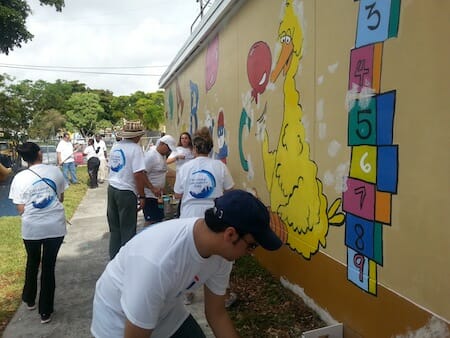
Volunteers paint a mural at the Liberty City Head Start Center as part of a Citi Global Community Day project organized by Greater Miami Service Corps, which hosts ServiceWorks.
employees, friends and family – volunteered at Saturday’s events, part of Citi’s Global Community Day. That day, more than 70,000 Citi volunteers served communities around the world.
In the U.S., from New York to Los Angeles, Citi volunteers worked alongside teams of ServiceWorks participants and the
– uses volunteer service to help underserved young adults in 10 cities develop the skills they need to prepare for college and careers.
Citi’s Global Community Day provided a great opportunity to shine a light on the effort and energy that is ServiceWorks. Through the myriad of projects, ServiceWorks participants demonstrated that they are learning to tap into their own power to be change agents in their communities, while developing the skills and relationships that will set them on a path toward success.
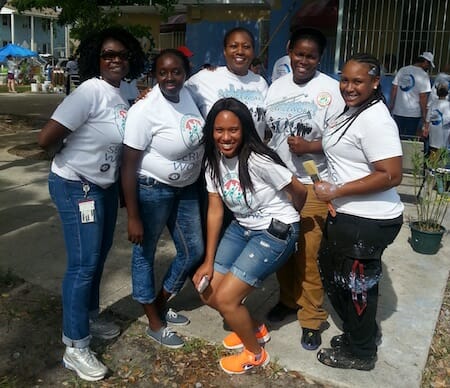
Volunteers at a Miami-based Citi Global Community Day service project, alongside participants of the ServiceWorks program, show their pride.
Service – the key ingredient of ServiceWorks – is a proven way to help us feel connected, to our communities and to each other. Too many young people from low-income families aren’t reaching their potential, in part because they lack support.
ServiceWorks participants, young people ages 16 to 24 from low-income households, benefit from training on a host of skills, from volunteer service project planning to conflict resolution to collaborating in a group.
Skilled professionals – including Citi employees – volunteer as success coaches, skills trainers and workshop facilitators throughout the program.
And the young participants use their newly developed skills to create service projects, such as the activities they took part in for Citi’s Global Community Day.
Eighteen-year-old Emmanuel Harris, a ServiceWorks participant in Chicago, told us recently, “What I liked most about the ServiceWorks program is the volunteer service – that we were able to help people who were truly in need. It made my day to see that I had a hand in making their day.”
6 Ways to Celebrate AmeriCorps Grads
Each year Points of Light’s AmeriCorps Alums welcomes 80,000 corps members to an alumni network that is already nearly one million strong. When they graduate from AmeriCorps, we want to make sure they are connected to the people, ideas and resources to help them grow as engaged citizens and civic leaders.
AmeriCorps Alums invites graduating corps members, alums, alumni chapters, AmeriCorps programs and state commissions, and all national service champions to join in celebrating the AmeriCorps Class of 2015 and their transition to the alumni network. Here are six ways to celebrate the year of service and beyond (#YSAB):
Click here to sign up for the fair or share the information with a graduating AmeriCorps member. If you think your company could benefit from having an alum on staff, click here to sign up for a booth.
If you represent an AmeriCorps program or state commission, click here to explore our professional development program and share resources with your corps members.
3. Join the Alums movement. Register with AmeriCorps Alums and help build the alumni network and movement of civic leaders.
If you represent an AmeriCorps program, state commission or chapter, click here for a membership guide to help you share information about Alums. The guide includes a registration link for your website, newsletter/email templates, a one-page flyer, an introductory PowerPoint and additional graduation message templates. Join the more than 70 organizations already partnering with AmeriCorps Alums!
If you’re a member or alum, click here to tweet to your fellow corps members and alums that you’ve just joined AmeriCorps Alums and invite them, too.
5. Get social! Join AmeriCorps Alums in late June for a social media celebration (#YSAB, for “year of service and beyond”) that will include the release of a Class of 2015 video slideshow. Email [email protected] the best high-resolution picture of your graduating corps members. We’ll be choosing the strongest pictures for our slideshow and featuring more on our social media pages.
6. Print a graduation certificate. Download and customize a certificate to celebrate your AmeriCorps graduation and proudly hang it in your home or office!
For more about AmeriCorps Alums and how to get involved, please visit www.americorpsalums.org.





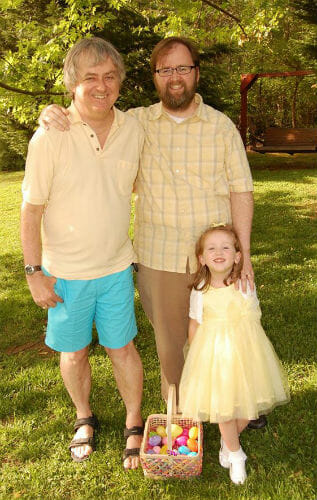 Matthew Little, center, with his father, Steve, and daughter, Maggie
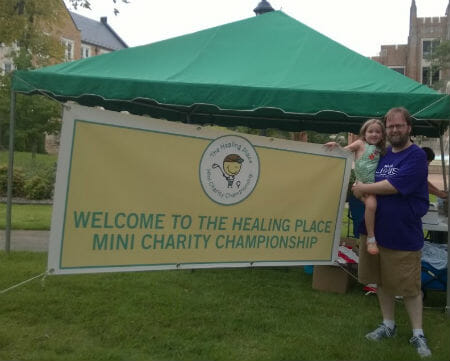 Matthew Little and his daughter, Maggie, participate in an event benefiting an Alabama center for grieving children and families.