employees deployed across the Washington, D.C., area during three simultaneous events to remember the thousands of military men and women who have sacrificed their lives since the terror attack and to help those who have come home.
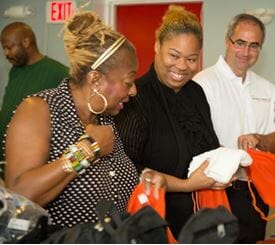
Exelis volunteers and Veterans On The
Rise staff assemble job-readiness kits.
in northeast D.C. to prepare 100 job-readiness backpacks, which included portfolios, deodorant and toothpaste. Volunteers then worked together to cook a nutritious meal for 50 residents and staff members of Veterans On The Rise, which provides housing and supportive services to homeless veterans.
At the Army and Navy Club in northwest Washington, 20 veterans heard from A. John Procopio, senior vice president and chief human resources officer for Exelis, about how to get ready for job hunting. They then sat down with Exelis executive volunteers for personalized career counseling sessions and had the opportunity to participate in a workshop hosted by tailor Aaron Goode, of VM Clothiers, on how to dress for corporate America. In a raffle, two veterans won tailor-made suits.
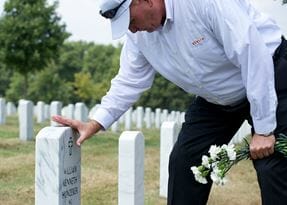
Ken Hunzeker, Exelis executive vice
president and president of Mission Systems,
lays flowers at a fallen soldier’s gravesite.
Across the Potomac River at Arlington National Cemetery, Exelis executives gathered with local veterans to pay their respects to the fallen. Following a wreath-laying ceremony at the Tomb of the Unknown Soldier, volunteers walked together throughout section 60 of the cemetery, laying flowers on gravesites. Volunteers then worked to build 100 MedEvac bags for wounded warriors arriving at Walter Reed and Ft. Belvoir medical centers.
“Military service men and women have dedicated themselves to a cause greater than themselves,” said Mike Monroe, vice president of military initiatives at Points of Light. “To show them that their nation, its citizens and corporations do not take this selfless act lightly, Points of Light and Exelis show their support on 9/11 and every day.”
To learn more about how Exelis and Points of Light are serving veterans, go to pointsoflight.org/veterans.
Do Good on 9/11: Volunteer
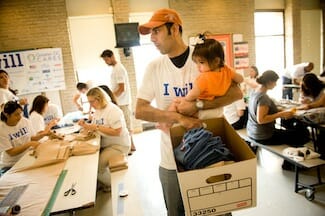
Volunteers make quilts for children in need during a
previous 9/11 Day.
Today, the 9/11 Day of Service and Remembrance, Americans across the country are reclaiming the legacy of 9/11 by doing good in their communities through volunteer service.
Won’t you join them?
Check out 911Day.org or Points of Light’s volunteer search for ideas. If you don’t have the time to participate in an organized event today, pledge to serve at another time. You can even create your own opportunities. Maybe you’d like to organize your child’s class to assemble care packages for troops overseas. Or perhaps you’d like to cook a meal for your local firefighters.
Click here to see if there are Points of Light affiliate events in your area.
Let us know what you decide to do to commemorate 9/11 at [email protected]. We might feature your story on our website and share it on social media.
Let’s Leverage Our National Investment in AmeriCorps to Build Civic Leadership
This post is by Ben Duda, executive director of AmeriCorps Alums, and Mary Bruce, chair of the AmeriCorps Alums National Advisory Council.
Since AmeriCorps was launched 20 years ago, nearly 1 million Americans have served, working to address our nation’s most pressing challenges. They’ve tutored in our toughest schools, provided emergency relief services after tornadoes and hurricanes and helped veterans get connected to employment opportunities.
Many of these AmeriCorps members directly link their success today with their service experience. Kellie managed volunteers during a disaster and now works on a global crisis management team for a major retailer. Traymone was a wildlands firefighter while in AmeriCorps and uses those same teamwork and leadership skills in managing military veterans in service. And Katie tutored young people and is now working in corporate philanthropy, guiding a Silicon Valley technology firms’ employee volunteering program.
These individuals were “made in AmeriCorps” and, each day, they continue to make America stronger.
Sadly, their experience is not universal. Many AmeriCorps alums are having a tough time finding a job. One alum served a successful term with a small town mayor, increasing resource allocations to communities in need. He’s now working shifts at a pizza joint. Another, who managed teams of volunteers retrofitting homes to higher energy efficiency standards, has been searching for a job for more than six months.
These individuals were “made in AmeriCorps,” too, but they’re not making it. They have skills that employers say they want but can’t find – in problem solving, teamwork and project management – and yet they can’t find a job.
A McKinsey survey of 2,000 U.S. companies found that two-thirds report difficulty in filling job vacancies because applicants have unsuitable work habits or insufficient experience. AmeriCorps alums – who have demonstrated dedication, commitment and skills – could help fill this gap. Yet there is no system connecting national service alumni with employers most in need of new talent.
We at AmeriCorps Alums are working toward a solution by launching bold new partnerships and programs to strengthen the pipeline of leadership. We’re making increased investments in professional development initiatives for alums, including adding a career coach to the national team.
We recently launched an “Employers of Service” campaign to celebrate public, private and nonprofit employers that actively support the recruitment, hiring and professional development of AmeriCorps Alums.
We announced a partnership this week with BoardSource to target and train women and people of color as prospective board members for local nonprofits.
We’re also calling on the federal government to extend hiring preferences to all full-time national service members. And, to help Alums continue to develop their skills, we’re calling on institutions of higher education to join the more than 100 colleges that already match the Segal AmeriCorps Education Award that all alums receive.
AmeriCorps Alums isn’t in this alone. The Peace Corps recently launched Career Link, a job board that carries on the proud, 50-year tradition of connecting returned Peace Corps volunteers with post-service career and education opportunities. New Politics (founded by an AmeriCorps alum) is working to elevate national service alums to political office, and the Veteran’s Campaign (founded by a veteran) is a similar initiative focused on veterans.
The nearly 1 million AmeriCorps alums nationwide are uniquely positioned to be the nation’s 21st century civic leaders. They’ve demonstrated their commitment. They’ve cultivated their talents. They’re hungry to lead. Now we must leverage our investment to pave the way for continued service to community and country.
Let’s Help AmeriCorps Alums Use Their Experience to Keep Giving Back
Today’s post is by Ben Duda, executive director of AmeriCorps Alums, a Points of Lightenterprise. (It originally ran on the website of social media expert Beth Kanter).
Last summer, I met a young man in Arizona named Kyle. He had spent his AmeriCorps term as a liaison between a mayor’s office and the homeless community, building relationships and creating resources. But even with all that valuable experience, Kyle was stuck working double shifts at a local pizza joint.
Countless organizations could benefit from Kyle’s skills, yet there is no system connecting national service alumni with nonprofits and public sector agencies most in need of young talent.
We at AmeriCorps Alums are working toward a solution by launching Employers of Service, a program exploring how we can link national service experience and a career pipeline. We’re kick-starting this initiative and conversation on June 20 in Washington, D.C., at Points of Light’s Conference on Volunteerism and Service, which runs from June 19 – 22.
During the conference, I’m hosting a session – AmeriCorps Alumni as Leaders: How to Grow as a Leader After Your Term of Service – showcasing Echoing Green’s Work on Purpose platform, which applies lessons from social entrepreneurs to professional development strategies for young people looking to make a difference. The session will also feature a roundtable conversation and Q & A with three nonprofit leaders (all AmeriCorps alumni): Linda Kay Klein, director of Work on Purpose; Michael Omenazu, recruitment manager at Commongood Careers; and Nakeisha Neal, executive director of Public Allies Washington, D.C.
The discussion is just part of a larger conversation about innovation and uniting communities woven throughout this year’s conference, the largest gathering of its kind, assembling roughly 5,000 nonprofit, corporate and government leaders. It will feature such big names as Grammy award-winning singer John Legend, New Jersey Gov. Chris Christie and social media expert Beth Kanter. Will you join us? Click here to register. (AmeriCorps Alums will also be featured at the 21st Century National Service Summit convened by the Franklin Project at the Aspen Institute later this summer.)
We often hear of an impending leadership shortage in the nonprofit sector. Meanwhile, more than 800,000 AmeriCorps alums are uniquely positioned to be the sector’s 21st century leadership pipeline. Together let’s figure out how to leverage this tremendous resource to benefit smart, young people with fresh ideas, while better serving our communities.
We’d love to hear about your experiences and ideas. Share them with me at [email protected].
HandsOn Tech Detroit compiled stories from AmeriCorps Alums in the Detroit area to highlight the work they did during their year of service. There is a lot of great work being done by AmeriCorps members in Detroit, and many of those who serve in the area stick around to contribute to the Detroit community after their year of service. We wanted to make sure their inspirational stories of service were shared.
Meet Isaac Gilman
Where did you serve (program/ location / year)?
I served in Michigan’s AmeriCorp program, through the Regents of the University of Michigan, during the summer of 2011. I served in Southwest Detroit for
(UNI), a small neighborhood nonprofit organization, for a total of 450 hours during that summer.
Describe your service – what population did you serve? What were the goals of your service year?
My service was amazing. Southwest Detroit is a unique area of the city because of its rich Hispanic culture and overall diversity in the area. I was specifically located in the Springwells Village Neighborhood which borders Dearborn on the west, Delray from the south, Chadsey-Condon from the north, and the Vernor/Mexican Town area on the east.
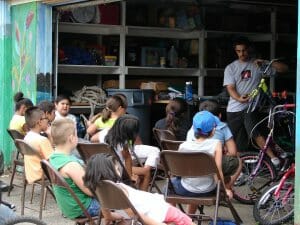
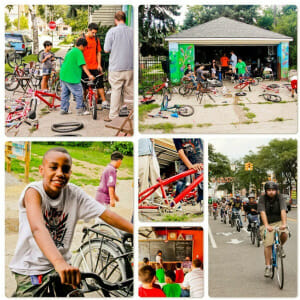
UNI asked me to coordinate a youth bike club that ran for six weeks during their summer program. The bike club was very grassroots, mainly coordinated by a community volunteer and a social work intern in the past. The mission of the bike club was to teach young neighborhood kids how to maintain and repair bikes. Further, the kids learned about the benefits of riding bikes and the importance of riding safely on the street.
When I started in May 2011, it was clear to me the small, young program had great potential. When I first began, I tried to learn as much as I could about the neighborhood, kids that I came in contact with, and especially the bike program. The program was about three years old as of May 2011. It was originally started by a group of kids who showed interest in customizing bikes. The kids would work out of the UNI Garage, and just fiddled around with their bikes. Structure was added over time, with lesson plans focused on repairing specific parts of the bike so kids learned how to properly maintain them. A few small grants were received to purchase proper bike tools and supplies.
When I started, I built off the foundation that was there for me. I added structure to the program by building additional lesson plans and keeping the shop open more hours per week. I saw a lot of success the first summer I coordinated the shop. We averaged 15 kids twice a week for six weeks; some days we had as many as 35 kids and other days (usually rainy days), only 5-10. It was clear to me the kids really liked learning about how to fix their bikes, and they wanted to keep doing it. In fact, at the end of the program, we went on a group ride to Clark Park, utilizing the bike lanes along West Vernor Highway. The kids loved it!
At the end of August 2011, my AmeriCorp service officially ended, but my vision for the shop grew stronger. A long term goal was to eventually build out a retail bike shop in the neighborhood, embedding the current education principles with youth entrepreneurship philosophies into the future shop. I’m proud to say we’ve made real progress towards reaching this goal. In the summer of 2012, I volunteered my time twice a week to work on opening the shop and build off the momentum that was created in 2011. Summer 2012 proved to be another huge success with similar demand and more exposure in the neighborhood.
This year, a team of six adults (including myself) created a business plan, started a fundraising campaign, found space for the shop, and plan to open Southwest Rides: Boards and Bikes Shop in southwest Detroit in summer 2013. The process has been long and taxing, but well worth it. I don’t expect to make huge profits or become famous, but
I do intend to continue to make an impact in Springwells Village and Detroit as a whole.
What was your biggest take-away from your year of service?
My biggest take away was seeing how much I could make a difference in the kids’ lives in such a short period of time. Within three months, I connected with almost every kid who came in to the bike shop. Whether they just wanted to learn how to fix bikes, or they were looking to earn a bike, every kid was eager to listen and learn. The kids really loved the shop as it provided an educational opportunity that they could not get in the K-12 school system.
How did your year of service help you grow personally and/or professionally? Where are you working now & how did your year of service help you get there (if applicable)?
My AmeriCorp placement is the reason I am living, working, playing, and giving in Detroit today.
When I was in school at the University of Michigan, I knew little about Detroit but became interested as soon as I visited the city for the first time. Now two years later, my amazing UNI experience showed me that like the bike shop’s potential, Detroit’s potential is amazingly endless.
Currently I am participating in the inaugural class of
. Challenge Detroit is a national initiative focused on revitalizing Detroit by retaining and attracting top talent to bring their intellectual capital to the city. There are 30 fellows and each fellow works four days a week at their host company. I work for a financial software company called
. When we are not at our host companies we come together to help various nonprofits fix some of the challenges that Detroit is struggling with today.
HandsOn Tech is a national program sponsored by a partnership between Google and Points of Light. This program is focused on increasing the nonprofit sector’s effective use of technology to increase community resources and improve outcomes for low-income communities. Serving in seven cities across the country, HandsOn Tech Detroit is one of the sites working to provide pro bono technology assessments, develop technology plans, and offer professional consulting, training, and resources to build capacity and support for qualified nonprofits. Click here for more information about HandsOn Tech Detroit.
Risks, Possibilities and Growth
Today’s post is written by Laura Nutty, an AmeriCorps VISTA and the Youth Service Program Manager at HandsOn Charlotte.
Life begins at the end of your comfort zone.
This quote by Neale Donald Walsch has been my motto to live by over the past few years, and is something I feel adequately defines the experiences as an AmeriCorps member.
My name is Laura Nutty and I am currently serving as an AmeriCorps VISTA member with Hands On Charlotte in Charlotte, North Carolina. Last year, I served with AmeriCorps National Civilian Community Corps (NCCC) in the Pacific Region. The year before that I served as an AmeriCorps State and National member in Rochester, New York. My decision to serve in AmeriCorps was largely based on the fact that I did not know what I wanted to do after graduating college, and I was so unsure of myself and what career option I wanted to pursue. AmeriCorps was the answer for me at the time, and proved to be the best decision that I could have made.
While each branch of AmeriCorps is very different from each other, there is one common link; you are not only serving with others in the community you are in, but you are serving yourself along the way. I not only served communities by cutting down trees on fuel reduction projects, and shingling a roof on a historical building during NCCC, but I also learned how to conquer fears and take risks. I not only managed volunteers for a family program or built planter benches for a local school during my VISTA year this year, but I also learned how to better communicate with community members and build valuable networking skills.
Each year, presented a new challenge. Whether it was my initial decision to serve in AmeriCorps, moving 3,000 miles away from home and living with 10 strangers for 10 months, or moving to a new city, to a new position for a year, I definitely stepped outside of my comfort zone each time. Once the initial shock and fright of the new situation subsided, I blossomed and really took advantage of the opportunities. I felt an increase in self-confidence and self-esteem after each year as a result of being able to tackle each challenge successfully.
The people you meet along the way in AmeriCorps are not only inspiring, but also motivating. As AmeriCorps members, we also step outside of our comfort zone with the people we surround ourselves with everyday. AmeriCorps places us in environments that most of us did not previously have exposure to before we started serving. These environments can include people who are our teammates, our staff members, or the community members we aim to serve with. The people that we engage with teach us about ourselves, and make us better versions of ourselves in the process. Through my experiences in different cities and neighborhoods, with different kinds of personalities and work styles, I have certainly learned how to be more patient, to be a better listener, and because of that to be a better communicator. I have learned to take each struggle and each challenge, along with each triumph, as a way to learn and grow.
My current term as an AmeriCorps VISTA member has been challenging in different ways. However, because of my past two years with AmeriCorps, I knew that it would be worth the risk in the end. This year with Points of Light and the Hands On Network I was given the opportunity to once again push myself, and step outside of my comfort zone to not only better myself, but better the community I am serving with.
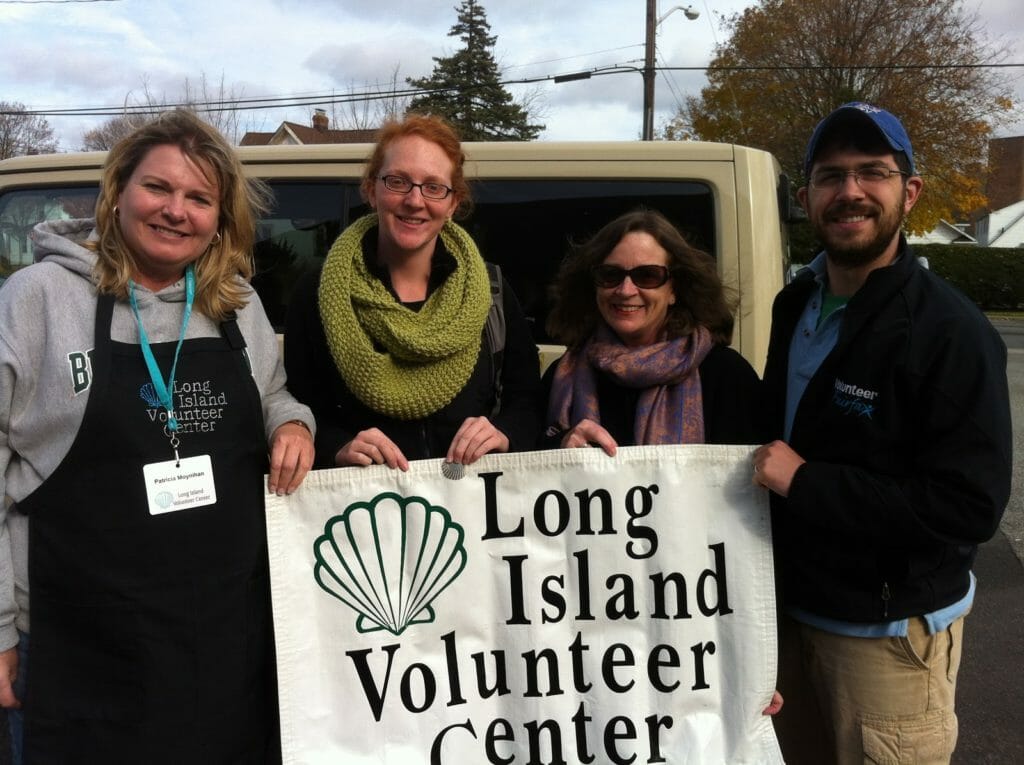
Lisa Tatum was deployed to the Long Island Volunteer Center as part of the HandsOn Network Disaster Task Force to respond to Hurricane Sandy. Lisa shares with us her top 5 most inspiring and memorable moments in responding to Sandy as an Alum.
Inspired by the Long Island Volunteer Center
This 24 member staff is 100% volunteers. Not one of them is a paid staff member. Each and every one of them was impacted personally by the storm. Some were without power for up to 15 days, others had trees fall through their roof and nearly all of them had friends or family members that needed help with cleanup as well. Their dedication to the effort was heroic. They had been through so much and yet they were doing everything they could to help others serve the community. I was humbled to be in their presence and to help in any way I possibly could.
Seeing a local AmeriCorps Alums Chapter Project through to completion
of which I am a part had conducted a September 11th commemoration project in which we created thank you cards to two specific groups. We made cards for Veterans and for AmeriCorps members serving on disaster relief assignment. I was just able to give cards to the members directly rather than having to mail them. I really enjoyed their smiles and laughter as they opened them. Most of the cards had been written by alums like myself who had served previously and just wanted to encourage the members during challenging circumstances. It was great to see a project through to completion. See the pictures of their reactions
I had worked with years before. They seemed like such a close and cohesive team that truly enjoyed working with one another. They also seemed to be very low key and flexible when it came to disaster and that is incredibly crucial. Every time the situation changed, they adapted and did so with positive attitudes and eagerness.
Diversity of Volunteers
More than 500 volunteers came to help and were assigned to projects. I was struck by the religious, ethnic and diversity of ages that were participating. I saw everyone from Southern Baptists to the Church of Scientology. Little kids to older folks. Everyone pitching in as best they could. What moved me the most was the smiles on the faces of the volunteers as they dropped off tools and gloves. People who did not know each other at the beginning of the day were laughing and joking with one another at the end of the day.
Seeing Disaster Collaboration Firsthand
During my time on this response I participated in conference calls and meetings with direct impact on the response. I saw how local, state, and federal government entities, faith based groups, corporations and community volunteers all work together. I was able to gather information to help better prepare North Texas for large disaster responses. While I have seen these things before it has never been for a response of this magnitude.
Today’s post is republished from the AmeriCorps Alums blog who, as part of Black History Month, is sharing inspiring stories from Black and African American alumni of AmeriCorps throughout February. Our first post comes from Tomika Anderson, a two-term AmeriCorps Alum and current AmeriCorps Program Manager at Playworks. Read more stories on their blog all month long.
My second year of AmeriCorps came at an unusual time for me. I was in my late 20s, finished with grad school, and had several years of professional experience under my belt. I found myself in a really bad work situation and opted to leave instead of being miserable every day. I decided to do another year of AmeriCorps in order to give back. What I didn’t plan on was getting something valuable out of my experience. I knew I’d help others, I knew I’d bring something good to the team, that I would work hard and do everything I could to do good, but I had no clue the gift I would receive from my time with the Youth Volunteer Corps.
Below is an excerpt from my personal blog that year that can explain what I mean:
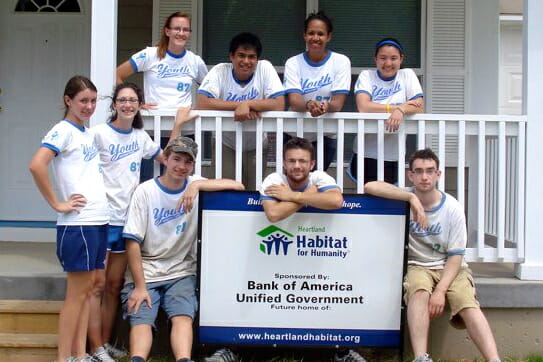
Serving during Summer Week 1: Habitat for Humanity with the Youth Volunteer Corps of Greater Kansas City.
April 2011: My life has been really hard this year. I’ve had some really unfair and challenging things to face and overall, it’s just been hard. Despite the hardships, I’ve found ways to be happy this year: my family, my friends, my future, there are good things happening. But today especially, I experienced something that made me feel really, really good about being me and about the choices and sacrifices I’ve made, as well as our country’s future.
I work as an AmeriCorps member with the Youth Volunteer Corps of Greater Kansas City. I am a Team Leader who, along with my team, essentially runs the program under the direction of a program director and a part-time assistant.
For our year of service, we:
Cultivate relationships with area nonprofits that have volunteer needs.
Design volunteer projects (on Saturdays, after-school, within schools, special holidays like MLK Day of Service and over the summer), these projects can include painting, cleaning, caring for the elderly, children or animals, etc. They also include service-learning components and team and leadership building lessons for the youth doing the volunteering.
We recruit youth (ages 11 – 18) to come and volunteer at the projects.
We volunteer alongside of them while teaching and supervising.
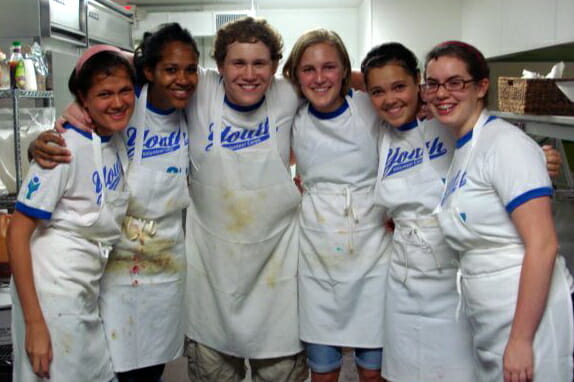
Serving during Summer Week 2: Kansas City Community Kitchen with a group of Youth Volunteers.
There are highs and lows of the actual job, of course, and it’s a constant learning process whether it’s creating new systems in the office or dealing with a problem kid who doesn’t want to work. The greatest thing about this job, however, is also one of the things that made me commit to the nonprofit sector, both academically and professionally. It’s the people who serve, in this case, youth.
This morning, we begin accepting applications for our Summer Program. The program is 8-weeks long (much like summer camp). There are five project choices each week at a variety of Kansas City nonprofits. Youth can sign up for one week or all eight and they commit to a minimum of 24 hours per project (9-3, M – Th). These projects are fun and work for the youth and can often be a huge opportunity for a struggling nonprofit. The amount of work that a group of just 10 youth can get done in 24 hours is incredible; in fact, one of our biggest challenges is ensuring that the youth will have enough to do and not get bored! This year we have 40 projects with 560 individual spots for Youth Volunteers. I don’t quite remember the math, but it’s about 15,000 hours of service in 8-weeks.
To apply, youth or their parents had to come into the office beginning at 7 am to turn in their application. Last year, we had several early birds so we were prepared for a rush of applicants first thing. I arrived at the office this morning at 5:30 am to be greeted by five teens and two parents who had proudly claimed their spot to begin the line. By 6:30 am, more than 50 people were in line, by 7 am over 80. By 8 am, after one hour of accepting applications, more than 150 youth had signed up. By the time I left at 6:15pm that night, 90% of the projects were full. There was no iPad, no concert tickets, no celebrity to photograph. The prize at the end of the line was serving their community…all by people 11 – 18.
How special is that?
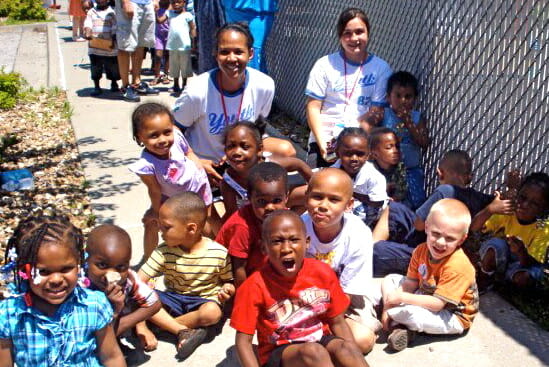
Serving during Summer Week 4: Operation Breakthrough with Audrey Simmons, Youth Volunteer.
People say this country is in trouble. People say youth have no voice. People say that family and community values are lost. They are wrong. This country has its issues, duh, but how incredible is it that kids will wake up hours before school to ensure that this summer, they get to volunteer? To commit to this program, youth are giving a large part of their summer where they could otherwise be working, playing, sleeping, traveling, you name it, but they have spoken. They want to volunteer.
This sector that I serve allows that to happen. It houses amazing 501c3s that change bad to good. It gives back. It teaches kids the importance of caring about where they come from and helping those in need for no reason but because it’s the right thing to do.
I’ve had a crappy year, there’s no doubting that. But these kids have changed my life and made me see love in a way that is truly, truly special. Not sure what your summer plans are but I guarantee you, my summer plans are pretty unbeatable.
Tomika Anderson, a two-term AmeriCorps alum, currently works as the AmeriCorps Program Manager at Playworks, a national nonprofit organization that transforms schools by providing play and physical activity at recess and throughout the school day. Formerly, she managed a skills-based international volunteer program at Architecture for Humanity and helped create and manage an AmeriCorps partnership program with NCCC and the Nonprofit Leadership Alliance. Tomika resides in San Francisco, CA and in her spare time loves running, Major League baseball, mentoring college students, and volunteering.
Guess Who’s Coming to Supper: Points of Light America’s Sunday Supper
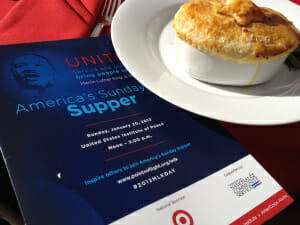
There is at least one fundamental rule all AmeriCorps Alums know well: if someone offers a free meal, we will come. It is also fair to say that AmeriCorps Alums have rather grandiose, heroic visions of fixing society’s ills and we relentlessly desire to be a piece of the action (as you may have guessed, the “action” presents opportunities to share our magnificent ideas and be a part of the solutions). So it was only fitting that even years after serving I would jump to the opportunity to enjoy a free (well, sponsored) supper at the United States Institute of Peace amidst a slew of honorable guests and thought leaders.
So what, you ask? Well, this wasn’t your everyday supper and these weren’t the usual guests. In addition to hosting the largest single-site service day event, Points of Light convened one of the largest groups of luminaries in the social innovation and national service world on January 20th for America’s Sunday Supper. The result of the gathering: a candid dialogue on how to increase access to educational opportunities and, thus, improve outcomes for all young people in our country.
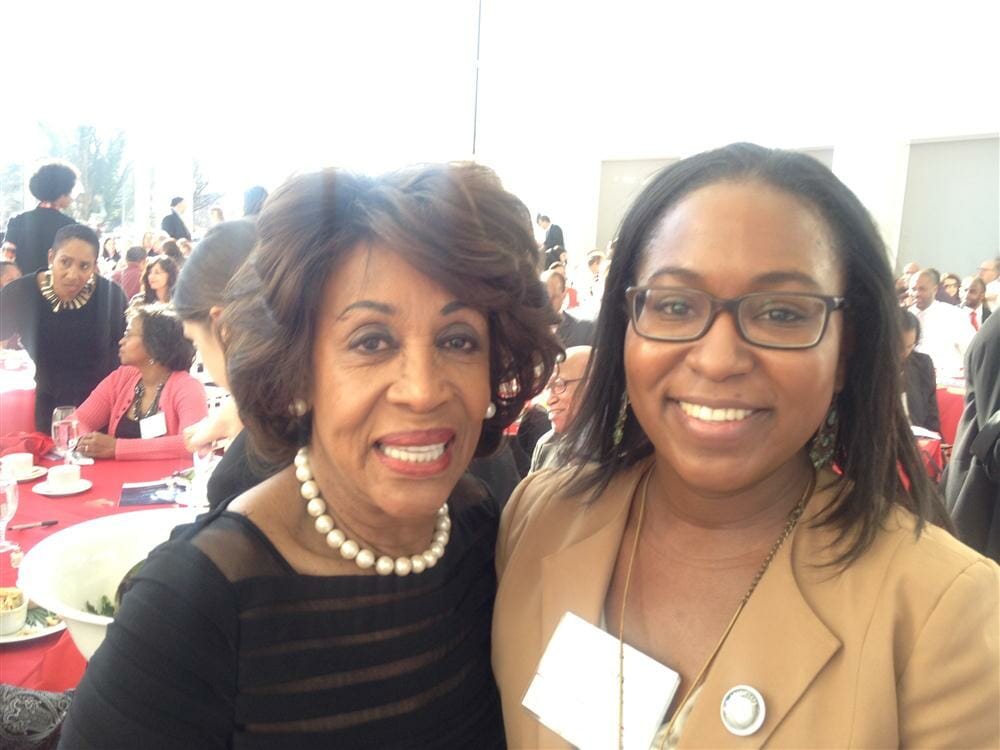
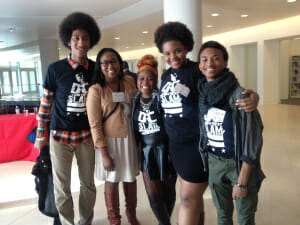
Moderated by CNCS Board Chair Laysha Ward of Target Corp. and MSNBC’s Melissa Harris-Perry, the discussion included speakers like General and Mrs. Colin Powell, Mayor Rahm Emanuel of Chicago, Mayor Michael Nutter of Philadelphia, Mayor Antonio Villaraigosa of Los Angeles, Janet Murguía of the National Council of La Raza, Former Mayor of New Orleans Mark Morial of the National Urban League, CEO of CNCS Wendy Spencer, and the Chancellor of DC Public Schools Kaya Henderson. Guests in the audience included the White House’s Jonathan Greenblatt, Senator Harris Wofford, Congresswoman Maxine Waters, and AmeriCorps Director Bill Basl. The list really does go on and on, so this is just to name a few. The DC Youth Slam (whom I have dubbed my “partners in rhyme”) shared their spoken word talents with the sea of guests who seemingly agreed with Mayor Emanuel on the declaration that the arts should be a staple in our public schools. Being on the Community HealthCorps team at NACHC, I was especially pleased to hear that the audience also agreed on the necessity for ample physical education offerings in every public school.
As this event was held during the MLK Day celebrations, the dialogue led to a summoning of our civic leaders for action; apropos DC Youth Slam’s affirmation that we can neither sit nor stand still “when we are standing on the shoulders of giants.” You cannot help but agree with them. It is necessarily true that we cannot stand still, because, on the civil rights issue of access to educational opportunities for all Americans, we simply don’t have a choice. The sacrifices of those giants of our past now demand that we provide an extraordinary level of civil service back to our communities. This is a mandate that cannot be challenged or ignored, and that is on the basis of mere moral obligation. Should we be defiant and stand still, then we are failing as citizens, and that failing simply isn’t in our nature as the American citizenry.
AmeriCorps programs embody and foster this broad set of ideals – that we owe a civic duty to our communities, that the solution is can be found within our communities, that we are in this together, and that we are obligated by our shared values to improve outcomes for all. The overall challenge is bold and the orders tall. But, is that not what drives us as a country? Americans dream big and do everything even bigger!
Following the Sunday Supper, I thought, “So, here we are.” As AmeriCorps Alums, members and programs, here we are confronted by many challenges and charged with some of the country’s most daunting tasks. But really, who else gets things done better than us? We think of the most effective solutions; we act on those solutions; and we make those solutions sustainable by motivating others. For us, “Service is the rent we pay for living. It is the very purpose of life and not something you do in your spare time,” Marian Wright Edelman. This is AmeriCorps. This is National Service. This is being an American.
We heard many great stories of AmeriCorps service in 2012! From the first AmeriCorps Alum in the Senate to lists on the reasons Alums would make fantastic dates, you read and shared with friends and family why AmeriCorps Works and matters in your life.
Here are some of the top posts (based on views) from our blog: