Make a New Year’s Resolution Your Company Can Keep in 2018
For most, the beginning of the year means one thing: New Year’s resolutions. Every new year brings a chance for improvement, a chance to better oneself not just in January, but throughout the entire year.
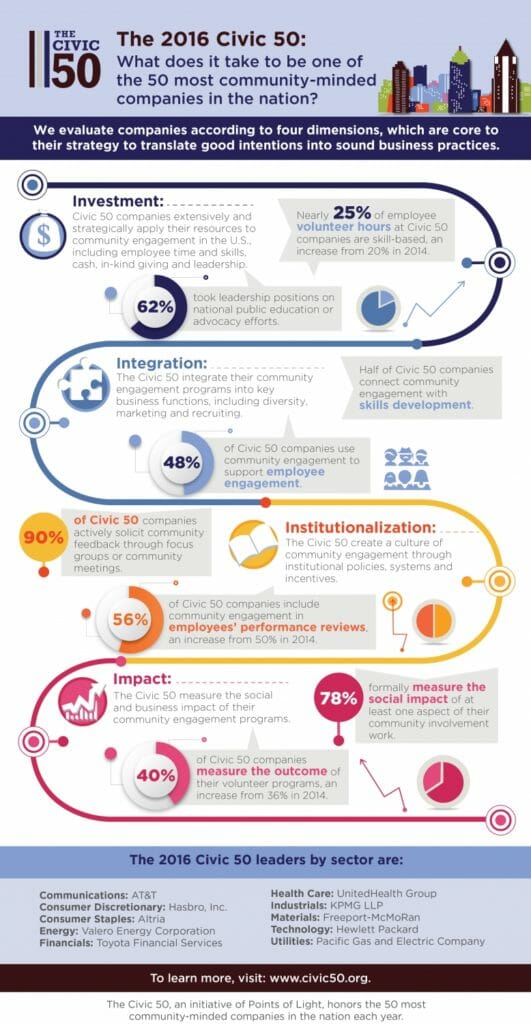
While many of us abandon our ambitious gym goals after just a few days, improving upon your corporate citizenship initiatives is an objective well within reach. The Civic 50, an initiative of Points of Light, annually recognizes and honors the 50 most community-minded companies in the nation. How? Through a quantitative annual survey that looks at four dimensions of corporate community engagement programs: investment, integration, institutionalization, and impact. In other terms:
Investment: How extensively and strategically does the company apply its resources to community engagement in the United States, including employee time and skills, cash, in-kind giving and leadership?
Integration: How does the company integrate its U.S. community engagement programs into key business functions, including employee engagement, marketing/PR, diversity and inclusion, recruiting, stakeholder relations and skill development?
Institutionalization: How does the company support community engagement in the United States through organizational policies, systems and incentives?
Impact: How does the company measure the social and business impact of its U.S. community engagement program?
While we can’t promise that every company that takes the Civic 50 survey will be recognized as an honoree, there is one thing we can guarantee: applying to the Civic 50 will help you and your team evaluate your community engagement program as related to these four dimensions, while also providing you with a personalized scorecard that ranks your company against the other applicants. Every company that takes the Civic 50 survey receives a benchmark to gauge organizational progress against a core group of leading organizations – true peers.
Time and time again, we hear from Civic 50 companies that the survey is an annual exercise for its corporate citizenship team to scrutinize their community engagement program’s impact, investment tactics, and overall integration and institutionalization into business strategy. The Civic 50 not only is a means to celebrate the great work companies are doing to strengthen the communities where they do business – it’s also a way to strengthen their programs through extensive analysis and inspiration from fellow applicants and honorees.
The evaluation doesn’t stop once the survey is submitted: companies receive scorecards from survey partner True Impact in the spring of 2018. These scorecards summarize how your company scored on the survey, ranked in each dimension, and more. The three options for the scorecard include:
Individual Scorecard | Free of charge: This one-page scorecard includes your company’s score, ranking as compared to all Civic 50 participants, and tier for each of the four dimensions.
Sector Scorecard | $1,500: In addition to all the content included with the individual scorecard, this enhanced scorecard includes sector-specific rankings and tier categorizations to quantify your performance as compared to your peers, and the additional percentage needed to be in top performance tiers for each dimension.
Comprehensive Scorecard | $3,500: The comprehensive scorecard builds upon the content of the individual and sector scorecards, adding question-specific rankings and benchmarks, information on score distribution across all companies and where your company falls, and more.
These scorecards help you take a deep dive into your corporate responsibility initiatives and provide a springboard for improvement in 2018 and beyond. Learn more about the different scorecards.
The Civic 50 sets the standard for excellence in corporate citizenship. Make 2018 your year to set yourself up for continuous improvement and distinction in community engagement. Get started.
The Civic 50 survey, powered by True Impact, is open to all private and public companies with annual revenue of $1 billion or more and operations in the United States. Learn more at www.civic50.org.
Through Strategic Volunteer Engagement, KPMG and Freeport-McMoRan Promote Youth Education
There are a variety of ways companies support education initiatives across the country, from philanthropic investments and fundraising to employee engagement activities and skills-based volunteering. For 2016 Civic 50 sector leaders KPMG and Freeport-McMoRan, investment in education translates to a firm-wide commitment and strategic business opportunity. Not satisfied with one-and-done service opportunities, these companies are using strategic corporate citizenship initiatives to ensure maximum impact for students in the communities where they do business.
For KPMG, Civic 50 industrials sector leader, an emphasis on youth and education has always been a focus of their philanthropic and foundational work. In an effort to improve reading levels across the country, KPMG established its signature community involvement program, Family for Literacy, which provides families and children from low-income areas with books. Since 2007, the program has engaged employees across all levels of KPMG – interns, its partners and professionals alike – to donate books to local schools and education centers. KPMG also finds ways to engage key stakeholders – including clients, alumni, and family members – in their community involvement initiatives. At KPMG, supporting learning and literacy is more than just providing books. For example, after realizing a lack of diverse representation in children’s books, KPMG worked with an outside publisher to create a children’s book about a disabled man in Ghana. Through its work in education, KPMG is striving to ensure all children grow up with a love of reading.
Freeport-McMoRan saw a different opportunity to strategically align philanthropy efforts with the needs of educators and students. After identifying a recruitment gap, the Civic 50 materials sector leader decided to work with universities around the country through their University Teams program. The company sent representatives from key business areas to eight universities with strong mining engineering, metallurgy and geology programs to create high-impact partnerships. This mutually beneficial program helps the company identify and cultivate a new talent pool and also gives the University Teams a chance to work hand-in-hand with schools to identify opportunities for grants, educational programs, scholarship needs, and more. The program also ingrains a strong culture of service at Freeport-McMoRan by offering employees an opportunity to be key players in the recruitment process and see first-hand how investments are helping students across the country.
By investing time, money and other resources in education programs, and connecting community engagement initiatives to key business functions, KPMG and Freeport-McMoRan demonstrate a strategic commitment to students across the United States. As sector leaders of The Civic 50, they scored highest in their industries in the annual Civic 50 survey, a benchmarking effort to recognize and honor the 50 most community-minded companies in the nation.
Do you work with a company that excels in community involvement and exemplifies the ideals of The Civic 50? The Civic 50 is currently looking for the next cohort of community-minded champions to take the 2017 Civic 50 survey, the deadline for which has been extended to 11:59 PM EST on March 13. The entirely quantitative survey looks at four dimensions of community engagement: impact, investment, institutionalization and integration. Any company with operations in the United States and an annual revenue of $1 billion or more is eligible to apply. For more information – including a best practices report, resources for survey-takers, and a full list of the 2016 Civic 50 honorees – visit www.civic50.org. For further updates and insights, follow The Civic 50 on LinkedIn or Twitter.
Using Employees’ Skills, Toyota Financial Services and UnitedHealth Group Build Stronger Communities
Giving back: it’s an action that can be carried out in countless ways. For some, giving back means volunteering in their community. For others, it means donating money or goods to those who need it most. For Civic 50 sector leaders Toyota Financial Services and UnitedHealth Group, employees give back by exercising their corporate know-how and investing their time and talent in communities to provide the biggest impact. In matching community needs with employees’ corporate expertise, these companies have identified a way to both give back and continually engage employees. These employee volunteering initiatives helped propel TFS and UnitedHealth Group to the top of their sectors in The Civic 50, the annual initiative from Points of Light to recognize and honor the 50 most community-minded companies in the nation.
TFS led the financial sector in the 2016 Civic 50 thanks to their robust community involvement programs. One such program, Financial Empowerment Initiative, helps under-represented youth and local community members make informed financial decisions through training and tools. TFS extends the reach of its programs through partnerships with nationally recognized organizations, such as Boys & Girls Clubs of America and Girl Scouts, providing financial education support and guidance, along with leadership and life skills and college scholarships and internships to youth across the nation
To improve the effectiveness and reach of their programs, TFS turns to its greatest asset: its employees. Through the TFS Community Ambassador program, team members are empowered to build strategic partnerships with local nonprofits in their community and engage TFS team members to participate in community activities. This leadership development program enables team members to increase their aptitude in the workplace through skill development, while informally guiding and shaping a culture of service in the organization.
UnitedHealth Group, the Civic 50 health care sector leader, leverages its expertise in health promotion and research in order to help make the health care system work better for everyone. To share nationwide health insights, United Health Foundation – the company’s philanthropic arm – publishes America’s Health Rankings every year, assessing nation’s health on a state-by-state basis. This year the foundation published its 27th report, tracking key trends and identifying ways to improve the health of different populations across the country on both the national and state level. Through these reports, which have covered the health of seniors, the health women and children, and the health of those who have served, UnitedHealth Group provides a blueprint for how other community-minded companies can use their expertise to influence positive change.
These two companies are using their corporate strengths to positively affect their communities. They scored highest in their sectors in the annual Civic 50 survey, which provides a framework and a roadmap for how companies can turn good intentions into sound business practices. Toyota Financial Services and UnitedHealth Group are just two examples of the many companies that are using their time, talent, and resources to improve the quality of life in the communities where they do business.
Do you work with a community-minded corporation that is a champion of corporate engagement and exemplifies the ideals of the Civic 50? Take the Civic 50 survey today at www.Civic50.org. Survey closes March 1, 2017. For more updates, follow the Civic 50 on LinkedIn and Twitter.
Building a Culture of Service: Altria and Valero Put Local Communities First
Crafting a mission statement is a chance for a company to put into words what truly drives the organization: what are the values it holds above all others? For many, success and profit come to mind. For Civic 50 sector leaders
, community is consistently held as the organizations’ driving force. These companies are doing their part to support local communities by institutionalizing policies, systems and incentives to build a culture of volunteerism and community engagement and to drive their social impact.
Civic 50 consumer staples sector leader Altria pioneered its
, which supports a culture of giving back to the community. Altria employees not only participate in charitable giving programs, they play an active role in managing and operating them. Founded in 2000 by Altria employees, the unique charitable giving program highlights the power of initiatives that bridge the gap between businesses and communities.
As the only publicly reported employee-giving program of its kind in the United States, employees choose the focus areas, lead fundraising, develop marketing and communications plans and allocate funds. Each year, 60 percent or more of Altria employees participate in the program. Since 2001, it has awarded 1,886 grants for a total of $49.8 million.
All administrative costs are covered by the company, which means that every dollar raised by employees goes directly to the community. This fund illustrates the company’s commitment to supporting a culture of community engagement, and employees routinely rate employee involvement as one of the top reasons to work at Altria.
Valero Energy, the Civic 50’s 2016 energy sector leader, has created a culture of community engagement by incorporating community involvement into its highest level of corporate governance. Valero’s commitment to communities is incorporated into its
, as the company pledges to share “success with the communities where we live and work through volunteerism, charitable giving and the economic support of being a good employer.”
During National Volunteer Week, all Valero plants sponsored food drives to address food insecurity issues. The company headquarters in San Antonio collected nearly 1.4 million pounds of food for the
. Valero leverages its strong community engagement culture to consistently and strategically encourage employees to give ample time and commitment to local communities, with 50 percent of employees participating in its community engagement initiatives and logging more than 130,000 volunteer hours annually.
As sector leaders of The Civic 50, Altria and Valero scored the highest in their sectors in the annual Civic 50 survey, a benchmarking effort to recognize and honor the 50 most community-minded companies in the nation. They are just two examples of the many companies that are adopting critical policies, systems and incentives to institutionalize community engagement and create a culture of giving back in the workplace.
Do you work with a community-minded corporation that is a champion of corporate engagement and exemplifies the ideals of the Civic 50? Visit www.Civic50.org to learn more and to take the Civic 50 survey today – survey closes March 1, 2017. Want to learn more? Follow the Civic 50 on LinkedIn or Twitter for updates, and email [email protected] with any questions.
Civic 50 Honorees AT&T and Hasbro Made a Difference by Mentoring Youth
Maya Angelou. Quincy Jones. Sting. Tom Brokaw. President Bill Clinton. What do all of these
sector leaders AT&T and Hasbro Inc. recognize the importance of mentorship – especially in the lives of underserved youth who may lack the resources or individuals in their lives to guide them through tough decisions such as college, career, and more. While leaders in their respective sectors, these companies have also taken the lead on aligning purpose with profit and giving back to the community, and in these examples, through youth mentoring.
With the introduction of their innovative community and talent development program, Transforming Talent,
– the consumer discretionary sector leader for the 2016 Civic 50 – stands by their purpose to make the world a better place for children and their families. In partnership with
, a leading workforce development and higher education nonprofit, Hasbro provides college classes, corporate internships, educational stipends, and mentoring to youth that simply need a chance. This strategic partnership with Year Up allows integration between Hasbro’s community engagement program and its business interests.
Transforming Talent provides a platform for Hasbro to work toward their employee engagement, and diversity and inclusion goals, but more importantly, generates a pipeline of full-time, diverse talent from young adults who would otherwise not have access to the corporate workforce. The success of Hasbro’s Transforming Talent program is evident through the statistics alone: 75 percent of the Transforming Talent graduates
, the company’s signature philanthropic initiative focused on helping students succeed in high school and beyond, launched an expanded mentoring program. Through Aspire, AT&T collaborates with leading education nonprofits to match employees with students who will benefit the most from mentoring. The program is a flexible resource for both employees and students as mentoring events take place in the classroom, at AT&T locations, within the local community and even online.
This school year, AT&T is contributing more than $1.3 million to innovative organizations such as
to help even more students explore their potential through online and in-person mentoring. They are also providing funding to bring careers to classrooms through an innovative program called
that matches professionals with classrooms virtually to help connect what students are learning at school to their future careers. As of January 2016, more than 160,000 students had been mentored in 336 cities for a total of 1 million employee volunteer hours. AT&T has demonstrated a profound impact on the communities they serve by helping underserved youth connect with their passions and potential.
AT&T and Hasbro demonstrate what can be accomplished when companies use their internal strengths and resources to improve the communities where they live and work. As sector leaders of the Civic 50, they scored the highest in the annual Civic 50 survey, a benchmarking effort to recognize and honor the 50 most community-minded companies in the nation. Hasbro and AT&T are just two examples of the many companies that are translating good intentions into sound business practices and best using their time, talent, and resources to improve the quality of life in the communities where they do business.
Do you work with a community-minded corporation that is a champion of corporate engagement and exemplifies the ideals of the Civic 50? Follow the Civic 50 on LinkedIn or Twitter or email [email protected] to receive updates on the 2017 survey, which will launch Tuesday, November 15 and close on March 1, 2017. For more information and a full list of the 2016 Civic 50 winners, visit www.civic50.org or sign up for our technical assistance webinar “2017 Civic 50: What You Need to Know” which will take place on Friday, November 18 from 1 – 2 PM ET.
What’s Their Secret? Lessons from the Most Community Minded Companies in America
Chances are that when you receive a package from UPS you don’t give a second thought to the complex logistics underway to deliver nearly 20 million packages a day. That’s because world class logistics is their expertise and core to their business strategy. But also core to UPS’ business strategy is a dedication to using that expertise to solve some of our world’s most pressing challenges.
When UPS employees learned that the inability to deliver life-saving medications results in millions of preventable deaths each year, they decided to act. This year, UPS will transform the delivery of humanitarian aid and life-saving vaccines by using drones. Through a new partnership with Gavi, the Vaccine Alliance, and Zipline, a robotics company, UPS employees will use drones to deliver vaccines to remote clinics throughout Rwanda. This cutting-edge partnership is a win-win for the people of Rwanda, for innovation at UPS, and for the talented employees who can do what they are really good at and save lives.
This is just one example of the many, many ways in which the companies on this year’s
are identifying the needs in their communities that are strategically connected to their business, and then aligning their community involvement and their employees’ skills towards those issues. These companies set the standard for good corporate citizenship across the country and demonstrate that service to others has become a fundamental part of successful businesses spanning every sector of the American economy.
Founded in partnership with Bloomberg and the National Conference on Citizenship in 2012, this annual survey and resulting top 50 list honors a culture of social responsibility in business. The survey considers four aspects of each company: its
investments
in the community (measured largely in volunteer hours, pro-bono donated talents, in-kind donations, money contributed to charity and leadership); the degree to which the company
integrates
its community service programs with key business functions; the ways in which community engagement is
institutionalized
as part of the business itself (for example, included the company’s mission statement); and how it measures the social and business
impact
of the company’s community involvement.
Civic 50 companies have gone beyond simply opening their checkbooks and are employing an “all-of-the-above” approach to community engagement — integrating input from employees, customers, and their local communities into everything from their employee handbooks to their workplace culture to their product design. As a result, Civic 50 companies are putting themselves at the center of change to create more enduring and sustainable business models.
Here’s a snapshot of how the Civic 50 are doing it:
90% have a formal, structured effort to solicit community feedback.
78% included community engagement on department scorecards. This was an increase from 70% in 2014.
56% included community engagement as a formal written component of employees’ performance reviews. This is an increase from 50% the previous year.
62% said they took a leadership position on four or more national public education or policy advocacy efforts.
Half use community engagement to support skill-development for employees, an increase from 46% in 2014.
Nearly one-quarter of employee volunteer hours are skill-based. This represents an increase from 20% the previous year.
The top five business functions that their community engagement programs support are: diversity and inclusion, recruiting, stakeholder relations, marketing/PR, and employee engagement.
This year’s Civic 50 winners demonstrate that they are doing the hard work of building more community-minded businesses, and that the business sector plays a critical role as a catalyst for civic engagement. This is big news. Increasingly, American businesses are partnering with government, nonprofits and individuals to solve the biggest challenges facing our communities. Both socially-minded employees and consumers are driving businesses to place social-oriented values at the center of their operations. This ingrained ethic of service helps socially responsible businesses recruit better employees, build customer loyalty, find bottom-line rewards, and become better corporate citizens.
Check out
to get an inside look at the secret sauce that helped these companies make the list.
Agents of Purpose, from Detroit and Around the World, Headline Conference Sessions
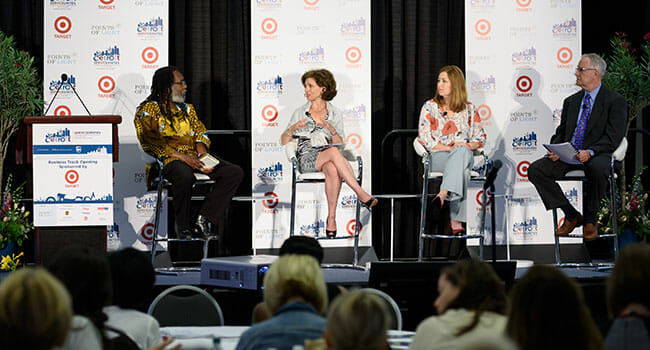
“Consumers want the companies, the brands they are loyal to, to be agents of purpose,” said Points of Light CEO, Tracy Hoover, as she opened the Business Track at the 2016 Conference on Volunteering and Service. Celebrating corporate changemakers who are inspiring the next generation of purpose-driven organizations, the session “What’s New? Leading with Spirit and Innovation” featured an impressive group of speakers who both inspired and challenged attendees to think about the role they play in collaborating with community and civic leaders.
In a TED-talk style format, speakers shared lessons of success grounded in the theme of “My Detroit, Our World.” Detroit’s youngest entrepreneur, 13-year-old Asia Newson (aka Super Business Girl), shared her winning strategy: teamwork. “You can’t do it all by yourself. You can try, but you need a team. And you need support from the community. It makes you stronger.” Attendees heard stories of triumph and change from citizen leaders, including, Damien Rocchi, CEO and cofounder of Grand Circus Detroit; Dan Carmody, president of Detroit Eastern Market Corporation; and Dennis Archer Jr., CEO of Ignition Media Group and president of ACS. Mark Davidoff, Michigan managing partner of Deloitte, moderated a discussion focused on making financial literacy a priority for the future of Detroit with panelists Sandy K. Baruah, president and CEO of Detroit Regional Chamber, and Kathleen Hatke Aro, president of the Accounting Aid Society.
“Innovation is the only path to sustainable growth,” said Jennifer Silberman, vice president of corporate social responsibility for Target, sponsor of the Business Track. She underscored the importance of leveraging the creativity and innovation of intrapreneurs—those who work within a company to accelerate change—saying “at the end of the day, agility isn’t just for startups anymore.”
Looking towards Detroit as a “Comeback City,” Professor Michael Gordon of the University of Michigan’s Center for Social Impact moderated a conversation about corporate and community leaders uniting in service to revitalize the city. Naomi Camper, head of the Office of Nonprofit Engagement at JPMorgan Chase & Co., and Heidi Magyar, director of community outreach programs for General Motors and president of General Motors Foundation, joined Malik Yakini, executive director of the Detroit Black Community Food Security Network, to discuss the importance of investing in citizen leaders who are addressing community needs, and how to make decisions about how and where those investments are made. “There is no room for competition when it comes to doing good,” Magyar said.
Detroit Mayor Mike Duggan explained that business, coupled with the power of employees as volunteers and leaders in the community, is an essential partner in the growth of Detroit and an economic driver of jobs and capital investment.
The 2016 Civic 50 honorees were announced during the Business Track Luncheon & Awards Ceremony, celebrating the accomplishments of the 50 most community-minded companies in the nation. Sponsored by Target, JPMorgan Chase & Co., and Deloitte, the luncheon explored insights and trends from the 2016 Civic 50 survey and honored the Civic 50 leaders that are providing a roadmap for how companies can use their time, skills, and other resources to improve the quality of life in the communities where they do business.
Leading advocates of military caregivers came together to discuss strategies for leveraging the power of volunteerism in support of our country’s “hidden heroes.” The forum, sponsored by the Bob Woodruff Foundation, included facilitated group discussions and a panel of experts from government and nonprofit organizations that are focused on the needs of military family caregivers who face many challenges and often struggle to find support. Joey Caswell, wife of a wounded veteran and a Dole Fellow-Michigan with the Elizabeth Dole Foundation, shared an emotional testimonial about the challenges she faced and
. “We want you to know, to love and appreciate, that behind every wounded vet is a caregiver who is helping to keep the vet alive,” said Caswell. “It is my goal that not one veteran or caregiver have to go through what we did.”
Larkin O’Hern, with the Bob Woodruff Foundation and a wounded veteran himself, added: “We want to take volunteering, which is good, to well executed volunteering, which can be life changing.”
The current challenges posed by the refugee crisis and the innovative solutions meeting them were in the spotlight at the Global Track’s “Harnessing the Power of Volunteering to Support Refugees.” Andre Cervi, co-founder of Atados and Abraco Cultural, laid out his organization’s work around hiring refugees to teach language and culture to local Brazilians. Joining him at this session, sponsored by Disney, were Celina de Sola, who grew Glasswing International from a three-person Salvadoran nonprofit into a network of 14 countries in Latin America; Lorrie Foster from IAVE (International Association for Volunteer Effort); and Lena Panagiotarea, general manager for Volunteer4Greece.
Volunteers building relationships—with causes, organizations and corporations, and each other—that is what forms the volunteer experience. At “Beyond the Volunteer Event,” sponsored by UPS, Maurice Hogan from Rock Ventures and Julia Sartor from The Greening of Detroit shared practical advice and insights on how they have successfully partnered to co-create volunteer events for employees. Sartor cites both customer service and providing a consistently positive experience as the most important factors in building volunteer connections—making sure that the experience is safe, directions are clear, and accommodations, such as bathrooms, are comfortable. A positive volunteer experience, said Maurice, is where “folks are honored and their time is honored.”
Is Your Company the Most Community Minded in America? Get Recognized by The Civic 50!
is searching for corporate trailblazers that are improving communities and driving social impact. Is your company engaged in the communities where you do business? Are your purpose-driven employees volunteering? Are your brand values reflecting social commitment? Is your philanthropy aligned with your corporate culture?
The Civic 50
recognizes these and other best practices each year and it all begins with a short survey.Interested companies can get started today at
companies are determined through a quantitative survey that benchmarks strategic philanthropy, employee engagement, business integration of community programs and measurement of impact.
Why Invest Your Time in The Civic 50?
Gain Recognition for Your Corporate Commitment to Community
The Civic 50
is the only award that recognizes corporate community-mindedness. Earning a spot on
The Civic 50
is a meaningful way to be recognized for what you do best and join the ranks of
and promoted through the webinars, press and social media throughout the year. Winners also earn opportunities to serve as speakers during global webinars, meetings, workshops and more.
Receive a Benchmark Scorecard When You Complete the Free Survey
The Civic 50
offers much more than a recognition platform. Every company that completes the survey, powered by
, will receive a benchmark report for this year’s participants and the opportunity for a deeper review of your results. Our valuable benchmarking resource has been described as a roadmap for maximizing community engagement programs and initiatives for social impact and business value. Completing
The Civic 50
survey is a simple way to help you translate good intentions into sound business practices for years to come.
How to Get Started
Participation in The Civic 50 survey is free and open to companies with revenue of $1 billion or more. Applications will be accepted through March 1. You can learn more about The Civic 50 and find the survey at www.Civic50.org.
Find resources and links to best practices here. Send your questions to [email protected].
Share your best practices on The Civic 50’s LinkedIn and Twitter pages.
What Past Winners Say
Adobe
– “Being on
The Civic 50
validates the importance of being involved in our local communities, a core value that is embraced by Adobe employees around the world. The impact that our time, talent and donations make where we live and work is felt by the company in many ways” – Michelle Crozier Yates, director, corporate responsibility, Adobe, and executive director,
list. We are proud of our community involvement. Our corporate citizenship program reflects our strategy to operate and grow our business while serving our customers and communities, mobilizes employees to create positive change and builds bonds with our customers.” – Scott Prochazka, president and CEO,
– “ConAgra Foods is thrilled and honored to be recognized by
The Civic 50
as one of most community-minded companies in the country. Supporting the communities in which we live and work is one of the key planks of our citizenship platform and this recognition is an important measure of how we are delivering on our ongoing commitment to being a good corporate citizen.” – Chris Kircher, vice president, corporate affairs, and president,
Do You Work for a Community-Minded Company? Check Out The Civic 50!
Does your company care about the communities where it does business? Join us Oct. 30, 2015 for a free webinar about participating in The Civic 50, an initiative of Points of Light that honors the 50 most community-minded companies in the nation each year as determined by an annual survey.
Benchmarking and sharing the best practices of community engagement offers companies that participate in The Civic 50 a roadmap for using their time, skills and other resources to improve the quality of life in the communities where they do business. The Civic 50 will help translate good intentions into sound business practices for years to come.
In this webinar, from 1 – 2 p.m. Eastern, you will learn:
What makes The Civic 50 survey unique
Why your company should participate
Technical and logistical details about the survey submission process
If you can’t join us for the webinar, but would like more information, please visit www.Civic50.org, email [email protected] or call 202-644-7245.
The Strengths of Community-Minded Companies
The following is an excerpt of “The Civic 50: Best Practices in Corporate Community Engagement,” by Yvonne Siu Turner, senior manager of corporate resources and programs at Points of Light, published byThe Conference Board. You can read the full version here.
Data from The Civic 50 – a Points of Light initiative that recognizes the 50 most community-minded companies in the nation – suggest we’re living in a world in which companies increasingly play a positive role in meeting community needs, through the power of their people and the power of their financial contributions.
Four strengths of The Civic 50, presented below, suggest companies are expanding and deepening their involvement in their communities by strategically integrating community engagement into their business strategies.
HP, for example, has data showing that employees who participate in community engagement efforts have 13 percent higher morale than those who don’t participate. Similarly, Hasbro’s employee survey revealed that the second-most referenced reason employees “love working at Hasbro” is the community engagement program, behind “year-round half-day Fridays.”
Companies and communities find value in skills-based volunteering
Skills-based volunteering continues to grow at Civic 50 companies, and, on average, one out of every five employee volunteer hours at Civic 50 companies is skills-based. Moreover, approximately 50 percent of companies offered pro bono service opportunities in 2013.
Skills-based volunteering provides communities with valuable, specialized support that can provide five times greater value than traditional volunteering, according to True Impact and the Bureau of Labor Statistics.
Two-thirds of Raytheon’s employees are engineers who use their skills to support communities through mentoring programs, including Stand & Deliver, Math Nights, and LASER – part of a nationwide effort to connect students with some of the world’s foremost engineers and business leaders.
Companies raise their voice to advance social change
Just over 80 percent of Civic 50 companies have taken a national leadership position on a social issue like ending hunger, texting and driving, and strengthening STEM (science, technology, engineering and math) education. Many companies invest in issues related to their own operations and are, therefore, often in a unique position to contribute lasting solutions.
Through the provision of health care solutions to the U.S. population, Aetna has significant experience with the effects of inequality in health care and has subsequently taken a leadership role in addressing these inequalities.
In 2002, for example, Aetna developed a policy on genetic testing and nondiscrimination that became the model for the industry.
In 2008, it worked with legislators to help pass a more meaningful mental-health parity law that allows for better coordination of coverage for physical and mental health care services. Aetna was an active voice throughout the health care reform debate of 2009 and 2010.
Purpose is aligned with profit
Research shows that solid business performance often accrues to companies that engage with their community.
For example, Harvard Business School found that companies with more community engagement practices significantly outperform their counterparts over the long-term, in terms of both stock market and accounting performance.
And market research has revealed that 56 percent of Americans will travel an extra 10 minutes out of their way to purchase a product that supports a cause they care about and that 71 percent are willing to pay more for that product.
More than 80 percent of Civic 50 companies integrate their community engagement into at least one of three business areas: marketing, skill development, and diversity and inclusion.
Whether they’re in the communications, technology or materials sector, Civic 50 companies have increased the impact of their community engagement by deepening the involvement of their employees, business units and other aspects of their operations.
Civic 50 companies are building and sustaining vibrant communities and tackling social challenges with greater seriousness than ever.