Volunteering feeds the soul. When you help someone in need or an organization that shares your beliefs or represents an aspect of your life, you are filling a need and potentially changing lives including your own. When people ask me why I volunteer in so many different capacities with the full plate I carry on a daily basis, I always tell people the same thing: The warm and fuzzy that I get from helping create something or make a change in my community makes me feel good. That warm and fuzzy is what volunteering is all about.
When I see a need I want to do what I can to fill that need if it is within my capabilities. My personal passion is helping Marine Corps families. As a Marine Corps spouse I know the feeling of needing community. I have experienced lost opportunities because I simply didn’t know about something or people didn’t reach out to me to share in the fun of an event. I have volunteered in my civilian community since I was a kid* and when I became a part of the Marine Corps community through my marriage I felt a drive to make myself as much a part of the new community as I could.
The bond Marine Corps families have is not always just felt but seen as well. When I organize fun events for fellow United States Marine Corps (USMC) families, it feels good to see kids having fun and spouses smiling and relaxing while they share stories about their kids that have happened at earlier duty stations. That feeling is what moves me forward to planning the next event. By giving USMC families an event to bond at, I am giving something positive to their lives.
I volunteer to help spouses reach their goals in their careers because one of my secret spouse powers is developing professionally while living the life of an Active Duty spouse through Permanent Change of Station (PCS), deployments, long recruiting duty hours, and whatever else this life we choose throws my way. Not everyone knows how to further themselves and I feel like since I do, I should help other spouses reach their dreams. If you know how to do something and you also know that your neighbor or friend or the brand new 18 year-old spouse attached to your spouse’s unit doesn’t but they are clearly in need, you should offer your hand to help them. Someone asked me why I think helping others is important. My answer is simple, because in my heart I want to help the person I see in need be successful in whatever it is they are working towards. Successful spouses equal successful families and the Marine Corps and our nation need successful families.
Even the smallest gesture such as making homecoming signs, working a community clothing drive, or baking for a fundraiser makes a positive impact. It is amazing what might be accomplished when you help others. There are many important reasons why Marine Corps spouses should volunteer, below are some important reasons why you shouldn’t let a volunteer opportunity pass you by.
Learning new skills: When you volunteer, you get to meet people who live their lives in many ways. You meet people who are in need, and then you meet people just like yourself who are looking to lend their talents and give back. Network with those who organized the homecoming sign event and chat with those people who are just looking for a warm coat. In the end, you not only will expand your network of people, but your life will be forever affected by the stories that you hear. You can develop your communication skills and learn how to build leadership skills. By networking with people you are developing “people” skills to take with you to the next duty station and beyond. The more volunteering you do, the further your leadership skills will develop as you begin to volunteer in different roles and take on more responsibility.
Make an impact: Whether it is cooking meals and handling carpool for a pregnant spouse who has a deployed husband with 3 school age children and a baby on her hip or working a booth at a USMC family day, one thing will always be the same: it is the thought that counts. Your gesture will help benefit those who are in need in some way. You have the choice to make a change, and when you make a change you begin to see the positive impact you are making on your community.
Personal development and satisfaction: Your time is valuable. Spend an hour organizing an on-base neighborhood pot-luck, or give two hours of your time at the child-care center. No matter what the task, in the end you are ultimately bettering yourself and your Marine Corps community. As you spend your time on different functions, you will come to know what you enjoy and what you don’t and what volunteer activities give you your own warm and fuzzy. Once you take a break from the everyday stresses of life, such as work, bills, kids, deployment, reintegration, etc., you will begin to see that all the little things and seemingly meaningless tasks matter.
Volunteering helps challenge you and can take you out of your comfort zone. Use these challenges to your advantage. Prove to yourself that no task is too small or role is too big. You will feel a satisfied happiness and experience feelings of accomplishment when fellow Marine Corps families say thank you and you step back and look at what you are doing for your community. Knowing that you make a positive impact on people’s lives, will help you to become a more positive person.
Always be grateful for what you have been given. Be grateful for your talents and skills and put them to use for no reason other than because someone needs what you can give. Give back to your Marine Corps community and “be the change you want to see.” (Mahatma Gandhi)
*Reference can be read about on USMC Families website, in part one of the volunteerism series “
Find ways you can help the military community in your area through the Community Blueprint.
Big or small, your business has the power to lead change through skills-based service
Today’s post is written by Jim Corcoran, the president and chief executive of the Fairfax Chamber, which represents 650 businesses with nearly 500,000 employees in Northern Virginia.
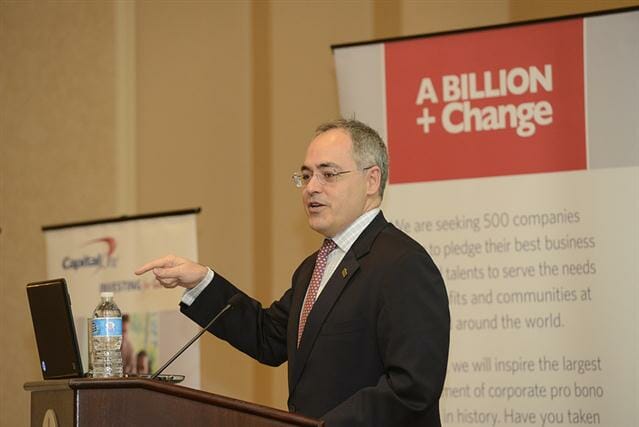
Photo of Dr. Angel Cabrera, president of George Mason University, who spoke at A Billion + Change’s pro bono summit on Monday. “The emerging generation of employees don’t want to follow a path of ‘make money now and give back later,’ he said. They “want opportunities for change from day one.”
, “collaboration is critical” emerged as the central theme. From the opening remarks to a vibrant keynote discussion, to a panel of corporate pro bono leaders and breakouts, the idea of cross-sector partnership and “we’re all in this together” (non-profits, government, educational institutions, intermediary organizations and the private sector) was the common thread. Throughout the day, the group discussed how to harness the power of pro bono – or skills-based volunteering – to move the needle on pressing issues like disconnected youth, hunger, affordable housing, homelessness, education, the environment and more.
For the
, pro bono is an important part of the solution to issues facing our region. The brain trust of knowledge and talent of the workforce in Northern Virginia and metro DC is exceptional. The intellectual capital of our people plays a key role in addressing our challenges. It was a pleasure to partner with these diverse organizations to leverage our private sector network to bring companies to the table – and more importantly – into the dialogue.
As Dr. Angel Cabrera, president of
, said in his opening remarks, the emerging generation of employees doesn’t want to follow a path of “make money now and give back later.” They “want opportunities for change from day one. They want to get involved and give back as they build their careers, and do so in a way that builds their skills, leadership capacity and furthers their professional development.”
For today’s employees, it’s about more than “here’s a T-shirt, go do something fun,” according to Deloitte’s National Leader of
Evan Hochberg. CEOs don’t want to see volunteering, they want to see impact. “It’s about change, not charity,” he says. And the great thing about skills-based volunteerism is that your company doesn’t have to be a large professional services firm like Deloitte to engage.
, which was represented by Vice President of Corporate Responsibility Jennifer Silberman at the summit, has a workforce that is largely hourly, and according to Silberman, there is an opportunity for the entirety of the company’s workforce to use their unique experiences and hospitality skills to help nonprofits deliver a better experience to their stakeholders. This means that employees from all levels of the company– from management and front desk staff to cleaning crews, food and beverage employees and more—can participate in service to their community.
According to
, the return on investment for their company has been tangible. CSR boosts employee engagement more than base pay and matters more than employee’s relationships with their manager, she told attendees.
Mid-size companies and small businesses have an important role to play in the pro bono movement. Margie Johnson, Acumen Solutions Senior Director of Corporate Care, spoke about her company’s Board Leadership Program, which trains Acumen’s leaders to effectively sit on nonprofit boards. Carrie Fox of C.Fox Communications also shared her small businesses’ “Inspired Thought” award, which provides a deserving nonprofit at least $20,000 worth of pro bono PR and marketing services every year.
and others to broker new pro bono partnerships in Northern Virginia and bring pro bono resources of business to local government and non-profits that are tackling our most pressing issues,” stated Patti Stevens, Executive Director of
, invest your human capital in partnering with Northern Virginia non-profits that are already making an impact on issues but need your support, and continue to dialogue with corporate peers on pro bono and other CSR issues through the
Change Notes: A Presidential Library Opening Prompts Thoughts of Legacy and Service
Friends,
They get together around openings and, well, closings. That is to say, current and former presidents seem to gather only for the openings of presidential libraries and funerals.
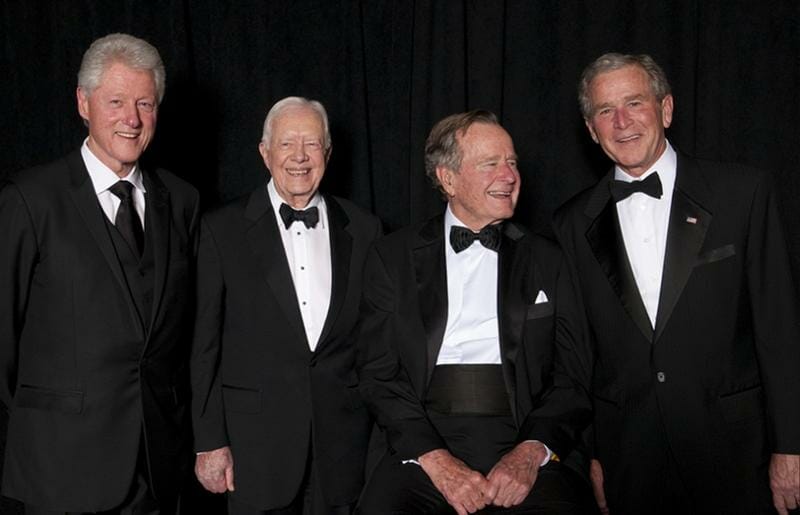
Four former presidents together at the Points of Light Tribute in 2011.
President Obama and the four living former presidents gathered today at the dedication of the George W. Bush Presidential Library and Museum on the campus on Southern Methodist University. They showed up, I presume, as a sign of respect for the office and for their extraordinary shared experiences, and, perhaps, as a nod to their shared concerns about legacy.
“When you’ve had the honor of being president and your ambition is slaked, and most of your fights are done,” said President Clinton in 2011, “all you really want to do is make sure that by the time you leave this earth, things are a little better off than they were when you showed up.”
And so the five men who are or have been President have gone out of their way to showcase their bedrock commitment to one common belief: Volunteers are part of the answer, and service is part of who we are as Americans.
President Carter began working with Habitat for Humanity after seeing an older woman living in a tenement in New York City. “There was no water, no heat, no electricity,” he said. “She was cooking her meal on a trash fire that she built between two bricks. I realized how much Habitat could mean to a neighborhood like this.” For almost 30 years now, Jimmy and Rosalynn Carter have given a week each year to build homes for those who need them.
President George H.W. Bush’s legacy will likely be built on volunteer service. In his acceptance speech at the 1988 Republican National Convention, Bush spoke of America’s volunteer organizations as “a brilliant diversity spread like stars, like a thousand points of light in a broad and peaceful sky.” Bush then went on to found Points of Light, a nonprofit that is now the largest organization in the world dedicated to volunteer service.
As he left office, the only thing Bush asked incoming President Clinton to do was to continue support for Points of Light. “It was a remarkable thing that he would ask Bill Clinton for anything,” says Jim McGrath, who handles media relations for the Bushes. “He’s not one to ask anyone for favors or to burden anyone.”
As it turned out, it wasn’t the only thing George H.W. Bush asked of Bill Clinton. The two became an unlikely – and powerful – duo, pairing up to raise millions for hurricane and tsunami relief.
President Obama saluted Bush – and service – just a few weeks ago when he allocated $10 million in his budget for the Volunteer Generation Fund, which he named after George H.W. Bush. The fund will provide competitive grants to support the recruitment, management and training of volunteers in direct response to critical national problems.
While in office, President Clinton founded AmeriCorps, which has for 20 years now engaged hundreds of thousands of people in full-time national service. And since he’s left office, Clinton’s Global Initiative has marshaled the volunteer efforts of thousands to improve the lives of millions worldwide.
George W. Bush is enjoying a much quieter post-presidency, but next month he’ll host his third annual 100-kilometer, three-day mountain bike ride with wounded war veterans at his ranch near Crawford, Texas. And volunteer service is one of the featured values of his new Presidential Institute.
It’s too soon to say what kind of volunteer service President Obama will incorporate in his life beyond 2016, but it seems clear that he’ll follow the tradition of his predecessors: He’ll volunteer and he’ll champion volunteer service. It’s what former presidents do best.
As Bush Sr. said in his inaugural address in 1989, “The old ideas are new again because they are not old, they are timeless: duty, sacrifice, commitment, and a patriotism that finds its expression in taking part and pitching in.”
Our presidents have been the most powerful men on earth, but it is in the humble act of serving others that they demonstrate America’s greatest strength.
In service,
Michelle Nunn
CEO, Points of Light
Empowering Young Women
Today’s post is written by Rachel Ley, 15, from Stevens Point, WI. Rachel is a founding Youth Advisory Council member for generationOn, the youth service enterprise of Points of Light. She is also the founder of a program called Literacy for Little Ones, which provides newborn babies with book packages, encouraging their parents to read to them on a daily basis.
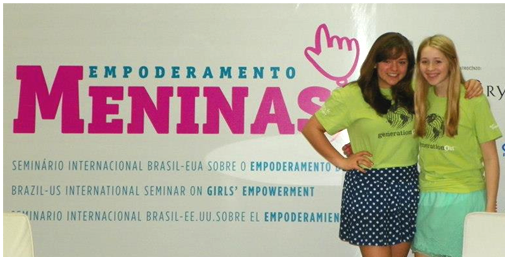
In early April, I was extremely fortunate to attend the Brazil-US International Seminar on Girl’s Empowerment in Rio de Janeiro, Brazil that was sponsored by Partners of the Americas whose mission is to build partnerships that create opportunity, foster understanding, and solve real-life problems. Together with 79 other young women who are change-makers from Brazil, Chile, Mexico, and Uruguay we spoke with government representatives about public policy regarding youth and women, participated in panels and workshops with female executives, and were encouraged to empower young women in our own communities. Although three different languages were spoken, there was no language barrier. We were able to communicate while gaining crucial leadership skills, creating lifelong friendships, and establishing incredible memories.
One of the most impactful lessons I learned from the conference was that in order to make a difference, you need to start small. I have found this to be completely true within my own volunteer work. When I first initiated Literacy for Little Ones, a program that encourages early literacy by distributing book packages to four Wisconsin hospitals, I gathered a group of my closest friends to assist me in assembling the book packages which went to one hospital in my community. Since then, I have engaged over 400 youth to volunteer with Literacy for Little Ones and over 3,800 families have benefited. The program was only able to grow once we created initial momentum, and ever since then the progress has been exponential.
In addition to attending a myriad of workshops and listening to several panels, we were able to tour parts of the incredible city. Rio de Janeiro was the perfect location, as it embodies the same change that we were talking about at the seminar. The once struggling city is now building to hold the 2014 World Cup and the 2016 Summer Olympics. It was inspiring to hear about the past of Rio de Janeiro and learn about the new developments they are implementing to create such an amazing city.
As I returned to the Minneapolis – St. Paul International Airport, I felt inspired and empowered. I am confident that I will continue to make a change in my own community and engage more girls than ever before to do the same. Attending the Brazil-US International Seminar on Girl’s Empowerment was a life-changing experience that has left me ready to lead the movement of the girls in my generation.
With the help of a Hasbro Make Your Mark Week grant, Rachel expanded her program to a second Wisconsin community in 2011 and then expanded to a third in 2012 as part of generationOn’s Community Action Heroes Needed initiative. In three years, over 3,800 babies have received book packages and some 400 Central Wisconsin youth have been inspired to become involved in the effort. Rachel has garnered many awards for her commitment to service including being named a Prudential Spirit of Community State Honoree, a Kids Who Care Regional Recipient and an NEA Leader for Literacy.
Short on Time? Here Are 6 Volunteer Ideas
It’s National Volunteer Week!Thank you to all the volunteers year round and everyone partaking in service projects this week. We are lucky to have people stepping up to make a difference in our communities and the world.
Here are six quick and easy ways to volunteer and start making a difference.
Multitask!
You have to go food shopping. Why not call an elderly neighbor, or someone who can’t get out, and do their shopping? How about picking up a few cans for your local food bank? You can help people and make someone’s day while you do your needed errands.
Like to chat?
Do you have an hour to spare a week? Visit a children’s hospital and spend time with the kids, go to a nursing home and visit the common rooms. Reach out and make connections with people in your community. Know another language? Maybe you can put that to use and help be a volunteer translator!
Throw a swap party!
Grab your friends for an hour and have a swap party. Choose a theme (books, clothes, toys, etc.). You might come away with something you didn’t know you needed, and all of those unused items will be recycled as something someone didn’t know they needed. All the unclaimed items can be donated to the charity of your choice.
Love animals?
Have adorable pets that are good with kids? Some hospitals have programs to bring in dogs to hang out and bring smiles to the children. Make someone’s day! Don’t have animals but love playing with them? Volunteer at your local animal shelter and make a dog’s day J
Utilize your own connections!
If there is a cause that really means something to you, you can help raise awareness of its work using your own network. You never know who might be listening who can help! Colleagues at work, friends and family, acquaintances that you find yourself chatting with – help spread the word by talking to people. If you have time free during your lunch hour, maybe that charity needs help writing e-mails or posters that need to be put up. Why not write to your newspaper to tell of the good work that the charity does? Start a personal blog to help get the word out!
Do what you know!
If you can cook, you can help. If you can read, you can help. Are you a computer programmer? A nurse? There are countless ways of using your existing skills to benefit others. Cook someone a meal, advise on health matters, fix a computer for an elderly neighbor or underfunded organization. Become aware of the people around you and figure out how much time you can spare each month. Even half an hour can make a huge difference for those who could benefit from your skills.
These are just a few small ways of donating a little bit of your time to help others. They are all unique volunteer activities and there are hundreds of more options out there. Small acts of kindness count and make large differences!
Friends,
Last week, as so many of us tried to make sense of the terrible events in Boston, this message from the beloved children’s television host Fred Rogers began to pop up on Facebook pages, twitter posts and in the news media: “Look for the helpers. You will always find people helping.'”
This is
, and there is no better time to “look for the helpers.” From marathon volunteers who aided the injured in Boston, to those who rushed to help those who were hurt in West, Texas, to the young Operation Lorax volunteers who planted 1,000 trees following a devastating wildfire in Washington State, helpers are everywhere.
In a White House
, President Barack Obama reminds us that, “We are home to more than 300 million people who come from every background, practice every faith, and hold every point of view. But where difference could draw us apart, we are bound together by a single sacred word: citizen. Ordinary men and women have stepped forward and accomplished extraordinary things together, uniting as friends and neighbors and fellow citizens.”
At
Points of Light
this week, we will be celebrating the power of volunteer service to bring people to together.
To kickoff National Volunteer Week, Points of Light lit up a Times Square billboard with a message about volunteering, thanks to our friends at Bank of America.
Today, generationOn, Points of Light’s youth service division, is mobilizing kids and their families in the fight against child hunger through events at Arby’s restaurants in five cities. The events are part of “What will you bring to the table?” a six-week campaign raising awareness of child hunger, and 1 million meals for children in need.
And in Tysons Corner, Virginia, 200 community leaders got together to discuss how to use skills-based volunteering to help solve critical community problems. The event was hosted by A Billion+Change, Deloitte, the Fairfax County Chamber of Commerce, George Mason University and Fairfax County Government.
On Tuesday, as part of a year-long tribute to the legacy of Dr. Martin Luther King, Jr. and volunteerism, Points of Light and Target will host an America’s Sunday Supper in Los Angeles. This year, more than 100,000 people will take part in Sunday Suppers across the nation. I hope you’ll join the conversation online at #2013MLKDay or by hosting your own Sunday Supper.
On Wednesday, Points of Light, with support from lead sponsor ITT Exelis, will testify to the power of volunteers to help veterans, military members and their families succeed before the U.S. Senate Committee on Veterans’ Affairs. Find out if your city or town is using proven tools and resources to help the 1 million veterans expected to transition out of the military in the next four years.
On Thursday, Points of Light will join with USA WEEKEND and Newman’s Own to honor Make a Difference Day award winners – volunteers whose extraordinary service is making our communities and our nation stronger.
On Saturday, HandsOn Inland Empire in Rancho Cucamonga, Calif., will lead 400 volunteers in a school makeover project at a local elementary school – just one of the many service projects and volunteer recognition events HandsOn Network affiliates are organizing across the nation.
Even in difficult times when we search our hearts to try to understand the marathon bombing and the loss of so many in West, Texas, we can take comfort, as Fred Rogers said, “by realizing that there are still so many helpers – so many caring people in this world.”
Take a moment to look for and celebrate the helpers this week and join me in extending our deepest thanks for the work volunteers do every day.
In service,
Michelle Nunn
CEO, Points of Light
What HandsOn Twin Cities Youth Advisory Board Will Bring to the Table…
Today’s guest post comes from Carly Bandt. Carly is a member of HandsOn Twin Cities Youth Advisory Board in Minneapolis. Carly and her 10 peers on the Youth Advisory Board aim to inspire meaningful volunteerism, develop youth leadership, and create innovative projects in the Twin Cities community. Through generationOn’s “What Will You Bring To The Table?” initiative, the HandsOn Twin Cities Youth Advisory Board has planned several projects to address the issue of child hunger. In the following post, Carly shares her perspective on how youth can play a critical role in tackling child hunger in their communities.
Put this into perspective: more than 1 in 5 kids in America don’t know where their next meal is coming from. Additionally, every year the number of kids who experience hunger exceeds the populations of New York City, Los Angeles, and Chicago combined. As you can see, hunger is a serious issue that America faces. Proper nourishment is essential for the functioning of the body and mind, and equal access to nutritious food should be an inherent right rather than a privilege. Sadly, this is not our reality. Luckily, generationOn has taken a stance to improve this situation, and you can, too, through the “What Will You Bring to the Table?” (WWYBTT) initiative!
It is so easy to take part in WWYBTT, and no matter the scope or success of your project, the feeling of accomplishment upon completion is truly rewarding. There are many different ways to join in on the fight against hunger. For example, the HandsOn Twin Cities Youth Board is putting on a Hunger Walk-a-Thon. For every lap participants walk, funds will be donated to a local food bank. In addition, we will be hosting speed volunteering stations where attendants can assemble healthy snack bags, create colorful placemats with messages promoting nutritious eating, and put together rice and bean meal packets to donate. We hope to educate and excite people to join in the fight against child hunger in America.
The HandsOn Youth Board is also planning an event to educate parents and children on ways to eat nutritiously on a budget. We will be putting on a presentation with interactive cooking demonstrations to teach children how to prepare inexpensive but nourishing meals and snacks. We hope to instill life long skills by encouraging nourishing options that are equally (or more!) delicious than empty calories.
These are only two examples of possible ways to contribute to the WWYBTT initiative, and there are so many other ways to get involved. In five seconds, you could make a post on social media to spread hunger awareness. In five minutes, you could make an announcement at your school to encourage classmates to join in on the WWYBTT campaign. In five hours, you could advocate through a letter writing campaign or phone call to your elected officials asking them to support increasing wages so low-income families have more money to spend on groceries. In five days, you could plan and organize a community garden. In five months, you could launch a Food Action Board to work towards long-term goals and initiatives with other like-minded leaders like yourself. Each one of these actions will make a positive impact in your community!
My best piece of advice to those wondering what type of project will make the most impact, be the easiest to plan, or create the most attention is to instead do something you are passionate about. Do something that excites you. Do something that will make you proud no matter how many volunteers show up or how many meals you donate. If you put your heart into what you are doing, chances are others will see that passion and want to join in.
Community Development: Morgan Stanley Challenges Its Employees to Get Involved
Today’s blog is republished from the CSRwire blog, part four of the Civic 50 series. Today’s post is written by Jackie Norris, Executive Director of Points of Lights’ Corporate Institute.
A few years back, New York investment banker Hashem Dabbas didn’t know much about East Harlem’s need for classes in English as a Second Language. The vice president of Morgan Stanley’s global industrialist group was an adviser on strategic financial modeling to major international corporations, not to neighborhood nonprofits.
Now he’s both.
Dabbas was on a four-member team that
sent to work with the Union Settlement Association to find ways the agency could survive the economic downturn while continuing to offer education and service programs to East Harlem families. The team’s solutions won first place in Morgan Stanley’s Strategic Challenge of 2012, which resulted in a $25,000 grant to launch the new approach.
“Giving people a skill set and tools like learning English to get a better job has a tremendous multiplier effect, and I find that enormously rewarding and valuable” Dabbas said.
For involving its employees in vital community projects like this one, Morgan Stanley earned top honors in
employee civic growth
last year from
The Civic 50,
a ranking of America’s most community-minded companies.
The Civic 50
, a partnership between National Conference on Citizenship and Points of Light, ranks corporations on seven dimensions of local involvement. The
employee civic growth
dimension requires a business to show that its approach motivates employees to get involved in the community and help meet local needs.
From Grant Making to Strategic Partnerships
Morgan Stanley has been funding Union Settlement for more than 20 years, but through the Strategy Challenge it deepened the engagement by better leveraging its employees’ talent. The group applied to Morgan Stanley’s annual Strategic Challenge program and was one of 12 community organizations selected to host a company team of advisers for eight weeks.
The timing, during what Dabbas called the organization’s post-recession “downward spiral,” was perfect. In 2010, the group offered 45 free ESL and GED prep classes to the people of East Harlem. By 2012, with grants and donations drying up, it could only offer 18.
Dabbas’ team researched other area ESL and GED providers, studied their curricula and pricing, and examined Union Settlement operations from A to Z, spotting a need Union Settlement could fill to raise funds while remaining affordable and true to its history: fee-based classes on weekends and a “Saturday academy” offered as a premium product.
“They just needed a third-party sounding board to give them some creative ideas,” Dabbas said. “That’s what I do in my day job—we’re advisers on strategic questions, financial modeling, figuring out price points, market research. That was broadly what we did with Union Settlement.”
Union Settlement’s leaders were thrilled.
The Morgan Stanley team was “superbly talented and brought tremendous levels of analysis, creativity and commitment to this project,” said Executive Director David Nocenti. “Its recommendation will lead to better jobs and greater opportunities and will have a transformational impact in East Harlem.”
A Cultural Commitment
But that’s not all.
Another Morgan Stanley team worked with Feeding America, a leading domestic hunger-relief nonprofit, in 2011 to help make the most of its resources. After months of study, the team recommended an online “deal café” where Feeding America’s 202 member food banks could share purchasing bargains in the areas they shared – office supplies, fuel, etc. – without alienating local suppliers or causing layoffs. When fully implemented, the program is expected to save the food bank network $10 million annually.
Morgan Stanley runs smaller projects among its 1,300 offices in 42 countries, challenging 62,000 employees to help their divisions and regional offices excel in service and fundraising campaigns.
And this past June, the firm’s senior leaders and 21,000 employees took part in the firm’s Global Volunteer Month, devoting 176,000 hours of service to 1,000 projects worldwide, according to Joan Steinberg, president of the Morgan Stanley Foundation.
What all these projects add up to is a big companywide commitment to community development. Hashem Dabbas will stay involved with Union Settlement for a long time to come. “You’d have to be heartless not to run through a wall for these people,” he said.
To learn more about Morgan Stanley, and employee civic growth, register for the next
Can Conference Change Your Life? Ask Joseph Peterson.
Change Notes: An investment in volunteer service, from one President to another
Friends,
President Obama’s 2014 budget includes a small investment for those who care about volunteer service and a big tribute to the father of the modern-day volunteer movement.
Yesterday, the President not only restored funding for the Volunteer Generation Fund but he allocated $10 million for it and renamed it in honor of President George H. W. Bush.
That’s fantastic news – for two reasons.
First, it’s smart policy. The fund will provide competitive grants to support the recruitment, management and training of volunteers in direct response to critical national problems.
In past years, the Volunteer Generation Fund has seeded an array of innovative and effective volunteer programs in 19 states. In Sioux City, Iowa, for example, the Fund helped create a new volunteer center that mobilized thousands of volunteers to respond to the Missouri River flooding in 2011. And when tornadoes decimated entire communities near Tuscaloosa, Ala., the Fund helped support a 211 volunteer hotline that mobilized more than 60,000 volunteers to assist with the recovery.
With state after state anticipating cuts in social services and as the nonprofit sector plugs away on the front lines of an embattled economy, it’s critical that we find new ways to leverage the one resource that is low-cost, plentiful, effective, renewable and provides a dramatic return on investment — volunteers.
Second, it’s a well-deserved honor for one of our country’s most remarkable public servants. President Bush’s record of service to his country is well known. He enlisted in the armed forces on his 18th birthday. He flew 58 combat missions before he was shot down over the Pacific during World War II. He served as a congressman, ambassador to the United Nations, U.S. envoy to China, director of the CIA, vice president and president.
Outside of his career, President Bush has given so much of his time to causes he believes in. From his work helping to launch the United Negro College Fund on the Yale campus after World War II to his relief work with Bill Clinton in the wake of Katrina to his work raising millions for cancer research, President Bush has been an extraordinary volunteer.
While President, George H.W. Bush heralded the power of volunteers – “points of light” – to create change. Even in times of scarcity, he said in his 1989 inaugural address, we have a natural resource that continues to grow – “the goodness and courage of the American people.”
Since his term, each succeeding President has embraced the power of service and joined across party lines to encourage Americans to serve. The Presidents Club has come to be defined by their shared commitment to lifting up and mobilizing “points of light” throughout the nation.
It is totally fitting that now – if Congress stands behind President Obama – millions of people will be mobilized to do critical community work in President Bush’s name.
You can help seal this bipartisan moment and support volunteers nationwide by sending a quick email to your members of Congress. Urge them to stand behind the George H.W. Bush Volunteer Generation Fund.