, this roundup highlights new and emerging research and trends shaping the nonprofit sector. We hope these insights help you champion volunteering in your community.
A new study indicates that attending live, in-person events—especially recurring ones with friends—can enhance social connections and reduce loneliness. Active involvement (conversation, hands-on activities) was key to feeling more connected. While effects diminish after a day, consistent in-person gatherings like volunteer activities may sustain benefits. Useful implications for volunteer managers weighing in-person vs. virtual engagement. The team also created a toolkit,
Using Global Flourishing Study data (200,000+ people, 22 countries), researchers found education and religious service attendance consistently predict formal volunteering, while age, marital and immigration status matter less. Gender and employment type also shape participation. Findings point to reducing barriers and expanding access.
Among 8,000+ adults near retirement, about one in five volunteered and a similar share provided informal care. Retirees, part-time workers, women and those with good health/financial security were more likely to volunteer; full-time work reduced participation.
Study of “super volunteers” identified three types—ideal workers, supporting actors and thrill seekers—each navigating freedom differently. Autonomy can both enable and undermine meaningful work, suggesting managers tailor roles and supervision.
Volunteers driven by intrinsic motivations showed significantly higher psychological well-being than those motivated by external rewards, reinforcing the value of purpose-aligned roles.
Corporate volunteering strengthens communities and boosts employee skills, satisfaction and cohesion, aiding talent attraction and brand reputation. Authors call for standardized metrics to better assess social impact.
They complement each other: people engaged in one often engage in the other. Income predicts both forms more than time availability; formal volunteering is more sensitive to resource fluctuations.
Trust in authorities and expectations of reciprocity increase disaster volunteering. Other-focused values predict more frequent helping, offering cues for effective engagement strategies.
Ask a CSR Friend: Engaging Remote and Hybrid Employees in Meaningful Service
Looking for CSR advice?
Hear from our experts right here in our Ask a CSR Friend monthly column.
Whether you’re a novice or a seasoned pro, we know collaboration is key to creating vibrant workplaces where employees are equipped to contribute to the communities and causes they care about. So, when you need a trusted advisor to lean on, rely on Points of Light to be Your CSR Friend. Each month, our experts share their wisdom and wit to address a specific but often universal challenge related to your work as a corporate social impact practitioner.
Have questions about employee community engagement? Submit your question and it may be featured in a future blog post.
Dear CSR Friend,
While I personally love the flexibility of my hybrid work situation and that our company continues to support remote and hybrid opportunities for our team members, I’ve seen a noticeable decrease in volunteer participation. With varying schedules across time zones and roles no longer having a central meeting place in a large, corporate office, it’s been a struggle to engage our workforce in meaningful volunteer opportunities. The Zoom fatigue is real and I’m running out of ideas that aren’t solo activities. What would you suggest to help engage a dispersed team?
Struggling in Seattle
Dear Struggling in Seattle,
At the risk of sounding cliché…the struggle is real!
For many of us the rise of remote and hybrid work models became increasingly prevalent following the COVID-19 pandemic, however, they’ve been in existence for many years prior. NASA engineer Jack Nilles known as the “father of telecommuting” first initiated this concept in the 1970s with early corporate experiments following in the 80s and 90s becoming more formalized as the internet enabled hybrid opportunities beyond just large corporations.
Today, while many large companies have enacted return-to-office mandates, U.S. work locations have
. However, when done effectively, these sessions can help employees feel more connected to the organization’s culture, increase team collaboration, foster working relationships, and promote cross-functional communication and collaboration.
So, where can you start?
1. Understand Operational Realities
Design volunteer initiatives that recognize the diverse schedules and responsibilities across your workforce. For teams spanning multiple time zones, consider extending volunteer opportunities over several days or even an entire week. This flexibility maximizes participation and ensures that everyone, regardless of location, can engage meaningfully.
, flex time, and company-wide service days are available to all employees, whether remote, hybrid, or on-site. By extending these benefits universally, you foster a culture of inclusion and demonstrate that every team member’s contribution is valued.
3. Empower Local Champions
Cultivate a network of volunteer ambassadors who can share information, motivate participation, and coordinate grassroots efforts tailored to their local communities. This is also a great opportunity to engage your ERGs to help reach employees across roles.
4. Offer a Variety of Options
Diversify your volunteer opportunities to accommodate different interests and working styles:
Virtual, skills-based volunteering such as translating materials, designing websites, or handling data entry.
Asynchronous projects like writing letters or recording audio versions of children’s books, allowing employees to participate on their own schedule.
Hybrid events that blend live, in-person activities with virtual components, ensuring everyone can join in regardless of location.
Pro tip: Hold a joint kick-off all together and then separate the virtual group into their own “breakout room.” Assign a dedicated facilitator for each “room” – virtual and in-person.
At-home, hands-on activities that can be completed individually or with family members.
On-site activities held during company gatherings or in-person meetings.
When in doubt, ask your employees what activities and cause areas they might be interested in to help generate buy-in.
5. Solicit and Act on Feedback
Establish regular feedback channels that encourage employees to share their experiences, suggestions, and concerns. Use this input to continuously refine your programs, demonstrating your commitment to building trust and meeting the evolving needs of all employee groups.
Ultimately there’s no magic fix for virtual fatigue. Instead of chasing a one-size-fits-all solution, try approaching it like a good CSR strategy: from multiple angles. Tackling the problem from a few directions gives you the best shot at real participation—and a more energized, connected crew.
Until next time,
Your
Ask a CSR Friend: Building an Effective Employee Volunteer Program Framework
Looking for CSR advice?
Hear from our experts right here in our Ask a CSR Friend monthly column.
Whether you’re a novice or a seasoned pro, we know collaboration is key to creating vibrant workplaces where employees are equipped to contribute to the communities and causes they care about. So, when you need a trusted advisor to lean on, rely on Points of Light to be Your CSR Friend. Each month, our experts share their wisdom and wit to address a specific but often universal challenge related to your work as a corporate social impact practitioner.
Have questions about employee community engagement? Submit your question and it may be featured in a future blog post.
Dear CSR Friend,
I’ve previously worked at companies with well-established employee volunteer programs but just started an exciting new role at a company looking to create an employee volunteer program and have no idea where to begin! How can I develop something people want to be a part of and aren’t just checking the box because their leader “voluntold” them for something? How can I build a program that supports both the company and the community? What are the nice to haves versus the need to haves?
Wondering Where to Start in West Allis
Dear Wondering Where to Start,
First, let’s take a deep breath and remember all those well-established employee volunteer programs out there had to start somewhere! They weren’t all successful right away and it most likely took them years to get to where they are now –
years
of learning, adapting and growing.
Next, let’s start with a few key building blocks to get you on your path towards a successful Employee Volunteer Program (EVP) framework – Listen. Learn. Lead.
BUILDING BLOCK #1: LISTEN
To develop a truly successful EVP, you’ll need to listen and gather feedback from your key stakeholders to build a program that supports business purpose and priorities, is aligned with organizational values and core competencies, addresses employee motivations, and delivers on community needs (as communicated by the community!).
Conduct a listening tour across the company and have conversations with both supporters and detractors to get a full picture of what YOUR specific company needs and build ownership and buy-in as you develop solutions. This could look like focus groups, employee surveys, one-on-one conversations, as well as reviewing existing internal policies and related programs.
Consider a landscape assessment where you can listen for learnings from your peers & competitors and evaluate what they are doing that might work for your program and what you can leave behind that doesn’t suit your needs.
Engage nonprofit partners to understand their needs and co-create an employee engagement program that aligns company resources with community-driven goals.
BUILDING BLOCK #2: LEARN
Once you’ve gathered and analyzed all those inputs, start building your program with an eye towards continuous improvement. Don’t be afraid to try things out – pilot new ideas, learn what works and doesn’t, adjust accordingly and try again!
Outline clear goals and objectives for your EVP framework so you can measure where you’re successful and learn where there’s opportunity to grow along the way.
Define your program offerings – you don’t have to launch with everything but clearly define what you will launch with and then add on as needed/as you grow.
Create clear and concise guidelines alongside eligibility criteria, with a focus on removing barriers for employees to volunteer. Creating an accessible program that understands cultural context, local priorities and varying role responsibilities will be needed to scale your program and meet employees where they are.
Determine process & system needs to reduce friction and enhance engagement for your employees.
How will your employees find & sign up for volunteer opportunities?
What will you need to track & measure impact of your volunteer program?
What kind of training and orientation will you provide?
Establish a communication strategy that will support your EVP as a visible and celebrated element of your company culture. Develop resources to educate and equip middle management.
Pilot, test, adjust and repeat. Leverage insights from successes and challenges to drive continuous improvement. Allow ongoing space for adaptability as business needs change, new generations join the workforce, community priorities evolve, etc.
Establish mechanisms to monitor and assess program performance. Collect quantitative data (e.g., hours volunteered, projects completed) and qualitative feedback (e.g., employee testimonials, community partner input). Regularly analyze results to identify strengths, address challenges, and refine your strategy. Share impact reports with stakeholders to demonstrate value and accountability.
BUILDING BLOCK #3: LEAD
Once you’ve established an EVP framework that works for your company, engages your employees and supports your community, share what you’ve learned and help lead others in the field!
Establish impactful measurement practices that go beyond inputs and outputs and use that data for responsible and ethical storytelling.
Highlight how volunteering helps employees build skills, expand networks, and find personal fulfillment, reinforcing both individual and organizational benefits.
Continue to advocate for the inclusion of community voice in your programs and commit to trust-based, responsive and transparent relationships with your nonprofit partners. Monitor emerging community needs and adapt your program to evolving challenges.
Educate your employees on why civic engagement matters and all the ways they can get involved in their communities whether at work or on their own.
Developing an effective EVP framework is both an art and a science. It is not a one-size-fits-all effort. It requires careful listening, thoughtful planning, willingness to iterate, an understanding of what inspires your employees, and a commitment to sustained, meaningful action. With a clear strategy, strong leadership support, and a culture that celebrates giving back, organizations can create powerful change—fostering connection, developing talent, and leaving a lasting legacy in the communities they serve.
Whether you are starting from scratch or revamping an existing program, these building blocks can help you establish an EVP that is impactful, inclusive and aligned with your company’s purpose. Now is the time to harness your organization’s collective energy to create change through volunteering and civic engagement.
Until next time,
Your
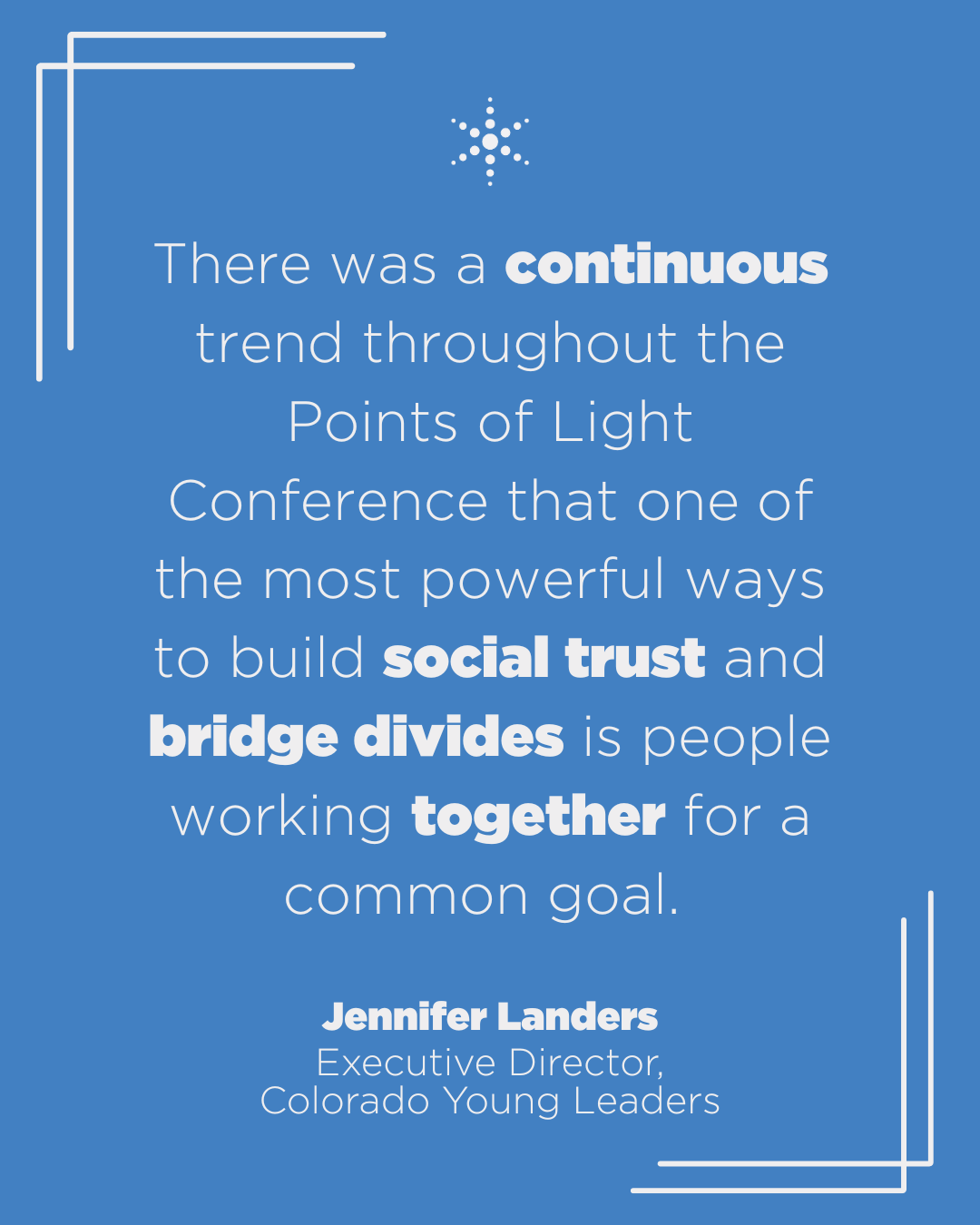
“Youth Can Lead Now”: Jen Landers on Building a Culture of Service in Colorado
Jen Landers has spent the last seven years helping high school students discover something many adults still struggle to believe: they already have what it takes to lead.
As executive director of
. CYL empowers teens to lead with courage and kindness, take action on issues they care about, and shape their communities with purpose.
But for Jen, this work isn’t just organizational—it’s deeply personal.
The Challenges Young People Face
“The young people in our community are navigating growing mental health challenges,” Jen said. “They’re navigating increased social isolation and lack of meaningful opportunities to connect with others and contribute to something bigger than themselves.”
At the same time, Denver metro communities face challenges that are happening across the country and around the world. Political, generational and cultural divides are making it harder to work toward shared goals.
Jen Serving alongside Young Leaders serving a meal to community members in partnership with Break Bread.
“As w
e look at our work, we want to find the intersection between those challenges. We want to figure out how we can really engage youth to feel a sense of belonging in communities, while we give communities the resources and talent of young people to help them solve their biggest issues and take advantage of their greatest opportunities.”
This simple insight, grounded in years of community-building, shapes how CYL works with young people. The organization doesn’t tell students where to serve—it gives them the space to choose, building resiliency, passion and confidence. Whether it’s environmental justice, food insecurity, or mental health, CYL meets young people at the intersection of passion and purpose. That trust not only keeps students engaged, but helps them grow into confident, community-minded leaders.
Learning and Connection Bring Insights for the Future
Earlier this year, Jen traveled to New Orleans for the
—her first time at the international conference where social impact leaders come together. Her attendance was made possible from a scholarship from Points of Light, with generous support from the
. The experience offered more than just inspiration. It provided a critical pause to reflect, connect, and realign.
“Receiving the scholarship for Colorado Young Leaders enabled us to do something that we would not have been able to do,” Jen reflected. “Our budget to participate in things like this is so small, but we recognize that really being able to have access to ideas and best practices is critical for us.”
Young Leaders helping with a diaper drive for new parents in partnership with WeeCycle.
For an organization at a key point in its evolution, the timing couldn’t have been better. CYL is currently expanding its reach beyond the Denver metro area with a bold vision: to bring diverse youth together from across Colorado—not just demographically, but across lived experiences, political perspectives, and cultural backgrounds.
“The conference helped reenergize my passion for our mission,” Jen said. “I walked away with fresh insights and practical tools we’re already weaving into our strategic plan—everything from how we train mentors to how we tell our story.”
Jen knows that kind of growth won’t happen in isolation. It will take partnerships, mentorship, and a shared belief across communities that youth-led service is not a “nice-to-have”—it’s essential. That’s the kind of message she brought to the conference, and the kind she returned home determined to amplify.
Today, as she and her team move forward with new tools and deeper clarity, Jen and the team at Colorado Young Leaders remain focused on the young people at the heart of it all. Every program, every decision, every story is about helping them lead—not someday, but now.
Every month, I wake up at 6 a.m. and join friends to cook breakfast at my local church kitchen. This simple act connects me with the humanity of others. I’m alongside dedicated volunteers, preparing warm meals for members of my community—from elders to children to unhoused neighbors. While the rest of my days are filled with phone calls, emails and meetings, nothing compares to the in-person connection and simple kindness of volunteering. This in-person connection is something we need much more of.
At the beginning of the year, I noticed many people sharing their resolutions. What surprised me was how many were focused on
disconnecting
—disconnecting from the news, getting off social media and stepping away from the inundation of tragedies, uproars and alerts on our screens each day.
I understand their intent, but I’m cautious. We are too disconnected already. According to a 2023 Pew Research survey, “
that eight in 10 members of Gen-Z said they experienced loneliness in the past year. In fact, my organization’s newest board member, a member of Gen-Z, said, “Gen-Z is increasingly online and disconnected, but we’re also a generation searching for connection.”
I propose another approach: Disconnect online but reconnect offline. Our world needs more connection. More closeness. More humanity. Volunteering is one of the most effective and valuable ways to foster these much-needed connections and create and strengthen community. A challenge is the perception that volunteering is nice, not necessary. But it’s more necessary than ever.
Communities Are Struggling And Nonprofits Are Trying To Meet Increasing Needs
Many of our local communities are in serious need of support and connection. Los Angeles is reeling from deadly wildfires. North Carolinians are still living among the destruction from Hurricane Helene. Nonprofits aim to help but face a lack of volunteers and critically needed unrestricted funds. Among nonprofits in the United States,
. Yet, 29% report less funding and fewer staff, and 47% struggle with volunteer recruitment.
It is nearly impossible to meet the needs of a community without enough financial or volunteer resources. Nonprofits are the ones that stand in the gap, connecting people with much-needed services while they wait months—or sometimes years—for state and federal funds to reach them. Volunteers enhance community resilience.
People Are Looking For Purpose
While nonprofits look for volunteers, people are looking for purpose. A
found that only 68% of 24-to-26-year-olds say they are somewhat happy. And many of these young employees are looking to find purpose through work. A study our company conducted found that
said they considered applying or taking a job because of the company’s social responsibility. They are a values-driven generation, and yet they feel disconnected. They’re searching for this purpose and connection through and from their workplace.
One of our Civic 50 honorees—organizations setting a superior example of corporate citizenship—serves as a good example of this. Partnering with Taproot Foundation, Blue Cross Blue Shield of Louisiana utilizes their employees to provide pro bono services to all nonprofits in Louisiana. For example, an HR professional could provide pro bono professional services by helping an organization draft an employee handbook. A graphic designer could provide branding advice and layouts. Having their employees use professional skills this way supports the capacity of local nonprofits with much-needed services and gives their employees community connections and a sense of purpose.
Bridging The Gap To Benefit Individuals, Communities And Society
It’s clear there’s a gap between the needs of nonprofits and communities and people’s desires for a purpose-filled life. We know that volunteering positively impacts individuals, communities and society. So how do we get there?
Disconnect online to reconnect offline. Find volunteer opportunities through online resources, local nonprofit organizations or even civic spaces like the public library or rotary clubs. Most people volunteer because they’re asked, so find an opportunity and invite a friend.
Provide volunteer opportunities to your employees. This supplies your employees with purpose and connects them to the community. Volunteer opportunities have been known to increase employee retention, attract stronger recruits and cultivate a sense of pride among your workforce.
Invest in volunteer infrastructure. Whether you run a company or foundation or are an individual community member, nonprofits need unrestricted operating funds for strong volunteer infrastructure. This allows them to meet the ever-evolving needs of the community. Unrestricted dollars recognize that the nonprofits you work with are the experts in the community, allowing them to respond as needed and helping their volunteer recruitment because their work is relevant, essential and inspiring. When you work with a nonprofit for a day of service for employees, ensure the project is aligned with community needs and is actually impactful. There is a cost to recruiting, training and retaining volunteers. Investing in nonprofits and intermediary organizations for volunteer infrastructure, not just program impact, can help scale and increase efficiencies.
These three steps create stronger opportunities for individuals, communities and society to bridge divides. In 2025, I predict the most meaningful moments are going to be the ones where we’re reconnected offline, in person and in community.
Ask a CSR Friend: Designing a Multigenerational Volunteer Strategy
Looking for CSR advice?
Hear from our experts right here in our Ask a CSR Friend monthly column.
Whether you’re a novice or a seasoned pro, we know collaboration is key to creating vibrant workplaces where employees are equipped to contribute to the communities and causes they care about. So, when you need a trusted advisor to lean on, rely on Points of Light to be Your CSR Friend. Each month, our experts share their wisdom and wit to address a specific but often universal challenge related to your work as a corporate social impact practitioner.
Have questions about employee community engagement? Submit your question and it may be featured in a future blog post.
Dear CSR Friend,
We have five generations represented in our workforce from Gen Z to a handful of retired employees who are still involved. I’m finding it increasingly hard to design a volunteer initiative that resonates across the board. What excites and energizes younger employees seems to barely move the needle with more tenured, mature staff. Do you have advice on how to build a multigenerational employee volunteer strategy that meets the majority of needs and expectations?
Signed,
Juggling Generations in Jacksonville
Dear Juggling,
There’s a joke that goes, “Five generations showed up to a company volunteer project: one brought a clipboard, one brought snacks, one brought caffeine, one brought a gratitude journal and one brought a ring light. Guess who’s already gone viral?”
Sure, this AI-generated joke is groan-worthy, but it’s also representative of an existing workplace reality. For the first time in history, five generations are clocking in side by side, each with distinct values, communication styles and ideas about what it means to contribute to something bigger than themselves. However, according to
, Changing Our World’s 2024 report, two-thirds of employees across all generations want companies to commit to long-term social impact using their unique skills and expertise to address community issues.
For corporate social impact leaders, the key isn’t to build five separate programs. It’s to design an adaptable, inclusive strategy that lets people connect with purpose in their own way. The real magic happens when we stop designing for assumed generational preferences and start co-creating with employees by listening to their lived experiences, motivations, barriers and the causes that matter most to them. How do you do that, you ask?
START HERE: LISTEN BEFORE YOU BUILD
Don’t rely solely on articles or studies (even this one!) to guess what each generation wants. Ask your people directly. Yes, trends can guide you, but people are people first. Generational labels only go so far. The best thing you can do is lead with curiosity, not assumptions. Just as in community development, effective solutions start with the voices of those they’re meant to support.
Before you design, ask:
What inspires you to volunteer?
What causes or experiences feel most meaningful?
What would make volunteering more rewarding and more accessible?
Use pulse surveys, focus groups or even casual “coffee & conversation” chats. And invite retired employees, too. They often have the time, wisdom and desire to contribute, but rarely get asked. This isn’t just about inclusion; it’s about relevance. Even the most beautifully branded initiative will flop if it doesn’t reflect the real needs, real schedules and real values of the employees it was designed for.
A QUICK GENERATIONAL TOUR
Here’s what we do know about the generations and what they value:
Silent Generation (Born before 1946): The Legacy-Driven Volunteers
Many see service as a civic duty, not a workplace perk. They value:
Long-term, high-impact commitments
Clarity, formality and respect
Opportunities to meaningfully share their expertise
Silent Generation Tip:
Offer mentorship programs, board roles and strategic projects. And yes, handwritten thank-you notes go a long way.
Boomers (Born 1946–1964): The “I Show Up” Generation
Boomers often lead by example. Although slower to adopt tech solutions, they have a strong sense of civic responsibility and are often your most consistent volunteers. They’re ready to roll up their sleeves and make a visible difference. They value:
Hands-on projects with tangible outcomes
Team-based service
Recognition for their efforts
Boomer Tip:
Offer in-person events like packing meals or sorting donations. Consider inviting retirees to serve as “volunteer mentors” for younger employees.
Gen X (Born 1965–1980): Your Pragmatic Problem-Solvers
Independent and often managing work, kids and aging parents, Gen X values efficiency. They won’t waste time, but they will show up for what matters. They value:
Skills-based, longer-term but flexible opportunities
Independence and impact
Family-friendly options
Gen X Tip:
Think pro bono consulting, project-based volunteering or virtual options that respect their packed calendars. Give them tools and the opportunity to include their families; they love a teachable moment.
Millennials (Born 1981–1996): The Purpose-Driven Planners
Millennials want alignment. They want to see your company walk the talk, and they want a seat at the table while it happens. They value:
Mission-driven opportunities that lead to personal development
Leadership and co-creation
Transparency and results
Millennial Tip:
Invite them to co-lead programs, build partnerships and drive innovation. Share outcomes openly. They want to see the “why” and the “what happened.” Many are also juggling familial responsibilities, so microvolunteering efforts appeal to them.
Gen Z (Born 1997–2012): The Activist Newcomers
Values-led and bold, Gen Z isn’t interested in performative gestures. They want action and impact, and they want it fast. They value:
Authenticity
Digital-first, creative approaches
A voice in shaping efforts
Gen Z Tip:
Support advocacy-focused volunteering, employee-led campaigns and social-friendly storytelling. Gen Z doesn’t just want to serve; they want to mobilize. Give them the mic and then get out of the way.
A CHECKLIST FOR MULTIGENERATIONAL ENGAGEMENT
Building an employee volunteer strategy that spans generations doesn’t mean pleasing everyone; it means making space for everyone. Here’s how:
Ask before you assume. Don’t build for Gen Z based on a LinkedIn post; ask a Gen Zer.
Offer multiple entry points. Include virtual, in-person, one-time, long-term, traditional, skills-based, on-and off-site and family-friendly options.
Center co-creation. Form mentor matches, intergenerational councils or annual planning teams. Your best ideas might come from the people least like you.
Celebrate all styles of service. Whether someone logs 100 hours on a nonprofit board or delivers one powerful workshop for nonprofit HR leaders, highlight their impact equally.
Communicate impact in many ways. Some want charts in email form. Some want a good story during an all-staff meeting. Use both.
Include retirees. Keep the door open for those who have left the building, but not the mission.
Stay curious. Gen Alpha isn’t here yet, but they’re coming. Keep listening and adapting, because the future of your workforce is already taking shape.
FINAL THOUGHTS: BUILD WITH, NOT FOR
When people of all ages feel seen, heard and invited to lead with purpose, something powerful happens: generational gaps shrink and workplace culture deepens. You don’t need a PhD in generational theory to get this right. You need meaningful questions, genuine curiosity and a willingness to build with—not just for—your employees.
Let your strategy be rooted in long-term vision and flexible enough to reflect how each generation defines impact. Your people will meet you there.
Until next time,
Your
Turning Insights into Action: Designing the Future of Employee Volunteering Together
This is the last post in a 3-part series on the evolution of employee volunteering. Revisit the introduction, part 1 and part 2.
The disruptions of the past five years have done more than challenge the status quo; they’ve revealed the power of business to drive purpose alongside profit. As we look ahead, the question isn’t how to return to what worked before, but how to design something better for everyone. What we build next will shape not only our programs, but the broader role of business in society.
Employee volunteering is being reimagined by those willing to rethink everything—how we structure volunteer time off, how we build partnerships and how we use AI to uncover insights, create efficiencies, and grow impact. Volunteering is no longer something to “fit in” to the workday. It is part of what makes work meaningful.
This evolution is also being fueled by the rising generation of employees who see social impact as essential, not optional. They expect their employers to align with their values and provide real opportunities to lead change. For programs to stay relevant and resilient, we must channel that energy while letting go of outdated models and building on what has created connection and credibility.
Now is the time to embrace forward-looking practices rooted in shared purpose, inclusive leadership, bold ambition and relevance. The future will be shaped by those willing to set transformative goals, foster authentic collaboration and treat the changing workplace as a catalyst for lasting community impact.
What principles will we take from the past and the current moment to serve our communities in the future?
Shared Ownership: Leadership is no longer the sole responsibility of CSR teams. In the most resilient and successful programs, it’s distributed enterprise wide. Employees, from ERG leaders to frontline staff, are helping drive positive change backed by infrastructure that empowers them. Community members and nonprofit partners are no longer passive recipients; they’re co-creators. This collaborative approach builds relevance, relationships and long-term impact.
Integrated Cross-Functionally: Employee volunteering can no longer be siloed. It must be woven into business strategies, talent development, sustainability goals and well-being initiatives. When it’s part of a cohesive whole, it delivers greater outcomes for business and society alike. Volunteering becomes a tool not only for external impact, but for cultivating inclusive, connected and purpose-driven workplaces.
Reciprocity: The future of volunteering doesn’t only serve the community; it serves the employee volunteer, too. Done well, it supports learning, development, connection and resilience. Volunteerism is a platform for purpose-driven growth, where giving and receiving are equally valued.
Flexibility: Today’s workforce is mobile, global and hybrid. Employee volunteer programs must reflect that. It needs to meet employees where they are with multiple modes of engagement: virtual, in-person, individual, team-based, traditional, skills-based, episodic and ongoing. Flexibility shouldn’t be extra; it should be expected.
Enabled by Technology: AI, personalization and automation are reshaping how we connect people to purpose. Smart tools can reduce administrative burdens and decision-making time. They can personalize experiences and expand access. But innovation must be grounded in ethics. We must use technology to enhance and not replace the human connection at the core of volunteering.
Rooted in Trust: Metrics matter, but relationships matter more. Programs that are extractive or performative are giving way to those that prioritize mutual respect and accountability. Trust is built when nonprofit partners are invited to shape, not just receive corporate support. Deeper partnerships mean shared planning, co-investment and long-term alignment on community-defined goals.
TURNING INSIGHTS INTO ACTION
The future won’t be built by chance. It will be shaped by leaders willing to question long-held assumptions and act with purpose. That means reevaluating even our most established practices from what counts as volunteering to how we capture and communicate impact.
It also means committing to courageous, measurable goals. Not just to increase participation, but to increase equity, resilience and systems-level change.
Here are a few tactical moves to build a stronger foundation:
Center Equity in Every Decision: From who gets to volunteer to which communities receive support, continuously audit for bias and actively expand access.
Prioritize Nonprofit Voice: Invite nonprofits into the design process. Build feedback loops that ensure they shape your initiatives, not just report on them. Value their insights, expertise and time as much as your own.
Balance Moments with Momentum: While single-day volunteer projects can serve as an entry point, build enterprise awareness and galvanize employees around a shared vision; impact also comes from deeper relationships. Invest in skills-based and long-term opportunities that deliver mutual value. Balance breadth with depth to create sustained change.
Plan for Outcomes, Not Just Activities: Don’t wait until year-end to define impact. Build metrics into your strategy that reflect more than inputs and outputs. Track employee growth, community outcomes and program alignment with business and social goals.
Reexamine Enabling Strategies and Policies: Ensure policies and support mechanisms reflect current workplace realities, recognize group and individual actions and remove barriers.
Invest in CSR Infrastructure: Ensure systems, staffing and cross-functional alignment are in place to scale and sustain purpose-driven programs.
Set Bold Goals that Matter: Aim higher. Define what success looks like not only in employee participation, but in shared community outcomes. Make your commitments public, co-developed with partners and focused on systemic change.
LEADING INTO TOMORROW
The most effective employee volunteer programs of tomorrow will embrace complexity, elevate shared leadership and use service as a tool for both business and community transformation. True success won’t be defined by how many employees show up, but by the positive change their participation creates.
This is our opportunity to make service central to how companies operate and what they value. Let’s define what comes next with intention, courage and collective action.
Turning Insights into Action: How Disruption Shaped a New Era of Employee Volunteering
Part 2 of a 3-part series on the evolution of employee volunteering. Revisit the introduction and part 1.
When the COVID-19 pandemic swept across the globe in 2020, it didn’t just change how we work, it reshaped how we live, connect and contribute. Offices closed, communities faced heightened needs and the systems we once relied on were tested in real time. This moment also marked a turning point, as businesses and communities alike responded to the call for community change by working to rebuild trust and broaden opportunities for all. Employees across generations and geographies began demanding more from their companies: more accountability, more empathy and more action.
Over the past five years, significant shifts have sparked innovation and reshaped the role of volunteering in the workplace. Disruption was the spark, sure, but a mindset change was the fuel. Many CSR leaders adopted a powerful belief: there is no growth without change, and every change brings opportunity. That shift, viewing a challenge as a catalyst, has led to a more human-centered, intentional approach to employee volunteering.
A NEW DEFINITION OF VOLUNTEERING EMERGES
Before 2020, volunteering in the workplace was often centered on structured, in-person events with nonprofits. But in the face of public health restrictions, CSR leaders were forced to think differently.
Virtual volunteering became a lifeline, not just a stopgap. Employees mentored youth online, wrote letters to frontline workers and connected with isolated seniors. Everyday acts of kindness like delivering groceries or helping a neighbor were embraced as valid and valuable contributions. Crowdfunding surged as a way to meet community needs, while hybrid volunteering became both common and complex. This broader view of
helped democratize engagement, opening the door for more people to participate regardless of role, schedule or location.
THE RISE OF EMPLOYEE VOICE AND COMMUNITY-CENTERED ACTION
The post-2020 landscape saw employees stepping into new roles not just as volunteers, but as activists, advocates and advisors. For the first time in history, all five generations were in the workplace at once, bringing with them diverse perspectives and expectations. Employees increasingly sought to align their personal values with their professional lives, pushing companies to show up authentically and consistently in their communities.
This period also gave rise to community-centered approaches to volunteering marked by a deeper understanding of power imbalances, a growing embrace of trust-based philanthropy and efforts to unburden nonprofit partners from extractive or performative models of engagement.
Mental health and well-being also took center stage. Volunteer efforts expanded to include opportunities for personal reflection, meaning and connection—focusing not just on what employees could give, but also what they needed to thrive.
LEADING INTO 2025: A STRONGER FOUNDATION
The disruptions of the past five years didn’t derail employee volunteering. They strengthened it. We now see companies embedding volunteering into their broader strategies by aligning service with business priorities, organizational values and social outcomes. There’s greater attention to
, integration with ERGs and building community resilience alongside an understanding that impact isn’t always immediate or visible.
This work is happening in the context of a dramatically shifting environment. Today, we face a new set of challenges:
Political polarization is seeping into the workplace, with companies under pressure to either take a stand or remain neutral on complex societal issues.
Backlash to efforts around belonging and sustainability is creating hesitation, even as employees and communities continue to value these commitments.
The workplace itself is changing, with hybrid and remote models becoming the norm, challenging traditional engagement strategies.
AI is emerging as both a powerful tool and a cultural disruptor, reshaping how we work, communicate and make decisions.
These pressures can feel overwhelming. But they also represent an opportunity to reimagine how we engage employees and support communities. We’re seeing leading programs respond by:
Designing community engagement around nonprofit needs, not just corporate objectives.
Empowering employees, especially ERGs and grassroots leaders, to drive engagement from within.
Offering flexible, virtual and skills-based opportunities that reflect today’s workplace realities.
Using AI to personalize and streamline experiences, while maintaining ethical boundaries and human connection.
This is not the time for retreat. It’s the time for boldness—grounded in purpose, equity and care. The future belongs to those who lean in, listen deeply and design with intention.
TURNING INSIGHTS INTO ACTION
Change has accelerated progress rather than delayed it and meeting the current moment requires leaders who act with courage and conviction. Use what we’ve learned from the recent past to align your programs with the current needs of employees, community partners and society.
Evaluate accessibility: Can employees regardless of role or work setting engage meaningfully in creating positive change? Are senior leaders actively championing your volunteer time off policy and are middle managers putting that commitment into practice?
Check power dynamics: Are your volunteer programs co-designed with communities, not just for them? Shift from transactional relationships to trust-based partnerships.
Explore responsible AI integration: Leverage AI to personalize and to streamline tasks but keep human connection at the core. Use automation for efficiency, not empathy.
Measure what matters: Move beyond counting hours and start assessing outcomes. Prioritize metrics that reflect community benefit, employee development and business value.
Embed equity into decision-making: Ensure your programs reflect a wide range of identities and lived experiences. Audit who’s shaping your initiatives and who’s being left out.
Normalize purpose in workplace culture: Make volunteering and civic action part of what it means to grow and lead in your organization. Recognize servant leadership as a core competency.
Prioritize internal collaboration: CSR doesn’t live in a silo. Break down barriers between departments like HR, Operations and even Compliance to build unified, employee-powered strategies.
LOOKING AHEAD
The path from 2020 to 2025 wasn’t linear, but it was transformative. Along the way, change challenged assumptions, surfaced new possibilities and opened doors to innovations we couldn’t have predicted. We’ve entered an era where CSR leaders must navigate through increased scrutiny, cultural division and rapid technological evolution. But these forces are also creating space to build smarter, more responsive and more inclusive volunteer programs.
We’ve seen what’s possible when companies listen deeply, respond with integrity and courage and equip employees with tools to lead real change. The next chapter of employee volunteering will reflect not only the realities of today, but also the opportunities and the growth that only disruption can make possible.
Up Next: In Part 3 of this series, we’ll explore how today’s most forward-thinking CSR practitioners are preparing for what’s next by setting bold goals, deepening community partnerships and redefining the future of work through volunteering.
Ask a CSR Friend: Engaging Employees in Disaster Response
Looking for CSR advice?
Hear from our experts right here in our Ask a CSR Friend monthly column.
Whether you’re a novice or a seasoned pro, we know collaboration is key to creating vibrant workplaces where employees are equipped to contribute to the communities and causes they care about. So, when you need a trusted advisor to lean on, rely on Points of Light to be Your CSR Friend. Each month, our experts share their wisdom and wit to address a specific but often universal challenge related to your work as a corporate social impact practitioner.
Have questions about employee community engagement? Submit your question and it may be featured in a future blog post.
Dear CSR Friend,
I’m a newer CSR practitioner and was caught off guard last year when severe flooding impacted nearby communities. While our operations weren’t disrupted, employees kept reaching out, asking how they could help, and I didn’t have a clear plan or resources ready to guide them. With the Atlantic hurricane season now underway, I want to be better prepared. How can I quickly and responsibly engage employees in disaster response and recovery, while also setting us up for a more proactive, community-focused approach moving forward?
Signed,
Course-Correcting in Charlotte
Dear Course-Correcting,
As CSR professionals, we know that natural disasters can create a ripple effect across operations, our employees’ lives and the communities we serve. But more than just a reactive moment, disaster response is a strategic opportunity for companies to show up with empathy, efficiency and impact.
The most effective disaster responses are not designed in the moment—they’re built well in advance.
That means forming a cross-functional disaster response team (including CSR, HR, operations, facilities and communications) and developing a clear plan before disaster strikes. Review it annually and ensure every relevant function understands their role in a coordinated response. For help creating a plan, check out
.
In crisis moments, employees naturally want to help. It’s our job to channel that desire into responsible and impactful action guided by community needs, company capabilities and nonprofit partner guidance. As you prepare for what may come this season, here are key strategies to help you meaningfully and responsibly engage employees in disaster response and recovery:
Prepare Year-Round: Build Readiness Before a Disaster Strikes
Form a Cross-Functional Disaster Response Team
Engage key internal stakeholders such as CSR, HR, communications, compliance, security and operations in developing and regularly updating your disaster response strategy (sometimes known as a business continuity plan).
Define clear roles and escalation protocols for potential disaster scenarios.
Maintain a Ready-to-Activate Employee Relief Fund
Promote your hardship or assistance fund throughout the year using multiple channels (e.g., onboarding materials, signage, intranet, QR codes).
Ensure the fund is well-resourced and ready to distribute grants quickly when crises hit.
Include multilingual and location-based communications for equitable access.
Plan, Practice and Revise
Conduct scenario planning and tabletop exercises across key teams (e.g., corporate, frontline, regional).
Train volunteer leads in high-impact sites like distribution centers, call centers and retail stores. Ensure all volunteer champions know how and when to plug into the disaster response strategy, so they don’t strike out on their own.
Create inclusive feedback loops after each crisis to identify gaps and iterate on the strategy.
When Disaster Strikes: Coordinate an Empathetic, Impactful Response
Prioritize Employee Safety and Communication
Ensure HR and Operations are prepared to check in on all employees, including shift-based and part-time staff. Use tools like badge swipes, text alerts or designated field leads to confirm employee safety.
Communicate updates and resources through trusted channels, including shift huddles, signage, manager toolkits and digital screens. Share “Building Sustainable Communities,” a disaster preparedness and response guide from Points of Light and The Allstate Foundation, featuring strategies for individual action across the disaster lifecycle and tips on advocating for affected communities.
Stay mindful that communities where frontline employees live are often the hardest hit and employees themselves may need support. Double-down on communicating about your employee assistance or hardship fund.
Lead With Funding
Cash is king in disaster relief. It’s the most efficient way to help communities recover. Communicate this to employees before the requests to host local donation drives roll in.
Launch disaster-specific giving campaigns that are mobile-optimized and accessible to employees across roles and work settings.
Offer company matches and recognize all contributions, big or small.
Support Nonprofit Partners Responsibly
Let trusted community partners guide your employer’s response. Don’t assume what’s needed. Ask first.
Know that bulk, palletized in-kind donations will be your best option when considering products your company can provide.
Be Thoughtful with Volunteer Opportunities
Volunteer opportunities often take time to become available. Wait until nonprofits confirm safety and capacity. Communicate this upfront with employees so they understand the fragile situation on the ground.
Do not allow or encourage employees to self-deploy or send employee groups uninvited. Uncoordinated help can do more harm than good.
When opportunities do arise, consider all these options:
In-person, when safe and locally coordinated.
Virtual and micro-volunteering that supports crisis lines, logistics or language translation.
Group activities that can be coordinated around shifts, especially for hourly teams.
Skills-based volunteering plays a significant role in response and recovery, not to mention building community resiliency. Projects can range from helping impacted residents navigate insurance claims, data mapping road closures and resource needs to more sophisticated support with logistics or restoring internet access.
Tap into all employee skill sets such as logistics, facilities, tech and customer support teams to provide valuable contributions beyond traditional office volunteering.
Once projects are identified, check in with your company’s risk management and/or compliance team to vet the opportunities. Having these relationships in place ahead of time makes it easier to move quickly when needed.
A strong disaster response strategy isn’t just about reacting, it’s about building long-term readiness, trust and resilience. You don’t need every employee to take action, but you do need a thoughtful plan that offers clear ways to help.
When you prepare early, communicate clearly and partner intentionally, your company can respond meaningfully when it matters most.
Until next time,
Your
Volunteering Research Roundup: Motivations, Health Impacts & Recruitment Trends
Welcome to the second issue of our quarterly research series from Points of Light. Curated by our Vice President of Research & Insights, Ferzana Havewala, this roundup highlights new and emerging research and trends affecting the nonprofit sector. We hope these insights help you champion volunteering in your community.
TimeHeroes (Bulgaria)
Motivations and Predictors of Volunteering
Using longitudinal data from over 17,000 individuals aged 50 and older across 19 European countries,
. The study finds that deteriorating health and worsening financial conditions are linked to reduced volunteering, while transitioning out of paid work and beginning weekly grandchild care are associated with increased volunteering. Notably, the effects of resource changes are asymmetric: negative changes reduce volunteering, but positive changes do not necessarily increase it. These findings highlight the complex and dynamic relationship between personal resources and civic engagement in older adulthood. (Europe)
Using survey data from over 2,200 Danish adults,
. Previous volunteers, driven by a sense of civic responsibility and embedded in existing networks, engaged in both ordinary and COVID-19–specific tasks. In contrast, new volunteers, motivated by anxiety and lacking prior civic engagement, focused almost exclusively on crisis-specific tasks. (Denmark)
Hands On Atlanta (U.S.)
Impact of Volunteering on Physical and Mental Health
Using data from nearly 10,000 participants in the U.S. Health and Retirement Study, researchers explored 57
. They found that volunteering for 100 or more hours per year was associated with a 16% reduced risk of mortality, with the strongest mediating effects observed through social factors such as increased contact with friends and helping others. Grouped social and physical health factors significantly explained the volunteering–mortality link. (United States)
explored the physical, mental, and spiritual changes experienced by those working with older adults at a senior fitness club. The findings highlight mutual benefits, including improved health and well-being for both volunteers and service recipients, and emphasize the importance of promoting volunteer services to address social needs and foster sustainable development. (Taiwan)
Hands On Tokyo (Japan)
Insights into Volunteer Recruitment
A study at a nonprofit food service organization in Philadelphia
. While the overall number of volunteers dropped significantly during the pandemic, individual volunteers—especially those with higher education levels—became more frequent and essential, replacing the previously dominant group-based episodic volunteers. The shift exposed the organization’s overreliance on larger volunteer groups and highlighted the importance of cultivating a core of committed and intrinsically motivated individuals. The study recommends a “quality over quantity” approach that emphasizes volunteer loyalty, meaningful engagement and preparedness for future disruptions. (United States)
surveyed youth volunteers from various nonprofits and found that motivation—both intrinsic and extrinsic—has a significant positive effect on the intention to continue volunteering. Volunteer satisfaction partially mediated this relationship, suggesting that understanding Generation Z’s motivations and satisfaction is key to retention. (Malaysia)
VOLUNTEER Hampton Roads (U.S.)
More recent studies exploring innovative approaches to understanding volunteering and its relationship with various life outcomes: