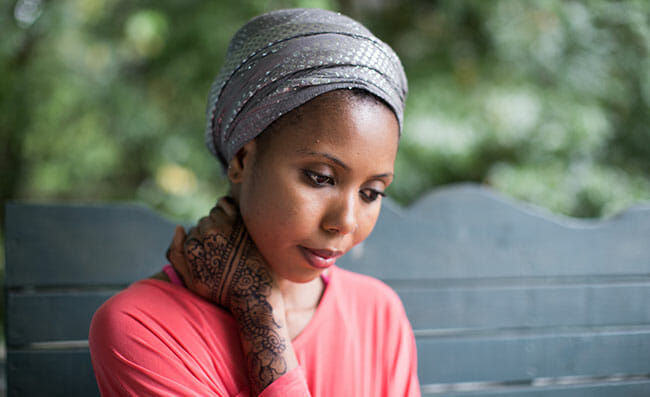
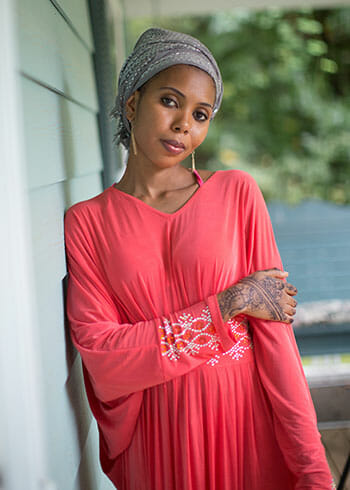
” List, honored alongside such leaders as Barack Obama, Christine Lagarde and Angela Merkel.
At age 15, Jaha moved from the West African nation of Gambia to the United States for an arranged marriage. Prior to her move, she was forced to undergo the most severe form of female genital mutilation and had to be surgically reopened upon her marriage.
Jaha went on to create
, an Atlanta-based nonprofit that raises awareness of female genital mutilation, or FGM, provides support to survivors and works to put an end to this harmful practice.
For her extraordinary efforts in the fight against FGM, Jaha received the
.
“Sometimes when a thing is unbearable to imagine, we do the opposite of what we should: we turn away, shielding our hearts and minds in order to preserve our own peace,” writes Peggy Orenstein, in
. “In speaking out against female genital mutilation, Jaha Dukureh has refused to let horror be silenced.”
FGM is often perceived as a problem that only happens in faraway places like Africa. But in the United States, young girls from immigrant communities – from countries where FGM is a cultural or religious coming-of-age ritual – are subject to the practice. Jaha travels the country to speak to communities affected by female genital mutilation. She also presents workshops and seminars at universities to raise awareness about FGM occurring in America.
Safe Hands for Girls supports survivors with legal aid, connects them with referral services and has created support groups for FGM survivors around the country.
“I started Safe Hands for Girls because as a survivor of FGM, I know how hard it was for us and having to deal with alone and I knew I needed to speak up and support other survivors,” she says.
Jaha has been instrumental in awakening public interest in the campaign against FGM in the United States. Her work includes national media outreach and formidable campaign work that preceded the passage of the Girls’ Protection Act of 2010, sponsored by U.S. Rep. Joseph Crowley of New York. She also launched a
calling for the Obama administration to develop a strategic plan to end FGM, which gained more than 221,000 supporters and resulted in the President announcing that he will commission a report to study the issue.
Meanwhile, Jaha’s work has inspired a new generation of survivors who are breaking the cycle from mother to daughter. She now trains other survivors to be advisers in their own communities.
“Women’s empowerment is allowing women to enjoy their God-given rights to sexuality, health and freedom,” she says. “We were born free and perfect.”
If you are interested in helping Jaha Dukureh put a stop to FGM,
6 Ways to Do Good for the Environment Through Civic Engagement
Warm weather has arrived, and if you’re like us, you can’t wait to get outside and soak up some sunshine. The best part? You can get your daily dose of Vitamin D while making a significant and lasting impact on the environment, your community and the world!
Here are six ways to give back in the great outdoors, as told by Parks and Recreation.
1. USE YOUR PURCHASE POWER TO SUPPORT SUSTAINABLE GOODS & SERVICES
Have you ever thought about the impact your purchases make? You have the power to use your voice in many ways, including your wallet. When it’s time to make your next purchase, choose a company that supports a healthy environment and uses sustainable practices. Check out this free issue of
We know that volunteers are happier, healthier people as a result of making a difference in the lives of others, and studies show there are similar health benefits from gardening. So double up on health and happiness by contributing to a local community garden! Just BYOS (bring your own seeds) and grow your own produce — or donate your goods to a local food bank. Not only do community gardens yield fresh, nutritious food, they build neighborhood relationships, promote community development, conserve resources and improve quality of life. Find a community garden near you, or start your own.
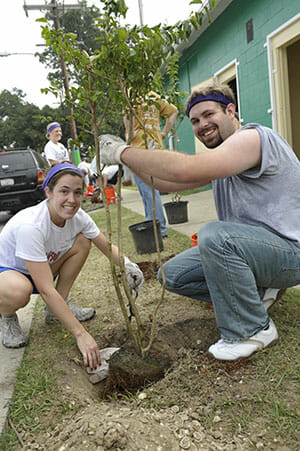
Teddy Roosevelt once said, “To exist as a Nation, to prosper as a state and to live as a people, we must have trees.” There are myriad reasons to plant trees – they produce oxygen, provide habitat for wildlife, assist in water conservation, and prevent soil erosion. You can plant a tree any day of the year, or you can take part in the annual national celebration of trees – Arbor Day. Check out the Arbor Day volunteer center to find out how you can help.
4. Join or Organize a Park Clean-up in your Community
Just a few hours of clean-up work can result in the removal of multiple garbage bags’ worth of waste. Check your local government’s website to learn about ongoing clean-ups for which you can volunteer. Can’t find an opportunity in your area? This guide is full of useful tips for starting your own park clean-up and enlisting other volunteers to help you.
Like cities and parks, rivers are often left neglected during the colder months. The National River Cleanup campaign enlists volunteers annually to get outside as the weather warms up to help clear trash and pollutants out of the river environment so that natural recovery processes can take place.
Pitch in to help preserve America’s natural and cultural resources by volunteering at a state or national park. Volunteers of all ages and abilities are needed for one-time service activities, long-term commitments. Opportunities range from park improvements, upkeep and preservation and visitor services and campground hosts to more specialized roles for those interested in scientific fields, such as geology, botany and archeology. Browse the volunteer portal to find out what opportunities are available near you.
This post is by Will Lourcey, youth advisory council member for generationOn, and originally appeared on the generationOn blog.
What can a kid do to fight hunger? That was a question I asked myself when I was 7 years old. I saw a man on a street corner holding a sign that read, “NEED A MEAL.” It made me realize that I needed to do something about it. But what could I do? I was only 7 years old.
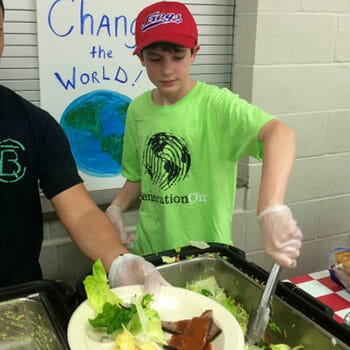
Well, it turns out a kid can do a lot. I founded the youth-led nonprofit, Friends Reaching Our Goals, or FROGs for short. FROGs has inspired hundreds of kids to take action in their community, and has provided more than 200,000 meals for the hungry.
Here is my simple recipe for changing the world!
See a Need – I saw a man standing on a street corner holding a sign that read “NEED A MEAL.” Do you see a need? Is there something in your community that could be improved or solved? Identifying a need is the first step.
Be a Doer – My motto is, “Be a doer, not a watcher.” Being a doer means acting and not waiting for others to address a problem. I could have waited and hoped that someone else would help the hungry man, but I didn’t. I acted.
Make a Plan – Decide who you might want to partner with to make the biggest impact and learn more about the issue or problem. I scheduled a meeting with the local food bank to educate myself about the issue of hunger and the things I could do to help. My goal was to create fun ways to get other kids excited about fighting hunger while creating positive change.
Gather Friends – Next, I gathered friends in my community to form a hunger-fighting team. Everything is more fun when you are with friends! We designed fun events to get our peers involved in fighting hunger. We ran lemonade stands, yard sales, video game parties, baseball and soccer tournaments, and dodgeball events to generate awareness about the issue of hunger and raise funds. FROGs would not be successful if it weren’t for this group of people coming together to make a difference in their community. I’ve learned that I can’t do everything by myself but that with my friends, anything is possible.
Change the World – This was the easiest step because any action, no matter how big or small, has the potential to make a positive impact. By being doers, we are changing the world! When you act, you create a ripple effect and other kids get inspired.
Now is your chance to become a doer. Follow this recipe for creating change in your community by participating in generationOn’s Make Your Mark on Hunger campaign. They’ll guide you through everything from creating a garden, to hosting a food drive, to holding a volleyball tournament — all of which can help you fight hunger!
My advice to kids who want to improve their community is to act. Choose to do something rather than waiting for someone else. Always remember: No matter how tall or small you are … you can make a big difference! You’ll be amazed at how many people will join your efforts and help. All you need to do is choose to be a doer and follow the recipe.
National Volunteer Week Celebrates Individual Changemakers and the History of Service
This post is by Tracy Hoover, Points of Light’s CEO.
Norman Hurns mentors elementary school boys on “life skills and character education” through Brothers Making a Difference, a program he created after he saw a need to inspire and motivate kids growing up in a city hit hard by changing economics and the shrinking auto industry – Detroit.
Kathy Koenigsdorf works tirelessly to raise money for people battling substance abuse and want help but can’t afford it. Through the foundation she started to honor her late son in 2013, she’s raised $156,000 and funded 172 people into facilities to start on the road to recovery.
And across the pond,
volunteers to teach karate for free or at low cost to kids in Basildon, in Essex County England, who otherwise couldn’t afford it.
Each of these changemakers has been recognized by Points of Light with a
– with Marc’s recognition coming because UK Prime Minister David Cameron has adopted a daily award to celebrate the impact of volunteers in his country.
It’s National Volunteer Week, and you may have already seen these individuals in the news. So many of you have stories about neighbors and friends making a difference through volunteer service. We’d love to learn more about these community changemakers through our
page, you’ll notice that many of the posts are from terrific volunteer organizations in Canada as well as the United States. National Volunteer Week first began in
in 1943, when Women’s Voluntary Services organized special events to draw attention to the important contributions women made on the home front during World War II. Over the years, the idea grew to include all communities and all volunteers. National Volunteer Week is now celebrated in both nations on the same week every year.
A bit of American history: President Nixon first proclaimed National Volunteer Week in 1974. President George H.W. Bush started the Points of Light movement, and National Volunteer Week became part of our mission. “From now on in America,” he often said, “any definition of a successful life must include service to others.” I’d say that’s the case now — anyone who is considered a success in America is almost always also volunteering either their time or their money to help others.
After the terrorist attacks of 9/11, President George W. Bush began the President’s Volunteer Service Award. These awards are given to Americans who have completed a required number of volunteer hours over a one-year period, or cumulative hours over the course of their lifetime. There are bronze, silver and gold awards for young kids, teens, young adults, adults and families, and all with different levels of service hours completed. Since the program’s inception in 2003, more than 1.5 million volunteers have been recognized.
Presidential attention to volunteerism can make a huge difference. Whether it was President Kennedy’s founding of the Peace Corps in 1961, or President Clinton’s creation of AmeriCorps in 1993, or President Bush’s President’s Volunteer Service Awards, the continued focus on recognizing and expanding volunteerism has resulted in a growing number of people mobilizing to take action and change the world. In his recent 2016
, President Barack Obama said, “During National Volunteer Week, let us shed the cynicism that says one person cannot make a difference in the lives of others by embracing each of our individual responsibilities to serve and shape a brighter future for all.”
Our organization now operates in 30 countries, working with volunteers on more than 250,000 service projects, giving more than 30 million hours of service annually for a total of over $635 million worth of donated volunteer time.
National Volunteer Week gives us great momentum for the recognition we do every day. Who do you know who is contributing to this changemaking effort? I encourage you to
them for a Daily Point of Light Award. And share your story with us on what service means to you – why you volunteer – using #NVW2016. Help us continue to build on the history and tell a story of volunteerism and service to others.
Songs and Stories with a Purpose – What’s Yours?
This post is by Tracy Hoover, Points of Light’s CEO.
Tracy Hoover
A friend emailed me this week, asking if I had watched the Academy of Country Music Awards the night before — and specifically what I thought of Tim McGraw’s show-stealing performance of “Humble and Kind.” According to my friend, it was “very Points-of-Light-y.”
Lately girl-power anthems and controversial rappers have featured prominently in my playlist. But all things are possible with YouTube, so I checked it out online. I noticed the lights were low when McGraw started singing, and it seemed nearly everyone in the audience started to wave their cellphone-flashlights. Certain there were at least “a thousand points of light,” I thought that must have been the “points of light-y” moment. But as I listened to the lyrics and watched the crowd react, I knew there was more to it.
Hold the door, say please, say thank you.
Don’t steal, don’t cheat, and don’t lie.
I know you got mountains to climb but always stay humble and kind
When the dreams you’re dreamin’ come to you
When the work you put in is realized,
Let yourself feel the pride but always stay humble and kind …
As McGraw sang, a line of people started arriving onstage, and as the lights went up, their outward differences were apparent – age, gender identity, physical ability and cultural and ethnic diversity. And in that instance, their common ground became apparent, too – as McGraw’s simple, profound call for kindness and humility resonated. Like rain on parched earth, that message must have been a welcome respite from the vitriol that is so pervasive in our national narrative right now. I found myself watching it again and again, and recognizing the many points of light – the singer and this message were definitely points of light that night, as were the individuals who came forward or just turned to the person beside them to nod and smile and embrace each other. On Twitter, #HumbleandKind started up, and my favorite tweet was this one:
Nice job @TheTimMcGraw In a world of 7 billion people could you imagine what we could accomplish if we were all #HumbleAndKind to each other
McGraw is part of a growing chorus of artists whose messages of purpose are resonating, and fans and follows are responding enthusiastically. For example, check out this video from Sugarland’s Kristian Bush, “Trailer Hitch.” The song became a wildly popular call to action for Goodwill Industries that inspired fans to “give it away” — whether that means money or the excess “stuff” we all have too much of — in order to help change someone else’s life. As Kristian put it recently, “Almost everyone knows someone who is struggling to make ends meet … and giving away what you no longer need can help someone. That’s pretty amazing to me.” I think he’s pretty amazing. If you’d like to help someone this way, search for a Goodwill near you.
Kenna performs “Sleep When We Die” at Points of Light’s 2015 Conference on Volunteering and Service in Houston.
Last fall, I met an incredible artist, Kenna, who seemed to personify this new generation of purpose-driven artist-activists. At Points of Light’s 2015 Conference on Volunteering and Service, Kenna’s talk about his fusion of art and activism ignited the crowd of 3,000 change makers. Their reaction to his song “Sleep When We Die” was just as strong as the ACM audience. And his response – equally memorable: “I want you to like my music,” he said “but I want you to love my purpose.” Check out his very cool talk and performance of “Sleep When We Die.”
Next week is National Volunteer Week – it’s a great time to celebrate volunteers. It’s also a great time to start volunteering and discover how your unique talents and interests can make a big difference – and like Tim, Kristian and Kenna, how you can marry your passion and purpose. Next week, I’m looking forward to sharing stories of some very special points of light. And again this year, we’re asking you to share your story on what inspires you to serve, with #NVW2016.
I’ve also decided it’s time for a new playlist, and in honor of National Volunteer Week, I’m starting mine with the three songs above. I’d love to know what songs and artist-activists inspire you – share them using #SongsThatInspire.
Thank you for the unique ways you are making a difference in lives and in communities – for being a point of light.
Women Making History, Building Stronger Communities and Changing Lives
This post is by Tracy Hoover, Points of Light’s CEO.
Tracy Hoover
For this past month, I’ve loved learning more about power-women in history and the mark they’ve made on the world. It also has me thinking a lot about the many women I get to meet through this work who are changing lives and communities, every day. These are the women who are making history by serving others.
It’s become a wonderful tradition: every year in March, we celebrate women who have changed history. Their rosters (see:
) include CEOs and seamstresses; soldiers and civil rights activists; athletes, autoworkers and astronauts; artists, educators and inventors. And this year, the UN’s International Women’s Day heralded the accomplishments – and struggles – of women around the globe. Companies like Microsoft have added their might to the call for gender equality in opportunity. I loved
– that honored women inventors and asked, “What are you going to make?” It’s a powerful message from a powerhouse brand, and it made a difference.
Another powerhouse brand making a special mark this month, is L’Oréal Paris, who announced this year’s call for nominations for their
program. From now through April 29, you can nominate a woman who is igniting social change on a local, national or global level. Following a rigorous review of thousands of nominations, 10 women are recognized with grants of $10,000 each to benefit their causes and get the opportunity to share their stories with the world. Over the last decade, L’Oréal has recognized 100 Women of Worth and awarded more than $1 million to advance their programs. This inspiring roster includes college students and CEOs; activists, attorneys and athletes; soldiers, educators; moms, daughters, and sisters, too.
Women like
, whose work has saved lives and whose advocacy has helped to change laws to combat human trafficking in Georgia. And Maria Rose Belding, a college student who created MEANS and has changed the way food pantries get food to 1,800 community agencies in 15 states. And Teri Kelsall, who, after losing her son Jonas, a Navy SEAL killed while serving in Afghanistan in 2011, started the Jonas Project to help veteran entrepreneurs develop business plans, pursue startup capital and launch new lives and careers. And Kathy Koeningsdorf – a New York mother who lost her son Jake to heroin, and then devoted her life to finding and funding lifesaving treatment for substance abusers who want help but can’t afford to go to a treatment center. “That’s what keeps people healthy – connection,” Kathy says. These women are changing lives and laws, they’re making a difference and they are making their mark on history.
I’m so proud that Points of Light has partnered with L’Oreal on this incredible program for more than ten years, and I hope you’ll nominate a Woman of Worth in your life.
For more information about Women of Worth, to nominate a woman making a difference and to learn about past honorees, visit www.womenofworth.com.
ServiceWorks Graduate Goes from Hollywood to the White House
By Jason Meucci, vice president of communications for programs at Points of Light.
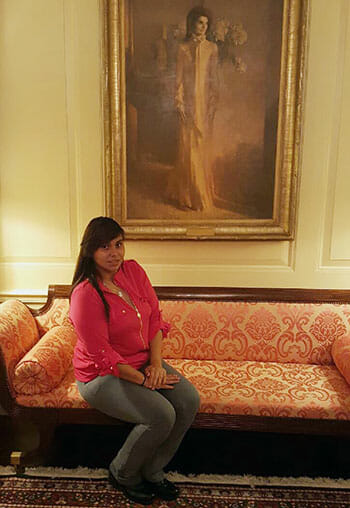
Sandy Aguirre during her visit to the White House.
By her own admission, Sandy Aguirre’s story is unbelievable. Some would say it’s the stuff of Hollywood. And in this case, it literally is. Only this fairy tale is a true story.
Actually born in Hollywood, California, this 18-year-old recent graduate of
in Los Angeles, was with her family in Central America, struggling just to get back into her own country.
Yet there she was, in late February, sitting in the State Dining Room of the White House – just a few feet away from Michelle Obama and a panel of celebrity recording artists she’d admired for years. She admits, “It never passed my mind in a million years that I’d ever be at the White House.”
So, how
does
such an improbable thing happen?
It starts with a key theme of the message the First Lady delivered that day: hard work. And working hard has been a core value to Sandy for a long time. Her family worked hard to get back to the U.S. after being robbed of their passports in Honduras, leaving them stranded outside the country during the years she should’ve been in high school. So when she finally got back home, she was ready to work hard to get her GED.
By October of 2015, she was doing just that at ServiceWorks partner YPI – which sits within view of the world-famous sign marking her birthplace. It was there that Cruz Solis, an AmeriCorps VISTA supporting ServiceWorks, noticed Sandy’s determination and yes, work ethic. He asked her if she’d be interested in furthering her development by participating in the program.
A young lady with big goals, ambition and a passion for helping her community, she was excited to enroll in ServiceWorks. It was a decision that immediately led to personal growth – and eventually, the trip of a lifetime. On Tuesday and Thursday evenings last fall, Sandy would join her cohort at YPI for sessions and service projects designed to improve her college readiness and expand her professional development.
“I changed a lot because I was shy. I wouldn’t say anything. Now if I have an idea, I’ll speak out about it. And my family noticed a big difference, because I talked more often. I was always talking about what I learned in ServiceWorks.”
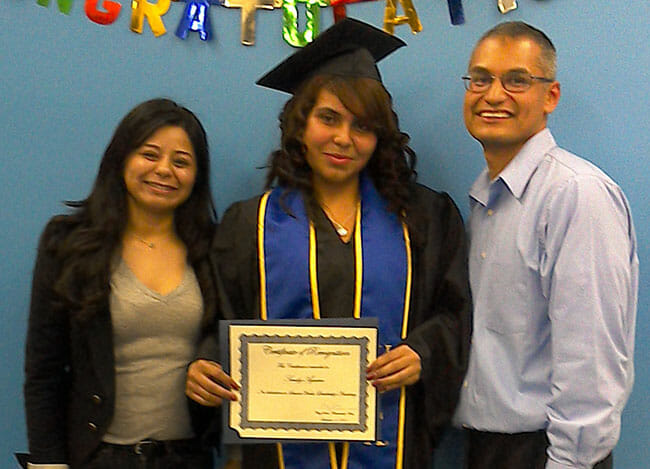
Sandy and Cruz Solis (right) at her ServiceWorks graduation.
Solis saw a similar transformation happening: “She got more confident within herself. The program made her comfortable to stand in front of a room and speak.”
But there was something else he noticed about Sandy – she was always going above and beyond in her assignments, always responsible and dependable. Juggling the demands of working towards her GED, while taking part in ServiceWorks – and working as an assistant, teaching English to adults at a local school, Solis was impressed by her commitment to better herself and her community.
So when YPI asked him if there was a Service Scholar that might be deserving of trip to Washington to attend a White House event honoring Ray Charles for Black History Month, he chose Sandy.
“It was a good opportunity for her because she hasn’t been to DC and I wanted to broaden her horizons. I know bigger and better things will come her way if she stays on this path. And I want to instill in all kids that opportunities will present themselves if they do so.”
You can imagine her reaction to getting the news, which came as a total surprise. “I thought it was a joke. Words couldn’t come out of my mouth. I was really proud of myself because I’m a student that didn’t go to high school, trying to get her GED, working … I never thought I’d get such an opportunity.”
Her parents were just as shocked. “At first they didn’t believe me. But then they were so proud because they said I earned it.”
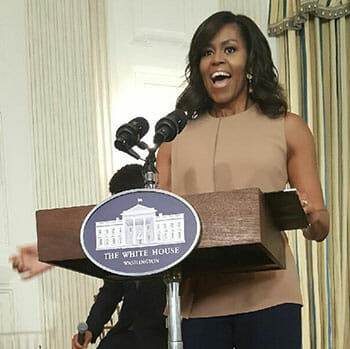
First Lady Michelle Obama speaks about the importance of an education.
And “earning it” is exactly what Sandy got to hear Michelle Obama speak about. Sitting just one row away from the First Lady, she listened intently about the importance of an education and how it’s something you have to work hard to earn.
She came away from the experience more motivated than she’s ever been. “It was a big impact on me because of my story. It changed me a lot to be at that event. Now I want to accomplish my goals and work even harder. And I want to motivate others to do the same.”
While her visit to the White House was the highlight of a nearly weeklong trip, a stop at the Lincoln Memorial fulfilled a dream she’s had since childhood – thanks to pop culture.
“You see the Reflection Pool on so many TV shows and movies. When I was there I actually touched the stairs at the Memorial because so many people have been filming there, like Forest Gump. I would always say to my mom that I wanted to be there. And she’d said ‘one day if you work hard and earn it.’”
Back in Southern California, that’s exactly what she intends to do. After earning her GED, she plans to go to Los Angeles Community College, then on to USC or Cal State so that she can be a special education teacher.
The confidence gained through Sandy’s participation in ServiceWorks, combined with the inspiration the program gave her to help others, comes through when she talks about her future. “I want people to say ‘she went from getting a GED to making a world change.’”
And Sandy’s doing some inspiring of her own. Cruz Solis, the
member who suggested her for that life-changing trip to the nation’s capital says people like Sandy are what make his work so worthwhile.
“You work with them, meet them at a point in their life when they’re very impressionable and you can plant a seed. I can step away and feel confident she’s going to achieve what she wants to achieve.”
This Hollywood ending feels like it’s just the beginning.
ServiceWorks, managed in partnership with the Citi Foundation and the Corporation for National and Community Service, is a national program that combines service learning, volunteerism and success coaching to help Opportunity Youth (low-to-middle income, ages 16-24) develop the skills and connections they need to prepare for college and career.
Help, Hope, and the Power of One Tweet in Brussels
This post is by Tracy Hoover, Points of Light’s CEO.
Between my news feeds and my faith traditions, I’ve thought a lot this week about suffering and hope; darkness and light.
In recent months, images and accounts from every corner of our world have told of the horrific human suffering caused by war, poverty, hatred and injustice.
As word spread about the terrorist attacks on Tuesday, “not again” echoed across social media, giving voice to the all-too-familiar sense of despair and hopelessness many of us felt in that moment.
But in Brussels, just moments after the attacks, messages of help and hope filled the airways as people, some of them victims themselves, started helping each other, and the glow of candles lit the night.
I don’t think it’s coincidental that whenever terror or tragedy strikes, we come together and light candles. Literally and figuratively, we fight the darkness. We seek out and connect with the light in each other and in ourselves. And especially this week, I was struck by those images and by the acts and expressions of hope and solidarity they inspired. Here are a few:
Buried in the
coverage of attacks was this quote: “There was a lot of humanity amid all the horror,” one woman said. “We received water. I was hungry, and a stranger offered me some nuts. People were helping each other.”
Social media powered a massive neighbor-to-neighbor response and hashtags like #OpenHouse and #PorteOuverte offered stranded victims a place to stay. And anyone who needed a ride, a meal or even a Wi-Fi connection could use #IkWilHelpen — “I want to help” in Dutch —to ask for and receive help from hundreds of people standing ready to help.
In multiple languages, hashtags like #PrayForBelgium and #JeSuisBruxelles captured the millions of messages of support that poured in from across the globe.
From a driver who provided a ride and set off a Twitter chain reaction of goodwill and offers of help. He later tweeted: “That ride yesterday. CRAZY how big the impact is of 1 tweet.” And when someone called him a hero, his response “I’m not a hero. If just everybody would do something kind for each other …”
I was surprised to hear a familiar voice from Brussels, NBA legend, fellow Atlantan and Points of Light Ambassador Dikembe Mutumbo, who was at Brussels Airport when Tuesday’s attacks took place. I love that Dikembe called the people who helped him “angels.” As someone who knows firsthand how much good Dikembe himself does, including through his
, I’d guess he’s been called an angel more than once, and I’m certain he is a point of light.
Especially this week, I am praying for those who are suffering, and I am thankful for those who care.
Thank you for your service and for being points of light in our world.
5 Ways to Spring into Volunteering
Spring has sprung, which means sunnier days, weekend barbecues and National Volunteer Week are just around the corner. As the weather warms up, don’t miss out on these fun opportunities to get outside, get involved and make a difference!
Many organizations take advantage of warmer weather by hosting fundraising walks and fun runs. From 5Ks benefitting causes like cancer research and mental health awareness, to events like the Boston Marathon, which raises millions of dollars every year for a variety of charities, there are plenty of ways to get active and do good. And if you don’t consider yourself a runner, there are plenty of fun, low-key walks and runs to participate. Find a race in your area or search for events by cause.
With the return of the spring comes the return of outdoor youth sports leagues. We know that kids benefit immensely from sports programs, so whether you volunteer as a coach, an assistant or as a team parent, you can be certain you’re making a significant difference in a child’s life. Check your local government’s parks and recreation website to learn more about getting involved with youth sports leagues.
3. Sign up as a dog walker or adoption volunteer at a local animal shelter
Volunteering at an animal shelter is an awesome experience — all the fun of having a furry friend, with a lot less responsibility! Shelters need help with all sorts of tasks, from walking dogs to socializing rescued animals to helping at adoption events, and more. Contact your local animal welfare group or humane society to learn more about volunteer opportunities. Not sure where to start? Find a shelter near you.
4. Take travel to the next level with a volunteer vacation
A volunteer vacation is a great way to travel the world, explore new cultures and make a meaningful difference. There are many ways to engage in purposeful travel, through organizations such as Discover Corps that seek to foster cultural understanding and promote global citizenship. Founded on a deep commitment to volunteer service, Discover Corps coordinates trips in response to requests from communities in need, where travelers can make a lasting impact in a short amount of time.
Interested in a longer-term commitment? You can build nature trails, construct homes, fight wildfires or help clean up after natural disasters with AmeriCorps National Civilian Community Corps. The team-based service program recruits young adults ages 18-24 to work and travel the country participating in a wide range of hands-on, direct service projects alongside community partners and local non-profits. Members receive a living stipend and education award, as well as lodging and travel expenses. Learn more and apply today!
Looking for more ways to get involved this spring? Search for volunteer opportunities in your community at AllForGood.org.
Forget Veggies! Science Shows Volunteering Is Healthier
This post is by Tracy Hoover, Points of Light’s CEO.
For years, volunteers nationwide have been telling Points of Light that they are happier, healthier people as a result of making a difference in the lives of others. Now, scientists are catching up with what these points of light are telling us, demonstrating that the benefits are tangible — mentally and physically — and a reason why so many keep coming back to help. They just feel better when they put others first. And this is despite the fact that the nature of their work often puts them in close contact with people who are suffering from illness, victims of crime or natural disasters, homeless, lonely, despairing or even dying. How can that be?
Let’s start with looking at the difference between two words that are often used interchangeably: empathy and compassion. Empathy is defined as “the visceral or emotional experience of another person’s feelings.” It’s that moment President Bill Clinton referred to when he famously said, “I feel your pain.” When you see a person who is suffering greatly, and feel sad — almost a grieving feeling in the pit of your stomach, really — that is empathy. Compassion, however, is different. One must first have empathy to feel compassion — you first have to recognize that someone else is suffering and in need — then have compassion to stop and help that person.
And it is compassion and its physical effect on the brain that has been the subject of several scientific studies over the years that are worth sharing, courtesy of the American Association of Psychological Science:
A study by Jordan Grafman of the National Institutes of Health using MRI images of the brain showed that the part of the brain that lights up when one is experiencing pleasure (such as that death-by-chocolate dessert or a George Clooney movie) is the same part that lights up when we give money to charity. The “joy of giving” appears to be anatomically based in the brain.
Steve Cole of UCLA and Barbara Fredickson of UNC Chapel Hill reported at a conference at Stanford Medical School’s Center for Compassion and Altruism Research and Education that people who describe themselves as “very happy” have lower levels of cellular inflammation (which is related to stress levels and cancer risks). But they found that this was the case only if people were happy because they lived a life of “purpose or meaning,” as compared to those who lived “the good life” of material wealth.
A compassionate lifestyle may also help lower stress levels. Michael Poulin of the University of Buffalo found that stress didn’t predict mortality in those who volunteer, but it did in those who did not. The theory is that the good feelings derived from being compassionate are so pleasurable that they may protect against the ravages of stress. Similarly, Sara Konrath of the University of Michigan found that people who volunteered lived longer than their non-volunteering peers, but only if they were engaged in charitable, not self-serving, activities.
Dr. Cole also found that a lack of social connection is more harmful to our health than obesity, smoking or high blood pressure. In fact, social connection builds a stronger immune system; the same genes that are affected by social connection are linked to immune responses and lower inflammation. As a result, people who are more connected to others recover from disease faster, are less anxious and depressed, have higher self-esteem, and tend to live longer. Conversely, those who lack social connectedness often see declines in physical and psychological health and are more likely to engage in anti-social behavior, leading to further isolation and loneliness.
All of this confirms what we’ve known for ourselves for years: that points of light are healthier, happier people despite the circumstances in which they often find themselves — whether it is an ICU at the hospital, the devastation left by a natural disaster, or even just the quiet sadness of a lonely nursing home. Through it all, volunteers are able to keep a smile on their face, stay healthier and live longer. Compassion fuels them, both literally and figuratively.
No wonder 62 million volunteers gave at least an hour a week of their time to others last year in this country. They know what’s good for them — and now we have scientific proof.