How Phillips 66 is Continuing the Spirit of Volunteerism
Sharing our talents, resources and compassion with others is the heart of who we are as a society. The global spread of the COVID-19 virus has had an indelible impact on every aspect of our lives and finding ways to connect with those in need is more important than ever. This April, Phillips 66 is honored to
. More than 14,000 Phillips 66 employees live and work in communities across the globe, and we feel a deep sense of connection with our neighbors. Together with our community partners, we’re being creative about new ways to support our community partners and the people we collectively serve. We’re adapting to continue our spirit of volunteerism.
We are engaged in ongoing conversations with our philanthropic and social outreach partners and recognize that many of our nonprofit partners and neighbors are facing new challenges. In a time of uncertainty, it is clear that now is not the time to retreat from our responsibility to take care of one another. We are adjusting our philanthropic and volunteer commitments and allowing flexibility in how our community partners use the resources we provide. Here are a few of the ways we’ve modified our social impact investments during this time of historic global need:
Working with our community partners to reallocate our financial commitments to meet virtual volunteering and fundamental outreach needs. Examples include:
A local children’s museum partner will host a daily virtual story time in both English and Spanish.
The Barbara Bush Houston Literacy Foundation is ordering 100,000 new books to donate. In partnership with the Houston Food Bank, these books will be distributed to families as they pick up food at the designated school locations. More than 75% of children in Houston ISD are on the National School Lunch program and will be using this program while schools are closed.
Many organizations have been forced to cancel important fundraising and volunteer events. We are encouraging organizations to reallocate our sponsorship funds to support their most urgent priorities.
We must keep giving during these times and allow our community partners to adjust our donations where necessary to ensure the health of their organizations. We understand the strain and stress they’re under to serve their constituents and maintain their fiscal integrity.
Making human connections is critical to our collective health and well-being. We are following the example of Points of Light and encouraging our employee community, family and friends to help one another through virtual volunteering.
Like many corporations, we encourage and support our employees and retirees to engage as volunteers and active participants in the communities where they live and work. At a time when we can’t be physically present to our community partners, we are inviting our employees to engage with organizations in need through virtual volunteering. We have shared the resources of Points of Light with our employees to help them find ideas and opportunities to offer their gifts of time, talent and compassion.
It is unknown what the long-term impact of the COVID-19 virus will be. Global Volunteer Month provides us all an opportunity to reflect upon how we are sharing our talents, resources and time with those individuals and organizations who need a helping hand. We are inspired by the vision of President George H. W. Bush in the founding of Points of Light. During this global time of need and in celebration of Global Volunteer Month, let’s all be the “illumination of a thousand points of light. Because, we all have something to give.”
Employee Volunteering When You Can’t Serve In-Person
Planning for the impacts of COVID-19 on communities, employees and business operations has been an added focus for most employers over the last several weeks. In the civic engagement sector, leaders have been asked to plan alternatives, postpone or cancel planned volunteer experiences for workers in response to limits on travel and event attendance. With the focus on the health and safety of staff and partners, how do you balance your purpose work?
It is an important question especially because the communities that we collectively serve still need support and depend on volunteers for that support. Can you identify community needs for supplies for first responders? Are there blankets and toys for kids who may see fewer visitors at the hospital, meals for seniors and other shut-ins who are especially isolated? Can you make a financial grant to compensate your nonprofit partner for the lost volunteer hours – currently valued at $25.43 by
?
And then for your own organization: how do you keep civic engagement momentum going and employees feeling engaged when normal routines and plans might be on hold? How do you continue to support your nonprofit partners and the communities that are experiencing significant impacts from reduced participation?
The Points of Light corporate innovation and solutions teams offer a few ideas below to fit a variety of needs and circumstances. Additional strategies and ideas can also be found in our webinar presentation and recording (
Kit-packing solutions can be delivered to your workplace, packed by your employee-volunteers and distributed without your employees leaving the workplace. This will ensure that you can still serve your nonprofit partners while keeping employees engaged. How to get started?
Confirm employee participants are healthy and that you are following government guidelines work with nonprofit partners to assure you are providing requested and needed support.
The Points of Light Global Network has affiliates around the world that can be a resource to connect to local nonprofits.
Order supplies or identify ready-made solutions that can be sourced online. Some recommendations include:
) and provide some skills-based support to your nonprofit partners. Does a favorite nonprofit need some advice on how to think about contingency planning for the impacts of COVID-19? Repurposing in-person time for deeper strategic planning time with your nonprofit partner may help to surface meaningful projects for the future. From executive coaching and mentoring to support for marketing and technology, there are many opportunities to move strategic partnerships forward without being face-to-face. The
can also help you to tailor a virtual experience for your workforce.
3. Explore the many virtual volunteering options.
Tech-based, virtual and remote opportunities pair volunteers with students and others for reading, mentoring and coaching in addition to amazing civic engagement projects. Many of these solutions enable long-term commitments and have waiting lists for volunteers because they offer meaningful and well-tested experiences for your volunteers.
4. If you can’t go “outside”, tackle an “inside” project.
Take this time to upskill organizational learning. Much like a rainy day, if you can’t go “outside,” tackle an “inside” project. Use this opportunity to engage your employees in learning about community challenges, bringing in virtual speakers and experts, developing ideas for future projects, supporting efforts like the U.S. Census and voting initiatives. Can you hold focus group experiences with employees to gather feedback and ideas? Finding time to listen and learn now can provide rapid-improvement solutions and breakthrough ideas for your programs.
5. Learn more.
Points of Light has several tools and resources to support your efforts. For more information, please contact us at
Jennifer Lawson is the Chief Civic Innovation Officer at Points of Light. She leads forward-thinking initiatives, partnerships and campaigns with leading brands to advance social change in the corporate sector.
Where Companies Need to Lead: Trust, Metrics, Social Change
With every milestone anniversary comes the impulse to reconnect with the older versions of plans and events, ground the current views to the past and strengthen the future mandate. In 2020 Points of Light marks the 15
anniversary.
Just last week in New York, at the home of our host AT&T/WarnerMedia, we celebrated with over 100 council members and guests at our annual meeting of members. It was amazing to see how far we have come – from a small office of President George H.W. Bush to a global organization working with hundreds of nonprofits and corporations across 37 countries.
As our council members gathered together, everyone was buzzing with what this new decade could hold for the future of social impact.
Couple that with the news from the recent World Economic Forum in Davos, with international brands and their leaders articulating a renewed understanding of the multiple stakeholders, including planet earth, whose needs must be addressed to truly have sustainable business value. The days of volunteerism as t-shirts and a few hours with paintbrushes are long gone. Business is leaning in with all assets to redefine the responsibility of the private sector.
This year’s
that the ESG, CSR, Citizenship and Employee Engagement leaders in the room are squarely at the center of that change. As the primary connectors of their brands and employees to communities and social challenges, they are being called upon to deliver on the awakening of business to its expanded role.
The mandate for this change is pushed and shaped each year by the tremendous work of the Edelman Trust Barometer, the annual measure of the individual’s expectations on business, government, nonprofits and the media. We were incredibly grateful to welcome Matt Harrington, President and COO of Edelman who shared the key insights from
. He shared the framework for what would become the synthesizing message for the summit:
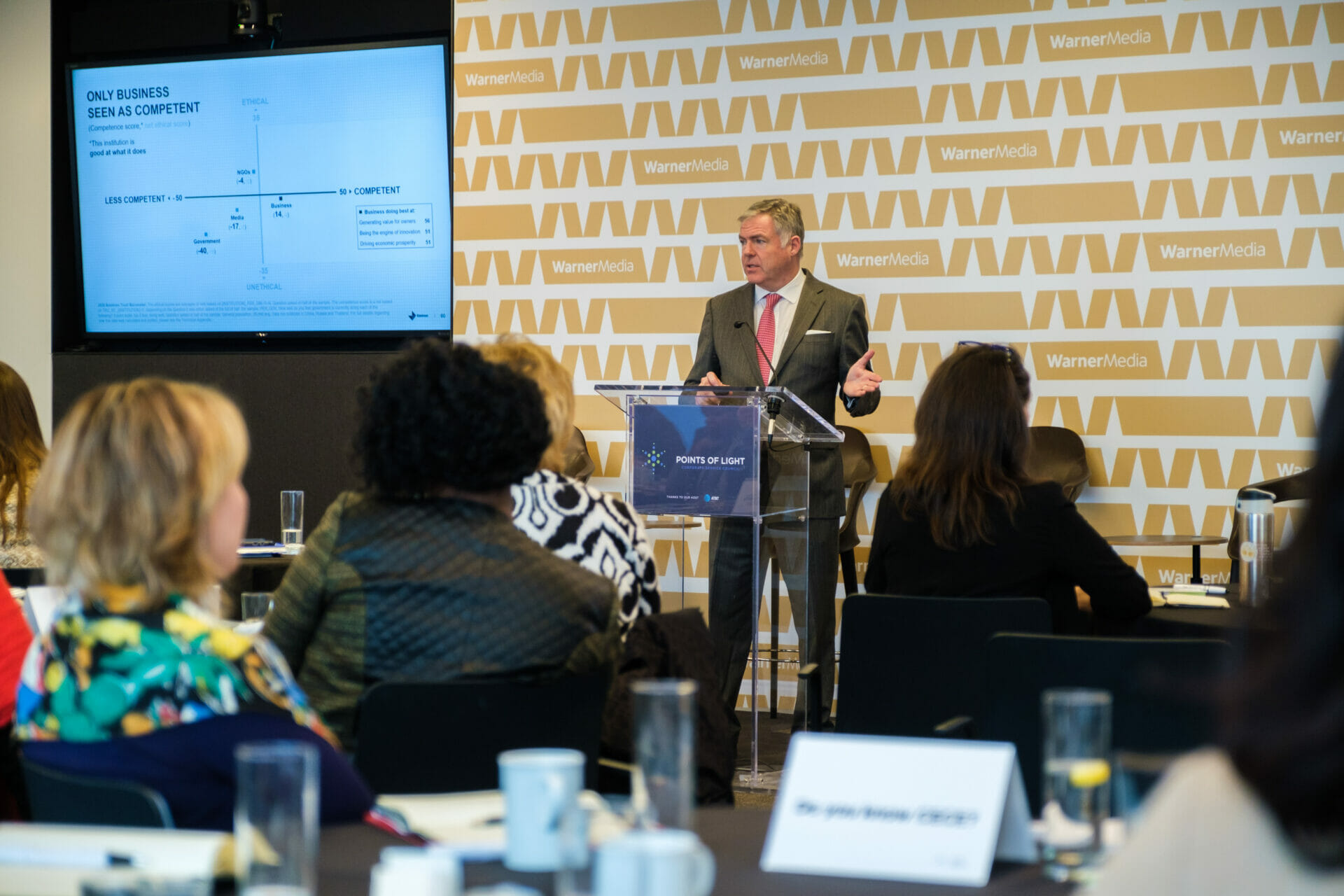
Matthew Harrington, president and COO, Edelman presents 2020 Trust Barometer.
Trust has to be earned through ethical action, partnership across sectors and realized commitments. Employees, customers and communities expect that CEOs will lead social issues and are ready to take change into their own hands when they sense a lack of authenticity and action.
Measuring and reporting on the value of this social purpose mandate, putting the “S” in ESG, was another significant theme addressed in the meeting, with a panel including: Catherine Blades, Aflac Senior Vice President, Chief ESG and Communications Officer; Jason Leiker, AT&T Associate Vice President, Corporate Social Responsibility; and Marc Siegel, EY partner in the Financial Accounting Advisory Services (FAAS), Sustainability Accounting Standards Board Sector Chair for Resource Transformation. A leading take away for businesses?:
As stakeholders and shareholders turn their attention to how companies deliver on social goals and commitments, articulating what metrics represent in the work of the company and the value to shareholders is an increasingly complex topic.
Defining common metrics that can be reported within industries and across sectors and retaining the authentic value of a company’s own purpose story for a broader audience of internal and external stakeholders are just some of the metrics companies seek to understand.
We look forward to continuing to provide information and opportunities for engagement through our Council and partners like CECP.
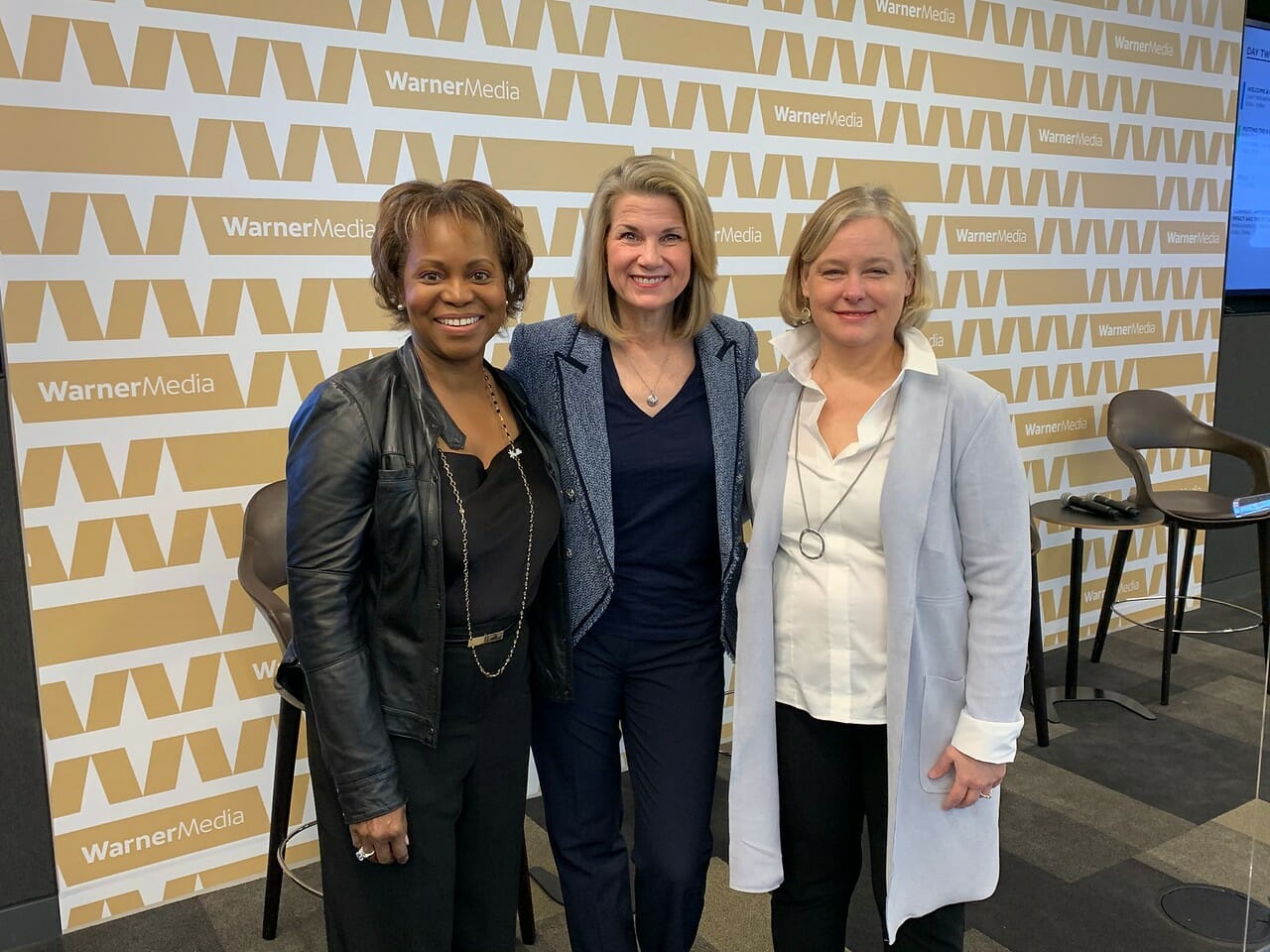
Points of Light President & CEO Natalye Paquin (left) and Chief Civic Innovation Officer Jenny Lawson (right) welcome new Corporate Service Council Chair, Charlene Lake, AT&T (center).
A chance to test the power of business to lead social change and address challenges was called into action by Don Lowery, Nielsen Senior Vice President, Community Engagement, who shared updates and materials from their newly announced TrueCount initiative. He urged leaders to
share information and materials with their employees to participate in the upcoming 2020 Census against fears of a significant undercount.
A representative census count is essential to providing resources, a voice and a representation for communities. You can find here census partner materials, promotional content and
to make sure your company is stepping up to this challenge.
As we create a world in which every person and every business has the power to create a world where it is impossible to sit on the sidelines of change, we look forward to working with you to help you and your company mobilize.
They say “be careful what you wish for”, but we think it’s time to be care-full.
This is the moment we have been waiting for.
Jennifer Lawson is the Chief Civic Innovation Officer at Points of Light. She leads forward-thinking initiatives, partnerships and campaigns with leading brands to advance social change in the corporate sector.
Leading with Purpose: What We Learned in 2019 And How Companies Can Prepare for 2020
This year brought us clear indicators of a profound change that is taking place in society and the evolution of the business landscape.
– defined by volatility, uncertainty, complexity and ambiguity – redefining the role of business in society. As the year ends, we looked at some of the significant changes in 2019 that will continue impacting corporate social responsibility and employee engagement as we move into 2020.
The UN’s SDGs pass the five-year postmark and progress is not moving fast enough.
It’s been five years since the United Nations unveiled the Sustainable Development Goals, a set of goals and benchmarks for the entire world to unite around to make our planet a better place by the year 2030.
. Climate change appears to be an unstoppable menace that threatens all life on the planet, and humans aren’t doing enough to stop it. Progress on the Sustainable Development Goals remains uneven, and is not moving fast enough to meet the ambitious
, would become one of its greatest allies, and her role is an illustration of the many changes that are coming. Gen Z (those born after 1996) comprised
of the global workforce by 2020.
Gen Z has grown up in a society shaped by discussions around climate change, gender, equality and diversity. In the workplace, Gen Z seeks a career path, and a working lifestyle vastly different from the generations that came before them. They care about a company’s
and gravitate towards companies that are purpose-driven. They want to know their work in some way will have a positive impact on the wider community, not just the business, and place high importance on joining an organization that shares the same values as them and that is proactive in its stance. Companies will have to be prepared to address the need for transparency and openness by acting with honesty and authenticity.
Civil society has become more fragile, volatile and divided.
Civil society saw an increase in duress in 2019. Civicus’
identifies the rise of authoritarian leaders, right-wing populists and anti-rights groups as three of several reasons civil society has become more fragile. With people increasingly getting their news and information from
, it has become harder for people to know what is true and what is false.
These turbulent times will affect how companies operate and might influence their bottom line. As an example, as the most recent quarter drew to a close,
shows that despite the lowering trust in mainstream media and “the system,” one relationship does remain strong and is trending upwards – the trust an employee has in their employer. The report states that “58 percent of general population employees say they look to their employer to be a trustworthy source of information about contentious societal issues.” 76 percent also say they “expect a CEO to take the lead on change.”
SurveyMonkey recently conducted a five-country
on what people expect of business leaders. Half of the respondents said they’ve bought from or boycotted a company because of the social or political views of the company, or the way it does business and/or treats its employees. And in every country surveyed, the majority of consumers want business leaders to stand up for social or political issues they believe in.
There are more activist companies and employees.
According to a report from global communications and marketing firm Weber Shandwick, the
after learning of an agreement the home décor company made to furnish migrant detention centers. These were just but a few of the many employee protests that made headlines.
The core part of a company’s function has evolved from not only being a driver of shareholder wealth but becoming a responsible steward and benefactor in the communities in which they operate – take BlackRock CEO Larry Fink’s
as an example. Companies are increasingly putting their brand behind social causes they believe in, and employees are demanding that their employers do more than provide a salary and benefits package.
So, what does all of this mean, and how is it tied together?
All of these waves of change mean it is no longer acceptable for companies to sit on the sidelines of change. At Points of Light, we believe all of us have a role to play in creating a society where it is easy for people to take action.
As we face a new decade filled with changing roles, expectations and immense challenges, companies must engage their people – from their employees, to their suppliers, to their board room – to take action.
By companies investing in community engagement initiatives and making a conscious decision to be active, responsible and thoughtful corporate citizens, companies have the opportunity to not only continue to provide shareholder value, but provide stakeholder value as well.
What will your company do in 2020 to set yourself, your stakeholders and you communities up for success and change in the next decade?
Daniel Elliott contributed to writing this article.
Corporate Citizenship and Social Good at Clif Bar & Company
At Points of Light, we envision a world where it is impossible to sit on the sidelines, where every individual has the opportunity to get involved. Businesses are increasingly realizing the importance of this, too, making it easy to do good – both through the empowerment of their employees, and through executive leaders who choose to take a stand on important social issues.
Clif Bar is no stranger to this. Last year, we featured the company’s
through it’s employee volunteer program, CLIF® CORPS. And, the company recently took a stand in advocating for closing the gender wage gap, with its LUNA brand
to make up the difference in roster bonuses between the men’s and women’s teams.
Jenny Lawson, chief civic innovation officer spoke with Cassie Cyphers, Clif Bar’s community program manager, to learn more about their culture of giving back and social impact.
More and more, the demand from customers to have an opinion on social issues, and to engage appropriately, is a challenge for many companies. Do you view this as a risk, and how do you decide when to take a stand?
It can be a risk because we have employees in different parts of the United States, and with different backgrounds and perspectives. We struggle with supporting and ensuring that we are being sensitive to what employees care about, but also what’s right for Clif Bar & Company. I think that closing the pay gap in women’s soccer was successful because it aligned with a really strong brand that started with a very clear vision to create a product for women. The neat thing about Clif Bar is that we are beginning to take a look at each of our brands and ask, “what does this particular brand stand for, and how can we dig in and have an impact in area that’s specific to that brand?”
How do you balance aligning issues authentic to your brands with supporting employees to just be great citizens in their community?
We’re fortunate to be able to fall back on the inspiration of the programs from the founders and co-CEOs who are leading the company today. Kit Crawford’s inspiration was her mother, who volunteered a little bit every day. Her inspiration is very important to the company and it is why we support volunteering on company time. This provides us a with a broad approach and our employees with a broad perspective.
We’re at a time at Clif Bar where we can dig deeper into a specific issue or cause where we want employees to participate, and we can build their acumen around how you show up and how you work with a nonprofit. I think it grounds people, which is going to make them stronger when they decide to engage in what they’re passionate about.
Listen to the full interview between Jenny Lawson and Cassie Cyphers:
Learn more about Clif Bar’s innovative social impact programs:
which provides networking opportunities, best practices and new ideas that catalyze high-impact social change initiatives. To learn more about how your company could benefit from membership, connect with us at
affiliate. While their projects range from literacy programs to food services, what these honorees have in common with each other is a desire to give back and make a difference in their community.
That impulse is shared by our Cabot farmers, too, and that’s what inspired
. It’s the heart and soul of Cabot, powered by the values of the co-op farmers, who also volunteer in their communities and want to encourage others to do the same.
These five Cabot Community Celebrities can inspire us all to do more:
Earl Dizon, volunteer with HandsOn Greater Portland.
Initiative and the Children’s Book Bank, Earl ensures children receive reading support and access to books early in life When asked why he volunteers, Earl said, “At first, it was just a way for me to pass the time. But once I realized I was able to help others in a way that reinvigorated me, I was hooked.”
, managing volunteer teams and special events. But even more important, she shepherds new volunteers – more than 5,000, so far – helping them get started. Those 5,000 volunteers have gone on to work on 12,000 projects for New York Cares, so you could say that Phara is a volunteer x 5,000!
Steffen Strayer (left), a volunteer with United Way of Northeast Florida.
to make his community better. He got the impulse to give back close to home from his grandmother, who also worked hard to serve her community. His focus at United Way is to help lift people out of poverty by providing support for basic needs, education and financial services. The best part about volunteering? “I like interacting with our clients,” Steffen says. “They have the most interesting and compelling stories to tell and the most love to share.”
both to give back and make new friends. Those connections are as invaluable as the connections she makes for network members with her work at Boston Cares, fulfilling a wide range of community needs, from ushering community concerts to judging student debates. Melissa makes sure affordable, healthy food can be had by all at
. She points out the importance of these connections: “A community depends on the strength of connections – between neighbors, community groups, public servants, and everyone in between,” Melissa said. “Volunteering builds those connections.”
, where she provides a wide range of services for various organizations. Her New York Cares experiences often inspire her to volunteer directly with a local organization, which is what happened with Bike NY, Road Runners and University Community Social Services, otherwise known as Meatloaf Kitchen.
How Companies Can Build Communities and Solve Social Issues
A sense of belonging – whether to a team, a neighborhood, a city, a state, a cause, a school or company – shapes our identities, making us healthier and more community oriented. We form communities in hundreds of ways. And yet for many people, the reality remains that they feel singled out, left behind, different. So how do we build stronger communities in all their forms, stopping attitudes and actions that isolate, and build more belonging?
Jenny Lawson, Chief Civic Innovation Officer
The 2019 Points of Light Conference left me with a vision for the answer. As we stand at the dawn of a new era – the Civic Century – where we imagine everyone being fully engaged, the idea of connecting to each other is an incredibly powerful stepping stone to the world we are yearning to create.
The strongest, most sustainable support for the Civic Century may come from companies. And why not? We will spend about 90,000 hours – almost one third of our lives – working. Companies can use this opportunity to educate, influence, and improve attitudes, skills and behaviors that can break down barriers and build more connected communities.
At the conference, companies came together – along with individuals and nonprofits – to hear from leaders in the sector on how building communities is not only good for the world, but good for business. Marc Freedman, president and CEO of Encore.org and author of the best-selling book
shared a vision of how we might increase our sense of belonging in the workplace. His premise: the barriers and boundaries we have created between young and old create separateness and isolation that might serve some definition of efficiency in the short run, but leave us less connected and less effective in the long run. His solution: look for ways your older employees can serve as coaches and mentors to younger employees – both in the workplace and in the community. Or, consider how younger employees may be able to help older employees polish 21st-century skills and redefine the value and opportunity offered by an aging workforce. While these tasks offer measurable value, the connections they create help to build a culture of belonging in the workplace and beyond.
In addition to Marc, speakers throughout the week discussed how businesses must focus on building community and purpose. Alison DaSilva, executive vice president of Cone Communications, discussed the value Gen Z places on purpose-driven brands, and Amy Smith, chief giving officer for TOMS, reminded corporate audiences that “staying on the sidelines and playing safe is no longer an option if you want to stay relevant.”
So how will we use community to solve the social challenges in front of us?
Points of Light is
, and the communities where their employees work and live, to move beyond deep divides and unite in action to improve the world. Bringing our collective partners of value and values along on the journey is how we will create the world that we envision. I hope you will join us in the year ahead.
Take a Look at Highlights from the 2019 Points of Light Conference:
Developing Future Civic Leaders, One Neighborhood at a Time
Points of Light was founded on the simple yet profound belief that individuals play an important role in solving community challenges, and that the innovation and dedication of ordinary citizens can accomplish extraordinary things. Starbucks has a similar commitment, reflected in its mission statement:
“to inspire and nurture the human spirit – one person, one cup and one neighborhood at a time.
”
Through a grant from the Starbucks Foundation, Points of Light created a groundbreaking program inspired by national service that provides Starbucks retail employees an opportunity to lend their hearts, hands and minds to local organizations that leverage volunteers to meet their mission. The
invests in local nonprofits through the power of human capital, serving as an amazing example of the power of public-private partnerships, and the importance of elevating and investing in service.
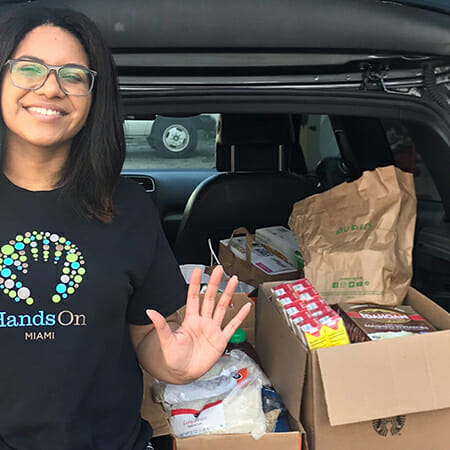
HandsOn Miami Service Fellow Cindy Ariza dedicated her time to recruiting and training community emergency response teams in Miami.
Points of Light’s commitment to leveraging service as a solution for organizational and community needs is based on the belief that cross-sector partnerships are a critical element of effectively informing and impacting social and community issues. Our partnership with Starbucks is an innovative approach to strengthening networks and nonprofits that complements other products and services in our capacity building portfolio. Our shared commitment to volunteerism and impactful community engagement served as inspiration for the initial vision for this program, which was to create a revolutionary model of catalytic citizenship.
For six months, Points of Light and 13 members of our
engaged 36 Starbucks Retail Partners (part-time employees) as Service Fellows, providing them with a robust experience that included civic education, community engagement and sector building. This pilot program provided Points of Light, our Global Network members and Starbucks a rare opportunity to co-create an experience that was responsive to the needs of networks and nonprofits while simultaneously developing future civic leaders.
Fellows not only made a difference in their communities, collectively providing more than 17,000 hours of volunteer service, but inspired others to do the same. This partnership will continue to drive catalytic changes to the existing volunteer infrastructure, while also significantly enhancing the capacity of nonprofit organizations to effectively engage volunteers and fellows within their workforce. We look forward to leveraging the lessons learned and impact achieved to explore future phases of the program.
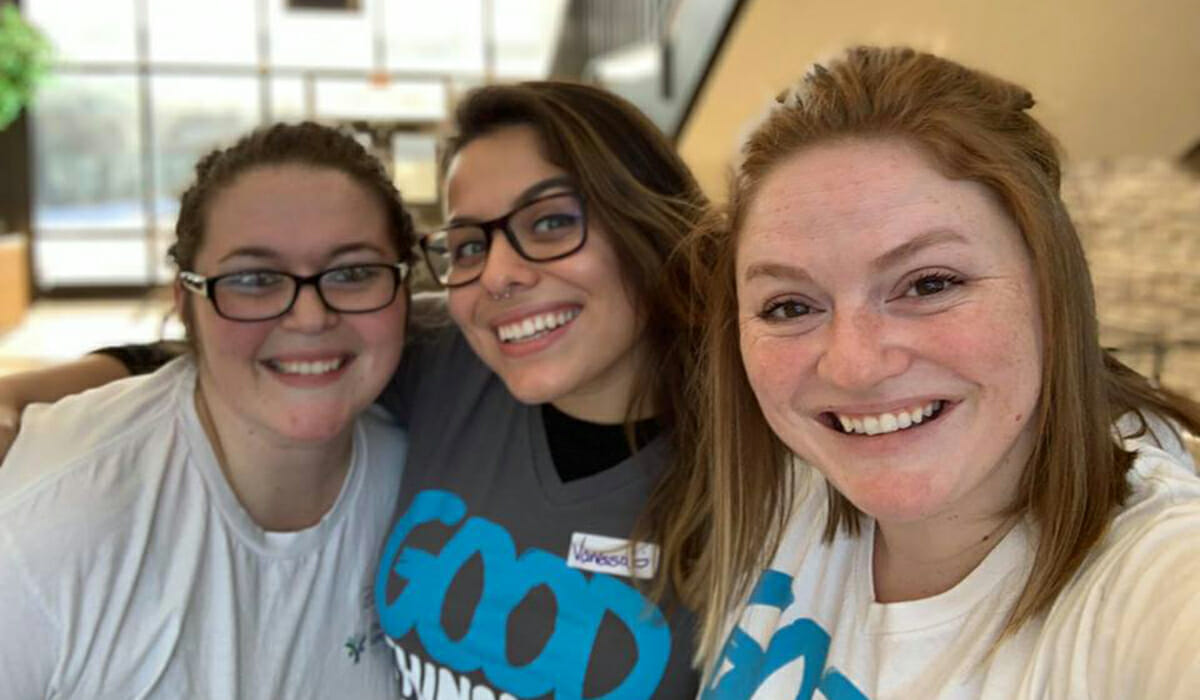
Shannon Galford, Starbucks global responsibility program manager (right), with Chicago Cares Service Fellows Zoe Pace and Vanessa Higueros.
Read stories from Points of Light Global Network members that hosted Starbucks Service Fellows during the pilot program:
Alison Doerfler is the senior vice president of capacity building at Points of Light.
The Power of Connectivity: A Reflection on Volunteering and Service
Craig Arnold supporting the Salvation army during a relief effort in Tacloban City, Philippines, following a cyclone. (Photo courtesy of Craig Arnold/UPS)
When I started at UPS, the plan was just to pay the bills during college and move on. More than three decades later, I’m still here —
why
?
Craig Arnold, Vice President of Sales, UPS
It comes down to service. My parents worked for the Salvation Army their entire adult lives, so I grew up seeing service in action.
I saw the same commitment when I walked through the doors at UPS. I still remember my first training class as a young supervisor when the instructor told us quite simply:
UPSers
serve
. Service is in our name. We serve customers, each other, shareowners and the community. I love that concept.
The instructor on that fateful day challenged us as leaders to make our decisions through the lens of service. I was hooked. All these years later, against the backdrop of
. As he said, the starting point for giving back starts within. When you find something you’re passionate about, giving time, sharing knowledge and offering financial support come naturally.
For me, the path was clear. My 32 years of developing logistics expertise and my passion for helping those in need were accelerators for giving back. I’m now part of an early-response Salvation Army team that goes to large-scale international disasters. Usually, we’re on the ground in the first couple of days after an event.
During the past nine years, I’ve deployed to Haiti, the Philippines, Vanuatu, the U.S. Virgin Islands and Puerto Rico. In each case, my role is to build a supply chain to deliver urgent aid to those in desperate need.
All disasters are different, but for me, they all have one common thread: We maximize our impact when we’re truly connected.
SUPPLIES BEING STAGED DURING A UPS HUMANITARIAN RELIEF OPERATION. (PHOTO COURTESY OF UPS)
Getting results
For example, after the earthquake in 2010 in Haiti, the Salvation Army cared for 15,000 displaced people living in a soccer stadium. They had more than 100 local volunteers, five trucks and an international team of disaster response experts, but they needed aid from outside the country as well.
UPS had never landed in Port Au Prince and needed landing rights, custom processes and a partner who could effectively distribute aid to people in need. I was blessed to be in the right place at the right time. From the ground in Port Au Prince, I could organize the inbound processes, set up local trucking and engage the 82
nd
Airborne to help us deliver support.
In 23 days, we delivered 1.2 million meals.
In Vanuatu, after the devastation brought by Cyclone Pam, a community in a remote island village perched on the side of a mountain needed PVC, plumbing connectors and hardware. The need here wasn’t for big jets — it was about connecting different networks.
UPS provided funding for a series of small charter flights from Vanuatu’s capital city to the island every day to provide enough water every 24 hours. The Salvation Army funded barge space to move the pipe. The French military supplied helicopter lift from the barge up the mountain. The local villagers rebuilt their own water supply system.
This was the power of connectivity at work.
More opportunities to give back
Most recently, in response to Cyclone Idai’s devastation in East Africa, UPS and The UPS Foundation worked with nonprofit organizations to
.
As the region rebounds, the need for support will continue. The work in all these countries shares the same common theme. It’s all about connecting people and networks. No single person can get these large-scale results. But working together, each person brings their own experience and expertise, ultimately creating a domino effect that produces life-changing solutions.
In 2018, UPS and The UPS Foundation responded to 29 major world disasters. Relief spanned 71 countries across continents around the globe. Beyond these headline stories are the stories of people in need. Some of them are in your neighborhood. Some are complete strangers. Either way, the opportunities to give back are endless.
As we celebrate National Volunteer Week, I’ll challenge you like my UPS instructor challenged me more than 30 years ago:
Go serve.
Craig Arnold joined Points of Light President & CEO Natalye Paquin for an interview with Atlanta’s 11Alive during National Volunteer Week:
Craig Arnold is vice president of sales for UPS. Since 2010, he has deployed as a front-line responder into disaster sites to help coordinate relief logistics after cyclones, hurricanes and earthquakes around the globe.
This story originally appeared on UPS Longitudes and was reposted by permission.
Trends in Business & Social Good: What Changes Will 2019 Bring?
By Jenny Lawson, Chief Civic Innovation Officer
I am lucky to love what I do. For the last eight years I have had the privilege to watch and encourage the incredible growth of civic and social engagement in companies. Over this time, we’ve seen incredible growth – from only 24 percent of companies offering pro bono programs (CECP, Giving in Numbers, 2011) to 56 percent offering such skilled talent to communities today (CECP, 2018). From CEOs speaking out to Super Bowl ads focused on social action, companies are leading and lending talent and resources at an unprecedented scale.
This year, we are already witnessing more change. Each year in January the Points of Light Corporate Service Council meets to exchange new ideas, hear from experts and shape their company community engagement strategies. Over two days, members from leading companies gather to discuss building purpose into the center of their business and breaking down barriers that prevent people and their employers from taking action that changes the world. Just ahead of Davos, where CEOs and world leaders would tackle some of the toughest global challenges, conversations at this year’s annual CSC meeting helped us understand how the challenges we face in our own communities can be examples for larger social issues.
Through our work and partnerships with these companies, which are working to strengthen their value and connection to communities, we see a few trends for 2019 that haven’t made the headlines yet.
Companies are building out the “S” in ESG
The powerful environmental, social, and governance factors have rapidly weighted and shaped investment decision making. Spurred by BlackRock’s Larry Fink’s letter ahead of Davos 2018 and reinforced in his 2019 update, companies continue to develop measures to capture created value beyond profit. With a highly visible demand from stakeholders to tackle climate and environmental challenges over the last five years, and issues of governance watched closely by investors and creditors, clear and commonly understood measures around the “S” in ESG have been slower to develop. But 2019 promises to be the year of the “S.” Several powerful studies and initiatives are tackling social impact measures head-on. We see inspiration and action from:
Coalitions building consensus and reporting muscle among leading brands like CECP’s Investor Initiatives and Impact2030 efforts to build measurement strategies connecting the impact of volunteerism to the SDGs.
Companies are innovating how they work with the social sector.
With ESG awareness and interest flooding into business thinking, companies are seeking shared value relationships and opportunities with external partners and inside the organization, too.
Companies are expecting more measurement and data analysis and seeking transparency around impact and value from their nonprofit partners. Companies are also understanding that nonprofit partners need support, including pro bono staff time from the corporate world, to build the capacity and infrastructure to be meaningful data-driven partners. Initiatives like Booz Allen Hamilton’s Data Science for Social Good are opening new pathways and partnerships.
Moving beyond support to stewardship, companies are seeking next-generation collaborations among stakeholders, including clients, vendors and respected NGO partners, to add depth, leverage and shared value to causes that reflect authentic interest in social challenges that align with the voice and values of the brand.
While companies are driving to connect their social engagement strategies to authentic brand values and have natural alignment with their products and services, they are also understanding that the “whole employee” has relationships, social values and causes that they care about. As Gen Z comes into the workforce, companies are getting creative with community engagement strategies and initiatives that support employee passion as attributes of their authentic brand values. It’s a tricky but doable objective for an increasing number of companies, focused on blending a suite of opportunities from company-sponsored events, to matching gifts, to recognition for civic action through rewards. There’s a growing interest in more family volunteering, too, that may build as companies look to support millennial and Gen Z families.
Over the next year, we look forward to partnering with corporations and business to achieve these goals. As society expects more from business, we help companies engage their customers and employees in the challenges facing their communities and our world.
The Points of Light Corporate Service Council provides networking opportunities, best practices and new ideas that catalyze high-impact social change initiatives. To learn more about how your company could benefit from membership, connect with us at [email protected].