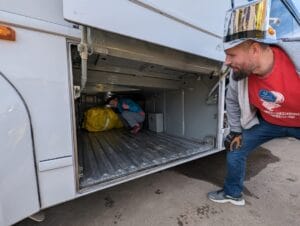
Voting is a vital part of actively participating in a democracy. Organizations – whether they’re nonprofit or for-profit – have a civic responsibility to encourage employees to vote, from making their own voices heard to volunteering to ensuring others have the same opportunity.
A responsible, engaged company will use its power and influence, from a nonpartisan standpoint, to encourage voter engagement, equipping their workforce with the tools and resources they need to get involved.
As the world braces for a year packed with national elections in over 60 countries, it’s crucial for businesses to take a stand in supporting voter participation and civic engagement. Here’s how your organization can make a real impact:
1. Foster a culture of civic responsibility
Encourage your employees to confirm they’re registered to vote. Whether through a company-wide email, a dedicated section in your internal newsletter, or a quick reminder in team meetings, ensuring your team is registered is the first step. Utilize resources like
in international markets to simplify the process. You can also draft a sample email to encourage employees to vote and keep it in your files to use in future election seasons.
“Encouraging your employees to be civically engaged is not just about volunteering. Making the space and creating workplace policies that equip all employees to vote is critical – they expect it, and communities depend on it. Voting is a major way we all take action for change.”
— Katie Stearns, chief program and impact officer, Points of Light
2. Provide paid time off to vote or volunteer
Voting is a fundamental right, but the demands of work can sometimes make it difficult. Offering paid time off to vote is a powerful way to remove this barrier. Review your benefits package to confirm that you offer paid time off for voting – or take it a step further by encouraging your employees to serve as poll workers, an essential role that can be supported through organizations like
offer comprehensive guides and toolkits that can be shared across your organization. Make sure these materials are readily available and accessible, whether through your company’s intranet or as part of a digital resource hub. And if you haven’t yet read our
, we encourage you to check it out. It’s packed with information about the voting process, tips to activate around voting and interviews with political leaders.
4. Host voter education sessions
Educating your staff on electoral issues and candidates is key to informed voting. Partner with nonpartisan coalitions like
to access valuable resources and educate leadership teams to organize and lead lunch-and-learn sessions or webinars where employees can ask questions and discuss the issues at stake.
By incorporating these strategies, your business can not only support voter engagement but also lead by example in fostering a culture of civic responsibility. The impact of your efforts will resonate far beyond Election Day, contributing to a stronger, more engaged community.
Working with Points of Light can take your employee community engagement to the next level. The Points of Light
is an annual membership program that empowers and equips CSR and corporate social impact leaders and their teams with actionable resources, insights, training and connections needed to advance their social impact goals and be recognized for their success.
Our mission is to support partners with comprehensive, end-to-end management of volunteer experiences and events that are not only well-executed but also deeply rooted in the community and focused on creating a lasting impact. To learn more about how we can support your work, please
Celebrate Senior Citizens Day: Volunteer for a Healthier Brain and a Stronger Community
August 21st marks National Senior Citizens Day, a time to honor the wisdom, experience and contributions of older adults in our lives and communities. Older individuals bring so much value and benefit to our communities, and
. This year, we encourage you to celebrate through volunteering. Not only will you be helping others, but research suggests you might be protecting your own cognitive health as well!
Cognitive Health and Volunteering
Exciting new research on volunteering presented at the
found a link between volunteering in later life and prevention of cognitive decline. While more studies are needed, this finding suggests that volunteering may be a valuable tool in protecting the brain against dementia and boosting memory capabilities.
Read the inspiring story of Daily Point of Light Awardee Bernice Voelker, who has mentored and supported more than 500 students over the past 22 years through the Americorps Seniors Foster Grandparents program.
National Senior Citizens Day is the perfect opportunity to start (or continue) your volunteering journey. Here are a few ideas to get you started:
Share Your Skills: Tutor students, mentor young professionals or offer your expertise to local nonprofits.
Serve Your Community: Volunteer at a food bank, senior center or animal shelter.
Advocate for Change: Join a cause you care about and use your voice to make a difference.
Connect with Others: Participate in social activities or group volunteering projects to build relationships and combat loneliness.
If you’re looking for a structured way to get involved and meet like-minded volunteers, consider AmeriCorps Seniors. This program offers a variety of volunteer opportunities for adults 55 and older, including:
RSVP: Match your skills and interests with local volunteer needs.
Foster Grandparents: Mentor and support children and youth with exceptional needs.
Senior Companions: Provide companionship and assistance to homebound seniors.
See how Daily Point of Light Awardee Mark Mandel spends five days a week in retirement serving New York City’s greatest institutions.
Take Action Today!
Don’t wait for National Senior Citizens Day to make a difference. Start planning your volunteer activities now. It’s a win-win: you’ll contribute to your community and potentially boost your brain health at the same time. Visit
to find opportunities near you and remember, every act of service counts! Let’s celebrate our seniors by getting involved and building a healthier, happier future for everyone.
Ask a CSR Friend: When it Comes to Volunteering, What Counts?
Whether you’re a novice or a seasoned pro, we know it takes a village to create vibrant workplaces where employees are equipped to contribute to the communities and causes they care about. So, when you need a trusted advisor to lean on, rely on Points of Light to be Your CSR Friend. Each month, our experts share their wisdom and wit to address a specific but often universal challenge related to your work as a corporate social impact practitioner.
Have questions about employee community engagement? Submit your question and it may be featured in a future blog post.
Dear CSR Friend,
I lead a well-loved and, I think, well-used employee volunteer program. However, every year we struggle to confirm how many employees are participating because we can’t seem to convince all employees to report what they’ve been up to. I know it’s only one way to measure the output of our employees’ efforts but it’s disheartening to not be able to move the needle on the annual participation goal we set because so many aren’t reporting their activities. Do you have any new ideas to incentivize or reward employees who track their volunteer time?
Signed,
Underreporting in Union City
Dear Underreporting,
Don’t you wish every CSR role came with a 101 session on behavior change and organizational psychology? Alas, it doesn’t, and corporate social impact leaders like yourself have been grappling with this question since the dawn of time! There are some straightforward ideas to motivate employees to track their volunteer activities, but first, let’s highlight one crucial element—defining your company’s view on volunteering.
At Points of Light, we have a formal definition of an employee volunteer program: a structured effort to motivate and enable employees to volunteer under the guidance of their employer. However, the true definition is shaped by each company’s unique culture, values, goals, priorities, employee interests, and the needs of the communities they serve.
Let’s first address the elephant in the room. Should we be tracking activities and participation in the first place?
Inputs and outputs are great to have on hand when goal setting, benchmarking, and applying for external recognition. For instance, I can tell you that, on average,
. But that number doesn’t paint a clear picture of the impact that these volunteers had on communities and causes. It does tell us that these honorees are going above and beyond the average participation rate provided each year by
. And it tells us that there is still room to grow when it comes to widening the pool of potential participants, ensuring equitable access across all employee roles and work settings.
A pro tip from me to you: tracking activities and participation help you understand employee interests and engagement but consider what else you may want to report on related to your volunteer activities to demonstrate the impact of your employer’s social impact strategy. Check out this resource from
to get started on measuring outcomes.
Explicit, written guidelines – especially as they relate to what counts as volunteering – ensure consistency and provide a clear understanding of eligible activities and partners. Surprisingly, many companies don’t write out guidelines, leaving employees unsure of what’s expected and what they should be reporting. With a global workforce where many cultures view volunteerism as simply being neighborly and some companies introducing “acts of kindness” that aren’t associated with a nonprofit, an agreed upon definition of what counts as volunteering will help all employees better understand what they need to track.
Why written guidelines matter:
They serve as a go-to source for program details.
They prevent misinterpretations and ensure uniformity.
They help manage future requests and align with company interests.
They solidify the program’s principles and expectations.
Accessible, up-to-date guidelines, regularly communicated to all employees, reduce daily inquiries and boost engagement. There’s no one-size-fits-all approach—each company should define what counts as volunteering based on its goals, culture, and reporting needs. A word to the wise: don’t get caught up in semantics. Call them “guidelines” or a “policy” or a “program manual,” whatever will indicate to colleagues that this is a resource that will explain what they should be reporting.
To start, consider your response to the activities listed below and whether they would count as volunteering at your company. There’s no right or wrong answer to whether or not these activities should count as volunteering and be tracked; it’s up to your program’s goals, your company culture and values, and most importantly, what your company wants to report at the end of the year.
Coaching a Little League team each spring
Running in or training for a charity race
Attending a bowl-a-thon or charity golf tournament
A gala dinner for a prominent nonprofit partner
Chaperoning a child’s field trip to a nonprofit arts museum
Volunteering for the PTA at your child’s school
Donating to a collection drive or shopping for holiday gifts for under resourced families
Giving blood at a company-organized blood drive
Participating in a career fair sponsored by your Veterans’ employee resource network
Fostering animals for a local pet rescue
Shopping for essentials for a home-bound neighbor
Marching with a well-known environmental nonprofit to drive awareness of climate change
Keep in mind some of the activities listed may come with stipulations, spell them out so no one is surprised when they go to track hours or when you pull a report! Consider specific parameters like:
What is the maximum number of hours that can be claimed for fostering an animal?
How much time can you track for donating a pint of blood and does that amount differ if you donated platelets?
Do the PTA volunteer hours count if there is a minimum required number of hours of service by my child’s school?
What if the organization is not a 501c3 – how do I track that?
Clear, thoughtful guidelines build a more cohesive and impactful volunteer program that aligns with company values and maximizes social impact.
As promised, here are some tried-and-true methods that many companies employ to encourage employees to report their volunteer activities:
Make it easy! Use technology to your advantage and automatically track the hours of volunteers who show up for their shift. Ask employees to share a story or photo on social media or on internal channels after their volunteer experience. Use a special hashtag and track the use of that hashtag as a proxy.
Ask volunteer champions to remind colleagues of the significance of reporting activities. Sometimes a personal request works better than another company-branded email arriving in inboxes.
Add achieving certain thresholds to your current volunteer recognition strategy.
Offer donations to the employee’s charity of choice for every hour they volunteer.
Consider non-cash incentives such as reserved parking spots, more vacation time, or access to key company leaders.
Create a points system where employees earn points for every hour volunteered or activity reported, redeemable for company or program-branded swag.
Offer professional development opportunities on social impact topics or volunteer leadership as a reward for committed volunteers.
Feature dedicated volunteers in company newsletters or on social media.
Provide letters of appreciation signed by senior leaders or schedule virtual lunches with senior executives for top volunteers.
Create digital badges for volunteers to add to their email signatures as they hit designated milestones.
These strategies not only reward employees but also foster a culture of giving back, enhancing employee engagement and satisfaction. Tailor the incentives to align with your company’s values and the interests of your employees for maximum impact.
Until next time,
Your
on June 11–14 at the Marriot Marquis Houston. Thanks to the generous support of UPS, The Samuels Foundation and CSAA and the Daily Point of Light Award Scholarship, a contingent of 18 honorees came together, joining the nearly 1,200 attendees for a week of learning inspiration and connection.
Hailing from nine U.S. states, Pakistan and the U.K., and spanning all ages from first year college student to retirees, these honorees spent time getting to know each other, being inspired and furthering their commitment to service. During a reception one evening, the energy in the room was palpable. They exchanged stories of their journeys and discussed innovative solutions to the challenges faced by their communities.
Growing Their Impact
Throughout the week, honorees gained invaluable insights into creating lasting social impact. As leaders of small nonprofit organizations in their communities, their conference attendance was made possible with the support of the UPS, The Samuels Foundation and CSAA Daily Point of Light Conference Scholarship. One honoree, who had left a successful career to dedicate herself fulltime to her organization’s mission, reflected, “without the support of the scholarship, I would not have been able to take advantage of this opportunity to grow my knowledge and impact.”
Save the Date for the 2025 Points of Light Conference in New Orleans, June 3–6. Sign up to receive updates.
A Legacy of Leading Change
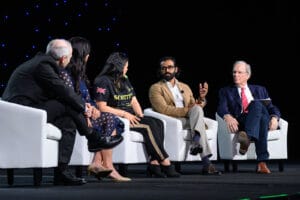
At the Closing Plenary session, all attendees heard from a panel of three honorees: Victoria Villareal (Daily Point of Light honoree #7,650) from Houston, Nikki Scott (U.K. Points of Light honoree #942) and Hamza Farrukh (Commonwealth Point of Light #129) representing the
. The three dove into their work and personal journeys of service, and left audience members with key take aways about leading social impact. They were joined by Points of Light board member Gregg Petersmeyer, who was the founding Director of the White House Office of National Service and supported President George H.W. Bush in the development of the Daily Point of Light award from the White House in 1989.
Points of Light was thrilled to welcome four new honorees from the Houston area to the Daily Point of Light honoree community. We were proud to work with our co-host, Interfaith Ministries of Greater Houston and Volunteer Houston, to celebrate incredible volunteers in the community. Four honorees we celebrated this week were:
Ann Kaesermann (#7,830) who serves as board treasurer of Interfaith Ministries;
Dee Dee Dochen (#7,831) who volunteers with ReelAbilities and is a long-time advocate for differently abled individuals;
Melissa Williams Murphy (#7,832) founder of iWrite, a nonprofit dedicated to empowering children to publish their own short stories;
Dana Farrar (#7,834), a volunteer with Theatre Under the Stars, a differently-abled theatre company.
Building Personal Connections
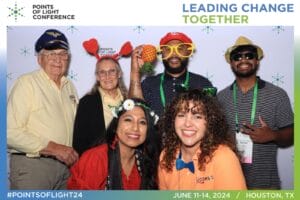
One of the joys of the Points of Light Conference is the opportunity to meet and grow relationships with other individuals passionate about change. In between diving into educational opportunities such as a workshop on building effective organization partnerships or a talk on leveraging AI for good, Daily Point of Light honorees made time to get to know each other – and have a little fun.
Honorees left with new knowledge, tools and relationships. In the words of one honoree, “I had so much fun and learned a lot from every single one [of my fellow honorees]. Keep up the good work!”
As we reflect on the Points of Light conference, we are reminded of the power of individuals to ignite change and the magic that happens when they come together.
Ask a CSR Friend: Gaining Senior Leader Support for Employee Volunteering
Whether you’re a novice or a seasoned pro, we know it takes a village to create vibrant workplaces where employees are equipped to contribute to the communities and causes they care about. So, when you need a trusted advisor to lean on, rely on Points of Light to be Your CSR Friend. Each month, our experts share their wisdom and wit to address a specific but often universal challenge related to your work as a corporate social impact practitioner.
Have questions about employee community engagement? Submit your question and it may be featured in a future blog post.
Dear CSR Friend,
I work for a small business, and we’ve done a few group volunteer projects from time to time over the years. I sit in HR and this has become a passion of mine after witnessing the benefits it can provide for our staff. I recently asked my supervisor for resources to turn our sporadic efforts into something strategic and sustainable. She’s set up a meeting with senior leadership so that I can present my ideas. I want to be fully prepared for what they might ask me. Do you have any guidance?
Signed,
Anxious in Annandale
Dear Anxious,
In today’s world, making a positive social impact is more important for businesses than ever before. If you’re about to pitch a workplace volunteer strategy to senior leadership, you’ve got a golden opportunity to turn those occasional volunteer events into a solid, ongoing strategy. Anticipating potential questions can help ensure you are well-prepared, so here are resources to respond to the top three questions senior leadership are likely to ask you.
Why should we invest in employee volunteering? What are the benefits and projected outcomes?
First, identify the business challenges that are top of mind for your senior leaders and then tailor your pitch accordingly. A strong and strategic employee volunteer program will benefit the communities where the company operates, employee well-being, and several other key business factors that will be incredibly relevant to your audience like:
Talent attraction and recruitment. Company support for employee volunteering provides an additional incentive for strong candidates to accept job offers.
Employee morale. This can lead to improved retention, greater satisfaction and productivity, along with increased company pride and loyalty.
Skill development. Participation in volunteer activities helps employees develop new skills and leverage current skills in addressing community needs.
Company image within the community. This can help differentiate a company from its competition while also creating a positive reputation among investors and consumers as a responsible corporate citizen.
Return on investment. Reduced turnover, increased productivity, potential new marketing and sales relationships, and more.
Honestly, it’s also incredibly risky to NOT engage in some type of corporate responsibility activities due to loss of market share – regardless of whether your company is B2C or B2B. See our learning brief,
, which will link you to research to help you further illustrate the need to invest in an employee volunteer program.
What resources are needed?
The adage “volunteering isn’t free” is true when it comes to your community partners and is paramount for senior leaders to understand. You’ll need to request financial investment for a multitude of things like salaries, partnership grants for project management and supplies, technology platform implementation and maintenance, communication materials and their production, volunteer t-shirts and branded swag, recognition and other operational items. You might also eventually consider having a budget set aside for supportive programs such as Volunteer Time Off or Dollars-for-Doers in which small grants are issued to nonprofits served by employees. But, you don’t have to ask for a sizeable investment upfront. Start slowly so you can showcase that return on investment after the first few years and then grow your budget.
Budgets vary greatly, and companies invest anywhere from less than $20 to more than $1000 per employee.
tells us that companies with revenue under $5 billion had median management and program costs of around $1.3 million. Traditionally, investments are low compared to employee training, which might be the most cost-comparable business function. The average organization spent $1,220 per employee on workplace learning in 2022, according to the
.
CECP’s 2023 Giving in Numbers also reports that the median number of FTEs for contributions staff (employees who oversee, manage, or directly administer corporate/foundation community investments and/or employee volunteering) was 11 in 2022. For companies with a less than 10k workforce, the median was 8. Having the support of 11 FTEs may seem totally unrealistic for the size of your workforce, so reiterate that, while top executives are increasingly recognizing the importance of having a dedicated team for corporate responsibility activities, we have seen magic happen with one FTE and some
spread throughout business functions. Having a dedicated team, though, will send a message internally and externally that the company understands their important role as a good corporate citizen.
What might be barriers to success and how can we plan for them at the outset?
A tried-and-true sign of a leader is bringing solutions rather than issues so absolutely be prepared to illustrate the barriers to success and ways you — with help from senior leaders — can overcome them.
Not being strategic: Identify those business priorities that can be supported through engaging in communities. But also think about the core services and competencies that the company and your fellow employees can offer to nonprofit partners. This will reinforce the notion that your program is a business initiative, not just the warm-and-fuzzy volunteering of yore. Be thoughtful about when and who you partner with and align with company milestones and those important focus areas.
Lack of buy-in from middle management (and sometimes senior leaders): Middle managers especially may feel that they do not have a stake in the program. Developing policies and practices that institutionalize the program and associated activities will give the workforce a place to reference and better understand what is permitted. You might also develop communication and training materials to provide to your middle management, so they feel confident in administering policies. Reinforce the benefits of serving together and how that can reap dividends for teams and the company at large. Top-down communications will also go a long way to support the idea that this is the direction in which the company is headed.
Driving internal awareness and participation in year one: Besides developing a strong and consistent internal communication plan using the appropriate channels and vehicles to reach your diverse workforce, use a galvanizing enterprise-wide moment to build excitement and motivation. Or build out an employee champion or committee infrastructure to support markets outside of HQ and ensure they feel empowered and educated. Download this learning brief to find out more about creating effective volunteer champion and council models.
Hopefully the last question you’ll be asked is, “how do we get started?” which indicates that senior leaders are ready to start the company’s formal social impact journey. But remember, you don’t have to go it alone. There are organizations out there that can help you fully design the right strategy for your company, including Points of Light. Check out our
brought together 1,200 nonprofit, business and civic leaders who believe in the power of service to create positive community change. Throughout their time in Houston, attendees gained new knowledge, forged impactful connections, and were filled with inspiration to continue their important work to lead change. They also found moments to celebrate as we acknowledged the
honorees, and attested to their own contributions to building a society characterized by compassion, volunteerism and civic engagement.
While corporate social impact leaders often have opportunities to meet and learn from one another, the Points of Light conference provides unique value by offering conversations that highlight cross-sector challenges, partnerships and solutions. These discussions brought forth valuable insights that help remind us of where we’ve been and where we’re headed.
Corporate Social Impact Insights
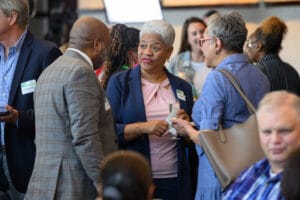
The reception for business leaders during the 2024 Points of Light Conference.
People: Building Belonging and Strengthening Relationships
At the heart of people-powered change are the volunteers themselves. While the collective efforts of individuals can spark transformation in the lives of others, it also brings significant value to volunteers. As Points of Light CEO Jennifer Sirangelo shared in the opening plenary, “there is an urgent need for connections, compassion, and community.” The world is at a pivotal moment; many feel isolated and lonely, othering has become commonplace, and differences seem too difficult to overcome. In the workplace, we are faced with record levels of disengagement and stress. Employees are searching for purpose, respect and inclusion. Volunteerism, by developing empathy and encouraging proximity, plays a crucial role in bringing people together to work toward common goals, fostering a sense of belonging, and building a resilient and supportive community where individuals feel valued and connected.
Not only do we need people to get involved in making positive change happen, but the true success of volunteer efforts also relies on the strength of relationships. Collaboration between community organizations and businesses creates a robust support network that amplifies impact and drives innovation. Strategic partnerships where significance is placed on mutual trust and transparency ensure that resources are effectively used and that outcomes are sustainable and far-reaching.
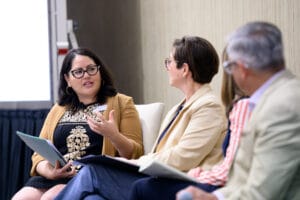
A panel discussion during the business leaders luncheon.
Power: Uncovering Agency and Centering Community
Corporate social impact leaders play a crucial role in helping colleagues realize their potential for making change happen. By meeting employees where they are on their journey and empowering them in authentic and varied ways, leaders can inspire actions that build momentum toward achieving larger goals. Encouraging active participation in one’s community, such as volunteering and voting, is essential. However, successful participation requires the centering of community voices.
We must co-create solutions by listening to those closest to the issues. As Katie Fessler, Senior Director of Community Impact at Altria Client Services, noted in the Business Leader Luncheon, we must do this work “with community, not for and definitely not to.” Harnessing the energy and agency of volunteers is vital, but we must also be mindful of the inherent power imbalances between companies and community organizations. Recognizing that both corporate and nonprofit leaders have much to learn from each other is key. Companies should approach community partnerships with humility, allowing community leaders who are ultimately closest to the issues to guide solutions and co-dream them together. This collaborative approach ensures that efforts are genuinely beneficial and sustainable. Understanding power dynamics is also important in telling stories of service. When we center the strengths of every stakeholder in our stories and approach each other with dignity, we create connection based on shared humanity rather than a desire to save. In all aspects of community, we have as much to learn as we do to give.
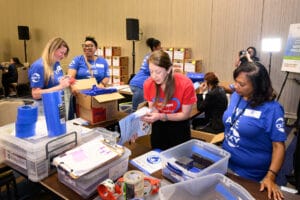
A service project during the conference hosted by the Barbara Bush Houston Literacy Foundation.
Progress: Measuring Impact and Valuing Transformation
Corporate social impact leaders continue to face the challenging task of proving outcomes and the return on investment. Senior leaders want to see quick results and tangible outcomes to justify the resources allocated. However, meaningful change rarely happens overnight. Achieving significant, sustainable impact requires a long-term perspective and perseverance. It also requires a framework aligned with goals and resources that allows you to course correct while translating intentions into impact and does not overburden or surprise community partners. The need to report outputs remains but encourage patience to better understand the results of this work, which may not be fully measured after one volunteer project or even in the span of one career.
It is essential that we continue thinking about our work in terms of transformation rather than transactions. We can no longer simply check hosting volunteer projects off our action plans. Instead, we must create space for listening to community, learning from their past and present, and offer volunteers time for reflection. Processing feelings and reflecting on volunteer experiences deepens the experience for volunteers and leads to the compassion and connection that the world needs now.
The landscape of social impact work has evolved significantly; today, there is more effective collaboration, a greater variety of approaches that meet employees where they are, and a deeper understanding of the value and impact of volunteerism. The Points of Light conference allowed attendees to acknowledge our collective journey while reinforcing the essential role of volunteers in creating positive community change and inspiring us to keep working together to build healthy communities. As corporate, nonprofit, and civic leaders move forward, they are better equipped to face challenges and seize opportunities, working together to build a more inclusive and engaged society.
We can’t wait to see you
Spark the Change Colorado Ignites Action in Unhoused Communities
A critical issue facing Denver is the rise in homelessness. Recognizing the urgency, the City of Denver launched a citywide initiative to address this crisis with the goal of housing 1,000 unhoused individuals by the end of 2023.
, a Points of Light Global Network Affiliate dedicated to igniting change through the power of service and civic engagement, played a crucial role in mobilizing volunteers to support this effort.
Volunteers answered the City’s call, contributing their time and energy in various ways. Through their dedicated service, Denver’s goal of housing 1,000 individuals was not only met but surpassed. We spoke with Leanne Mersmann, manager of Volunteer Services at Spark the Change Colorado, to learn more.
Adrian, House1000 Mental Wellness Coordinator, shows a volunteer how to hand out hygiene kits. Caption and Photo Provided by Spark the Change Colorado.
Tell us about a project or initiative you’re working on that’s making a big impact on your community.
According to a 2023 Point in Time survey, 1,400 Denver residents were unsheltered and living outdoors without access to the basic housing and services we all need to thrive. This problem has expanded dramatically since 2019. The City of Denver decided to bring together a coordinated citywide response to the homelessness crisis affecting many Denverites.
The goal was to house 1,000 people experiencing homelessness and permanently close encampments by the end 2023. With the help of Spark the Change Colorado volunteers, we reached that goal! Volunteers moved luggage, made beds, cleaned hotel rooms, installed carbon monoxide detectors, made dog toys, put together hygiene kits and so much more throughout December 2023.
The results of this remarkable effort are truly inspiring:
1,034 individuals were moved indoors, with 98% remaining housed
270 unique volunteers participated, with 43 volunteering multiple times
708 hours of service were contributed
100% of volunteers felt appreciated and expressed willingness to volunteer again
“At Spark the Change Colorado, volunteerism has no age, no particular look, race, gender or background. All of our volunteers are the heroes that embody what it means to show up for community! This is why we love doing what we do at Spark! It’s so easy to find pride and joy in celebrating every volunteer who is sparking change with us across the state.” —Patrice Hawkins, CEO
Married couple Amanda and Brandon volunteered more than anyone else in the month of December 2023. They are taking residents’ bags off the bus and into their new tiny homes. Caption and photo provided by Spark the Change Colorado.
How are you recognizing and thanking volunteers for their contributions?
We had a volunteer appreciation party in January with a special video from all the housing directors and Mike Johnston, the mayor of Denver, saying thank you to our amazing volunteers. During Global Volunteer Month, we will be running a campaign to highlight our volunteers from across various program areas to thank them for their commitment and love of community. We plan to run a campaign where we take photos of people doing their volunteer service, and will call it, “Caught Caring…” We have many nonprofit partners we plan to ask to help highlight their volunteers as well. This would go along with a photo of volunteers holding a sign saying why they volunteer.
What’s one piece of advice you’d give someone who’s looking to get more involved in their community through civic engagement?
If you’re someone in Colorado, go to the Spark the Change Colorado website! We have a large database of nonprofits throughout the state that lists their needs and volunteer opportunities that anyone can read and sign up for.
A Century of Service: President George H.W. Bush’s Legacy at Points of Light
June 12, 2024, marks a significant milestone: the centennial birthday of
, the founder of Points of Light. This day serves as a touching reminder of a life dedicated to service and the enduring legacy that continues to inspire millions across the globe.
As those who served alongside him can attest, President Bush’s commitment to service was a cornerstone of his character and a guiding principle in his presidency. He believed in the transformative power of volunteerism, recognizing that everyday individuals possess the ability to spark extraordinary change. This conviction led to the establishment of Points of Light, an organization empowering people to take action and create a better world.
The values that President Bush embodied – including integrity, empathy, respect, optimism and an unwavering belief in the human spirit – are woven into the fabric of Points of Light. They are, in fact, the driving force behind our mission to inspire, equip and mobilize individuals to make a meaningful impact in their communities.
As we celebrate this milestone of President Bush’s 100th birthday, we are reminded of the immense progress that has been made, but also of the work that still lies ahead. Today, the need for volunteerism is greater than ever, and it is in this spirit that we recommit ourselves to President Bush’s vision.
Points of Light’s Tribute to President Bush’s Legacy of Service
This year’s Points of Light Conference is taking place in President Bush’s hometown of Houston, serves as a fitting tribute to his remarkable life and legacy. As part of this celebration, we are honoring a
awardee each day, highlighting individuals and organizations who exemplify the values that President Bush held dear.
The Daily Point of Light program, a pillar of the organization, recognizes the extraordinary efforts of everyday heroes who are making a difference in their communities. By showcasing their stories, we hope to inspire others to join this movement of service and create a brighter future for all.
Highlights from the Daily Point of Light Program
In fiscal year 2023:
572 Daily Point of Light Award nominations were received
260 Daily Point of Light Awards were given
43% of DPOLs were under 18 years old
11% of DPOLs were over 65 years old
California had the most DPOLs of any state
Texas was the state with the second most DPOLs awarded
Health, Hunger & Well-being was the most supported cause area by DPOLs
Your Invitation to Join the Movement
On this centennial birthday, we invite you to honor President George H.W. Bush’s legacy by taking action. Whether it’s volunteering your time, supporting a cause you care about through donating or simply spreading the word about the power of service, every contribution makes a difference.
If you’re ready to lend your time and talent to a cause you care about, you can search the
database to discover volunteer opportunities near you or to find a virtual opportunity you can complete from home. And if you know of someone who deserves to be celebrated for the positive impact they’re making, consider nominating them as a
.
Together, we can carry on President Bush’s legacy and ensure that his vision of a more compassionate and just society continues to shine brightly for generations to come.
Ask a CSR Friend: Integrating CSR Impact Company-Wide
Whether you’re a novice or a seasoned pro, we know it takes a village to create vibrant workplaces where employees are equipped to contribute to the communities and causes they care about. So, when you need a trusted advisor to lean on, rely on Points of Light to be Your CSR Friend. Each month, our experts share their wisdom and wit to address a specific but often universal challenge related to your work as a corporate social impact practitioner.
Have questions about employee community engagement? Submit your question and it may be featured in a future blog post.
Dear CSR Friend,
We’ve really hit our stride and are consistently achieving our annual employee volunteering and giving goals. We have the right infrastructure in place to support employees no matter how they choose to contribute to the causes and communities they care about it. But I feel like we could be doing more as a company. So much of how we invest in communities seems to be dictated and led by our small corporate citizenship team. What could we be doing to take our company’s social impact strategy to the next level?
Signed,
Leveling Up in Las Vegas
Dear Leveling Up in Las Vegas,
Congrats on achieving your goals and wanting to take things up a notch! I’ve got a proposal for you — one that is based on evidence and not just anecdotes. To unlock your company’s full potential for doing good, start by thinking outside the lines of what you and your mighty team are responsible for.
Each year Points of Light and partners,
last month? One of several things these honorees have in common is integrating social impact across different business functions. I’ve even got stats to prove it – 100% of this year’s honorees formally integrate social impact work with teams that lead diversity, 94% integrate with marketing/PR and employee engagement strategies, and 86% with supplier diversity. And those are just the top functions; there are others!
You might be thinking to yourself – everybody already has opinions on our team’s work, do I really need to engage other leaders or functions? Let’s look at some of the benefits:
For the community, it opens up a wealth of resources and services that can address community needs more effectively and help shift your company’s nonprofit interactions from transactions to transformational relationships. Integration also allows for multifaceted support when responding to urgent and evolving community needs.
For the company, it scales positive organizational outcomes across so many more functional areas. Integration helps build company-wide buy-in and commitment. It truly demonstrates your company’s values in action.
For employees and leaders, it creates shared ownership, increases awareness for the programs you’ve developed and the issues prevalent in their community, and it helps your team better understand those functions so you can create more accessible opportunities for them.
For you, if you (like so many of us) are on a small team, integrating your work with other departments allows you to scale your team’s achievements by bringing in supporters, ambassadors, and ultimately partners to help you deliver deep impact for your community on behalf of your company.
It might sound daunting at first and, yes, it will take some prompting and persuasion on your part to demonstrate the value-add. However, the ideas and the work that ensues will blend into shared responsibilities and goals, which allow your company to become a greater force for good – and maybe even a future honoree of
!
What does it look like when companies have integrated social impact across other departments? Imagine new strategic partnerships with community organizations that drive an increase in diverse representation in different industries or increased funding for BIPOC leaders of start-ups. It can be reflected in intentionality around your company’s purchasing power, lifting up small businesses and minority-owned vendors. Truthfully, there’s no limit to the impact you can create when you combine business leaders together with your team’s guidance on what communities need and what interests employees. Social impact strategy will be more deeply ingrained in your company’s operations and purpose – and easier for you to make the case for additional resources should you need to in the future.
So, is it as simple as calling a meeting with these other leaders? It can be! We’ve developed a free-to-download
to get you started. The section on integration points out questions to ask before reaching out to set up that first meeting and you’ll find more examples of the power of integration from past honorees of The Civic 50.
If I haven’t yet convinced you, I encourage you to join us for a
when Points of Light and our partners will reveal key findings from the 2024 honorees of The Civic 50. You’ll hear more about the power of integration and why it will elevate your current strategy and unlock additional business value and greater social impact.
Integrating community engagement and social impact throughout your company ensures you’re not just checking a few boxes. Your company will be contributing to a better future, one where communities thrive, and businesses play an integral role in their success.
Until next time,
Your
next week. I am thrilled to spend another birthday week at this great event, learning from amazing session presenters, being inspired by the keynotes, connecting with corporate social responsibility and community engagement professionals, and exploring new ideas and possibilities with other volunteer engagement professionals. Here are five great ways to connect with
Check out the AL!VE & CCVA booth. There, you will meet Gretchen Jordan, AL!VE’s Association Manager, and Faiza Venzant, CCVA’s Executive Director. These two are a wealth of knowledge and can answer all your questions about being an AL!VE member or becoming a certified volunteer administrator. They may even know 90% of the volunteer engagement professionals at the conference between the two.
Look for AL!VE badge ribbons. Our amazing members will have green ones and Service Enterprise organizations will have blue ribbons. Even if you aren’t yet an AL!VE member or a Service Enterprise organization, you can get fun and sassy ribbons at our booth.
Whether it is your first time attending the Points of Light conference or you’ve attended more than ten, I hope you make the most of your time in Houston. Whether it be socializing in the Texas sunshine, being inspired by people and organizations that are taking innovative approaches to the challenges we are facing, joining us at




 A Legacy of Leading Change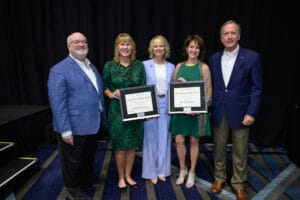
 Building Personal Connections