Strengthening the Fabric of American Society through Volunteering
By Michael D. Smith, AmeriCorps CEO
We are thrilled to welcome AmeriCorps CEO Michael D. Smith to the mainstage of our Points of Light Conference in Houston, Texas. He will join Carol Spahn, Director of the Peace Corps, as part of the Opening Plenary to discuss the power of national service. Join us from June 11-14 to connect with social impact leaders across various sectors. Our conference empowers nonprofit, government, business, and civic leaders to make bold community impacts, offering valuable resources and inspiration. Register today!
In the complex tapestry of American history, volunteering and service have undeniably been a strong thread holding the pieces together. Our collective tapestry has been painted with tumult and trial but also with compassion and collective action. Through wars, pandemics, and economic uncertainty, Americans always turned outward with a spirit of giving that has helped us overcome every challenge.
A Nation Built on Service
From barn raisings and volunteer fire brigades to freedom riders and refugee support teams, volunteering is embedded in American history and character. Today, volunteers show up by the millions to tutor and mentor our children in schools and community centers, to feed and clothe the hungry and houseless, to care for the sick in clinics, and to rebuild after devastating natural disasters.
These volunteers run toward challenge not only because of compassion or conviction but also because they find hope, encouragement, and even personal reward in giving.
Empowering Individuals and Communities
Volunteering offers dual benefits: it enriches the lives of those who give their time and serves as a catalyst for economic and health-related advantages. Volunteers are more likely to
, including increased longevity and higher life satisfaction. This relationship highlights the profound impact of volunteering, both on individual lives and on broader societal health. In essence, volunteering doesn’t just add years to life, but also life to years, showcasing that the act of giving is, in itself, a reward.
Additionally, we’ve seen that national service not only hones leadership skills but serves as a vital pathway to careers in public service. A significant
regard their service as a defining professional experience, one that has equipped them to navigate unexpected challenges in their future careers. Relative to the general workforce, AmeriCorps alumni are far more likely to pursue careers in the nonprofit, social services, or public sectors. Only
they plan to transition into the private sector after service.
The benefits of civic engagement extend far beyond the immediate impact of individual acts of service. Communities with high levels of social capital showcase remarkable outcomes: heightened academic achievement, active and engaged citizenry, accelerated economic growth, and reduced crime rates. These communities demonstrate a remarkable resilience, better equipped to navigate economic downturns, respond to disasters, and mobilize collective action to address local challenges.
Data we’ve collected with the 2021 Census through our
in America research revealed that while we saw a decline during the pandemic, more than 60 million Americans still formally volunteered with nonprofit organizations, contributing 4.1 billion hours of service. This generosity translates to almost $123 billion in economic value! Moreover, an astounding 124 million people lent a helping hand to their neighbors in informal ways in 2021, including doing favors like house-sitting, watching each other’s children, lending tools, and running errands. house-sitting, watching each other’s children, lending tools, and running errands.
Findings reveal that civic behaviors are linked in a complex web that encompasses joining organizations, advocating for political issues, engaging with neighbors, and staying informed. These modes of civic engagement are deeply interconnected, suggesting that actions taken in one area can have far-reaching impacts. This research underscores the powerful ripple effects that can emanate from even a single act of service, highlighting its potential to strengthen the very foundations of our democracy.
From Inspiration to Action
The journey from charity to justice is also central to the volunteering experience. It’s about turning interest into action, growing from spectator to advocate, and moving beyond wanting to help out to wanting to understand root causes and systemic solutions. And no matter who you are, where you live, or what you do, there is a way for you to take action today.
If you are a corporation, consider joining Employers of National Service and partnering with nonprofit organizations and state service commissions to provide matching dollars to increase benefits for national service members.
If you are a university, consider joining Schools of National Service to attract students with real-world service experience to your degree programs.
If you are running a volunteer center, a foodbank, or a shelter, AmeriCorps can be a force multiplier to help you reach more people. Consider applying for a grant through AmeriCorps VISTA to bring on additional staff capacity or the Volunteer Generation Fund to help recruit, retain, and manage volunteers.
Nonprofit organizations of any size can consider applying for a AmeriCorps State and National grant to make an even bigger impact on your mission.
The joy and fulfillment derived from helping others is at the core of American life. As we celebrate AmeriCorps’ 30th anniversary, we’re reminded of the
. This occasion not only prompts reflection on past achievements but also inspires a forward-looking vision of continued commitment to communal well-being and social impact.
The story of American volunteerism is one of individuals and communities coming together to strengthen and transform communities. It is a powerful force that fosters unity and builds character, creating a ripple effect that can transform our society for the better.
Affiliate dedicated to empowering individuals to create change through meaningful volunteering. HandsOn London believes everyone should have the opportunity to make a difference. Their model is based on connecting volunteers with impactful projects across London, focusing on flexibility and convenience. With a focus on corporate volunteering, individual volunteering and family volunteering, they offer options for anyone wanting to contribute. We spoke with Tanshi Bhatia at HandsOn London to learn more about what this organization is doing throughout the city and beyond.
Tell us about a project or initiative you’re working on that’s making a big impact on your community.
WrapUp London is one of the largest winter volunteering events in the city aiming to collect warm coats for those in need, including unhoused communities, refugees and families. The collection usually runs from November to the start of December at the Kings Cross, Liverpool Street, Moorgate, Waterloo and London Bridge tube stations. After 13 successful volunteering years in the U.K., the initiative has now become global.
Over three days, 2,861 coats were donated and 182 volunteers took part. In all, 16,420 coats were donated for WrapUp London and 1,115 individual and corporate volunteers gave more than 5,575 hours to the Wrap Up London Campaign.
“I want to say a huge thank you to everyone who came out and donated coats, shared their stories and supported this campaign. It’s great to see how many people want to help those in need. I’d like to extend a hearty thank you to our wonderful individual and corporate volunteers, who selflessly give their time to make this campaign what it is – outstanding. The smiles and energy brought a bit of joy to commuters, which is an achievement in itself! Thank you!!” — Cassandra Wales, project & volunteer coordinator, HandsOn London
Do you have an upcoming special event or milestone that your organization is celebrating? Tell us about it!
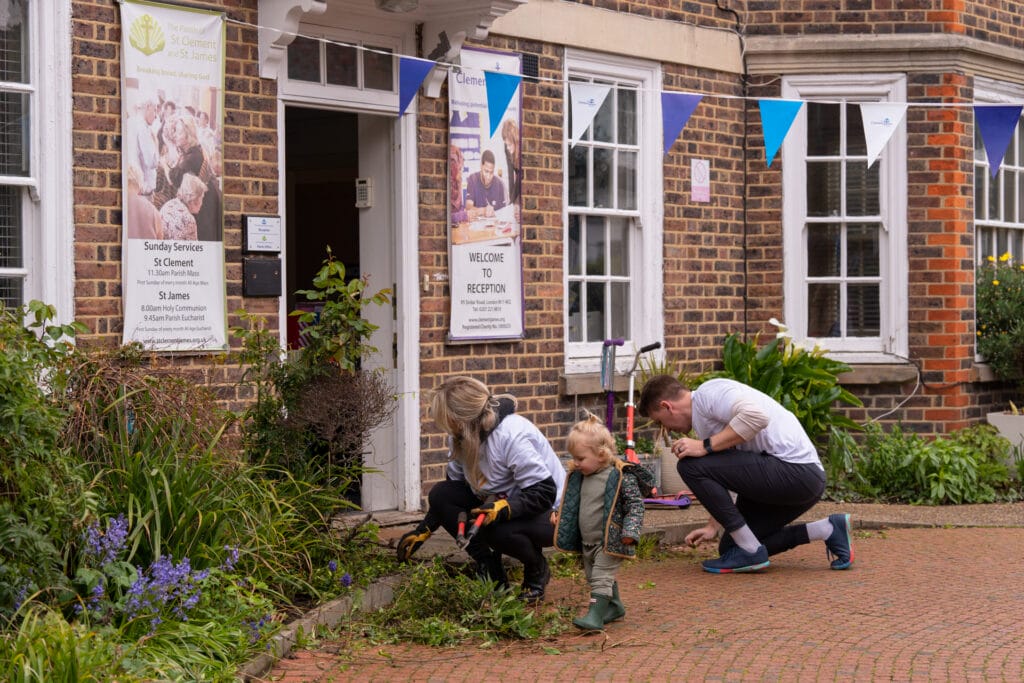
is celebrated in April across 110 countries and shines a yearly spotlight on community and government volunteering initiatives. Throughout the month we host corporate teams and smaller groups events in order to spread the word about volunteer stories and the positivity that volunteering generates. This past year volunteers joined us at St. James Clements Community Centre in North Kensington to renovate the garden of the social hub for an underserved neighborhood. With more than 30 volunteers of all ages and abilities committed to the project, we were able to prepare the outdoor space ready for therapy gardening and allowing the center to use its garden to offer more counseling services to their community. We are hoping to create an even bigger difference this year on April 14th, 2024 for Good Deeds Day.
Do small things with great love. A young volunteer helps their parent tidy up a plant pit. Photo and Caption Courtesy HandsOn London
Are you working with Points of Light Global Network affiliates on a community project? Share the details.
AbbVie’s week of possibilities is a week of corporate volunteering, from June 24th through June 28th. It’s based in the Windsor area, with volunteering projects focusing on green space developments and community care projects. Some of the events include volunteering at seniors’ day centers and doing activities like interacting with members of the center, cleaning, painting and gardening.
Giggle Bags is another project that we host in which the volunteers help create and decorate small goodie bags filled with toiletries and essentials for people in need. We also have some remote projects such as book making for positive ageing for seniors.
How are you recognizing and thanking volunteers for their contributions?
We are always thankful for all our volunteers and all the contributions and work they do to help bring a change in the community. We recognize our volunteers and their contributions through online shoutouts and thank you newsletters after family days.
In addition to volunteering, describe other elements of the Points of Light Civic Circle®️ that your work involves. How has the Civic Circle become central to your approach?
For the Social Entrepreneur, element, we partner with the needs of charities and volunteers with flexibility. Since we don’t receive government funding, we are able to respond to the needs of communities and charities. For the Listen and Learn element, we give high priority towards recognizing the needs of the people in our community and working towards bringing a change. We also focus on gaining feedback from our volunteers and trying to be better everyday.
What’s one piece of advice you’d give someone who’s looking to get more involved in their community through civic engagement?
Find what you are passionate about and start getting involved, even if it is on a small scale.
Impact Icons Spotlight: AmeriCorps VISTA Builds Capacity for Change
The Points of Light Impact Icons series celebrates organizations that are creating measurable change within their communities. This month we are shining a light on the
is dedicated to fostering vibrant collaborations between higher education institutions and the communities they serve. One way they achieve this is by hosting and supporting AmeriCorps VISTA members in the region. We spoke with Lucio Perez, AmeriCorps VISTA Program Director at PCCE, who shares his perspective on the program’s transformative power.
What makes your organization an Impact Icon?
For the past 30 years, we have led the charge to advance equitable, place-based community engagement, provided grant support for campuses and developed innovative professional development for members in the region. That ensured New York and Pennsylvania colleges and universities would graduate students who not only become future leaders in their chosen fields but also civically engaged leaders in their communities.
Further, throughout PCCE’s inception, we’ve fostered the AmeriCorps VISTA Program for over two decades as an area of civic engagement, collaborative impact and commitment to our communities. We believe that fostering sustainable change for people, organizations and the climate is at the core of what we do. We seek to deepen learning, enrich intellectual humility and catalyze civic innovation.
Tell us about a project or initiative you’re working on right now that’s making a big impact on your community.
Currently, PCCE is leveraging the AmeriCorps VISTA program to expand the resources and capacity of member campuses in addressing co-identified priorities and systemic barriers to poverty. AmeriCorps VISTA members are being placed among college campuses and nonprofit community organizations across the regions of New York and Pennsylvania. VISTAs will be instrumental in building the capacity within their community, while simultaneously addressing issues of poverty through the four AmeriCorps priority focus areas: Education, Environmental Stewardship, Healthy Futures, Economic Mobility and Opioid Epidemic.
As full-time members over 12 months (service term), PCCE VISTA’s service will take many forms: tutoring program development (both middle school and high school), college access and success, youth development, literacy, ESL, community-school partnerships, migrant and refugee resource development, mentoring initiatives, efforts to tackle the digital divide via campus/community development and civic engagement, cross-sector approach for employment workforce, strengthening county government to address re-entry, recovery, individual and community resilience of the opioid pandemic, nutritious food access and education, and access to health care initiatives.
For the 22-23 fiscal year, PCCE placed 20 full-time (365 days) VISTA members and 14 summer associate members (10-week long program) across host sites composed of higher education institutions and nonprofit organizations. In 2022-2023 the PCCE VISTA program reported 220 community organizations were made more efficient, effective and/or increased their program outreach.
In regard to resource development, the PCCE VISTA program generated $7,786,782 of cash resources and in-kind resources during the program term. In total, the PCCE VISTA program recruited and managed 1,146 of both on-and-off campus volunteers with a combined total of 18,178 service hours during the project period. Additionally, a reported average of 3,859 youth received services provided by our VISTA-supported partners in all focus areas; 40 veterans, active duty and family members received services in all focus areas; 50 individuals received services in substance abuse programming; and 95 youth and adults experiencing homelessness received services in all of our VISTA focus areas.
“I’ve been a [PCCE] VISTA supervisor for 15 years with over 8 VISTA programs at my institution. Before being a VISTA supervisor, I was a VISTA with the PA Campus Compact (now PCCE) in 2005-2007. This organization mirrors my philosophy of mentorship, partnership and action. It is one of the few professional organizations I can say has had a tremendous recognizable impact on the communities in which they work. It is powerful to see young professionals grow and thrive as a VISTA into amazing colleagues. It’s equally amazing to see the longevity of anti-poverty programs initiated through the campus community partnerships supported through the organization and college campuses.”
— Meghan Boone Valkenburg, PCCE Partner & AmeriCorps Alumni
Do you have an upcoming special event or milestone that your organization is celebrating? Tell us about it!
PCCE is pleased to announce the release of $15,000 for our Civic Imagination Grants, which are available to partners (nonprofits and higher ed institutions) for up to $3000 each. PCCE’s Civic Imagination Grant program is designed to support community-based organizations and higher ed institutions working together in New York & Pennsylvania whether by proximity or interest in similar topics to address common issues. These grants may focus on one of these types: Partnership and Co-Sponsorship. Funds are drawn from an internal grant and have been approved by PCCE’s Board.
The Civic Imagination Grants build on partners’ capacity to cultivate civic imagination, deepen civic and community engagement, and strengthen PCCE’s regional communities. This year, we are especially interested in supporting efforts that focus on racial healing, democratic engagement and climate justice/change. However, we will consider applications with robust ideas that may not directly focus on these three topics. For more information, please email Danelle Wagner at [email protected].
What role does volunteerism play in your organization’s overall mission and objectives?
PCCE has a strong partnership with AmeriCorps VISTA Program. Over two decades, we’ve mobilized VISTA members, as well as community volunteers and stakeholders to the center of sustainable programming and implementation of robust services that meet the needs of the community and tackle poverty-induced barriers at the same time.
How are you recognizing and thanking volunteers for their contributions?
PCCE is a proud organization that is certified each year to award the prestigious
to our volunteers and VISTAs for their ongoing dedication and impact on uplifting our partners and community resources. PCCE hosts an annual in-person retreat for our VISTAs to gather, reflect and celebrate their accomplishments together! PCCE host’s a celebratory dinner to recognize the VISTAs impact on their work/community and ensure to share these great stories with the Mid-Atlantic VISTA office.
In addition to volunteering, describe other elements of the Points of Light Civic Circle®️ that your work involves. How has the Civic Circle become central to your approach?
PCCE’s approach to ongoing collaboration, equity, leadership, service and transformation closely aligns with Civic Circle’s focus. Our foundation is crucial as we listen and learn from our partners and their respective communities to ensure we work together to tackle the root of the problem.
Additionally, these elements ensure that PCCE places priority on supporting our partner’s capacity to cultivate partner engagement which leads to the public good; professional and skill development opportunities; venues for disseminating exemplary practices in campus-community partnerships; and leveraging, advocating and educating at the national, state and local levels for issues related to civic and community engagement.
What’s one piece of advice you’d give someone who’s looking to get more involved in their community through civic engagement?
Don’t be afraid – and step out of your comfort zone! There are a plethora of resources, organizations and passionate people who are eager to point you in the right direction and hear your voice.
Ask a CSR Friend: 5 Ways to Increase Access through Volunteer Ambassadors
Looking for CSR advice?
Hear from our experts right here in our Ask a CSR Friend monthly column.
Whether you’re a novice or a seasoned pro, we know it takes a village to create vibrant workplaces where employees are equipped to contribute to the communities and causes they care about. So, when you need a trusted advisor to lean on, rely on Points of Light to be Your CSR Friend. Each month, our experts share their wisdom and wit to address a specific but often universal challenge related to your work as a corporate social impact practitioner.
Have questions about employee community engagement? Submit your question and it may be featured in a future blog post.
Dear CSR Friend,
Like most companies, we saw a significant decrease in participation in our employee volunteer program during the pandemic. Now that most employees are back in the office three days a week, we’re still not seeing interest and engagement close to our pre-pandemic levels. Our small but mighty team has tried hosting lunch and learns to build awareness for upcoming projects and offering company-branded swag to those who sign-up first but what are we missing?
Searching for Solutions in St. Louis
Dear Searching for Solutions,
Have I got an idea for you! But before I get to it, I encourage you to reframe your interest in increased participation. Sure, it feels great to hit higher participation goals year over year, but (as we like to ask ourselves at Points of Light), “To what end?” Too often corporate social impact leaders get weighed down by the endless pursuit of achieving lofty numbers without realizing that what they’re truly seeking is providing opportunities for every employee, regardless of their role or work setting, to make positive change happen. You’re likely not interested in tracking more volunteer hours from the same employees but, instead, widening your pool of participants.
Now back to the idea. Drumroll, please! Although it will take time, resources and relationship building to get started, I promise the value it will bring to your company, your coworkers and the impact it will make on communities is worth the effort. The idea is simple: introducing people-powered infrastructure to not only scale and manage volunteer activities but truly, to ensure that every employee can realize their potential for creating community impact.
This isn’t a new idea for the sector, but it is one we continuously advocate for. Many companies employ a champion or ambassador model to help them mobilize in markets outside of HQ and connect to local community issues, those that might have impacts on the business and those that employees are most affected by. While companies may call them by different names, local champions can drive an uptick in participation by leading and communicating social impact throughout your company’s footprint, reaching and advocating for those who often aren’t considered easily eligible. It’s a powerful, cost-effective way to develop leaders, strengthen relationships and, ultimately, ensure equitable access.
Let’s unpack the connections between setting up a volunteer ambassador network and accessibility. These local leaders can help social impact teams to:
Better understand and advocate for the functional areas or markets they represent. They’ll be able to tell you what barriers employees face for certain roles and work settings, along with the business priorities for their department or market, important timing and guard rails to keep in mind, which leads to less friction with business processes.
Foster a culture of inclusivity and support. Volunteer champions create an environment where all employees feel empowered to participate, create local connections, rally their colleagues, and offer new perspectives as the voice of employees.
Reinforce the company’s purpose, culture and commitments. Ensuring equitable access to social impact activities demonstrates corporate values and directly ties to fostering a sense of belonging and strengthens relationships across the enterprise. They can gain buy-in and more easily share information and success metrics with middle managers or local leaders who are often the only hurdle to inclusion.
Inspire colleagues to get involved. By sharing their own experiences and passion for volunteering, they raise awareness for the company’s social impact strategy. Because they’re situated in that market or function, they can more easily cascade information to their peers and be the “personal ask” that influences a potential volunteer.
Serve as relatable and approachable points of contact for their peers. They can offer guidance, address concerns, and provide valuable insights to ensure that volunteer opportunities cater to diverse needs and preferences within the workforce.
To help get you started on developing and implementing an ambassador network, check out our learning brief,
. It presents more benefits of implementing people-powered infrastructure along with considerations to think through before finalizing your strategy. You’ll also find a compilation of best practices gathered from leading companies who’ve seen great success with this people-powered model.
We’ve also gathered successful practices for incorporating accessibility into social impact programs for your coworkers in
.
Both briefs offer guidance, but it’s your leadership that holds the power to ignite more positive change by expanding accessibility to all your colleagues. The world, and your co-workers, will thank you for it.
Until next time,
Your
Top 10 Ways Volunteering Improves Your Mental and Emotional Health
May is Mental Health Month and offers an opportune time to reflect on your mental and emotional health and any ways they can be improved. Dedicating time to volunteering and becoming more involved in your community can have a profound impact, with
showing that civic engagement can be an excellent way to bolster your mental health. In this era of increasing digital isolation and societal stressors, finding meaningful connections and purposes in life is more crucial than ever.
Civic engagement and volunteering not only strengthen communities but also
, increase physical health and happiness, and fortify our mental and emotional resilience. Whether it’s through local community service, national initiatives or even global projects, acts of getting involved have a ripple effect that enhances individual mental health and fosters a more empathetic and connected society.
10 Ways Volunteering Improves Your Mental and Emotional Health
1. Sense of Purpose
Engaging in civic activities instills a sense of purpose, significantly impacting mental wellbeing.
that individuals with a strong sense of purpose have lower levels of stress and depression. Volunteering offers a path to finding that purpose, leading to enhanced mental health.
2. Social Connection
Volunteering fosters social connections, reducing isolation and promoting belonging.
that volunteering has been shown to reduce mortality rates and improve physical functioning. There is also evidence of increased physical activity, strength and self-rated health.
7. Skill Development
Volunteering is a platform for skill development and personal growth. It contributes to a sense of accomplishment and wellbeing – as outlined in
Engaging in civic activities broadens your social network, as both volunteers and community members being served all come from diverse backgrounds. The
emphasizes that civic engagement helps individuals better cope with life’s challenges and setbacks, bolstering mental fortitude.
For organizations and employers, supporting employee volunteering and civic engagement can be extremely beneficial. Companies that encourage volunteering report higher employee satisfaction and better workplace morale. This not only aids in the mental health of employees but also contributes to a more positive and productive work environment.
Volunteering and civic engagement go hand in hand. They’re not just good for the community; they improve your mental and emotional health, too. Whether it’s finding a sense of purpose, building social connections, reducing stress or developing resilience, these activities offer a multitude of benefits that can enhance your overall wellbeing. You can embrace these opportunities, not just during Mental Health Month but throughout the year, for a healthier, happier life.
If you’re looking for in-person or virtual volunteer opportunities, check out Points of Light Engage.
Uniting Forces for Social Impact: Why Business Leaders Should Attend the Points of Light Conference
Are you a corporate social impact leader looking to strengthen community strategies, elevate employee volunteering and ultimately increase the impact of your work? Then join us at the
, happening at the Marriott Marquis Houston from June 11–14, 2024. This conference isn’t your typical gathering of industry professionals—it’s a convergence of social impact leaders from all sectors, offering a unique experience that goes beyond traditional networking and learning opportunities.
At the Points of Light Conference, you’ll find more than just educational workshops and leadership discussions. You’ll discover a vibrant community dedicated to driving positive change through people-powered solutions. Here are three reasons this conference is a must-attend event for business leaders committed to social good:
Discover Community-Led Solutions: Our conference is all about learning to empower colleagues to support community-led initiatives that drive meaningful change. Find new ways to harness the power of your workforce to create a lasting impact in the communities you serve.
Learn how Citi aligned community needs with employee talents in “Community First: Building a Responsive Skills-Based Volunteer Program.”
Strengthen Nonprofit Relationships: Gain invaluable insight into building stronger alliances with nonprofits. Explore the nuances of collaboration and discover strategies for maximizing the effectiveness of your company’s corporate social responsibility initiatives.
Check out “Building Transformational Mentorship Programs: Women in the Workforce” to better understand the role of authenticity in co-creating programming.
Develop Impactful In-Person Connections: In an era dominated by virtual meetings, the Points of Light Conference offers a rare opportunity for focused connection with peers and partners face-to-face, away from the day-to-day elements of your role. Join us to forge new relationships and strengthen existing ones in a dynamic and collaborative environment.
Join us for three Civic Talks that offer all conference attendees deep learning and takeaways from innovative cross-sector leaders on the connections between education and equity, AI and civic engagement, and faith and belonging.
But what truly sets the Points of Light Conference apart is its inclusive and intentional approach to conference programming. By bringing together both peers and community partners, this conference offers a range of benefits:
Diverse Perspectives: Engage in discussions enriched by the diverse perspectives of community partners from across the world, leading to innovative solutions and a deeper understanding of social issues.
Networking Opportunities: Expand your professional network beyond your immediate circle and explore collaboration opportunities with stakeholders from different sectors, which can open doors to new partnerships, investment possibilities and resource-sharing.
Holistic Solutions: Strategize with peers and community partners to design comprehensive approaches that address complex problems and solve for the needs of all stakeholders involved.
Knowledge Exchange: Tap into the collective wisdom of all attendees to enhance your understanding and expertise. Your peers can share best practices, research findings, and professional experiences, while community partners can provide on-the-ground insights and real-world examples.
Enhanced Impact: By bridging the gap between sectors, conferences like Points of Light amplify the impact of your work, leading to more effective solutions and greater positive outcomes for communities.
The Points of Light Conference offers corporate social impact leaders a unique opportunity to connect, collaborate, and co-create solutions that drive meaningful social impact. Join us in Houston this June and be a part of a movement that’s shaping the future of corporate social responsibility.
(Önkéntes Központ Alapítvány), a Global Network Affiliate building a brighter future by connecting volunteers with meaningful opportunities in Hungary.
Volunteering Hungary understands that a thriving society is built on connection and cooperation. They believe in connecting volunteers, nonprofit organizations and businesses to foster collaboration, meet community needs and create lasting change.
We spoke with Borbála Hadrévy, a project manager at Volunteering Hungary, to learn more about how they work with their communities, especially seniors, and recognize their volunteers.
Tell us about a project or initiative you’re working on that’s making a big impact on your community.
Our Friends of the Elderly program aims to help those living alone in society. Our volunteers visit seniors as friends — chatting, walking, playing games, listening to their stories or even shopping together. Volunteers are often their only link to the outside world. We also organize outside activities for seniors, to get them out of their home, at least for a little while. Every year we organize a Christmas lunch featuring performers, but they have also taken part in Women’s Day greetings, kids’ gymnastics, a ballet and folkdance show, a petting zoo program, an Easter party and a sightseeing cruise.
We supported 60 seniors in Budapest, with 139 new applying volunteers, 50 active visiting volunteers, three training events for volunteers and four fun programs in 2023.
“I always look at the faces of the elderly. It is wonderful how the loneliness disappears, and we can see their true faces.” — Gréti Kázmér (leader of Friends of the Elderly program, Volunteering Hungary)
Do you have an upcoming special event or milestone that your organization is celebrating? Tell us about it!
We had our Friends of the Elderly carnival in February 2024, which saw 50 seniors, volunteers and 50 children from different kindergartens. The carnival includes crafts with children, a costume show and children’s show for seniors, eating special carnival delicacies together.
Are you working with Points of Light Global Network affiliates on a community project? Share the details.
: A Pathway To Employment. For this initiative, we work with unemployed young people as well as people over 45 to make them aware of their skills and improve their employability in sectors of the future, through an innovative and unique pathway.
We also work with the Regionalne Centrum Wolontariatu in Poland on the EST Erasmus+ project: European Seniors Together. The project aims to develop a precise method for senior experts to mentor young people who need help in their professional or personal lives.
In the past we’ve worked with Pro Vobis in Romania and TimeHeroes in Bulgaria as well.
How are you recognizing and thanking volunteers for their contributions?
Each year, we give Volunteering Awards in four categories. This ceremony is held to thank them for their outstanding work. We celebrated more than 100 senior volunteers on their volunteer club’s 10th birthday in 2023. Every Christmas we give presents to our volunteers who are active in any of our programs. We are continuously working on finding and providing them with more and more volunteering opportunities.
In addition to volunteering, describe other elements of the Points of Light Civic Circle® that your work involves. How has the Civic Circle become central to your approach?
For the “Vote” element, in 2024 Volunteering Hungary participated in the VVV campaign (Vote Volunteer Vision). The aim is to call the attention of volunteer-involving organizations to discover and develop the European Parliament candidates’ opinions on volunteering for the 2024 European Parliament Election. We also share the idea in secondary schools for those over 18.
We’ve used “Listen & Learn” for trainings in volunteer management, pro bono projects, EST (Europen Seniors Together) European project for mentoring young people by senior experts.
For “Work” we have our “APTE” (A Pathway To Employment) European project for job seekers. For “Donate,” we collect and distribute our corporate partners’ donations. And for “Social Entrepreneur,” we support institutions (shelters, temporary homes for families, children’s homes, schools, etc.) with corporate volunteer programs, mentoring programs for young people in need and sensitization programs between NGOs and corporate sector.
What’s one piece of advice you’d give someone who’s looking to get more involved in their community through civic engagement?
Try to find a volunteer activity in which you feel comfortable and fulfilled in every way.
How United Way of Ventura County Fosters Healthy Smiles
is a time to recognize the power of individuals working together to make a positive difference in their communities. This month, Points of Light is highlighting United Way of Ventura County, a Points of Light Global Network Affiliate dedicated to improving lives by focusing on education, financial stability and health.
Tooth decay, despite being largely preventable, remains the most common chronic childhood disease.
understands its detrimental impact on nutrition, development and school attendance. That’s why they’ve launched the Building Healthy Smiles program. We spoke with Aissa Fernandez, manager of Community Impact Programs at United Way of Ventura County, to find out more about the program and its impact.
Tell us about a project or initiative you’re working on that’s making a big impact on your community.
United Way of Ventura County’s Building Healthy Smiles program seeks to tackle the issue of tooth decay by focusing on education and prevention. Despite being preventable, tooth decay is the number one chronic disease affecting children. It can contribute to a wide range of problems including poor nutrition, sub-normal growth and unnecessary pain. Dental pain because of tooth decay can also impact school absenteeism and lead to a significant loss in attendance-based school funding.
Our strategy is a school-liked prevention approach where we, in collaboration with our oral health care partners who volunteer their time, conduct on-site oral health education, screening and fluoride varnish application events. We specifically target schools where 50% or more of the student population is eligible for the Free or Reduced-Price Meal program. For children who we identify with dental decay during the screening process, we work with our dental partners, the school nurse and the child’s family to connect the child to dental care and treatment.
Establishing a dental home for students without one remains our top priority. The assessment events we provide focus on kindergarten and 3rd grade students. Kindergarteners who have not completed the state mandated oral health assessment are a part of our target population. We also screen 3rd grade students to follow California’s Oral Health Plan which sets targets for tooth decay, untreated decay and sealant prevalence in 3rd grade children. In fiscal year 2022-2023, Building Healthy Smiles screened over 1,000 students and provided over 600 students with an application of fluoride varnish.
“In Ventura County, we have over 100,000 children who do not have access to a dental home. We’ve partnered strategically with Clinicas and others to provide school-based programs that provide children with an education component of proper dental hygiene and preventative treatment, with the ultimate goal of providing a dental home for those 100,000 children.” — Mitchel Sloan, president & CEO, United Way of Ventura County
Do you have an upcoming special event or milestone that your organization is celebrating? Tell us about it!
In honor of National Children’s Dental Health Month, throughout the month of February, Building Healthy Smiles conducted school screenings at local elementary schools.
What’s one piece of advice you’d give someone who’s looking to get more involved in their community through civic engagement?
Any act of service, no matter how small, can make a difference. Do what you can, with what you’ve got, wherever you are.
affiliate that connects businesses and community organizations throughout the Netherlands to build stronger communities.
Samen voor Eindhoven believes that magical things happen when businesses and community organizations work together for a common cause. The organization’s goal is to foster a world where everyone has the opportunity to participate, and they believe that connecting businesses and community organizations helps achieve that. We spoke with Marbritta van Boldrik, content manager at Samen voor Eindhoven, to get her perspective.
“The most important thing in life is the connections you make with others,” says Paul Ypinga, CEO of Samen voor Eindhoven.
Tell us about a project or initiative you’re working on that’s making a big impact on your community.
Courtesy Samen voor Eindhoven
We organize (almost every day) impact day for corporate volunteers and local NGO’s. For example, our popular street tour, where formerly unhoused individuals walk with corporate people through our city and tell them about how they survived their period of homelessness. They also show them their personal spots. After every impact day, we send a survey with questions to measure and learn.
How are you recognizing and thanking volunteers for their contributions?
We thank them during the (personal) briefing or de-briefing. Sometimes we call the volunteer leader or give them a thank you postcard.
In addition to volunteering, what other initiatives inform your approach?
Courtesy Samen voor Eindhoven
Corporate volunteering is big. Daily, we connect people from Brainport companies with local NGO’s and their target groups (like people living with illness or underserved individuals). We like to burst bubbles so two groups can learn from each other!
What’s one piece of advice you’d give someone who’s looking to get more involved in their community through civic engagement?
Keep an open mind and open heart and try to listen to each other. And remember: doing good makes you happy.
Where Justice Meets Service: The Volunteer Spirit of Thurgood Marshall
in April and prepare for National Volunteer Week (April 21-27, 2024), the legacy of Thurgood Marshall reminds us of the profound impact volunteerism can have on our world. Marshall wasn’t just the first Black Supreme Court Justice. He was a tireless advocate for civil rights, dedicating his life to volunteering in the pursuit of justice and equality.
The Making of a Volunteer
Thurgood Marshall’s commitment to serving others took root early. While many of us may know him for his landmark Supreme Court wins, his journey began decades prior. As a young lawyer and recent graduate of Howard University, Marshall returned to his hometown of Baltimore to build a private practice, offering his time and expertise to fight for those marginalized by systemic oppression.
His passion soon led him to the NAACP Legal Defense and Educational Fund. As its chief counsel, Marshall developed a meticulously crafted “volunteer” legal strategy that culminated in the historic win in Brown v. Board of Education of Topeka (1954), paving the way for the desegregation of public schools nationwide.
Volunteering is a Pathway to Change
Marshall’s story is a timeless reminder that volunteering is much more than just getting involved in your community. It’s about acting as a catalyst for change. Whether we volunteer with local organizations or support broader causes close to our hearts, the simple act of donating our time and abilities makes an enormous difference.
Thurgood Marshall’s influence also reminds us that volunteering is not limited to a single act; it’s a mindset. As a tireless fighter for equality, Marshall argued a remarkable 32 cases before the Supreme Court, winning 29 – an unparalleled track record that highlights the impact a single dedicated “volunteer” can have on the world.
Step Up and Serve
This Global Volunteer Month and National Volunteer Week, let’s honor Thurgood Marshall’s legacy by finding ways to get involved. The needs are great, but so are the opportunities:
Volunteer in your community: Mentor a student, help at a local food bank or support a cause that aligns with your passions.
Volunteer globally (even from home): Remote and virtual volunteer opportunities open up a world of options to make positive changes. Search Points of Light Engage to find opportunities!
Volunteer your voice: Advocate for causes you believe in, write to representatives and use your voice to make change.
As Thurgood Marshall so eloquently said, “Where you see wrong or inequality or injustice, speak out, because this is your country. This is your democracy. Make it. Protect it.” Our volunteer efforts are a way to make and protect the world we want to live in. Let’s use this Global Volunteer Month and National Volunteer Week as a chance to rededicate ourselves to the ideals Thurgood Marshall championed and pave the path to a better future for all.