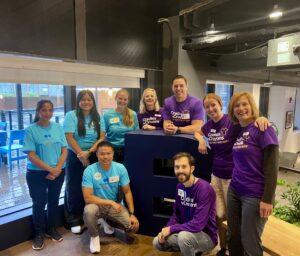
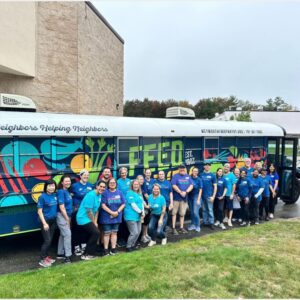
, impact is built on a 15-year promise to “show up, give back and repeat.” This mindset is exactly what has defined their signature Service Day initiative for the last 15 years.
What started in 2011 as an employee-driven effort to translate a corporate mission into hands-on impact has blossomed into one of the nation’s most recognized corporate volunteer programs. Today, Blue Cross doesn’t just participate in community service; they set the standard for what a high-impact employee volunteering program looks like.
Engagement By the Numbers
82% Volunteer Rate: While the national corporate average hovers around 20%, Blue Cross consistently sees more than four times that engagement.
$12 Million Invested: Since its inception, the program has driven massive community investment through direct labor and financial contributions.
45,000 Acts of Service: From packing kits to virtual consulting, the scale of impact is immense and the cause areas diverse.
This is a culture that prioritizes frontline employee engagement and has seen results in action. Through the BlueCrew Leadership Council, more than100 colleagues participate in year-round civic leadership development, ensuring that when Service Day arrives, the projects are led by passionate, trained internal stakeholders.
Trust-Based Philanthropy in Action
At the heart of Blue Cross’s strategy is a commitment to trust-based philanthropy. This means moving away from traditional charity and toward long-term, mutually beneficial partnerships where nonprofit voices lead the way. For example, their 15-year partnership with
has resulted in over 135,000 essential kits for children.
“Through critical funding and volunteer support, Blue Cross fuels our mission to ensure that children in our community have the basic essentials they need to thrive at home and in school—including warm winter coats and backpacks.”
— Alicia Kabir, executive director of Cradles to Crayons Massachusetts
, Blue Cross ensures its efforts contribute to truly sustainable communities. Rather than imposing a pre-set agenda, this approach allows nonprofits to define their own metrics for success, ensuring that volunteer hours and resources are directed toward the most urgent local needs, like food insecurity or youth mentorship.
Innovation and Inclusivity
As the landscape of volunteering has changed, Blue Cross has changed with it. To ensure every employee can “show up,” they’ve pioneered a hybrid volunteering model. Whether it’s community-based work, in-office building projects or virtual, skills-based volunteering, the program is designed to be inclusive of geography, mobility and schedule.
As Blue Cross celebrates its 15th anniversary of Service Day, the theme remains: Show Up. Give Back. Repeat. The future holds even deeper integration of digital service and an expanded geographic reach, maintaining their status as a national leader in the healthcare sector and a perennial honoree on
Success stories like Blue Cross Blue Shield of Massachusetts don’t happen in a vacuum. They’re fueled by a network of peers and resources that help CSR leaders navigate the complexities of modern social impact.
If your company is looking to build a program with this kind of longevity and impact, consider the
l, which provides the tools, research and peer-to-peer connections necessary to turn something like a single day of service into a year-round engine for change.
15 Insights for a Changing CSR Landscape
In an ever-evolving landscape, social impact work is being shaped by economic pressures, shifting policies and customer expectations. And change is coming at a more rapid pace than ever before.
On March 5 and 6, 2025, Points of Light convened its
in Chicago for the annual Winter Summit, “Purpose & Progress: Leading the Next Era of Corporate Social Impact.” Hosted by the chair of the Council, Anita Whitehead, president and chair, KPMG U.S. Foundation, the Winter Summit brought together top corporate social impact leaders from across the nation for thought-provoking discussions, facilitated networking, and practical learning and insights into the latest trends shaping the sector. The event also celebrated Points of Light’s 35th anniversary and 20 years of collective impact with its Corporate Service Council, and explored how companies will chart the path forward to advance corporate social impact and employee volunteering.
“This year’s Winter Summit underscored the crucial role that corporate social impact plays in developing meaningful programs that provide opportunities for employees to volunteer with purpose. As we gathered together, leaders from diverse industries, regions and positions united around our common goal of engaging employees and companies in building stronger, more connected communities, while taking moments to learn from our past and grow towards our future.”
— Lacey Gaitan, Senior Vice President, Corporate Programs
15 KEY INSIGHTS FROM THE 2025 WINTER SUMMIT
Impactful and Authentic Storytelling Matters
Reframe the Hero Narrative: Ethical impact storytelling prioritizes shared agency, human connection and empowerment over traditional “savior” narratives. Asset-framing helps center stories on an individual or community’s strengths and aspirations, rather than on their hardships.
Find Power in Human Stories: Transformative stories don’t require dramatic narratives or elaborate impact reports. Personal moments of change and discovery from employees, volunteers and partners build trust and inspire action.
Trust is Harder to Earn: Consumers and employees demand responsible corporate action but remain skeptical of intent. Efforts must be consistent, strategic, genuine and deeply integrated into business priorities.
Authenticity Builds Credibility: Long-term strategy, “skin in the game” investments, leveraging business strengths and third-party endorsements build CSR credibility. Employees and nonprofits are the most trusted voices when communicating CSR, while a company’s own advertising and social media are the least.
Employees Want Meaningful Messaging and Experiences
Customize CSR for Generations: A one-size-fits-all approach to communicating and engaging diverse workforces won’t work. Tailor messaging and feedback channels to different age groups to ensure CSR initiatives remain relevant and impactful.
Beyond Participation to Purpose: Effective employee volunteer programs move beyond events focused on participation to create purposeful volunteer experiences that empower and inspire employees. Companies must design inclusive programs that remove barriers and create access for harder to reach employees to meet them where they are.
Volunteering Needs a Rebrand: Companies present a unique opportunity to shift the perception of volunteering from something that is “nice” to “necessary” and increase volunteering at scale. Younger voices, especially Gen Z, are key to shaping the future of volunteering.
Growing Volunteer Programs Centered on Community
Scale Through Networks: Activating employee groups and ambassadors along with nonprofits with their own networks enables companies to drive impact at scale while still aligned with a focused strategy.
Prove the Value of Volunteering: Companies need stronger data to demonstrate the impact of volunteering on business outcomes, nonprofit organizations and employee volunteers. Proving this value will lead to more effective practices and greater investment in volunteering capacity.
Rethink Impact Measurement: Companies often measure CSR by dollars and hours, while communities focus on systemic change. Aligning on long-term goals and outcome measurements is crucial and requires honest conversations between the company and nonprofit.
Don’t Overlook Social Capital: While less trackable, companies have significant networks, relationships and influence that can be used to support and accelerate community-led initiatives and nonprofit organizations.
Invest in Community-Led Partnerships: Long-term, authentic partnerships with nonprofits help ensure CSR programs address real needs and community-led solutions, rather than imposing company-driven initiatives. It is critical that companies invest time, effort and resources to truly understand the communities where they live, work and serve.
Volunteering Strengthens Your Work
Diverse & Connected Workplaces Thrive: Companies represent diverse communities and have a unique opportunity to foster relationships across religious and cultural differences through volunteering and engagement programs.
Loneliness & Disconnection Costs Money: Social isolation is a widespread issue that negatively impacts mental health, economic stability and community well-being. Isolated employees have lower commitment, higher turnover and increased absenteeism.
Workplace Volunteering is a Solution: Volunteering facilitates social connections, builds empathy and fosters a sense of belonging and purpose. These benefits help employees in the workplace and as more civically engaged members of their community.
The Points of Light Corporate Service Council is a vibrant community dedicated to empowering and equipping corporate social impact leaders and their teams. Through an annual membership, CSR and corporate social impact leaders and their teams gain access to actionable resources, insights, training and connections needed to advance their social impact goals and be recognized for their success.
To learn more about becoming a member of the Corporate Service Council,
Voting is a vital part of actively participating in a democracy. Organizations – whether they’re nonprofit or for-profit – have a civic responsibility to encourage employees to vote, from making their own voices heard to volunteering to ensuring others have the same opportunity.
A responsible, engaged company will use its power and influence, from a nonpartisan standpoint, to encourage voter engagement, equipping their workforce with the tools and resources they need to get involved.
As the world braces for a year packed with national elections in over 60 countries, it’s crucial for businesses to take a stand in supporting voter participation and civic engagement. Here’s how your organization can make a real impact:
1. Foster a culture of civic responsibility
Encourage your employees to confirm they’re registered to vote. Whether through a company-wide email, a dedicated section in your internal newsletter, or a quick reminder in team meetings, ensuring your team is registered is the first step. Utilize resources like
in international markets to simplify the process. You can also draft a sample email to encourage employees to vote and keep it in your files to use in future election seasons.
“Encouraging your employees to be civically engaged is not just about volunteering. Making the space and creating workplace policies that equip all employees to vote is critical – they expect it, and communities depend on it. Voting is a major way we all take action for change.”
— Katie Stearns, chief program and impact officer, Points of Light
2. Provide paid time off to vote or volunteer
Voting is a fundamental right, but the demands of work can sometimes make it difficult. Offering paid time off to vote is a powerful way to remove this barrier. Review your benefits package to confirm that you offer paid time off for voting – or take it a step further by encouraging your employees to serve as poll workers, an essential role that can be supported through organizations like
offer comprehensive guides and toolkits that can be shared across your organization. Make sure these materials are readily available and accessible, whether through your company’s intranet or as part of a digital resource hub. And if you haven’t yet read our
, we encourage you to check it out. It’s packed with information about the voting process, tips to activate around voting and interviews with political leaders.
4. Host voter education sessions
Educating your staff on electoral issues and candidates is key to informed voting. Partner with nonpartisan coalitions like
to access valuable resources and educate leadership teams to organize and lead lunch-and-learn sessions or webinars where employees can ask questions and discuss the issues at stake.
By incorporating these strategies, your business can not only support voter engagement but also lead by example in fostering a culture of civic responsibility. The impact of your efforts will resonate far beyond Election Day, contributing to a stronger, more engaged community.
Working with Points of Light can take your employee community engagement to the next level. The Points of Light
is an annual membership program that empowers and equips CSR and corporate social impact leaders and their teams with actionable resources, insights, training and connections needed to advance their social impact goals and be recognized for their success.
Our mission is to support partners with comprehensive, end-to-end management of volunteer experiences and events that are not only well-executed but also deeply rooted in the community and focused on creating a lasting impact. To learn more about how we can support your work, please
(CSC) gathered in Chicago last month before the official kickoff of the Points of Light Conference. The conversations were lively with folx reconnecting with peers and making new connections.
Although we stay connected via virtual meetings year-round, some of the best learning and inspiration comes from our in-person events. When we gather,
always flow from our guest speakers and peer conversations. I was scribbling fast notes to keep up with the great thoughts shared by our dynamic speakers, many of whom – like me – are Chicagoans and all of whom are doing good in the world, whether that is through academia, social entrepreneurship, filmmaking, storytelling or business.
More than 100 of us packed the room to hear from Dr. Nicholas Pearce, clinical professor of management and organizations at Northwestern University Kellogg School of Management and founder and CEO of
; and a panel moderated by Marianna Ruiz, executive vice president and executive creative director at Edelman, featuring Brenda Robinson, head of film finance and inclusion strategies at HiddenLight Productions, Diane Quon, producer at Quonco Productions, Mark Mitten, founding and managing partner of Mitten Media, and Nate Clark, global director of corporate social responsibility at John Deere and president of the John Deere Foundation.
Here are just a few of the top takeaways from our time together:
Pursue Purpose as a Pathway
Staying connected to your purpose, particularly as a CSR professional, is a daily pursuit. We must “connect soul to role,” said Dr. Pearce, and really do the work we are built for as individuals. And even when you have connected soul to role, rest is essential. It’s not a reward we earn after working until exhaustion; we have to work from and out of rest, not for it. On the days when your work feels like an uphill climb, when a program isn’t having the impact you hoped or the business integration you know matters isn’t materializing, that’s when you most need to reconnect to purpose.
Learn and Lead Locally
Real and sustainable change happens at the hyperlocal level, but only if we start by listening and learning from the community. As CSR and employee volunteer programs go to scale or become global, the voices of the local nonprofits and neighborhood leaders can get lost, leading to systemic inequities going unaddressed. Jahmal Cole shared some powerful reminders about why the grassroots connection is key and encouraged all of us to conduct community asset maps before seeking to partner or program in a geography.
Stories on the Screen = Social Impact
Films can make us think or act differently, and that’s especially true for documentary projects that introduce us to new places, people, and realities. As panelist Brenda Robinson said, “The first thing we [filmmakers] look at is how to you change minds and hearts with art.” CSC member John Deere is one company that has leveraged filmmaking for social impact (learn about America’s volunteer fire service in
), but even if your company never makes a documentary, there are some transferable storytelling lessons all of us can learn from. One that’s stuck with me: storytelling is about listening and learning, and that’s the foundation for high-impact social action, and it can come in many forms, like your internal corporate newsletter, a panel conversation, a first-person share from a colleague or nonprofit partner, or even a social media post.
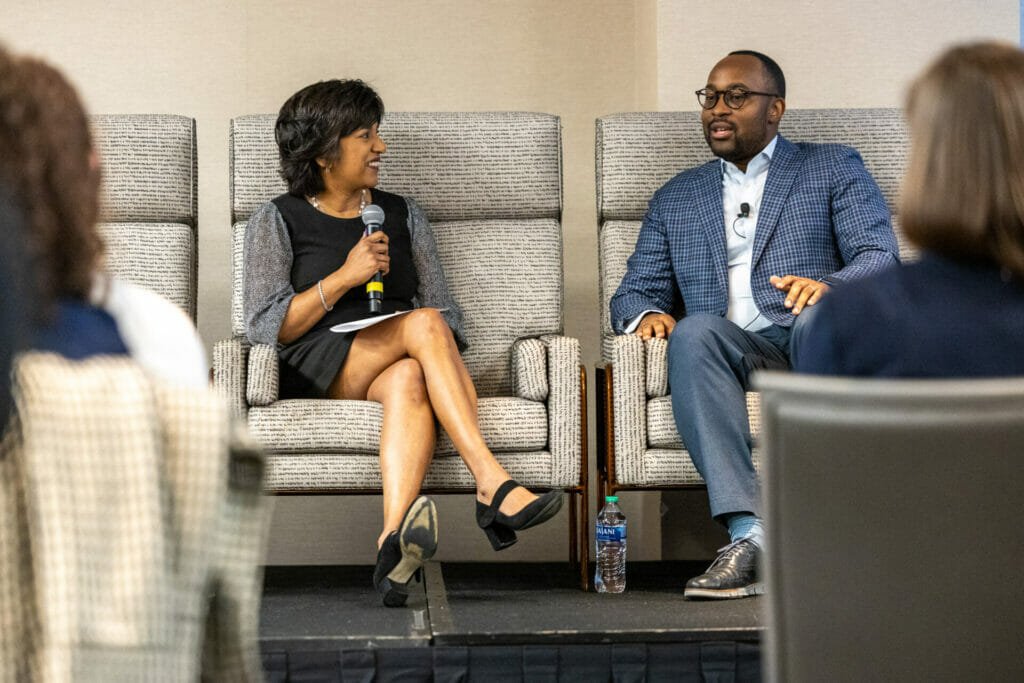
New Corporate Service Council Chair, Anita Whitehead, president and chair of the KPMG US Foundation in conversation with Dr. Nicholas Pearce, clinical professor of management and organizations at Northwestern University Kellogg School of Management and founder and CEO of The Vocati Group.
In our time together, we also announced our next Corporate Service Council chair: Anita Whitehead, president and chair of the KPMG US Foundation. Since the CSC started in 2005, our chair companies have played a critical role in leading the council and ensuring that we continue bringing together top brands, purpose-driven leaders and subject matter experts.
I’m looking forward to gathering with all the forward-thinking and purpose-driven CSC members at our next events to keep the conversation going. And if you want to be in the room where all this inspiration and learning happens,
Bridging Divides: The Role of Business and Civic Engagement in Addressing Polarization
In a world characterized by increasing polarization, businesses and business leaders find themselves at the center of a brewing storm. Action might come with backlash and silence could signal complicity. What can corporate citizenship practitioners do to mitigate the negative effects of polarization inside and outside their company and help others find common ground? The Business Summit at the 2023 Points of Light Conference explored this theme and the crosswinds that corporate citizenship leaders are navigating daily.
68% of Business Summit attendees believe that polarization has impacted their workplace.
Points of Light’s Chief Global Corporate Solutions Officer Katie Stearns kicked off the session with a focus on the business case for engagement. Although the question of whether companies should voice opinions on societal issues remains contentious, research indicates that, around the world, stakeholders expect them to take a stand. Depending on the issue, roughly 70 to 90% of respondents in the
said they “expect CEOs to take a public stand on issues” such as climate change, discrimination, and the wealth gap. The same goes for smaller businesses. Points of Light’s recent
reports that the general public has high expectations of how small businesses get involved in social issues. For instance, half the public and two-thirds of small business owners ranked speaking out as “pretty important or essential.”
A
report highlights that 88% of CSR leaders believe companies should be courageous and take a stand, even if it means alienating some people. With this much buy-in, it becomes a business imperative to determine a course of action and who better than social impact professionals to champion this work? Stearns doubled down on this point by highlighting the power corporate citizenship leaders have to positively shape the discourse and dealings inside their company, which ultimately trickle out into society.
“You have influence. Not just at the table with senior leaders when they’re deciding how to engage on an issue publicly, but also internally as interpreters and agents of your company’s core values, civic engagement strategies, and culture of service,” said Points of Light’s Chief Global Corporate Solutions Officer katie stearns.
CSR leaders can navigate economic and social pressures successfully by being prepared and joining the bridging movement as a safe space to invest in democracy and civility. Bruce Bond, co-founder and CEO of a bridging organization called
, shared that, although media might emphasize our polarity, many studies reveal that Americans are closely aligned on major social issues. He also introduced their
as one of the models that companies can use to empower employees to have respectful conversations in the workplace and emphasized one of its most appreciated tenets to take winning off the table.
Then, Bruce welcomed three business leaders to the stage to share how their companies are navigating polarization in the workplace. The panel included Pamela Everhart, senior vice president, regional public affairs and community relations at Fidelity Investments; Nick Nottoli, director, reputation management and insights at Allstate; and Clarita Santos, executive director of corporate and civic partnerships at Health Care Service Corporation (HCSC).
The panelists agreed that the pervasive challenge of polarization requires companies to implement strategies that create civility and build empathy within organizations. Consistency in both corporate action and application of values is vital for gaining and maintaining stakeholders’ trust.
Here are some approaches that the panelists shared:
Authenticity is Essential: Senior leaders must recognize the importance of engagement and move beyond the sidelines. Demonstrating authentic reasons for taking a stand can help companies gather allies and build collective courage. Case in point, Nottoli described the societal engagement framework that provides Allstate leaders with a decision-making tree on whether the company takes on an issue. Criteria for taking a stand include: an issue that aligns with company values, impacts stakeholders, is relevant to Allstate’s business, and on which the company can meaningfully affect change.
Proximity Matters: Contact theory suggests that simply being around others can promote tolerance, acceptance and allyship. Activities such as volunteering together, offering listening and learning sessions, providing nonpartisan voter education, and creating space for open dialogue can help employees connect beyond political differences while also developing a deeper understanding of their community and the issues affecting it. To build civility, each panelist emphasized the importance of putting relationships ahead of any task. In fact, Santos mentioned that the CEO of HCSC is often quoted as saying, “it’s okay to disagree but not be disagreeable.” Social connection built through supportive and inclusive relationships strengthens an individual’s wellbeing and also the resiliency of communities.
“If my corporate social responsibility team is thinking alike on an issue, then we’re not thinking,” said Pam Everhart, senior vice president, regional public affairs and community relations at Fidelity Investments
Culture is Key: Since most of us spend half our waking lives at work, mutual respect built inside workplaces can have positive consequences for society. Employees are more likely to stay and thrive in an environment where they feel respected, heard, valued, and connected to a larger purpose. That culture should also be inquisitive and ready to explore an issue from all sides as no one person shares the same lived experience. Everhart encouraged the audience to question their own echo chambers and build “challenge networks.“ She said, “If my corporate social responsibility team is thinking alike on an issue, then we’re not thinking.” Truly, workplaces need to embrace having better arguments to enable the discovery of better solutions. As ambassadors of organizational values, every CSR practitioner has the power to influence and champion an inclusive culture.
To conclude the Business Summit, Founder and Managing Partner of
and Co-Founder of NYCNext Maryam Banikarim took the stage to share a story of a recent project she dubbed, The Longest Table. Put simply, during the COVID-19 lockdowns in 2020, she and her New York City neighbors hosted an outdoor meal where more than 500 community members came together – even those who might not normally break bread together. This simple act of community building is now being replicated around the world. She ended her keynote with two significant learnings from the project that resonated with attendees: it takes just a few to build a movement and that there is no better time for “we, not me.”
In today’s polarized world, businesses have a significant role to play in helping society find common ground. Although challenges persist, there are strategies that can promote empathy and mitigate the negative impacts of polarization. By embracing these strategies, companies can foster a sense of purpose, enhance employee wellbeing, and contribute to a more cohesive and inclusive society. As CSR leaders can demonstrate, community engagement breeds belonging and service truly unites.
includes developing a strategy that reaches your entire organization, engaging employees in volunteerism, tracking hours, developing a volunteer time off policy, reporting on outcomes and impact, and creating connections to employees and community. And the benefits of CSR that stem from these efforts are good for your company, your employees and your community.
Companies are constantly striving for ways to set themselves apart and employees are consistently looking for ways to
choose socially-conscious companies over profit-focused brands? When these two ideas come together, along with finding innovative ways recruit new talent and retain employees, you have the perfect rationale for launching a CSR at your company.
When making the case for the importance of starting a formal CSR program, here are a few ways it can add value. Share this reasoning and data points in your presentation to senior leadership about the positive outcomes of doing well by doing good.
1. CSR Programs Save Money and Grow Employee Engagement
Creating a thoughtful and structured CSR program can actually offer cost savings. Companies can improve revenue by more than $2 million and reduce costs by almost $400,000 for every 1,000 employees because happy staffers are more productive staffers.
Plus, when companies drive social impact, they see an increase in the number of
. Sixty percent of employees reported improved engagement among peers after companies implemented an enterprise-wide social impact strategy. And employees who participate in employer-sponsored volunteering are
have 24% less staff turnover, 17% higher productivity rates and 21% higher profitability. Obviously, companies have a fiscal responsibility to operate in the black, but there’s more to that practice than meets the eye. Employees want to see that companies are having a
. Building a team solely focused on social impact through a formalized CSR program creates an environment that supports employee engagement, which is good for the bottom line. Plus, companies that take a stand on social issues retain employees when they drive social impact.
“Know your company’s philanthropic priorities, the causes around which you hope to make the biggest impact, and the types of resources — human, financial, product, expertise, networks, visibility — you can bring to the table.” — Katie Stearns, Chief Global Corporate Solutions Officer
3. CSR Programs Drive Recruitment
Having a clear and demonstrated impact sets you up to attract top talent. A company’s social impact track record can not only influence a candidate’s decision to choose to work there, it can also influence future candidates’ perception of that company.
if a company doesn’t have strong corporate social responsibility values.
“Gen Z and millennial workers are looking for more than just a paycheck – they want to work for an employer that provides ways for them to use their voice and strengthen communities.” — Katy Elder, Vice President, Business Innovation
4. CSR Programs Create Favorable Brand Awareness
It’s common to see a company doing positive things in their community on social media. These posts typically highlight the work done through a CSR program. Setting your company apart with a well-organized CSR program can offer positive brand awareness your company will benefit from. Take
and their work to inspire and prepare high school students for careers in tech and engineering. Seeing employees volunteering within their community demonstrates a more organic way of promoting your company versus paying for ad space on social.
Consider using these points as you think about how best to reach your senior leadership audience and speak to what’s important to them. If you are approaching the Human Resource Vice President, for example, do your research on specific ways the CSR program can influence and even reduce costs for recruitment and retention. If you are speaking to the Chief of External Affairs, consider explaining all the built-in story opportunities their team will have with the addition of employees giving back—anywhere from organic campaigns, to the increase use of employee-generated content, to plentiful heartfelt stories to use for the annual report. If you’re speaking to the Chief Financial Officer, it’s great to connect the performance metrics of engaged employees to the bottom line. It’s a wise investment. No matter your audience, the benefits of CSR are clear: they save money, grow employee engagement, boost retention, drive recruitment and reflect well on your brand.
4 Facts to Make the Case for Your Employee Engagement Program
, you may need to provide supporting reasons for your leadership to invest. Here are four facts to help you make your case for formalizing employee engagement.
can be a valuable human capital resource for communities, especially as local governments are often left with a shrinking pool of resources. Employee volunteers may hold the key to bolstering nonprofits and boosting community impact.
According to VolunteerMatch, nonprofits continue to operate with reduced resources when compared to pre-pandemic operations, even in light of the record number of philanthropic dollars given in 2020.
65% of nonprofits said they’re working with reduced resources compared to before the COVID-19 pandemic.
10% reported their operations were “temporarily halted” altogether.
Almost 90% of nonprofits say the demand for their services is rising while nearly 60% say they can’t meet demand.
see a sense of purpose at work as more important than a big paycheck, and you’re left with an unprecedented opportunity for companies to step up to lend their time and talent to drive positive impact in communities
Volunteers provide a skilled and talented volunteer pool to raise awareness of critical community needs and create quantifiable social impact. In fact,
spends just 2% or less of its total budget on infrastructure, compared to the 20% average traditionally spent by companies.
Employee engagement and employee retention are linked
Employees can discover a host of benefits through their engagement, including the satisfaction that comes from sharing time and talent for a good cause and amplified awareness about the diverse needs of their community.
, nearly one-third of all employees mention opportunities for education in their reviews. Through a wide variety of volunteer opportunities, employees have access to growing their skills at work and becoming community ambassadors at the same time.
Pride and sense of purpose can come from a strong employee engagement program, enabling volunteers to feel good about their coworkers, their team and the company itself. It builds camaraderie and teamwork and allows for a change of pace by doing something different or applying talents and skills to a new situation. In fact,
that the more a person volunteers, the happier they become. In fact, people who begin with lower levels of happiness may get an even bigger boost from their engagement.
Varied perspectives give your CSR program a competitive edge
Creating a successful community engagement program takes hard work, an investment of time and resources, and a variety of perspectives. Many companies invest too little in their programs, making measured success difficult to attain. Companies that don’t invest enough will often get limited results, leading to potential cuts in program investment and poor participation. This deterioration continues until the program is so misaligned with the company’s goals that it simply no longer makes sense.
shows that companies with diverse and inclusive cultures have a competitive edge. It’s not a reach to see how the same idea would generate better outcomes for employee engagement. Getting participation from multiple functional areas of the company and senior leaders is essential, each offering different motivations and perspectives. Managers have the difficult task of bringing these diverse parties together to develop a successful volunteer program that molds and adapts as the business continues to grow. A well-thought-out volunteer program can satisfy overlapping motives and unify all stakeholders.
A
s you build your case for initial or deeper investment in your social impact strategy, consider partnering with a knowledgeable and experienced strategic partner like
, an annual event that draws global nonprofit, government, business and civic leaders from all over the world, is the premier civic engagement, volunteer and CSR conference to keep you educated and inspired. Here are five reasons you should attend the Points of Light Conference in 2023.
What sets this civic engagement conference apart?
There’s no better way to access compelling professional development and CSR networking opportunities. A post-event survey from The Points of Light Conference 2022 showed that 81% of respondents left with new knowledge that they were able to apply in their work. One attendee said the conference “…was terrific – friendly, inspiring and educational!” Another leader reported, “We had team members from several different departments attend and everyone gained something!”
“There was a great diversity of perspectives and strategies about the subject matter, volunteering and the devotion to civic improvement that transcended a variety of international cultural perspectives. Additionally, everyone was very driven and practical in regards to outlining strategies for success that can be applied to a daily lived experience and can be scaled up or down.” — Points of Light Conference Attendee
, “58% of employees feel that their employers should lead in initiating higher standards to address various social justice issues affecting their communities,” while “64% of Millennials are not interested in working in companies that don’t value social responsibility” and “97% of past volunteers are more motivated in their duties” since the COVID-19 pandemic.
There’s no doubt about it: The Points of Light Conference is sure to provide a rich experience to aid you in the important, impactful work you do.
1. Get inspired by top speakers
Each year, Points of Light hosts inspiring speakers and presenters from across the globe who are making massive impacts in their spheres. Whether you’re a
, you will hear from some of the leading voices in the CSR and ESG fields. Past conferences have welcomed news anchors, bestselling authors, actors and entertainers, and leaders of some of the largest organizations in the world to the stage. Expect to hear inspiring stories from this year’s cohort and gain insight into steps you can take to increase and sustain your own impact.
2. Grow your network
One of the top reasons to attend this civic engagement conference is for the networking opportunities. Not only will you have the chance to meet inspiring leaders working toward the common good, but you get to rub elbows with like-minded people doing similar work. Want to exchange successful marketing strategies you’ve been using? Catch up on new initiatives your colleagues have implemented this past year? Have lunch with a friend from last year’s conference? Now’s your chance to build and sustain your own professional network.
3. Get equipped with the latest research and tools
Attending this CSR conference can open the door to ideas and resources that will transform the way you work. Explore the
shaping the social sector and deepen your impact with new tools and solutions to current problems. As the landscape has shift due to COVID-19, you can’t rely on pandemic-era methods of volunteer or employee engagement. At the Points of Light Conference, you will dive into the topics and tools most relevant to where you are now.
“The Points of Light Conference is a place for both bold civic engagement strategy conversations and re-energizing reflection to fuel your day-to-day work. It’s an investment of time and budget that pays off tenfold in new ideas, fresh inspiration, and relevant connections” — Katie Stearns, Chief Global Corporate Solutions Officer, Points of Light
4. Revitalize your passion and commitment
Keep burnout at bay by stoking your passion for civic engagement. When times get tough, how do other leaders and their teams handle the hurdles? What are the key moments that keep them engaged and committed to the work over the course of decades? Reconnect to the reasons you started on your civic engagement journey in the first place. From Main Stage moments to workshops and presentations, you’ll experience moving stories of both successes and failures. You’re sure to find a story you can personally relate to and draw on later through good times and challenges.
5. Make the most of your time in Chicago
This year’s conference provides a brand-new opportunity to explore a major metropolitan area: Chicago! We’re hosting the Points of Light Conference in the middle of June, which is the perfect time to explore the beautiful weather of the Midwest. Snap a selfie at Cloud Gate, (aka “The Bean”) at Millennium Park. Grab your group and head to The Garfield Park Conservatory or the Art Institute of Chicago, cultural staples of this bustling city. History buff? Take a 90-minute cruise along the Chicago River to hear about the origins behind the stunning Chicago architecture.
“We are thrilled to welcome the global Points of Light community to Chicago!” said Points of Light Conference Co-host Ellen Ray, CEO of Chicago Cares. “We look forward to the Points of Light conference serving as an opportunity to celebrate and strengthen the ways our beautiful and complicated city brings the power of people to the work of change.”
Register for the Points of Light Conference 2023
Whether you’re in the corporate world or the social sector, leading teams or new to your organization, don’t miss this powerful conference. The Points of Light Conference is your chance to refine your skills, revitalize your passion and network with other people making waves in the world of civic engagement. Head over to our
to sign up for updates and stay abreast of announcements.
How Companies Build Trust Both Inside and Outside Company Culture
Since early 2022, there has been a constant conversation about work. Return to Office, the Great Resignation, Quiet Quitting and more. Undoubtedly, work remains a large part of everyone’s lives, and no matter what form it takes, people are still spending more time working on work than most other things in their lives.
It’s essential to consider how companies build trust in this shifting environment with an increasingly younger workforce.
Social Responsibility is Now a Core Function of Business
was released last month, and it highlighted some interesting facts about where we are as a workforce.
Once again, Edelman’s findings reinforced their previous reports that stated societal leadership is now a core function of business. Nearly seven in 10 employees believe that societal impact is a strong expectation or deal breaker when considering a job, according to the report. This is backed by Points of Light’s own
from 2020, where we found that more than 40 percent of Generation Z have considered applying to or taking a job because of the company’s social responsibility. However, in this report, Edelman asserted a new mandate. This mandate stated that business should play a critical role in bridging divides and restoring societal trust. What might be required to fulfill this call to action?
In the wake of the 2016 election, a moment in time where many pinpoint the beginning of increased incivility, distrust and polarization,
, CEO of Citizen University suggested a path forward. He said what was required included “more listening, more serving, and—perhaps counterintuitively—more arguing.”
Building Trust Requires Authenticity
In April 2022, Points of Light Global Civic Engagement Research found that Eric’s suggested path may be the one people are in fact taking. Our research told us that the
. So if people are taking the right actions, why is trust still broken?
While people are engaging in these actions, they may not be equipped to engage in them in ways that are effective…and people know it.
Edelman found that 60 percent of young employees, ages 18-34, feel their employers should train employees on how to have constructive debates about contentious issues inside and outside the workplace. Employees feel it’s not just a company’s job to hold space for discourse, like Employee Resource Groups, but to cultivate the space by preparing people to enter those conversations effectively. People want their companies to create spaces where progress can be made.
Having constructive debates in a time where the world is so polarized is a critical part of civic engagement. So much so that Points of Light included the actions “Listen & Learn” and “Voice” within the
In our assembly of the Civic Circle, some questioned if these were truly actions worthy of the other elements – they’re admittedly viewed as less “hands on” than things like “Volunteer” and “Vote.” However, listening and learning are critical for building the foundation of trust and empathy within a community – including the workplace community – to support people’s ability to constructively voice their options, while listening to understand, not just respond.
Trust Equals Impact
Edelman’s report also showed that 69 percent of employees believe the people they work with are a significant source of community in their life, ahead of people who share their personal interests (64%) and their neighbors (59%). For this reason and others mentioned in the report, Edelman called the workplace an “island of civility.” While business should continue to foster their workplace communities, it shouldn’t keep these communities insulated from the world and the incivility that can threaten to push in. If you can cultivate engagement within the workplace to build purpose, trust and skill for civil discourse, you can build bridges to places outside the workplace.
This is why so much of Points of Light’s work focuses on supporting companies in activating their employees in community, creating experiences that are:
Local – Addresses issues important to the community the company works in.
Credible – Delivered by an organization with local/issue expertise.
Personal – Engages employees directly with those experiencing the issue.
Social – Allows me to engage in a common purpose with my colleagues.
Impactful – Shows employees the outcomes of their actions.
These opportunities also build trust and effectiveness. Seventy-eight percent of employees trust their employer, while trust in other institutions like government, NGOs and media plummets, so it becomes increasingly critical for companies to provide these engagement experiences The more trust you have, the more likely you are to believe in your impact. The more you believe in your impact, the more likely you are to be willing to work within the systems in place – like nonprofits or supporting elections – to create important change and be more engaged.
If you’re a business trying to figure out how to cultivate these conversations, reach out to Points of Light. Our Listen and Learn discussion series and
can help you provide a strong plan to engage with your employees and create change both inside and outside the office.
The 2022 Points of Light Conference Offers Education, Inspiration and Connection
In a world of conferences, webinars and workshops, Points of Light works hard to ensure that our events are more than relevant. They’re designed to empower and instill a sense of purpose. You’ll leave with a sense of determination and tools to help turn your vision into reality.
The Points of Light Conference is an annual gathering that many in the sector eagerly await. That’s no accident. Each year, we reflect on our history, turn to former attendees and a host committee made up of local leaders to help shape the content and experience
for feedback, examine what worked and what didn’t, and put together a fresh agenda that speaks to the current state of the world. We work to ensure our conference is always a high-value proposition to companies and organizations that are leaders in corporate social responsibility.
Get ready to reimagine, revitalize and recommit as the 2022 Points of Light Conference begins. Here are a few of the benefits you can look forward to.
Content Tailored to Your Needs
While there’s no shortage of divisive topics in our world today, the Points of Light Conference is centered on creating meaningful dialogue and respectful conversation. We value authentic and dignified approaches to listening and learning, and we’re eager to hear from experts in the field about recognizing, addressing and removing bias.
For instance, the Civic Talk entitled “Bold Moves” will address head-on racial equity, hate and barriers to the complex issues that communities face. Our conference speakers will share their methods for championing social change and spreading solutions using popular platforms.
There’s also the Service Summit, which will explore models of national service. From the AmeriCorps shared agenda to creating pathways to employment in the public sector, our speakers—including Michael D. Smith, CEO of AmeriCorps, and Dalila Wilson-Scott of Comcast NBCUniversal Foundation—will dive into the countless shapes and forms that national service takes throughout the world.
Concrete Strategies and Inspirational Stories
We know that hearing stories of both successes and failures from top leaders can help inspire other leaders. There are those “aha” moments that conference attendees experience simply by listening to speakers share their experiences. Don’t miss the “Nailed It” Stage and Luncheon, where a few brave individuals will share their remarkable results… and big mistakes!
We also believe that people are most empowered when they’re given specific strategies they can implement in their spheres of influence. That’s why our speakers are preparing presentations with tangible takeaways for you to actually use in your day-to-day life.
Speakers like Glennon Doyle and Tara Schuster will not only acknowledge the landscape of activist burnout, but present ideas for deep self-care. In the “Oxygen Masks On! Caring for Ourselves and our Communities” they’ll be talking through small, practical actions you can take in your ongoing efforts to care for yourself and your community.
Key Connections Build Your Network
As we resume an in-person conference format, you’ll have many opportunities to network with others in and outside your field. You’ll mingle with others who are passionate about the causes you’re championing and find mutually beneficial connections.
We’re hosting a variety of workshops with topics like “Antiracism 101,” “Leveraging Trust in Communications” and “Economic Mobility and Equitable Policy and Practice.” Here, you’ll have the ability to share ideas, ask questions, talk through hindrances in your work and get valuable insights to help you break through them.
We encourage you to forge connections with other conference attendees, exchange contact information and find ways you can collaborate with complementary efforts and resources.
Welcome to the 2022 Points of Light Conference
We’re thrilled to kick off this year’s Conference and honored that you’ll be joining us. These three days are bursting with inspiring speakers, creative solutions, rich conversations and powerful opportunities for the future of our collective impact.
To the global leaders across the nonprofit, corporate and government sectors… to those new to their careers in the social sector… to the seasoned C-level executives… and to everyone in between: welcome to the 2022 Points of Light Conference. Let’s get started.