Time Well Spent: Jocelyn Nelson’s Case for Volunteer Time Off
Jocelyn Nelson, director of Corporate Social Impact Consulting at Points of Light, has always had a heart for community service. From being a founding member of Liberation Library to leading the external affairs team at Chicago Cares and now her current role, Jocelyn’s path has been fueled by a deep-seated belief in the power of volunteering. Recently that belief was reaffirmed through her own transformative experiences with Volunteer Time Off (VTO), which shaped her understanding of its potential to benefit both employees and the communities they serve.
Points of Light is proud to offer VTO to all employees, which can be used in increments of either eight hours one day a month, or two hours per week. When Jocelyn joined the organization, she was eager to take advantage of this generous VTO policy. “At Points of Light, volunteerism is the center of our work,” she explains. “To know that we had a significant VTO policy showed me that the company was walking the talk. That policy – coupled with my being a somewhat newer resident of Rhode Island – gave me the opportunity to not only volunteer but also physically connect to the area where I lived. The work I do at Points of Light is very national and global, so getting hyper-local in my personal volunteer work was important to me.”
Jocelyn’s VTO led her to the Social Enterprise Greenhouse, a coworking space and network supporting social impact ecosystems in Rhode Island. Initially hesitant about her ability to contribute, she soon discovered her skills were much needed. “When I met with the volunteer manager there, I kept thinking to myself, ‘Honestly, what do I have to offer small businesses? My background is in nonprofit,’ But I soon learned that my assumptions were false,” she admits. “They were also supporting nonprofits. I learned that helping to organize this incredible network of volunteers was a need I could support by offering a new set of eyes to see opportunities, brainstorm volunteer categorization, define the volunteer pipeline and help build a volunteer engagement strategy.”
This is the work that Jocelyn and her team do at Points of Light every day, as they help enable companies to strengthen their corporate social responsibility and employee volunteer engagement strategy. With Social Enterprise Greenhouse, she realized her career skills were just what was needed for this pro bono volunteer opportunity.
“We mapped the types of experiences volunteers have and Jocelyn was an incredible soundboard in the process,” says Serena Manna, senior manager of Network Engagement at Social Enterprise Greenhouse. “She asks the right questions that help focus the objective – and she’s practical and patient through it all. With her support, there was less rumination on crucial decisions, and we finished drafting an intake form that feels personal and engaging!”
With her own experiences as living proof, Jocelyn firmly believes that companies can reap significant benefits from investing in robust VTO programs. Beyond boosting employee engagement, VTO shows potential and current employees that the company values community involvement. “A VTO policy serves as a signal for folks who are looking to apply for a position that community is a priority and a value for that company,” Jocelyn explains. “Plus,” she emphasizes, “as we know very well at Points of Light, there are incredible mental health benefits that can be experienced in powerful ways through volunteering. Providing a VTO policy encourages and promotes a critical component of employee well-being. So, it’s both a recruitment and retention tool.”
Nonprofits also stand to gain from VTO programs. Jocelyn, drawing from her experience in the nonprofit sector, highlights the year-round need for volunteers. “As someone who has worked at and with nonprofits for 15 years, I can say that nonprofits need volunteers throughout the year – not just during the holidays,” she states. “VTO policies that give employees the flexibility to volunteer when they want really helps meet community needs by supporting organizations that can, in turn, support their communities.”
“Skills-based volunteering brings a different dimension to a nonprofit,” Serena Manna adds. “Caseloads are high and most of the team is dedicated to the day-to-day support and coordinating various opportunities for participants. While we’re able to identify challenges, there isn’t a lot of time for implementing changes.”
In essence, VTO is a win-win proposition. It empowers employees to make a difference in their communities while fostering a sense of purpose and belonging. It also strengthens the company’s bond with the community and enhances its reputation as a responsible corporate citizen. Jocelyn adds, “VTO is also a way to celebrate and maximize the efforts of those who are already volunteering. A lot of what a VTO policy does is support existing behaviors, as well as make those behaviors permissible which, naturally, encourages more volunteering.”
Jocelyn’s passion for volunteerism and her insights into its benefits offer a compelling case for companies to embrace this valuable perk. As she eloquently puts it, VTO is not just about companies increasing their volunteer engagement; it’s about creating a ripple effect of positive change that benefits everyone involved – the employees, the community and the company itself.
If you’re ready to explore how Points of Light can help your organization implement a VTO policy or increase engagement in other ways, watch our latest virtual session “Policies that Enable Employee-Powered Change,” designed for corporate social responsibility practitioners. We’ll explore innovative and proven policies – like Volunteer Time Off – that enable employees to support their communities both during and outside of working hours.
And save the date for the launch of our Volunteer Time Off Learning Brief of Sept. 24!
Ask a CSR Friend: The Value of Signature Volunteer Programs
Whether you’re a novice or a seasoned pro, we know it takes a village to create vibrant workplaces where employees are equipped to contribute to the communities and causes they care about. So, when you need a trusted advisor to lean on, rely on Points of Light to be Your CSR Friend. Each month, our experts share their wisdom and wit to address a specific but often universal challenge related to your work as a corporate social impact practitioner.
Have questions about employee community engagement? Submit your question and it may be featured in a future blog post.
Dear CSR Friend,
For years my employer has offered volunteer opportunities that connect to our focus area – financial literacy. We reward employees for supporting and participating in these activities and ask that the company match they receive, either for financial donations or for volunteer time, are donated to nonprofits working in this space. We’re proud of the deep impact we’ve created by closely aligning corporate and employee support for this specific cause. However, in the results from our most recent employee survey, I noted that there is waning interest in signing up for financial literacy projects. Why do you think this is happening and do signature volunteer programs continue to provide value?
Signed,
Impact Impasse in Irvine
Dear Impact Impasse,
Without knowing your exact short and long-term goals, I’ll give you a fairly general response – yes, they absolutely provide value and continue to be a strategic way to positively affect a particular cause or community.
Before answering your question, let me first describe for our readers how I define a signature volunteer program. I like to think of it as a standout or flagship, strategic initiative that reflects a company’s unique values and purpose, concentrating resources on a specific cause or community need to create significant, long-term impact. This intense focus can be referred to as being “a mile deep, rather than a mile wide.”
Signature initiatives are hopefully integrated across different functions so that each department plays a role in marrying their objectives with advancing the cause. They are often branded and provide a cohesive goal for employees, investors, and customers to rally behind. A signature program becomes a defining element of a company’s social impact efforts, reinforcing brand identity while engaging participants in a unified and meaningful way.
Okay, now that we’re all on the same page… let’s tackle the first part of your question – why interest in your employer’s signature volunteer program may be declining. I think the fading interest can be attributed to several workplace dynamics:
Desire for Greater Flexibility and Inclusivity: A signature program may be perceived as too restrictive, limiting employees’ ability to support diverse issues that matter to them personally. They may also expect their employer’s CSR efforts to reflect a broader range of social issues. A narrowly focused signature program may not resonate with the diverse interests of employees who are passionate about multiple causes.
Shift Toward Immediate Action: Employees can be motivated by opportunities that offer immediate, tangible impact. Signature programs, which often require long-term commitment, may be seen as less appealing in a world where employees want to address urgent and varied needs as they arise.
Perception of Brand Overreach: There can be a perception that a tightly aligned signature program is more about promoting the company’s brand than about genuine social impact. This perception can lead to skepticism among employees, particularly if the cause doesn’t resonate deeply with them or if the program feels more like a marketing effort than a sincere commitment to social change.
Potential for Volunteer Fatigue: Over time, employees may experience fatigue or burnout from being continually engaged in the same cause, particularly if they feel their efforts aren’t producing impact.
The evolving expectations and interests of employees can lead to decreased engagement, especially if you’re repeating similar messaging year-over-year and not taking the time to communicate the positive impact that employee volunteers generate for that particular organization or cause area.
But the value of signature programs remains, and I implore you to stay the course, while also contemplating how you might better meet the interests of your colleagues and support other community needs through a multi-faceted approach. In fact, companies that support both company-created and employee-created volunteering opportunities have participation rates that are, on average,
of those companies employing neither feature. Let’s look at the benefits of a signature volunteer program:
Positive Community Impact: A signature program allows the company to make a significant, long-term impact on a chosen social issue or community—full-stop. This deep, focused involvement leads to measurable outcomes and lasting change. Employees get to know your strategic partners and build a deep understanding of the issue or community need, which drives greater awareness in and outside the workplace.
Strengthened Brand Identity and Increased Recognition: A signature volunteer program can become synonymous with your brand, reinforcing your company’s commitment to social responsibility. It creates a unique identity that differentiates your company from competitors and enhances your brand’s reputation. These programs can also gain media attention and recognition from industry groups, which can further enhance your company’s public image.
Improved Accessibility: A signature program can be a way to provide greater access to volunteer opportunities. Because it can be seen as an important, enterprise-wide initiative it can have increased support and buy-in from all levels of management and it can be harder to deny participation. Read our learning brief, Making Social Impact Accessible for All Employee Roles and Settings, to explore additional ways to improve access.
Reinforced Corporate Culture: Signature volunteer programs foster a sense of unity and shared purpose among employees. As you know, employees who participate in meaningful volunteer activities are more engaged, feel a stronger connection to the company, and have higher job satisfaction. This can lead to improved employee retention and a more positive workplace culture.
Attraction of Top Talent: A well-publicized volunteer program can attract prospective employees, especially millennials and Gen Z, who often prioritize working for socially responsible companies. It can be a key differentiator in talent acquisition. According to the 2023 Bentley-Gallup Business in Society Report, 71% of American workers aged 18 to 29 say they would leave their job to work for an employer that has a greater positive impact, and 29% say they would take a 10% pay cut to do so.
Deeper Relationships with Stakeholders: A signature program can deepen relationships with key stakeholders, including customers, investors, and community leaders, by demonstrating your company’s long-term commitment to social issues.
By investing in a signature volunteer program, companies can create a legacy that benefits employees, communities, and the business itself.
My unsolicited advice to you is to two-fold.
Find time to critically evaluate your current signature program to ensure that it is still meeting both community and business goals, enhancing workplace culture, and building bonds with partners and stakeholders. Are there small tweaks in messaging or structure that can breathe new life into the program? If you’re not sure, ask your partners and fellow employees what they might suggest. A Fidelity Charitable study states that nearly half of Millennials want their voice heard about how their workplace giving programs are structured and managed.
Contemplate how you might begin to infuse new tactics that support the personal interests of your coworkers. A growing number of employees are showing a clear preference for programs that allow for personal or open choice. Recent research from Ares Management tells us employee ownership matters: 79% of survey respondents want variety in activities, 72% say that they would like variety in causes, 72% say they want to provide input on the types of volunteer activities that are made available, and 73% desire a voice in deciding the types of charitable organizations and causes that their organization supports.
Of course, balancing a signature volunteer program with an open choice model has its own set of pros and cons – just as sunsetting a signature program does whenever that time comes. But I’ll save those lists for future posts!
Until next time,
Your
Voting is a vital part of actively participating in a democracy. Organizations – whether they’re nonprofit or for-profit – have a civic responsibility to encourage employees to vote, from making their own voices heard to volunteering to ensuring others have the same opportunity.
A responsible, engaged company will use its power and influence, from a nonpartisan standpoint, to encourage voter engagement, equipping their workforce with the tools and resources they need to get involved.
As the world braces for a year packed with national elections in over 60 countries, it’s crucial for businesses to take a stand in supporting voter participation and civic engagement. Here’s how your organization can make a real impact:
1. Foster a culture of civic responsibility
Encourage your employees to confirm they’re registered to vote. Whether through a company-wide email, a dedicated section in your internal newsletter, or a quick reminder in team meetings, ensuring your team is registered is the first step. Utilize resources like
in international markets to simplify the process. You can also draft a sample email to encourage employees to vote and keep it in your files to use in future election seasons.
“Encouraging your employees to be civically engaged is not just about volunteering. Making the space and creating workplace policies that equip all employees to vote is critical – they expect it, and communities depend on it. Voting is a major way we all take action for change.”
— Katie Stearns, chief program and impact officer, Points of Light
2. Provide paid time off to vote or volunteer
Voting is a fundamental right, but the demands of work can sometimes make it difficult. Offering paid time off to vote is a powerful way to remove this barrier. Review your benefits package to confirm that you offer paid time off for voting – or take it a step further by encouraging your employees to serve as poll workers, an essential role that can be supported through organizations like
offer comprehensive guides and toolkits that can be shared across your organization. Make sure these materials are readily available and accessible, whether through your company’s intranet or as part of a digital resource hub. And if you haven’t yet read our
, we encourage you to check it out. It’s packed with information about the voting process, tips to activate around voting and interviews with political leaders.
4. Host voter education sessions
Educating your staff on electoral issues and candidates is key to informed voting. Partner with nonpartisan coalitions like
to access valuable resources and educate leadership teams to organize and lead lunch-and-learn sessions or webinars where employees can ask questions and discuss the issues at stake.
By incorporating these strategies, your business can not only support voter engagement but also lead by example in fostering a culture of civic responsibility. The impact of your efforts will resonate far beyond Election Day, contributing to a stronger, more engaged community.
Working with Points of Light can take your employee community engagement to the next level. The Points of Light
is an annual membership program that empowers and equips CSR and corporate social impact leaders and their teams with actionable resources, insights, training and connections needed to advance their social impact goals and be recognized for their success.
Our mission is to support partners with comprehensive, end-to-end management of volunteer experiences and events that are not only well-executed but also deeply rooted in the community and focused on creating a lasting impact. To learn more about how we can support your work, please
Whether you’re a novice or a seasoned pro, we know it takes a village to create vibrant workplaces where employees are equipped to contribute to the communities and causes they care about. So, when you need a trusted advisor to lean on, rely on Points of Light to be Your CSR Friend. Each month, our experts share their wisdom and wit to address a specific but often universal challenge related to your work as a corporate social impact practitioner.
Have questions about employee community engagement? Submit your question and it may be featured in a future blog post.
Dear CSR Friend,
I lead a well-loved and, I think, well-used employee volunteer program. However, every year we struggle to confirm how many employees are participating because we can’t seem to convince all employees to report what they’ve been up to. I know it’s only one way to measure the output of our employees’ efforts but it’s disheartening to not be able to move the needle on the annual participation goal we set because so many aren’t reporting their activities. Do you have any new ideas to incentivize or reward employees who track their volunteer time?
Signed,
Underreporting in Union City
Dear Underreporting,
Don’t you wish every CSR role came with a 101 session on behavior change and organizational psychology? Alas, it doesn’t, and corporate social impact leaders like yourself have been grappling with this question since the dawn of time! There are some straightforward ideas to motivate employees to track their volunteer activities, but first, let’s highlight one crucial element—defining your company’s view on volunteering.
At Points of Light, we have a formal definition of an employee volunteer program: a structured effort to motivate and enable employees to volunteer under the guidance of their employer. However, the true definition is shaped by each company’s unique culture, values, goals, priorities, employee interests, and the needs of the communities they serve.
Let’s first address the elephant in the room. Should we be tracking activities and participation in the first place?
Inputs and outputs are great to have on hand when goal setting, benchmarking, and applying for external recognition. For instance, I can tell you that, on average,
. But that number doesn’t paint a clear picture of the impact that these volunteers had on communities and causes. It does tell us that these honorees are going above and beyond the average participation rate provided each year by
. And it tells us that there is still room to grow when it comes to widening the pool of potential participants, ensuring equitable access across all employee roles and work settings.
A pro tip from me to you: tracking activities and participation help you understand employee interests and engagement but consider what else you may want to report on related to your volunteer activities to demonstrate the impact of your employer’s social impact strategy. Check out this resource from
to get started on measuring outcomes.
Explicit, written guidelines – especially as they relate to what counts as volunteering – ensure consistency and provide a clear understanding of eligible activities and partners. Surprisingly, many companies don’t write out guidelines, leaving employees unsure of what’s expected and what they should be reporting. With a global workforce where many cultures view volunteerism as simply being neighborly and some companies introducing “acts of kindness” that aren’t associated with a nonprofit, an agreed upon definition of what counts as volunteering will help all employees better understand what they need to track.
Why written guidelines matter:
They serve as a go-to source for program details.
They prevent misinterpretations and ensure uniformity.
They help manage future requests and align with company interests.
They solidify the program’s principles and expectations.
Accessible, up-to-date guidelines, regularly communicated to all employees, reduce daily inquiries and boost engagement. There’s no one-size-fits-all approach—each company should define what counts as volunteering based on its goals, culture, and reporting needs. A word to the wise: don’t get caught up in semantics. Call them “guidelines” or a “policy” or a “program manual,” whatever will indicate to colleagues that this is a resource that will explain what they should be reporting.
To start, consider your response to the activities listed below and whether they would count as volunteering at your company. There’s no right or wrong answer to whether or not these activities should count as volunteering and be tracked; it’s up to your program’s goals, your company culture and values, and most importantly, what your company wants to report at the end of the year.
Coaching a Little League team each spring
Running in or training for a charity race
Attending a bowl-a-thon or charity golf tournament
A gala dinner for a prominent nonprofit partner
Chaperoning a child’s field trip to a nonprofit arts museum
Volunteering for the PTA at your child’s school
Donating to a collection drive or shopping for holiday gifts for under resourced families
Giving blood at a company-organized blood drive
Participating in a career fair sponsored by your Veterans’ employee resource network
Fostering animals for a local pet rescue
Shopping for essentials for a home-bound neighbor
Marching with a well-known environmental nonprofit to drive awareness of climate change
Keep in mind some of the activities listed may come with stipulations, spell them out so no one is surprised when they go to track hours or when you pull a report! Consider specific parameters like:
What is the maximum number of hours that can be claimed for fostering an animal?
How much time can you track for donating a pint of blood and does that amount differ if you donated platelets?
Do the PTA volunteer hours count if there is a minimum required number of hours of service by my child’s school?
What if the organization is not a 501c3 – how do I track that?
Clear, thoughtful guidelines build a more cohesive and impactful volunteer program that aligns with company values and maximizes social impact.
As promised, here are some tried-and-true methods that many companies employ to encourage employees to report their volunteer activities:
Make it easy! Use technology to your advantage and automatically track the hours of volunteers who show up for their shift. Ask employees to share a story or photo on social media or on internal channels after their volunteer experience. Use a special hashtag and track the use of that hashtag as a proxy.
Ask volunteer champions to remind colleagues of the significance of reporting activities. Sometimes a personal request works better than another company-branded email arriving in inboxes.
Add achieving certain thresholds to your current volunteer recognition strategy.
Offer donations to the employee’s charity of choice for every hour they volunteer.
Consider non-cash incentives such as reserved parking spots, more vacation time, or access to key company leaders.
Create a points system where employees earn points for every hour volunteered or activity reported, redeemable for company or program-branded swag.
Offer professional development opportunities on social impact topics or volunteer leadership as a reward for committed volunteers.
Feature dedicated volunteers in company newsletters or on social media.
Provide letters of appreciation signed by senior leaders or schedule virtual lunches with senior executives for top volunteers.
Create digital badges for volunteers to add to their email signatures as they hit designated milestones.
These strategies not only reward employees but also foster a culture of giving back, enhancing employee engagement and satisfaction. Tailor the incentives to align with your company’s values and the interests of your employees for maximum impact.
Until next time,
Your
Whether you’re a novice or a seasoned pro, we know it takes a village to create vibrant workplaces where employees are equipped to contribute to the communities and causes they care about. So, when you need a trusted advisor to lean on, rely on Points of Light to be Your CSR Friend. Each month, our experts share their wisdom and wit to address a specific but often universal challenge related to your work as a corporate social impact practitioner.
Have questions about employee community engagement? Submit your question and it may be featured in a future blog post.
Dear CSR Friend,
I work for a small business, and we’ve done a few group volunteer projects from time to time over the years. I sit in HR and this has become a passion of mine after witnessing the benefits it can provide for our staff. I recently asked my supervisor for resources to turn our sporadic efforts into something strategic and sustainable. She’s set up a meeting with senior leadership so that I can present my ideas. I want to be fully prepared for what they might ask me. Do you have any guidance?
Signed,
Anxious in Annandale
Dear Anxious,
In today’s world, making a positive social impact is more important for businesses than ever before. If you’re about to pitch a workplace volunteer strategy to senior leadership, you’ve got a golden opportunity to turn those occasional volunteer events into a solid, ongoing strategy. Anticipating potential questions can help ensure you are well-prepared, so here are resources to respond to the top three questions senior leadership are likely to ask you.
Why should we invest in employee volunteering? What are the benefits and projected outcomes?
First, identify the business challenges that are top of mind for your senior leaders and then tailor your pitch accordingly. A strong and strategic employee volunteer program will benefit the communities where the company operates, employee well-being, and several other key business factors that will be incredibly relevant to your audience like:
Talent attraction and recruitment. Company support for employee volunteering provides an additional incentive for strong candidates to accept job offers.
Employee morale. This can lead to improved retention, greater satisfaction and productivity, along with increased company pride and loyalty.
Skill development. Participation in volunteer activities helps employees develop new skills and leverage current skills in addressing community needs.
Company image within the community. This can help differentiate a company from its competition while also creating a positive reputation among investors and consumers as a responsible corporate citizen.
Return on investment. Reduced turnover, increased productivity, potential new marketing and sales relationships, and more.
Honestly, it’s also incredibly risky to NOT engage in some type of corporate responsibility activities due to loss of market share – regardless of whether your company is B2C or B2B. See our learning brief,
, which will link you to research to help you further illustrate the need to invest in an employee volunteer program.
What resources are needed?
The adage “volunteering isn’t free” is true when it comes to your community partners and is paramount for senior leaders to understand. You’ll need to request financial investment for a multitude of things like salaries, partnership grants for project management and supplies, technology platform implementation and maintenance, communication materials and their production, volunteer t-shirts and branded swag, recognition and other operational items. You might also eventually consider having a budget set aside for supportive programs such as Volunteer Time Off or Dollars-for-Doers in which small grants are issued to nonprofits served by employees. But, you don’t have to ask for a sizeable investment upfront. Start slowly so you can showcase that return on investment after the first few years and then grow your budget.
Budgets vary greatly, and companies invest anywhere from less than $20 to more than $1000 per employee.
tells us that companies with revenue under $5 billion had median management and program costs of around $1.3 million. Traditionally, investments are low compared to employee training, which might be the most cost-comparable business function. The average organization spent $1,220 per employee on workplace learning in 2022, according to the
.
CECP’s 2023 Giving in Numbers also reports that the median number of FTEs for contributions staff (employees who oversee, manage, or directly administer corporate/foundation community investments and/or employee volunteering) was 11 in 2022. For companies with a less than 10k workforce, the median was 8. Having the support of 11 FTEs may seem totally unrealistic for the size of your workforce, so reiterate that, while top executives are increasingly recognizing the importance of having a dedicated team for corporate responsibility activities, we have seen magic happen with one FTE and some
spread throughout business functions. Having a dedicated team, though, will send a message internally and externally that the company understands their important role as a good corporate citizen.
What might be barriers to success and how can we plan for them at the outset?
A tried-and-true sign of a leader is bringing solutions rather than issues so absolutely be prepared to illustrate the barriers to success and ways you — with help from senior leaders — can overcome them.
Not being strategic: Identify those business priorities that can be supported through engaging in communities. But also think about the core services and competencies that the company and your fellow employees can offer to nonprofit partners. This will reinforce the notion that your program is a business initiative, not just the warm-and-fuzzy volunteering of yore. Be thoughtful about when and who you partner with and align with company milestones and those important focus areas.
Lack of buy-in from middle management (and sometimes senior leaders): Middle managers especially may feel that they do not have a stake in the program. Developing policies and practices that institutionalize the program and associated activities will give the workforce a place to reference and better understand what is permitted. You might also develop communication and training materials to provide to your middle management, so they feel confident in administering policies. Reinforce the benefits of serving together and how that can reap dividends for teams and the company at large. Top-down communications will also go a long way to support the idea that this is the direction in which the company is headed.
Driving internal awareness and participation in year one: Besides developing a strong and consistent internal communication plan using the appropriate channels and vehicles to reach your diverse workforce, use a galvanizing enterprise-wide moment to build excitement and motivation. Or build out an employee champion or committee infrastructure to support markets outside of HQ and ensure they feel empowered and educated. Download this learning brief to find out more about creating effective volunteer champion and council models.
Hopefully the last question you’ll be asked is, “how do we get started?” which indicates that senior leaders are ready to start the company’s formal social impact journey. But remember, you don’t have to go it alone. There are organizations out there that can help you fully design the right strategy for your company, including Points of Light. Check out our
brought together 1,200 nonprofit, business and civic leaders who believe in the power of service to create positive community change. Throughout their time in Houston, attendees gained new knowledge, forged impactful connections, and were filled with inspiration to continue their important work to lead change. They also found moments to celebrate as we acknowledged the
honorees, and attested to their own contributions to building a society characterized by compassion, volunteerism and civic engagement.
While corporate social impact leaders often have opportunities to meet and learn from one another, the Points of Light conference provides unique value by offering conversations that highlight cross-sector challenges, partnerships and solutions. These discussions brought forth valuable insights that help remind us of where we’ve been and where we’re headed.
Corporate Social Impact Insights
The reception for business leaders during the 2024 Points of Light Conference.
People: Building Belonging and Strengthening Relationships
At the heart of people-powered change are the volunteers themselves. While the collective efforts of individuals can spark transformation in the lives of others, it also brings significant value to volunteers. As Points of Light CEO Jennifer Sirangelo shared in the opening plenary, “there is an urgent need for connections, compassion, and community.” The world is at a pivotal moment; many feel isolated and lonely, othering has become commonplace, and differences seem too difficult to overcome. In the workplace, we are faced with record levels of disengagement and stress. Employees are searching for purpose, respect and inclusion. Volunteerism, by developing empathy and encouraging proximity, plays a crucial role in bringing people together to work toward common goals, fostering a sense of belonging, and building a resilient and supportive community where individuals feel valued and connected.
Not only do we need people to get involved in making positive change happen, but the true success of volunteer efforts also relies on the strength of relationships. Collaboration between community organizations and businesses creates a robust support network that amplifies impact and drives innovation. Strategic partnerships where significance is placed on mutual trust and transparency ensure that resources are effectively used and that outcomes are sustainable and far-reaching.
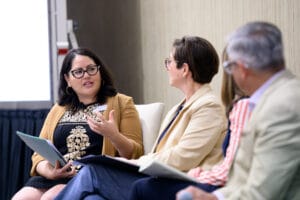
A panel discussion during the business leaders luncheon.
Power: Uncovering Agency and Centering Community
Corporate social impact leaders play a crucial role in helping colleagues realize their potential for making change happen. By meeting employees where they are on their journey and empowering them in authentic and varied ways, leaders can inspire actions that build momentum toward achieving larger goals. Encouraging active participation in one’s community, such as volunteering and voting, is essential. However, successful participation requires the centering of community voices.
We must co-create solutions by listening to those closest to the issues. As Katie Fessler, Senior Director of Community Impact at Altria Client Services, noted in the Business Leader Luncheon, we must do this work “with community, not for and definitely not to.” Harnessing the energy and agency of volunteers is vital, but we must also be mindful of the inherent power imbalances between companies and community organizations. Recognizing that both corporate and nonprofit leaders have much to learn from each other is key. Companies should approach community partnerships with humility, allowing community leaders who are ultimately closest to the issues to guide solutions and co-dream them together. This collaborative approach ensures that efforts are genuinely beneficial and sustainable. Understanding power dynamics is also important in telling stories of service. When we center the strengths of every stakeholder in our stories and approach each other with dignity, we create connection based on shared humanity rather than a desire to save. In all aspects of community, we have as much to learn as we do to give.
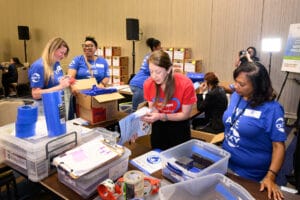
A service project during the conference hosted by the Barbara Bush Houston Literacy Foundation.
Progress: Measuring Impact and Valuing Transformation
Corporate social impact leaders continue to face the challenging task of proving outcomes and the return on investment. Senior leaders want to see quick results and tangible outcomes to justify the resources allocated. However, meaningful change rarely happens overnight. Achieving significant, sustainable impact requires a long-term perspective and perseverance. It also requires a framework aligned with goals and resources that allows you to course correct while translating intentions into impact and does not overburden or surprise community partners. The need to report outputs remains but encourage patience to better understand the results of this work, which may not be fully measured after one volunteer project or even in the span of one career.
It is essential that we continue thinking about our work in terms of transformation rather than transactions. We can no longer simply check hosting volunteer projects off our action plans. Instead, we must create space for listening to community, learning from their past and present, and offer volunteers time for reflection. Processing feelings and reflecting on volunteer experiences deepens the experience for volunteers and leads to the compassion and connection that the world needs now.
The landscape of social impact work has evolved significantly; today, there is more effective collaboration, a greater variety of approaches that meet employees where they are, and a deeper understanding of the value and impact of volunteerism. The Points of Light conference allowed attendees to acknowledge our collective journey while reinforcing the essential role of volunteers in creating positive community change and inspiring us to keep working together to build healthy communities. As corporate, nonprofit, and civic leaders move forward, they are better equipped to face challenges and seize opportunities, working together to build a more inclusive and engaged society.
We can’t wait to see you
Whether you’re a novice or a seasoned pro, we know it takes a village to create vibrant workplaces where employees are equipped to contribute to the communities and causes they care about. So, when you need a trusted advisor to lean on, rely on Points of Light to be Your CSR Friend. Each month, our experts share their wisdom and wit to address a specific but often universal challenge related to your work as a corporate social impact practitioner.
Have questions about employee community engagement? Submit your question and it may be featured in a future blog post.
Dear CSR Friend,
We’ve really hit our stride and are consistently achieving our annual employee volunteering and giving goals. We have the right infrastructure in place to support employees no matter how they choose to contribute to the causes and communities they care about it. But I feel like we could be doing more as a company. So much of how we invest in communities seems to be dictated and led by our small corporate citizenship team. What could we be doing to take our company’s social impact strategy to the next level?
Signed,
Leveling Up in Las Vegas
Dear Leveling Up in Las Vegas,
Congrats on achieving your goals and wanting to take things up a notch! I’ve got a proposal for you — one that is based on evidence and not just anecdotes. To unlock your company’s full potential for doing good, start by thinking outside the lines of what you and your mighty team are responsible for.
Each year Points of Light and partners,
last month? One of several things these honorees have in common is integrating social impact across different business functions. I’ve even got stats to prove it – 100% of this year’s honorees formally integrate social impact work with teams that lead diversity, 94% integrate with marketing/PR and employee engagement strategies, and 86% with supplier diversity. And those are just the top functions; there are others!
You might be thinking to yourself – everybody already has opinions on our team’s work, do I really need to engage other leaders or functions? Let’s look at some of the benefits:
For the community, it opens up a wealth of resources and services that can address community needs more effectively and help shift your company’s nonprofit interactions from transactions to transformational relationships. Integration also allows for multifaceted support when responding to urgent and evolving community needs.
For the company, it scales positive organizational outcomes across so many more functional areas. Integration helps build company-wide buy-in and commitment. It truly demonstrates your company’s values in action.
For employees and leaders, it creates shared ownership, increases awareness for the programs you’ve developed and the issues prevalent in their community, and it helps your team better understand those functions so you can create more accessible opportunities for them.
For you, if you (like so many of us) are on a small team, integrating your work with other departments allows you to scale your team’s achievements by bringing in supporters, ambassadors, and ultimately partners to help you deliver deep impact for your community on behalf of your company.
It might sound daunting at first and, yes, it will take some prompting and persuasion on your part to demonstrate the value-add. However, the ideas and the work that ensues will blend into shared responsibilities and goals, which allow your company to become a greater force for good – and maybe even a future honoree of
!
What does it look like when companies have integrated social impact across other departments? Imagine new strategic partnerships with community organizations that drive an increase in diverse representation in different industries or increased funding for BIPOC leaders of start-ups. It can be reflected in intentionality around your company’s purchasing power, lifting up small businesses and minority-owned vendors. Truthfully, there’s no limit to the impact you can create when you combine business leaders together with your team’s guidance on what communities need and what interests employees. Social impact strategy will be more deeply ingrained in your company’s operations and purpose – and easier for you to make the case for additional resources should you need to in the future.
So, is it as simple as calling a meeting with these other leaders? It can be! We’ve developed a free-to-download
to get you started. The section on integration points out questions to ask before reaching out to set up that first meeting and you’ll find more examples of the power of integration from past honorees of The Civic 50.
If I haven’t yet convinced you, I encourage you to join us for a
when Points of Light and our partners will reveal key findings from the 2024 honorees of The Civic 50. You’ll hear more about the power of integration and why it will elevate your current strategy and unlock additional business value and greater social impact.
Integrating community engagement and social impact throughout your company ensures you’re not just checking a few boxes. Your company will be contributing to a better future, one where communities thrive, and businesses play an integral role in their success.
Until next time,
Your
Ask a CSR Friend: 5 Ways to Increase Access through Volunteer Ambassadors
Looking for CSR advice?
Hear from our experts right here in our Ask a CSR Friend monthly column.
Whether you’re a novice or a seasoned pro, we know it takes a village to create vibrant workplaces where employees are equipped to contribute to the communities and causes they care about. So, when you need a trusted advisor to lean on, rely on Points of Light to be Your CSR Friend. Each month, our experts share their wisdom and wit to address a specific but often universal challenge related to your work as a corporate social impact practitioner.
Have questions about employee community engagement? Submit your question and it may be featured in a future blog post.
Dear CSR Friend,
Like most companies, we saw a significant decrease in participation in our employee volunteer program during the pandemic. Now that most employees are back in the office three days a week, we’re still not seeing interest and engagement close to our pre-pandemic levels. Our small but mighty team has tried hosting lunch and learns to build awareness for upcoming projects and offering company-branded swag to those who sign-up first but what are we missing?
Searching for Solutions in St. Louis
Dear Searching for Solutions,
Have I got an idea for you! But before I get to it, I encourage you to reframe your interest in increased participation. Sure, it feels great to hit higher participation goals year over year, but (as we like to ask ourselves at Points of Light), “To what end?” Too often corporate social impact leaders get weighed down by the endless pursuit of achieving lofty numbers without realizing that what they’re truly seeking is providing opportunities for every employee, regardless of their role or work setting, to make positive change happen. You’re likely not interested in tracking more volunteer hours from the same employees but, instead, widening your pool of participants.
Now back to the idea. Drumroll, please! Although it will take time, resources and relationship building to get started, I promise the value it will bring to your company, your coworkers and the impact it will make on communities is worth the effort. The idea is simple: introducing people-powered infrastructure to not only scale and manage volunteer activities but truly, to ensure that every employee can realize their potential for creating community impact.
This isn’t a new idea for the sector, but it is one we continuously advocate for. Many companies employ a champion or ambassador model to help them mobilize in markets outside of HQ and connect to local community issues, those that might have impacts on the business and those that employees are most affected by. While companies may call them by different names, local champions can drive an uptick in participation by leading and communicating social impact throughout your company’s footprint, reaching and advocating for those who often aren’t considered easily eligible. It’s a powerful, cost-effective way to develop leaders, strengthen relationships and, ultimately, ensure equitable access.
Let’s unpack the connections between setting up a volunteer ambassador network and accessibility. These local leaders can help social impact teams to:
Better understand and advocate for the functional areas or markets they represent. They’ll be able to tell you what barriers employees face for certain roles and work settings, along with the business priorities for their department or market, important timing and guard rails to keep in mind, which leads to less friction with business processes.
Foster a culture of inclusivity and support. Volunteer champions create an environment where all employees feel empowered to participate, create local connections, rally their colleagues, and offer new perspectives as the voice of employees.
Reinforce the company’s purpose, culture and commitments. Ensuring equitable access to social impact activities demonstrates corporate values and directly ties to fostering a sense of belonging and strengthens relationships across the enterprise. They can gain buy-in and more easily share information and success metrics with middle managers or local leaders who are often the only hurdle to inclusion.
Inspire colleagues to get involved. By sharing their own experiences and passion for volunteering, they raise awareness for the company’s social impact strategy. Because they’re situated in that market or function, they can more easily cascade information to their peers and be the “personal ask” that influences a potential volunteer.
Serve as relatable and approachable points of contact for their peers. They can offer guidance, address concerns, and provide valuable insights to ensure that volunteer opportunities cater to diverse needs and preferences within the workforce.
To help get you started on developing and implementing an ambassador network, check out our learning brief,
. It presents more benefits of implementing people-powered infrastructure along with considerations to think through before finalizing your strategy. You’ll also find a compilation of best practices gathered from leading companies who’ve seen great success with this people-powered model.
We’ve also gathered successful practices for incorporating accessibility into social impact programs for your coworkers in
.
Both briefs offer guidance, but it’s your leadership that holds the power to ignite more positive change by expanding accessibility to all your colleagues. The world, and your co-workers, will thank you for it.
Until next time,
Your
Uniting Forces for Social Impact: Why Business Leaders Should Attend the Points of Light Conference
Are you a corporate social impact leader looking to strengthen community strategies, elevate employee volunteering and ultimately increase the impact of your work? Then join us at the
, happening at the Marriott Marquis Houston from June 11–14, 2024. This conference isn’t your typical gathering of industry professionals—it’s a convergence of social impact leaders from all sectors, offering a unique experience that goes beyond traditional networking and learning opportunities.
At the Points of Light Conference, you’ll find more than just educational workshops and leadership discussions. You’ll discover a vibrant community dedicated to driving positive change through people-powered solutions. Here are three reasons this conference is a must-attend event for business leaders committed to social good:
Discover Community-Led Solutions: Our conference is all about learning to empower colleagues to support community-led initiatives that drive meaningful change. Find new ways to harness the power of your workforce to create a lasting impact in the communities you serve.
Learn how Citi aligned community needs with employee talents in “Community First: Building a Responsive Skills-Based Volunteer Program.”
Strengthen Nonprofit Relationships: Gain invaluable insight into building stronger alliances with nonprofits. Explore the nuances of collaboration and discover strategies for maximizing the effectiveness of your company’s corporate social responsibility initiatives.
Check out “Building Transformational Mentorship Programs: Women in the Workforce” to better understand the role of authenticity in co-creating programming.
Develop Impactful In-Person Connections: In an era dominated by virtual meetings, the Points of Light Conference offers a rare opportunity for focused connection with peers and partners face-to-face, away from the day-to-day elements of your role. Join us to forge new relationships and strengthen existing ones in a dynamic and collaborative environment.
Join us for three Civic Talks that offer all conference attendees deep learning and takeaways from innovative cross-sector leaders on the connections between education and equity, AI and civic engagement, and faith and belonging.
But what truly sets the Points of Light Conference apart is its inclusive and intentional approach to conference programming. By bringing together both peers and community partners, this conference offers a range of benefits:
Diverse Perspectives: Engage in discussions enriched by the diverse perspectives of community partners from across the world, leading to innovative solutions and a deeper understanding of social issues.
Networking Opportunities: Expand your professional network beyond your immediate circle and explore collaboration opportunities with stakeholders from different sectors, which can open doors to new partnerships, investment possibilities and resource-sharing.
Holistic Solutions: Strategize with peers and community partners to design comprehensive approaches that address complex problems and solve for the needs of all stakeholders involved.
Knowledge Exchange: Tap into the collective wisdom of all attendees to enhance your understanding and expertise. Your peers can share best practices, research findings, and professional experiences, while community partners can provide on-the-ground insights and real-world examples.
Enhanced Impact: By bridging the gap between sectors, conferences like Points of Light amplify the impact of your work, leading to more effective solutions and greater positive outcomes for communities.
The Points of Light Conference offers corporate social impact leaders a unique opportunity to connect, collaborate, and co-create solutions that drive meaningful social impact. Join us in Houston this June and be a part of a movement that’s shaping the future of corporate social responsibility.
I lead my employer’s employee volunteer program and, while we do some great spontaneous recognition of employee volunteers, we’ve never put together something that formally honors their dedication to showing up and going above and beyond. Plus, I’ve heard from a few of my peers that other companies use recognition strategies to accelerate growth and interest in employee volunteering. I think 2024 is the year we start putting plans in place, but I’m not sure where to begin. Can you give me some advice?
Ready to Recognize Volunteers in Rome
Dear Ready to Recognize,
There’s no time like the present, and I commend you for seeing the need for improvement in the way you celebrate and lift up employee volunteers and volunteer leaders. I’ve put together some questions to guide your journey in developing a formal recognition strategy. Let me know how it turns out.
Determine Readiness
Is your organization and program prepared to integrate a recognition strategy? Is now the right time to begin formalizing your plan and tactics?
Knowing that it will take time to develop and approve a strategy, begin with an assessment of current capacity and upcoming milestones while surveying your key stakeholders for their thoughts on timing.
Set the Stage
What are the overall objectives underlying your recognition strategy? Set goals around what’s important to you, the program and your senior staff. Think about setting goals around increased awareness internally or externally, increased participation, increased volunteer satisfaction and retention, increased understanding of volunteer guidelines and so forth. Then, create a plan for data collection.
Who should be included in the program’s development? Gather feedback from employees (whether they volunteer or not) on how they’d like to be recognized and include them, as well as other key stakeholders, in the process of designing the strategy.
What kind of budget will you have access to year over year? To sustain momentum and avoid inconsistency, a formal recognition program must be consistently well-funded and administered. Can you take advantage of enterprise-wide recognition tactics already in place to defray your need for a sizeable budget? If you’re working for a small organization or haven’t yet been able to set aside funding for recognition, understand those limitations and focus on what you can accomplish in that environment.
How can the recognition program help meet the volunteer program’s objectives and overall company or employee development goals? When you are celebrating someone’s actions, you are also lifting them up as a role model. Consider aligning your tactics with certain leadership competencies important to your company.
Do you have a solid understanding of cultural nuances that may affect localizing a company-wide volunteer recognition strategy across all markets? While corporate culture may override local culture in some instances, ask your in-country teammates for direction. For example, in some countries emphasis is placed on productivity so a celebratory event that takes employees away from their workday may not fit. Employees in China have a deep respect for authority, so engagement with and acknowledgment from senior leaders is key. And your European co-workers may feel uncomfortable being recognized formally for their participation and may balk when asked to report their volunteer time.
Design the Right Approach
How can recognition for — and from — different types of volunteers be integrated into the strategy (e.g., project leaders, executive sponsors, champions or committee members, etc.)? Evidence shows that when recognition is shared and peers can add their own congratulations, it is more impactful and amplifies your investment.
Will your strategy be 100% digital and virtual, solely events-based, or a mix of both? Will you give symbolic awards, financial rewards, some or all of these? Many of these decisions will be based on capacity, resources, corporate culture and goals along with how your colleagues want to be recognized.
What will the reward criteria and eligibility rules include? Who will judge nominations if needed? Are there company assets or resources that can be leveraged as rewards? Ensure rules and criteria are specific and in line with the achievement and the degree of effort they represent. To be impactful, recognition must be specific and call out exactly what was so remarkable. Make sure your strategy is fair and objective and appears that way to participants; every employee volunteer who meets criteria should be eligible.
How and when will the volunteer award(s) be announced?What communication vehicles currently exist to promote the award internally and externally? Are there corporate milestones to which you can align the planning process and/or announcement(s)? Make sure award presentations are timely. Once a year may not be enough for the volume of your program. Create a steady drumbeat of communications around recognition, even if your budget only allows for an annual company-wide opportunity.
Implement and Administer
How much staff time can be devoted to administering the recognition program? Will it be administered from the company’s headquarters or local offices? You may decide that everyone has access to informal recognition tactics, while the more formal, enterprise-wide strategy is led by your team with input and support from champions or staff in other markets.
What resources will you need to develop to reinforce and support the program? Write guidelines and make them readily accessible in different languages so that all employees and especially your volunteers know: eligibility requirements, approval/decision-making processes, types of awards provided, frequency of award presentations, performance goals or behaviors or desired outcomes that will be measured, as well as thresholds for awards. Senior leaders and managers may need communication materials like talking points, templates or training to deliver volunteer rewards.
Are there core functions of the program that should be outsourced? Should external counsel and expertise be sought to help develop this volunteer recognition program? There are organizations (including Points of Light!) readily available to help design a strategy or provide technology platforms to manage your recognition activities. U.S. employers should also consult with their legal, employee relations and tax teams to fully understand their tax obligations and how rewards could affect employees.
Evaluate and Evolve
What plans can be implemented to ensure the recognition strategy is regularly evaluated? As the volunteer program evolves, so should your recognition efforts. Add a disclaimer to your guidelines that reminds employees the company has the right to re-evaluate the recognition program at any time.
How can the recognition strategy inform future program enhancements or support other business functions? Companies measure what matters. Keep track of who is being rewarded as those trends and data can be useful in the future or when your HR team or senior leaders are looking for high performers to lead a significant business effort.