, service has been a way of life, his entire life.
Growing up as the son of an immigrant father in Brooklyn, New York, he recalls how his mother took care of everyone around her. The whole neighborhood was that way, he says. “Doors were always open. If someone was laid off, people showed up with food. Everyone helped each other out. Because everyone was just trying to survive.” Nick says he didn’t really know what “volunteering” meant. It was just what you did. It was a way of life.
Nick’s dad was working a minimum-wage job when he became disabled with multiple sclerosis. Nick was just eight years old. The responsibility of caring for the family fell to his mom. His mother and her friends made sure Nick never felt as if he was going without. “We didn’t have much, but nobody did,” he remembers. Nick says his mother worked hard to provide for the family, and in tough times showed kindness. “My mother would give the shirt off her back to help anyone,” he said, and that gave him the foundation from which to learn, to excel, and to give back.
Today, Nick has certainly built on that foundation, serving as the President of Information Technology at UPS, the world’s largest package delivery company. You can feel a sense of service and concern for others in the way he talks about his work. Nick says, “I have the privilege of leading a team of the best IT professionals in the world. Together, we build innovative, industry-leading technologies that power our customers’ supply chains.”
Photo of Nick’s Mother | Photo provided by Nick Costides
Despite his leadership role and demanding job at UPS, just as his mother instilled in him, Nick always finds time to give back. After relocating from his native New York to Atlanta for UPS several years ago, Nick’s wife began volunteering for an organization and learned they were having funding challenges. She joined their board and together, she and Nick led a financial turnaround of the organization. As part of that effort, they used a Points of Light Global Network affiliate, Hands on Atlanta, to help coordinate volunteer efforts. A few years later, Nick was asked to join Hands on Atlanta’s board and in that role, he interacted with the team at Points of Light often. Eventually, Nick was asked and honored to join the Points of Light board.
“The Points of Light mission really resonates with me, and it’s very important,” Nick says. “Points of Light
inspires and engages individuals into service – anywhere in the world. Their impact is felt by the individuals who receive service through Points of Light and its partners; they help nonprofits in terms of capacity and management, and can make these organizations feel larger than they are; and just think about how many communities are being served by Points of Light and their affiliates. They provide the processes, the infrastructure, and more – and that can turn anyone into a point of light.”
At Points of Light, Nick has worn many hats, including on the Financial Investment Committee, as the Chair of the newly created Technology Committee, and working to support strategies related to data management and innovation that can change the way nonprofits interact digitally. Nick’s a resource for Points of Light operationally as well as on our board of directors as an advisor. He says being able to provide that kind of multidimensional support, beyond just going to board meetings, is what he loves about his role with us.
“When you think about Points of Light and its impact, especially around their concept of the civic circle, I look at it as an anchor point that depicts that there’s many ways to be a point of light,” Nick says. “It’s akin to the golden rule. There are so many ways to do good. It starts with the decisions you make and the causes you lean into. It truly is the way you live your life. The people who want to do good or create change don’t assign themselves labels; they just do it. It’s all about how you express yourself each and every day.”
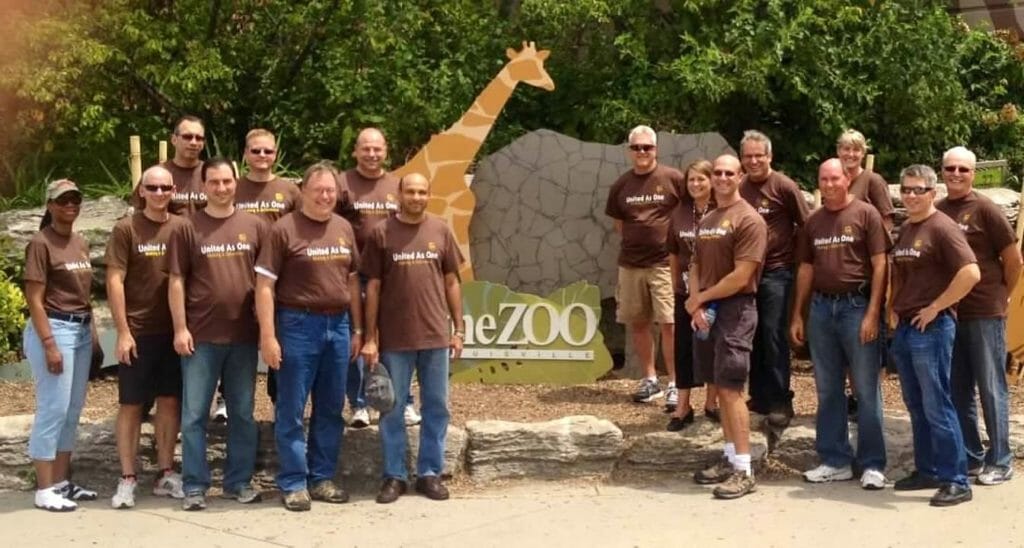
Nick Costides (back row, third from left) and UPS Volunteers at the Louisville Zoo.
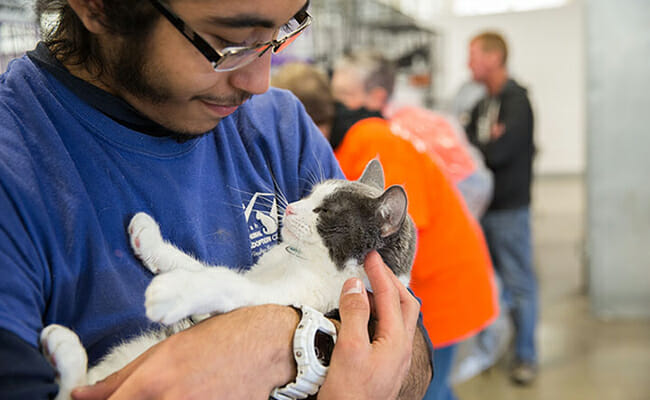
When he’s not at UPS or working with Points of Light, Nick and his wife support multiple animal rights, welfare, and health organizations, including having previously served on the board of the Louisville Zoo and the Kentucky Humane Society. Nick is still an advisor to Hands on Atlanta and an advisor to a nonprofit called ToolBank, which provides tools like shovels and picks for volunteer projects. Working with them and with the UPS Foundation, Nick helped to coordinate and create a mobile warehouse of tools, so that the tools could easily be moved to markets when disasters hit.
To those looking to get involved in their communities and make a difference, Nick’s advice is simple. He says, “You just have to find a cause that resonates with you. Just get out there. If you help in even a small way, it can really make a difference in the lives of others. Whether you can help with marketing, swing a hammer, or tutor a student, it makes a difference. There’s no downside. And everybody benefits.”
Employee Volunteering When You Can’t Serve In-Person
Planning for the impacts of COVID-19 on communities, employees and business operations has been an added focus for most employers over the last several weeks. In the civic engagement sector, leaders have been asked to plan alternatives, postpone or cancel planned volunteer experiences for workers in response to limits on travel and event attendance. With the focus on the health and safety of staff and partners, how do you balance your purpose work?
It is an important question especially because the communities that we collectively serve still need support and depend on volunteers for that support. Can you identify community needs for supplies for first responders? Are there blankets and toys for kids who may see fewer visitors at the hospital, meals for seniors and other shut-ins who are especially isolated? Can you make a financial grant to compensate your nonprofit partner for the lost volunteer hours – currently valued at $25.43 by
?
And then for your own organization: how do you keep civic engagement momentum going and employees feeling engaged when normal routines and plans might be on hold? How do you continue to support your nonprofit partners and the communities that are experiencing significant impacts from reduced participation?
The Points of Light corporate innovation and solutions teams offer a few ideas below to fit a variety of needs and circumstances. Additional strategies and ideas can also be found in our webinar presentation and recording (
Kit-packing solutions can be delivered to your workplace, packed by your employee-volunteers and distributed without your employees leaving the workplace. This will ensure that you can still serve your nonprofit partners while keeping employees engaged. How to get started?
Confirm employee participants are healthy and that you are following government guidelines work with nonprofit partners to assure you are providing requested and needed support.
The Points of Light Global Network has affiliates around the world that can be a resource to connect to local nonprofits.
Order supplies or identify ready-made solutions that can be sourced online. Some recommendations include:
) and provide some skills-based support to your nonprofit partners. Does a favorite nonprofit need some advice on how to think about contingency planning for the impacts of COVID-19? Repurposing in-person time for deeper strategic planning time with your nonprofit partner may help to surface meaningful projects for the future. From executive coaching and mentoring to support for marketing and technology, there are many opportunities to move strategic partnerships forward without being face-to-face. The
can also help you to tailor a virtual experience for your workforce.
3. Explore the many virtual volunteering options.
Tech-based, virtual and remote opportunities pair volunteers with students and others for reading, mentoring and coaching in addition to amazing civic engagement projects. Many of these solutions enable long-term commitments and have waiting lists for volunteers because they offer meaningful and well-tested experiences for your volunteers.
4. If you can’t go “outside”, tackle an “inside” project.
Take this time to upskill organizational learning. Much like a rainy day, if you can’t go “outside,” tackle an “inside” project. Use this opportunity to engage your employees in learning about community challenges, bringing in virtual speakers and experts, developing ideas for future projects, supporting efforts like the U.S. Census and voting initiatives. Can you hold focus group experiences with employees to gather feedback and ideas? Finding time to listen and learn now can provide rapid-improvement solutions and breakthrough ideas for your programs.
5. Learn more.
Points of Light has several tools and resources to support your efforts. For more information, please contact us at
Jennifer Lawson is the Chief Civic Innovation Officer at Points of Light. She leads forward-thinking initiatives, partnerships and campaigns with leading brands to advance social change in the corporate sector.
Yes or No: Will your business support the 2020 Census?
It’s a simple, yet incredibly important and urgent question every business must ask itself.
We wanted to share the below resources and information not to raise awareness, but to drive action from the business community, whether you are a Fortune 500 company or local business committed to serving your community. Every action, no matter how small, can have an impact.
For many reasons including the following, we call upon the business community to support the 2020 Census:
Businesses make data-driven strategic and operational decisions that require an accurate Census count
Your employees, customers and their communities may be largely impacted by the $900 billion in federal spending allocated based on Census data (view this infographic to see how 9 million children from low-income families will be impacted)
If there is an undercount, businesses will be asked to cover the funding gap to support nonprofits and the communities they serve (a 1percent undercount can cost a state millions of dollars)
Most important,it’s the right thing to do. An accurate Census is good for business, our communities and our country
Below are business and state-specific resources from
plan their outreach efforts to support the 2020 Census
:
Mid-March – April 2020: This is a critical time for business to help with the effort around the count, because households will now be able to complete their census forms. Beginning in mid-March, households will receive census information inviting them to complete their questionnaires. These will be sent by mail or delivered by a census worker in some rural and all remote areas. Messages to employees, customers, and the public should explain why the census is important for their communities and encourage them to complete their questionnaires.
April 1, 2020 (Census Day): This is neither the beginning of the Census nor the deadline, but, instead, a day that is designated to promote the census around the country. Companies can help by participating in local Census events, posting messages on social media, and communicating with employees, among a range of other strategies.
May 2020: By this time, residents would have had several weeks to complete their forms, so if they have not yet self-responded, a census worker will visit their home to help them complete the questionnaire in person. Households, though, can still self–respond at any time — encouraging their participation is still important.
Summer 2020: Census wraps up.
By December 31, 2020: Congressional reapportionment determined; state population totals sent to the president.
On January 1, 2021 how will your business be able to respond to the question, “yes or no, did your business support the 2020 Census?”
If your business is not planning to do anything, ask why not? And if they are, ask what other businesses and organizations they can bring along from their ecosystem to amplify this critical work.
A Global Movement for a Global Decade
It’s a new year, a new decade with a new sense of purpose. I, like so many of us, feel refreshed and excited for all that lies ahead of us. As we move into a new decade, we’re seeing more people than ever before getting involved and the multiplying effect of the positive change they’re making.
As a society – despite what the headlines might portray – we’re more connected to each other than ever before. We largely have instant access to information, and to each other. Because of this constant connection, we’re reminded all the time that we have so much in common, despite the miles or borders or oceans that may separate us, and that people are always looking to lead and to bring about change.
We see a
in Greta Thunberg, who was named Time’s Person of the Year. In her we see a part of the next generation, ready to get involved. We see celebrities taking a stand, but more importantly, taking action. For example, Shakira splits her time performing on stages around the world, (including next month’s Super Bowl) and building
. By using her voice, time and resources to really make change, hopefully we’re inspired to help in our own communities, too.
Every day, people are changing our world for good. But the reality is, unlike Greta and Shakira, most of them don’t make the news.
There are teenagers like Crystal Chan, who, as a senior in high school, started a nonprofit organization called
to help first-generation American students explore job options and gain access to opportunities to help them build fulfilling careers. Your circumstances today don’t define your tomorrow and Crystal is certainly proving that!
.
Liam Hannon is another inspirational change-maker. At just 10 years old, he started making lunch for homeless men and women in his native Cambridge, Massachusetts, turning it into an operation called
.
Naveen Prathapeneni, from Hyderabad, Telangana, in India, works as a cloud solution architect with IBM India and also supports rural education. He holds STEM workshops, mentors high school and college students, and has developed a mobile application to help small-scale farming businesses.
.
At Points of Light, we want to continue to uplift and celebrate these kinds of stories – because, as a society, what we celebrate reflects what we value. This year, in addition to National Volunteer Week, we are going to expand our celebration worldwide and will
throughout the month of April.
We see this as an opportunity to expand our collective work, joining in celebration with the affiliates, corporate partners and others who’ve helped us along the way. We’re going to highlight the work that is done all year long and that makes our communities and our world stronger, better, and even more full of light and promise.
Will you join us?
; we may highlight them during Global Volunteer Month. We can’t wait to see your submissions and to hear your stories!
Natalye Paquin was the president and chief executive officer of Points of Light from 2017–2022.
She is a visionary and results-oriented leader, with more than 20 years of experience providing strategic, operations and fiscal leadership in the nonprofit and public sectors.
Leading with Purpose: What We Learned in 2019 And How Companies Can Prepare for 2020
This year brought us clear indicators of a profound change that is taking place in society and the evolution of the business landscape.
– defined by volatility, uncertainty, complexity and ambiguity – redefining the role of business in society. As the year ends, we looked at some of the significant changes in 2019 that will continue impacting corporate social responsibility and employee engagement as we move into 2020.
The UN’s SDGs pass the five-year postmark and progress is not moving fast enough.
It’s been five years since the United Nations unveiled the Sustainable Development Goals, a set of goals and benchmarks for the entire world to unite around to make our planet a better place by the year 2030.
. Climate change appears to be an unstoppable menace that threatens all life on the planet, and humans aren’t doing enough to stop it. Progress on the Sustainable Development Goals remains uneven, and is not moving fast enough to meet the ambitious
, would become one of its greatest allies, and her role is an illustration of the many changes that are coming. Gen Z (those born after 1996) comprised
of the global workforce by 2020.
Gen Z has grown up in a society shaped by discussions around climate change, gender, equality and diversity. In the workplace, Gen Z seeks a career path, and a working lifestyle vastly different from the generations that came before them. They care about a company’s
and gravitate towards companies that are purpose-driven. They want to know their work in some way will have a positive impact on the wider community, not just the business, and place high importance on joining an organization that shares the same values as them and that is proactive in its stance. Companies will have to be prepared to address the need for transparency and openness by acting with honesty and authenticity.
Civil society has become more fragile, volatile and divided.
Civil society saw an increase in duress in 2019. Civicus’
identifies the rise of authoritarian leaders, right-wing populists and anti-rights groups as three of several reasons civil society has become more fragile. With people increasingly getting their news and information from
, it has become harder for people to know what is true and what is false.
These turbulent times will affect how companies operate and might influence their bottom line. As an example, as the most recent quarter drew to a close,
shows that despite the lowering trust in mainstream media and “the system,” one relationship does remain strong and is trending upwards – the trust an employee has in their employer. The report states that “58 percent of general population employees say they look to their employer to be a trustworthy source of information about contentious societal issues.” 76 percent also say they “expect a CEO to take the lead on change.”
SurveyMonkey recently conducted a five-country
on what people expect of business leaders. Half of the respondents said they’ve bought from or boycotted a company because of the social or political views of the company, or the way it does business and/or treats its employees. And in every country surveyed, the majority of consumers want business leaders to stand up for social or political issues they believe in.
There are more activist companies and employees.
According to a report from global communications and marketing firm Weber Shandwick, the
after learning of an agreement the home décor company made to furnish migrant detention centers. These were just but a few of the many employee protests that made headlines.
The core part of a company’s function has evolved from not only being a driver of shareholder wealth but becoming a responsible steward and benefactor in the communities in which they operate – take BlackRock CEO Larry Fink’s
as an example. Companies are increasingly putting their brand behind social causes they believe in, and employees are demanding that their employers do more than provide a salary and benefits package.
So, what does all of this mean, and how is it tied together?
All of these waves of change mean it is no longer acceptable for companies to sit on the sidelines of change. At Points of Light, we believe all of us have a role to play in creating a society where it is easy for people to take action.
As we face a new decade filled with changing roles, expectations and immense challenges, companies must engage their people – from their employees, to their suppliers, to their board room – to take action.
By companies investing in community engagement initiatives and making a conscious decision to be active, responsible and thoughtful corporate citizens, companies have the opportunity to not only continue to provide shareholder value, but provide stakeholder value as well.
What will your company do in 2020 to set yourself, your stakeholders and you communities up for success and change in the next decade?
Daniel Elliott contributed to writing this article.
Be a Role Model for Civic Engagement
It’s hard to believe that summer is already drawing to a close and it’s back-to-school season. After working in the education sector for more than a decade, it’s a time of year for me that offers space for planning, reflection and thought.
As we think about the new school year and all that our young people will learn and experience, especially with what has been
my mind turns to how they will be taught about the importance of improving community and civic engagement.
Certainly, teachers improve community by committing to a profession that’s all about giving of themselves, in the education of others to make the world a better place. And many families are deeply rooted in actions and traditions that improve community. But where else will our young people see this type of engagement, in a way that is organic and natural in every ecosystem? Where will they learn to celebrate it? To value it? To look for ways to get involved?
Young, old; rich, poor; no matter where we live in the world, we all have the same amount of time in a day. And what a privilege it is to be able to share any amount of time supporting issues that matter most to you, for the benefit of others.
Civic engagement, particularly in support of improving conditions for humanity, is not something that should be forced. It’s not an act or series of actions to categorized as a checked box, or had-to-do-it-for-credit thing. Emotions – be it passion, or empathy, or a determination for a better world –
that’s
what fuels willingness to get involved.
And youth are getting more and more involved. Young people are building the world we want to see tomorrow and they’re also impacting the world we see today. As we heard from Lindsay Peoples Wagner, editor-in-chief at Teen Vogue, at our Points of Light Conference in June, “young people are not the future, they are the NOW.”
The foster system, women’s health, hunger, the environment – at our conference, we heard from young people who are taking on these issues (and more), fueled by their passion and by the knowledge that they’re making a difference.
Where does that passion and commitment come from? How did they learn it?
It comes from all of us; from the role models who showed them that engagement matters, that it’s everyone’s job to be engaged, that even though they are young they can make change, and that together, we can create a better world.
Let’s model engagement for others, so we can keep building the Civic Century – making it impossible to stand on the sidelines. Let’s create pathways to make getting involved easier and part of our daily lives. Let’s recognize and celebrate all efforts of community involvement and inspire each other in ways that accelerate impact.
So, on the eve of a new school year, I ask: What will you do to encourage the young people in your life to get involved in their community and become civically engaged? How will you be a role model? Or, better yet, what can you do
together
in support of your neighbors, your community and others?
If you need help finding volunteer opportunities,
and other resources right here on the Points of Light website.
We’ll be glad you did. And the young people in your life may remember it for their lifetime.
Natalye Paquin was the president and chief executive officer of Points of Light from 2017–2022.
She is a visionary and results-oriented leader, with more than 20 years of experience providing strategic, operations and fiscal leadership in the nonprofit and public sectors.
Meet the 2019 Cabot Community Celebrity Cruise Honorees
When you do amazing things, people notice. That’s why we were so excited to honor these five incredible individuals on the
affiliate. While their projects range from literacy programs to food services, what these honorees have in common with each other is a desire to give back and make a difference in their community.
That impulse is shared by our Cabot farmers, too, and that’s what inspired
. It’s the heart and soul of Cabot, powered by the values of the co-op farmers, who also volunteer in their communities and want to encourage others to do the same.
These five Cabot Community Celebrities can inspire us all to do more:
Earl Dizon, volunteer with HandsOn Greater Portland.
Initiative and the Children’s Book Bank, Earl ensures children receive reading support and access to books early in life When asked why he volunteers, Earl said, “At first, it was just a way for me to pass the time. But once I realized I was able to help others in a way that reinvigorated me, I was hooked.”
, managing volunteer teams and special events. But even more important, she shepherds new volunteers – more than 5,000, so far – helping them get started. Those 5,000 volunteers have gone on to work on 12,000 projects for New York Cares, so you could say that Phara is a volunteer x 5,000!
Steffen Strayer (left), a volunteer with United Way of Northeast Florida.
to make his community better. He got the impulse to give back close to home from his grandmother, who also worked hard to serve her community. His focus at United Way is to help lift people out of poverty by providing support for basic needs, education and financial services. The best part about volunteering? “I like interacting with our clients,” Steffen says. “They have the most interesting and compelling stories to tell and the most love to share.”
both to give back and make new friends. Those connections are as invaluable as the connections she makes for network members with her work at Boston Cares, fulfilling a wide range of community needs, from ushering community concerts to judging student debates. Melissa makes sure affordable, healthy food can be had by all at
. She points out the importance of these connections: “A community depends on the strength of connections – between neighbors, community groups, public servants, and everyone in between,” Melissa said. “Volunteering builds those connections.”
, where she provides a wide range of services for various organizations. Her New York Cares experiences often inspire her to volunteer directly with a local organization, which is what happened with Bike NY, Road Runners and University Community Social Services, otherwise known as Meatloaf Kitchen.
Developing Future Civic Leaders, One Neighborhood at a Time
Points of Light was founded on the simple yet profound belief that individuals play an important role in solving community challenges, and that the innovation and dedication of ordinary citizens can accomplish extraordinary things. Starbucks has a similar commitment, reflected in its mission statement:
“to inspire and nurture the human spirit – one person, one cup and one neighborhood at a time.
”
Through a grant from the Starbucks Foundation, Points of Light created a groundbreaking program inspired by national service that provides Starbucks retail employees an opportunity to lend their hearts, hands and minds to local organizations that leverage volunteers to meet their mission. The
invests in local nonprofits through the power of human capital, serving as an amazing example of the power of public-private partnerships, and the importance of elevating and investing in service.
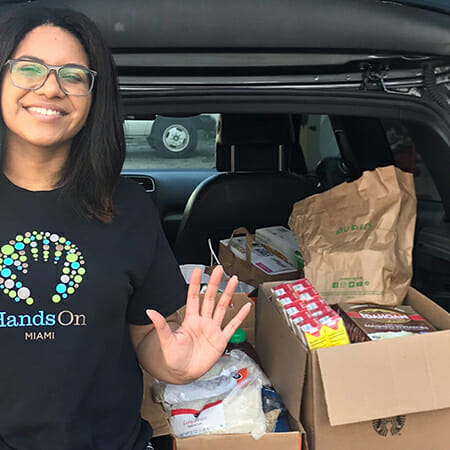
HandsOn Miami Service Fellow Cindy Ariza dedicated her time to recruiting and training community emergency response teams in Miami.
Points of Light’s commitment to leveraging service as a solution for organizational and community needs is based on the belief that cross-sector partnerships are a critical element of effectively informing and impacting social and community issues. Our partnership with Starbucks is an innovative approach to strengthening networks and nonprofits that complements other products and services in our capacity building portfolio. Our shared commitment to volunteerism and impactful community engagement served as inspiration for the initial vision for this program, which was to create a revolutionary model of catalytic citizenship.
For six months, Points of Light and 13 members of our
engaged 36 Starbucks Retail Partners (part-time employees) as Service Fellows, providing them with a robust experience that included civic education, community engagement and sector building. This pilot program provided Points of Light, our Global Network members and Starbucks a rare opportunity to co-create an experience that was responsive to the needs of networks and nonprofits while simultaneously developing future civic leaders.
Fellows not only made a difference in their communities, collectively providing more than 17,000 hours of volunteer service, but inspired others to do the same. This partnership will continue to drive catalytic changes to the existing volunteer infrastructure, while also significantly enhancing the capacity of nonprofit organizations to effectively engage volunteers and fellows within their workforce. We look forward to leveraging the lessons learned and impact achieved to explore future phases of the program.
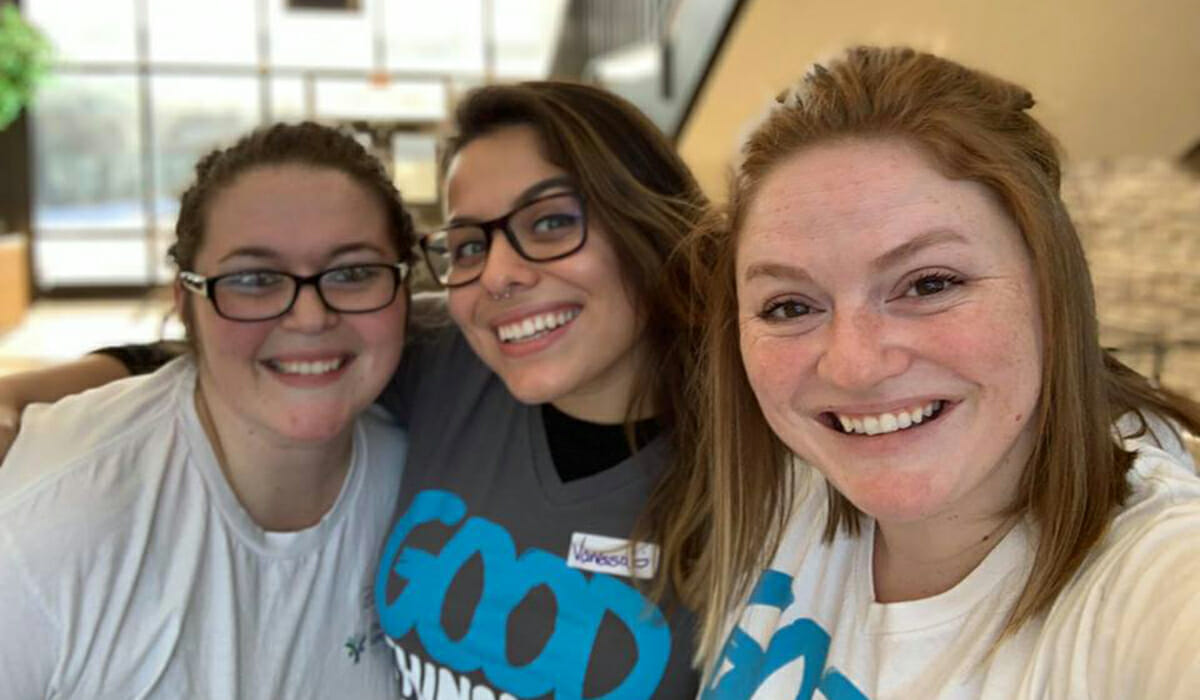
Shannon Galford, Starbucks global responsibility program manager (right), with Chicago Cares Service Fellows Zoe Pace and Vanessa Higueros.
Read stories from Points of Light Global Network members that hosted Starbucks Service Fellows during the pilot program:
Alison Doerfler is the senior vice president of capacity building at Points of Light.
Transforming Organizations Through Strategic Volunteer Engagement
Despite a surge of passionate leaders, the social sector continues to struggle with getting volunteer engagement just right while creating sustainable infrastructure for effective volunteer engagement. That’s where the Service Enterprise Initiative comes in. A national change-management approach, the Service Enterprise Initiative helps organizations gain a greater return on volunteer investment to meet their missions by tackling tough questions like: How do we address myths or misconceptions about volunteers among our staff? How can we get more resources for volunteering and make our program more sustainable? How can we work with volunteers to do more with less? The initiative is inspired by principles from Reimagining Service, a coalition of cross-sector leaders, researchers and practitioners that identified what was needed for effective volunteer engagement after the Serve America Act was signed into law in 2009. At its core, Service Enterprise transforms an organization’s culture so that it values volunteers as part of its human capital strategy.
A Paradigm Shift for Volunteer Organizations
Through a diagnostic, training, coaching and certification model, certified Service Enterprises have seen real impact. Asheville Humane Society in North Carolina has seen the number of animals they care for increase by more than 25 percent because of how they partner with volunteers. Thanks to Service Enterprise, they can also demonstrate that for every $1 they invest in volunteer engagement, they see a return of $18.24. The humane society is part of the national Best Friends Animal Society, which has taken on a leadership role by joining Service Enterprise as a Hub to certify its network of rescue organizations to operationalize its mission to “save them all” and end the killing of homeless pets. It’s working.
“Service Enterprise is changing our paradigm regarding volunteers and their role,” said Tracy Elliott, executive director of Asheville Humane Society. “They have always been important to us, but we are beginning to see and experience vastly expanded roles and responsibilities for volunteers, in turn increasing our ability to achieve our mission.”
Leaders like Elliott are committed to the future of nonprofit capacity building, and see the Service Enterprise model as the way forward in changing the way organizations can achieve their missions by harnessing the power of volunteers.
A growing number of organizations, including food banks, animal shelters, mentoring organizations, and agencies providing affordable housing and community services, are getting certified. Even cities like Boulder and Fort Collins, Colorado, and NYC Service in New York, are joining the ranks of more than 400 certified Service Enterprises across the country as they seek to bridge the gap between local government and residents.
Points of Light founder President George H.W. Bush likened community organizations like these to a thousand points of light, “spread like stars throughout the nation, doing good.” By helping organizations create a sustainable environment for volunteering as part of their culture, the Service Enterprise Initiative enables these points of light to shine even brighter.
To learn more, including how your organization can become a Hub to lead Service Enterprise transformations in your community, visit www.pointsoflight.org/SEI.
Experiencing the Living Legacy of Dr. Martin Luther King
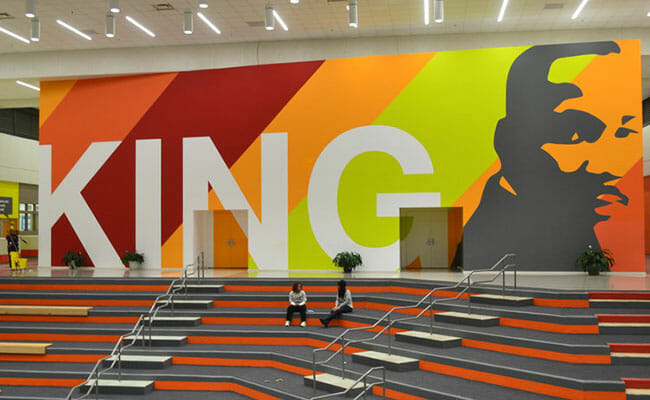
At Atlanta’s Martin Luther King Jr Middle School, volunteers with Hands On Atlanta sit in front of a mural of Dr. King on MLK Day of Service.
As someone whose early career was as a civil rights attorney and who now leads a global organization focused on volunteering and service, spending the Martin Luther King Jr. holiday in Atlanta is a full circle experience. In the span of five days, we joined this community to honor civil rights leaders; break bread together while discussing economic justice; roll up our sleeves to offer love and care to a west Atlanta neighborhood; and host just more than 50 Fortune 500 companies focused on integrating social purpose with business strategy. Dr. King said, “Life’s most persistent and urgent question is ‘what are you doing for others?’” The answers we heard inspire hope.
On a national stage, at the Salute to Greatness hosted by
, Dr. Bernice King honored amazing leaders who work to make their community and our world a better place. From U.S. Sen. Corey Booker, whose policies promote the values of social and economic justice, to Puerto Rico’s San Juan Mayor Carmen Yulín Cruz who has been a light in the darkness, leading her community out of despair after a devastating hurricane, to Hamdi Ulukaya, the founder and CEO of Chobani, who shared that his company’s values include producing affordable nutritious food and its employees’ rights. These honorees demonstrate what’s possible when you value and commit to doing what’s right.
Dr. King’s teachings show us that agreeing on “what’s right” isn’t easy but can come from meaningful dialogue about difficult subjects. Rooted in that philosophy, Points of Light provides tools for hosting
to offer a facilitated forum for people to come together, have tough conversations, learn from each other and discover actionable solutions. This year, our affiliate
, which gave the entire community a chance to be part of a rich discussion about economic justice and opportunity. The growth of this event, the attendance and engagement demonstrate the need and desire of community to share, reflect and problem-solve, together.
Photo courtesy of Hands On Atlanta
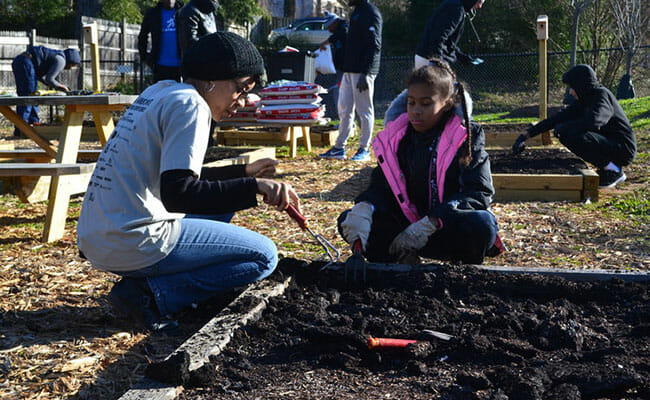
Volunteers do some gardening work as part of a beautification project in Atlanta’s English Avenue neighborhood on MLK Day of Service.
Despite frigid temperatures in Atlanta, the MLK Day of Service was reinvigorating as nearly 150 people rolled up the sleeves of their big, bulky coats and got to work in the city’s English Avenue neighborhood. The volunteers, including residents, along with Southwest Airlines and KPMG employees, and members of the Points of Light Corporate Service Council, cleaned up a park, restriped a parking lot, and painted vibrant art boards with inspirational messages. These projects were part of Points of Light’s Resilient Communities work with Southwest Airlines, an 18-month initiative in partnership with three of our local affiliates. Hands On Atlanta’s focus effort in English Avenue has been in collaboration with residents, like Annie Moore, to revitalize the area. Annie freely and wholeheartedly chooses to make every day a day about serving and being a light for others, and we were honored to recognize her with Daily Point of Light Award No. 6,175.
The English Avenue service projects were a subset of
across the city organized by Hands On Atlanta that engaged nearly 1,900 people as volunteers. These efforts are representative of the energy and activity across the country in which Points of Light, our affiliates and grantees engaged nearly 150,000 people in service projects and Sunday Suppers.
Our greatest opportunity for meaningful impact is through this coordinated effort that includes residents, community leaders and business leaders. More than 50 corporate partners that are focused on integrating social purpose into their business strategy joined us in Atlanta to connect and collaborate as part of our
. UPS Chairman and CEO David Abney, along with chief diversity and inclusion officer and UPS Foundation President Eduardo Martinez, welcomed us to the company’s headquarters where a diverse group of speakers representing small and large companies discussed everything from data philanthropy to storytelling. This determined group wasn’t deterred by the snow and ice that closed down the city on day two, as our Points of Light team quickly organized what would have been workshops into webinars. More than 50 participants who had traveled to Atlanta stayed warm in their hotels and joined the online discussions and we didn’t miss a beat.
This series of events marking Dr. Martin Luther King’s birthday throughout the week is significant. It shows us that even as we approach 50 years since Dr. King’s voice was silenced, his vision was not and his legacy lives on through the ways in which we answer that question, “what are you doing for others?”