Find Your Nonprofit Voice: Build a Bridge Between Donors and Trust
Using your voice to advocate for the causes you care about is a critical part of civic engagement. At the individual level, people use their voices through the conversations they have with friends and family members or what they post on social media. But what does an organizational voice look like – specifically for nonprofits looking to build a bridge between donors and trust? Below are four tips for finding your nonprofit voice.
Learn More About Advocacy
A critical step to unleashing your voice is to be clear that advocacy and lobbying are two different things. Broadly speaking,
advocacy
is defined as “public support for or a recommendation of a particular cause or policy,” whereas
lobbying
is urging “…the public to contact members or employees of a legislative body for the purpose of accepting, rejecting, proposing, supporting, or opposing legislation,” according to the United States Internal Revenue Service. Most nonprofits heavily lean into advocacy to advance their missions and individuals impacted by their work. In fact, advocacy is the backbone of many nonprofit efforts. As an organization, you can add your voice to the public square and join the chorus of individuals seeking to effect positive change.
One useful resource is
Bolder Advocacy
, an organization consisting of lawyers, coaches and nonprofit experts who provide educational resources for nonprofit and foundation leaders on advocacy. They offer a wide range of information, tools and training to help organizations navigate advocacy rules and regulations.
Find Your Voice
When you represent a nonprofit organization, you may feel hesitant to engage your voice in some of these movements or policies that might drive or impact them. You might avoid using your platform in new or bolder ways out of fear of putting off volunteers, funders or other stakeholders. You may be concerned about appearing “too political” or “too controversial” by speaking up about current social or political issues. But in doing so you miss opportunities. You miss advancing your mission, as well as building deeper connections with donors and the very people we serve.
Your staff and Board of Directors should decide on your advocacy strategy. Identify the issue(s) that are connected to your mission and your organizational values. Where it makes sense, engage other constituents such as volunteers or members of your community. Use
this checklist
from the Council of Nonprofits to help you plan effectively.
Listen and Learn
Educate yourself more deeply on current social movements that relate to the issue(s) your organization has identified. From Black Lives Matter to #MeToo to the LGBTQIA+ rights movement to campaigns like the Ice Bucket Challenge, there has been a range of social movements that inspired, motivated and empowered our society in recent history alone.
Evaluate which tools, resources and strategies already exist and which organizations might already be engaged in advocacy related to those issues. Take note of how nonprofits use social media to engage with their communities on these topics, then mimic these strategies on your own social media channels.
Inform Your Network
Finally, spread awareness and share resources, like the “Civic Life Today” issue about
Voice
, offering educational resources help to deepen everyone’s understanding of the issue(s).
Distribute information and answer questions about your new strategies. Help to inform your network about your nonprofit’s current or planned advocacy efforts and why they matter to your organization and the people you serve. Leveraging learning and advocating together strengthens your organization’s connection with your constituencies as you work toward systemic change.
5 Tips on How to be Transparent With Donors
Making sure you know how to be transparent with donors is essential to building trust. While every organization is different, many nonprofits rely heavily — sometimes exclusively — on donor support. In 2021, overall
charitable giving
in the United States increased 8.5% compared to the previous year. While you may be used to considering factors such as
donor churn
and
donor retention
, there’s another area to consider: donors and trust.
As a nonprofit organization, you thrive when your donors trust that their gifts are being spent wisely and effectively. But how do you communicate the impact that donations have in order to meet that gap between donors and trust? The answer is simple — transparency.
Donors and Trust, by the Numbers
The Independent Sector’s
Trust in Civil Society
report explores factors that drive trust in American nonprofits and philanthropy. As part of their key findings, they share that there appears to be a two-way street between trust and civic action.
Donors and volunteers both indicate they have higher trust for nonprofit organizations, while also identifying trust as a necessary factor for them to support the organization.
From the survey:
- 63% agreed that “many factors, including how much I trust a nonprofit to do what is right, determine whether or not I support it financially, or through volunteering.”
- 83% agreed that “nonprofits must earn my trust before I support them.”
According to the report, there are four primary dimensions that comprise trust capital: ability, dependability, integrity and purpose. For nonprofits, statistical modeling indicates that the latter two dimensions, integrity and purpose, contribute the most to building or reducing trust.
Transparency demonstrates both of these facets, even when it means admitting failure. In the article, “
Why Failing Transparently Is a Good Thing
,” author Wayne Elsey, founder and CEO of Funds2Orgs, explains that discussing failure, and the learnings from it, can be a pathway to earning trust.
Here are Elsey’s quick tips for being more transparent with your donors and supporters.
Publish your nonprofit financials.
Even if you have a small organization, place your audited financials on your website. This action alone can significantly help bridge the gap between donors and trust.
Consider getting a Guidestar Seal of Transparency.
With a
Seal of Transparency
from Guidestar, you may be able to increase your donations by 53%. Guidestar is an independent organization, and having their approval can showcase the dependability and credibility of your nonprofit.
Publish your outcomes and impact.
Donors want to know what your organization does and your metrics for success. Be clear and transparent. For all of your programs, give regular updates via a newsletter or email blast. Always publish an annual report of achievements from the past year.
Make sure to have whistleblower and conflict-of-interest policies.
Have policies in place to discourage illegal or corrupt activities and promote speaking up. Not only is this tenet vital to maintaining your organization’s integrity, but it also demonstrates to donors that you understand best practices in these arenas and take corruption seriously.
Experiment and create pilot programs or initiatives.
Finally, nonprofit leaders must develop their organizations. Thinking outside the box with vision and transparency shows you want to be a better nonprofit leader and expand your outcomes and impact.
Want to learn more? Donate is one of the nine elements in the
Points of Light Civic Circle
Ⓡ
, your system for changing systems. Our Civic Life Today issue on
Donate
explores the act of donating, thoughtfully encourages individuals to understand the power of their donations and shows people how to approach donating through a thoughtful lens in order to have the greatest impact.
Learn How to Spot Social Intrapreneurs Within Organizations
Social entrepreneurship is one of nine elements in Points of Light’s
Civic Circle
, a framework to help people understand how doing good can come in many forms. (If you haven’t read the Civic Life Today issue on
social entrepreneurship
, we highly recommend it!)
Social entrepreneurs get to the root causes of today’s issues and work to find innovative solutions. They identify a need that has not been met by traditional structures, research the existing landscape and then lead the charge to solve the issue in a new way.
While social entrepreneurs operate outside of organizations, did you know that they can exist within organizations too? Social “intrapreneurship” has a few definitions, but generally, it is the “Successful adaptation of entrepreneurial attitudes and strategies inside of a bureaucratic organization.”
Think about your own organization – do you know any intrapreneurs? They could be existing leaders at your organization or even highly-engaged volunteers that serve with you. Or maybe you are one yourself. There are many different qualities you might expect from an intrapreneur, but here are a few common ones.
Qualities of Social Intrapreneurs
Social intrapreneurs are passionate about the cause or issue they are supporting. Like any successful social entrepreneur, they take the time to understand the issue they are seeking to address. (By the way,
listening and learning
about issues before acting on them is another element of Points of Light’s Civic Circle!)
They’re also willing to take risks. They don’t see the status quo or any traditional approaches as limiting to their potential, and they’re comfortable with taking data and their broader lived experiences to try different ways of solving issues.
Social intrapreneurs are resilient and driven, helping them to be more adaptable to adversity. Beyond resiliency though, there is a hopeful optimism they possess. They truly believe change is possible and that they have the passion to make it happen!
Intrapreneurs are also able to understand and work within existing organizational structures, while also seeing opportunities to adapt them in order to foster change. Intrapreneurial talent can be a significant benefit to your organization in moving your mission forward and serving your community. Instead of forcing these individuals into a box, it’s a good idea to cultivate their creative solutions and encourage idea sharing.
Supporting Your Social Intrapreneurs
If you read through that list of qualities and have one person or a few people in mind, read on for a few ways your organization can help support and cultivate their intrapreneurship (ideas adapted from
The Innovators Handbook
.)
First, create a culture of learning. This may come as no surprise, but an organizational culture that is unwilling or unable to adapt and learn will likely not be able to support new, entrepreneurial ideas. A culture that values creativity and future thinking will better fit intrapreneurs seeking to create change.
Next, recognize biases. We all have them; no one is exempt. Fostering a culture or system that avoids biases isn’t possible unless you can recognize them in the first place. Three to be particularly aware of:
- Authority bias: Our tendency to attribute greater accuracy to anyone in a higher position. Also known as the HiPPO effect – or the Highest Paid Person’s Opinion.
- Bandwagon bias: Our predisposition to replicate and emulate what others are doing.
- Law of the instrument: Our habit of becoming unquestioningly enamored with a methodology, process or tool. Hence the well-known idiom, “if you have a hammer, everything looks like a nail.”
Finally, try to see innovation as an opportunity, not a requirement. Great ideas can come from anywhere, but they shouldn’t just be more criteria on a job description. Ideas are opportunities and leaders should assume that there is already much untapped potential throughout their organizations. Organizational structures should invite everyone to the innovation table.
What other ways can your organization foster innovation and creativity to support social intrapreneurs? Do you have any particular intrapreneurs who have inspired you? Share with us on
Facebook
,
Instagram
,
LinkedIn
and
Twitter
!
Top 5 Reasons to Attend the Points of Light Conference 2023
The
Points of Light Conference
, an annual event that draws global nonprofit, government, business and civic leaders from all over the world, is the premier civic engagement, volunteer and CSR conference to keep you educated and inspired. Here are five reasons you should attend the Points of Light Conference in 2023.
What sets this civic engagement conference apart?
There’s no better way to access compelling professional development and CSR networking opportunities. A post-event survey from The Points of Light Conference 2022 showed that 81% of respondents left with new knowledge that they were able to apply in their work. One attendee said the conference “…was terrific – friendly, inspiring and educational!” Another leader reported, “We had team members from several different departments attend and everyone gained something!”
“There was a great diversity of perspectives and strategies about the subject matter, volunteering and the devotion to civic improvement that transcended a variety of international cultural perspectives. Additionally, everyone was very driven and practical in regards to outlining strategies for success that can be applied to a daily lived experience and can be scaled up or down.”
— Points of Light Conference Attendee
According to
recent research
, “58% of employees feel that their employers should lead in initiating higher standards to address various social justice issues affecting their communities,” while “64% of Millennials are not interested in working in companies that don’t value social responsibility” and “97% of past volunteers are more motivated in their duties” since the COVID-19 pandemic.
There’s no doubt about it: The Points of Light Conference is sure to provide a rich experience to aid you in the important, impactful work you do.
1. Get inspired by top speakers
Each year, Points of Light hosts inspiring speakers and presenters from across the globe who are making massive impacts in their spheres. Whether you’re a
business leader
, a nonprofit employee or a passionate
volunteer
, you will hear from some of the leading voices in the CSR and ESG fields. Past conferences have welcomed news anchors, bestselling authors, actors and entertainers, and leaders of some of the largest organizations in the world to the stage. Expect to hear inspiring stories from this year’s cohort and gain insight into steps you can take to increase and sustain your own impact.
2. Grow your network
One of the top reasons to attend this civic engagement conference is for the networking opportunities. Not only will you have the chance to meet inspiring leaders working toward the common good, but you get to rub elbows with like-minded people doing similar work. Want to exchange successful marketing strategies you’ve been using? Catch up on new initiatives your colleagues have implemented this past year? Have lunch with a friend from last year’s conference? Now’s your chance to build and sustain your own professional network.
3. Get equipped with the latest research and tools
Attending this CSR conference can open the door to ideas and resources that will transform the way you work. Explore the
research and trends
shaping the social sector and deepen your impact with new tools and solutions to current problems. As the landscape has shift due to COVID-19, you can’t rely on pandemic-era methods of volunteer or employee engagement. At the Points of Light Conference, you will dive into the topics and tools most relevant to where you are now.
“The Points of Light Conference is a place for both bold civic engagement strategy conversations and re-energizing reflection to fuel your day-to-day work. It’s an investment of time and budget that pays off tenfold in new ideas, fresh inspiration, and relevant connections”
— Katie Stearns, Chief Global Corporate Solutions Officer, Points of Light
4. Revitalize your passion and commitment
Keep burnout at bay by stoking your passion for civic engagement. When times get tough, how do other leaders and their teams handle the hurdles? What are the key moments that keep them engaged and committed to the work over the course of decades? Reconnect to the reasons you started on your civic engagement journey in the first place. From Main Stage moments to workshops and presentations, you’ll experience moving stories of both successes and failures. You’re sure to find a story you can personally relate to and draw on later through good times and challenges.
5. Make the most of your time in Chicago
This year’s conference provides a brand-new opportunity to explore a major metropolitan area: Chicago! We’re hosting the Points of Light Conference in the middle of June, which is the perfect time to explore the beautiful weather of the Midwest. Snap a selfie at Cloud Gate, (aka “The Bean”) at Millennium Park. Grab your group and head to The Garfield Park Conservatory or the Art Institute of Chicago, cultural staples of this bustling city. History buff? Take a 90-minute cruise along the Chicago River to hear about the origins behind the stunning Chicago architecture.
“We are thrilled to welcome the global Points of Light community to Chicago!” said Points of Light Conference Co-host Ellen Ray, CEO of Chicago Cares. “We look forward to the Points of Light conference serving as an opportunity to celebrate and strengthen the ways our beautiful and complicated city brings the power of people to the work of change.”
Register for the Points of Light Conference 2023
Whether you’re in the corporate world or the social sector, leading teams or new to your organization, don’t miss this powerful conference. The Points of Light Conference is your chance to refine your skills, revitalize your passion and network with other people making waves in the world of civic engagement. Head over to our
2023 Points of Light Conference page
to sign up for updates and stay abreast of announcements.
Points of Light Partners With AL!VE to Grow Service Enterprise
Service Enterprise
is now being operated by
Association of Leaders in Volunteer Engagement (AL!VE)
. As this program begins to change hands, Points of Light is partnering with AL!VE to ensure a smooth transition. This is the first in a series of updates from AL!VE. This one comes from Service Enterprise Administrator Kayla Paulson around the organization’s work with Service Enterprise.
It is exciting to be part of the Association of Leaders in Volunteer Engagement (AL!VE) and to help create the next progeny of the Service Enterprise Program. From the rich and collaborative infancy with Reimagining Service and California Volunteers to
Points of Light
nurturing Service Enterprise through the national pilot initiative and continuing to push forward the growth and research, build a vibrant network of hubs and make curriculum improvements, the program has been able to be housed with entities that are uniquely qualified to guide and support the program through its next stage. AL!VE’s national presence, partnerships and membership base uniquely position us to lead Service Enterprise with Points of Light’s support and continued guidance. Our existing national connections create opportunities to identify and develop new hubs along with our proven track record of providing training and technical assistance to leaders in the profession, demonstrating our ability to expand resources and support for hubs and participants. A direct connection to AL!VE members will create a pipeline of potential participants already seeking to enhance volunteer efforts and strategy at their organization.
How AL!VE is Uniquely Positioned to Operate Service Enterprise
AL!VE continues to listen to members and partners about the needs of volunteer engagement practitioners, changes in the sector, and potential services to further leadership development and develop programming to address these needs. We also plan to expand our offerings through various modalities that fit different styles of learning (e.g., presenters delivering training through AL!VE Academies, peer in-person or virtual learning through the Hybrid Conference, information sharing and peer coaching through Communities of Practice, and one-on-one leadership development through the mentor program). In the last annual member survey, all AL!VE programs received over 95% favorability for being important to member growth and development. Our program offerings and attendance continue to grow year over year, yet the key piece that we were missing was an organization-wide approach to volunteer engagement. Service Enterprise will fill that gap.
Many of AL!VE’s Board Members have been longtime advocates of Service Enterprise. I, personally, have been a trainer with a certified hub since the national pilot. Our Board President, Michelle Raymer, runs a certified state-wide hub. Past-President Megan Vixie took her organization through Service Enterprise achieving certification. We also have additional board members who are currently starting their organization’s Service Enterprise journey or have already achieved certification. AL!VE is not yet a Service Enterprise certified organization but has been focused on implementing practices and laying the foundation to position us to participate in the Service Enterprise program to become a certified organization. Our leadership and committed volunteers value the Service Enterprise process as well as achieving certification.
Looking Back at Service Enterprise
During Points of Light’s leadership tenure, Service Enterprise has transformed the culture of over 600 organizations across the country. AL!VE, with the support of Points of Light, will take this program to scale through expanded access, continuing to build on Points of Light’s momentum, creating a movement that captures the attention of nonprofit leaders, funders and stakeholders. With the support of our members and Service Enterprise hubs, we will empower Service Enterprise to be the game changer it was designed to be, breaking the cycle of scarcity so organizations can do more with more to meet our world’s most pressing needs.
“When we first started this work, we knew we were looking at the transformation of how an organization leverages a diversity of resources to build capacity. Over the following decade our re
search has consistently proven that nonprofits operating as a Service Enterprise can operate at a 50% decrease in revenues while achieving the same results as their peers
,” said Elizabeth Schwan-Rosenwald, Chief Program and Network Officer of Points of Light. “We chose AL!VE because they are uniquely positioned to take Service Enterprise to the next level.”
The AL!VE team is already beginning to transition the technology and systems over to AL!VE’s platforms and we have begun conducting listening sessions with hubs to ensure that we are taking a collaborative needs-based approach to creating additional infrastructure and support to empower more effective promotion and delivery of the program by the hubs. Initially, we are focused on creating a smooth transition for hubs and participants but will soon begin looking for philanthropic partners, subject matter experts and industry leaders to help us ensure program sustainability and accessibility.
“Service Enterprise aligns perfectly with AL!VE’s mission and values, and its national presence will allow for further promotion of the initiative within the field of volunteer engagement,” says member and Service Enterprise Trainer Lisl Hacker, Director of Training & Technical Assistance at Massachusetts Service Alliance. “They are also well respected and connected not only to their members but to other leaders and partners in the field, which will help move the program forward and bring further credibility. They have what it takes to evolve, implement and cultivate this transformative program.”
As trainers and participants of the hub network, we know that we need to update the curriculum for dynamic in-person, virtual or hybrid delivery models using inclusive language and designing an equitable approach to Service Enterprise, both for hubs and participants. We are committed to designing an equitable model that can help hubs identify and acknowledge the barriers which historically positioned some organizations from being able to participate and/or prevent equality in opportunity and acting to remedy this problem. We will work with DEAIJ (
diversity, equity, anti-racism, inclusion, and justice
) experts and plan to design an approach and resources that further empowers our hubs to tailor support, terminology and program delivery dependent on the type and severity of barriers faced and focus support to underserved communities.
We look forward to integrating Service Enterprise characteristics into our internal volunteer engagement practices at AL!VE and foster the development of the program to meet the needs of the nonprofit sector while honoring the dreams and practices that Points of Light has championed over the last 10 years. If you would like to explore how you can bring Service Enterprise to your community, help your organization begin its Service Enterprise transformation, want to help AL!VE create a vibrant and inclusive program, or just want to learn more about AL!VE
I would love to hear from you
.
How We Access the Tools for a Strong Democracy
Democracy is defined as a form of government but, generally, most people associate more with its characteristics than its definition. These ideals include freedom of speech and religion, the right to own property and the right to vote, among others. We hold them in high regard and defend them when they’re threatened.
That’s true in every democracy.
In Brazil
and
in India
where citizens are questioning their government’s perceived moves to stifle free speech.
In Italy and Sweden
where elections are ushering in sweeping changes in the parties in control. And, yes, in the United States as we approach our own mid-term election.
We talked about how to protect and strengthen democracy recently when Points of Light held a session for board members and advisors to explore the role of civic engagement in democracy. Eric Liu, CEO of Citizen University, reminded us that, “Democracy is a game of infinite repeat play.” You’re always in it; it’s an ongoing conversation, which means there needs to be a tool we can use throughout our lives to be part of the ongoing democracy.
Points of Light’s Civic Circle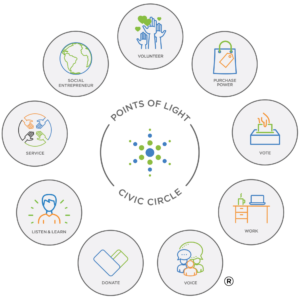 is just that – a tool for us to use in different ways, in different times in our life. When you’re young, you’re less likely to have the expendable income to donate, but you can use your voice and offer your time to volunteer or choose to do a year of service. As you move ahead in your career, you may have more income to use your purchase power and more influence at work to drive decisions like giving time off to employees to volunteer and vote. Eric put it best, saying, “the Civic Circle names power.” And throughout your life, you can combine these powers to advance causes you care about and create a thriving democracy.
Listening and learning is one element of the Civic Circle we can all do, at any time. At our session, Jon Meacham, Pulitzer Prize-winning author and presidential historian, called it curiosity, saying it’s one of three things needed to be successful in our civic engagement work:
- To be curious – engage with and take in new ideas that make you uncomfortable;
- To have candor – be honest with ourselves and others. Intellectual honesty means we can say something good about anyone, and still be critical of those we tend to agree with;
- To have empathy – understanding other points of view from a place of compassion and understanding.
Finally, the best part about our democracy is there is always opportunity. Michael D. Smith, CEO of AmeriCorps, said we should all “own the challenges and opportunities in our community. We have the chance to be part of it.”
And that is one of the most critical parts of democracy. We need to create a culture where we’re all invested, “where we believe we’re better off when we’re all better off,” as Eric Liu said.
Points of Light’s Civic Circle is a cultural catalyst. It can help people figure out how they can best get engaged in their community and deepen engagement for those who are already involved.
Consider how you’re engaging in your community – from your work to your place of worship to conversations with your friends and family. How can we make civic engagement more accessible for everyone and encourage people to be curious, candid, empathetic and involved?
If you’re looking for ways to get started,
visit our Civic Circle page
for videos, digital magazines and action plans to help you get started.
How we show up and take action every day creates the type of democracy we want to be part of. Whether it’s registering to vote, learning more about an issue, using your voice to advocate for a cause or being a public servant, member of the military or working with AmeriCorps. Today, take one extra step toward creating the world you wish to see. We’ll all be better for it.
Add These 9 Reads to Your Civic Engagement Book List
Calling all bookworms! Have you been following our series on ways you can activate around the
Points of Light Civic Circle
? If you’ve checked out our other articles with resources like
apps
,
documentaries
and podcasts you prefer the written word, we’ve got the civic engagement book list you’ve been waiting for.
These books take a deeper dive into the various elements of the Civic Circle, a framework designed to help individuals connect to opportunities and understand that doing good comes in many forms. Written by authoritative voices in their spaces of expertise, these reads are a must for any budding volunteer, donor, social entrepreneur or engaged citizen.
Looking for an easy-to-understand guide on donating responsibly? Advocate Dan Pollotta delivers in this book exploring topics from researching nonprofits to understanding overhead ratios to the actual impact you’re making with your donations. Written for people from all walks of life and of all ages, Dan will demystify donating so you can make better decisions about where and how to give.
American poet, essayist and playwright Claudia Rankine is perhaps best known for her award-winning collection of essays,
Citizen
, but
Just Us
is a powerful confrontation of racism. She demonstrates what racism looks like in the United States – from restaurants to theaters to airports – in this moving arrangement of essays, poems and images.
Using your wallet to make a statement? Influence your clients and customers to do the same? Become a conscious consumer and master marketer for good with this comprehensive guide to marketing based on shared values and a unique brand purpose. Even if you aren’t in marketing, this book can help you more fully understand how the companies you support with your dollar are marketing to you. A must read!
It’s not often we get to peek into the personal lives of military personnel, and even less common for us to hear detailed narratives from women in combat. Journalist Helen Thorpe follows the lives of three women deployed to Afghanistan and Iraq and the effect of their military service on their personal lives and families – over the course of twelve years. It’s a compelling illustration of just what it takes for military personnel to serve their countries.
If only social entrepreneurs had some kind of manual for exactly how to launch their enterprise… psst – they do! This playbook is the authoritative guide on the three phases of the start-up to scale-up process. Written by two Wharton professors, this tough-love approach will help social entrepreneurs avoid common pitfalls and navigate the landscape of solving the world’s toughest issues in innovative ways.
Penned by journalist Erin Geiger Smith, this book looks at the past, present, and future of voting, including the ongoing fight for voting rights. It covers the voting process, actionable steps for voters to take to become more civically engaged, and an examination of why, in the 2016 presidential election, about 40 percent of Americans didn’t vote. Even the most well-versed voter will walk away having learned something new about democracy from this read.
Your voice matters, but using it to better the world is not always clear-cut. Get a leg up with insights about the ways you choose to live your life. Jonah Berger takes us deep into the concept of social influence and how others’ behavior shapes our own. Once we fully understand why we do the things we do, we can decide what we want to to resist and what we want to embrace.
Poverty remains one of the leading issues our world has yet to solve, and it can feel so big and overwhelming that you may not know where to start. Join Peter Singer on this journey of exploration into the current state of global poverty and how you can be part of the solution. You may be surprised at some of the ways you can start working to end poverty right now, in your very own community.
VeraWorks President Bea Boccalandro teaches readers how to transform “meaningless” jobs into purpose-driven ventures in her book about making work more fulfilling. Through real-life stories and plenty of tools, tips and techniques, she offers employees in any industry a way to draw civic engagement into the workforce.
Intrigued? Time to get reading!
Tag us on social media
to share your favorite book from the list, and let us know how it impacted you and your journey of advocating for the causes you care about.
This piece is part of a series that highlights the many ways you can activate the
Points of Light Civic Circle
using various tools.
Check out all the ways you can live your best civic life
.
Local Action Leads to Local Impact: It’s Time to Get Out and Vote
With less than 50 days until midterm elections in the United States, there’s rightfully much talk, news and action focused on the senate, house of representatives and governors’ elections.
And while these elections are critical, they are not the only ones that make a difference in our daily lives. Voting in local elections is equally, if not more, important.
Local elections affect our lives in countless ways we might not realize, and it all comes down to our vote.
In Chicago in the 1990s, due to legislation and ambitious school reform efforts, the Mayor of Chicago gained full control of the school district. At the time shifting power from a local elected school board to mayoral or gubernatorial appointees was a novel idea. The impact of one person to appoint a school board whose governing body oversaw a $6 billion budget, education of more than 300,000 students, and the support of 40,000 employees could not be overstated. And that decision came down to who you voted for in the mayoral election.
Whether it’s the school board, investment in infrastructure for clean water, mental health services for our young and old, or creating more green space and parks, local politics impact every neighborhood and every family everywhere.
I often say that systems are reinforced or dismantled one decision at a time. I’ll double down on that and add that government systems are upheld or dismantled one vote at a time, especially those impacted by local elections.
Did you know that a vast majority of city or county coroners are elected? And medical examiners are appointed, usually by another local official. These individuals hold the authority to mark cause of death on a death certificate. Their determinations lead to or prevent individuals seeking greater due process in questionable deaths, and may impact social justice. The system that perpetuates or changes the status quo is decided by your vote.
Have you ever voted on a local or state ballot or referendum? Those questions can sometimes be unclear and confusing – whether intentionally or unintentionally. And the individuals who write those ballot questions are often elected officials, ranging from attorney general, lieutenant governor or the proponent of the bill.
And, of course, there are the more well-known positions like mayor, governor, secretaries of state, district attorneys, judges, sheriffs and others that influence and control our local and state taxes and laws.
Voting is one of the most important civic actions we can take – not just every two or four years, but as often as we are presented an opportunity, particularly when there is a special referendum or in run-off elections. Voting allows us to use our voices to influence issues that impact our daily lives.
Local action leads to local impact. Don’t cede your power to others. Use your voice in your community. Listen and learn more about candidates who want to represent your community.
Use nonpartisan websites like vote.org to find your state and county board of elections, register to vote, learn where your polling location is and more. Register to be a poll worker and contribute to fair and open elections. We all have something to say. Speak loudly with your vote.
Listen to These 9 Podcasts About Civic Engagement
There are many ways to live a full civic life. Today’s post is part of a series that has already covered
apps
and
documentaries
that can help you reach your civic engagement goals. As we continue exploring ways you can activate around the
Points of Light Civic Circle
, we’re looking at nine podcasts about civic engagement that highlight timely and relevant ways for you to champion social good.
Points of Light’s Civic Circle is a framework designed to demonstrate the various ways that individuals and organizations can lead, lend support and take action for causes they care about. After all, volunteering and donating are important facets of civic life, but doing good comes in many other forms, too. The following list of podcasts* about civic engagement will help you bring all nine elements to life.
*Note: These podcasts may contain mature language or content. Parents and caregivers, we recommend being mindful to listen first, before sharing them with children.
This podcast, brought to you by BBB Wise Giving Alliance Give.org, exists to educate and empower people who are interested in donating responsibly. By showcasing stories of philanthropic leaders, government figures and active donors who have a passion for giving, episodes discuss strategies and tools to help listeners make impactful gifts that stretch far and benefit many.
This episode of the podcast Hidden Brain tackles the idea of “listening and learning” head-on. When we believe we are experts in something, we imagine that we know more than we do. Psychologist Adam Grant discusses what actually happens in the brain when we choose to challenge our own deeply held beliefs.
Green Dreamer is a beautifully produced podcast for those pursuing more environmentally conscious lifestyles. It takes on the concept of capital as a means of expressing deep values
and building a more responsible economy. The podcast features themes of creative transformation as it discusses the deconstruction of harmful economic systems, healing from materialism, addressing global waste and how people can repair their relationship to consumerism.
Each week this podcast interviews a different person with a career in public service to gain insights on why they do what they do. You can hear from U.S. Senators, think tank employees and leaders of advocacy groups on their journeys to public service. If you’re interested in serving in any capacity – whether on your local school board or in national government – this podcast is for you.
This multi-award-winning podcast is sure to move you to action (and possibly tears) with incredible stories of courage and purpose. Finding Humanity takes listeners into the heart of the most complex social and political issues facing our world, featuring global leaders, human rights experts and more. Each season of the podcast zeroes in on a specific realm of advocacy, and the “B Lab Special Series” focuses on people in the business sector who are addressing today’s biggest challenges.
As a United States citizen, one of the most powerful ways to ensure your values are represented in government is to participate in democracy. This nonpartisan podcast examines a different aspect of democratic life each week — from voting to criminal justice to the free press. You might be surprised at what you learn about the origins and issues of these facets of democratic life, as well as what you can do to help build and sustain a healthy democracy.
This riveting podcast highlights impactful people working for social change, including educators, activists, social workers and more. Each guest shares a bit about their personal journey as well as real-life stories from the field. Discussions are honest and bold, with guests leaving listeners tangible tips for getting involved in addressing issues like racism in education, equity in mental health, immigrant rights and responsible crisis intervention.
The Pro Bono Perspectives podcast from nationally-recognized nonprofit Common Impact covers a wide variety of topics, including social impact, CSR, philanthropy, partnerships, climate justice, how companies can take action for racial equity, where pro bono can be a solution for some of society’s biggest challenges and much more. You’ll finish each episode feeling inspired by social impact thought leaders who are creative transformative change in their spheres of influence.
The Fairer Cents podcast is a cheeky, often comedic podcast taking on some serious issues, like the wage and wealth gap, the economics of motherhood and the roots of economic inequality. Whether you’re a woman in the
workplace
or simply curious about the role of your money and career on your personal relationships, this is a fantastic podcast to start exploring big themes.
Now you’re equipped with these nine podcasts about civic engagement you can listen to on your next walk around the neighborhood, daily commute or unwind time before bed. If you find one you really love, tag us on social media to let us know! Remember, educating yourself on the issues is just one piece of the puzzle, so be sure to find ways you can
take action
on the issues once you’ve been more informed through these podcasts. Check out all nine issues of our free digital magazine series
Civic Life Today
for inspiring stories of civic engagement and actionable steps you can take to live your best civic life.
This piece is part of a series that highlights the many ways you can activate the
Points of Light Civic Circle
using various tools.
Check out all the ways you can live your best civic life
.
3 Labor Day Employee Engagement Ideas to Help Busineses Reach CSR Goals
Labor Day is a federal holiday that recognizes the social and economic accomplishments of American workers. It celebrates a proud history that deserves to be remembered and honored. It’s the perfect day for
businesses
to celebrate the
civic engagement
contributions of their employees. Here are three Labor Day employee engagement ideas to help you reach CSR goals, both big and small.
Why Do We Celebrate Labor Day?
Labor Day is officially celebrated on the first Monday of September. Labor activists began advocating for a holiday in the 1880’s. They used their collective
voice
to lobby for a day that would recognize their contributions to the success of the nation – specifically, the prosperity of
the world’s largest economy
. First recognized among individual states, it was eventually deemed a holiday when Congress passed an act to officially recognize it as such on June 28, 1894.
How COMPANIES Can Support Employees on Labor Day
1. Give Employees the Holiday Off, and Pay Them for It
Provide your employees with a paid holiday. This practice can include just Monday, the actual holiday, but may also include the Friday before the weekend. Not only is observing important historical holidays like this an important part of staying civically engaged and culturally relevant, but it allows your employees time to recharge and come back refreshed, which means better productivity. It’s a win-win proposition.
In some parts of the U.S., this holiday can coincide with the first week or two of school, so many parents will be thankful for the additional time off. Employers can largely prevent burnout by supporting employees with regularly scheduled holidays and time off… and a strict no-work policy on holidays whenever possible.
2. Provide Volunteer Opportunities and/or Volunteer Time Off
Offer a paid volunteer day in addition to the holiday. Many organizations opt to host a company-wide volunteer day on the Thursday or Friday preceding the Labor Day holiday. Work with your
Corporate Social Responsibility team
to decide on an inclusive, accessible
volunteer activity
(or multiple activities, if you have employees or different locations.)
Provide clear communication about the volunteer event to your employees in advance so they can plan accordingly. Be sure to share that the time spent volunteering will still be paid. Alternatively, you can provide “volunteer time off,” allowing employees to choose their own volunteer activities. And if you don’t yet have an
employee engagement program
in place, now is the time to start mobilizing towards creating one for your next fiscal year.
3. Review Your Internal Systems and Structures to Ensure Adequate Employee Support
It’s a great idea to do an annual audit of your internal processes and policies – and what better time than around the Labor Day holiday? You might choose to begin with an anonymous employee survey you can send out company-wide to gather current data and important feedback about improvements. In fact, we recommend keeping some channels for employee feedback and suggestions open year round. Often, employees are eager and willing to set up their own initiatives or suggest solutions, but only if they feel welcome to speak up.
Examine your current pay structures, benefits packages and recognition programs. How often are you saying “thank you” to your employees through competitive salaries, insurance plans and paid time off, annual bonuses, paid lunches or corporate retreats? This internal audit is also an excellent opportunity to review your diversity, equity and inclusion efforts. Where do you stack up among other employers in your industry with training and resources on DEI, as well as providing a safe and inclusive environment for your workers?
Above all, remember that your organization simply wouldn’t exist without your employees. Take this opportunity to celebrate Labor Day in a way that will feel meaningful to your workers. Remembering to thank them not only creates a culture of gratitude, it’s the right thing to do.



