Millennials Have Spoken. Here’s Why CSR Professionals Need to Listen.
Over the past two years, with nearly every sphere of society upended by the COVID-19 pandemic, navigating toward a new normal at work and in communities seems almost impossible. But signals from Gen Z and millennials point to a workforce powered by their voices, their involvement, and their desire to tackle society’s toughest problems.
America’s millennials and their activist Gen Z peers are poised to reshape society to a greater degree than any generation since the Greatest Generation. As two million baby boomers retire each year, millennials are projected to constitute the majority of the workforce by 2025 while the number of
. These younger generations are savvy employees and consumers who are checking up on businesses and demanding more social value for their time and money than ever before.
Points of Light, in partnership with research and design firm INFLUENCE|SG, released their latest study on
, which studied the attitudes, motivations and barriers to civic engagement with a special section dedicated to Gen Z.
While it’s impossible to define any group of 72 million Americans, the data reinforce the need for business to evolve or get left behind.
One of the key insights we found was that millennials view social issues through a very personal lens. Whereas volunteering used to be seen primarily as helping other people, this generation sees themselves as among those affected. Businesses need to be social change leaders not just because it’s the right thing to do, but because their millennial workforce is counting on them for support.
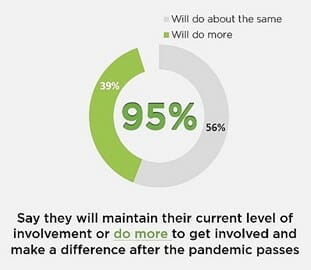
And their own civic engagement is one of the primary ways they’re taking action to change their circumstances. Almost 50% of millennials believe more in civic engagement now than before the pandemic, 69% are more likely to volunteer, and 85% think people should help their community and the world.
Businesses that foster a culture of civic engagement know that it’s not just about staying current. It really does affect the tangibles — like recruitment, retention, productivity, and even the bottom-line.
From a consumer perspective, millennials believe companies should be actively involved in social issues, and two-thirds visit corporate websites at least somewhat often to learn about their efforts when making purchase decisions. Black American males, especially, think companies should meet with consumers about the effects of their products and services.
Here again, we see that being a social change leader is not only good for the planet and its people, but for the companies and their profits. Millennials are the largest generation on the earth right now. Chances are that they currently are, or will soon be, interacting with your products and services.
Corporate social responsibility is a symbiotic relationship between brand and consumer, between employer and employee, between big business and society as a whole. Companies have an opportunity to inhabit this space and drive change as we create our better post-COVID world.
The New Philanthropist: An Interview with Pamela Norley
As president of Fidelity Charitable, Pamela Norley is a leading voice in advocating for the power of American philanthropy across the world. Outside of the office, Ms. Norley volunteers her time as vice-chair of the Board of Directors for Points of Light. She also serves on the boards of the U.S. Impact Investing Alliance, Research Triangle Park Foundation and the Flying Kites School Network.
For those not familiar with the concept of philanthropy, what is it? What makes someone a philanthropist?
For many, the term “philanthropy” has traditionally called to mind wealthy families bestowing large endowments on major institutions. But for me, my idea of what it means to be a philanthropist was shaped by my dad.
Donating was second nature to my father, and he had this knack for knowing what people needed and when he could help. When he ran his own business, he made sure all his employees had turkeys at Thanksgiving and Christmas and hams at Easter. And it wasn’t until later that I learned that he anonymously paid off the mortgages of neighbors whose homes were in foreclosure and bought suits for local high school students interviewing for college.
My dad really embodied the original meaning of philanthropy—”love of humanity”—and, luckily for the world, he’s not the only one. Increasingly, we’re finding that people are embracing this much more broad and multifaceted definition.
Recently, donors—particularly those of younger generations—are thinking beyond traditional monetary donations to 501(c)(3) organizations and reframing the concept of philanthropy as any act of social good, whatever form it takes. That could besharing your time through volunteering, using your social media platform to advocate for a cause or changing your consumer habits to better align with your values. To put it simply, anyone sharing their time, talent or treasure to make the world a better place can be a philanthropist. And we’ve really seen this more accessible and inclusive definition resonate with younger donors. In fact, three-quarters of millennial donors say that they consider themselves to be philanthropists, compared to just 35 percent of Baby Boomer donors.
How are the ways in which younger generations, such as millennials and gen Z, make decisions about how and where to make philanthropic contributions changing?
We certainly see younger donors approach their decisions differently than donors of older generations. We see younger donors prioritize contributing to small, innovative organizations where they can easily see the effectiveness of their support. We see peer-to-peer advocacy creating an influencer culture around donating. But this question really goes far beyond how younger generations approach charitable giving and gets at how they approach life.
Younger generations are finding ways to integrate their values around philanthropy into everyday decisions. For their parents or grandparents, donating has often been siloed as an action separate from other aspects of daily life, but younger donors take a more holistic approach. It is now second nature to consider the social benefit of their actions before making a decision. They choose products from brands like Warby Parker, TOMS, or Bombas that incorporate social good into their business models. They leverage major milestones like birthdays and weddings to fundraise for their favorite causes. They consider a company’s corporate social responsibility when deciding whether to take a job offer. And these are just a few examples. Particularly for these generations, it’s no longer about charitable giving; it’s about charitable living.
What can older generations learn from younger generations about investing in the issues they care about?
To me, the greatest lesson from younger generations’ philanthropy is the power of using your voice to increase the power of your dollars. Many older donors don’t want their donating to be visible, which may be related to feelings that anything connected to money should be handled privately. But younger generations understand the power of sharing and making the causes they care about more visible. Even if you aren’t able to afford large donations, you can use your voice to share favorite causes or organizations and to ask for others to support the same issues. Every post and interaction is an opportunity to plug into something bigger and make more of a difference.
Recent research has shown a growing trend by younger generations to donate to individuals versus the organizations themselves. Why is it important for people to also donate to nonprofits?
For many, giving money directly to an individual or family is one of the most tangible ways to support others. With the growing accessibility of online platforms such as GoFundMe, Patreon or DonorsChoose—and younger donors’ strong focus on seeing the demonstrated impact of their donations—it’s no surprise that direct donations are an appealing way to engage in philanthropy.
However, through their on-the-ground experience, nonprofit organizations are centers of knowledge and expertise in addressing the challenges that their communities face. They also may have greater visibility into the populations who leverage their services. Further, unlike one-to-one gifts, nonprofits work at scale to help a greater number of people with a similar donation. For example, Feeding America reports that they are able to provide 10 meals for every $1 donated. This combination of expertise and efficiency enables organizations to set up systems that can transform whole communities.
Finally, while donating directly can make an immediate impact in meeting one individual’s request, the underlying systemic issues that influence those requests continue to go unaddressed. Often, nonprofit organizations not only work to provide direct services, but also advocate for systemic change at the policy level. That scope of work is much more difficult to organize and manage on the individual level.
How can donating be a pathway to deeper civic engagement (volunteering, using your voice, etc.)?
Above all, I hope donors understand the full breadth of ways that they can make an impact on the world. Sometimes it starts with just one donation, sometimes with a vote, sometimes with a simple ”like” on social media. All of these are great entry points to making more of a difference, and they can build on each other over time.
I’m reminded of Fidelity Charitable donors Peter and Kendra Amico. They believe that passion for a cause should inspire your donations, but that the opposite is also true. In addition to donating to causes that they care deeply about—those that are top of mind and heart because of a direct experience—they also give to causes that they
want
to care more about, including issues outside of their experience and maybe their imagination.
When you put your money toward something, you begin to care more about it and become personally invested in progress in that area. And that new passion can be the inspiration needed to engage more deeply, through volunteering and speaking up for those who need your voice even when it’s tiring or difficult.
A Deeper Look at Social Intrapreneurship: An Interview with Mark Horoszowski
Mark Horoszowski is the CEO at MovingWorlds, a social enterprise that helps companies scale their social impact programs by engaging employees. Markis a founding adjunct faculty member and lecturer on Corporate Social Responsibility at the University of Washington Tacoma’s Center for Leadership and Social Responsibility.
Tell us more about social INTRApreneurs.
We tend to be eager to create these exciting new labels or get people to self-select as “social intrapreneurs,” but the reality is that most of the people we call social intrapreneurs do not identify themselves as that. They are simply individuals trying to make their company and the world a little better. In fact, I’ve spoken to a lot of people that run away from this label as they fear it could have a negative impact on their career.
So my first piece of advice here is to ditch the label and start small. In our guide for social intrapreneurs, we suggest that companies need to both “do less harm” while also contributing to “do more good.” Let’s take a marketer as an example. A marketer can “do less harm” by ensuring that any place that they are paying to place advertisements exists for social good. This past year we saw so many ironic combinations – like companies that were lambasting fake news websites, while their ads were showing up on these very sites and, in turn, providing a financial incentive to these websites.
Alternatively, marketers can “do more good” by reimagining their marketing strategy and shifting away from traditional efforts to cause-based marketing campaigns that direct all their marketing spend to social causes. You don’t need to be a fancy intrapreneur to propose this, rather, you need to be a strategic marketer that analyses your assets and thinks about using them in ways that reduce harm and contribute to the sustainable development goals.
Many people are familiar with social entrepreneurs – those that start their own organizations to solve a problem. But what are social intrapreneurs? And what’s the difference between the two?
My colleague created a simple infographic to explain this difference here. The basic idea is that a social ENTREpreneur finds a new business model to create a social impact. A social INTRApreneur finds a way to make an existing business model create more social impact.
Social intrapreneurship sounds like being an advocate. How are they the same? Different?
Coming back to the idea of labels, I do think that we miscategorizethese individuals. An advocate does things beyond the company’s existing business model and operations to create a more sustainable and equitable enterprise – like advocating for employees on the board, organizing walkouts, campaigning for unions, etc.
We definitely think there is a need for employee activists, but this is different from intrapreneurship. An intrapreneur is working directly in the core business, marketing, supply chain and other day-to-day operations to increase the competitiveness of the enterprise while making a positive impact and/or creating less harm.
Can you tell us about social intrapreneurs you’ve worked with in the past? What impact did they have?
Ricardo Wagner at Microsoft may be one of the best examples I’ve seen because he has found ways to be an intrapreneur in every role he has served in. Ricardo has long been passionate about accessibility in software. While on a skills-based volunteering project through the MySkills4Afrika program, he realized that there were inequities in some algorithms, and so went to the technical leaders to help them understand how their technology could be improved.
As time went on, he saw a bigger need for accessibility, but since he is not an engineer, he could not influence this directly. Instead, he started working with partners to understand their needs, and then brought his findings back to the business as a business opportunity, showing how Microsoft could financially benefit and accelerate progress towards its mission by building more accessible software. His work led to massive business deals with the Canadian government.
He didn’t stop there. From this, he learned that there was even more that could be done and then assembled a team to generate a new technology and business model around accessibility. I love Ricardo’s story because he shows that you can start small and then keep growing as you see more opportunities, and do that in a way that is positive to your own career.
How do you gain buy–in from others, including leaders?
In our MovingWorlds Institute and corporate CSR workshops, we talk about the need to “immunize corporate antibodies” and “navigate the naysayers.” Most guides on social intrapreneurship will talk about the need to build the business case, align with corporate priorities and mobilize champions – and indeed this is critical – but it takes just one naysayer to block an initiative like this. As such, it’s important to spend time identifying who may block your idea, and then figure out how to convert them to champions (or at least have them not be a blocker.) We recommend starting with systems-mapping and building executive sponsorship as early as possible to help navigate these naysayers.
Being a social intrapreneur isn’t for everyone. How can others support a social intrapreneur within their own organization without becoming one themselves?
I agree with this, but I think it’s because we want people to be these big and audacious social intrapreneurs. Look – most people don’t want to be intrapreneurs. It’s risky. It’s hard. I think we need to change the conversation and show that every person, no matter their role, can make small changes that can make an important difference. In our guide explaining how professionals can use their job to help contribute to the Sustainable Development Goals, we tell people to simply start conversations with their colleagues to brainstorm how they can both reduce the harm they may be creating in their day-to-day jobs, while also contributing to positive progress.
Delivering Hope
Laura Lane, UPS Chief Corporate Affairs, Communications and Sustainability Officer
In spite of the challenges brought on by the COVID-19 pandemic, I remain optimistic. In these mettle-testing times, the generosity of the human spirit has remained strong. Even amid social distancing, we’re still finding ways to connect with each other and help communities around the world.
These moments of shared humanity provide an important lesson:
We need one another
. We cannot allow this pandemic to create divisions among us —
we are stronger together when united in purpose
.
Collective Momentum
Even before the pandemic, there was a critical need for community engagement. But now with the virus taking its toll on economies around the world, the number of people in need has skyrocketed.
inspires us to action at a time when collective momentum for volunteerism has never been more critical.
In my role as UPS Chief Corporate Affairs, Communications and Sustainability Officer, I have seen how our half-million UPSers have risen to address our world’s most daunting challenges during the past year. That UPS mindset for engagement is reflected in our purpose statement:
Moving Our World Forward by Delivering What Matters.
To us, giving means more than just writing a check — it means combining our skills, passions and time with our logistics expertise, transportation assets and NGO partnerships to make a measurable difference in our world.
And delivering hope for people and our planet means setting ambitious goals for engagement where it matters most. We already met our goal of providing more than 20 million volunteer hours a year ahead of schedule.
In response to some of the past year’s social unrest, we took on a new commitment to advance equity and justice by dedicating more than 1 million more volunteer hours toward Black and underserved communities.
And in our effort to address climate change, we also set a new goal of planting more than 50 million trees by 2030, including the 15 million we already planted. We know the world is counting on us to deliver what matters, which is why UPS will continue to drive meaningful change wherever we can.
Driving Meaningful Change
As essential workers throughout this pandemic, UPSers have delivered everyday essentials and critical PPE; we have helped businesses reinvent their supply chain strategies; and now, maybe most importantly, we are delivering lifesaving vaccines around the world to help defeat this virus.
Service is in our name, and we will continue to serve in every way we can. So, as we celebrate Points of Light’s Global Volunteer Month, we hope our incredible UPSers help give everyone good reason to be optimistic about our future because we know delivering what matters means delivering hope.
Three Things the Pandemic Revealed About Employee Volunteerism
It’s been exactly 13 months and one week since the World Health Organization declared COVID-19 a global pandemic. So much of the world and our daily activities stopped or, to use the latest term in ”corporate buzzword bingo,” pivoted to fit within the latest health and safety guidelines and the new realities of so many working from home.
As we celebrate the second annual
, we ask two questions: what has the global health crisis illuminated about employee volunteerism and where should we go from here? Simply put, the pandemic has forced the rapid evolution of the field and has expanded what we do, how we do it and who we do it for.
What we do
Not since the early 2000s, which gave rise to enterprise-wide “days of service,” has there been such a remarkable change in the way companies meet the needs of communities while continuing to build their internal culture of service. Corporate social impact strategies increasingly include nontraditional volunteerism like informal acts of kindness for neighbors and strangers, employees expressing their voice by attending a march, listening and learning about deep-rooted community issues and the push for voting access. And why not? Serving others aligned with a 501(c)3 nonprofit partner isn’t the only way we build community. While having a trusted partner is important when it comes to liability issues and impact reporting, perhaps the old school way of volunteering has discounted the ways local communities have solved problems for decades.
Attention is now focused on developing new norms and standards, tracking and measuring the impact of informal volunteering and civic involvement. Inputs and outputs might remain similar to traditional volunteerism but standards and frameworks for measuring outcomes is evolving to include these new ways of engagement.
How we do it
New ways to serve and measure have certainly leaned heavily on technology to support the transition. CSR leaders quickly integrated virtual volunteering into their strategy and infrastructure. Engaging remote employees, who previously were often afterthoughts when developing large-scale, market-based, in-person service events, became the focal point. While not a new volunteer concept, many more companies have incorporated the use of technology to create connection and community, even doubling-down on skills-based volunteering to help partners turn in-person opportunities into virtual solutions. At the same time, nonprofit partners have had to make significant shifts to their volunteer operations to adapt their need for volunteers to the digital environment.
Because there will be more remote employees who either rarely or never come into the office, we’ll need to continue finding creative ways to symbolically bring them together to continue building a values-based culture. At the same time, we must realize that supply-heavy projects that also require shipping can put quite a strain on budgets, not to mention the “Zoom fatigue” that occurs when virtual service is added to an already long day of virtual meetings. Family integration will also be important for these employees as work and life continue to blend.
And will these activities – whether remote or virtual – still strengthen our bonds to each other, to the community and to the company the same way they do through in-person service? It is a moment of growth and expansion and for new proof points for social impact investment.
Who we do it for
As community needs increased during the pandemic, a host of inequities were exposed. Those most vulnerable in our society were much harder hit by the virus, being statistically more likely to get sick and lose their jobs, their homes and their businesses. The pandemic led to all-time highs in poverty, food insecurity, evictions and mental health challenges. Small businesses took a massive direct hit. Women left the workforce in droves to help with family needs while many BIPOC community members worked the hard, necessary jobs that couldn’t shut down or be done remotely. Students transitioned to distance learning and the digital divide was highlighted as more and more households needed computers and reliable internet services. No doubt this digital divide, along with an incredibly difficult environment for learning, will disrupt the future talent pipeline. The realities and impacts of systemic racism and social injustice called us all to a new moment of consciousness and a new responsibility for change leadership.
In the midst of fragile public trust, companies must continue to step up, not just by issuing public statements of support but by integrating equity into their existing business practices in authentic ways. CSR leaders will need to reinforce the mantra of “serving with, not for,” expanding employees’ world view and deepening opportunities for personal growth and change. The powerful opportunity to align equity solutions with employee civic engagement will require testing of strategies and sharing of outcomes to deliver new definitions of best practices. Employee civic engagement is a strong bridge between solving equity issues and developing collective empathy and it can help to build more just and equitable communities and community leaders.
We’ve come a long way since last year and we continue to witness powerful changes inside our companies, in our communities and within our daily lives that will define a ‘next normal.’
Fidelity Continues to Deepen their Commitment in the Communities they Serve
Last year has been unlike any year in recent times. As we tackled a global pandemic, we also were confronting issues of social justice and racial equity. As employers operating in this “new normal,” we should all be asking ourselves, “What does corporate volunteerism look like in 2021? How do you continue to create authentic community engagement?”
The importance of corporate social responsibility has grown over the last several years. Consumers increasingly value companies not just by what they produce, but how responsibly they operate as a business.
At Fidelity Investments, we paused to take a deeper look at our community relations efforts and listen to our nonprofit partners. Our goal was to focus on better aligning our community relations efforts with our expanding focus on diversity and inclusion.
“We are deepening our commitment to supporting racial equity across all of our programming and partnerships, and finding new ways to understand and support the underlying issues that underrepresented and underserved communities are facing”, said Teresa Pelletier, Vice President of Community Relations.
For a decade, Fidelity volunteers have helped beautify school campuses in regions where Fidelity has a large employee presence by painting classrooms and building outdoor seating. While the work we’ve done at schools has been a tremendous help to our partners over the years, we will begin to look even deeper into the issues that the students in our communities’ face. In partnership with Points of Light, we have evolved our School Transformation Day programming to a Season of Transformation for 2021.
The Season of Transformation will focus on “listening, responding and reflecting.” Our Points of Light Global Network affiliates will convene nonprofits in the communities and Fidelity associates for Listen and Learn sessions. The goal is to help Fidelity associates better understand the systemic issues affecting students and local communities and the challenges within the education sector and get connected with the ecosystem of community partners supporting students and their families.
Fidelity volunteers, working with Points of Light, will respond by designing meaningful and impactful virtual or at-home projects and programming to supply local schools with much needed resources.
Lastly, once the programming has been completed, Points of Light Global Network affiliates will help our volunteers reflect on the impact of their collective efforts and understand how they can act in their communities to support sustainable change.
By focusing and better understanding the needs of underserved communities, while adapting to a virtual environment, we are continuing our focus of supporting the communities where we live, work, learn and serve.
Employee Volunteerism and the Impact of Purposeful Partnerships
Companies have a unique and critical role to play as partners in fostering a thriving society. As both business and civic leaders, companies are responsible for serving the diverse needs of employees, customers, community partners, investors and neighbors. At their best, they share their resources and act as trusted counsel, collaborators and problem solvers. Employee volunteerism is an integral component of this equation.
Every company is born out of an idea to provide a product or service to meet a human need. As an energy company, Phillips 66 makes products people use every day – our fuels and products are an essential part of connecting, feeding, clothing and caring for the world’s growing population. We are in business with one enduring purpose: to provide energy and improve lives.
How does our company live its purpose to better society? We create purposeful partnerships – with our employees, nonprofit organizations, academia and community leaders. Together, we openly share the best of our resources, and collaborate to solve society’s greatest challenges. Our partnerships in local communities go well beyond philanthropic giving and product donations.
At Phillips 66, we seek to build purposeful social impact partnerships in multiple ways. We:
Provide community organizations with funds to meet strategic, changing and urgent needs.
Provide people power – from skilled volunteerism and leadership to simple acts of volunteer service.
Share intellectual capital and expertise.
Utilize company resources, facilities and equipment.
Help partners expand their relationships and networks.
One example of a purposeful partnership in action is our Phillips 66 multitiered collaboration with the American Red Cross. Through this partnership that we view as a “gold standard” we:
Dedicate an executive to serve on the Houston Red Cross Board of Directors.
Provide significant, annual, financial contributions to support natural disaster preparedness and response efforts.
Volunteer our time by donating blood, serving meals and building hygiene kits for those in need.
And at the onset of COVID-19, our Phillips 66 board member and the Houston Red Cross CEO initiated weekly calls to discuss best practices and learnings from the Phillips 66 Health, Safety and Environment team, which the Red Cross used to help safely open its facility as a dedicated location for blood and plasma drives.
Like many companies, Phillips 66 was eager to step up and offer its resources to help relieve the burdens of the pandemic. We shifted our involvement to meet the greatest and immediate needs of our partners. In support of the Barbara Bush Houston Literacy Foundation, we reallocated funds to include book donations as part of meal distributions in public schools and to transform educational summer camps to virtual learning opportunities. In communities around the country, we also donated personal protective equipment, sewed masks and made face shields with 3-D printers to distribute to community members, worked with a local food bank to redesign the food service model to meet COVID-19 safety standards, and significantly increased our social impact investment.
We have created a powerful model for change by working with a shared purpose and in partnership with community organizations. As we celebrate
this April, it’s a good time to consider how we can be most effective in sharing our collective talents, resources and time.
This month, alongside Points of Light, Phillips 66 is proud to mobilize a global call to volunteerism. Let’s connect with our neighbors, empower community partners and engage citizens to join in service.
affiliates across the country to revitalize school learning environments with the goal of supporting students in achieving academic success. Through our School Transformation Day project, employee-volunteers roll up their sleeves for school beautification projects, from painting walls to building outdoor classrooms. This annual event has become a favorite of employees, attracting more than 20,000 Fidelity volunteers in the last 10 years.
This year, due to COVID-19, our decade-long, beloved School Transformation Day was at risk of cancellation. But at Fidelity, we believe that long-term change and success comes through collaboration, listening and adapting to the needs of our communities. And that is exactly what we did. Throughout the regions, our community relations team worked closely with local Points of Light affiliates to understand our community partner’s top needs and priorities during the 2020-2021 school year, mid-pandemic. We also engaged our passionate colleagues across the country to gauge their interest in completing community projects from home, with their families.
New York-New Jersey Season of Transformation
“Despite the unusual nature of 2020, we saw that our employees, while working in a virtual environment, were even more enthusiastic about supporting community,” said Heidi Siegal, vice president, community relations at Fidelity Investments. “Our people are our greatest asset.”
As a result, we pivoted School Transformation Day to a fully virtual, experience reflecting the unique needs and difficult challenges of each community. Our community relations team consistently heard three themes: COVID-19 safety needs, support of virtual learning and addressing the digital divide.
Fidelity assisted schools and nonprofits with replenishing the resources utilized throughout the crisis to meet the ongoing needs of students including COVID-19 safety kits, face shields, contactless thermometers and touchless water fountains.
Employee volunteers focused on the social and emotional support of students. Working at home with their families, volunteers created mindfulness kits and recorded guided meditations and beginning yoga videos for students as part of one school’s new self-regulation room sponsored by Fidelity. Volunteers also created inspirational canvas art to hang in hallways, garden kits for students to build their own gardens at home, classroom safety signs, reading corners to promote literacy and even tie-dyed t-shirts for the students.
Additionally, volunteers placed over 380 Amazon Wish List orders which provided schools with more than 4,000 individual supplies including notebooks, folders, paper and snacks.
A mom and daughter create a mural together in Texas.
Through our community partners we learned that the pandemic exacerbated educational inequalities among students, and none more critical than the lack of access to technology for Black and Brown students. In response, Fidelity committed to providing technology resources for educators and students to effectively engage in remote learning. Students in schools where Fidelity has a presence received equipment needed for virtual learning including iPads®, Chromebooks™, earbuds with mics and lap desks. Many teachers also received a second monitor to enhance their online teaching experience. Additionally, community partners like the Boys & Girls Clubs, which throughout the pandemic have become centers of education by extending their hours to support virtual learning, were supported with enhanced Wi-Fi and additional equipment.
Community and school partners were also supported through a series of grants made in each region. The grant funding was used at the discretion of the recipients to purchase safety and cleaning equipment needed to combat COVID-19, technology for students and teachers, virtual curriculum and more.
“Our strong partnership with Points of Light and the commitment of our employee volunteers make it possible for Fidelity to continue impacting communities,” said Siegal.
The 2020 annual School Transformation Day involved more than 620 employee volunteers and their families virtually connecting with 14 schools and organizations across the country impacting more than 28,000 students and nearly 500 teachers.
Virtual Volunteering: How 2 Companies Shifted Their Days of Service Online Amidst the Pandemic
Like many other aspects of our lives, employee civic engagement – mainly traditional employee volunteering – has been considerably affected by recent global events. Restrictions imposed to protect the health and safety of communities worldwide have forced well-planned company-wide galvanizing moments of service to be either postponed or canceled.
Despite the complete upheaval to everyone’s daily life, Points of Light corporate partners have responded to the initial outbreak of the COVID-19 crisis, provided emergency relief and adapted to a new working environment. We are proud to tell the stories of some of our long-standing corporate partners that have built on the sense of community, history of supporting one another through the crisis and provided opportunities for their employees to be part of something bigger through their annual days and weeks of service.
The Vertex Day of Service has been an annual tradition for Vertex employees for the past 12 years. Vertex moved forward with their Day of Service celebration this year, making a few key changes to ensure safety and provide employees with a variety of ways to get involved:
Expanded the time for employees to get involved. Instead of reserving a day for community engagement, Vertex employees could take some time and engage in activities during the week of Sept. 28 to Oct. 2, 2020.
Expanded the range of volunteer opportunities. Vertex curated and offered remote, virtual or outdoor activities for employees in partnership with several different nonprofit partners.
Vertex partnered with Points of Light and our Global Network of innovative volunteer-mobilizing organizations to create custom remote and virtual employee volunteering opportunities in eight countries. Through the joint effort, we mobilized 195 volunteers that were engaged in 18 different volunteer activities, interacting with 23 local nonprofit organizations. Volunteer opportunities for Vertex employees included:
An online career day with students from a high school in Warsaw, Poland. Vertex volunteers reviewed the high school students’ resumes, provided feedback, discussed career pathways and participated in a job interview simulation exercise.
An at-home activity in Rome, Italy, where volunteers spent time assembling creative objects to help two local nonprofits support their programs and activities.
An at-home kit-building activity in Sao Paulo, Brazil, where volunteers put together supply kits to donate to 250 children.
“While our Day of Service may have looked a little different this year, we knew our employees were committed to supporting our community partners more than ever,” said Amy Seto, Vertex Pharmaceuticals. “Working with Points of Light and their local affiliates allowed us to expand our ideas of service while giving back to those most in need.”
One day each year, Casey Wasserman invites Wasserman employees and athletes to volunteer during the annual Wasserman Serve Day hosted by the Wasserman Foundation. With this year marking the 10
th
anniversary celebration of Serve Day, Wasserman company and the Wasserman Foundation especially wanted to show employees that the spirit of kindness, generosity and community involvement is more needed than ever.
Points of Light Global Network affiliates organized remote and virtual employee volunteering opportunities for Wasserman offices in nine cities across five countries. On Oct. 1, 2020, more than 550 Wasserman employees joined a variety of volunteer activities that included:
Writing articles, creating games and trivia quizzes, and putting together a printed newspaper that was distributed to more than 5,000 seniors in residential care centers across the Netherlands.
Assembling art-supply kits and creating simple, personalized art for youth served by a local nonprofit in Portland, Oregon.
Creating educational videos for children, encouraging them to learn and look into STEM subjects in London.
“The Wasserman Foundation was thrilled to partner with Points of Light to host the 10
th
annual Wasserman Serve Day,” said Cassidy Carol, Wasserman Foundation. “Points of Light went above and beyond to ensure that our first ever virtual events ran smoothly and were still fun and engaging for the volunteers. Their vast network of nonprofit partners around the world allowed us to curate impactful projects in 9 cities across 5 countries.”
The CSR leaders from these companies had the inspiration and courage to think more creatively about enabling their fellow employees to be involved fully and flourish. By continuing to coordinate company-wide days of service, they met the expectations of addressing current pressing community needs while harnessing employees’ passion for serving.
Points of Light remains committed to working alongside community-focused companies and corporate social responsibility leaders in this challenging work. From employee activation to consulting custom programming, we are here to make your ideas a reality. To learn more,
What the 2020 Civic Engagement Research Reveals for Businesses
“What’s next?”
How many times have you asked yourself that question since March? Planning for social and civic engagement has become an art of “if-then” scenarios as companies and their employees, nonprofits, and communities respond to the pandemic and the mental health and economic damage it continues to create for so many people in neighborhoods around the world.
What if the answer to “what’s next” was hope and action?
Perhaps we see a glimmer of that already. People are helping each other – whether it’s marching for racial justice, showing up to food banks and food pantries, helping to bring internet connectivity to communities and gathering laptops for at-home learning, or making masks and
to give to those in need.
To better understand the future of civic life and identify a path forward for businesses, nonprofits, and individuals, Points of Light and partners Carol Cone and Hart Research conducted a study, with generous support from AT&T, surveying adults in the United States about their attitudes, behaviors, barriers and motivations for civic engagement. In September 2020, Points of Light shared the results in a new report entitled “
.” This research offers the most current and comprehensive look into the state of civic engagement today, a universal desire to do more in the future, and how we can help convert good intentions into positive action.
How will businesses step up?
The research reveals the potential of this global health crisis to serve as a catalyst for a new era of civic engagement. It’s an era where businesses like yours are expected to lead and serve in partnership with nonprofits and communities. Your Gen Z employees come with expectations for engagement and social action that is outpacing any living generation.
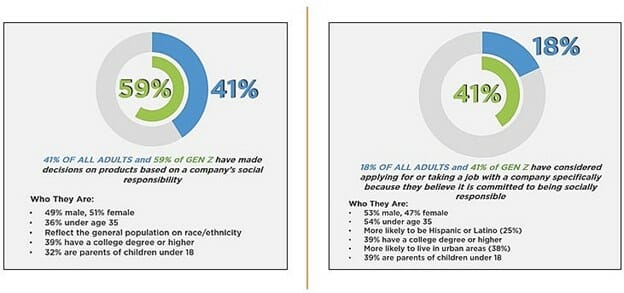
Business, organizations, and governments must prepare to meet this generation’s high expectations for social responsibility. Not only is Gen Z the most likely to have decided about purchasing a product based on a company’s social responsibility, but they are also most likely to consider a company’s social responsibility when applying for or accepting jobs. Businesses stand to lose both customers and talent without robust civic engagement and social responsibility.
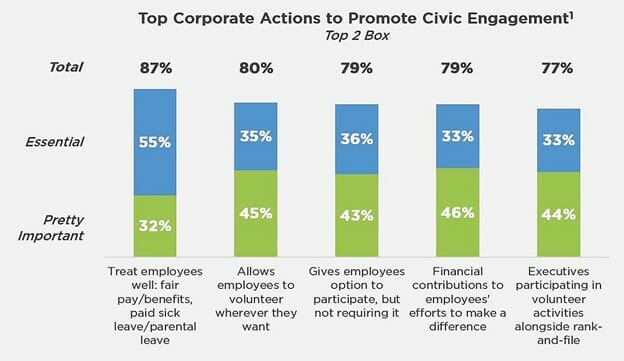
But, what does robust corporate civic engagement and social responsibility look like? In today’s age of corporate social justice, employee welfare and empowerment are top priorities as presented in the chart below. Providing opportunities for interested employees to volunteer in their communities, perhaps alongside top executives, and offering matches to employees’ donations of time and money are also important actions for any company that wants to promote civic engagement while also attracting and retaining talent and developing strong, positive relationships with their customers.
For 20 years, Edelman, a global communications firm, has studied the dynamic shifts in trust in the four major societal institutions: government, business, media and NGOs. The
indicates that 68% of respondents agree that companies can take actions that both increase profits and improve conditions where they operate. There is no longer any doubt that doing good can help a company do well – and this “if-then” statement is a clarion call to all business leaders.