Honoring Those Who Served: Reflecting on Veterans Day
During November, in celebration of National Veterans and Military Families Month, we turned to a leader who works at the intersection of two components of the Points of Light Civic Circle® – service and work. Meg Hendricks, Head of Military & Veterans Affairs at Fiserv, who is also an Army Veteran, has responsibility for Fiserv’s military and Veterans programming. Through a U.S. military and veterans engagement strategy called Fiserv Salutes, Fiserv, a long-standing partner of Points of Light, provides the military community with career opportunities, educational resources and business solutions. Fiserv was recently ranked #1 on the Military Times Best for Vets Employers list and has been ranked in the top 10 for the last seven years. Read on for her advice to fellow veterans and her challenge to you – our readers.
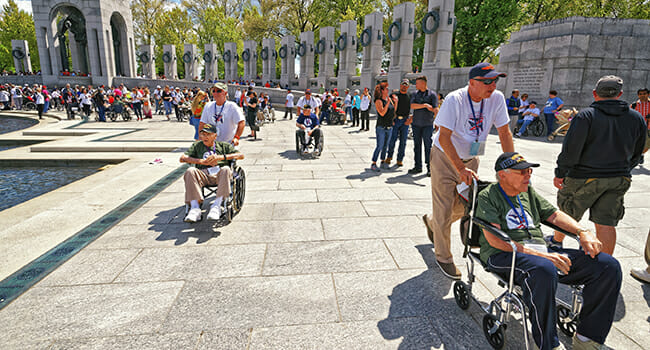
Every year, on November 11, the United States and several other countries around the world come together to honor and reflect upon the service of our veterans. It is a day to pause, reflect and express our deepest appreciation for the bravery and dedication of these individuals. One of the most powerful aspects of Veterans Day is that it is not limited to a specific branch of the military or a particular conflict. It is a day to honor all who have served. It’s an opportunity to recognize the sacrifice made by the soldiers, sailors, airmen and marines, as well as the countless support personnel and their families.
So, what does it mean to be a veteran? It could mean that you served in a time of war or in a time of peace. It could mean that you served for two years or more than 30. Why is it that one of the most valuable things about being a veteran is comradery and kinship? I feel it with all those who have served. Which is why as I reflect on Veterans Day, after spending another year at the NYC Veterans Day parade, I can’t help but feel so honored that my job is to support my fellow veterans and the whole military community through my role as Head of Military and Veteran Affairs at Fiserv.
I believe that providing support and assistance to those who have served is a great way to give back to the military community. So, coming from someone who has worked in this space for almost a decade and is also an Army Veteran, the following are a few of my suggestions to those who have served:
Start with One
There are so many resources and service organizations out there, it can be daunting to try to navigate them all. So, start with one. Veteran service organizations have become more and more connected over the years and if the one you start with isn’t the right one, I know they will send you in the right direction. It may take some time but keep a list of those connections along the way, you never know when you might need them or could be helpful to them in return.
Ask For Help
Let’s face it, it has been shown time and again that veterans are not good at asking for help. Studies have found that seeking help can be associated with stigma, particularly among veterans. Furthermore, these studies reveal that while many veterans express concerns about being negatively judged if they were to seek mental health treatment, they hesitate to judge a fellow veteran negatively in a similar situation. This highlights the complex dynamics of help-seeking in the military community. Break the cycle! Ask for help! If you think about it, being a military veteran means you are part of one of the biggest alumni groups in the world. So, reach out; the worst that can happen is that you get no response or someone says no. However, the likelihood if you reach out to someone in the military community or who supports the military community is that, if they can’t assist, they will point you in the right direction.
Leverage Your Network
Networking is a powerful tool. I know you may feel like this is said too much, but your network truly is your net worth. I cannot tell you the number of times I have leaned on my network to provide support both personally and professionally. The great thing about those of us who have served is we are always willing to pick back up where we left off. So, call your old battle buddy, reach out to a fellow service member on LinkedIn, go to military-related events in your local area, seek out virtual events that will be helpful. Figure out a way to engage and expand your network in a way that works for you.
Your Health is Your Wealth
How many of us completely stopped working out when we got out of the military? Or said, “I’m going to take a break from it” and then never fully got back into it? I bet quite a few. Yes, there are those who continue to maintain a strict schedule, but there are others who drift away from it when it is no longer required and planned for us. Or maybe life just got in the way. Physical activity is often the thing that gets taken off the schedule when things get too busy. So, my best advice is make taking care of yourself a priority and find the things that you enjoy that also keep you active, both mind and body.
Your Work is Important
What you choose to do professionally after service is important. You spend a huge chunk of time at your job, so it is smart to take some time to determine where you fit. There are a ton of resources out there to help you find the best company for you. Notice that I said “the best company” not the best job. Yes, the organizations that provide employment assistance will also help you with identifying jobs but in my opinion, it is more important to find a company that fits with your values, morals, lifestyle. Once you start working at that company, then there will be opportunities for internal mobility if the first job you take is not the best fit.
None of this advice is earth shattering or new, but it may be a helpful reminder. On that note, remember that no matter how long it has been since you transitioned from active duty, it is all part of the journey, and it’s okay to seek help and advice along the way. Your military experience has equipped you with valuable qualities that can contribute to your success in the civilian world. It is my belief that the best thing that we can do for our fellow brethren in the military community is lift them up, meet them where they are, and give them the support they need when they need it. As my Navy friends say, “A rising tide lifts all ships.” My challenge to you, whether you are a veteran or not, is to find some time to help a veteran this holiday season.
For more information on ways Fiserv supports the Veteran and military community, please visit the Fiserv Salutes web page.
4 Ways to Observe National Veterans and Military Family Month
When was the last time you thanked a military member or veteran for their service? November is National Veterans and Military Family Appreciation Month, and Points of Light is highlighting ways you can celebrate, support and honor our service members. Here are four ways you can get involved, from volunteering to donating and beyond.
1. LISTEN AND LEARN WITH AN EDUCATIONAL PODCAST
Before acting on an issue, understanding it is essential. This is where listening and learning comes into play. When we are informed and educated about an issue, we can think more critically, make better decisions and lend stronger support.
Military OneSource has created
for military members and families to equip them with the knowledge and resources they need to thrive. Topics include deployment, recreation, casualty assistance, relationship health, money management, parenting resources and how to care for family members with special needs.
See how military veteran and Daily Point of Light honoree Michael Wisecup continues to serve by running a camp for children and families with life-threatening illnesses.
2. VOLUNTEER AS A VIRTUAL CASEWORKER FOR MILITARY FAMILIES
Volunteering is a crucial part of leading a civically engaged life and driving real and sustained change in your community. This type of hands-on support is some of the most impactful in the nonprofit sector, and organizations rely heavily on volunteer power to carry out their missions. The American Red Cross is
caseworkers for military members, veterans and families. This volunteer role requires some training, but it can be carried out from anywhere, and shifts are flexible.
If you’re looking for other remote volunteer opportunities or want to find an in-person opportunity in your area, search Points of Light Engage, the world’s most comprehensive database of volunteer opportunities around the globe.
See how Navy servicewoman Daily Point of Light honoree Michaela White advocates for mental health in the military.
3. DONATE TO VETERANS, SERVICE MEMBERS AND THEIR FAMILIES
Donations to nonprofits remain critical in helping these organizations address the issues that matter most to us, societally and personally. Nonprofits and NGOs are dependent on donor support to pay their staff, recruit volunteers and execute their high-impact work. This year marks
, and you can support their mission by making a donation for National Veterans and Military Family Appreciation Month.
Wounded Warrior Project has been serving and supporting over 1 million post-9/11 wounded veterans, service members and their families since 2003 – through career and VA benefits counseling, mental health support, adaptive sports initiatives and more.
4. CELEBRATE AND HONOR VETERANS IN YOUR WORKPLACE
Supporting a cause you care about isn’t limited to your personal life. In fact, carrying civic engagement into our places of work is part of being a conscious contributor to social good. Military members and veterans add exceptional value to workplaces, bringing
that can greatly benefit companies.
If you work with service members or veterans, consider ways you can celebrate and honor them this month. It might be as simple as thanking a coworker for their service, or as grand as hosting a lunch to honor them. You might consider organizing a volunteer event with your team that benefits service members. Whether gestures are large or small, thanking service members and veterans can go a long way in helping them feel seen and appreciated – not to mention boosting morale and contributing to a stronger team mentality across your workforce.
See how retired fireman, Army veteran and Daily Point of Light honoree Tom Schneider continues a life of service helping those in natural disasters.
There are a multitude of ways to get involved in National Veterans and Military Family Appreciation Month. Making a plan now will help set you up for success as you prepare to contribute your time, talent and resources to honoring our former and current military members and their families.
Service Is a Catalyst: An Interview with Scott Beale
Scott is a lifelong champion for international volunteerism. Currently he is the Associate Director of the Peace Corps leading the agency’s global operations. He is passionate about supporting leaders from diverse backgrounds in the U.S. and around the world. For the past 15-years, Scott founded and led
, a leadership development program for the world’s best social change professionals.
Sometimes called a “reverse Peace Corps,” Atlas Corps brings leaders from around the world to serve in the U.S. Atlas Corps has supported more than 1,100 individuals from 110 countries. The Nonprofit Times twice named Scott one of the Top 50 Nonprofit CEOs in the U.S.
Previously, Scott worked with the State Department in India; he led Ashoka’s Youth Venture; he served in the Clinton White House as the associate director of intergovernmental affairs; and worked with Governor Carper when he was Chair of the National Governors’ Association. After volunteering in Mostar, Bosnia in 1996, Scott returned as a core supervisor for OSCE organizing the first-ever municipal elections.
He also authored ”The Millennial Manifesto,” a book on the politics and activism of the Millennial generation in 2003.
Scott has a bachelor’s degree from Georgetown University and a master’s in public administration from the University of Delaware. He is a Presidential Leadership Scholars alum and was an adjunct professor at Georgetown and UVA. He serves on the Board of AIESEC USA.
He has lived in eight different countries.
Scott is a triathlete who has completed a half-Iron Man and enjoys racing with his wife and two sons.
What role has service played in your life both personally and professionally?
My parents were both teachers and my education was paid for largely by the generosity of scholarships. Due to my parents’ influence and as a result of benefitting from the generosity of others, I committed myself to service early. This has been through public service (White House, State Department, Peace Corps) and through nonprofit service (as a volunteer in DC and Bosnia, and professionally through Ashoka and Atlas Corps). Initially service was a way for me to support a school, a community and a nation that had given me so much, but quickly my service evolved into a way to develop my own skills and to build my empathy and knowledge in a complicated world.
As a student at Georgetown, my service journey started through student government and expanded to include Alpha Phi Omega (international coed service fraternity). Through these groups I developed my leadership abilities and learned that I had the power to not only make a difference through my own actions, but to inspire and assist others on their service journey. I also learned the importance of building a personal community that inspired me to do more as well. These friends inspired me to volunteer at a youth house in Bosnia in 1996 and then drop out of school in 1997 to work for State Department organizing elections in Bosnia. Service put me on a trajectory that led to launching an international nonprofit that provides opportunities for thousands of people around the world to volunteer and to now leading global operations at the Peace Corps.
What is Atlas Corps and what inspired you to found it?
Atlas Corps is an international nonprofit with the mission to address critical social issues by developing leaders and strengthening organizations through professional development opportunities that include an overseas exchange as well as online training. Atlas Corps is most known for being a “reverse Peace Corps” that identifies civil society leaders overseas and gives them the opportunity to volunteer in the U.S., but the organization also has a robust online training program as well. Over the past 15 years, 1,100 leaders from 110 countries have joined the Atlas Corps Leaders Community.
I was inspired to found this organization because my own experience as a volunteer in Bosnia taught me the powerful affect service can have on developing one’s professional capacity and leadership skills. And while living in India as a U.S. Diplomat, it occurred to me that more people overseas should have the opportunity that I had to serve abroad. I was struck by how talent is universally distributed in the world, but opportunity is not. I founded Atlas Corps to give the world’s best leaders the opportunity to serve in the U.S. to advance their professional development, while also allowing people in the U.S. to learn from their perspectives and experience.
During your career, how have you witnessed the impact of service on an individual?
Much of my career has been focused on long-term, overseas service. I have interacted with thousands of people from all over the world who have participated in this type of service and it has literally changed the lives of every single participant. It is impossible to volunteer outside of your country for an extended period of time without being impacted by that experience.
One Atlas Corps Volunteer from India, Meenakshi Monga, who served at Making Cents International in the U.S., thanked me for changing her life and went on to say, “You’ve also changed the lives of my future children and grandchildren. This experience of service overseas has changed my perspective, advanced my skills and set me on a new path.” Her comment rang true with me because I met my own wife volunteering in college and our experiences volunteering overseas led us into State Department. We now have two boys who have spent most of their young lives abroad while my wife and I worked in Cuba and Mexico. There are so few decisions as powerful as the decision to volunteer abroad; it changes your life, the lives around you and impacts generations to come.
As you’ve noted, we know programs like Peace Corps and Atlas Corps have a profound impact on the people who serve. Tell us more about the importance of service for communities.
I believe one of the long-term effects of the pandemic is a reorientation of the focus from self, to a wider focus on others. My hope is that as we get through the terrible wake of COVID, there is a greater appreciation for how our actions can harm, or help, others and that we do not live in isolation.
To me, service is the highest form of love for others. In particular, volunteerism is most powerful when done with a humble heart, and an open and informed mind. We live in communities, in a country, in a world with great inequality – not just of resources, but also of opportunity. We live in a world shackled by structural racism and injustice. In different ways we are all a part of it and we are all held back by it. When done right (humble, open), volunteerism is a path to empower others and yourself to overcome some of these challenges. Whether tutoring a child in your community or in a refugee camp 1,000 miles away, you are expanding opportunities. When addressing climate change in your state or serving overseas on environmental projects, you are making an impact for everyone.
People in service want to make a positive impact on the communities they work with. How can they best balance this intention while avoiding unintentional harm that can come into play with service?
The greatest community impact of volunteerism is when the programs are well-designed to build the capacity of local communities, in partnership with local communities. We need to be careful to volunteer in ways that are not a form of white saviorism, nor neocolonialism. We must avoid the unintended consequences of creating dependencies through our actions. Much of this responsibility is on the organizers of the volunteer opportunities. From the very beginning the program design must have the input from the community – what help are they seeking, how can it be done in partnership, what must volunteers know to respect local traditions and customs. Too often the volunteer experiences are designed poorly from the start because the local community was engaged too late in the process. At the Peace Corps, each placement begins with the Host Country asking for the support and the sites are designed in partnership with the community.
It would be naïve to say all volunteerism is positive for all communities all of the time. But I truly believe the ingredients for success are not complicated and volunteers can address critical issues at home and abroad, particularly through long-term service that is done in partnership with communities and in a humble manner to both learn and serve. Service does not need to be perfect for it to be profoundly good, but it does require more than just good intentions.
What advice would you give to someone interested in a service program but is unsure if they want to make the commitment?
Ask yourself what is holding you back? Is it fear? It is your parents? Is it insecurity about how you can make a difference? Is it economic instability or some pre-determined definition of what success looks like? I understand this fear.
When I graduated from college not only did I have a ton of debt, I thought two years with the Peace Corps would be an eternity. I remember two years later one of my best friends coming back from serving in Costa Rica and thinking to myself, “I cannot believe two years just passed by.” And, that friend had more money from his education award than I had saved working on Capitol Hill. In fact, I am a firm believer there is no one best time to volunteer.
Most of the time, we create excuses for ourselves out of some form of fear. I hope you are able to overcome that fear and embark on a journey that will likely have the greatest impact on your life and those around you. For me, only who I married was a bigger decision – and I met her through volunteering! So, service can be a large commitment and can come with risks, but the rewards are so much greater and long lasting than you can even imagine.
After Returning from War in Afghanistan, She Raises the Profile of Female Soldiers and Veterans
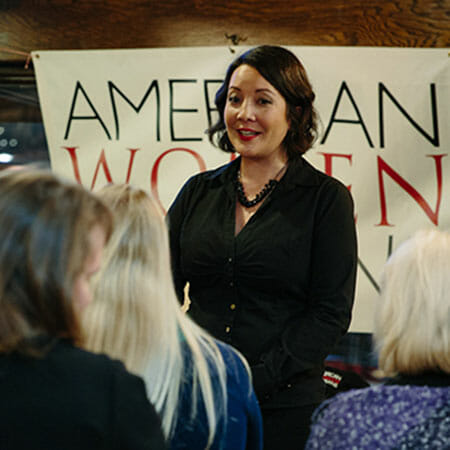
Genevieve Chase founded American Women Veterans to connect women veterans with the resources necessary to make the transition from military to civilian life.
Meet Daily Point of Light Award honoree Genevieve Chase, who was a Top 10 finalist for the L’Oréal Paris Women of Worth Award in 2018. Each year L’Oréal Paris and Points of Light recognize and celebrate Women of Worth who make a beautiful difference in their communities. Ten honorees each receive a $10,000 grant to support their most cherished cause, and an online vote determines one honoree who will receive an additional $25,000 grant. Nominations for 2019 are now open! If you know a woman who works to create lasting and significant change in her community, nominate her to be one of the 2019 Women of Worth.
“Transitioning from combat to civilian life can be difficult, and it’s even more difficult for veterans whose contributions are ignored, as women’s often are,” said Genevieve Chase. “I want raise the profile of the woman veteran – to give her a platform to share her stories and a way to connect with others like her, to ensure that she gets the benefits she earned, and to inspire her to continue her service out of uniform.”
Picture this: You’re a woman who was injured in battle in Afghanistan. Now you’re back home, and every time you go to the veteran’s affairs hospital, the staff assumes you’re there for your husband. When you’re up for a big promotion at work, and you lose out to a man who has experience in a field it was illegal for you to work in despite having more qualifications than him. That sort of treatment is what prompted Genevieve Chase to start
“We want to change the profile of what people think when they hear the word ‘Veteran,’” said Genevieve. “Being seen is shockingly undervalued but so incredibly important.”
Following 9/11, Genevieve left a successful real estate career to join the Army as an intelligence agent working to thwart attacks against military personnel. She spent 2006 in Afghanistan, and when she came home, she fought to conceal her brain injury, developed PTSD and became deeply depressed. She tried to fight her suicidal urges by getting involved with veterans’ groups, but she felt her contributions were minimized because she was a woman.
At the end of 2008, Genevieve invited a group of female veterans to a cafe in New York City. Hearing their experiences led to the creation of American Women Veterans, and founding the organization saved Genevieve’s life. “It gave me a purpose; it made me feel like I had a right to live,” she said.
American Women Veterans started as a Facebook page, with a primary focus on raising awareness of women’s contributions to the military and giving female veterans a place to connect and share their stories. Its secondary focus was advocacy. Genevieve and her organization worked to repeal “don’t ask, don’t tell,” lift the policy excluding women from combat and improve treatment of women veterans at VA hospitals.
As part of that work, Genevieve testified before the Senate Veterans Affairs Committee and the Senate Foreign Relations Committee. She also organized letter-writing campaigns, gave speeches and advocated her positions to congressional representatives. While working on the combat exclusion issue, she helped draft legislation. Due to her efforts, and those of others, women – who make up about 15 percent of military personnel – can now receive the same training and promotion potential as men for work they have already been doing.
American Women Veterans continues to focus on raising the profile of female soldiers and veterans. It also connects women veterans with the resources necessary to make the transition from military to civilian life. The organization’s Facebook page has become a one-stop source for information about scholarships, job opportunities, benefits updates, events and more. Genevieve said that because of her organization’s reach, military branches and service providers often get in touch with her directly when they want to get the word out about something.
Today, American Women Veterans is a small organization with a roster of about 30 active volunteers and only a few partners: the law firm Orrick, Herrington, & Sutcliffe; private donors and in 2017, REI; and ally Army Women’s Foundation. What Genevieve is trying to do with the organization is build community. Her digital community is up and running, with more than 109,000 Facebook followers, many of whom are quick to comment on posts and share personal stories.
Genevieve believes the next step is to create local chapters of the organization so that women can connect face-to-face with other female veterans in their area. “I want to help them build community where they are,” Genevieve said.
Genevieve Chase delivers a speech on behalf of American Women Veterans./Courtesy Nilaya Sabnis for L’Oréal Paris USA
In the military, personnel assigned to a new area are given a sponsor – someone who has been there a while who can tell newcomers what to expect and where to go to get their needs met. Genevieve would like to see her organization function in the same way. “There are a lot of resources out there, but they’re not all effective,” added Genevieve. “Sponsors can point people to the valuable ones.”
Allison Adkins first met Genevieve in basic training and has been involved with the organization since its early days. A 14-year soldier who is also a lesbian, Allison was particularly appreciative of American Women Veterans’ efforts to repeal “don’t ask, don’t tell.”
“It was very hard for me; I wanted to be out and be happy and to let people know that this is who I am while also serving my country,” Allison said. “ [American Women Veterans] kept me up-to-date on what they were doing and sent me messages saying, ‘Don’t give up.’”
When Allison was assigned to Colorado and found herself confronted with discrimination, the organization helped connect her with local groups – a rock-climbing club and a sewing group – so she could build a friend network. When Allison felt suicidal in 2015, Genevieve found her a therapist and life coach who helped her work through her emotions.
As someone whose military contributions have often been overlooked, Allison is also grateful for Genevieve’s efforts to raise the profile of female soldiers. “People forget that women serve in the military,” said Allison. “They just don’t get a lot of recognition, and American Women Veterans is trying to change that.”
Early in her first deployment to Afghanistan, a car carrying an improvised explosive device plowed into the truck in which Genevieve was riding. She and her fellow soldiers suffered external wounds and traumatic brain injuries.
Genevieve is still living with the after-effects of the brain injury, but hasn’t let that stop her from trying to make life better for the nation’s two million female veterans. She works without a salary to keep the organization afloat and continues to serve as a 1SG in the Army Reserve.
Mobilizing Corporate and Community Volunteers to Improve Veterans’ Lives, One Home Repair at a Time
Providing support for the men and women who have served in the armed forces is a priority for many social organizations across the United States. Among the critical needs being addressed by these groups, such as providing access to healthcare, education and employment, is the need to help veterans find and maintain safe, sustainable housing. HandsOn Greater Phoenix, a Points of Light affiliate, has stepped up to this challenge, leveraging the power of corporate partnerships and volunteers to have an impact on the local veteran community.
The organization has been serving the Phoenix metro area for almost 25 years, connecting volunteers with opportunities to serve where they are needed most. Founded as Make A Difference in 1993, the organization set out to meet critical community needs, with a special focus on creating opportunities for working people to serve.
“There were a group of busy professionals that just liked the idea of plugging into multiple issue areas and using groups of colleagues and friends and networks to do good things in the community,” said Rhonda Oliver, president and CEO of HandsOn Greater Phoenix.
After 15 years of rapid growth, the organization re-established itself as HandsOn Greater Phoenix in 2008. Today, it functions as a traditional volunteer center, engaging all types of volunteers in more than 60 high-impact, one-time community service projects each month. But, Rhonda said, corporate volunteers are still a centerpiece of their programming.
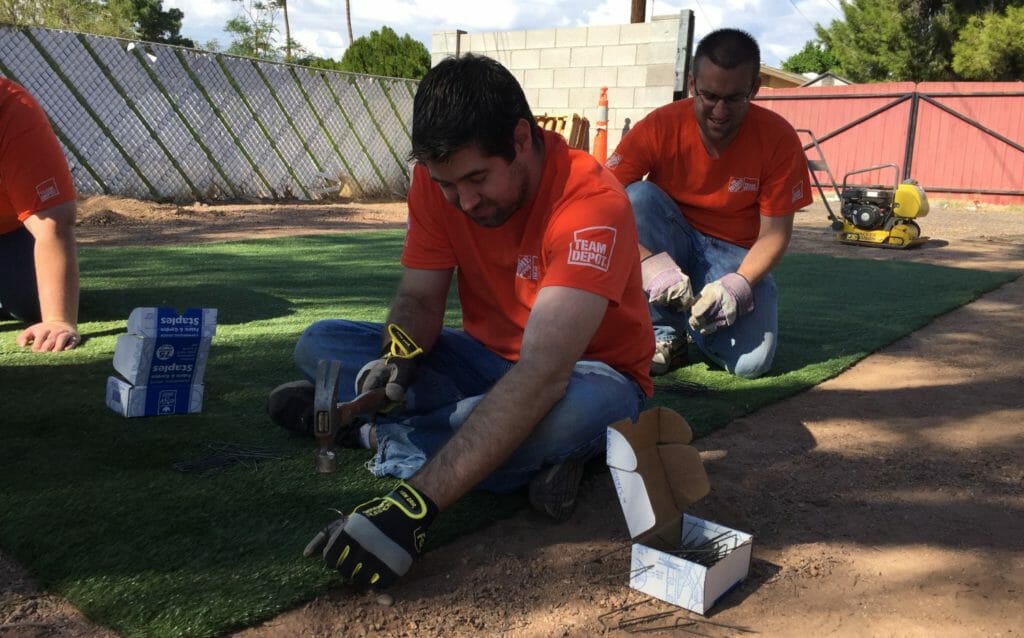
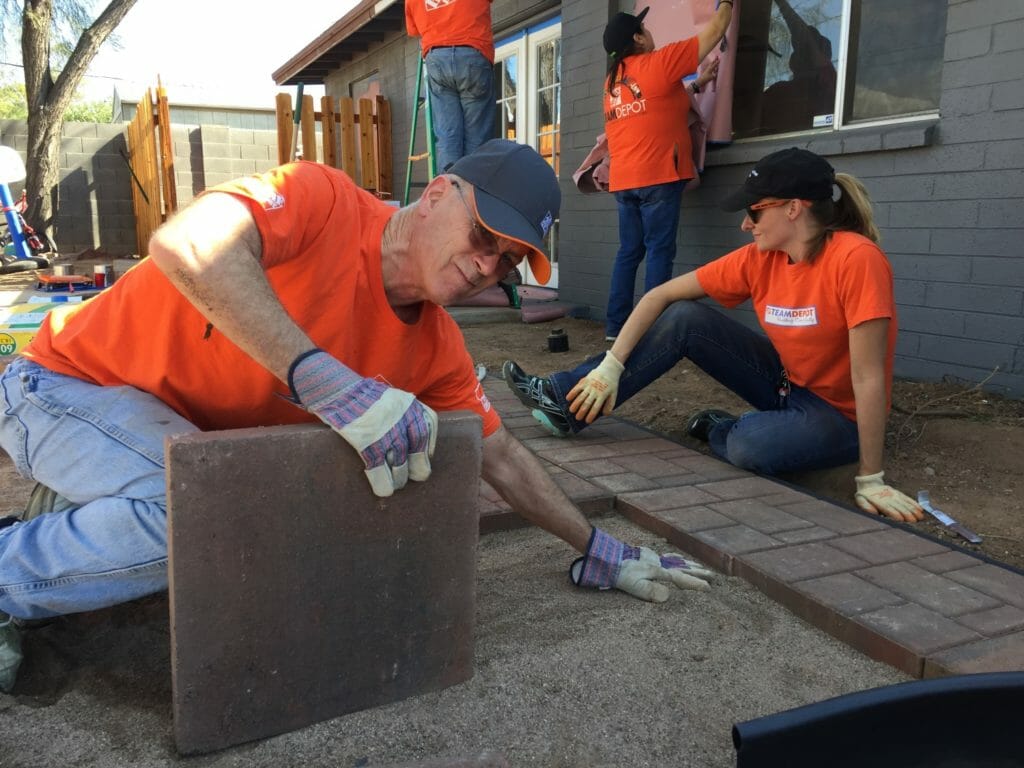
Through a long-standing partnership with Home Depot, HandsOn Greater Phoenix mobilizes teams of community and employee volunteers for its Veteran Home Improvement Program – supporting local veterans by providing needs-based home repairs and upgrades for weatherization, code violations or other modifications.
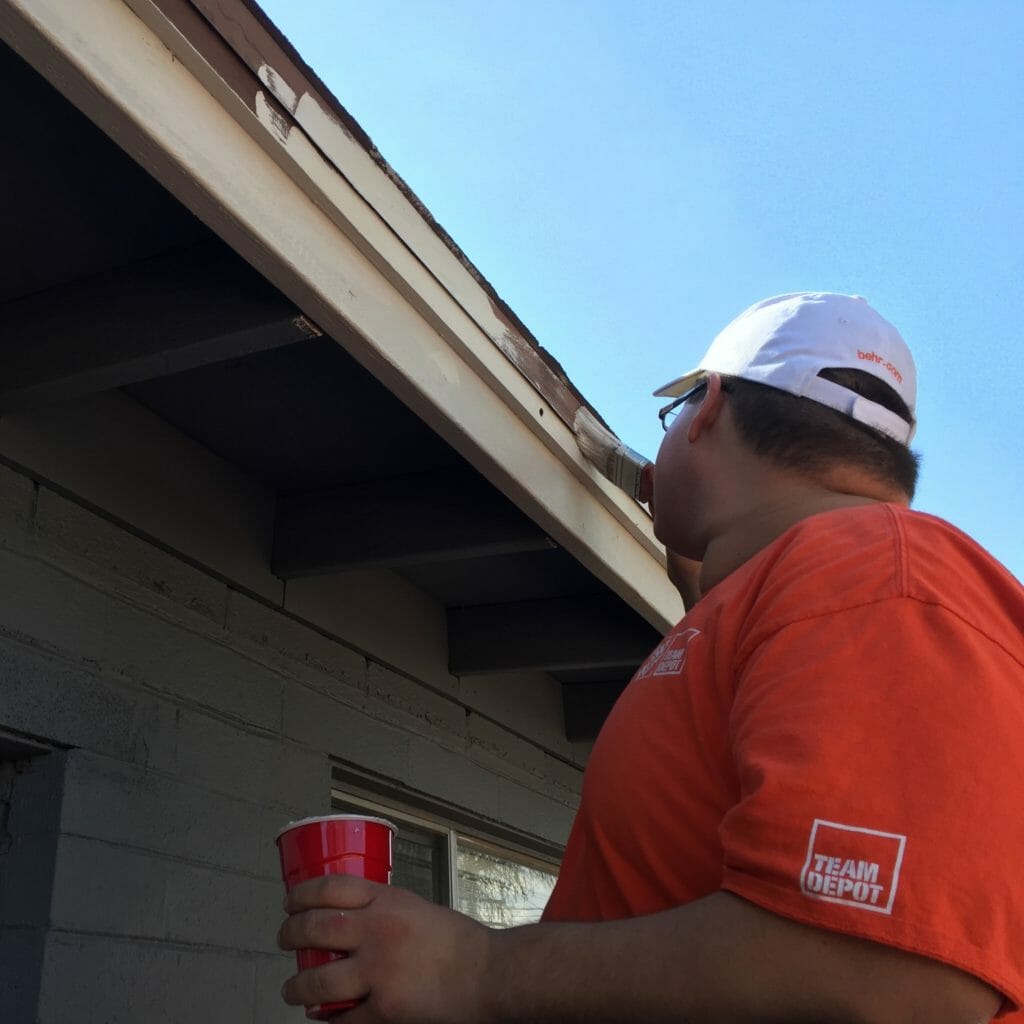
Four “Team Depot Captains” – representing the 39 Home Depot stores in the Greater Phoenix market – each conduct site visits, work with HandsOn Greater Phoenix to identify the improvements each home needs, and connect with local vendors that donate the necessary materials. Projects cover a range of activities, including painting, installing turf yards or even tree removal. Some of the most common projects are exterior paint jobs. HandsOn Greater Phoenix recruits community volunteers for these kinds of projects, as well as calling upon employee volunteers from other local businesses – among which, employees from companies like Wells Fargo, Intel and Cox are all regular contributors.
For more complex or large-scale projects, such as building ramps for disabled veterans, installing windows or walls, or other major modifications, Home Depot employees or volunteers from the vendor that donated the materials will offer up their time and skills to do the work.
“Some of our team captains have employees within their stores that have contracting-level experience,” said Steve Woodhams, a project manager at HandsOn Greater Phoenix. In one case, a Home Depot employee with experience as a contractor helped complete a renovation project that added a door in the shared wall between a veteran’s bedroom and her bathroom, giving her some added privacy as she prepared to welcome a foster child into her home. For projects like energy efficient window upgrades, where product warranties are important, employees from the window company often volunteer their time to complete the installation.
Veterans apply for the program through the HandsOn Greater Phoenix website, but they are also identified in a number of other ways, including through word of mouth and through the municipalities they live in, as cities and communities identify homes that are not up to code. The participating Home Depot stores will also identify veteran customers who would benefit from the program.
In addition to veterans, HandsOn Greater Phoenix programs support many causes. Through a youth mentorship program called Your Experience Counts, adults with daytime availability are put in classrooms to work alongside teachers and help ensure students’ academic success. The organization also has an AmeriCorps VISTA program that engages 19 VISTA members as volunteer or program coordinators serving with nonprofit partners across Phoenix, building infrastructure and providing the necessary tools for the nonprofits to more effectively manage their resources. Annual events like Serve-A-Thon, Make A Difference Day, Martin Luther King Jr. Day and 9/11 Week of Service and Remembrance also provide opportunities for volunteers to get involved.
This year for 9/11 Day of Service, HandsOn Phoenix is planning several projects, including a letter-writing campaign for active-duty service members and a curb address painting project to help first responders identify houses when answering emergency calls. The organization is also planning a veteran home makeover through the Veteran Home Improvement Program. Volunteers will help weatherize the home of WWII veteran Maxine and her daughter, who is her caretaker. The project, which is open to general volunteer sign-ups, will provide energy-efficiency updates and bring the exterior of the home up to city code compliance.
Since its founding, HandsOn Greater Phoenix has mobilized approximately 400,000 volunteers through its programs, events and initiatives. Its partnerships with both local companies and nonprofits make it one example of the many ways that Points of Light network affiliates are using local resources to meet community needs and putting volunteers to work where they are needed most.
Bridging the Transition to Civilian Life Through Volunteerism
This post originally appeared in the spring 2017 issue of Stars and Stripes Magazine and was written by Malikah Berry, chief programs officer for Points of Light.
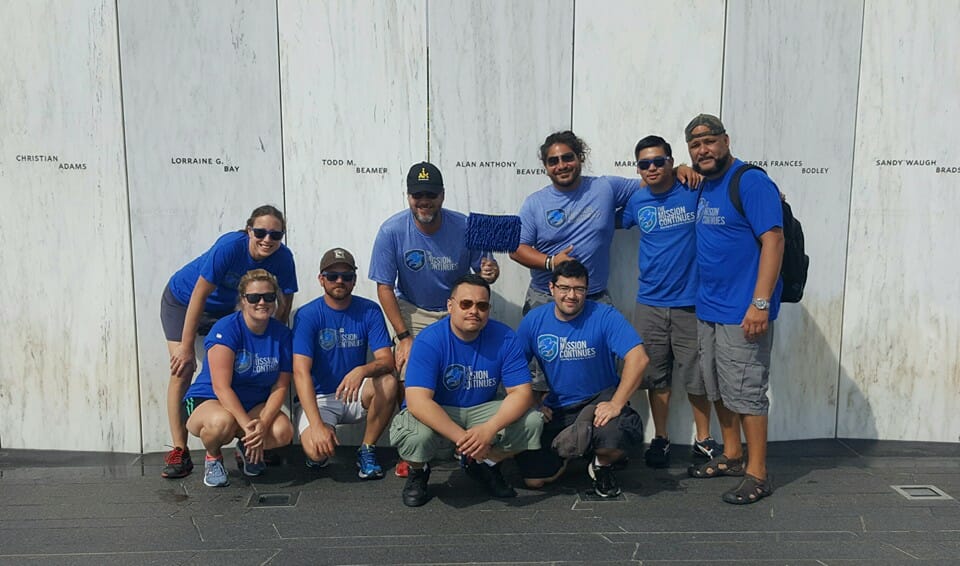
Courtesy: The Mission Continues Volunteers with The Mission Continues at a service project for the United 93 Memorial.
Service to country is in Jaime Waterbury’s blood. The daughter of a retired Army colonel, Jaime served in the Air Force with two tours to Iraq. Jaime’s husband is active duty Air Force and currently serving his fourth tour in Iraq. When Jaime transitioned from active duty to the Air Force Reserve she still felt a call to service. Jaime joined the Points of Light Frontline Families AmeriCorps program, where she found a new sense of duty by helping empower others to volunteer.
“Nothing makes me happier than to guide a veteran or soldier to building their own volunteer program – whether it is a one-time special project or building a volunteer program from the ground up,” said Jaime. “I enjoy seeing the end result and how much better the community is because of the dedicated volunteers I get to work with every day.”
Jaime is just one of more than 1 million service members who will re-enter civilian life over the next few years. Reintegration is a process that requires an extensive amount of time and effort. When service members transition out of the military, they are often faced with the impact of deployment, combat-related injuries and continuous transitions. They also retain a deep sense of civic responsibility. Service members are among America’s biggest untapped civic assets.
Volunteerism is proven to be a successful bridge that links veterans and military families with their community through civic engagement, improves their physical and emotional well-being, and provides meaningful connections with their civilian neighbors to create more vibrant and resilient communities. According to the
, veterans demonstrate higher levels of engagement than non-veterans on all civic health indicators. Veterans volunteer an average of 169 hours a year, compared to 129 by non-veterans. They are also nearly 30 percent more likely to work with neighbors to fix problems in their community.
Across the country, service members, veterans and their families are sharing their unique skills and talents to build bridges with their civilian neighbors through volunteerism. With an emphasis on reintegration, the Points of Light Frontline Families program inspires and empowers veterans and military families to be volunteer leaders to help address the most pressing challenges facing their communities in collaboration with local nonprofit organizations.
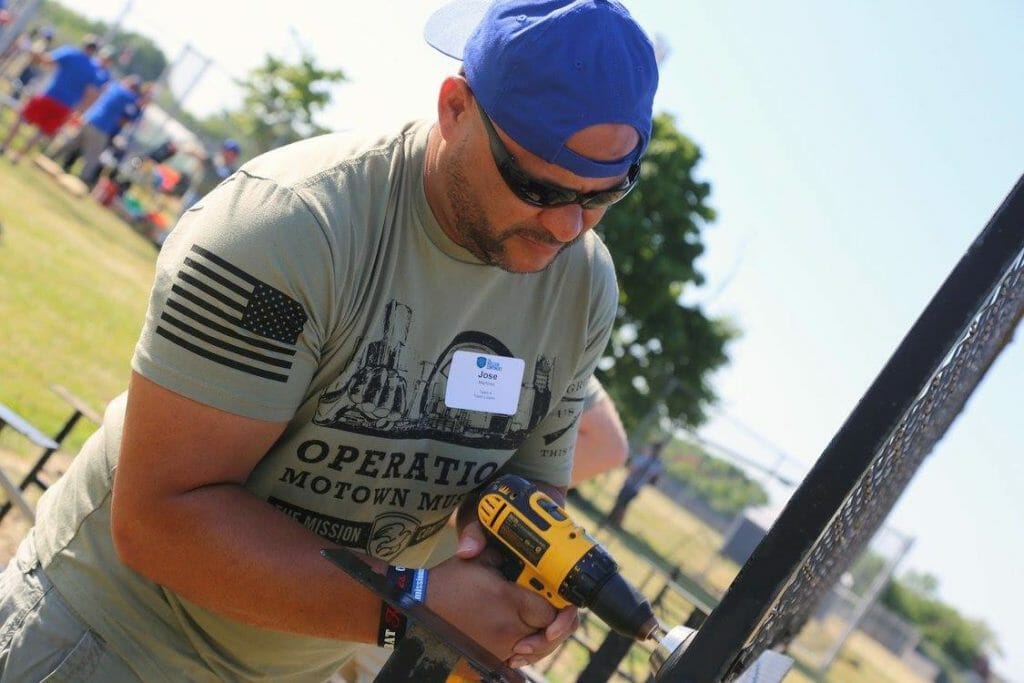
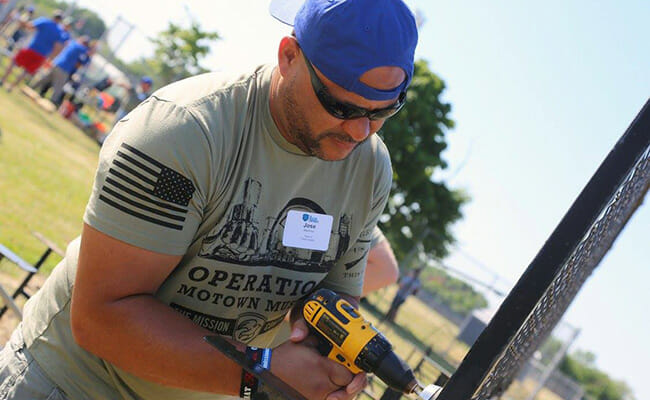
Courtesy: The Mission Continues Jose Martinez, an Army veteran, works on various projects with The Mission Continues to help other veterans.
After more than 22 years in the U.S. Army, Jose Martinez retired in 2013. Following a successful military career, he struggled to find anything more than an entry level job.
“When you leave the military, you’re starting all over. And you lose that – whatever it was in the military that you were – sergeant first class, a private, even your name because in the military we go by last name or nickname. You’re no longer that person anymore. And that was really hard for me,” said Jose, “I felt like I was going backwards, so I decided the best course of action for me would be to go to school.”
At age 40, Jose enrolled at Drexel University, in Philadelphia. It was there that his future started to take shape. On top of his studies and dad duties, Jose started volunteering to help fellow veterans. He connected with
, a nonpartisan, nonprofit organization that evokes veterans’ inner call to service and engages them in projects that will improve their communities.
“What happens to a lot of us is we tend to isolate ourselves when we get out of the military. We don’t want to build relationships with people who don’t understand the struggle of what it is to be in the military,” Jose said. “[The] Mission Continues allows us to make those relationships again, to serve again and be part of something that’s bigger than we are.”
In September 2016, Jose was recognized with a
AmeriCorps member, she is stationed with the local Red Cross at Winn Army Community Hospital. Jaime helps recruit, onboard and train new volunteers. She also helps the staff determine volunteer needs, promotes Red Cross Reconnection Workshops and supports different volunteer-run initiatives.
Serving with Frontline Families has not only been rewarding, but has also provided Jaime a sense of stability. “The joy and experience I have felt working with the American Red Cross and all of the wonderful volunteers have been truly spectacular,” she said. “The opportunities that Points of Light’s Frontline Families program has afforded me have been nothing short of amazing in the sometimes tumultuous time of being a military spouse, having to move often and looking for a career that you love.”
Points of Light and The Mission Continues are part of a growing coalition of organizations that want to evolve military reintegration from providing support for veterans to engaging and problem solving
, we create opportunities for veterans and their families to create new roles for themselves as civic leaders in their communities. We believe that together, we can bridge the military-civilian divide and strengthen our local communities.
3 Ways You Can Support Military Caregivers in 2017
There are nearly 5.5 million military caregivers in the United States, with 20 percent caring for and supporting post-9/11 veterans. Military caregivers are hidden heroes, dedicating their time, efforts, and love to a role that receives little recognition and acknowledgment.
Good work is being done to help our injured heroes and their families, and you can help! Here are three easy ways you can support military caregivers in 2017.
, is calling together its community of changemakers to pledge a gesture of gratitude to the people caring for our service members, veterans, and their families.
, the only national institute of its kind dedicated to bridging the civilian-military divide through free online education and a support center staffed with mental health experts.
3. Volunteer
Whether it is a one-time volunteer project or an ongoing commitment, your actions will make a difference to military caregivers in your community. You can find an existing project by searching
for DIY projects.
Interested in learning more? Points of Light’s Military Initiatives support service members, veterans, their families, and families of the fallen through volunteer opportunities. Together, civilian volunteers and military members can address our communities’ greatest challenges.
, revealed that veterans are more likely than non-veterans to volunteer with their neighbors to fix problems in their communities.
Last year veterans volunteered an average of 169 hours of their time compared to an average of 126 hours spent volunteering by non-veterans. More than 10 percent of veterans worked with their neighbors to fix problems in their community compared to just under 8 percent of non-veterans.
“The military teaches us the value of purpose and the importance of principles,” said Bill Rausch, executive director of Got Your Six, during a panel discussion on the findings of the report.
Janaia Deshields, vice president of veterans and military programs at Points of Light, joined Rausch and Sec. Bob McDonald, Department of Veterans Affairs, on the
.
“There are tons of issues in our communities right now and our country where we should be uniting to come up with solutions. … Our veterans are going to be leaders in those communities,” said Deshields, who is also a U.S. Army veteran.
Volunteering is a two-way street, and while there are many ways the veterans benefit from the work of volunteers, communities nationwide benefit greatly from the dedicated, ongoing service of veterans and military families.
Daily Point of Light Award honoree Jose Martinez found his calling with
, an organization that evokes veterans’ inner call to service and engages them in projects that will improve their communities. Through a platoon-like structure, meant to resemble the internal structure of the military, The Mission Continues helps veterans reconnect with both their communities and themselves.
“When you leave the military, you’re starting all over. And you lose that – whatever it was in the military that you were – sergeant first class, a private, even your name because in the military we go by last name or nickname. You’re no longer that person anymore,” Jose explained.
This sentiment is echoed by many other veterans who find that volunteer service gives them renewed purpose as they transition back to civilian life. “All of us have this sense of wanting to be part of something bigger than ourselves,” said Sec. McDonald, during the Got Your 6 panel discussion.
In addition to connecting with their community, veterans are able to connect with other veterans through volunteer service.
For example, Daily Point of Light Award honoree Krystol Stinson, a veteran of the U.S. Navy, works with returning vets who struggle with mental health and finding employment. Her work with
, which unites veterans facing physical and mental disabilities with service dogs. Since he started this program in 2007, Stovroff has helped more than 250 veterans recover from physical and psychological challenges.
15-year Marine veteran and Daily Point of Light Sean Gobin founded
, a nonprofit therapy program that takes veterans on scenic nature hikes to aid their transition and help fight PTSD. Gobin has hiked with more than 71 veterans.
To engage veterans interested in volunteer service, some nonprofits and other volunteer organizations are leveraging the hard work ethics and tactical organization skills gained through their military service. Veterans can become service leaders in their communities through programs like Points of Light’s
Engaging with veterans through volunteer service can be one of the best ways to thank them for their service, provide much-needed support and recognize the important role they play in our communities. Veteran reintegration is not a challenge but an opportunity to partner with and support them as they transition. Here are some ideas for giving back and celebrating their service on Veterans Day and all year round:
provides an excellent opportunity to give back to veterans locally by helping them with everyday tasks like grocery shopping, yard work, or running errands. It’s a great way to build relationships with veterans in your community and help them remain independent.
2. Serve alongside veterans
Many veterans get involved in community service as a way of finding purpose and connecting with their neighbors upon their return to civilian life. Through organizations like
, you can support service projects led by veterans and partner with them to create change in your community.
3. Volunteer at a hospital
Department of Veterans Affairs hospitals, nursing homes and clinics can always use volunteers to support patients and staff by performing various duties. To get involved,
Get creative and organize your own DIY service project to benefit veterans in your community. Some ideas include building a community garden, hosting a resume preparation workshop for returning vets or organizing a welcome home project, or collecting and archiving a veteran’s story through the Veterans Oral History Project.
Learn about Points of Light’s Military Initiatives, and the importance of engaging with veterans and the military community through service. And, find more opportunities to get involved at www.allforgood.org.
Veteran Finds Renewed Purpose Through Volunteering
Through volunteer service, Americans connect with the spirit of unity that arose in the aftermath of 9/11. As Points of Light commemorates the 15th anniversary of 9/11 National Day of Service, we highlight those who have been inspired to give back to their communities.
As a veteran of the armed forces, Brittany Chaney has long been dedicated to giving back to those who have served. Like many veterans, Chaney looked to volunteer service upon leaving the military to ease her transition back to civilian life, and became involved in a variety of service projects through Points of Light affiliate Hands On Orlando. Chaney says she enjoys the opportunity to be involved with a lot of causes – her commitment to volunteerism being the driving force behind it all.
“I have a love for volunteering and being involved in the community.” Reflecting on her time in the Navy, Chaney says the military was one more opportunity to give back.
Through her involvement with Hands On Orlando, Chaney, now 33, came across the opportunity to work as a Frontline Families AmeriCorps member.
Through Frontline Families, Chaney and her fellow veteran volunteers have worked supporting organizations like Fairways for Warriors, a group in central Florida that teaches combat veterans how to use golf as a form of therapy; Crossroads Corral, an organization that hosts equine-assisted learning programs where veterans interact with horses to ease the symptoms of PTSD; and Cocktails for a Cause, an annual fundraiser that supports veteran organizations.
As a Frontline Families AmeriCorps member, Chaney has been responsible for coordinating the volunteer efforts of veterans in the local community. Most recently she has been involved in the Booyah Veteran Bus Project which helps disabled veterans get to and from their doctors’ appointments.
Chaney encourages other veterans to get involved. Volunteering “helps you integrate and get involved again,” she says. “It gives you a sense of purpose.” For veterans who are interested in volunteer service, Chaney recommends visiting their local VA to search for opportunities to serve their community.
In honor of 9/11 Day of Service this year, Chaney and other Hands On Orlando volunteers helped plant 25,000 flags outside the Dr. Phillips Center for the Performing Arts in Orlando to honor those who have served. This is one of many projects Hands On Orlando volunteers participated in across the city, not only honoring service men and women, but also memorializing the June terror attack at the Pulse Nightclub.
You can get involved by sharing a story honoring 9/11 first responders or a service member close to you on Twitter or Instagram using#911Dayand#HonoringService, and visit our 9/11 Day of Service gallery to see how volunteers nationwide commemorated the 15th anniversary through service.

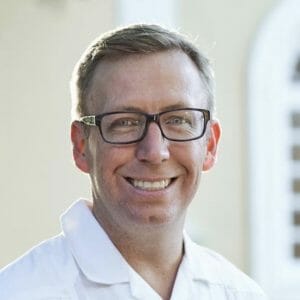 Scott is a lifelong champion for international volunteerism. Currently he is the Associate Director of the Peace Corps leading the agency’s global operations. He is passionate about supporting leaders from diverse backgrounds in the U.S. and around the world. For the past 15-years, Scott founded and led