Reclaiming the Public Square: Bringing Communities to the Table
Unlocking the Power of Voice through Community Engagement
The Fourth of July should be a time of reflection about the state of our nation and what we hope for its future, but how do we keep the momentum going year round? Civic engagement requires a renewed commitment to drive real and sustained change in communities worldwide. The work demands an inclusive public square where everyone’s perspectives are heard, valued and leveraged.
, president of The Field Foundation of Illinois, has a long history of bringing together disparate voices as a strategy for tackling systemic racism. In a recent presentation at the
, he highlighted the importance of reactivating the public square as a space for civic discourse, idea exchange and community celebration. Ash emphasized the need to reclaim this space and rebuild the civic relationships that underpin our society.
“I have spent all my career dealing with the various facets of segregation fueled by systemic racism that has plagued our beloved city [of Chicago], while recognizing its brilliant architecture, public art, diverse cultures and civic generosity,” said Ash.
To truly harness the power of voice, it’s essential to ensure that all community members have a seat at the table. The
is one of its most powerful elements, because true change occurs only when everyone’s voices are included and respected.
So, how can we bring communities to the table and activate their voices within the public square?
1. Value Differing Voices
Creating an inclusive public square requires actively seeking diverse perspectives and ensuring a platform for underrepresented voices. This means asking community leaders who have historically been marginalized to lead the conversations. A more comprehensive understanding of the issues that affect communities will, in turn, demand inclusive solutions.
2. Promote Dialogue and Active Listening
Engaging in open and meaningful dialogue is essential for fostering civic engagement across different groups and generations. Encouraging active
builds for empathy for and promotes the sharing of others’ experiences and perspectives. Actively seek opportunities for community members to come together, exchange ideas and engage in constructive conversations.
, communities need to lead decision-making processes. Ensure that established inclusive and collaborative decision-making mechanisms exist, such as community forums, town halls or advisory committees. Decisions made by a community result in a more active and participatory democracy.
4. Cultivate Community Leadership
Invest in community leadership who share the understanding that inclusivity is crucial for sustaining long-term change. Identify and support emerging leaders, providing resources, training and platforms necessary to amplify their voices and drive positive transformation. By nurturing community leadership, a ripple effect is created, inspiring others to step forward, take action and become advocates for change.
Bringing communities to the table is a fundamental step in activating the power of voice within the Civic Circle framework. By promoting dialogue, facilitating collaborative decision-making, and cultivating community leadership, we can create an inclusive public square that reflects our national communities.
The journey toward a more equitable and just society requires collective action, and by combining elements of the Civic Circle, you can amplify your impact. Each one of us has the power to contribute and make a difference. So, invite others to the table, and reclaim the public square as a space where all voices are valued, heard and respected.
What are your thoughts on activating the power of voice through community engagement? How can we bring communities to the table? Follow us on social media to share your ideas and experiences.
Building Collaborative Networks for Social Impact: Insights from the 2023 PreConference
“My challenge to all of us is this: to have the courage to reclaim a healthy public square that calls us to come together and to use our collective power to care for each other,” said Daniel O. Ash, president of Field Foundation of Illinois, at his opening keynote for the 2023 PreConference in Chicago, hosted by KPMG and sponsored by UPS.
It was an inspirational way to kick-off conversations with the
, reinforcing the value of their own efforts as leaders in societal-changing social impact work in communities around the world.
The day continued with informative breakout sessions, led by members of Points of Light’s Global Network Assembly. Sessions ranged from Disaster Management, facilitated by Chris Cameron of HandsOn New Orleans to Corporate Activation Goals & Strategies, facilitated by Jay Cranman of HandsOn Atlanta to Engaging Volunteers in
led by Rob Pabon of Chicago Cares. Attendees then moved to a second round of sessions with Assembly Chair Vanessa Diamond, Greater Richmond Community Foundation and Assembly Co-chair Julia Aramendi, Volies, building collaboration and offering opportunities for networking.
Day one ended with a fireside chat on “The Power of Networks as Change Makers,” which I had the privilege of facilitating with
(IAVE) CEO Nichole Cirillo.
“Networks are the key to resiliency,” said Cirillo. “The more people who use a network, the better and stronger it becomes.”
She went on to challenge perceptions of volunteerism sharing that, “volunteerism has shifted from civic duty to systems change Our younger generation is flipping the perception from civic duty to civic dissent.”
Cirillo emphasized how volunteering is finding the solution and delivering it to solve a societal problem. She also touched upon the importance of connecting the work to on the ground impact. We ended the day with her encouragement to take chances to reach one’s full potential.
“Failure is how we change and grow,” she said. And those words proved especially true later that same night.
“An excellent plan. What could possibly go wrong?”
— Kristina DaSilva, COO, HANDSON BROWARD, describing a moment in her career at Failure Night 2023.
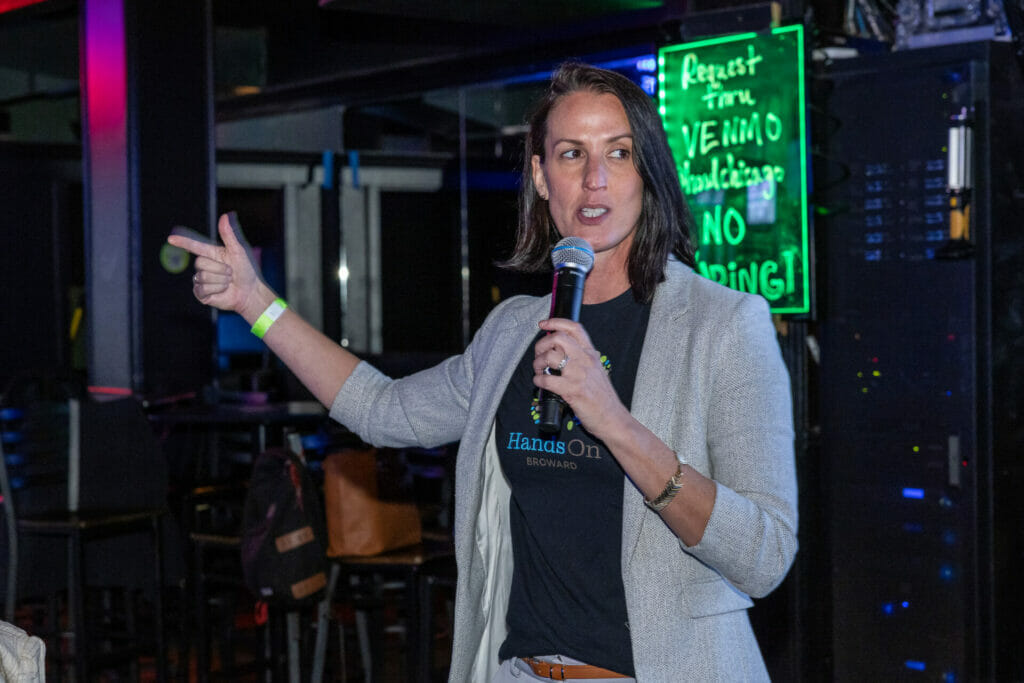
Failure Night hosted by Tim Atkins at HandsOn Atlanta was a raucous gathering of Points of Light affiliates who came together to share their biggest failures, reminding us that failing is an essential part of learning and growing. The crowd represented, shoring up the presenters with warm laughter and understanding. Five brave leaders embraced vulnerability and shared their tales of failure, accompanied by valuable lessons learned:
I did my best to use humor with a healthy dose of humility to expose the hazards of ignoring stakeholder instructions and placing all your bets on hope.
Kristina da Silva, CEO at HandsOn Broward, shed light on the unpredictable nature of events, emphasizing that they often take on a life of their own, deviating from carefully crafted plans
Rosie Drumgoole, chief programs officer at Chicago Cares, imparted the vital message that neglecting self-care should never be an option.
Alana Jorge, operations director of Atados, divulged the consequences of picking the worst possible timing for an event—during the World Cup and elections, for example—reminding us timing is everything.
Stephen Davalos, vice president of external affairs at L.A. Works, demonstrated the repercussions of chasing grand ambitions while ignoring the subtle cues conveyed by the universe ultimately resulting in an overwhelming array of headaches.
Day two began with the group hearing “Bright Spot” stories from leaders worldwide as they showcased their impactful work, including that of Riakos Adams from
. More breakout sessions followed, ranging from Effective International Expansion and Engagement with Leila Saad and Stephen Joseph of Common Impact to How to Expand Your Impact and Reach Through Building up Your Network with Hannah Wojno & Kaynan Rabino from Ruach Tova.
PreConference ended with a historical first-ever shared luncheon between Global Network affiliate and the Points of Light Board of Directors. Board members, including Neil Bush, Nikki Clifton and Jeff Hoffman, mixed and mingled with affiliates. Lunch concluded with a fireside chat between Points of Light Board Member Michelle Gavin and Points of Light Interim CEO Diane Quest that focused on shared learnings from the Global Gathering in Brazil.
Gavin noted that it was a privilege spending time with affiliates and added, “It was like a cup of coffee in the morning. It was a jolt of energy that made me excited for the future of the organization.”
, who has given the last 13 years to supporting and building her community.
The event ended with palpable excitement, an invitation to Warsaw Poland February 4–10 in 2024 for the Global Gathering, and a reinforcement of the power the Points of Light Global Network, especially when its members connect and learn in person, together.
operates with innovative volunteer-mobilizing organizations that serve more than 145 affiliates across 39 countries around the world. Together, we are inspiring, equipping and mobilizing more people to use their time, talent and resources to create positive change in their communities.
We spoke with Andre Salkin from
, a Points of Light affiliate in France, to discuss how the organization is creating positive change in its region and beyond. Benenova was created in 2013 and is currently present in four regions in France: Paris, Nantes, Lille and Rennes. The organization’s mission is to facilitate the civic engagement of as many people as possible by offering a large variety of short, collective volunteer missions accessible to all through special programs of inclusivity.
Learn more about this nonprofit’s outstanding work in the realm of inclusive volunteer opportunities.
What role does volunteerism play in your organization’s overall mission and objectives?
Since 2013, Benenova’s primary mission has been to mobilize citizens to get involved in a wide variety of volunteer missions with a focus on making volunteering accessible. Not only through the variety and choice of volunteer opportunities offered on our website, but also through inclusive programs which provide an entry into volunteering for those with physical or mental disabilities and those in situations of precarity. We do this by working closely with our volunteers and partner associations to ensure each mission is suited to the needs and desires of those involved.
Benenova also promotes a change in the way we envision volunteering. Our programs of inclusivity encourage a reversal of the relationship between the helper and the helped. Our volunteer base is largely young and new to volunteering. Forty-three percent of our volunteers had their first experience with Benenova, and 53% are under the age of 35. Rather than going out and “serving” a community, we want to show how volunteering serves us all, even the volunteers. To volunteer is to strengthen our bond within our cities and neighborhoods – to be really and truly included.
How are you engaging with volunteers to inspire them to participate in community service activities?
Our specialty at Benenova is providing an introduction to volunteering for those who are interested in getting involved. One of the ways we do this is through the “permanence,” in which first-time volunteers, particularly those suffering from situations of economic insecurity or social exclusion, can come to our office and be guided through the process of becoming a fully autonomous volunteer by starting an account and finding missions that suit their needs.
We held 22 permanences last year, allowing us to accompany 110 people in situations of precarity to get involved in volunteering missions. Our most active volunteers, called “supernovas,” help out with these introduction programs, representing Benenova in public spaces.
What resources or tools are you providing to volunteers to help them get involved in their community?
Our main resource is accessibility. We offer a wide variety of volunteer opportunities on the online calendar. Across four cities, over 800 monthly listings relating to the fight against poverty, protecting the environment and aiding the youth and aged populations.
In addition to the permanence, we offer a specialized inclusive volunteer program to make volunteering accessible to those with disabilities – mental or physical. We also follow up with both volunteers and associations to ensure missions are going smoothly and everyone’s needs are being met.
Share one success story of a volunteer (or a group of volunteers) in your community who have made a significant impact.
One of our most notable success stories is that of Seijirô, a young man with ASD (autism spectrum disorder) who we accompanied as he began his volunteer journey. We started with an interview to better get to know Seijirô, his interests and his desire to help others feel useful. We were also able to identify some difficulties to take into account in order to propose adequate missions – for example, his sensitivity to noise, or difficulties related to fine motor skills or speech.
We worked with Seijirô to find a form of volunteering that worked for him, and we worked with the volunteer associations to ensure the task remained suitable for Seijirô. While Seijirô admitted the tasks were difficult for him at first, volunteering made him feel useful, and like he was able to help others. Alexia, a psychologist who has worked with Seijirô and his parents for years, echoed Seijirô’s positive sentiments, saying that volunteering made it easier to go about daily tasks, improving Seijirô’s mood and sense of personal autonomy.
The entire mission of Benenova revolves around adapting and welcoming every person willing to give time to a cause or an association. In that sense, the inclusive volunteer program is simply an extension of our values and core mission.
What are some future plans for your organization to continue promoting volunteerism and civic engagement?
There are two large yearly milestones for Benenova – World Refugee Day (June 20) and World Volunteer Day (December 5) – both big opportunities for Benenova to raise awareness and rally involvement in volunteerism.
We are also in the process of making a film about our 10 years of social involvement, incorporating spoken testimonials from those involved at every level of the organization. In addition, one of our most current objectives is the expansion of corporate volunteerism – getting salaried employees engaged in volunteering by presenting real initiatives to companies.
What’s one piece of advice you’d give someone who’s looking to get more involved in their community through volunteerism?
The best advice is to stay human-centered. We can never be in touch with every individual, but we can stay available and accommodating. All people can give is their time – the least we can do is be thankful.
L.A. Works Uses Social Media During Global Volunteer Month for Volunteer Recruitment and Recognition
2023, and continuing to celebrate individuals and organizations around the world affecting change and advocating for social good. We’ve been featuring a handful of
affiliates who are positively impacting their communities through volunteer recruitment, recognition and special events throughout April.
The Points of Light Global Network operates with a network of innovative volunteer-mobilizing organizations that serve more than 145 affiliates across 39 countries around the world. Together, we are inspiring, equipping and mobilizing more people to use their time, talent and resources to create positive change in their communities.
is a member of the Points of Light Global Network and is Los Angeles’ largest volunteer action center. The organization aims to unite Angelenos and inspire action for a more equitable Los Angeles.
We spoke with Samantha Wheeler, director of communications at L.A. Works, to talk about why volunteering matters and how the organization utilizes its resources to uplift volunteers and the overall mission.
How is your organization recognizing Global Volunteer Month this year?
L.A. Works has volunteers across many different categories and programs, and we intend to highlight them across social media this month. We have reels and posts planned to highlight corporate volunteers, volunteers who are over 55, FAVE volunteer families, climate action/disaster preparedness teams, VISTA members and general volunteers.
What resources or tools are you providing to volunteers to help them get involved in their community?
We utilize our website, social media, tabling events and canvassing to get people involved.
How are you recognizing and thanking volunteers for their contributions during Global Volunteer Month?
We are using a social media campaign to thank all of our volunteers – from corporate volunteers to family volunteers and all in between – for their service.
What role does volunteerism play in your organization’s overall mission and objectives?
Volunteering is the heart of what we do. Our purpose is to make sure that Angelenos work on local needs through hands-on service and feel empowered to address the most critical needs in Los Angeles.
What’s one piece of advice you’d give someone who’s looking to get more involved in their community through volunteerism?
Volunteering is a great way to follow your passion. We have so many volunteers come to us because there’s a specific area that they care about but maybe they don’t get to explore because of work obligations. Volunteering is an excellent way to engage in something you care about.
It’s also a great way to discover a new interest. We’ve also had volunteers who discovered they had an interest in something new nurtured by a few hours of service in a specific area, not to mention the benefits of volunteering: meeting new people, learning new things, lowering blood pressure to name a few.
2023 Global Network Gathering Recap
We’ve spent three and a half amazing days with NGO affiliate members of the
, CEO Daniel Morias and staff were incredible (anfitrioes incriveis!), and of course, this event wouldn’t have been possible without our generous sponsors at UPS. We were welcomed, introduced to Brazilian social engagement leaders, offered learning opportunities, and given experiences within the Brazilian culture in São Paolo that will stay with us forever. Thank you, Atados team and UPS! Obrigado equipe Atados e UPS!
The Points of Light Global Gathering is an annual get together of our affiliate members where we convent with NGOs from small towns in Texas to Hong Kong, China, share around
and social impact and the failures we’ve learned from and the successes we’ve seen. We connect with each other to strengthen and uplift the community programs each of us is driving and take those learnings back to our teams. And there’s always a bit — ok, a lot— of fun, laughter and some dancing sprinkled throughout.
“Bringing together Points of Light affiliates from across the globe is an energizing and powerful experience. This gathering gave us the opportunity to learn about civic leadership programs in California and then about innovative corporate volunteer programming in Spain. We also heard from our affiliate in the Ukraine about refugee relief work,” said Vanessa Diamond, SVP civic innovations, Community Foundation for a greater Richmond. “As we learn about new program models, unique ways affiliates are integrating the
®, we each walk away with insight on how we can make our localized programming more efficient, equitable, and in turn, create more positive change in our communities. As we are catalysts for volunteer action in our own communities, in bringing us together, Points of Light created an opportunity to inspire and educate us so we can do more.”
We kicked off our time together on Tuesday, March 14, with a visit to Atados headquarters in São Paolo, where participants of the Service Project gathered to meet and exchange gifts with their Pen Pals after exchanging letters for weeks leading up to the Global Gathering. We were treated to a delectable dinner Tuesday night with a special welcome dinner at MSTC, The Roofless Movement from the Center, led by Carmen Silva. This activist organization rehomes the city’s unhoused population into previously abandoned buildings. MSTC provides access to healthcare, education, work opportunities and is the model for more than 160 similar sites in the area. It will live with us as a moment of shared understanding of Brazilian culture.
Points of Light Global Network Gathering Photo Gallery
Wednesday, March 15, was the first Social Engagement Summit in São Paolo that brought together Points of Light Global Network affiliates, local São Paolo corporations and leading NGOs in Brazilian social impact work for a day of learning and collaboration. The morning panels delved into current social impact trends featuring our own Interim CEO Diane Quest, Atados Founder Daniel Morias, and Points of Light Board Member and Assembly Chair Vanessa Diamond. I was honored to be invited to speak on the ways data is changing civic engagement, particularly in post-pandemic societies. Points of Light affiliates shared their expertise on panels ranging from disaster recovery and relief to examples of collaboration and innovation in corporate partnerships. Points of Light Board Member Michelle Gavin shared insights on the Civic Circle and its role in societal change.
“Being the host of the global gathering in Brazil proves the power of collaboration. It is an opportunity to bring international knowledge to Brazil and shows the strength of the Points of Light Global Network,” said Daniel Morais, founder and CEO, Atados. “Together with Points of Light, we could bring methodologies and credibility for our work and access to new networks. We hope it was also good for Points of Light to have a Brazilian experience.”
Our affiliates then transitioned into a day-and-a-half of Global Network discussions and learnings where we kept belonging, learning and strategy at the forefront. Vanessa Diamond, SVP of civic innovations for Community Foundation for a greater Richmond, along with Julia Aramendi, project director of Volies and Vice-Chair of the Network Assembly, talked about the catalytic nature of being together. They explored the value proposition of being a member of the Points of Light Global Network – from affiliate to Points of Light, and Points of Light to affiliate – and how the current structure of the network offers opportunities for shared learning through communities of practice, and local regional roundtables.
We then delved into how our world has transitioned to people seeing themselves as “taking action” vs. the historically more traditional role of volunteering. We heard examples from five affiliates around their community projects in alignment with the
® including Rosie Drumgoole with Chicago Cares, Bia Lin with Hands On Hong Kong, Stephen Davalos with LA Works, Leo Petrov with Children for a Better World and Amy Lytle with Hands on NW North Carolina.
On the final day of the gathering, four affiliate partners, including Daniel Morais with Atados, Hannah Wojno of Ruach Tova, Monica Gil with Hands on Colombia and Celina Lesta with Volies, shared what makes successful and not-so-successful collaborations both as network members and overall. Afternoon conversations centered around the Civic Circle and how
. Group discussions explored how the social impact landscape is evolving and the ways the Civic Circle applies to our collective work with various audiences – from nonprofits and NGOs to corporations to individuals, including youth activation. We talked about what we need to extend the reach and understanding of all civic actions with audiences in different parts of the world.
“I have so much gratitude for the expertise, knowledge sharing and commitment of our network. The 2023 Global Gathering in Brazil forged new and strengthened existing connections and grounded us all in the important collective work we’re doing together,” said Diane Quest, interim CEO and president of Points of Light. “We are so grateful for our host team Atados and leave Brazil with a better understanding of the work they are doing to build a social engagement society.”
We ended the day with an invitation and brainstorming around the next time we would be together in Chicago at the annual
We’ll leave you with some of our new favorite Portuguese phrases from the group:
Bom = good
Xicara de café = cup of coffee
Obrigado = thank you
Together we inspired each other, we laughed at our shared human fallibilities, we explored Brazilian culture, and we created memories and friendships that are at core of the Points of Light Global Network.
is an annual event to encourage volunteerism and civic action. Learn how to recognize volunteers who are actively participating in bettering their communities for this monthlong event, including National Volunteer Week and year-round. Nonprofits get the opportunity to raise awareness for their organization’s current needs and funding opportunities, businesses have a way to engage every employee in spring volunteer initiatives, and individuals are able to give back to their local communities.
The celebration happens in April of 2023, but now is the time to begin to mobilize your community, employees, family and friends, or your volunteers to participate. Here are three ways to get the ball rolling on your Global Volunteer Month efforts early, so you can maximize turnout.
Plan Your Participation in Global Volunteer Month Starting Now
Contribute your time and talents personally:
So you want to volunteer, but you’re not sure where to get started. Find local nonprofits in your area by searching online, and reach out to them directly to see what their needs are. Maybe there’s a donations drive you can support by donating gently used clothing or canned goods. You can also search for in-person and virtual volunteer opportunities on
, the world’s largest digital volunteer network featuring hundreds of thousands of volunteer opportunities throughout the world. You can even check out these
Nonprofit organizations will want to consider which programs to elevate during Global Volunteer Month. Invite supporters to make a difference by participating.
Companies looking to engage employees in volunteerism and civic action in the spring might consider partnering with a
partner. Working with a knowledgeable partner in the nonprofit space can help connect you with valuable volunteer opportunities, create strategic plans for employee engagement, increase volunteer turnout across your organization, measure your success and celebrate your employees accordingly.
include logos, social media graphics and sample messages to easily share your participation with your audiences. It’s critical for nonprofit organizations to communicate consistently throughout April through donor and volunteer outreach. It’s not unusual for people to need to hear about events up to ten times before the message “sticks,” so don’t hesitate to promote your programs, needs and fundraising opportunities for this month early and often.
Companies seeking optimal turnout among employee volunteers will need to do the same. Promote the employee volunteering activities your company is offering, and be clear about how employees can participate. Send out information in your employee newsletters, email blasts or other internal communications, and promote events on social media as well.
Tell Amazing Stories
Finally, you’ll want to make a plan to recognize and celebrate all of the ways your volunteers are contributing to their communities! For individual volunteers, this could mean posting on social media to share the civic actions you took during the month. For nonprofits and companies, you might consider collecting and sharing volunteer stories, videos and photos for publishing throughout the remainder of the year. You might throw a month-end luncheon or other event to celebrate your work.
Recognition and celebration takes careful planning and preparation, so as you’re laying out your plan for the month, make this the final phase and figure out how you will reward your volunteers throughout the month and year round. Two ongoing opportunities for volunteer recognition include
that’s tailored specifically to you, whether you’re an individual, nonprofit, company or government official. However you choose to get involved in Global Volunteer Month, we can’t wait to hear about the social impact you make in 2023.
Volunteer Power Across Causes Remains a Constant Need, Even in a Crisis
affiliates tell us that volunteering is one of the primary ways people have supported the humanitarian relief efforts in and around Ukraine. They also explained that, because this crisis comes on the heels of the COVID-19 pandemic, there have been unforeseen ramifications including volunteer burnout as well as a singular focus on Ukraine relief work from those who want to remain engaged.
“People stopped helping in other areas, as they used to, and everyone wants to help the Ukrainian refugees — which is great — but when I talk with corporate partners or volunteers, they’re not interested in helping children, elders,” said Agnieszka Lissowska-Lewkowicz, who is the President of
affiliate and Polish non-governmental organization Centrum Wolontariatu. “We have to find a balance.”
There are countless needs waiting for support, from trash pickup in your neighborhood to walking dogs at your local animal shelter. There are so many ways to shine a light on your community by volunteering for a cause that speaks to you. To find a cause area that you feel passionate about, check out Points of Light’s
Figure out which areas of focus are important to you and which organizations you want to support. Now there are more ways to get involved than ever before. Consider whether you prefer to join volunteer opportunities that are in person or virtual.
Decide on Skills-based vs Learning Opportunities
Think about what skills you have to offer or whether you’d like to learn something new. Some organizations are looking for specialized talent like translators. Others may offer volunteer opportunities that require training, such as becoming a crisis counselor for Crisis Text Line.
Find Balance
Be realistic about balancing your volunteer time with other areas of your life, like your job and your family. Volunteering as a family may be one way to combine family time with living your best civic life.
Points of Light operates with a network of innovative volunteer-mobilizing organizations who serve more than 177 affiliates across 38 countries around the world. Together we are inspiring, equipping and mobilizing more people to use their time, talent, voice and resources to create positive change in their communities. Learn more about our Global Network.
85 Orphans Rescued from Ukraine Find a New Home in Spain
At dawn on a Sunday, 85 orphaned children fled their home in Lviv, Ukraine.
Four volunteers from Fundación Madrina had traveled over 2,000 miles from Spain to help them evacuate, along with their caregivers, during crossfire. The group boarded a bus and drove for a full 24 hours, taking a circuitous route to avoid areas of conflict. They arrived in Krakow, where a military plane was waiting to deliver them to the Torrejón Air Base in Madrid. Once in Spain, they were temporarily taken in by a hotel until Spanish government officials and nonprofits were able to work collectively to find stable housing for them.
“After spending two days in a hotel in Madrid, the little ones needed a place to spend the next three months,” explained Director of Corporate Social Innovation Almudena Pérez Molina of Fundación Hazloposible, a member of the Points of Light Global Network. “They could not separate them into groups. They were offered a monastery in the province of Guadalajara, but the Guadalajara City Council, that same morning, informed them that the space was not ready with the necessary conditions. They were going to be separated, but someone from Fundación Madrina made an appeal to the collaborator, and finally, they were all transferred together to a hotel in Salamanca.”
Spain, like much of Europe, is seeing a rapid increase in displaced Ukrainians. In late March, the country welcomed 10,000. That number had increased to 100,000 in just two weeks’ time, and a quarter were not yet legally registered. Forty percent were children.
Almudena says she feels for the children who are affected by the Ukrainian crisis, but she’s also proud of how quickly Spanish citizens and organizations banded together to find a solution for this latest group. She cautioned that this crisis is going to require stamina and long-term thinking.
“The short term is already done. Many NGOs are working hard for doing this,” she said. “But this is not a one-day crisis. Four million people have left their homes, and although they would love to come back to their homes, we don’t know when the conflict will end, and probably their homes don’t exist anymore. So the people will need to build a new life, and they need the support to do it.”
When asked her advice on the best ways to help, Almudena encouraged people to connect with an organization doing work around this crisis to ask what the needs are before acting alone. A crisis of this magnitude requires a lot of coordination and united effort.
Almudena cautioned: “The individual response is great, but in these types of crises, we cannot do it all by ourselves as individuals.”
Points of Light operates with a network of innovative volunteer-mobilizing organizations who serve more than 177 affiliates across 38 countries around the world. Together we are inspiring, equipping and mobilizing more people to use their time, talent, voice and resources to create positive change in their communities. Learn more about our Global Network.