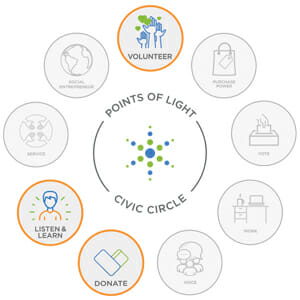
6 Ways to Activate Points of Light’s Civic Circle Around Ukraine Relief
As Ukrainian refugees evacuate their homeland and begin to build new lives in new countries, you can support them. We’ve gathered a collection of ways for you to activate
Cash donations offer flexibility for organizations to respond in real time to people’s developing needs. Do your research first so you can be sure that the organization you plan to support is legitimate. Points of Light has established the
is happening all April long. Now is a great time to register to volunteer, but please do not self-deploy. There is limited access around humanitarian relief efforts right now. Working in the aftermath can be both dangerous and complex. It’s safest to wait until the impacted community has requested support, then coordinate with a vetted organization. Find a
, where we share updates and valuable information from our affiliates and other organizations about ways to support Ukraine. You can also follow first responders that are taking action to learn about the most pressing needs. Be intentional to watch media that cover both conservative and liberal views.
Through signing a petition, creating artwork with a statement or even staying silent, you can make your voice heard. And of course, you can share on your own social media network to raise awareness about long-term recovery needs. Just be careful to choose trustworthy sources to ensure you’re spreading accurate information. Check out our issue of
Your dollars can have an impact. You can choose to do business with companies supporting relief efforts in and around Ukraine with proceeds from your purchases. Participate in your own
by searching for companies that are selling products and services that you need. Some companies that are doing this work include Epic Games, maker of the popular video game, Fortnite. The company is giving away all proceeds from the game through April 3. Video game console maker Xbox has joined their effort by donating their net proceeds as well. Ukraine’s Ministry of Digital Transformation launched the ‘Meta History: Museum of War’ collection, a series of NFTs that support the war effort in Ukraine. Grammarly, an English language app, is donating $5 million to organizations and funds supporting the people of Ukraine.
There is a growing movement in the corporate sector toward “doing well by doing good,” This ideal could look like giving to humanitarian relief efforts through employee matching, which not only supports the cause but amplifies employee donations. Find out if your company is supporting Ukraine through donations and matching or other means.
Some companies that are doing this type of work include:
Bank of America, which pledged to donate $1 million to the people of Ukraine via five groups: the Red Cross and Red Crescent network in Ukraine and the region, World Central Kitchen, Cooperative for Assistance and Relief Everywhere, International Medical Corps and Project Hope. The bank also said it would match employee donations to support the relief effort.
KPMG Chair and CEO, Paul Knopp, shared via Twitter, “At KPMG we stand with and support the people of Ukraine, condemning violent attacks by the Russian givernment [sic]. Today, KPMG is making an initial $250,000 donation to GlobalGiving’s Ukraine Crisis Relief Fund and encouraging our partners and professionals to donate as well.”
Whether you activate all six elements of the Civic Circle or choose just one, you’re exercising your civic power. Which will you choose? Tag us on
Points of Light operates with a network of innovative volunteer-mobilizing organizations who serve more than 177 affiliates across 38 countries around the world. Together we are inspiring, equipping and mobilizing more people to use their time, talent, voice and resources to create positive change in their communities. Learn more about our Global Network.
HandsOn London and HandsOn Greenville Excel in Capacity Building During the COVID-19 Pandemic
comprises 177 innovative volunteer-mobilizing organizations across 38 countries around the world. Day in and day out, these organizations are actively responding to the planet’s toughest conflicts.
While the COVID-19 pandemic left nonprofits across the globe short of resources, many developed new services, programming or partnerships in response. In fact, our Affiliate Annual Report showed that 91% of affiliates took this route in 2020 and 2021, pivoting in the face of immense challenge and finding ways to continue to support their communities.
made great strides in supporting two strands of work responding to community needs around the pandemic. The first was using grant funding to support capacity-building for a Westminster-based food bank.
Over the course of two months, 1,300 volunteer applications and 6,000 inquiries were processed. Six administrative volunteers were trained and worked tirelessly to deliver food parcels and handle the flow of volunteers.
HandsOn London’s second initiative involved developing a remote entertainment program for older people within two separate organizational projects. Not only did the team successfully achieve this outcome, they expanded their reach to two additional groups, or four weekly sessions.
One such group is The Crusoe Club, a club for visually impaired older members of the community. The group usually meets every Friday in person and has a hot meal prepared for them by volunteers. They play games, socialize, have a sing-a-long and even take part in a yoga class. However, these activities had to be put on hold during the pandemic, making this group more isolated than ever before. HandsOn London quickly pulled together volunteers to organize a weekly virtual video call, featuring activities like music quizzes and trivia games.
The calls were so successful that even after The Crusoe Club was able to start gathering in person again, they opted to keep the additional weekly virtual meeting.
“You are all magic. We are not worrying about Crusoe Club now, because you and your team are keeping them well connected.” – Tina Johnston, Coordinator, Positive Aging at Blackfriars Settlement
) also stepped up to the plate during the stresses of the COVID-19 pandemic. They utilized funding to expand existing programs and create new ones that responded to pandemic-specific needs.
Through the HandsOn Greenville 2020 Series and the COVID-19 Relief/Response program, the organization activated over 1,600 volunteers who completed almost 2,000 hours of service through food drives, educational workshops, back-to-school supply drives and virtual and in-person volunteer opportunities.
New programs that were supported with the aid of Points of Light and Center for Disaster
Philanthropy funds included supporting food banks and supplying direct-service agencies with essentials like first-aid kits and other household products. An essential school supply drive was another big success.
And the 2-1-1 Greenville Community Resource Line was also established, connecting people with the services available to address their needs. Through fielding these calls, HandsOn Greenville was able to learn firsthand what and where the highest number of people in need were living throughout the county. One-thousand-nine-hundred-twenty individuals and families were able to hear a reassuring voice on the other end of a phone call in moments of crisis, connecting them to critical services.
Both organizations’ work was done with new and ever-changing protocols, like contactless collection drives and mask-mandatory volunteer events. Learning new technology has been a challenge for many throughout the pandemic, but volunteers, communities and organizations are walking away with new knowledge and skills that could propel them for years to come.
Points of Light is proud of HandsOn London, HandsOn Greenville and all of our global affiliates for demonstrating what capacity building looks like in trying times. It’s clear that nonprofits around the world have ample opportunity to serve their communities, an
d we salute all who put forth effort and make great strides as a result.
3 Ways to Support Relief Efforts in Ukraine Right Now
We have added trusted organizations seeking support that have activated local and international relief efforts.
Points of Light will continue to provide updates on new and developing opportunities for support. Follow us on Facebook, Twitter, Instagram and LinkedIn for updates on how you can help.
Points of Light and our Global Network stand in solidarity with the people of Ukraine who are being impacted by attacks of war that are placing millions of lives at risk. As images of people fleeing their homes and seeking refuge are broadcast across screens around the globe, it’s natural to feel an urgency to help. You can have an impact, no matter where you are in the world. Below are three ways you can support relief efforts, as recommended by Points of Light and our Global Network disaster committee.
Donate. Research and give to a reputable international relief organization or one of our network affiliates listed below. Cash donations offer flexibility for organizations to respond in real time to people’s developing needs. Organizations are able to direct your dollars to the most-needed resources and put them in the hands of experienced responders, giving them the tools they need to help people recover. Do your research first so you can be sure that the organization you plan to support is legitimate. See our list below of trusted organizations.
Register to volunteer. While there is limited access for humanitarian relief efforts right now, working in in the aftermath can be both dangerous and complex. It’s crucial not to self-deploy. Until a need has been identified and the impacted community has requested support, volunteers should not enter. In the meantime, there may be opportunities to support relief efforts from home or in your community. Find a Points of Light Global Network affiliate in your area to learn how local organizations are responding to the events in Ukraine.
Be patient. The recovery process of any crisis or disaster can last much longer than the news cycle. There will be a persisting need for donations and volunteers for years to come. Stay informed by listening and learning to find out what the community needs. You can also use your voice by sharing on social media to raise awareness about long-term recovery needs.
When a crisis unfolds, we know that acting globally means acting locally. That’s why we look to elevate and support our most valuable resources in the region, our Global Network affiliates. Our affiliates in the vicinity of Ukraine are positioning themselves to respond to needs as they arise.
As natural disasters increase in frequency, we all express our deepest concern and compassion to all those affected, but sometimes that doesn’t feel like enough. Many of our Global Network affiliates and partners have mobilized to provide critical disaster relief services in many disasters, from emergency housing assistance to food and supply distribution.
Individuals throughout the nation and across the globe are searching for ways they can help support these relief efforts. Below we’ve included some tips for how you can maximize your contributions, provide help where it’s needed and keep from hindering the necessary emergency services in motion right now.
offers a holistic framework to help businesses, nonprofits and individuals to understand, identify and engage in the full scope of civic life. There is perhaps no better time to see the breadth of these various vehicles of engagement than during a crisis. Below are three ways you can make an impact and support relief efforts, as recommended by Points of Light and our Global Network disaster committee.
Want to donate? Donate cash. During a disaster, many people think the best way to help is to donate food, clothing or goods to those affected. But money is actually the most needed commodity in times of crisis, because it allows experienced responders the flexibility to obtain the exact resources needed. Numerous local and national organizations are assisting in the rescue and recovery efforts. Do your research thoroughly, as scams can unfortunately arise during natural disasters. Many nonprofit organizations make Amazon wish lists for donors during a natural disaster. This tool allows you to fill in a specific and immediate need for a disaster-affected community. To check if these are legitimate organizations, you can look them up on Charity Navigator to make sure donations and other efforts are going to those in need. Also, check with your employer and ask if they are able to match funds donated by employees. Corporations and organizations have immense potential to make an impact after a natural disaster. Many companies have existing donation-matching programs already in place, and others are happy to set up such a program for specific circumstances. Some of Points of Light’s recommended partners include HandsOn New Orleans, United Way of Acadiana, United Way of Southeast Louisiana, HandsOn River Region, American Red Cross, Good360, World Central Kitchenand Team Rubicon. Read more about impactful donations in the Donate issue of Civic Life Today.
Volunteer with an agency — not on your own.Volunteering locally during a crisis is an excellent way to provide boots-on-the-ground support. But don’t go it alone! Self-deploying in a disaster area is incredibly dangerous and you can inadvertently undermine the efforts of expert responders. Instead, support relief efforts by finding a Points of Light Global Network affiliate in your area, and wait until they ask for volunteer support. Many times, the most needed relief services with these organizations can happen remotely from your home.
Practice patience. Remember that recovery is a long (often multi-year) process. So if you feel like there’s little you can do right now, be patient. There will be volunteer and cash needs for many months, often years, after the disaster – especially when the community enters the long-term recovery period. Organizations that specialize in disaster relief tend to lose donations and volunteer support as time passes, so they’ll be glad to have as many people as possible stick around for the long haul. Stay informed by listening and learning to find out what the community needs and meet them where they are. And in the meantime, share on social media to use your voice to raise awareness about the disaster relief and long-term recovery needs.
For anyone impacted directly or indirectly by a natural disaster, the national Disaster Distress Helpline (DDH) offers 24/7 crisis & emotional support to anyone in the U.S. impacted by natural or human-caused disasters/traumatic events. Callers to the DDH 1-800-985-5990 can connect with counselors in 100+ languages via 3rd party interpretation services.
Follow us on social media @PointsofLight for updates from Points of Light and our Global Network affiliates.
3 Ways to Support Relief Efforts in Haiti and Afghanistan
Points of Light and our Global Network stand in compassionate solidarity with those impacted by the events in Haiti and Afghanistan. We value that acting globally means acting locally and have already seen our affiliates respond to pressing needs, from providing refugee housing assistance to organizing donation drives in their local communities and more.
In the immediate aftermath of any natural disaster or upheaval, we know that you may want to step up to help. Below are three ways you can make an impact and support relief efforts,
as recommended by Points of Light and our Global Network disaster committee.
Cash is best. Research and donate to a reputable international relief organization. Cash gives agencies the most flexibility in obtaining the most-needed resources, and a donation helps to put experienced responders on the ground, giving them the tools they need to help people recover. It’s also important to avoid charity scams, and background research can help make sure that your donation goes to a legitimate organization.
Register to volunteer with a responding agency. Do not self-deploy and don’t underestimate the complexity of working in a disaster area. Until a need has been identified and the community impacted has requested support, volunteers should not enter. There may also be opportunities to support disaster relief efforts from home or in your local community. Find a Points of Light Global Network affiliate in your area to learn how local organizations are responding to the events in Haiti and Afghanistan.
Be patient. Recovery lasts a lot longer than the media attention around international events. There will be volunteer and cash needs for many months, often years, after the disaster – especially when the community enters the long-term recovery period. Continue to monitor relief efforts and the organizations responding to the events so you’ll be ready to take action and connect to an opportunity when the need arises.
Follow us on social media @PointsofLight for updates from Points of Light and our Global Network affiliates.
Service Enterprise Program Equips Volunteer Leaders throughout COVID-19 Pandemic
The COVID-19 pandemic created unknowns for individuals and organizations around the globe. Early on, the realization that human connection was essential became widespread, and organization leaders began to reimagine what volunteer service looked like in a global crisis.
Mark Storrey, chief executive officer of the Haven Humane Society in Redding, California, has been with the animal shelter for eight years. After 20 years in the Air Force, Storrey transitioned to helping animals find their forever homes with his family and four dogs.
The Haven Humane society has past experience in adapting to crisis, like the California Carr Fire. In times of crises, it’s rewarding to be able to help the community because it’s like an extended family, Mark said.
The shelter shut down when the COVID-19 pandemic began — but when it shelters more than 300 animals, people can’t just walk away.
It operated with a skeleton crew and a limited number of volunteers. Staff began to post photos and videos of the animals on their volunteer Facebook page to keep volunteers engaged — and the response was overwhelmingly positive.
“I think it really brought us together, even though we were apart, and it kept volunteers invested. As soon as we opened back up, it was like the volunteer floodgates lifted,” Storrey said.
More than two thousand miles across the U.S., United Way of East Central Iowa continued to unite the caring power of communities to invest in effective solutions that improve people’s lives — even in the middle of a pandemic.
Kayla Paulson serves as a retired and senior volunteer program director and volunteer engagement capacity builder at UWECI.
“The organization is really about helping people help people — we are that connector and that force that can help mobilize and deploy people,” Paulson said.
UWECI acted as an emergency volunteer center in the pandemic and let volunteers step in and step up where they were uniquely qualified. It partnered with Iowa Habitat for Humanity and leveraged their AmeriCorps members for disaster response efforts.
Both organizations are a part of the Points of Light Service Enterprise program, which is designed to help organizations leverage volunteers to achieve maximum operational efficiency and greater social impact. Due to the skills gained in becoming a certified Service Enterprise, a stronger foundation was in place for the transition needed to keep volunteers safe and engaged during the pandemic.
“Through the training we received from Points of Light, I think we made a lot of really positive changes,” Storrey said. “We’ve laid the groundwork to grow, and once we can actually socialize again, I think we’ll be able to start realizing even more potential,” he added.
Storrey expected to learn about recruiting and engaging volunteers during the program, but was pleasantly surprised to realize additional deficiencies and training opportunities. Shortly after, the Haven Humane staff started to make training videos for volunteers and future staff onboarding.
“I think that it really highlighted that we can take skills-based volunteers and we can really work with them by integrating them into the org chart and getting them more involved in the organization as a whole. I think it’s made us a much stronger team,” Storrey said.
“I want to thank Points of lIght for having the program. I wasn’t sure what to expect, but it exceeded all my expectations and I think that our organization is a better organization because of it,” he added.
Volunteers have a variety of opportunities to get involved at the Haven Humane Society. From dog walking, cat socializing, assisting with the veterinary hospital and fundraising, volunteers are critical to the shelter, Storrey said, even the volunteers who show up and are allergic to the animals.
UWECI is a Service Enterprise Hub — an important partner in Points of Light’s capacity-building efforts — and helped other organizations in Iowa get certified and recertified as a Service Enterprise during the pandemic.
Due to UWECI’s leadership and hard work, other nonprofits like the Catherine McAuley Center — a shelter that provides supportive and educational services to immigrants, refugees and women in Iowa — had the volunteer infrastructure and network needed to adapt when food pantries shut down.
“If they didn’t already have those pieces in place, and they didn’t already invest the time and staff training, they wouldn’t have been able to switch and quickly adapt,” Paulson said.
“I really love being able to watch our volunteers be the best version of themselves,” Paulson said. “So whether it’s the Service Enterprise and building the capacity of our nonprofits to better leverage volunteers or being able to respond as we continue to have disasters — I want to help my volunteers see that they have transferable skills that they have built up over a lifetime,” she added.
Exciting things are on the horizon for both organizations.
The Haven Humane Society will host its annual Putt for Paws golf tournament in July 2021 to raise funds and promote animals available for adoption. It will be named after Daniel Zanine, the organization’s former chief financial officer, who passed away from the coronavirus the day before Thanksgiving in 2020.
UWECI plans to celebrate volunteers during its Time for Art: A Celebration of Volunteers event in April 2021. Participants can virtually celebrate and bid on art from upcoming artists in Eastern Iowa. Its annual Day of Caring will take place in May 2021.
“With volunteering, you can see immediate rewards. You can get positive reinforcement within a couple days — So that’s why I hope everybody gives back and everybody chooses to find a space that they can help others,” Paulson said.
How Volunteers Supported Wildfire Response and Long-Term Recovery Efforts in Northern California
Over the past few decades, several major disasters have tragically shaken communities across the United States. From natural disasters like hurricanes, tornadoes and wildfires, to man-made disasters like the Flint water crisis, these events test the unity, strength and resilience of our communities. The path to recovery and rebuilding is long, often continuing for years after a disaster strikes – and this work is most successful as a collaborative, cross-sector effort that includes the ongoing support of volunteers. Disasters can be scary and unpredictable, but the incredible individuals who step up to help represent the great humanitarian spirit that we see rise up, time and time again, in moments of need. As local experts in volunteer management, Points of Light Global Network affiliate often play a critical role in managing volunteers throughout response and recovery efforts.
North Bay Wildfires, Fall 2017
Wildfires are incredibly powerful and can gain speed rapidly, quickly devastating entire neighborhoods. The North Bay Wildfires caused thousands of families across Northern California to lose their homes and businesses, and brought more than 8,000 firefighters in to battle against raging flames.
In Napa, Marin, and Sonoma counties, the
serves as an emergency volunteer center, overseeing spontaneous volunteers and donations in the aftermath of a disaster. We spoke with CEO Linda Jacobs and Elaine Tokolahi, director of volunteer services, to learn more about their disaster preparedness, response and recovery efforts – and the critical role played by volunteers.
How did the North Bay Wildfires impact your community or region, and what was your organization’s role in the disaster response and recovery efforts?
In the last four years, CVNL has stood up an emergency volunteer center multiple times due to fires and earthquakes. The most recent disaster that struck our region was the North Bay Fires, which started on Oct. 9, 2017. We operated two EVCs simultaneously in two different counties. In Napa, we managed more than 2,000 volunteers who staffed three evacuation centers and shelters, and in Marin we managed nearly 1,000 volunteers who staffed one large evacuation center and shelter. Following the fires, we partnered with Redwood Credit Union to distribute $1.621 million to people impacted by the fires. We also distributed grants to nonprofits that provided direct services to people and animals impacted by the fires. CVNL is still involved in Napa’s long-term recovery by recruiting and managing volunteers for Napa’s Long-Term Recovery Group, comprised of nonprofit and government agencies dedicated to the whole community’s recovery.
How did this disaster impact your community?
In Napa County, more than 600 families lost their homes in the fire, many more people lost their jobs because businesses burned down, and thousands more residents suffered financially due to the weakened economy. Nonprofits saw a significant increase in the number of clients and in the severity of client needs.
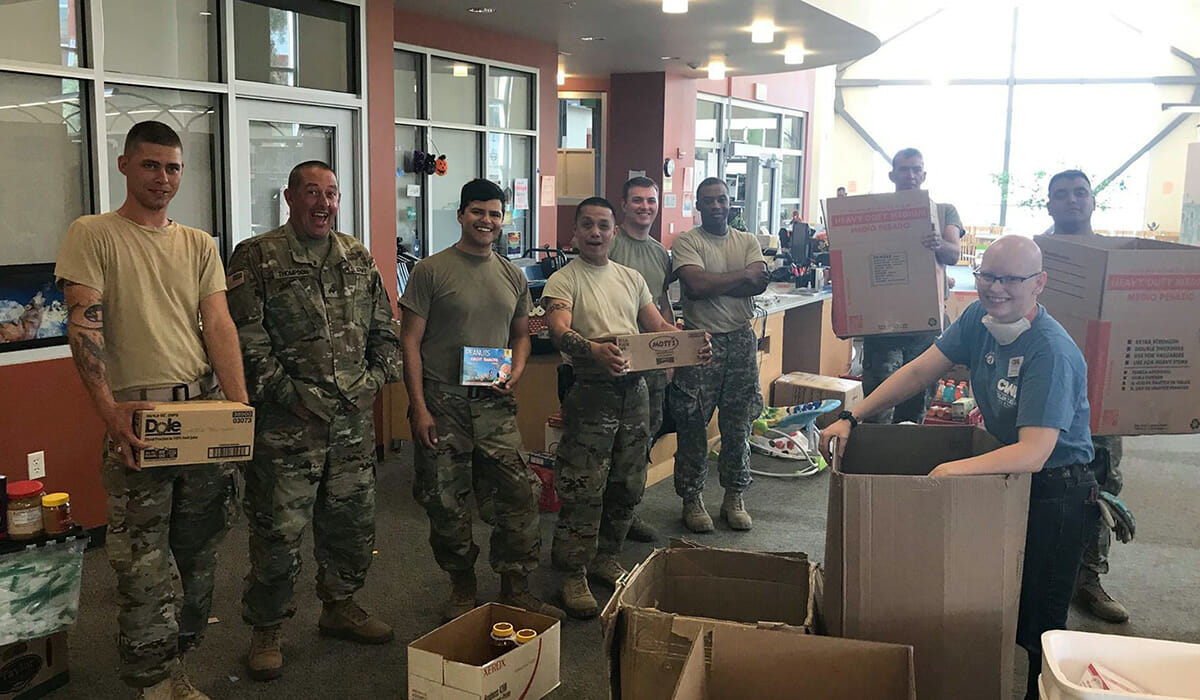
National Guard members from Travis Air Force Base visit the American Canyon shelter to help sort donations.
What role did volunteers play in supporting your organization and the community, both in the immediate response and long-term recovery?
During the fires, volunteers stepped up to fill nearly every role in the shelters and evacuation centers. They cooked and served food, set up cots, took care of animals, interpreted between Spanish and English, and sorted mountains of in-kind donations. Volunteers with professional affiliations provided medical care and childcare. AmeriCorps members filled volunteer lead positions. After the fires, volunteers continue to help. They rebuild homes and schools, plant trees, hold donation drives, and rally their coworkers to volunteers alongside them.
What do you want eager disaster-relief volunteers to know before they begin serving affected communities?
Registering in advance through the organization that manages the emergency volunteer center guarantees that you will be used if there is a need. Just showing up often gets in the way of the first- and/or second-responders. We recommend getting training ahead of time, as knowing what the roles are and how the process works in advance makes service smooth and more supportive during a chaotic time.
What lessons has your organization learned, and what advice do you have for other volunteer management organizations that may face a similar situation in the aftermath of a disaster?
As the old adage says, “practice makes perfect.” Dedicate time to practice your emergency plans and continuity of operations plans. Learn how to serve as an emergency volunteer center by practicing at least once a year. Work with your local government agencies so that they know how to integrate volunteers into their own plans. Ultimately, you will be staffing the response efforts that they lead, so show them that volunteers can be assets during disaster response. Government agencies often fear that spontaneous disaster volunteers will become liabilities, but when we strategically plan ahead for volunteer involvement in response, those fears go away and volunteers can significantly contribute to disaster response efforts.
Is there one particular moment or memory that stands out to you as you think back to this period of response and recovery?
Disaster volunteers come from all walks of life, yet share the same goal: alleviate suffering. One particular memory comes to mind. The local Islamic Center learned of our need for shelter volunteers, so three teenage sisters who worship there signed up for an evening shift at a shelter. They said they finished their homework and came right over, with their parents’ permission. On the second night, they volunteered again and brought their cousins to help. On the third night they brought their parents, too. By the last evening shift, the original group of three sisters had grown into a group of 12 volunteers, who stepped in to feed people, help the elderly walk around at night, gave water to sleepy children, signed-in new fire evacuees, and did anything else needed to make the shelter a warm and welcoming place.
In the event of a disaster, Points of Light supports first-responder organizations, like FEMA and the American Red Cross, connects with Voluntary Organizations Active in Disaster chapters across the United States to assess the situation, and coordinates with our Points of Light Global Network affiliates and partner organizations in the affected areas. Remember – in the immediate aftermath of a disaster, it is critical that people who want to volunteer, especially those outside of the immediate area, do not self-deploy. Connect with local organizations responding to the disaster to find out the best way to get involved.
The Power of Connectivity: A Reflection on Volunteering and Service
Craig Arnold supporting the Salvation army during a relief effort in Tacloban City, Philippines, following a cyclone. (Photo courtesy of Craig Arnold/UPS)
When I started at UPS, the plan was just to pay the bills during college and move on. More than three decades later, I’m still here —
why
?
Craig Arnold, Vice President of Sales, UPS
It comes down to service. My parents worked for the Salvation Army their entire adult lives, so I grew up seeing service in action.
I saw the same commitment when I walked through the doors at UPS. I still remember my first training class as a young supervisor when the instructor told us quite simply:
UPSers
serve
. Service is in our name. We serve customers, each other, shareowners and the community. I love that concept.
The instructor on that fateful day challenged us as leaders to make our decisions through the lens of service. I was hooked. All these years later, against the backdrop of
. As he said, the starting point for giving back starts within. When you find something you’re passionate about, giving time, sharing knowledge and offering financial support come naturally.
For me, the path was clear. My 32 years of developing logistics expertise and my passion for helping those in need were accelerators for giving back. I’m now part of an early-response Salvation Army team that goes to large-scale international disasters. Usually, we’re on the ground in the first couple of days after an event.
During the past nine years, I’ve deployed to Haiti, the Philippines, Vanuatu, the U.S. Virgin Islands and Puerto Rico. In each case, my role is to build a supply chain to deliver urgent aid to those in desperate need.
All disasters are different, but for me, they all have one common thread: We maximize our impact when we’re truly connected.
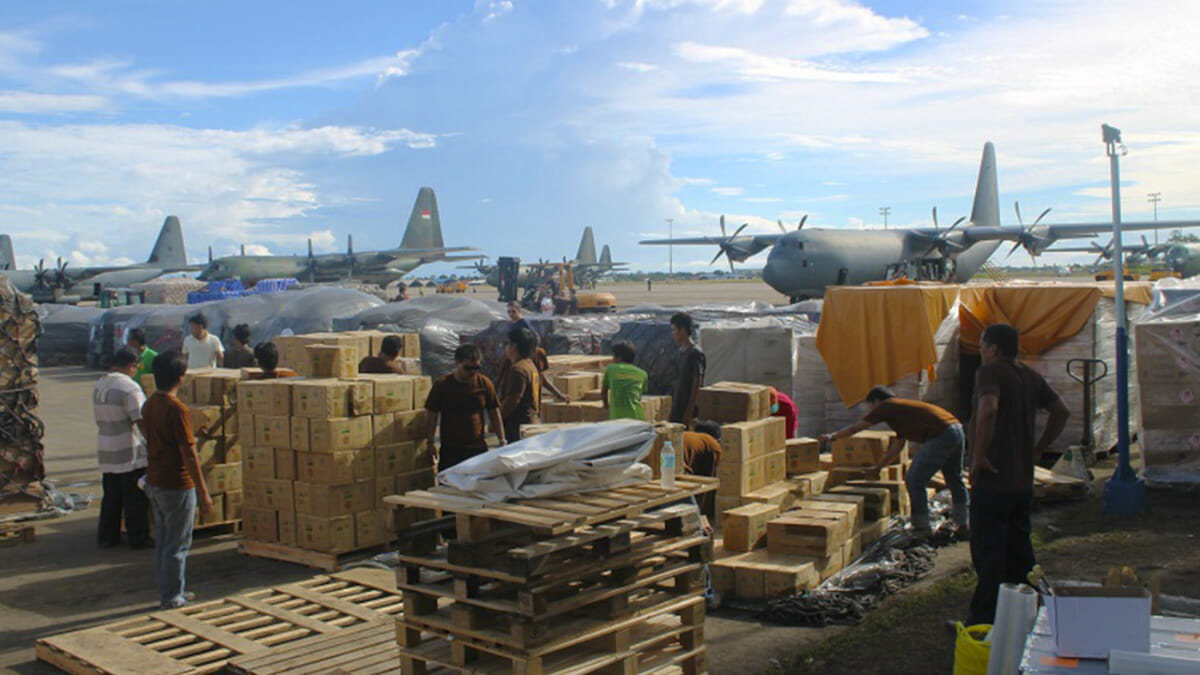
SUPPLIES BEING STAGED DURING A UPS HUMANITARIAN RELIEF OPERATION. (PHOTO COURTESY OF UPS)
Getting results
For example, after the earthquake in 2010 in Haiti, the Salvation Army cared for 15,000 displaced people living in a soccer stadium. They had more than 100 local volunteers, five trucks and an international team of disaster response experts, but they needed aid from outside the country as well.
UPS had never landed in Port Au Prince and needed landing rights, custom processes and a partner who could effectively distribute aid to people in need. I was blessed to be in the right place at the right time. From the ground in Port Au Prince, I could organize the inbound processes, set up local trucking and engage the 82
nd
Airborne to help us deliver support.
In 23 days, we delivered 1.2 million meals.
In Vanuatu, after the devastation brought by Cyclone Pam, a community in a remote island village perched on the side of a mountain needed PVC, plumbing connectors and hardware. The need here wasn’t for big jets — it was about connecting different networks.
UPS provided funding for a series of small charter flights from Vanuatu’s capital city to the island every day to provide enough water every 24 hours. The Salvation Army funded barge space to move the pipe. The French military supplied helicopter lift from the barge up the mountain. The local villagers rebuilt their own water supply system.
This was the power of connectivity at work.
More opportunities to give back
Most recently, in response to Cyclone Idai’s devastation in East Africa, UPS and The UPS Foundation worked with nonprofit organizations to
.
As the region rebounds, the need for support will continue. The work in all these countries shares the same common theme. It’s all about connecting people and networks. No single person can get these large-scale results. But working together, each person brings their own experience and expertise, ultimately creating a domino effect that produces life-changing solutions.
In 2018, UPS and The UPS Foundation responded to 29 major world disasters. Relief spanned 71 countries across continents around the globe. Beyond these headline stories are the stories of people in need. Some of them are in your neighborhood. Some are complete strangers. Either way, the opportunities to give back are endless.
As we celebrate National Volunteer Week, I’ll challenge you like my UPS instructor challenged me more than 30 years ago:
Go serve.
Craig Arnold joined Points of Light President & CEO Natalye Paquin for an interview with Atlanta’s 11Alive during National Volunteer Week:
Craig Arnold is vice president of sales for UPS. Since 2010, he has deployed as a front-line responder into disaster sites to help coordinate relief logistics after cyclones, hurricanes and earthquakes around the globe.
This story originally appeared on UPS Longitudes and was reposted by permission.
CSAA Insurance Group: Supporting Community Safety During Disaster
By Roger Hancock, Manager of Community Affairs, CSAA Insurance Group, a AAA Insurer.
This year’s Northern California wildfires burned more than 600,000 acres – the largest wildfire in California history. The fires were devastating, resulting in the destruction of numerous structures, the displacement of thousands of residents, and several fatalities. While first responders met the wildfires head-on, volunteers also played an important role, providing comfort and counsel for those at risk of losing everything.
CSAA Insurance Group’s award-winning corporate volunteer program, AAA Volunteers, empowers and motivates employees to address diverse community needs through volunteer service. In response to the wildfires, employees volunteered to take time from their normal job duties and daily routines to contact impacted customers. These calls helped confirm that those who were forced to evacuate or prepare for displacement were safe and had the information they needed to provide for themselves and their families. Within a single week, more than 4,000 calls were made to individuals impacted by the fires.
While our employees are always looking for ways to give back, it is in times of urgent need that we often receive an overwhelming number of requests from our staff to help out. Any one of us could need help in an emergency, so we all want to be there for those who do.
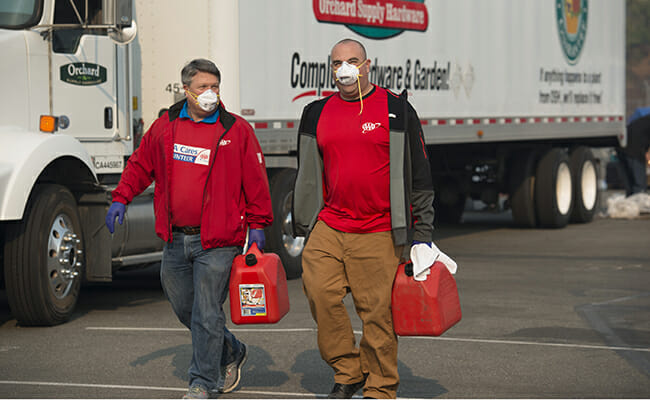
In addition to the phone bank, employees volunteered to provide on-the-ground assistance at evacuation shelters and local assistance centers. While customers await news about their home and family members, AAA Volunteers are often there to provide a cup of coffee, share a stuffed animal for a child, or offer a sympathetic ear. These simple gestures of kindness can have a profound effect.
In anticipation of catastrophe-related needs, employees who deploy for emergencies receive up to 80 hours of paid time off to volunteer, and help position skilled labor, supplies and other critical resources before disaster strikes. In addition, training on personal preparedness, including courses in First Aid and CPR, is also available.
As demonstrated during the recent wildfires, as well as during other natural disasters, anyone can be impacted by catastrophic events. AAA Volunteers play a critical role in response and recovery, and provide for the safety and stability of our communities.
Last year, 99 percent of the employees at CSAA Insurance Group volunteered, largely because service is the cornerstone of the company’s community involvement efforts, and all of the company’s outreach programs are built around employee volunteerism.
Our employees tell us they choose to give back because they find the experience meaningful and rewarding. AAA Volunteers provides each of them with the opportunity to find ways to make a lasting difference, and know that they are contributing to something important.
Roger Hancock is a volunteer manager with more than 30 years of leadership experience creating and managing award-winning national corporate volunteer programs. He has managed the “AAA Volunteers” program since 2003, is a past-president of the Volunteer Centers of California, and has served under two governors on California’s Volunteer Service Commission.
Committed to serving AAA members for more than 100 years, CSAA Insurance Group offers AAA-branded automobile and homeowners insurance in 23 states and the District of Columbia
Once You’ve Worn the AmeriCorps ‘A,’ You’re Always Ready to Answer the Call
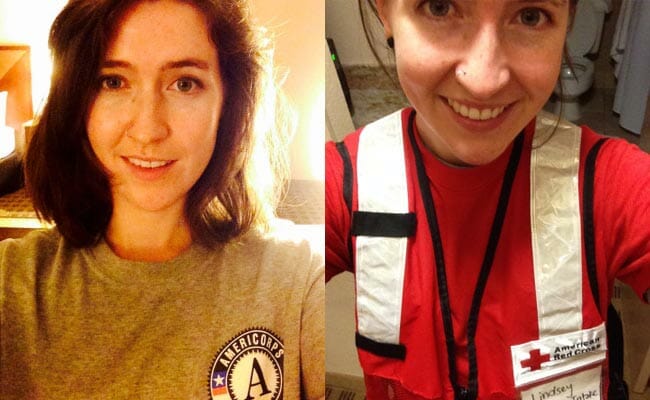
As Hurricane Harvey moved across Texas, causing massive flooding and damage, AmeriCorps Alums partnered with the American Red Cross to mobilize skills-based volunteers from the organization’s national service alumni network – specifically those who have served with FEMA Corps or NCCC, had experience with disaster response, and who could travel to Texas to assist with immediate recovery. Volunteers, like AmeriCorps alum Lindsey Earl, quickly responded and helped provide on-the-ground support in Houston.
Lindsey arrived in Houston on Aug. 19 to begin an internship with local nonprofit
at Illinois State University. She had heard news coverage of an impending hurricane heading her way, but could have never anticipated the scope of what was to occur.
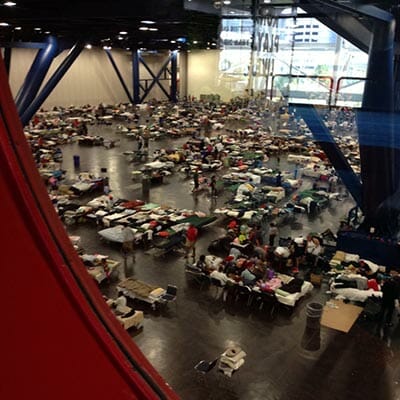
Exactly one week later, as Hurricane Harvey tore through Lindsey’s new community, she answered a phone call in the hotel where she was taking refuge. The Red Cross needed her help. Lindsey arrived at the local Red Cross headquarters and was asked to use the skills she had gained in AmeriCorps to support many tasks required in the response and recovery effort. Initially, she oriented incoming staff and created a resource guide for flood victims. Within several days, she moved to the George R. Brown Convention Center emergency shelter to conduct volunteer intake, where at times she was the sole manager as more than 6,000 volunteers streamed in.
Lindsey recently returned to her internship at Change Happens, where she will lead disaster recovery operations for the organization. She shared, “I’ve become extremely connected to the city of Houston. I truly can see the beauty in it. So many people poured in to assist those in need. It was phenomenal to watch people so eager and willing to help their neighbors.” No matter what comes next, Lindsey will continue to get things done, building upon her