3 Themes From the 2022 Points Of Light Conference to Support Your Nonprofit’s Impact
The annual
Points of Light Conference
yields a wealth of unique opportunities, and a big one is hearing from experts in the nonprofit sector on current issues, innovative ideas and best practices. The 2022 conference hosted a variety of inspiring speakers from nonprofit organizations from around the world offering insightful and educational messages. Here are a few key takeaways for nonprofit leaders that emerged from this year’s stage:
People will engage with what they’re most passionate about.
Work in the nonprofit sector can be uplifting
, but it isn’t always easy. Knowing how to keep the flame alight among your team, your volunteers and your stakeholders is crucial to avoiding fatigue and burnout. This year’s conference theme was “Revitalize. Reimagine. Recommit.” and we featured speakers and sessions that spoke directly to this mission… like Jennifer Taylor, who shared on the topic of “rage giving.” With increasing polarization on the political and social landscapes, now is the time for nonprofits to develop specific strategies that allow people to act on the very causes they feel most strongly about. How can you leverage what you and your stakeholders are most excited, hopeful, frustrated or angry about to sustain your impact?
Listen to the communities you serve to learn what they need.
Intentional listening and learning in the communities you serve allows you to find solutions to the
true
unmet needs of that community, rather than the issues you might
assume
to be the most pressing. In the Opening Plenary, Points of Light CEO Natalye Paquin shared a story about
Daily Point of Light Honoree Briana Daniel
, an Orlando native. When she chose to voluntarily live alongside the people she was working with who were unhoused, she found that food insecurity was not their greatest unmet need, but hygiene was. This knowledge led her to create Street Team Movement, a nonprofit providing laundry services, haircuts and hygiene products to people experiencing homelessness, offering solutions to the exact needs the community expressed were most urgent.
PEOPLE FEEL significant positive impact from VOLUNTEERING.
Several conference sessions discussed the immense benefits that come from volunteer work – not just to communities, but also to the volunteers themselves. Points of Light
civic engagement research
shows that
one in four people said a reason they took action was, “I believe it supports my own personal well-being.”
As you engage volunteers in your efforts, keep in mind that they are likely benefitting from this work as much as the communities they serve. Volunteering can
boost memory, cognition
and
mental health
as well as provide job skills One
study
even asserts that:
- Volunteers are as healthy as non-volunteers who are five years younger.
- Volunteering activities on a resume can yield higher employment opportunities.
You can begin to see that this benefit goes beyond the altruistic feelings of spending worthy time in support of social impact. Often, volunteers walk away with new skill sets, relationships and perspectives they may not have the opportunity to gain anywhere else. Framing volunteer work in this way can help organizations to promote greater equity and remember that they are providing mutually-beneficial resources rather than just rescue.
One thing we know from working with our
Global Network
of affiliates from around the world is that the nonprofit sector is teeming with innovative thinkers and creative problem solvers. Nonprofit leaders, what are some insights you’d add to this list?
We’re already gearing up for the 2023 Points of Light Conference in Chicago on June 14-16, 2023, with a special pre-conference day for nonprofit professionals. Sign up to receive updates, and join us next year for another powerful conference.
4 Resources to Get Young Changemakers Engaged This Summer
Leading a civic life isn’t just about lending time and resources as an established adult. It’s also about involving youth, showing them that they, too, can make an impact, regardless of their age.
While young changemakers can stay involved all year long, summertime is prime time for kids to become more civically engaged. After all, school’s out, schedules tend to be more lax and there is ample time to fill with worthwhile activities. Plus, getting involved with causes you care about can be rewarding when done with those you love.
Fortunately, Points of Light has a wealth of resources for youth and families to get involved in their communities. Here are a few to get you started.
Civic Life Today
You may have heard about
Points of Light’s Civic Circle
, a framework we created to show people that doing good comes in many forms. But have you taken a deep dive into each element of the Civic Circle in our free digital magazine series,
Civic Life Today
? Points of Light partnered with
The Starbucks Foundation
to publish nine unique issues, including interviews and articles from leaders in the field.
Best of all, at the back of each issue you’ll find a special section devoted to Youth and Family, with additional resources to explore. You’ll also discover a Personal Action Plan section, created in partnership with
HandsOn Greater Richmond
, for your family members to figure out exactly how they can best leverage their time and talent for a specific cause area.
Find a Volunteer Opportunity
There are hundreds of thousands of volunteer opportunities throughout the world, just waiting for the right volunteer to step up. Some of these opportunities are in person, while others are virtual or a combination of the two. Points of Light offers the world’s largest digital network, allowing you to search for these opportunities in an intuitive, user-friendly interface.
Points of Light Engage
is our
database listing volunteer opportunities—inside and outside of the home—that meet critical needs. You can search for volunteer projects in your local area, or get inspired by what’s happening in other areas and start your own initiative.
DIY Projects
If you and your family haven’t tried a
DIY Project
, summer is a great opportunity to do so. With a variety of different kinds of projects, from creating a mobile library to cleaning up a local park to collecting old cell phones, there are ample options for kids of all ages.
Each DIY Project guide comes with an overview and a step-by-step guide, including materials and resources needed, as well as helpful tips along the way. Take special note of those “Pre-Project Discussion” questions. They can help you start a rich dialogue with your children that connects the “what” of the project to the “why.”
Celebrate Your Civic Journey
At Points of Light, we’re firm believers in the power of recognition. If your kids have taken the time to learn, grow and get more involved with causes they care about, that’s certainly worth celebrating! This celebration might look like getting ice cream after wrapping up that volunteer day, debriefing with some “wins” after completing your DIY project or maybe something even bigger.
Points of Light’s founder, President George H.W. Bush created the
Daily Point of Light Award
to honor ordinary individuals doing extraordinary things. If your family knows of someone in your community who is leading and lending support in the volunteer space, nominate them for a Daily Point of Light Award. (Psst – you can also hold your own “award ceremony” as a family, giving each member special recognition for something unique that they brought to your volunteer activity.)
However your family chooses to get engaged, know that you are setting a wonderful example for a life of service. Many nonprofit founders and recipients of the Daily Point of Light Award reflect on how concepts like volunteering and donating were taught early on and became ingrained in them from a young age. The seeds you’re planting today could lead your kids to a more active, civically engaged life for decades to come.
The Points of Light Civic Circle Offers Real Ways You Can Change the World
Sixty-six percent of Americans don’t believe they can make a big impact in the world.
That figure is according to Points of Light’s
research
on civic engagement. But what if we told you there are actually many ways to drive change?
Today’s political climate can feel divided or even stagnant, but the truth is, you really can make things better, starting with your own community, one act of kindness at a time. And those aren’t just words. We’re here to share real, practical ways for you to make a difference.
The Points of Light Civic Circle
helps people connect to opportunities and understand that doing good comes in many forms. It is a framework that represents your power to lead, lend support and take action for causes you care about and live your best civic life.
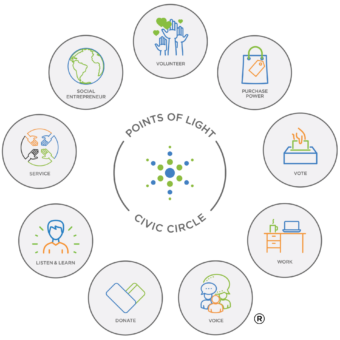
The Civic Circle provides actionable examples of all the ways you can change your community to reflect the world you want to see around you. In fact, you’re probably doing some of these things already. Are you helping a neighbor by picking up groceries or chaperoning on your child’s class field trip? You’re volunteering. Did you vote in the last election or help others get to the polls so they could vote? Those acts of civic duty illustrate the “vote” element. When you buy a product, do you choose to support companies that reflect your values or advance a social cause? That’s called “purchase power.” There are nine elements of the Civic Circle, and countless ways to bring each one to life.
This blog is the first in a seven-part series that will help you find real and manageable ways to activate the Civic Circle through
apps
,
documentaries
,
podcasts
,
books
,
TED Talks
and
blogs
.
We also offer other resources to help you connect with all the ways you can become empowered to be the change you want to see in the world. Check out our
videos
that provide an in-depth look at each element of the Civic Circle. And don’t miss
Civic Life Today
, our digital magazine series. Each issue takes a deep dive and provides materials, ideas and inspiration so that you can become civically engaged. Get started today, and launch your own civic engagement journey with these tools.
This piece is part of a series that highlights the many ways you can activate the Points of Light Civic Circle using various tools. Check out each one so you can live your best civic life:
- Apps
- Documentaries
- Podcasts
- Books
- TED Talks
- Blogs
What we can learn from ‘The State of Global Civic Engagement’
This piece was originally published in Philanthropy News Digest.
For nearly two and a half years, we’ve shared one collective experience around the world. And while most of us are ready to leave behind the years of fear, uncertainty, and loss, we should think twice before rushing to get back to our “old lives,” and for good reason.
History tells us that pandemics and other crises can be catalysts for rebuilding society in new and better ways. If we seek to get back to our old ways, we—especially in the nonprofit sector—are missing an opportunity to take this historic moment to address the fractured systems and stark inequities the global pandemic has exposed, exacerbated, and solidified. We cannot be “done” when there is still so much to do.
At
Points of Light
, we’ve been shining a light on the organizations and individuals serving as those catalysts for rebuilding society. We continue to uplift hundreds of stories of light so those changemakers who have taken action, supported their communities, and made each day just a little better for others can inspire a movement.
Beyond sharing stories, we also need to take this opportunity to meaningfully study the nonprofit sector and determine how organizations can make an impact amid this “new normal.” We’ve been asking ourselves:
Who is taking action? In what ways are they engaging and on behalf of which social issues? And for those who are not engaging, why not?
Points of Light just released
Civic Life Today: The State of Global Civic Engagement
, a series of five in-depth reports that provide insight into the attitudes and behaviors of individuals and the barriers they face—globally and across the United States, the United Kingdom, Brazil, and India—to help us begin to answer these questions. Here are some of the key findings from our research:
Engagement is changing.
The studies examined the top civic actions taken in support of a social issue as defined by the engagement framework of
Points of Light’s Civic Circle
: donating, listening and learning, using your purchasing power, service, social entrepreneurship, using your voice, volunteering, voting, and doing good through work. In the global survey, using one’s
voice
through the posting or sharing of content on a social media platform and
listening and learning
were the top two civic actions taken. These actions are important because they have low barriers to entry and are more accessible to different segments of the population, yet they can prove just as influential as traditional actions such as volunteering or donating.
The takeaway isn’t to replace one with the other but to embrace these new forms of engagement and the people who use them. The challenge we must collectively take up is to open and expand access to pathways of more direct engagement.
Now, the next part of the conversation needs to address how people are using these actions in tandem. And our research reinforces that taking a number of civic actions together can increase impact and effectiveness.
This may be an area where companies can set an example. How are companies not only speaking up about social issues but also demonstrating their efforts to listen to the communities they aim to support and sharing what they learn with their employees, consumers, and peers?
Address the perception of privilege.
Globally, survey respondents listed finances as the largest barrier to engagement: Two of the top three reasons people gave for not engaging in social issues were “unable to financially support social issues causes in general” (more than one in five respondents) and “unable to financially support causes due to negative effects of pandemic” (nearly one in five). This finding indicates a need for organizations to educate potential constituents and create additional pathways to participation beyond making donations.
The misconception that supporting social causes requires money is a barrier that we have to overcome in order to ensure that we are valuing and tapping into what each individual has to contribute to their community and the causes they care about.
How can social sector leaders help signal that easily accessible civic actions like using one’s voice and listening and learning are particularly important? One idea is for nonprofits to highlight their greatest unpaid social media amplifiers alongside their donors in annual reports. Who has helped bring the most attention to your cause?
Challenge inertia.
Newton’s first law of motion says: An object in motion will stay in motion, and an object at rest will stay at rest
unless acted upon by an outside force
.
Our research indicates that this phenomenon exists within civic engagement as well. Individuals already engaging in certain civic actions are the ones most likely to continue taking those actions. For example, 91 percent of the individuals who said they would volunteer over the next 30 days were the same people who had volunteered in the previous 30 days. This is an indicator that we are simply maintaining the volunteer force instead of growing it.
While maintenance is important, how can we put more people in motion on behalf of social good? We know that the most common reason someone volunteers is that they are asked. When was the last time you invited someone to volunteer with you?
Bridge individual change to systems change.
Systems are reinforced or dismantled one decision at a time. The journey of systems change starts with the individual, but it requires organizations everywhere to help people participate in the transformation of policies, to be included in the power dynamics, to evolve social norms, and to strengthen the civic mindset of this country and the world at large.
Our research underscored that people are looking to companies for leadership, with 82 percent of global respondents and 95 percent of respondents in India expecting companies to address the social issues in their country.
What we conclude from our research is that nonprofits can do more to provide opportunities for engagement, particularly ensuring new and more accessible pathways of entry into civic action. How can nonprofits and companies seek meaningful partnerships to engage employees and consumers, extend reach, and expand impact?
So much change in our world today can be directly translated into a wealth of opportunity, specifically how the social and nonprofit sector operates in this new normal. To meet this moment and engage the people who are critical for us to make an impact on our respective missions, we can’t wait for society to return to what it was. Instead, we must address these new challenges head on so that we can shine a light on tomorrow.

Natalye Paquin was the president and chief executive officer of Points of Light from 2017–2022.
She is a visionary and results-oriented leader, with more than 20 years of experience providing strategic, operations and fiscal leadership in the nonprofit and public sectors.



