brings together global nonprofit, government, business and civic leaders for inspiration, education and connection. And each year, we work tirelessly to host conversations that will truly empower Conference attendees and equip them with tools and strategies to bring their respective missions and CSR goals to life.
This year’s conference will include a Service Summit Luncheon, a time for global perspective that explores models of national service in the United States, United Kingdom and India. From the AmeriCorps shared agenda to creating pathways to employment in the public sector, our speakers will dive into the countless shapes and forms that national service takes throughout the world.
What the Research SaysPoints of Light’sCivic Life Today: The State of Global Civic Engagement research yielded some interesting statistics regarding perspectives on civic engagement from around the world. Among them:
Individuals stated their highest priority issue is education in India (59%) and Brazil (70%).
Individuals stated their highest priority issue is environment/climate in the U.K. (52%).
Individuals stated their highest priority issue is healthcare in the U.S. (48%).
Volunteering was the activity ranked third or fourth by every country as important.
Nearly every respondent in India and Brazil and two-thirds of those in the U.S. and the U.K. said they expect companies to address social challenges.
The Service Summit will open with a fireside chat with Michael Smith, CEO of AmeriCorps, and Dalila Wilson-Scott, executive vice president and chief diversity officer at Comcast Corporation.
is the eighth CEO of AmeriCorps and was nominated by President Biden in June 2021, confirmed by the U.S. Senate in December 2021 and officially started in January 2022. Smith has dedicated his career to social justice and public service in underserved communities like those where he grew up.
He previously served as director of the Social Innovation Fund for the Obama Administration. Through his work on this key White House initiative and program of the Corporation for National and Community Service, he reinvigorated the program, managing its largest funding competition, introducing its first Pay for Success grant program and overseeing a portfolio of more than $700 million in public-private investments in support of more than 200 nonprofits. Prior, Smith served as senior vice president of Social Innovation at the Case Foundation, where he oversaw the foundation’s domestic giving and program strategy, and guided numerous global public-private partnerships.
oversees all Diversity, Equity and Inclusion initiatives and philanthropic strategy for Comcast, including the company’s $100 million commitment to advance social justice and equality. She also leads Comcast’s community impact initiatives, working across the organization to provide strategic leadership throughout all aspects of its corporate social responsibility programs, including employee engagement and volunteerism.
In addition, Wilson-Scott oversees efforts to utilize Comcast’s world-class media platforms to bring greater attention to the work of its philanthropic partners. In 2020, Comcast provided nearly $500 million in total support to 4,500 nonprofit partners sharing Comcast’s commitment to creating a more connected and equitable world.
Additional Service Summit speakers will include AnnMaura Connolly, president of Voices for National Service, Aarti Madhusudan, principal consultant from iVolunteer India and Stephen Greene, CEO and co-founder of RockCorps. These leaders will participate in a panel discussion.
Points of Light is honored to host these global changemakers and share their insights. They bring unparalleled perspective on the power of national service to address urgent needs in healthcare, public services and the environment. They instill a spirit of service in children through school-based volunteerism. They are developing the next generation of leaders
. We’re thrilled for Conference attendees to have the opportunity to hear from them and gain key takeaways from this session.
Are you registered for Conference yet? Don’t wait! Head over to the Points of Light Conference page for all the details, and join us July 13-15, 2022.
Ellie LeBlond Sosa Shares How Mental Health Builds Better Communities
To recognize Mental Health Awareness Month, Points of Light connected with Ellie LeBlond Sosa, granddaughter of President George H.W. Bush and Executive Director of Events at BB&R Wellness, to discuss our recent global civic engagement research and the lasting impact the global pandemic has had on the mental health of respondents around the world.
Question:
Why is the area of mental health and well-being a personal and professional passion area for you?
Ellie:
Recently, I have entered a new chapter of life: motherhood. I know I’m not alone when I say that I struggled during pregnancy and postpartum with anxiety and depression. There are so many things to worry about. Add in a complete lack of sleep, and I was left feeling completely drained and not myself. I knew I needed help, so I started therapy for the first time in my life. I was able to work through some of my fears as a new mom and learned the coping mechanisms to use when I felt anxious or sad.
I am also lucky to work for a company, co-founded by my mom Doro Bush Koch, called
. BB&R educates and inspires people to take better care of themselves: mind, body and spirit. Through my work, I have learned the powers of mindfulness and meditation in our overall health and well-being.
asked respondents to share the ways the global pandemic impacted them individually and their community collectively. Globally, “my mental health” and “the mental health of my family” were the third- and fourth-largest impacts. As we head into the third year of this pandemic, how do we support our own mental health and well-being and the well-being of those in our circle for what has been an extended period of stress, isolation and tension?
Ellie:
If you suspect that someone you know is suffering, start by observing behaviors and moods that have changed. Initiate a non-judgmental conversation in a place where they are safe and comfortable. If they are open to talking, do not diagnose anything since you aren’t a doctor. Suggest ways to de-stress, practice self-care and offer to accompany them to the doctor or join them for a conversation with a family member or friend. Of course, if you feel like they are in immediate danger, you should take urgent action to make sure they are safe. If you are experiencing difficulties, talk to someone, and be honest with how you are feeling. Your loved ones want the best for you and will help you if you ask.
Question:
Points of Light’s research on the Millennial generation showed just how personal social issues have become by identifying mental health and wellness as one of their top priorities. This trend diverges from previous generations who don’t identify this as a top area of societal concern. Which role do you think the next generations, both Millennials and Gen Z, can play in moving mental health and wellness from an individual and personal priority to one that society as a whole prioritizes?
Ellie:
The Millennial and Gen Z generations understand that health and wellness are incredibly important for communities to thrive. The first step in making this a top priority for all is de-stigmatization. One in five Americans suffer from some form of mental health issue every day, so why does it still feel taboo to talk about? Although it may be difficult, have an open and honest conversation with your supervisor about mental health and how the company can support their employees. Outside of the workplace, you can start a book club and include books that touch on important mental health topics. Every little bit helps and the more we talk about it, the more we will erase the terrible stigma around mental health.
Question:
At Points of Light, we have observed, and research supports that there is a strong correlation between individuals who engage civically and those with strong physical and mental well-being. From his words and actions, we know that your grandfather, and Points of Light’s founder President George H.W Bush, really believed that compassion, empathy and connectedness were fostered in those who participated in their communities and reached out in support of others. What have you learned from your family and your work that highlights this connection between civic action and overall well-being?
Ellie:
My grandfather taught all of us the importance of serving others. It does not matter whether that’s on a big scale or small scale. What matters is that you do it with love and compassion. There is a phenomenon called, “Helper’s High,” which refers to that feeling you get after helping someone. Endorphins are released into our brain that can decrease pain and increase our mood. Overall, serving others is a win-win.
Question:
At Points of Light, we talk about “listening and learning” being among the most important civic actions someone can take. As May is Mental Health Awareness Month, do you have any favorite thought leaders, books, resources and podcasts that you would recommend that may help to deepen our understanding of mental health and well-being?
Ellie:
In my unbiased opinion, the podcast Health Gig co-hosted by Doro Bush Koch and Tricia Reilly Koch is one of the best resources out there. They have had some incredible guests and offer fantastic weekly guided meditations. For books, “
Together: The Healing Power of Human Connection in a Sometimes Lonely World”
by Dr. Vivek Murthy is fantastic. Dr. Murthy traveled the United States and found loneliness is an underlying cause for many issues: alcohol and drug addiction, violence, anxiety and depression. He offers some thoughtful solutions to help ourselves and those we love create more connected lives. I also recommend “
The Book of Joy: Lasting Happiness in a Changing World”
by Dalai Lama, Desmond Tutu and Douglas Carlton Abrams, which shares how they find joy in the face of suffering.
Question:
If you could give just one actionable step someone could take to advance mental health and well-being in their community, what would it be?
Ellie:
Reach out to someone who you’ve been thinking about. Ask if they want to talk or need help with anything. Maybe they haven’t had the courage to ask and this simple question from you will make all the difference for them.
Looking for more mental health resources available online or in your community? Visit
provides nine different paths for people to take civic action to solve the world’s toughest issues. Current and ongoing events have presented ongoing mental health struggles for many, particularly as a result of social isolation due to the COVID-19 pandemic.
There are a number of compelling data points surrounding this issue as well as exactly how people are taking action in Points of Light’s most recent
research. Data show different, yet strikingly similar, perspectives from across the globe and spanning generations. The results paint a picture of civic life in the United States, the United Kingdom, Brazil and India.
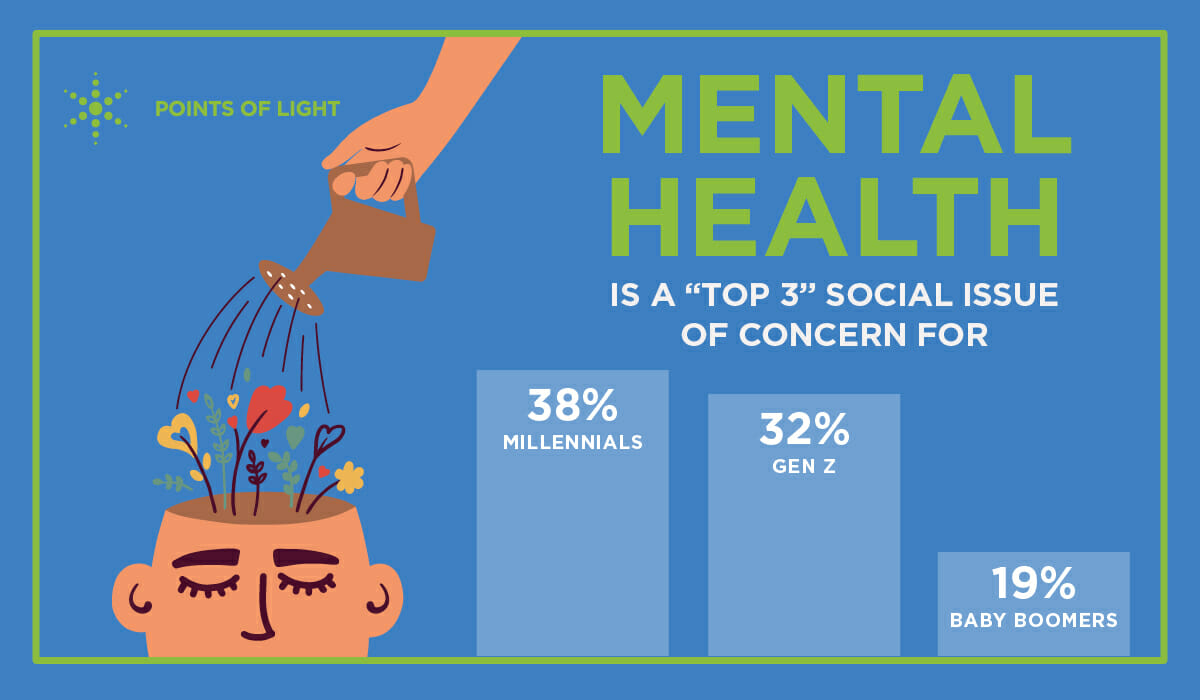
Twice as many Millennials (38%) listed mental health as a “Top 3 Social Issue of Concern” compared to Boomers (19%). Gen Z fell just behind Millennials, with 32%, listing it as a Top 3 issue. In regards to gender, 38% of women listed mental health as a Top 3 Social Issue of Concern compared to 22% of men.
With 72% of global respondents saying they took at least one civic action in the past 30 days on behalf of mental health, and 93% of global respondents claiming that they took at least one civic action on behalf of mental health in the past year, it’s clear that people are eager to contribute their time, talent, resources and attention. This data also speaks to people recognizing the necessary work of reducing the stigma around mental health.
(68%), showing that the individual posted or shared content on a social media platform. These two actions are often some of the most accessible ways to civically engage. And since speaking up about an issue is best done from an informed perspective, the two can work in tandem – listening and learning has the potential to result in more powerful, knowledgeable voices speaking on the issue.
One of the key takeaways from this research is the apparent motives behind these acts of civic engagement. Thirty-five percent of respondents said, “I have been personally impacted.” Thirty-two percent of respondents reported, “A close friend and/or family member has been impacted,” and 28% of respondents claimed that acting on this issue, “Supports my own personal well-being.” These statistics show that mental health is
personal
, and generally speaking, deeper impact is made and more momentum is maintained when people have a personal connection to the issue.
You can dive into all nine elements of Points of Light’s Civic Circle, as well as explore each of them in depth via issues of our free digital magazine, “Civic Life Today.”
A Network of Volunteers Helps Displaced Ukrainian Children See a Zoo for the First Time
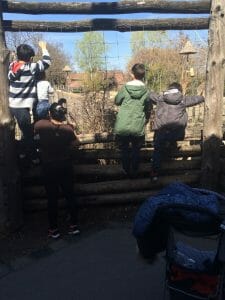
April 6 was a warm, sunny day. A group of displaced Ukrainian children and their families pulled up in front of the Budapest Zoo beneath a cloudless blue sky. They arrived by public bus, accompanied by a special police escort.
The group spent the day exploring the zoo, seeing all the highlights, from the menagerie of exotic animals to climbing to the top of an amazing “Magic Mountain.” It was a day filled with joy in the midst of a time of extraordinary hardship and sorrow. Making it happen took the time, dedication and cooperation of many volunteers and organizations.
Budapest Methodological Social Centre and Institutions (BMSZKI) is one of the largest social organizations in Hungary and in the Central European region. It has set up accommodation for refugees in two locations, hosting nearly 200 displaced people in total. One location, Gyáli út, has been welcoming mostly Ukrainian families, since late February, at the start of the Russian-Ukrainian conflict. According to capital city officials, about 2,000 refugees had been supported with food and housing by mid-March.
The BMSZKI’s Budapest institutions mainly accommodate Hungarian-speaking Roma families from Transcarpathia and Ukrainian Roma from the Kyiv region. These are typically larger families of anywhere from eight to twenty members. These families tend to be very disadvantaged and cannot travel farther West, so they’ve remained in Hungary for a longer period. The big question is: What will happen to the people who are staying, who may number in the thousands? By the end of March, 7,700 people had applied for asylum status, and that figure is considered to be a conservative estimate.
Their situation is dire in many ways. They are not familiar with their surroundings, have never traveled by metro or tram and they do not speak local languages. Families from outside Kyiv tend to speak Ukrainian and Gypsy. Many of the adults cannot read or write. Even those who did not flee directly from the fighting have been traumatized by war, with the lives they’ve built collapsing overnight accompanied by constant worries about their relatives and homes.
BMSZKI’s facilities are dedicated to the care of unhoused people, which means they are well versed in how to support people in these circumstances. When the crisis in Ukraine first began, BMSZKI had the infrastructure and experience to help those who were displaced in the quickest and most efficient ways. The biggest challenge turned out to be the sudden influx of children, which was beyond what they were prepared to handle, but that didn’t stop them from problem-solving on the fly.
Displaced Ukrainian children enjoying the Budapest Zoo. Photo by Points of Light Global Network Affiliate Volunteering Hungary.
A weekly schedule was quickly developed, in cooperation with several Nongovernmental Organizations. It outlined which organization would host various children’s activities, along with when and how.
Many of the volunteers associated with these organizations were already giving their time to the Budapest Zoo, so it was decided that they would take a group of children, ages six months to 13 years — along with their families — on a field trip. The zoo’s philanthropic arm, Foundation for the Budapest Zoo, offered free tickets to the group.
Next came the challenge of how to get there. The Municipality of Budapest offered to provide a bus.
Once on site, Erzsi, a zoo volunteer, led the group on a tour of animal exhibits and other exciting highlights. The children loved climbing to the top of the “Magic Mountain,” where they could look around, see a beautiful view of Budapest and even slide down the mountainside. It was an unforgettable experience for the children and their parents, most of whom had never been to a zoo before. It turned out to be a glimmer of happiness in the midst of their trials, and the volunteers loved the experience too, receiving payment in the form of thanks and hugs from children and adults alike.
The group has plans to take the children on more adventures, including an expedition to a nearby airport to watch the planes take off and land. Participants say these activities are an essential part of keeping their enthusiasm going.
Corporate Volunteer Programme Coordinator Judit Tarcsai of
Points of Light operates with a network of innovative volunteer-mobilizing organizations who serve more than 177 affiliates across 38 countries around the world. Together we are inspiring, equipping and mobilizing more people to use their time, talent, voice and resources to create positive change in their communities. Learn more about our Global Network.
What we can learn from ‘The State of Global Civic Engagement’
For nearly two and a half years, we’ve shared one collective experience around the world. And while most of us are ready to leave behind the years of fear, uncertainty, and loss, we should think twice before rushing to get back to our “old lives,” and for good reason.
History tells us that pandemics and other crises can be catalysts for rebuilding society in new and better ways. If we seek to get back to our old ways, we—especially in the nonprofit sector—are missing an opportunity to take this historic moment to address the fractured systems and stark inequities the global pandemic has exposed, exacerbated, and solidified. We cannot be “done” when there is still so much to do.
At
, we’ve been shining a light on the organizations and individuals serving as those catalysts for rebuilding society. We continue to uplift hundreds of stories of light so those changemakers who have taken action, supported their communities, and made each day just a little better for others can inspire a movement.
Beyond sharing stories, we also need to take this opportunity to meaningfully study the nonprofit sector and determine how organizations can make an impact amid this “new normal.” We’ve been asking ourselves:
Who is taking action? In what ways are they engaging and on behalf of which social issues? And for those who are not engaging, why not?
, a series of five in-depth reports that provide insight into the attitudes and behaviors of individuals and the barriers they face—globally and across the United States, the United Kingdom, Brazil, and India—to help us begin to answer these questions. Here are some of the key findings from our research:
Engagement is changing.
The studies examined the top civic actions taken in support of a social issue as defined by the engagement framework of
: donating, listening and learning, using your purchasing power, service, social entrepreneurship, using your voice, volunteering, voting, and doing good through work. In the global survey, using one’s
were the top two civic actions taken. These actions are important because they have low barriers to entry and are more accessible to different segments of the population, yet they can prove just as influential as traditional actions such as volunteering or donating.
The takeaway isn’t to replace one with the other but to embrace these new forms of engagement and the people who use them. The challenge we must collectively take up is to open and expand access to pathways of more direct engagement.
Now, the next part of the conversation needs to address how people are using these actions in tandem. And our research reinforces that taking a number of civic actions together can increase impact and effectiveness.
This may be an area where companies can set an example. How are companies not only speaking up about social issues but also demonstrating their efforts to listen to the communities they aim to support and sharing what they learn with their employees, consumers, and peers?
Address the perception of privilege.
Globally, survey respondents listed finances as the largest barrier to engagement: Two of the top three reasons people gave for not engaging in social issues were “unable to financially support social issues causes in general” (more than one in five respondents) and “unable to financially support causes due to negative effects of pandemic” (nearly one in five). This finding indicates a need for organizations to educate potential constituents and create additional pathways to participation beyond making donations.
The misconception that supporting social causes requires money is a barrier that we have to overcome in order to ensure that we are valuing and tapping into what each individual has to contribute to their community and the causes they care about.
How can social sector leaders help signal that easily accessible civic actions like using one’s voice and listening and learning are particularly important? One idea is for nonprofits to highlight their greatest unpaid social media amplifiers alongside their donors in annual reports. Who has helped bring the most attention to your cause?
Challenge inertia.
Newton’s first law of motion says: An object in motion will stay in motion, and an object at rest will stay at rest
unless acted upon by an outside force
.
Our research indicates that this phenomenon exists within civic engagement as well. Individuals already engaging in certain civic actions are the ones most likely to continue taking those actions. For example, 91 percent of the individuals who said they would volunteer over the next 30 days were the same people who had volunteered in the previous 30 days. This is an indicator that we are simply maintaining the volunteer force instead of growing it.
While maintenance is important, how can we put more people in motion on behalf of social good? We know that the most common reason someone volunteers is that they are asked. When was the last time you invited someone to volunteer with you?
Bridge individual change to systems change.
Systems are reinforced or dismantled one decision at a time. The journey of systems change starts with the individual, but it requires organizations everywhere to help people participate in the transformation of policies, to be included in the power dynamics, to evolve social norms, and to strengthen the civic mindset of this country and the world at large.
Our research underscored that people are looking to companies for leadership, with 82 percent of global respondents and 95 percent of respondents in India expecting companies to address the social issues in their country.
What we conclude from our research is that nonprofits can do more to provide opportunities for engagement, particularly ensuring new and more accessible pathways of entry into civic action. How can nonprofits and companies seek meaningful partnerships to engage employees and consumers, extend reach, and expand impact?
So much change in our world today can be directly translated into a wealth of opportunity, specifically how the social and nonprofit sector operates in this new normal. To meet this moment and engage the people who are critical for us to make an impact on our respective missions, we can’t wait for society to return to what it was. Instead, we must address these new challenges head on so that we can shine a light on tomorrow.
Natalye Paquin was the president and chief executive officer of Points of Light from 2017–2022.
She is a visionary and results-oriented leader, with more than 20 years of experience providing strategic, operations and fiscal leadership in the nonprofit and public sectors.
Top 5 Reasons to Attend the 2022 Points of Light Conference
is an annual gathering bringing together global nonprofit, government, business and civic leaders for inspiration, education and connection. You have options when it comes to choosing which events to attend, so why this particular conference?
1. Hear from impactful leaders
From the All-Conference Plenary to the Youth Summit and Civic Talks, this conference offers moments that dive into relevant issues and inspire new thinking.
Choose from over 70 workshops online or in-person from presenters in India, London, Hawaii and several U.S. states
. Workshop sessions cover a variety of topics including volunteerism in social change, community strengthening collaboration, diversity and inclusion and digital disinformation. And new this year, you will find sessions focused on caring for ourselves while serving others, The All-Conference Plenary and other main stage moments feature global leaders and special guests including artists, actors, influencers and entertainers including the likes of ABC News’ Nightline Co-anchor Juju Chang, former head of innovation and creativity at Disney, Duncan Wardle, AmeriCorps CEO Michael D. Smith, and Points of Light President and CEO Natalye Paquin.
2. Share ideas and resources
This conference strengthens the social sector by curating innovative ideas and proven solutions while providing attendees with actionable steps to broaden their impact in new and meaningful ways. Nonprofits and businesses come together to share best practices and develop custom solutions to engage employees and drive transformative change in their communities.
Engaging Civic Talks will draw insight from across all disciplines. Speakers will include individuals who have stepped out of their comfort zones in unexpected ways to live their best civic lives and take action to make the world a better place.
3. Network with like-minded professionals
Connecting with people who are doing similar work is invaluable. Conference allows volunteer managers, community engagement professionals, program managers and corporate social responsibility leaders the opportunity to collaborate and build capacity. Those who attend Conference year after year know the power of making new friends, seeing familiar faces, catching up on successes and sharing strategies. After last year’s fully-virtual Conference, we’re looking forward to networking in person once again!
The past few years have shown us that trials produce triumph — or another opportunity to get it right.
The “Nailed It” Stage and Networking Luncheon, during the in-person experience, will allow attendees to learn from nonprofit and business colleagues who are willing to share lessons learned from recent initiatives where they either ”nailed” remarkable results or learned valuable lessons.
4. Renew passion for the work
Social impact and community engagement work can be challenging, yet seeing dedicated individuals and organizations committed to taking action that improves communities around the world can renew passion. Join a community of peers to
reimagine, revitalize and recommit to leading our communities to a better future.
Attending conference workshops can also be applied to the education requirement for initial CVA Certification or CVA Renewal. CVA certification is the only internationally recognized credential in the field of Volunteer Administration.
Surely, seeing the number of youth leaders gathered will be enough to inspire anyone. The Youth Summit is an all-conference session that will feature inspirational stories from young civic leaders who demonstrate that age has no limit in addressing the issues facing our world.
5. Enjoy the gorgeous location
We’re fortunate to gather for the 2022 Points of Light Conference at Disney’s Coronado Springs Resort. Located in the heart of the Walt Disney World® Resort—near Disney’s Animal Kingdom® Theme Park and Disney’s Hollywood Studios—the newly reimagined Disney’s Coronado Springs Resort celebrates the unique blend of Spanish, Mexican and Southwest American cultures.
This beautiful lakeside oasis offers classic influences, imaginative Disney touches and modern comforts both inside and out so you can feel energized and inspired throughout your stay. Attendees might consider stopping by one of the parks to have some fun for a day while they’re in the area.
Register for the 2022 Points of Light Conference
If your focus at work or in the community involves nonprofit management, volunteer engagement and management, national service management, corporate social responsibility, employee engagement or community engagement, you do not want to miss the 2022 Points of Light Conference! There’s still time to
of speakers and workshops and map out the most compelling schedule for yourself. If you need support pitching the idea of attending to your leadership, we’ve made it even easier with our “
” materials, including actionable steps and an editable letter. D
ownload
the materials and present to your supervisor.
If you’re excited about this year’s offerings but your organization doesn’t have the bandwidth to send you this year, choose our virtual option. Points of Light will be broadcasting portions of the conference in our hybrid event from July 13-15. Virtual attendees will have access to sessions and content through the conference website, and these sessions will be a combination of prerecorded and live segments. Virtual attendees will also have the ability to build their network by connecting with attendees from across the globe in the virtual community and have access to virtual exhibitors to check out innovative products and services.
No matter how you choose to join us, we look forward to seeing you at the 2022 Points of Light Conference.
Volunteer Power Across Causes Remains a Constant Need, Even in a Crisis
affiliates tell us that volunteering is one of the primary ways people have supported the humanitarian relief efforts in and around Ukraine. They also explained that, because this crisis comes on the heels of the COVID-19 pandemic, there have been unforeseen ramifications including volunteer burnout as well as a singular focus on Ukraine relief work from those who want to remain engaged.
“People stopped helping in other areas, as they used to, and everyone wants to help the Ukrainian refugees — which is great — but when I talk with corporate partners or volunteers, they’re not interested in helping children, elders,” said Agnieszka Lissowska-Lewkowicz, who is the President of
affiliate and Polish non-governmental organization Centrum Wolontariatu. “We have to find a balance.”
There are countless needs waiting for support, from trash pickup in your neighborhood to walking dogs at your local animal shelter. There are so many ways to shine a light on your community by volunteering for a cause that speaks to you. To find a cause area that you feel passionate about, check out Points of Light’s
Figure out which areas of focus are important to you and which organizations you want to support. Now there are more ways to get involved than ever before. Consider whether you prefer to join volunteer opportunities that are in person or virtual.
Decide on Skills-based vs Learning Opportunities
Think about what skills you have to offer or whether you’d like to learn something new. Some organizations are looking for specialized talent like translators. Others may offer volunteer opportunities that require training, such as becoming a crisis counselor for Crisis Text Line.
Find Balance
Be realistic about balancing your volunteer time with other areas of your life, like your job and your family. Volunteering as a family may be one way to combine family time with living your best civic life.
Points of Light operates with a network of innovative volunteer-mobilizing organizations who serve more than 177 affiliates across 38 countries around the world. Together we are inspiring, equipping and mobilizing more people to use their time, talent, voice and resources to create positive change in their communities. Learn more about our Global Network.
Four Inspiring Speakers You Don’t Want to Miss at the 2022 Points of Light Conference
The Points of Light Conference has more than 100 speakers ready to take a deep dive into relevant issues, inspire new thinking and entertain. From the All-Conference Plenary to the Youth Summit and Civic Talks, our Main Stage moments offer something for everyone. Workshop sessions are delivered by global leaders across the nonprofit, corporate and government sectors from those new to a career in the social sector to seasoned C-level executives.
Here’s a first look at several of our Main Stage speakers:
Michael D. Smith is CEO of AmeriCorps, the federal agency for national service and volunteerism formerly known as the Corporation for National and Community Service. He has dedicated his career to social justice and public service – particularly in underserved communities like those where he grew up. We are excited to welcome him as our featured speaker at both the Business Summit as well as our Service Summit Luncheon.
Dalila Wilson-Scott is the executive vice president and chief diversity officer of Comcast Corporation and president of Comcast NBCUniversal Foundation. She oversees all diversity, equity and inclusion initiatives and philanthropic strategy for Comcast, with a focus on advancing digital equity through Project UP, and the company’s $100 million pledge to advance social justice and equality. Hear from her as our featured speaker at the Service Summit Luncheon.
Duncan Wardle, former head of innovation and creativity at Disney, is a multiple TEDx speaker and has been featured in many publications including Fast Company, Forbes, Inc., and more. He teaches innovation and creativity masterclasses at Yale University, UNC and U.F. Catch him at our All-Conference Plenary.
Orion Jean, 2021 TIME’s Kid of the Year and author of “A Kids Book About Leadership,” he’s a young man on a mission. Orion may be only 11 years old, but the number on his mind is 500,000. That’s how many books this Texas boy hopes will be donated by the end of the month. We’re proud to present him as a speaker at our Youth Summit.
. You’ll hear inspiring speakers, learn from engaging workshops and enjoy excellent networking opportunities. This is one event you don’t want to miss.
A Tale of Three Cities: What Humanitarian Relief Looks Like Across Europe
Hungary, Ireland and Spain. When it comes to aiding in the humanitarian relief effort around the Ukraine crisis, they share common ground. They are also worlds apart.
reports that a “very disadvantaged population” is arriving in her country. Some have never seen a toilet. Most have never attended school. Those with more education or a higher income tend to travel straight through. Only about 1,200 have been allowed to apply for refugee status in the country. For the rest, Judit and her coworkers pass out hygiene kits filled with toiletries and fresh clothing.
Fifteen hundred miles
away in Ireland, Terri O’Brien, corporate & programmes manager at
says that of the 15,000 displaced Ukrainians who have arrived so far, most tend to be from more highly educated and affluent backgrounds. However, the next wave is expected to be less advantaged. She noted that for her small country of five million, this influx is significant.
“We don’t always know people are coming,” she said. “It’s quiet, then 300 people arrive.”
Although Ireland has worked quickly to welcome displaced Ukrainian citizens, accommodations are already in short supply, and new arrivals are being diverted to remote towns. This latest crisis comes on the heels of the COVID-19 pandemic, which placed tremendous strain on Irish systems.
“Covid prepared us for disaster but has also contributed to burnout,” she said. “People are getting worn out, but still, amazing stuff is happening.”
Director of corporate social innovation Almudena Pérez Molina of
, painted a picture of hope in her homeland of Spain. For the next year, new arrivals will have the same rights as Spanish citizens. They can work and have access to free healthcare services. The government has set up four refugee reception centers across the nation designed to help find housing and field other integral needs.
Almudena shared that, prior to the Ukrainian crisis, there are some towns in Spain that were becoming depopulated because younger people were moving into big cities. These are perfectly functional places with infrastructure including roads, schools, hospitals and housing. They have come to be known as “Empty Spain.” The area of Galicia is one such example. Its inhabitants have welcomed displaced Ukrainians with open arms. Elderly Spanish citizens here, and in other small towns, are happy to welcome new people.
“This could be a beautiful opportunity for refugees,” said Almudena.
How You Can Help
The universal need across Europe is cash donations. When you donate to our Global Network affiliates,
you’re directly supporting real people, on the ground, doing essential work in humanitarian relief efforts. Your donation not only supports their important work but also stimulates their local economies through purchasing and hiring, which makes for a successful transition for displaced people and their host countries.
Gifts through this fund are directed to Global Network affiliates in the region that know best what the emergent needs are in their areas. These organizations are experts in their field and have a firm grasp on what must be done and how to do it.
Points of Light operates with a network of innovative volunteer-mobilizing organizations who serve more than 177 affiliates across 38 countries around the world. Together we are inspiring, equipping and mobilizing more people to use their time, talent, voice and resources to create positive change in their communities. Learn more about our Global Network.
Can an Old Fashioned Day of Service Strengthen Post-pandemic Connections?
The collective global experience of the COVID-19 pandemic has changed the world in many ways. The shift to remote work has revolutionized the workplace, with positive outcomes such as reduced commuting times and increased flexibility. On the flip side, it has resulted in isolation of workers from colleagues, a depleted sense of belonging and sometimes struggles with mental and physical health. These disruptions to workplace relationships, as well as volunteering, have kept us apart, separating us from our communities and each other.
Workplaces around the world are seeking strategies to build post-pandemic culture and reset toward a future vision. As a civic engagement leader, it got me to thinking, can an old-fashioned day, week or month of service hosted by businesses around the world spur a culture comeback and reconnect colleagues and communities?
The answer is
yes.
At Points of Light, we live by this principle every day, and it’s a clear affirmation of everything
In a recent conversation, a Points of Light corporate partner reflected that, “Volunteering used to be a way to get people out of the office. But now, perhaps, it’s a way to get people back in.”
Focusing on greater purpose, both individually and for your company, can boost your mood, improve work performance and help rebuild a values-based culture. Bea Boccalandro’s,
are both fun and meaningful tools for exploring how you can build purpose. purpose.
There are countless ways to help your community — a host of issues just waiting for a willing pool of volunteers to help solve. Throughout the pandemic, communities have struggled
have increased and spread from cities to suburbs. Volumes of residential waste and recycling have placed increased demand on city workers and infrastructure. There’s no denying the increase in plastics and cardboard usage as ordering-in and home delivery have thwarted our reduce, reuse, recycle goals. School districts and parks need a helping hand to refresh and revitalize their public spaces.
Can your company build a day of service into its return to work plan? The classic example of a clean-up day provides much-needed extra hands to tackle a real need. It also engages colleagues, captures the health benefits of people being outside and introduces everyone to neighborhoods and communities for ongoing learning and action.
Perhaps there is a hybrid volunteer model that matches your company’s hybrid return to work.
showed that all students are behind in reading and math, and students in majority-Black schools are now 12 months behind their peers in majority-white schools. Programs like
are responding to those challenges with new initiatives that engage employees as mentors and coaches and use aligned talent and capabilities to bring programs that close the gap both in-person and online. A great volunteering experience can address important community needs, inspire your employees and support your company’s comeback strategy, but how do you make it great? Points of Light recommends working at the intersection of good for community, good for employees and good for your brand:
Focus on Company Values: What aligns with the authentic products, services and values of your brand? Who are your customers? What community needs align with these attributes? Company values demonstrated by volunteering in support of a community need offer the greatest opportunity to instill refreshed purpose and strengthen culture. These efforts can start in the virtual world as listening and learning efforts that prepare employees to be better leaders and citizens when in-person volunteering returns to your company. Many companies are expanding their employee engagement and volunteering programs to include training that serves a social purpose or benefit. Examples include providing opportunities for employees to learn sign language or take disaster training courses through the American Red Cross. Are the uncertainty, delay and hybrid variations challenging your planning? Some companies have had great success with projects like “virtual” cleanups, where employees coordinated and tracked cleanup efforts in their local areas.
Listen to Your Employees: Employees are citizens first. Are they raising community needs? How can you support them as change agents to tackle the challenges they identify? Consider offering volunteer time off and matching grants for volunteer time. Can you help organize teams of colleagues for a day of service? Can you bring leadership together with employees hired in the last two years for a litter pick up or schoolyard refresh?
Identify Your Strongest Assets: Can a day of service launch a place-based commitment for your organization? Perhaps a schoolyard update introduces your company to a school and community that might welcome mentors, advisors and coaches for students and faculty. Are there career learning experiences that your company could offer? Can leaders build relationships that expand the networks of nonprofit leaders to help them better connect to media, mentors and money?
Board training and matching programs present an impactful and scalable opportunity to engage employees. Not only can companies track and set targets for employee board service,
but
these programs can also support the organization’s DEI initiatives to increase minority board representation and expand support for racial equity-focused organizations. Check out organizations like
No matter where you chose to start, now is the time to build service into your comeback plans.
Points of Light supports companies of all sizes that are interested in building and growing their civic engagement programs. You can access tools and resources to help you get started at