Elevate Your Employee Volunteering Program by Integrating Volunteer Days and Key Milestones
Timing is everything, and when it comes to employee volunteering, aligning efforts with meaningful moments can transform a program from routine to remarkable. Whether it’s a nationally recognized volunteer day, a cultural celebration or a corporate anniversary, these inflection points offer unparalleled opportunities to drive awareness, engage employees and amplify impact.
By integrating volunteering with these milestones, companies can tap into a natural sense of collective energy and shared purpose. These times often come with built-in resources—whether it’s national campaigns, public awareness, nonprofit initiatives or collaboration with employee resource groups—making it simpler and more intuitive to connect employees with opportunities to serve or launch a new volunteer program component.
Additionally, leveraging such occasions can help companies reach new audiences—internal and external—deepen employee engagement and align their social impact strategies with broader societal movements.
Listed below is a calendar of some of the opportunities throughout the year when integrating employee volunteerism and your program makes good sense. Although this list isn’t exhaustive, capitalize on what’s culturally relevant and aligned with your company’s values and focus areas.
Leveraging key moments and milestones not only energizes interest and participation but also helps embed volunteerism into the rhythm of workplace culture, which fosters a sense of purpose and community year-round.
What other moments and milestones matter to your employee volunteer program?
Suggested company milestones
Founder’s birthday
Anniversary of the founding of the company or a merger or acquisition
Launch of new internal tagline or employee-focused initiative
Launch of a new brand, product or service
Anniversary of first location (store, office, plant, etc.)
Leadership transitions
Achieving significant partnerships, goals and targets
Entrance into a new market
Achieving sustainability certifications or patents
in New Orleans, from June 3–6, will feature dynamic Gen Z leaders who are shaping the future of social good and the workforce.
As we look to our future, we believe it’s essential to bring new voices to the table. That’s why we’re not only showcasing Gen Z changemakers at the Points of Light Conference but also welcoming a Gen Z trailblazer,
Alex is a dynamic Gen Z civic leader dedicated to fostering meaningful youth engagement and bridging generations. As Youth Engagement Manager at Made By Us, he leads the National Youth250 Advisory Bureau, amplifying the voices of 100 diverse young leaders in shaping the United States’ 250th anniversary in 2026. A UC Berkeley graduate, Alex has designed civic engagement courses, advised mission-driven organizations and earned numerous honors for his leadership, including the John Lewis Youth Leadership Award. He also serves on several national boards and committees, mentoring young changemakers and championing civic participation across the country.
Lella Violet Halloum
Sessions: Business Social Impact Summit and Closing Plenary
Lella is an award-winning digital changemaker and one of the most influential women in UK technology, renowned for her innovative work in STEAM. A self-taught coder since age 8, Lella became IBM Europe’s youngest-ever employee at 15 and now leads global outreach initiatives to empower underserved communities through technology. Lella’s impact spans partnerships with industry, global government, UN entities and grassroots digital inclusion charities.
Tay Moore
Session: Closing Plenary
Tay, a Research and Policy Associate at the Aspen Institute, was shaped by his upbringing in rural Louisiana that fueled his passion for public education, youth development and community engagement. A recent graduate of LSU with degrees in Political Science and Music, Tay earned distinctions like the Tiger Twelve Class of 2024 and the prestigious Harry S. Truman Scholarship. His experience spans K–12 schools, universities, government, and nonprofits, and he has been recognized through fellowships such as the Ron Brown and John Robert Lewis Scholars. Tay’s work focuses on fostering equity and opportunity in education.
Kaleb Sy
Session: Opening Plenary
Kaleb is a dedicated student leader from Memphis, Tennessee, passionate about using servant leadership to craft proactive solutions and drive policy change. A student at Columbia University, Kaleb uplifts youth voices through civic leadership, education advocacy and published works.
Get to Know These Gen Z Leaders at Our Breakfast Table Talks
In addition to sharing their insights on various panels, some of our Gen Z speakers will be hosting conversations at our Breakfast Table Talks. These casual yet structured conversations create opportunities for attendees to connect over shared interests or delve into a specific subject in an informal setting, fostering both learning and camaraderie.
Whether you’re a novice or a seasoned pro, we know it takes a village to create vibrant workplaces where employees are equipped to contribute to the communities and causes they care about. So, when you need a trusted advisor to lean on, rely on Points of Light to be Your CSR Friend. Each month, our experts share their wisdom and wit to address a specific but often universal challenge related to your work as a corporate social impact practitioner.
Have questions about employee community engagement? Submit your question and it may be featured in a future blog post.
Dear CSR Friend,
It’s time to set our employee volunteer program’s goals for the new year and, after leading this work for the past four years, I’m struggling to balance ambition with what’s achievable. Leadership seems focused only on numbers – mainly increased participation and higher outputs. But I want to ensure the program evolves strategically and is aligned with community needs, employee interests and definitely company objectives so my budget remains intact. I want to focus on boosting engagement and strengthening partnerships, which I believe will deliver greater impact, but I’d really value your advice. What would you recommend to guide my planning?
Signed,
—Ambitious and Attainable in Atlanta
Dear Ambitious and Attainable,
The start of a new year brings with it possibility and potential. It’s the perfect time to think about what you and your leadership want to accomplish in 2025. But let’s be honest—goal setting can quickly veer into the land of the unrealistic and vague, leading to frustration and missed opportunities for impact. The key? Set realistic, measurable goals that stretch your program without snapping it (or you) in half.
Why Realistic Goals Matter
Realistic doesn’t mean small. It means thoughtful, data-informed, and achievable—pushing your program forward while respecting current capacity. Here’s how to get there:
Know Your Capacity: How supportive is your program’s infrastructure? What resources—human, financial, technological and otherwise—are reasonably available?
Engage Stakeholders: Align with leadership, employees, and nonprofit partners to find shared priorities.
Pro tip — now is the time to start co-dreaming with your community partners as you begin to map out goals for the year. Remember that changing or adding to goals mid-stream can create an undue burden for the nonprofit.
Use Data as Your Compass: Review participation rates, feedback and impact metrics from the past to set future benchmarks.
For example, skip “Let’s double participation!” and aim for something like: “Increase employee engagement by 20% by removing barriers, refining communication and introducing new volunteer formats.” Make a 2025 plan to host listening sessions to uncover what’s keeping people on the sidelines. Here’s a bold idea: move away from strict participation metrics and focus on
. Yes, leadership might cringe initially desperate to compare your company’s average participation rate with industry standards, but greater access is the key to inclusion — and meaningful impact.
Collaboration: Your Secret Weapon
Want to make a bigger splash? Collaborate more deeply, both internally and externally.
Community Partners: Co-create strategies and goals with your nonprofit partners. They know their needs better than anyone else.
Internal Teams: Strengthen relationships across departments. The Civic 50 honorees excel here — 100% of 2024 honorees integrated social impact with diversity teams, 94% with marketing/PR, and 86% with supplier diversity. Take note: cross-functional integration amplifies impact.
Measure to Improve (Not Just Prove)
The most impactful programs make measurement a habit, not an afterthought. Evaluations aren’t just about counting trees planted; they’re about uncovering insights to refine your program. Here’s why it matters:
Track Progress: See where you hit, missed or exceeded your goals—and why.
Spot Trends: Participation data and employee feedback can reveal what works (and what doesn’t).
Learn from Challenges: Use obstacles as a guide for improvement—whether it’s accessibility, communication or partner alignment.
Plan Smarter: Armed with insights, you can set sharper goals next year.
Consider leveraging tools like
The Civic 50
to analyze your strategy. Even if you’re not aiming to become an honoree, the scorecard and benchmark report can spotlight strengths and gaps in your program, policies, and partnerships.
Close the Loop
Evaluation isn’t just for you; it’s a chance to share successes and lessons with stakeholders. Transparency builds trust and reinforces commitment. For example, if employees preferred hands-on volunteering over virtual options, let them know you’re planning more in-person opportunities. Show them their voices matter.
Do Better, Not Just More
This year, focus on setting goals that matter—for employees, the business and the community. Realistic, data-driven goals paired with right-sized strategy, collaboration and thoughtful measurement create a sustainable, high-impact program. In the new year, let’s commit to not just doing more but doing better—because that’s where the volunteer magic happens.
Until next time,
Your
. This organization is dedicated to building “kid success,” providing families with children from birth to 8 years old with what they need to be school-ready, healthy and stable. They do this by providing proven programming and support year-round out of Brilliant Detroit homes in high-need neighborhoods.
We recently had the opportunity to speak with Cindy Eggleton, Brilliant Detroit’s CEO and a driving force behind this incredible organization. Join us as we take a peek into the world of Brilliant Detroit, exploring their innovative approach to building kid success, one family and one neighborhood at a time.
How is your organization making an impact?
When we came together eight years ago to create Brilliant Detroit, we began with a question – what can we do to ensure that Detroit children are kindergarten-ready? We knew that the answer began at the beginning. The fact is that 90% of a child’s brain is developed by age 3 and much of their future is impacted by their first eight years of life.
We challenged ourselves to be innovative and explore how we could disrupt the current early childhood ecosystem. Here is what we came up with: Instead of families getting in a car or bus to access help, let’s renovate abandoned homes and offer evidence-based programming right in the middle of neighborhoods. Instead of directing what happens to families, let’s listen and learn and provide programming that families need and want. Instead of creating yet another program, let’s act as a connector and bring together organizations that are addressing different early childhood needs in one warm and safe place. Let’s create “Kid Success Neighborhoods” where families with children ages 0-8 have what they need to be school-ready, healthy and supported.
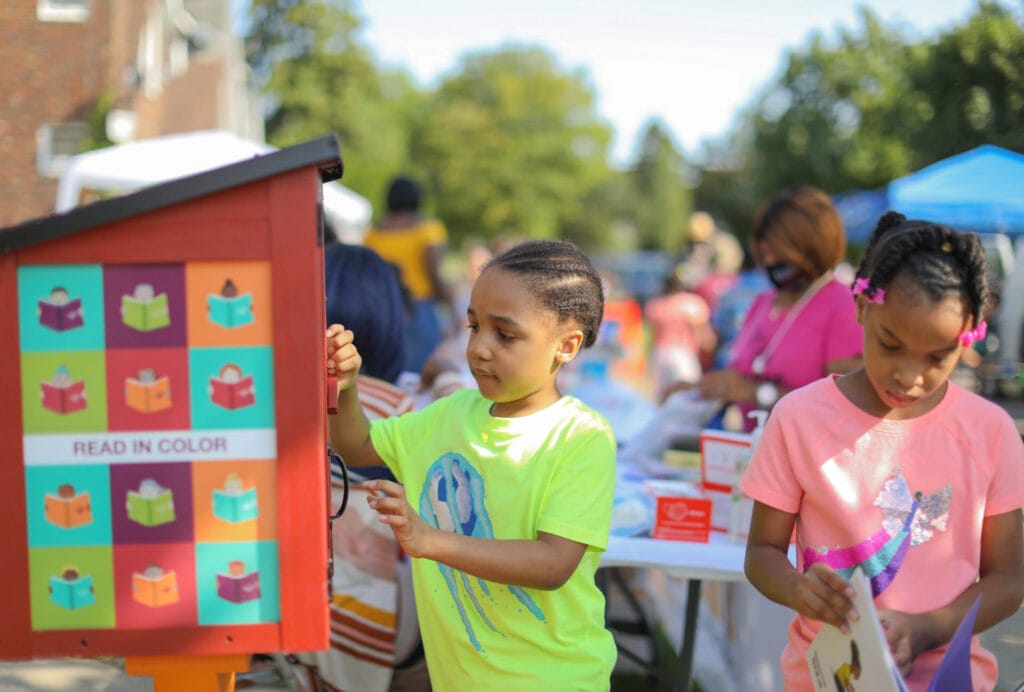
Brilliant Detroit provides material and programmatic support for literacy growth. Resources are made as accessible as possible through partners such as Little Free Library. Image courtesy Brilliant Detroit.
Tell us about a project or initiative you’re working on right now that’s making a big impact on your community.
This summer, we piloted a citywide literacy initiative called Detroit Reads. The goals of the program were to combat “summer slide” (a loss of academic ability in youth outside of the school year) and build a love of reading in our young children. We served over 300 youth through our daily summer programming, which was hosted at 12 hubs. We had a city-wide men read day, an author day and family health nights, among other things. This is in addition to our specific tutoring and family efforts. Ultimately, we are pleased with the impact of the first summer of Detroit Reads. We look forward to building the program by expanding to more of our hubs and by partnering with other champions of literacy across Detroit.
The Detroit Reads program was a success both on a macro and micro level. Over 30 community partners participated in seven weeks of programming at the 12 hubs. Each location included at least three hours per day (over 3,000 combined hours) of literacy programming, which included small group tutoring, storytelling and read-alouds. Ten young adult interns supported by the Grow Detroit Young Talent Program provided student leadership to youth campers. Students explored improvisation, STEM, nature and gardening through hands-on experiences and reflection activities. Students were able to connect theories and knowledge to real-world situations. Perhaps the greatest testament to a successful pilot was all the smiling faces of the youth we served!
“My favorite moments at Brilliant Detroit are those when I can see the positive change that families are making in their own lives using the resources of our organization. I wake up every day inspired by all the people I get to work with who are moving their lives forward. We see this transformational change all the time. Caregivers join us as participants and then start volunteering their time and skills or join our staff to help spread our mission of ‘Kid Success’ to more of their fellow neighbors. It is truly energizing.” — Cindy Eggleton, CEO, Brilliant Detroit
Do you have an upcoming special event or milestone that your organization is celebrating?
We are looking forward to celebrating a long-coming and major milestone in 2024. Years ago, when researching the potential growth of Brilliant Detroit, it was determined that 24 hubs was the number needed to create population level change in Detroit. In other words, 24 was the magic number where we would start to see the needle move on the statistics that inspired the creation of Brilliant Detroit, namely kindergarten and third grade reading ability, the number of families living in poverty and lack of access to books and childcare options.
What role does volunteerism play in your organization’s overall mission and objectives?
Volunteerism is a huge element of the success of Brilliant Detroit. Many of our programs are fueled by volunteer support, including one of our most impactful programs, high dosage literacy tutoring. Our goal in utilizing volunteers is to further include community in our work and also educate volunteers as to why current conditions exist.
We believe it is important that volunteers understand factors that led to the inequities we see today in Detroit. Volunteers bring a passion and a diverse set of perspectives and experiences to our families. We see working with volunteers as an extension of our value of creating neighbor to neighbor connections.
How are you recognizing and thanking volunteers for their contributions?
We recognize our most dedicated volunteers via social media highlights as well as our “Brilliant People” campaign that spotlights our most dedicated supporters. We also thank our volunteers via swag giveaways and an annual volunteer celebration picnic. We are always happy to verify service hours for our volunteers for awards, including the
What’s one piece of advice you’d give someone who’s looking to get more involved in their community through civic engagement?
So often in social justice movements, people are providing solutions for others and not seeing those people as individuals and embracing their insights. The reality is that people have more to say about what is right for them than we could ever figure out. I always say what is most important is transitioning from listening to talk or to tell, to listening to hear, to learn and then to help do and achieve. You have to first see people for them to grow.
Ask a CSR Friend: Gaining Middle Management Buy-in for Employee Volunteering
Whether you’re a novice or a seasoned pro, we know it takes a village to create vibrant workplaces where employees are equipped to contribute to the communities and causes they care about. So, when you need a trusted advisor to lean on, rely on Points of Light to be Your CSR Friend. Each month, our experts share their wisdom and wit to address a specific but often universal challenge related to your work as a corporate social impact practitioner.
Have questions about employee community engagement? Submit your question and it may be featured in a future blog post.
Dear CSR Friend,
When I review our year-end volunteer reports, there are always several departments that have minimal representation year-over-year. The problem isn’t at the top; my company’s senior leaders have sponsored initiatives, shown up at projects of their own accord and always share photos of themselves in action on the Slack channel dedicated to our volunteer program. We offer a range of opportunities throughout the year to ensure there’s at least one way every employee can get involved, but I think some department heads are blocking access or just aren’t interested. How do I get these supervisors on board in the new year?
— Seeking Support in Sandy Springs
Dear Seeking,
As CSR practitioners, we firmly believe in the value of employee volunteering—for communities, for volunteers, for living out a company’s values, achieving its purpose and frankly, bolstering its bottom-line. Yet, one critical group often determines the success of our volunteer programs: middle managers. Without their buy-in, our efforts to promote volunteering can stall. Middle managers are uniquely positioned between frontline staff and senior leadership, meaning they play a vital role in granting permission, removing barriers and encouraging—or inadvertently discouraging—employee participation.
So, how can we convince these leaders that volunteering benefits them, too? We must redefine volunteering as a vital component of both corporate culture and business success, which also equates to their success as a team leader!
I’m going to assume you’re already ensuring they’re aware that volunteer opportunities exist—whether it’s company-wide programs or tools for business units to plan their own projects. I bet you’ve also implemented communication campaigns and info sessions designed for leaders, catching them as they’re hired or promoted.
The most significant next step is
taking time to understand their unique pressures and challenges
. Middle managers face daily demands to deliver on performance targets, manage team dynamics, and meet senior leaders’ expectations. They often worry that volunteering will strain their team’s time and productivity. By putting yourself in their shoes, asking them about pain points and demonstrating genuine care, CSR leaders can start the conversation on common ground and position volunteering as a solution.
Here’s how I might craft an argument to convince middle managers who mention the specific challenges listed below. However, before you engage in these discussions, I encourage you to mine your company’s data or find external sources that provide validation that employee volunteer programs strengthen the employee experience. A great starting place to uncover evidence is the Points of Light learning brief,
Retention: Managers are under immense pressure to retain talent, especially in a competitive market and an increasingly purpose-driven workforce. Supporting volunteer programs is one way for them to reduce turnover. Employees who are given opportunities to volunteer report greater job satisfaction, a stronger sense of purpose, and a deeper connection to their organization. These factors directly influence retention, as employees are more likely to stay with a company that supports their values and gives them opportunities to make a positive impact. If available, share internal data that reflects similar outcomes, such as lower attrition among employees who regularly participate in volunteer activities.
Engagement and Productivity: Middle managers often prioritize initiatives that directly benefit their team’s output and morale. When employees engage in volunteer efforts, they feel recharged, a renewed sense of belonging and a broadened perspective that helps them approach problem-solving more creatively and efficiently. Moreover, team-based volunteer projects promote collaboration and strengthen relationships across departments, which can lead to better cross-functional teamwork and smoother workflows. Volunteering programs can also improve employee morale, leading to a more motivated and engaged workforce, which naturally boosts productivity and overall organizational performance. Ask leaders who are already engaging their teams in volunteering for testimonials, which might lessen the concern for lost productivity.
Leadership Development and Upskilling: For managers seeking ways to develop their teams without extra budget for formal training, volunteering presents a unique “on-the-job” learning opportunity. This is especially helpful when upskilling employees in areas such as communication, critical thinking, and adaptability. Highlight volunteering as an innovative way to support career development through hands-on experiences that build hard and soft skills. Offer a list of company-approved volunteer programs that align with the company’s competency frameworks or development goals with details on the skills they’ll help employees develop and practice.
Depending on the outcomes of your conversations with middle managers, consider this additional guidance:
Showcase Options and Flexibility: One concern middle managers may have about volunteering is its impact on team schedules. Offering various formats—like on-site projects, micro-volunteering (short, time-limited activities), and virtual opportunities—gives managers options to support their team without straining resources. Share a guide that outlines all available volunteering options by time commitment, location, and relevant skills. Let managers know they can opt-in to projects that fit seamlessly with the team’s workload. For more ideas, check out the “Equipping Managers” section of the Points of Light learning brief on Volunteer Time Off.
Make Support Visible and Celebrated: Middle managers need to feel that encouraging volunteering will be seen as a valued leadership action. By giving visibility to managers who champion volunteerism, you can help normalize support for volunteering as a best practice across the organization. Managers want to be recognized for doing what’s best for their teams. When volunteer participation is celebrated and included in performance reviews, they see a clear incentive to encourage it. Recognition can include features in company newsletters, shout-outs at company meetings, or even performance-based incentives tied to supporting team engagement in volunteer activities.
Designate a Volunteer Champion: To support middle managers in being aware of and contributing to volunteer plans on the horizon, as well as being an advocate for their department’s needs and interests, have them select an employee who can rally their teammates and be an extension of your team. Ensure they are adequately informed and inspired to plan projects, share feedback, and motivate colleagues within those departments.
Middle managers play an essential role in scaling social impact within any organization. When we gain their buy-in, we’re creating ambassadors who not only empower their teams but contribute to a culture where social responsibility is woven into the fabric of a company’s values and long-term success.
By addressing their concerns and positioning volunteering as a help and not a hindrance, employee volunteer program leaders can turn middle management into a powerful ally. While it might not happen overnight, through empathy, transparency, and data-driven insights, we can build a more collaborative approach to volunteerism that benefits the whole company.
Get them to try it once, and you just might have them hooked for life.
Signed,
Your
, many companies are planning their employee volunteer activities for this important day focused on getting involved. It is an opportunity to reflect on Dr. King’s legacy and his commitment to justice and equality. It is also a chance for companies to contribute to their communities and make a real difference in the lives of others.
However, it is important to remember that volunteerism is not just about showing up and doing a task. It is about building relationships with the community and working together to address systemic issues. Community-centered volunteerism is one foundational element of trust-based philanthropy, an approach to giving that addresses the inherent power imbalances that exist between funders, nonprofits and the communities they serve.
What Does It Mean to Be Community-Centered in Our Volunteer Approach?
Community-centered volunteerism means shifting our focus from our own needs and desires to the needs and desires of the community. It means listening to the community and working with them to identify their priorities. It also means recognizing that the community is the expert on their own lives and that we are there to support them, not to tell them what to do.
As a company, you too can be community-centered in your approach to MLK Jr. Day of Service, as well as any other employee volunteer initiatives. Here are a few tips:
Partner with a local organization that is already doing work in the community. This will help ensure that your volunteer efforts are aligned with the community’s needs.
Ask the organization how you can best support their work. Do not assume that you know what the community needs.
Be prepared to do the work that the organization needs to be done. This may not be the most glamorous work, but it is the work that will make a real difference in the community.
Be respectful of the community’s time and space. Do not overstay your welcome or make assumptions about the community.
Follow up with the organization after your volunteer event. Let them know how your employees felt about the experience and ask how you can continue to support their work.
In addition to the tips above, here are some questions that your company’s CSR leaders can ask themselves to ensure that their MLK Day volunteer activities are community-centered:
What are the root causes of the issues that we are trying to address?
How can we work with the community to address these root causes?
What are the community’s goals for MLK Day?
How can we help the community achieve these goals?
How can we ensure that our volunteer efforts are sustainable?
This MLK Jr. Day of Service, let’s shift our focus to redistributing power in service of a healthier and more equitable philanthropic ecosystem. By working together with community organizations and listening to the needs of the community, we truly can make a difference in the lives of others. And if you need some guidance, Points of Light’s
Whether you’re a novice or a seasoned pro, we know it takes a village to create vibrant workplaces where employees are equipped to contribute to the communities and causes they care about. So, when you need a trusted advisor to lean on, rely on Points of Light to be Your CSR Friend. Each month, our experts share their wisdom and wit to address a specific but often universal challenge related to your work as a corporate social impact practitioner.
Have questions about employee community engagement? Submit your question and it may be featured in a future blog post.
Dear CSR Friend,
As MLK Day approaches, my U.S.-based company wants to organize an enterprise-wide volunteer project to honor Dr. King, but I’m not sure how to do it in a way that’s truly respectful to his legacy. How can we ensure that our efforts are aligned with the values he stood for, and avoid coming across as performative?
Signed,
Aiming for Authenticity in Austin
Dear Aiming for Authenticity,
I applaud your effort to make MLK Day a “day on” rather than a “day off” while being reflective of the values and practices that the legacy of Dr. King represents such as nonviolence, equality, justice, unity, and compassion. On this day and every day, we must ensure that volunteer work upholds his vision by aligning with a community’s actual needs and providing opportunities to work together toward the greater good.
In his “I Have a Dream” speech, Dr. King said, “We cannot walk alone.” This quote serves as a great reminder that any volunteer work we do—especially in his name—should be done with the community, not for them. So how can CSR leaders plan meaningful, thoughtful projects that capture the spirit of MLK Day whether they’re encouraging employees to volunteer on their own, advising volunteer champions on creating projects in local markets or planning a company-wide endeavor? Here are a few guiding principles.
Be Respectful in Your Approach: Dr. King’s belief that nonviolent resistance was the most powerful and just way to achieve change wasn’t just about avoiding physical or structural harm. It was about being mindful and respectful in all actions. When you’re planning a volunteer project, make sure it doesn’t unintentionally hurt the community or distract a nonprofit from delivering their important mission. For example, don’t assume you know what the community needs without asking first. It’s important to approach these efforts with humility, engaging with local leaders to understand how your company can contribute in a helpful, sustainable way. This can also be demonstrated by finding an existing project that nonprofits have already planned and scheduled rather than putting your employer’s interests above others. Community-centered volunteerism means not only meeting needs but also respecting the dignity, expertise, and agency of those in the community.
Collaborate with the Community: Dr. King knew that real progress only happens when we are grounded in partnership, and that’s especially true for volunteer projects. Work with local organizations and community members to co-create something meaningful. Think also about internal collaboration, working alongside ERG leaders to make an impact on MLK Day. When everyone has a seat at the table, the work is more impactful and lasting.
Address Root Causes: Dr. King was all about fighting for equality and justice, so think about how your volunteer project can make a difference in tackling the primary drivers of community issues. Maybe it’s supporting educational programs, addressing food insecurity, or partnering with groups that work toward racial equity. The goal should be to align your efforts with Dr. King’s vision of a more just and equitable world. Don’t forget to create ways for all employees to participate regardless of their role or work setting to enable equal access across the workforce.
Include Listening & Learning: Dr. King emphasized the importance of education in combating ignorance and prejudice. MLK Day is a perfect time to educate colleagues about the broader social issues impacting communities. Consider building educational components into your volunteer projects, whether it’s a brief discussion about racial justice, an article to read ahead of time, or a guest speaker from the community. This helps employees understand the deeper context of the work they’re doing, creating a more meaningful and informed experience.
Lead with Care: At the core of Dr. King’s message was empathy and compassion for others, particularly those facing injustice. Encourage your employees to connect with the community on a personal level—whether it’s during the project or before and after. This is a chance for employees to not just do good but to really understand the experiences of others and show genuine care. Volunteer projects that focus on direct service are opportunities to practice compassion, not just as an act of kindness but as an act of justice.
Commit to Long-Term Collective Action: The impact of MLK Day should be more than just a one-day project. It’s an opportunity to inspire your employees to take sustained action toward positive change. Dr. King’s legacy was built on courage, moral leadership and persistence, so think about how your company can make ongoing commitments to the community, whether through continued volunteerism or, as mentioned above, other initiatives that tackle systemic issues.
A final note to those who work for multinational companies – central to Dr. King’s beliefs was the concept of “Beloved Community,” a global vision of a community with equal access to resources and opportunities for all people, not only in the U.S., but also around the world. He emphasized that injustice anywhere is a threat to justice everywhere, so this framework can and should apply in all geographies.
Dr. King’s values and practices remain a blueprint for today’s social movements. By aligning your volunteer work with these principles, you honor his legacy while actively advancing the fight for justice and equality.
For those interested, we’ll be discussing many elements of community-centered volunteering at our conference next June.
Prioritizing Health and Wellbeing: A Rising Trend in Corporate Culture
A fundamental shift is underway in the world of work. While salaries and benefits remain important, employees are increasingly demanding a greater focus on their overall health and wellbeing. This shift is reflected in the rising focus on “Health and Wellbeing” for Points of Light’s
honorees, an annual recognition of the most community-minded companies in the United States.
The Civic 50 2024: A Healthy Trend
For the past four years, the Civic 50 has tracked how companies prioritize health and wellbeing, both within their organizations and in their external CSR efforts. What began as a response to the pandemic has since become a core value. In 2021 and 2022, “Health and Wellbeing” ranked #4 as a cause area by The Civic 50. By 2023, it climbed to #3, and in 2024, it reached #2, signifying a deeper commitment to community health. This increased focus is also demonstrated by a rise in Civic 50 honorees working intentionally with teams responsible for “Employee Health and Wellness”; growing from 80% of honorees integrating with that business function in 2022 to 84% in 2024.
Why the Shift?
This trend is driven by several factors:
Increased Awareness: The pandemic and recent world events have highlighted the importance of physical and mental health.
Employee Expectations: Employees now expect employers to prioritize their wellbeing, both inside and outside the workplace.
Social Responsibility: Companies recognize their role in contributing to a healthier society.
Challenges and Opportunities
The 2024 Civic 50 report reveals a strong focus on addressing critical health challenges. Companies are stepping up to invest in training and development programs to combat the global health worker shortage, ensuring communities have access to qualified healthcare professionals. They’re also supporting initiatives that mitigate the health impacts of climate change, recognizing the growing threat to public health.
Additionally, companies are increasingly providing resources and programs to address mental health concerns, acknowledging the importance of mental wellbeing for both employees and communities. Access to safe water remains a critical issue, and The Civic 50 honorees are partnering with organizations to improve water quality and access in underserved communities.
The report also highlights a commitment to tackling chronic diseases. Companies are supporting research and programs focused on the prevention and management of conditions like diabetes, heart disease and cancer. Finally, there’s a growing emphasis on addressing health inequities. By tackling social determinants of health and promoting health equity, these companies are working to ensure that everyone has the opportunity to live a healthy life.
exemplify this commitment to health and wellbeing. UnitedHealth Group’s Diversity in Health Care Scholarship program, for instance, supports the next generation of diverse healthcare professionals. PDS Health is actively involved in community health initiatives, and Blue Cross Blue Shield of Massachusetts demonstrates its commitment through its annual day of service and ongoing programs.
The Mental Health Benefits of Volunteering
The Civic 50 also highlights the growing alignment between CSR strategies and employee health and wellness. Companies are increasingly recognizing the link between volunteering and improved mental health.
In today’s world, loneliness and social isolation are significant concerns. The
reports that 50% of adults experience loneliness, with even higher rates of non-belonging in the workplace (64%) and local communities (74%). These feelings can negatively impact mental health, productivity and overall wellbeing.
Volunteering offers a powerful antidote. It provides opportunities for social connection, fosters a sense of purpose and improves mental and social wellbeing. Workplace volunteer programs can strengthen team bonds, combat isolation and create a more inclusive and supportive work environment.
Learn More and Invest in Wellbeing
Prioritizing health and wellbeing is no longer a trend; it’s a necessity. By investing in their employees’ wellbeing and supporting community health initiatives, companies can create a more engaged workforce, improve productivity and contribute to a healthier society.
To learn more about how companies are leading the way in community engagement and social impact,
.
Points of Light can help your company develop and implement impactful employee volunteer programs that promote health, wellbeing and social responsibility.
, to be celebrated on November 23, 2024, is a time to come together and make a difference. It’s a chance for families to strengthen their bonds while making a positive impact on their communities. The world is facing many challenges, but there is an opportunity for all of us to step up and create change. Family Volunteer Day provides a unique opportunity to inspire hope and create lasting change.
Why volunteer as a family? Beyond the inherent rewards of getting involved in your community through volunteerism, doing this together as a family offers a wealth of benefits:
1. Family volunteering promotes shared values.
Volunteering is a powerful way to instill compassion and a sense of social responsibility in children. By actively participating in community service, families demonstrate their commitment to making the world a better place. These shared experiences lay the foundation for a lifelong commitment to civic engagement.
2. Family volunteering creates a foundation for a lifetime of volunteering and commitment to social change.
A recent study from FoundationSource found 58% of Gen Z volunteered their time in the past year. 70% of Gen Z said they aspire to be described as “changemakers.” Younger generations are passionate about being involved in their local communities, and the earlier their engagement begins, the better understanding they have of being a supporter and partner with nonprofits.
3. Family volunteering helps you spend quality time together while having fun.
In a fast-paced world, finding quality time for family can be difficult. Volunteering provides a shared experience that fosters communication and creates lasting memories. As adults look to find ways to spend time with kids disconnected from screens, volunteering is a great way to connect. Working together towards a common goal strengthens family bonds and creates a sense of shared accomplishment.
3. Family volunteering helps children develop empathy.
Volunteering exposes children to diverse perspectives and lived experiences, fostering empathy and understanding. It helps them connect with people from different backgrounds and appreciate the challenges faced by others. These interactions nurture compassion and broaden their worldview and decrease bias in the long term.
4. Family volunteering encourages lifelong learning.
Volunteering offers a unique learning experience outside of the traditional classroom setting. Children develop valuable skills, gain knowledge about social issues and discover their potential to make a difference. It instills a love of learning that extends beyond textbooks and classrooms.
5. Family volunteering helps everyone hone important skills.
From practical skills like gardening and painting to essential life skills like teamwork and problem-solving, volunteering provides opportunities for children and adults to learn and grow. It’s a chance for families to discover hidden talents and develop new skills together.
Family Volunteering: A Catalyst for Growth, Connection and Change
Volunteering as a family in 2024 offers a refreshing opportunity to disconnect from the digital world and reconnect with each other and your community. We invite you to put down the devices and engage in meaningful real-world experiences that foster a sense of purpose and belonging.
Studies show that helping others reduces stress and boosts well-being for all ages, making family volunteering a valuable investment in your family’s mental and emotional health. It’s also a chance to connect with neighbors, strengthen community ties and contribute to a sense of shared responsibility.
By volunteering as a family, you can learn about global issues and actively participate in creating solutions, fostering a sense of global citizenship and empowering your children to become agents of change.
celebration, held annually, shines a spotlight on exceptional individuals who have devoted themselves to making a difference. This year’s event, coinciding with what would have been President Bush’s centennial, takes on a special meaning as it pays tribute to his enduring legacy of compassion and action.
The
are a diverse group hailing from various walks of life and championing a wide range of causes. Their paths may be unique, but they converge in their shared dedication to service, as well as their impact on the lives of countless individuals. Let’s explore the remarkable stories of two of these honorees.
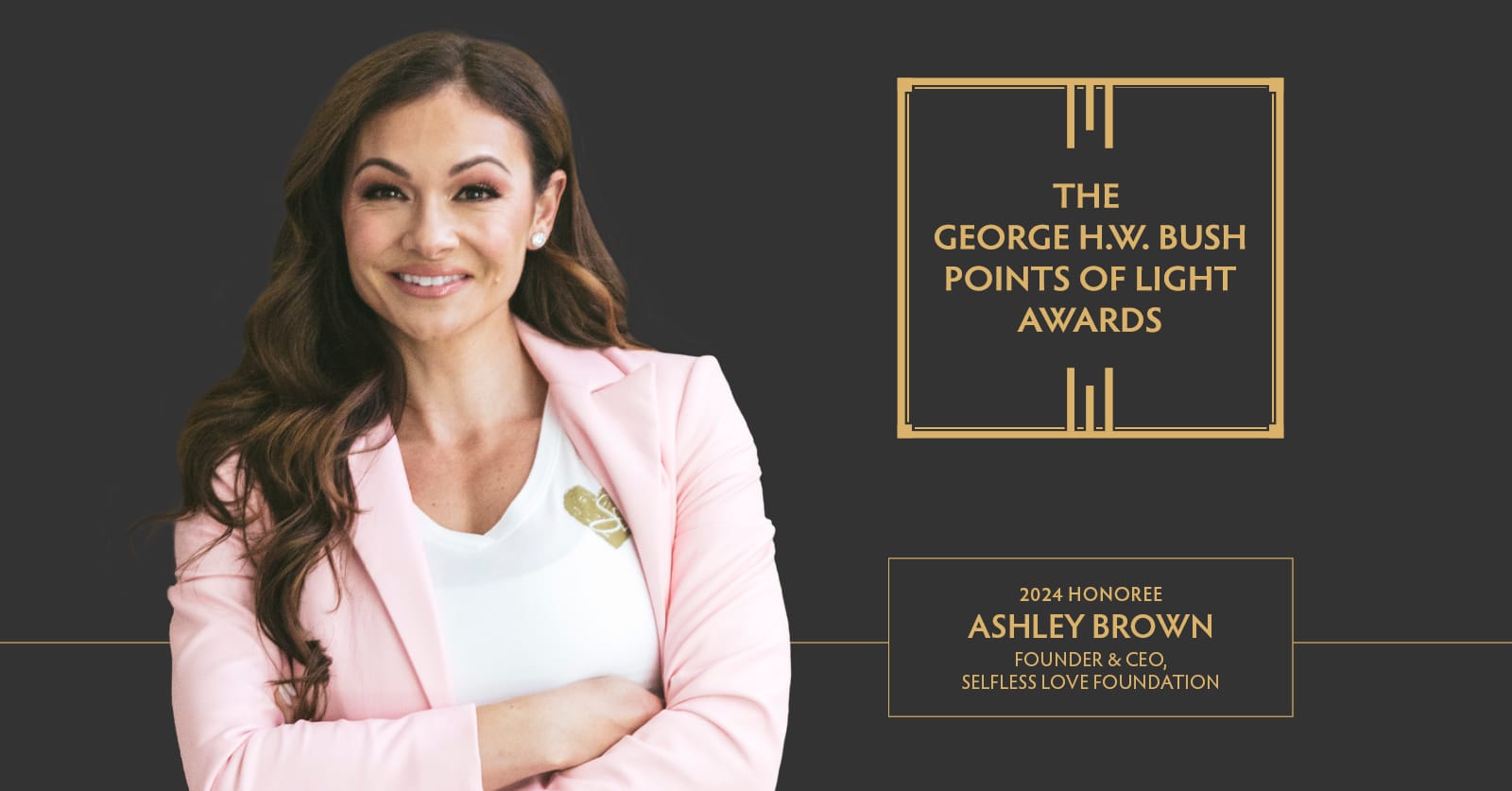
Ashley Brown: A Luminary of Selfless Love for Foster Children
Ashley Brown’s dedication to improving the lives of foster children stems from her own personal experience. Adopted as an infant, Brown understands the lasting impact a loving family can have on a child’s life. Fueled by the belief that every child deserves a permanent home and nurturing environment, she founded the
, an organization committed to transforming the child welfare system and ensuring more foster children find their forever families.
Brown’s journey is a testament to the power of turning personal experiences into catalysts for change. Her adoption story ignited a passion within her to advocate for children in foster care, recognizing the systemic challenges they face in finding stability and belonging. This understanding drives her relentless pursuit of creating a more effective and compassionate child welfare system.
“I’ve always had a deep love and respect for my parents because they truly did give me a second chance at life,” Brown reflected. “I am so grateful for them adopting me, and their act of selfless love not only transformed my life, but has transformed thousands of lives.”
Selfless Love Foundation tackles the complex issues surrounding the child welfare system, working in three impactful areas, adoptions, independent living, and advocacy. The Foundation creates opportunities for children in foster care to find forever families and supports prospective parents along their adoption journey. For youth who age out of the system, Selfless Love provides housing, resources, and the support they need to become self-sufficient adults. The organization’s advocacy work aims to create system-wide improvements that benefit children currently in care and youth who have aged out of foster care. Selfless Love believes the people closest to the issue also hold workable solutions. That’s why youth who have experienced foster care are part of the organization’s advocacy team. Youth are integral in setting policy priorities and meeting with legislators to create change.
Brown’s leadership and advocacy have spurred significant progress in the process and system. The Selfless Love Foundation has successfully facilitated numerous adoptions, providing children with the stability and love they deserve. It has also played a crucial role in raising awareness about the needs of foster children and advocating for policy changes that prioritize their well-being.
“After advocating for two years, Florida now has a law that protects children’s photos and information who are available for adoption. Thanks to our advocacy team, now only families are able to access these photos on secure websites,” Brown said. “We plan to advocate for this to get passed federally.”
Brown’s vision extends beyond simply finding forever families for children in foster care; she strives to create a society where every child feels valued and supported. A belief that every child deserves to be loved unconditionally and to have a safe and stable home fuels her tireless efforts to build a more compassionate and effective system that meets the needs of all children.
Through her work, Brown personifies the essence of selfless love, demonstrating a sustained commitment to the well-being of children impacted by foster care. Her journey is a reminder that even in the face of complex systemic challenges, individuals can make a significant difference.
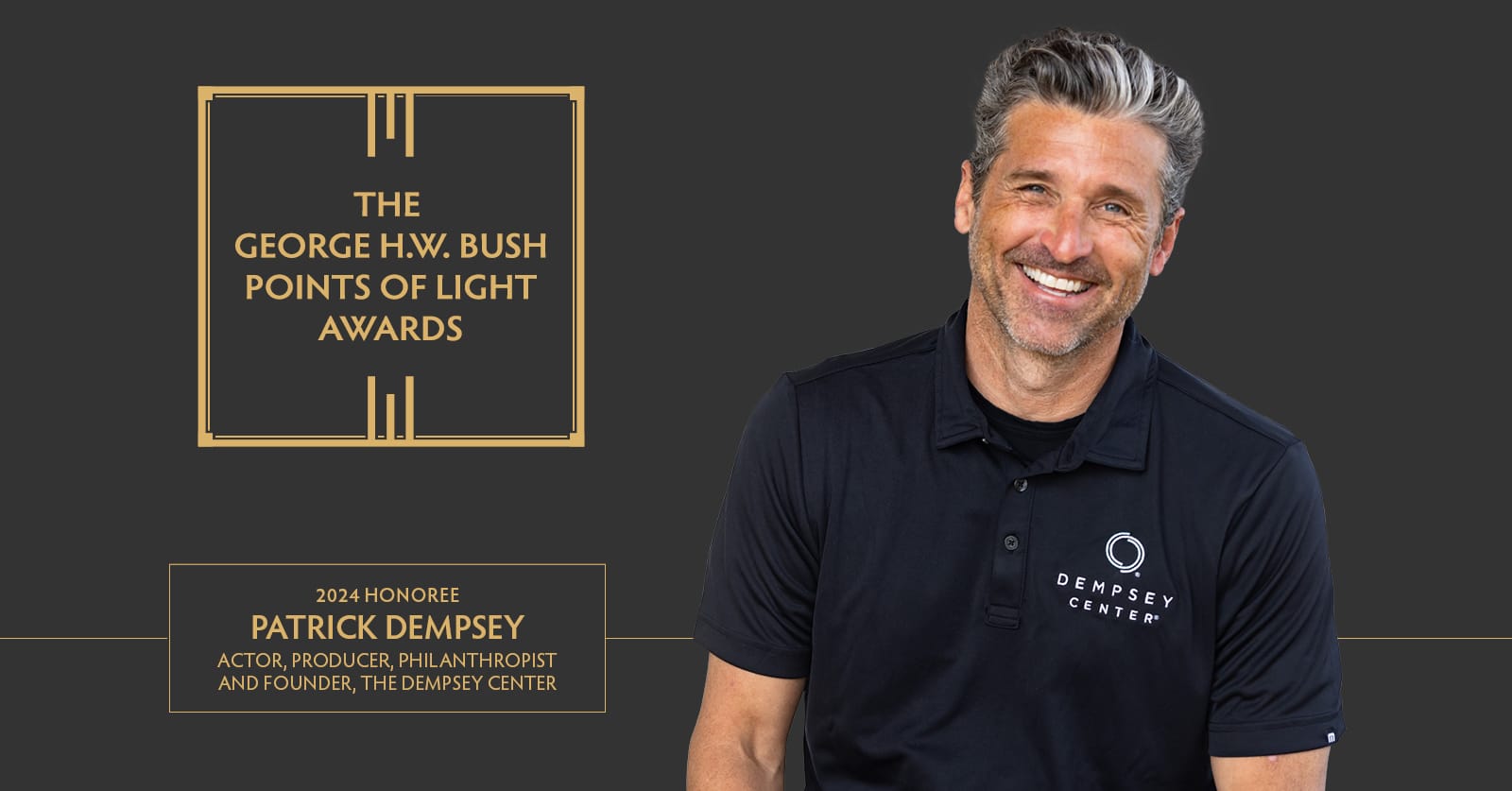
Patrick Dempsey: Championing Compassion in Cancer Care
Patrick Dempsey, renowned actor and founder of the
, has devoted himself to supporting people living with cancer. Inspired by his mother’s courageous battle with ovarian cancer, Dempsey witnessed firsthand the devastating impact the disease has on patients and their families. “My personal impact was my mother was diagnosed in the late 90s with ovarian cancer,” Dempsey shares. “She had over 12 recurrences during a 14-year period.”
Dempsey’s experience illuminated the critical need for comprehensive care that extends beyond medical treatment. Recognizing the importance of addressing the holistic needs of patients and their families, Dempsey established the Dempsey Center in his home state of Maine to provide free support services. The center’s commitment to offering services at no cost stems from Dempsey’s understanding of the financial burden cancer can place on families. He emphasizes, “With the cancer diagnosis, with the insurance, with the payments, all that stuff that can get wiped out very quickly and it produces a lot of anxiety.”
The center fosters a welcoming and supportive environment, ensuring that patients feel embraced and understood from the moment they walk through the door. “They’re not numbers. They’re human beings,” Dempsey states. The involvement of volunteers who have personally experienced cancer further contributes to the compassionate atmosphere, fostering an immediate connection and understanding between those who have faced similar challenges.
Over the past 17 years, the Dempsey Center has evolved and expanded its services, driven by the growing awareness of its impact and the feedback received from clients. Virtual programs, such as
, have enabled the center to reach individuals in 32 states, ensuring that those in rural communities or facing mobility challenges can access support. Dempsey reflects on the center’s evolution, noting, “We’re servicing more people, and it just shows me and the staff and the team what a great need this is. This should be mandatory treatment.”
Looking to the future, Dempsey envisions a world where supportive care is integrated into standard cancer treatment and covered by insurance. He acknowledges the potential for technology to enhance the center’s services, envisioning a database that connects patients with relevant clinical trials and programs. Dempsey is also passionate about advocating for policy changes that address systemic issues related to cancer prevention and treatment, including education and access to healthy food.
The Dempsey Center’s approach is rooted in compassion, empathy, respect and dignity – virtues that Patrick Dempsey himself displays in spades.
The unique and inspiring stories of Ashley Brown and Patrick Dempsey are a testament to the ripple effects that individuals can make when they dedicate themselves to a cause greater than themselves. Points of Light is honored to recognize their outstanding contributions at The George H.W. Bush Points of Light Award celebration at the Capital Hilton in Washington, D.C., on October 23, 2024.




 January
 March
March May
May July
July September
 November
 Alex Edgar
 Lella Violet Halloum
 Tay Moore
 Kaleb Sy