Volunteering and mental health connect deeply, providing powerful pathways to healing, emotional wellness, and personal growth. Across generations and communities, people have found purpose and belonging through acts of service. Whether it’s helping others after personal loss, rediscovering identity after trauma, or finding joy in civic engagement, these personal reflections convey how volunteering can improve mental and emotional health. Research highlights that civic engagement can boost mental health by reducing isolation and fostering meaningful connections.
In honor of
Volunteering for Mental Health Recovery and Healing
“I want to help people who are struggling with mental health know they’re not alone. Volunteering gave me a way to turn my own pain into purpose.”
— Daily Point of Light Honoree (Youth Volunteer, 2024)
“After losing my brother to suicide, I started a nonprofit to raise awareness and provide peer support. Every time I share his story, I feel like I’m helping someone else find hope.”
— Daily Point of Light Honoree (Mental Health Advocate)
“Volunteering became my therapy. It helped me heal from trauma and gave me the strength to help others do the same.”
— Daily Point of Light Honoree (Veteran Volunteer)
“Helping others helped me find my voice. It’s the most healing thing I’ve ever done.”
— Daily Point of Light Honoree (Survivor Advocate)
“I lost my mom to suicide when I was 15. Volunteering helped me find hope again and gave me a way to honor her memory.”
— Daily Point of Light Honoree (Youth Mental Health Advocate)
“After my diagnosis, I felt lost. Volunteering gave me a way to reclaim my identity and feel useful again.”
— Daily Point of Light Honoree (Mental Health Advocate)
“I started volunteering after my own mental health struggles. It gave me a sense of purpose and helped me reconnect with my community.”
— Daily Point of Light Honoree (Youth Advocate)
Volunteering as Self-Care for Emotional Wellness
“Service is my self-care. It’s how I stay grounded and remind myself that I’m part of something bigger.”
— Daily Point of Light Honoree (Healthcare Worker)
“Volunteering helped me reconnect with myself. It gave me structure, community, and a reason to get out of bed when I was struggling.”
— Daily Point of Light Honoree (Veteran Volunteer)
“Volunteering helped me find peace. It’s how I care for myself while caring for others.”
— Daily Point of Light Honoree (Community Volunteer)
“Volunteering is how I recharge. It’s my way of practicing self-care while making a difference.”
— Daily Point of Light Honoree (Healthcare Worker)
Building Connection and Belonging Through Service
“Mental health isn’t just personal—it’s communal. When we show up for each other, we heal together.”
— Daily Point of Light Honoree (Community Organizer)
“I used to feel invisible. Now, through service, I feel seen, valued, and part of something bigger.”
— Daily Point of Light Honoree (Youth Leader)
“It’s my way of meeting like-minded people and making new friends as an adult!”
— Volunteer
“I was struggling with anxiety and depression. Being part of a volunteer team gave me a sense of belonging and reminded me I’m not alone.”
— Daily Point of Light Honoree (Veteran Volunteer)
“I was burned out and disconnected. Giving back helped me reconnect with myself and others.”
— Daily Point of Light Honoree (Educator Volunteer)
Finding Purpose and Personal Growth Through Volunteering
“Volunteering is important because it allows me to make a positive difference in my community, provides personal growth opportunities, fosters a sense of connection and belonging, and contributes to mental and emotional well-being.”
— Volunteer
“I am 77 years old and I like to volunteer because it gives me a purpose.”
— Volunteer
“Volunteering is my sanctuary. It’s where I go when the world feels heavy.”
— Daily Point of Light Honoree (Youth Leader)
“I believe that taking care of yourself is the first step to being able to care for others. That’s why I advocate for mental health awareness in every community I serve.”
— Daily Point of Light Honoree (Community Organizer)
“The young people in our community are navigating growing mental health challenges. They’re facing increased social isolation and lack of meaningful opportunities to connect with others and contribute to something bigger than themselves.”
— Executive Director, Nonprofit
Ready to start making a positive impact on yourself and your community?
Every month, I wake up at 6 a.m. and join friends to cook breakfast at my local church kitchen. This simple act connects me with the humanity of others. I’m alongside dedicated volunteers, preparing warm meals for members of my community—from elders to children to unhoused neighbors. While the rest of my days are filled with phone calls, emails and meetings, nothing compares to the in-person connection and simple kindness of volunteering. This in-person connection is something we need much more of.
At the beginning of the year, I noticed many people sharing their resolutions. What surprised me was how many were focused on
disconnecting
—disconnecting from the news, getting off social media and stepping away from the inundation of tragedies, uproars and alerts on our screens each day.
I understand their intent, but I’m cautious. We are too disconnected already. According to a 2023 Pew Research survey, “
that eight in 10 members of Gen-Z said they experienced loneliness in the past year. In fact, my organization’s newest board member, a member of Gen-Z, said, “Gen-Z is increasingly online and disconnected, but we’re also a generation searching for connection.”
I propose another approach: Disconnect online but reconnect offline. Our world needs more connection. More closeness. More humanity. Volunteering is one of the most effective and valuable ways to foster these much-needed connections and create and strengthen community. A challenge is the perception that volunteering is nice, not necessary. But it’s more necessary than ever.
Communities Are Struggling And Nonprofits Are Trying To Meet Increasing Needs
Many of our local communities are in serious need of support and connection. Los Angeles is reeling from deadly wildfires. North Carolinians are still living among the destruction from Hurricane Helene. Nonprofits aim to help but face a lack of volunteers and critically needed unrestricted funds. Among nonprofits in the United States,
. Yet, 29% report less funding and fewer staff, and 47% struggle with volunteer recruitment.
It is nearly impossible to meet the needs of a community without enough financial or volunteer resources. Nonprofits are the ones that stand in the gap, connecting people with much-needed services while they wait months—or sometimes years—for state and federal funds to reach them. Volunteers enhance community resilience.
People Are Looking For Purpose
While nonprofits look for volunteers, people are looking for purpose. A
found that only 68% of 24-to-26-year-olds say they are somewhat happy. And many of these young employees are looking to find purpose through work. A study our company conducted found that
said they considered applying or taking a job because of the company’s social responsibility. They are a values-driven generation, and yet they feel disconnected. They’re searching for this purpose and connection through and from their workplace.
One of our Civic 50 honorees—organizations setting a superior example of corporate citizenship—serves as a good example of this. Partnering with Taproot Foundation, Blue Cross Blue Shield of Louisiana utilizes their employees to provide pro bono services to all nonprofits in Louisiana. For example, an HR professional could provide pro bono professional services by helping an organization draft an employee handbook. A graphic designer could provide branding advice and layouts. Having their employees use professional skills this way supports the capacity of local nonprofits with much-needed services and gives their employees community connections and a sense of purpose.
Bridging The Gap To Benefit Individuals, Communities And Society
It’s clear there’s a gap between the needs of nonprofits and communities and people’s desires for a purpose-filled life. We know that volunteering positively impacts individuals, communities and society. So how do we get there?
Disconnect online to reconnect offline. Find volunteer opportunities through online resources, local nonprofit organizations or even civic spaces like the public library or rotary clubs. Most people volunteer because they’re asked, so find an opportunity and invite a friend.
Provide volunteer opportunities to your employees. This supplies your employees with purpose and connects them to the community. Volunteer opportunities have been known to increase employee retention, attract stronger recruits and cultivate a sense of pride among your workforce.
Invest in volunteer infrastructure. Whether you run a company or foundation or are an individual community member, nonprofits need unrestricted operating funds for strong volunteer infrastructure. This allows them to meet the ever-evolving needs of the community. Unrestricted dollars recognize that the nonprofits you work with are the experts in the community, allowing them to respond as needed and helping their volunteer recruitment because their work is relevant, essential and inspiring. When you work with a nonprofit for a day of service for employees, ensure the project is aligned with community needs and is actually impactful. There is a cost to recruiting, training and retaining volunteers. Investing in nonprofits and intermediary organizations for volunteer infrastructure, not just program impact, can help scale and increase efficiencies.
These three steps create stronger opportunities for individuals, communities and society to bridge divides. In 2025, I predict the most meaningful moments are going to be the ones where we’re reconnected offline, in person and in community.
The Voices That Matter Most at the 2025 Points of Light Conference
Real People. Real Impact. Real Conversations.
At the Points of Light Conference, we know that the most meaningful insights often come from the people who are driving real change every day. This year, we’re centering the voices of the do-ers—the nonprofit leaders, corporate social impact professionals, volunteer managers and community advocates who are at the heart of the work.
As social impact leaders face uncertainty and evolving expectations around their work, the Points of Light Conference will connect you with those on the frontlines who are navigating these challenges and finding innovative ways to do the work, motivate their teams and more.
Here’s what you can expect:
✅
Over 70 Workshops
led by practitioners tackling today’s most pressing challenges, featuring speakers from:
L.A. Works
Minnesota Alliance for Volunteer Advancement (MAVA)
to help you go deep on the topics that matter most to you.
✅
Actionable insights
from people who are truly making an impact in communities.
✅
Opportunities to connect
with fellow attendees who share your passion for social change through structured networking.
If you’re looking for inspiration, practical strategies and a network of peers who truly understand the work you do—
to highlight the professional development, networking and industry insights you’ll gain—making it clear why this is a must-attend event.
Plus, you can stretch your budget and stay near all the conference activities by booking your room at our official hotel, the New Orleans Marriott.
for an unforgettable gathering of nonprofit, government, national service, faith-based and corporate leaders driving volunteerism and civic engagement worldwide. This year, we’re introducing six distinct learning pathways designed to meet you where you are—whether you’re looking to strengthen community partnerships, spark new ideas, or take your impact to the next level. Get ready for bold conversations, cross-sector solutions, and actionable strategies to create real change!
Learning Pathways
70 Workshops over Six Learning Pathways
Creating Transformational Volunteer Programs
Explore tactical strategies for: shifting from transactional to transformational volunteer programs, recruiting and retaining volunteers across generations, and addressing challenges in response to evolving volunteer motivations.
Uncover key volunteer recruitment trends, marketing practices and conversion benchmarks.
Empowering Community-Centered Volunteerism
Explore the role of community in creating models of volunteerism that prioritize collaboration, respect for local knowledge and sustainable impact. Learn how to engage your community to play a central role in the design and implementation of volunteer programs.
Workshop Preview | Community-Centered Volunteer Impact: What Matters to Those Closest to the Mission
With Sue Carter Kahl, Volunteer Commons
Discover how prioritize and track what matters to the community those closest to your mission.
Mobilizing the Next Generation of Volunteers
Gain insights into Gen Z and Gen Alpha’s motivations, preferences and barriers to service. Workshops will focus on youth-centric volunteerism, offering perspectives directly from youth and exploring how volunteerism in schools can inspire the next generation of leaders.
Workshop Preview | Youth at the Table: Redefining Leadership in Volunteerism
With Sonali Ratnasinghe, Youth Ambassadors of Service
Move beyond tokenistic youth involvement and learn ways to foster genuine intergenerational collaboration in volunteerism.
Unlocking Revolutionary Employee Engagement
CSR professionals will explore strategies to align social impact with business goals while collaborating with HR, DEI, ERG and ESG leaders. Through engaging discussions, they’ll discover ways to foster employee belonging, boost retention and connect their workforce to the communities they serve.
Workshop Preview | Lessons in Building an Inclusive Employee-Centered Engagement Program
With Lindsay Mason and Stephanie Meredith, Liberty Mutual Insurance
Find out how Liberty Mutual Insurance promotes an egalitarian culture of philanthropy that meets employees where they are while elevating the business value that comes from community engagement.
Reigniting National Service
There are many forms of service – from running for office, to serving one’s country through military service, to serving others as part of AmeriCorps, Peace Corps or National Citizen Service. Globally, national service is essential to meet the changing needs of today’s community leaders. Explore how these programs are evolving to provide flexible, skills-based opportunities that align with values, drive social change and serve as pathways to the workforce.
Workshop Preview | Creating a Community Strategy to Cultivate Volunteerism and Civic Capacity
With Analise Gammel and Samantha Lukasiewicz, Serve Virginia
Learn actionable community strategies to increase volunteer engagement and empower your community to work towards long-term transformation.
Fueling Organizational Growth
Discuss challenges and discover proven solutions for increasing organizational effectiveness. Explore solutions to strengthen partnerships, develop leaders, drive innovation, generate powerful storytelling and diversify funding. Learn how AI is transforming the sector by streamlining operations, amplifying impact and enabling data-driven decisions that advance volunteering and civic engagement.
Workshop Preview | A Quality Pipeline for Volunteering
With Terri O’Brien, Volunteer Ireland
Examine how systems can be implemented across diverse non-profits to enhance volunteer impact, organizational effectiveness, and the overall quality of volunteering.
if you register five or more team members from the same organization!
Stretch your budget and stay near all the conference activities by booking your room at our official hotel, the New Orleans Marriott.
Points of Light’s Commitment to Community Organizations
For 35 years, Points of Light has championed volunteering and supported community organizations through our network of volunteer-mobilizing organizations serving over 50,000 local nonprofit organizations. America’s nonprofit ecosystem supports vital services and programs millions of Americans rely on, including healthcare, disaster relief, and youth education.
Points of Light remains deeply committed to strengthening America’s nonprofits and empowering local community members to solve problems and meet urgent needs through volunteering, everyday acts of service, and helping neighbors. Thousands of nonprofits are navigating uncertain times and potential programmatic impact, including 50 Points of Light local nonprofit volunteer-mobilizing organizations and the thousands of nonprofit organizations that depend on them to recruit, train and place critical volunteer roles. Points of Light is closely monitoring developments in Washington and staying closely connected with our partners.
Our dedicated volunteers and nonprofit affiliates are essential to strengthening communities. And we know that in a time of great division, volunteering and serving alongside one another uniquely brings us together with purpose and helps bridge divides.
As the sector navigates potential shifts, we urge philanthropy and corporate partners to join us in providing critical support to nonprofits, especially the need to harness the power of volunteers during challenging times. Through the power of volunteer time and talent, we can build stronger, more resilient communities.
To our nonprofit partners, while we can’t predict what’s next, we know that our country needs your skills and expertise to advance our important work- fostering civic engagement, volunteering, service, and social impact in communities. We’re here to support you and be the champions of your work. We also want to hear from you on the potential impact your organization is facing, now and in the future, to your programs and those you serve. Please send us a message with “Impact Stories” to our team at [email protected]. To stay updated on the latest information, visit the National Council of Nonprofits’ tracker.
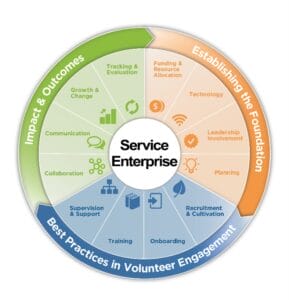
Service Enterprises Amplify the Ability of Communities to Meet Local Needs By Leveraging Local Assets
Service Enterprise Accreditation, the national standard for strategic volunteer engagement, is backed by
and Points of Light, with training and implementation partners nationwide. However, the true path to successful, enduring change lies in engaging the community — activating the community to fight for causes they care about, share their skills and lived experiences, and build a stronger sense of community.
Intentional community activation is about recognizing and valuing the role of community members in mobilizing and deploying their assets. They are the key to overcoming the issues their neighbors or themselves face, making them an integral part of the Service Enterprise process.
Throughout the curriculum and coaching, organizations focus on working with their community to make positive change instead of working for them. Words matter; intentionally inviting the community to volunteer with — not for — an organization, or exploring community solutions with — not for — the community creates a more equitable power dynamic and helps keep the focus centered on the community and the cause.
Ways Service Enterprises Take a Community-Centered Approach to Mission Delivery
United Way of New Bedford embodies this community-centered approach by having volunteer committees representing the communities they serve as donors and benefactors. Community members are actively involved in the design of volunteer opportunities and program delivery models.
ReEstablish Richmond relies on strong community partnerships to create a welcoming and inclusive environment for newcomers. What helps their collaborations thrive is clarifying roles and responsibilities so that community partners, volunteers and staff know how each other contributes and how they can ask each other for support when needed.
Willis Dady Homeless Services believes all volunteerism should be mutually beneficial. To that end, they help the community connect with established volunteer opportunities and welcome community members to share their insights and services to meet the community’s and client’s needs.
About AL!VE’s Service Enterprise Program
This organization-wide change management program engages a cross-functional team to transform how an organization sees, values and utilizes community members as volunteers. No matter the organization’s size or style, the Service Enterprise Training & Implementation Partners can meet organizations where they are and help them more strategically engage volunteers. We have seen success with hospitals, government libraries with unions, organizations with no paid staff or less than 1 FTE, and more. To learn more about delivering this program or having your organization join the movement, contact AL!VE’s National Service Enterprise Administrator, Kayla Paulson, at
MLK Day of Service is a national day of service that focuses on human rights, racial equity and civic engagement. The third Monday in January is dedicated to the life and legacy of
is a framework to help you realize all the ways you can lead, lend support and take action. Often, people think that civic engagement needs to look one specific way – when the truth is that there are multiple ways to get involved, no matter where you are or how much time you have.
This year, mark your calendar for Jan. 15 and make a plan to get involved.
Ways to Live out MLK’s Legacy
Volunteer
Make MLK Day “a Day On, not a Day Off” by finding a volunteer opportunity.
is always needed, but on dedicated days like MLK Day, there are typically additional opportunities available. Community centers, schools, places of worship, food pantries and shelters near you may be hosting extra projects. You can search
. When we hear from others about their perspectives and the life experiences that have shaped their identities, we can better honor who they are and where they come from. Plus, we have the opportunity to expand our own perspectives. You can also learn how to support and advocate for people of color through Points of Light’s
, coining the phrase “Give Us the Ballot” in his 1957 speech. The United States national elections will take place on Tuesday, Nov. 5, 2024, but that doesn’t mean it’s too soon to get involved. Voting is a crucial part of driving change at the systemic level. Start by
to vote, then educate yourself on the issues and the people on this year’s ballot. You may also dedicate time to protecting democracy by advocating for voting rights for all Americans. Then, don’t forget to mark your calendar to ensure you’re ready to vote in November.
is one way to support communities – like BIPOC business owners – or causes you care about. By doing your homework, you can find out which brands that you might buy from regularly are supporting communities of color and advocating for human rights. This may be reflected in their donations, certain projects or campaigns they lead, how they lift up their BIPOC employees and more. Research before you buy, so you can ensure your hard-earned money is going toward the causes you care about.
Work
You might find ways to champion human and civil rights
, even if your job isn’t directly related to these missions. For example, you could organize a group of coworkers who are interested in volunteering on MLK Days. Or you might do a project featuring the voices of
in the community and screen it after work or on a lunch break to help educate and start a conversation within your workplace. If you don’t receive MLK Day off from work, you can also advocate with your employer to make this a day of service for employees.
Voice
Dr. King was a powerful voice in the Black community and used his influence to organize rallies and protests, petition for change and speak with public officials when he could. You can
in your own spheres of influence. This can start around the dinner table, presenting a topic you’re passionate about and leaving space for respectful debate and sharing perspectives. You might find a specific issue you want to champion and create an online petition for it. Or maybe you join an organized rally to make your voice heard. There are plenty of ways to use your words to communicate what you care about and pave the way for change.
Donate
If you want to use your resources to advocate for human and civil rights, you can also
to a cause or organization. By donating financially, you can let an organization allocate funds where they’re most needed. But even donating goods like
can greatly impact an individual or group of people who may not have access to these items. Just check with the organization you’re donating to first, to ensure that you’re contributing items they need and can use.
Service
If you want to follow Dr. Martin Luther King Jr.’s footsteps in dedicating your life to championing human and civil rights, you might consider making a vocation out of it. Through a
. Social entrepreneurs find innovative solutions to the world’s toughest issues, like inequality and racism. These individuals identify a need that hasn’t yet been met by the existing traditional structures, which takes a lot of time, creativity and grit but can also be a supremely impactful career option.
3 Ways You Can Make a Difference on MLK Day of Service
is a defining moment each year when Americans across the country step up to make communities more equitable and take action to create the “Beloved Community” of Dr. King’s dream. While Dr. King believed the Beloved Community was possible, he acknowledged and fought for systemic change. His example is our call to action. This National Day of Service encourages companies, nonprofits and individuals to make a difference on MLK day.
During the last quarter-century, the MLK Day of Service has grown, and its impact increased as more Americans embraced the idea that citizenship involves taking an active role in improving communities. Here’s how to make a difference on MLK day, taking place on January 15, 2024, regardless of whether you’re working solo, as part of a corporate team or with a nonprofit organization.
Things Companies Can Do for MLK Day
Companies have a unique opportunity to participate in MLK Day, both by encouraging employee engagement and addressing racism and bias in the workplace. First, be sure to put together an internal communications plan that encourages employees to get involved and notifies them leading up to the day. You may also opt to organize a corporate volunteer project for your team or give paid volunteer time off for this day. If you need help with your employee engagement efforts, Points of Light’s
can be a great resource.
If you haven’t hosted training or education on racism, bias and inequalities in the workplace, make an effort to implement this, starting with MLK Day. Acknowledge that discrimination still exists and open the floor for your employees to discuss
featuring Bernice A. King, CEO of The King Center, that also offers additional resources for deeper learning.
Other ways you can help employees engage in this work might be centered around an educational opportunity, like a “Lunch and Learn,” to explore microaggressions, biases in communication and more. It could be a meeting that allows for challenging conversations about identity. Or it could be an all-staff email that recognizes the existence of discrimination and reiterates an open-door policy to address these issues with management.
can utilize MLK Day to spark engagement among employees and volunteers alike in a variety of ways. Your nonprofit might run a donation drive, host an event at a food bank or shelter, or run a campaign for donors to give to a specific cause related to dismantling racism and discrimination.
If your organization hasn’t yet, consider adding your volunteer opportunities to
, the world’s largest digital volunteer network. This collection of volunteer opportunities from sites across the web provides the most comprehensive database of volunteer opportunities in the world. Additionally, you can browse the
to get started. It’s a place that connects individuals to hundreds of thousands of volunteer opportunities — in person and virtual — all just waiting for the right volunteer to step up.
You can also check out Points of Light’s collection of
to find a project you can complete in your spare time. And don’t forget that even the smallest act of service, like caring for a sick loved one or picking up your elderly neighbor’s mail, counts as civic engagement and can create a ripple of positive impact in your own backyard and beyond.
Celebrating the AmeriCorps Journey: 30 Years of Community Investment and Philanthropy
This year marks a significant milestone for AmeriCorps: 30 years of unwavering dedication to community service and philanthropy. Over the past three decades, Points of Light has witnessed and supported AmeriCorps’ journey of embracing the shared vision of empowering communities and fostering a culture of service. In this reflection, we honor the undeniable impact AmeriCorps has had on our nation, embodying the ethos of “getting things done.”
A Legacy of Service and Impact
Three decades ago, President Bill Clinton signs the National and Community Service Trust Act of 1993, creating AmeriCorps. A remarkable journey began with more than 20,000 Americans pledging to serve their country. These pioneers of service ventured into more than 1,000 communities, laying the groundwork for what would become an enduring legacy of community investment. This initial step symbolized a commitment to unity, resilience and the power of collective action.
Since 1994, more than 900,000 Americans have served as AmeriCorps members, contributing more than 1.2 billion hours of service to their communities across the U.S. And when considering the value of a volunteer hour is $31.80, that accounts for more than $38 billion in service hours given across every state and U.S. territory. Their work has spanned diverse fields, from education and health to environmental stewardship and disaster response, embodying a holistic approach to community development and philanthropy.
Responding to Moments of Crisis
AmeriCorps’ resilience and adaptability have been most evident in times of national crises. When the country faced the aftermath of September 11th terrorist attacks, the devastation of Hurricane Katrina and the unprecedented challenges of the COVID-19 pandemic, AmeriCorps members were there, leading recovery and rebuilding efforts. Their response in these pivotal moments underscores the essence of their mission – to answer America’s call with action and compassion.
At Points of Light, our partnership with AmeriCorps has been integral to fostering a culture of service and volunteerism. By collaborating on various initiatives, we have amplified the impact of community service, inspiring others to join in this noble cause. Our combined efforts underscore the belief that every individual has the power to make a difference, and together, we can illuminate the path to a brighter, more inclusive future.
Looking Ahead: The Future of Service
As AmeriCorps celebrates this 30-year milestone, we look to the future with optimism and determination. The foundation laid by those first 20,000 members has grown into a robust, diverse and impactful network. Moving forward, their focus remains on deepening community investment, fostering inclusive philanthropy and nurturing the next generation of service leaders.
AmeriCorps’ achievements reflect a collective commitment to bettering our nation, one community at a time. Points of Light celebrates AmeriCorps’ past accomplishments, and we look forward to the continued impact of this remarkable organization. Together, we reaffirm our pledge to get things done for America, turning every moment of impact into a movement of national service. AmeriCorps’ 30-year journey is a testament to the enduring power of service and community. And it’s just the beginning.
Voter Education: 6 Keys to Understanding the Nuances of Voting
Voting is a cornerstone of a civically engaged life, offering every person a voice in the collective direction of their community and nation. In an era where information – and misinformation – is at our fingertips, it’s both a privilege and a responsibility to be informed, especially when it comes to our democratic processes.
isn’t just about choosing a preferred candidate; it’s about understanding how that choice will affect our daily lives for the years to come. Voter education is the avenue that leads to such an informed decision. It is the responsibility of both the individual and the larger societal systems to ensure voters understand the candidates and ballot. Here are some tips on how to become more informed and some resources to help you do so.
The Power of Local Elections
While presidential elections often command a lot of attention, it’s local elections that have the most immediate and tangible impact on our daily lives. In most major cities, fewer than
Elected officials at the local level, from school board members to mayors and city council members, shape policies on everything from public transportation to local taxes to educational reforms and more.
Given the smaller voter pool in local elections, each ballot cast carries more significant weight, making it an invaluable opportunity for individuals to influence their immediate surroundings and advocate for the issues that matter most to them.
Where to Find Resources
To be an informed voter, a little homework is in order. Start by finding out if your state offers an app for voting. Apps can offer access to the upcoming ballot, tell you where to vote, help you update your registration, vote by absentee ballot and more.
To learn more about who and what is on the ballot, check local newspapers and community websites, which frequently offer insightful profiles of candidates and provide breakdowns of local issues. Nonpartisan websites such as
offer a comprehensive look at your ballot, from the top offices to the local issues, and provide insights on measures and candidate stances. This resource was launched by the League of Women Voters Education Fund and tailors election information to your specific location, ensuring you have all the details you need to cast your vote confidently. Similarly,
serves as an objective online encyclopedia of neutral, detailed information about elections at all levels.
Interpreting the Ballot
Ballots can sometimes present a challenge to voters, especially when measures are described in dense legal language. To truly grasp the meaning and implications of these measures, voters should turn to nonpartisan resources like the websites listed above or attend local community forums that offer clear and concise explanations.
When researching candidates, it’s beneficial to peruse candidates’ official websites and social media pages. These platforms often provide a candid view of the candidate’s priorities and standpoints on various issues. But what if a candidate doesn’t necessarily have a robust website that answers your questions?
Engage with Local Officials
The beauty of local governance lies in its accessibility. Local officials, unlike their national counterparts, tend to be more reachable and responsive to their constituents. If there’s ever uncertainty about a candidate’s stance on an issue, or if there’s a desire to voice a concern, you shouldn’t hesitate to
This kind of direct engagement not only provides valuable insights but also informs officials about the issues that matter to their community. Additionally, attending town hall meetings or public forums hosted in local community centers, schools or libraries offers a direct channel to engage with and learn from candidates.
Purging voter rolls is a necessary and important process. Registered voters can be purged for a number of reasons, including death, moving and committing a felony among others. The reason can
A thriving democracy relies on the active and informed participation of its citizens. By dedicating time to understanding the local landscape—both the candidates and the issues—you become an integral part of shaping your community’s future direction.
In the realm of local elections, your vote isn’t just a voice; it’s a call to action. As election day approaches, be prepared to wield that power, knowing fully the impact and influence of your choice.




 Creating Transformational Volunteer Programs
 Empowering Community-Centered Volunteerism
 Mobilizing the Next Generation of Volunteers
 Unlocking Revolutionary Employee Engagement
 Reigniting National Service
 Fueling Organizational Growth