How to Support Volunteer Engagement at the Intersection of Civic Engagement and Mental Health
What do civic engagement and mental health have in common? Points of Light Chief Growth and Strategy Officer Christine Schoppe and Crisis Text Line Chief Program Officer Becka Ross got together to talk about these two cause areas and how they intersect, starting with an overview of each organization.
Since 1990, Points of Light has acted as a cultural catalyst, working in partnership with
to build a world where it’s impossible to sit on the sidelines. Through its corporate partners and 177 affiliates in 38 countries, the organization has mobilized 5 million volunteers. In recent years, Points of Light has worked to define a
for the 21st century, one that calls on people to give their time, talents and resources to build a brighter future for everyone.
Crisis Text Line began in 2013, hosting more than 7.5 million conversations around mental health since its launch. The organization provides text-based crisis intervention by empowering a community of thousands of trained volunteers to support people in their moments of need. The service is offered in the U.S., Canada, the U.K. and Ireland. It’s free, anonymous and available round-the-clock.
Both organizations have a deep understanding of mobilizing volunteers and a focus on research in their respective cause areas.
Research Shows That Civic Engagement and Mental Health Go Together
“There’s a lot of research out there around the mental health benefits of volunteering combating loneliness in particular,” said Ross. “Volunteers are telling us that they are using their training in their personal lives, too, and it’s improving romantic relationships and work relationships and being able to build the skill of empathy and understand the importance of validating somebody’s perspective”
is open-source, sharing data-informed insights into mental health with other nonprofits, corporate partners, policymakers, media and the general public to raise awareness around mental health issues.
is also shared publicly and shows that four out of 10 people see mental health as a top cause area of concern. This cause area tops a list of more than 20, including poverty and gun rights. These trends, led by Gen Z and
, a framework of nine pathways to civic engagement. These pathways include volunteerism, listening and learning, using your voice and being strategic when choosing where you work.
“The company you work for, and the internal volunteerism you can do there. The resource groups you can join to advocate for your kind of special interest group, you can use your place of employment to express your values and your beliefs,” Schoppe pointed out. “There’s more than one way to get it done.”
In addition to choosing a workplace that supports your values, Points of Light research shows that the two of the most common actions people are taking to advocate for the issues they care about are
. Points of Light research shows that a strong motivator for people when choosing which social issue to champion is having personal experience around that issue. That connection and personal investment is central to strength and longevity of commitment.
Schoppe and Ross touched upon how to find willing volunteers and how to retain and incentivize them to keep up this work. Efforts should reach beyond how meaningful the work itself is.
“Many of our volunteers come to us because they want to make an impact and make a difference in somebody’s life. [Our crisis counselors] are really changing the mental health landscape, reducing stigma, ensuring that people know that it’s okay to reach out for help and get support,” said Ross. “We center our volunteers and their experience.”
Crisis Text Line knows a lot about volunteer engagement with a volunteer base of more than 55,000 people who have gone through a 30-hour virtual training to become crisis counselors. One of first things volunteers are asked to do is create a self-care plan, so they can recharge after a tough shift.
This type of thoughtful method of supporting a volunteer force is essential to sustainability as volunteerism remains one of the most valued pathways to civic engagement. Points of Light research shows that the top three actions people are taking around the issues they care about are:
Schoppe said, “That’s really what drives our research is understanding those goals, and then creating insights and actions with our ecosystem.”
Listen and Learn About the Intersection of Civic Engagement and Mental Health
Watch the entire conversation between Points of Light Chief Growth and Strategy Officer Christine Schoppe and Crisis Text Line Chief Program Officer Becka Ross:
How Companies Build Trust Both Inside and Outside Company Culture
Since early 2022, there has been a constant conversation about work. Return to Office, the Great Resignation, Quiet Quitting and more. Undoubtedly, work remains a large part of everyone’s lives, and no matter what form it takes, people are still spending more time working on work than most other things in their lives.
It’s essential to consider how companies build trust in this shifting environment with an increasingly younger workforce.
Social Responsibility is Now a Core Function of Business
was released last month, and it highlighted some interesting facts about where we are as a workforce.
Once again, Edelman’s findings reinforced their previous reports that stated societal leadership is now a core function of business. Nearly seven in 10 employees believe that societal impact is a strong expectation or deal breaker when considering a job, according to the report. This is backed by Points of Light’s own
from 2020, where we found that more than 40 percent of Generation Z have considered applying to or taking a job because of the company’s social responsibility. However, in this report, Edelman asserted a new mandate. This mandate stated that business should play a critical role in bridging divides and restoring societal trust. What might be required to fulfill this call to action?
In the wake of the 2016 election, a moment in time where many pinpoint the beginning of increased incivility, distrust and polarization,
, CEO of Citizen University suggested a path forward. He said what was required included “more listening, more serving, and—perhaps counterintuitively—more arguing.”
Building Trust Requires Authenticity
In April 2022, Points of Light Global Civic Engagement Research found that Eric’s suggested path may be the one people are in fact taking. Our research told us that the
. So if people are taking the right actions, why is trust still broken?
While people are engaging in these actions, they may not be equipped to engage in them in ways that are effective…and people know it.
Edelman found that 60 percent of young employees, ages 18-34, feel their employers should train employees on how to have constructive debates about contentious issues inside and outside the workplace. Employees feel it’s not just a company’s job to hold space for discourse, like Employee Resource Groups, but to cultivate the space by preparing people to enter those conversations effectively. People want their companies to create spaces where progress can be made.
Having constructive debates in a time where the world is so polarized is a critical part of civic engagement. So much so that Points of Light included the actions “Listen & Learn” and “Voice” within the
In our assembly of the Civic Circle, some questioned if these were truly actions worthy of the other elements – they’re admittedly viewed as less “hands on” than things like “Volunteer” and “Vote.” However, listening and learning are critical for building the foundation of trust and empathy within a community – including the workplace community – to support people’s ability to constructively voice their options, while listening to understand, not just respond.
Trust Equals Impact
Edelman’s report also showed that 69 percent of employees believe the people they work with are a significant source of community in their life, ahead of people who share their personal interests (64%) and their neighbors (59%). For this reason and others mentioned in the report, Edelman called the workplace an “island of civility.” While business should continue to foster their workplace communities, it shouldn’t keep these communities insulated from the world and the incivility that can threaten to push in. If you can cultivate engagement within the workplace to build purpose, trust and skill for civil discourse, you can build bridges to places outside the workplace.
This is why so much of Points of Light’s work focuses on supporting companies in activating their employees in community, creating experiences that are:
Local – Addresses issues important to the community the company works in.
Credible – Delivered by an organization with local/issue expertise.
Personal – Engages employees directly with those experiencing the issue.
Social – Allows me to engage in a common purpose with my colleagues.
Impactful – Shows employees the outcomes of their actions.
These opportunities also build trust and effectiveness. Seventy-eight percent of employees trust their employer, while trust in other institutions like government, NGOs and media plummets, so it becomes increasingly critical for companies to provide these engagement experiences The more trust you have, the more likely you are to believe in your impact. The more you believe in your impact, the more likely you are to be willing to work within the systems in place – like nonprofits or supporting elections – to create important change and be more engaged.
If you’re a business trying to figure out how to cultivate these conversations, reach out to Points of Light. Our Listen and Learn discussion series and
can help you provide a strong plan to engage with your employees and create change both inside and outside the office.
3 Labor Day Employee Engagement Ideas to Help Busineses Reach CSR Goals
Labor Day is a federal holiday that recognizes the social and economic accomplishments of American workers. It celebrates a proud history that deserves to be remembered and honored. It’s the perfect day for
contributions of their employees. Here are three Labor Day employee engagement ideas to help you reach CSR goals, both big and small.
Why Do We Celebrate Labor Day?
Labor Day is officially celebrated on the first Monday of September. Labor activists began advocating for a holiday in the 1880’s. They used their collective
. First recognized among individual states, it was eventually deemed a holiday when Congress passed an act to officially recognize it as such on June 28, 1894.
How COMPANIES Can Support Employees on Labor Day
1. Give Employees the Holiday Off, and Pay Them for It
Provide your employees with a paid holiday. This practice can include just Monday, the actual holiday, but may also include the Friday before the weekend. Not only is observing important historical holidays like this an important part of staying civically engaged and culturally relevant, but it allows your employees time to recharge and come back refreshed, which means better productivity. It’s a win-win proposition.
In some parts of the U.S., this holiday can coincide with the first week or two of school, so many parents will be thankful for the additional time off. Employers can largely prevent burnout by supporting employees with regularly scheduled holidays and time off… and a strict no-work policy on holidays whenever possible.
2. Provide Volunteer Opportunities and/or Volunteer Time Off
Offer a paid volunteer day in addition to the holiday. Many organizations opt to host a company-wide volunteer day on the Thursday or Friday preceding the Labor Day holiday. Work with your
(or multiple activities, if you have employees or different locations.)
Provide clear communication about the volunteer event to your employees in advance so they can plan accordingly. Be sure to share that the time spent volunteering will still be paid. Alternatively, you can provide “volunteer time off,” allowing employees to choose their own volunteer activities. And if you don’t yet have an
in place, now is the time to start mobilizing towards creating one for your next fiscal year.
3. Review Your Internal Systems and Structures to Ensure Adequate Employee Support
It’s a great idea to do an annual audit of your internal processes and policies – and what better time than around the Labor Day holiday? You might choose to begin with an anonymous employee survey you can send out company-wide to gather current data and important feedback about improvements. In fact, we recommend keeping some channels for employee feedback and suggestions open year round. Often, employees are eager and willing to set up their own initiatives or suggest solutions, but only if they feel welcome to speak up.
Examine your current pay structures, benefits packages and recognition programs. How often are you saying “thank you” to your employees through competitive salaries, insurance plans and paid time off, annual bonuses, paid lunches or corporate retreats? This internal audit is also an excellent opportunity to review your diversity, equity and inclusion efforts. Where do you stack up among other employers in your industry with training and resources on DEI, as well as providing a safe and inclusive environment for your workers?
Above all, remember that your organization simply wouldn’t exist without your employees. Take this opportunity to celebrate Labor Day in a way that will feel meaningful to your workers. Remembering to thank them not only creates a culture of gratitude, it’s the right thing to do.
Watch the Points of Light Civic Circle Come Alive in These 9 Documentaries
We’ve been exploring ways you can activate around the
, a framework designed to help individuals connect to opportunities and understand that doing good comes in many forms. The Civic Circle represents your unique power as an individual or organization to lead, lend support and take action for causes you care about.
Since a big part of being civically engaged is being informed, we’re offering nine interesting, must-see documentaries that will educate, inspire and stay with you as you continue on your own journey to make the world a better place.
*Note: As these documentaries are capturing real situations and circumstances from across the globe, viewers may find some scenes to be graphic or disturbing. Parents and caregivers, we recommend being mindful to screen these films first before showing them to children.
This incredible documentary has won more than 60 international film festival honors. It challenges each of us to consider whether what we’re contributing could actually be part of a big problem that has developed in the world of philanthropy. With over 200 interviews filmed in 20 countries, the film will empower you to donate your dollars, goods and time more consciously.
When this film was released on Netflix, it became one of the most-viewed documentaries the streaming network had seen. In a world where many people are receiving the bulk of their information via social media, which, unlike credible news media or peer-reviewed publications, isn’t vetted by experts. This film gives some great insight into how this phenomenon is shaping public opinion.
Fashion can be a fun and unique way to express oneself, but “fast fashion” has devastated many critical cause areas, including the environment and workers’ rights. This film documents the lives of real people around the world living in poverty and war-torn areas, who make clothes for the world’s fashion. It will have you thinking twice about doing your research on clothing brands you support and how to spend your dollar in a way that supports sustainable fashion.
This film, narrated by Annette Bening, has garnered accolades too numerous to count. It dives into the nearly six decades of the trials and transformations of this agency through stories from its incredible host country nationals, Peace Corps Volunteers and staff, as well as scholars and journalists.
This fascinating documentary will not only help you understand the concept of social entrepreneurship but also follows the journeys of three Millennial changemakers who are prioritizing meaning and purpose above financial considerations. You’ll finish this film feeling inspired by how entrepreneurial-minded people are using their skills to find creative ways to solve some of the world’s toughest issues.
Tune into this intimate account of legendary U.S. Representative John Lewis, following his life, legacy and more than 60 years of extraordinary activism, from the bold teenager on the front lines of the Civil Rights movement to the legislative powerhouse he was throughout his career.
It will leave you feeling empowered in your right to vote in every eligible election and championing the right for all people to vote.
When it comes to the power of one voice to make an impact on an issue or cause area, perhaps few modern people come to mind as vividly as Greta Thunberg. This compelling documentary follows the teenage climate activist from Sweden on her international crusade to get people to listen to scientists about the world’s environmental problems.
Volunteers share their time and talent with organizations working to advance the causes they care about. Volunteering is one of the best ways you can directly support the solutions to any issues that you’re passionate about, but volunteering comes with responsibility too. This documentary illuminates the impact of international volunteering on local communities. If you’re interested in volunteering overseas, you’ll want to watch this first so that you can plan to do so consciously.
Who says that businesses and their employees can’t use their for-profit work as a way to change the world for the better? Real Value is an award-winning economics documentary that interviews top leaders in the world of agriculture, apparel, insurance and biofuel. This inspiring look at what happens when businesses value the planet and its people in the same way as its profit will leave you both informed and inspired to make change in your own workplace and want to support socially-minded businesses too.
With nine documentaries highlighting nine different ways to lead a civically engaged life, we know you’ll find one that speaks to your specific passions and interests. Once you’ve watched,
4 Themes from the 2022 Points of Light Conference That Shine a Light on CSR Trends for Business
Points of Light knows that when the world’s largest companies get it right, the world gets it right, which is a theme at the heart of the 2022 Points of Light Conference. As a part of this year’s conference experience, we welcomed leaders from the corporate citizenship community to our stages and workshop spaces to meet like-minded peers and share insights from the challenging work that faces the business community as leaders in social impact.
Several themes were explored, shining a light on the direction where business needs to lead:
The “to do” list of the business community has become longer. For the business community, it can feel like we are being outpaced by the problems of the world that we seek to solve. In addition to economic and societal responsibilities, global communications firm Edelman shared with Points of Light’s Corporate Service Council that almost six out of 10 people in the U.S. believe it is a responsibility of business to take action on the world stage, engaging in geopolitical issues such as the war in Ukraine. Navigating how to respond to or engage in these issues has introduced new and unique challenges for corporate citizenship professionals.
Our brains are wired for stories. As companies seek to capture the measurable impact of their efforts, they should leverage the power of stories. Disney Institute shared with conference attendees that stories are one of the strongest forms of communication, evoking a sense of connectedness in those who hear them. At Points of Light, we say that “Data + Stories = Proof.” The relentless pursuit of data must be coupled with an equal desire to share more about the people and places at the heart of that data. Additionally, leaders within companies must be equipped to tell these stories, communicating the company’s and their own passions and values through the story.
Volunteer engagement must adapt to the hybrid world. As we enter the third year of the COVID-19 pandemic, we continue to grapple with variant surges, return-to-office starts and stops and disruptions to in-person events. It has become clear that the current hybrid work environment will not be a temporary condition of the pandemic, but a lasting model of collaboration that must extend to deepen employee engagement. In one workshop, Common Impact shared how companies can look to skills-based volunteering as a partial or fully virtual strategy to deliver on employee engagement goals.
There is a CSR and ESG identity crisis. The corporate citizenship community is caught between two acronyms. Several workshops sought to answer the question: What is the difference between CSR (Corporate Social Responsibility) and ESG (Environmental, Social, and Governance)? The role of business in society has been discussed and expanded upon over 50 years. The growing influence of ESG is rooted in CSR, which marked the starting point of businesses taking ownership of their impact on society. Without CSR, there would be no ESG, but the two are far from interchangeable. CSR helps companies give context to their corporate responsibility strategy and culture, while ESG is the action and measurable outcomes of that agenda.
Whether or not you joined us this year at the 2022 Points of Light Conference, we invite you to continue learning with us year-round by accessing our body of
. These studies shed light on global trends that are central to maximizing the impact of corporate social responsibility. We look forward to the 2023 Points of Light Conference in Chicago on June 14-16.
initiative – a global, in-person volunteering program that
unites approximately 15,000 employee volunteers in more than 50 countries around the world with a single purpose: to strengthen local communities through volunteering.
This investment in community at this level reflects AbbVie’s values, and their commitment to supporting the people and causes that matter to the communities where they work and live.
Claudia Carravetta, AbbVie vice president, Corporate Responsibility & Global Philanthropy, shared a little more about the Week of Possibilities and how AbbVie works to transform the communities where they work and live.
“Working with our local communities is a big part of who we are at AbbVie,” said Claudia Carravetta. “Through our AbbVie volunteer programs, we strive to inspire our people to do purposeful work around the world.”
We share the story about this work as an inspiration and model of how companies are engaging.
Points of Light’s recent global civic engagement research shows 82 percent of people expect companies to take a stand on social issues. However, over the past few years, companies have had the difficult task of responding to various and ongoing worldwide crisis, including the COVID-19 pandemic, social unrest and the war in Ukraine.
AbbVie’s Week of Possibilities is an inspiration and model of how companies are engaging employees to drive positive change in communities. Beyond supporting communities, corporate volunteering is a great way to build employee engagement and culture. According to Carravetta, thousands of AbbVie employees will experience its global, in-person volunteering event for the first time after a two-year pause due to the pandemic.
“We are thrilled our employee volunteers are returning to service projects in local communities this year and we could not do this program without Points of Light to make a real impact across the globe,” added Carravetta.
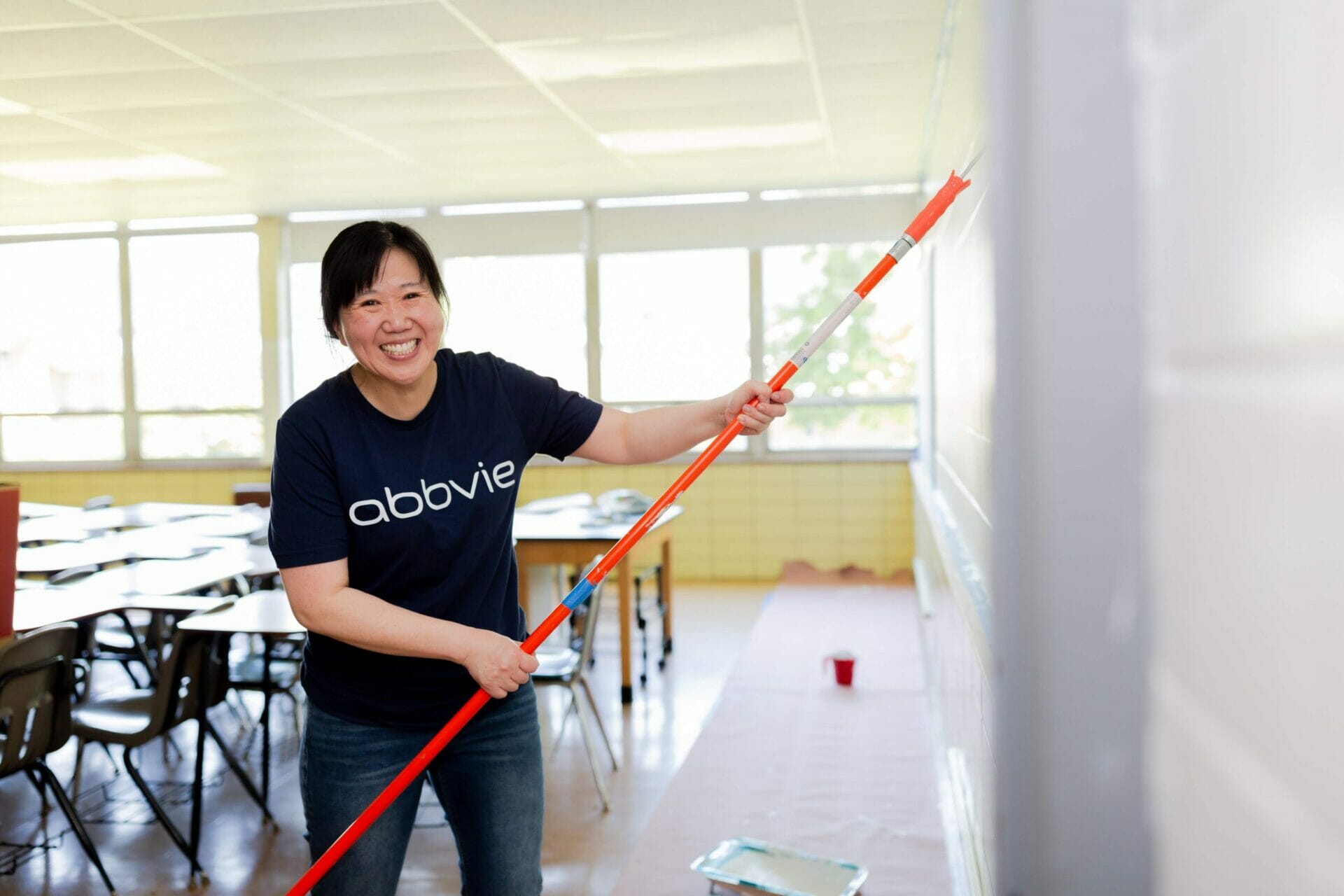
Hands-on projects for Week of Possibilities includes renovating schools, playgrounds and community centers to benefit local communities impacting tens of thousands of people. For example, in the U.S., employee volunteers will support local school enhancements to enrich the student experience, including the development of immersive STEM labs and STEM-focused library spaces, as well as transform new playgrounds for community parks and support local food programs.
. Through our Global Network of 178 affiliates in 38 countries, we work in and with communities to understand their needs and help corporate partners respond, engaging their resources and employees. It is this kind of partnership and ability that makes events like these possible.
While the past few years have brought changes in employment for many people, that also means a wave of new employees in new roles.
Companies can lead the way and set a model for what it looks like to work with and in communities, making a positive impact on the communities and their employees. And Points of Light is
.
We are grateful to AbbVie for making this investment and showing how employee engagement creates possibilities.
Natalye Paquin was the president and chief executive officer of Points of Light from 2017–2022. She is a visionary and results-oriented leader, with more than 20 years of experience providing strategic, operations and fiscal leadership in the nonprofit and public sectors.
Can an Old Fashioned Day of Service Strengthen Post-pandemic Connections?
The collective global experience of the COVID-19 pandemic has changed the world in many ways. The shift to remote work has revolutionized the workplace, with positive outcomes such as reduced commuting times and increased flexibility. On the flip side, it has resulted in isolation of workers from colleagues, a depleted sense of belonging and sometimes struggles with mental and physical health. These disruptions to workplace relationships, as well as volunteering, have kept us apart, separating us from our communities and each other.
Workplaces around the world are seeking strategies to build post-pandemic culture and reset toward a future vision. As a civic engagement leader, it got me to thinking, can an old-fashioned day, week or month of service hosted by businesses around the world spur a culture comeback and reconnect colleagues and communities?
The answer is
yes.
At Points of Light, we live by this principle every day, and it’s a clear affirmation of everything
In a recent conversation, a Points of Light corporate partner reflected that, “Volunteering used to be a way to get people out of the office. But now, perhaps, it’s a way to get people back in.”
Focusing on greater purpose, both individually and for your company, can boost your mood, improve work performance and help rebuild a values-based culture. Bea Boccalandro’s,
are both fun and meaningful tools for exploring how you can build purpose. purpose.
There are countless ways to help your community — a host of issues just waiting for a willing pool of volunteers to help solve. Throughout the pandemic, communities have struggled
have increased and spread from cities to suburbs. Volumes of residential waste and recycling have placed increased demand on city workers and infrastructure. There’s no denying the increase in plastics and cardboard usage as ordering-in and home delivery have thwarted our reduce, reuse, recycle goals. School districts and parks need a helping hand to refresh and revitalize their public spaces.
Can your company build a day of service into its return to work plan? The classic example of a clean-up day provides much-needed extra hands to tackle a real need. It also engages colleagues, captures the health benefits of people being outside and introduces everyone to neighborhoods and communities for ongoing learning and action.
Perhaps there is a hybrid volunteer model that matches your company’s hybrid return to work.
showed that all students are behind in reading and math, and students in majority-Black schools are now 12 months behind their peers in majority-white schools. Programs like
are responding to those challenges with new initiatives that engage employees as mentors and coaches and use aligned talent and capabilities to bring programs that close the gap both in-person and online. A great volunteering experience can address important community needs, inspire your employees and support your company’s comeback strategy, but how do you make it great? Points of Light recommends working at the intersection of good for community, good for employees and good for your brand:
Focus on Company Values: What aligns with the authentic products, services and values of your brand? Who are your customers? What community needs align with these attributes? Company values demonstrated by volunteering in support of a community need offer the greatest opportunity to instill refreshed purpose and strengthen culture. These efforts can start in the virtual world as listening and learning efforts that prepare employees to be better leaders and citizens when in-person volunteering returns to your company. Many companies are expanding their employee engagement and volunteering programs to include training that serves a social purpose or benefit. Examples include providing opportunities for employees to learn sign language or take disaster training courses through the American Red Cross. Are the uncertainty, delay and hybrid variations challenging your planning? Some companies have had great success with projects like “virtual” cleanups, where employees coordinated and tracked cleanup efforts in their local areas.
Listen to Your Employees: Employees are citizens first. Are they raising community needs? How can you support them as change agents to tackle the challenges they identify? Consider offering volunteer time off and matching grants for volunteer time. Can you help organize teams of colleagues for a day of service? Can you bring leadership together with employees hired in the last two years for a litter pick up or schoolyard refresh?
Identify Your Strongest Assets: Can a day of service launch a place-based commitment for your organization? Perhaps a schoolyard update introduces your company to a school and community that might welcome mentors, advisors and coaches for students and faculty. Are there career learning experiences that your company could offer? Can leaders build relationships that expand the networks of nonprofit leaders to help them better connect to media, mentors and money?
Board training and matching programs present an impactful and scalable opportunity to engage employees. Not only can companies track and set targets for employee board service,
but
these programs can also support the organization’s DEI initiatives to increase minority board representation and expand support for racial equity-focused organizations. Check out organizations like
No matter where you chose to start, now is the time to build service into your comeback plans.
Points of Light supports companies of all sizes that are interested in building and growing their civic engagement programs. You can access tools and resources to help you get started at
for program design consulting and engagement solutions.
Lowe’s Grant Recipient Creates More Culturally Responsive School Campus
We sat down with Rachel Axelrad, one of the winners of the Lowe’s
Hometowns Partnership, to learn about her experiences as a grant recipient and how the project impacted not only her school but the community at large. As a full-time teacher, the project was a big undertaking for Rachel, and she discusses how Points of Light and
provided critical support and expertise to her team of parents and teachers.
T
ell
us
a little about yourself and how the project got started
.
It is my
eighth
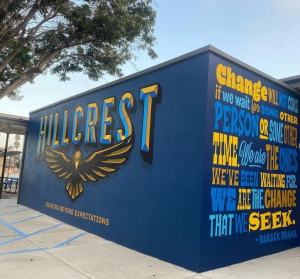
year teaching at Hillcrest Elementary, a public school in the Crenshaw District of Los Angeles
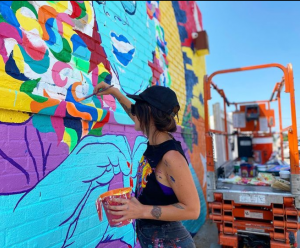
. Our school used to have murals, and the school district had some funding to redo them. We were offered two color choices: tan with brown borders or tan with gray borders. Those are not welcoming or inspiring colors! We believe that spaces define how you feel and act. Our new space needed to be warm, safe, welcoming, bright
,
and happy.
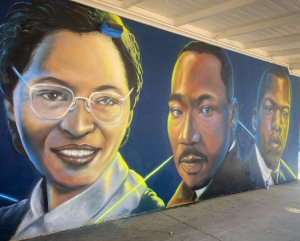
We wanted to use the murals as teaching points and to reflect our community. Our school is around 50% Latinx and 50% Black and
is
located in a historically Black neighborhood of Los Angeles. How wonderful it would be to have meaningful, intentional murals that included portraits of historical people of color who were changemakers.
Our team began fundraising and came across the Lowe’s
Hometowns grant. We were so fortunate to win $100,000
,
because that goes a long way.
The results are stunning and must have had a strong impact on the students. How did your colleagues react?
The final product is even more impactful on us, the staff. In our society, so many things about teaching are hard, especially in public school settings. I enjoy being in such a beautiful space and being able to use the murals as a teaching opportunity. When we started Black History Month, I printed pictures of murals and asked my students who they knew and who they did not know. At this point, I have taught
about
most of the individuals commemorated in our murals.
How daunting was it to take on a project like
this
during
a pandemic
,
while also tackling all the challenges teachers
were facing
?
Honestly, I did not understand what I was getting into, and the size of the project was extremely tough on my work-life balance. When I first found out about our award, I was so excited. Quickly that turned into feeling overwhelmed because I have a full-time job, and this project was a second full-time job.
Luckily, Lowe’s and Points of Light connected me to a Points of Light affiliate, LA Works, and they took over a lot of the coordination and planning pieces. I could not have done what LA Works did with this project. They had a way of making this come to fruition by helping with all the communications and paperwork
,
along with sourcing equipment and finding skilled labor. It was a big relief that I was not left alone. They saved the day!
How does this project inspire the students to believe
that
they have the power to create change?
Our kids got to see change in action. They were witnesses to us taking agency over our situation. We did not like what we saw, so we made it better as a school community.
Points of Light’s Civic Circle shows how making a difference can go beyond traditional volunteering.
Intentional p
urchases, thoughtful donations, employment choices and posts on social media can all have an impact on their community.
Yes, I agree with you. One person who was as integral as LA Works was one of our muralists
,
Erin. She had never done anything like
this
before, but she felt like she needed to do this and help us. She was a full partner in emailing, scheduling, planning
,
and budgeting. That was how she gave her time and energy to support very deserving students.
So many people want to do good, and skilled volunteers like Erin are critical. Also, we needed people to give us funding. Lowes’ donation was essential. Companies come in with the best of intentions, but they often engageat the community and very rarelywith the community. This was the first time we felt that everyone was working with us and letting us make decisions since we knew what would be best for our school.
What would you say to a donor considering making a gift to Points of Light and our affiliate network?
I am Jewish, and in my faith, we believe in levels of charity. The highest form of charity is giving without being asked and helping someone you do not know. By doing so, you are showing respect and trust that the donation will be used for the highest and best purpose. State funding is not always attuned to our needs. If someone gives to Points of Light, and then Points of Light helps us, that person can know that the resources are being used effectively and in tangible ways that are meaningful to our community. That type of funding and support is transformative.
Lowe’s: Rejuvenation and Impact in America’s Small Towns
When it comes to changemaking, corporations often wield the power to impact communities. And when put into thoughtful, strategic initiatives, this power has the potential to make a world of difference.
In 2021, as part of the company’s centennial celebration, Lowe’s partnered with Points of Light to help resource 100 community impact projects across the United States. The program became known as
100 Hometowns
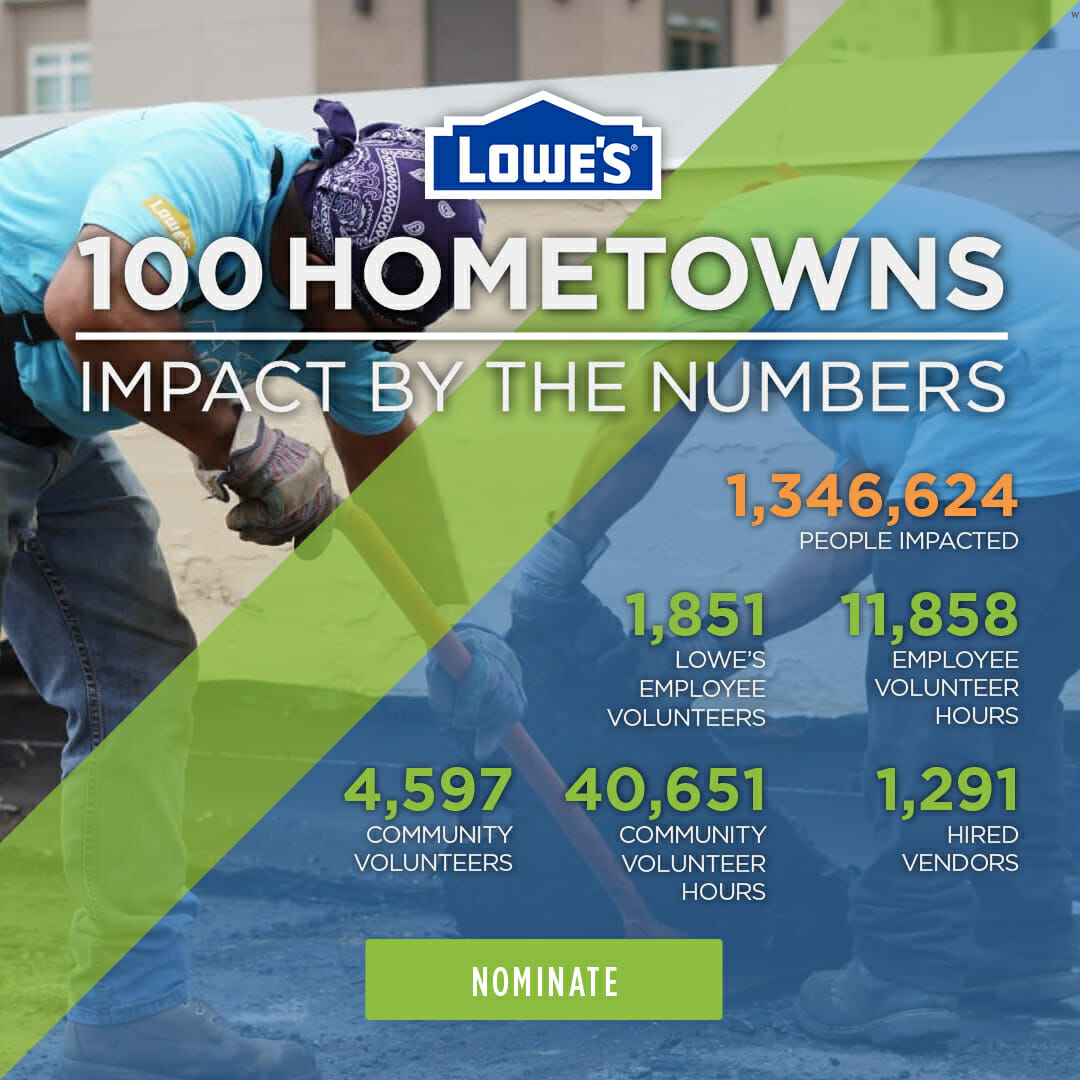
, and it ultimately helped 1.3 million people across 36 states from coast to coast.
Now, as part of its goal to make homes better for all, Lowe’s is making its largest-ever commitment to give back to the communities it serves. Over the next five years, Lowe’s will invest $100 million in community impact projects – supporting nearly 1,800 communities each year.
Now through March 28, Lowe’s is inviting Americans nationwide to nominate their hometown projects in need as part of a new, annual initiative called Lowe’s Hometowns.
Lowe’s Hometowns will help repair, restore, or improve the following types of community spaces:
Skilled Trades Education Facilities (e.g., mobile bus, workshops)
Community Centers (e.g., senior citizen center, youth center, accessible home needs, food pantry)
Parks/Outdoor Spaces (e.g., community playground, greenway, community garden)
“Each day, our associates and neighbors come together to help build and strengthen their communities. With this investment through Lowe’s Hometowns, we are demonstrating our commitment to make homes – and hometowns – better for those in need,” said Marvin R. Ellison, Lowe’s chairman and CEO. “We look forward to working with communities across the country to make sure that our investments serve their needs and have a positive impact that lasts for years to come.”
Nominate a project in your community to be a part of LOWE’S HOMETOWNS
Last year, thousands of projects were nominated, and 100 grant recipients pulled together with their local Lowe’s store associates to transform their needs into realities. Many of these recipients simply needed additional funding, skilled workpeople and a handful of volunteers to push a years-delayed project over the finish line.
Take, for example, the Paintsville Veterans Referral Center in Paintsville, Kentucky. This nonprofit veterans center had been heavily damaged by flooding and needed assistance in completing restorations so that it could continue to provide vital outreach and programs. With a grant awarded as part of Lowe’s 100 Hometowns, the center was able to be completely restored.
“After losing everything, we were prepared to close the doors…. Talk about a change in our veterans’ wellbeing. This center has been packed and back to business, and then some,” said Stephanie Rodriguez, project manager at Paintsville Veterans Center.
Mingus Job Accelerator in Mingus, Texas, is a program that provides on-the-job training for adults with intellectual disabilities. Its grant from 100 Hometowns was devoted to finishing a cluster of tiny houses, a cornerstone of its program. Without these houses, participants could only enter a daily program, which left them missing out on the most important aspect of their training, learning how to live independently.
“The largest impact, next to the beauty of the project, is the inclusiveness and awareness our project brings to the general public,” said CEO Jan Underwood.
A fallacy for corporations is thinking that their contribution to bettering the world exists only in monetary resources. While fiscal funding is absolutely crucial for nonprofits and under-resourced groups, companies can also use multiple assets, including their people power, material goods and in-kind donations.
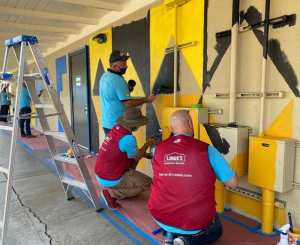
program, local Lowe’s store associates got involved on “Red Vest Days,” named after the hallmark Lowe’s uniforms. These workers teamed up with folks at nonprofit organizations and within the communities to provide additional labor on the specific projects being completed.
Bringing supplies and much-needed skill sets, Lowe’s associates helped further these projects while completing nearly 12,000 volunteer hours. This approach allowed community members, nonprofit workers and volunteers to get help with troubleshooting issues and build valuable connections with local Lowe’s stores.
a project in your community to become part of Lowe’s Hometowns in 2022. And to learn more about how your company can support employees and communities by fostering stronger civic engagement, visit
Fostering Civic Engagement Among Your Millennial Workforce
After the past two years of nearly every sphere of society being upended by the COVID-19 pandemic, the world is wondering what will become our new normal. Millennials, with their voices, their involvement and their power, are shaping it.
While Gen Z are undoubtedly today’s trendsetters, millennials are the new power-holders driving societal change. Millennials make up the majority of the workforce. They hold most of the leadership positions within organizations. They often have the resources to help significantly move the needle on social issues. For business leaders to stay relevant in a post-pandemic world, we need to prioritize our understanding of millennials as the leaders of social change.
Points of Light teamed up with research and design firm INFLUENCE|SG to conduct a study on civic engagement among the millennial generation. We were interested in the perspective of this group in particular, for whom social issues prompting civic action have become highly personal. The research showed some interesting trends. Five of the six social issues millennials said were of most interest to them were pandemic-related. Of course, this is to be expected.
But the issues that millennials took action to support were not, in fact, their issues of highest concern. 93% of respondents said the social issue for which they performed at least one action in the past year was civil rights/racial discrimination/social justice. 92% said they performed at least one action in the past year for the issues of sexual orientation and gender identity.
As social unrest continues and as some workers begin to return to offices, companies and brands need to create a culture of civic engagement and—more importantly—opportunities to channel employees’ desire to act, especially as it relates to millennials.
In a recent Edelman Trust Barometer Special Report, 59% of people currently leaving their jobs say they want an employer that shares their values. Seven in ten employees say they expect opportunities for social impact from their employer. And 61% say they will not work at a company if they disagree with its stand on social issues.
Without a doubt, socially engaged businesses recruit and retain more employees. Providing employees with opportunities for civic engagement isn’t just about doing the right thing; it’s better for companies’ bottom lines. In order for companies to seize the moment, satisfy their workforce and maintain business continuity, there are some key strategies to start implementing.
Have a purpose and platform for civic engagement to drive social impact and leverage employees’ desire to make a difference. Our research in 2020 confirmed that not knowing where and how to volunteer are the biggest barriers for those who have not volunteered but are interested. Make it easy for employees to understand what’s important to the company and how to get involved. In November, our partners at RW Institute will release their 2021 edition of the Corporate Volunteering, Giving and Grants Technology Review for those looking for technology solution that makes social impact opportunities accessible to everyone across your company’s footprint.
Next, engage in meaningful dialogue with employees, partners and competitors about how we all can address old systems that don’t work for our new world order. The millennial research showed that the number one action taken to support social issues was spending time learning about them. We launched a partnership with Morehouse College called Listen. Learn. Act to End Racism on a diverse set of topics to inspire and educate. AT&T offered employees a 21-day challenge and Altria took up the mantle and created their own.
Educate employees and stakeholders about how they can get involved and what individual actions they can take to make an impact. We developed the Points of Light Civic Circle® as a framework to help individuals understand that doing good comes in many forms. Companies can use the framework to ensure they have opportunities that align with Civic Circle components and encourage employees to use their vote, their purchase power and their voice.
Provide opportunities for employees to be civically engaged and give them the time off to do so. Of the 2021 Civic 50 honorees, 88% provide employees with time off or flexible scheduling to vote, while 82% do the same for volunteering. Companies of any size can help facilitate civic action by offering opportunities to get involved, and making them easily findable.
Recognize individuals for their impact. Creating incentives for employees to be engaged, whether through internal communications spotlights or organizational awards or merits, shows that the company cares about civic engagement and wants to highlight employees making a difference.
Fostering civic engagement is critical for companies to reach, recruit and retain the millennial generation — the generation deciding what our future looks like. 47% of respondents in our study said the pandemic has made them think more than ever before that people like them should try to make a difference to improve our communities and our country. 38% said they have always thought it was important to get involved in social issues. And 69% said they’re now more likely to volunteer than ever before.
Finally, it’s critical that organizations — whether nonprofit or for-profit — are genuine with their communication. It’s not simply about asking for support with the latest issue. Organizations must recognize that they’re reaching out to a generation that feels personally affected by these issues. Asking millennials what they need and how you can partner with them to achieve the desired goal is going to have the biggest impact. In this way, organizations become a conduit for millennial civic engagement, influencing social issues to build back better as we forge ahead post-pandemic.
Finally, it’s critical that organizations — whether nonprofit or for-profit — are genuine with their communication. It’s not simply about asking for support with the latest issue. Organizations must recognize that they’re reaching out to a generation that feels personally affected by these issues. Asking millennials what they need and how you can partner with them to achieve the desired goal is going to have the biggest impact. In this way, organizations become a conduit for millennial civic engagement, influencing social issues to build back better as we forge ahead post-pandemic.





 How daunting was it to take on a project like