How Companies Build Trust Both Inside and Outside Company Culture
Since early 2022, there has been a constant conversation about work. Return to Office, the Great Resignation, Quiet Quitting and more. Undoubtedly, work remains a large part of everyone’s lives, and no matter what form it takes, people are still spending more time working on work than most other things in their lives.
It’s essential to consider how companies build trust in this shifting environment with an increasingly younger workforce.
Social Responsibility is Now a Core Function of Business
was released last month, and it highlighted some interesting facts about where we are as a workforce.
Once again, Edelman’s findings reinforced their previous reports that stated societal leadership is now a core function of business. Nearly seven in 10 employees believe that societal impact is a strong expectation or deal breaker when considering a job, according to the report. This is backed by Points of Light’s own
from 2020, where we found that more than 40 percent of Generation Z have considered applying to or taking a job because of the company’s social responsibility. However, in this report, Edelman asserted a new mandate. This mandate stated that business should play a critical role in bridging divides and restoring societal trust. What might be required to fulfill this call to action?
In the wake of the 2016 election, a moment in time where many pinpoint the beginning of increased incivility, distrust and polarization,
, CEO of Citizen University suggested a path forward. He said what was required included “more listening, more serving, and—perhaps counterintuitively—more arguing.”
Building Trust Requires Authenticity
In April 2022, Points of Light Global Civic Engagement Research found that Eric’s suggested path may be the one people are in fact taking. Our research told us that the
. So if people are taking the right actions, why is trust still broken?
While people are engaging in these actions, they may not be equipped to engage in them in ways that are effective…and people know it.
Edelman found that 60 percent of young employees, ages 18-34, feel their employers should train employees on how to have constructive debates about contentious issues inside and outside the workplace. Employees feel it’s not just a company’s job to hold space for discourse, like Employee Resource Groups, but to cultivate the space by preparing people to enter those conversations effectively. People want their companies to create spaces where progress can be made.
Having constructive debates in a time where the world is so polarized is a critical part of civic engagement. So much so that Points of Light included the actions “Listen & Learn” and “Voice” within the
In our assembly of the Civic Circle, some questioned if these were truly actions worthy of the other elements – they’re admittedly viewed as less “hands on” than things like “Volunteer” and “Vote.” However, listening and learning are critical for building the foundation of trust and empathy within a community – including the workplace community – to support people’s ability to constructively voice their options, while listening to understand, not just respond.
Trust Equals Impact
Edelman’s report also showed that 69 percent of employees believe the people they work with are a significant source of community in their life, ahead of people who share their personal interests (64%) and their neighbors (59%). For this reason and others mentioned in the report, Edelman called the workplace an “island of civility.” While business should continue to foster their workplace communities, it shouldn’t keep these communities insulated from the world and the incivility that can threaten to push in. If you can cultivate engagement within the workplace to build purpose, trust and skill for civil discourse, you can build bridges to places outside the workplace.
This is why so much of Points of Light’s work focuses on supporting companies in activating their employees in community, creating experiences that are:
Local – Addresses issues important to the community the company works in.
Credible – Delivered by an organization with local/issue expertise.
Personal – Engages employees directly with those experiencing the issue.
Social – Allows me to engage in a common purpose with my colleagues.
Impactful – Shows employees the outcomes of their actions.
These opportunities also build trust and effectiveness. Seventy-eight percent of employees trust their employer, while trust in other institutions like government, NGOs and media plummets, so it becomes increasingly critical for companies to provide these engagement experiences The more trust you have, the more likely you are to believe in your impact. The more you believe in your impact, the more likely you are to be willing to work within the systems in place – like nonprofits or supporting elections – to create important change and be more engaged.
If you’re a business trying to figure out how to cultivate these conversations, reach out to Points of Light. Our Listen and Learn discussion series and
initiative – a global, in-person volunteering program that
unites approximately 15,000 employee volunteers in more than 50 countries around the world with a single purpose: to strengthen local communities through volunteering.
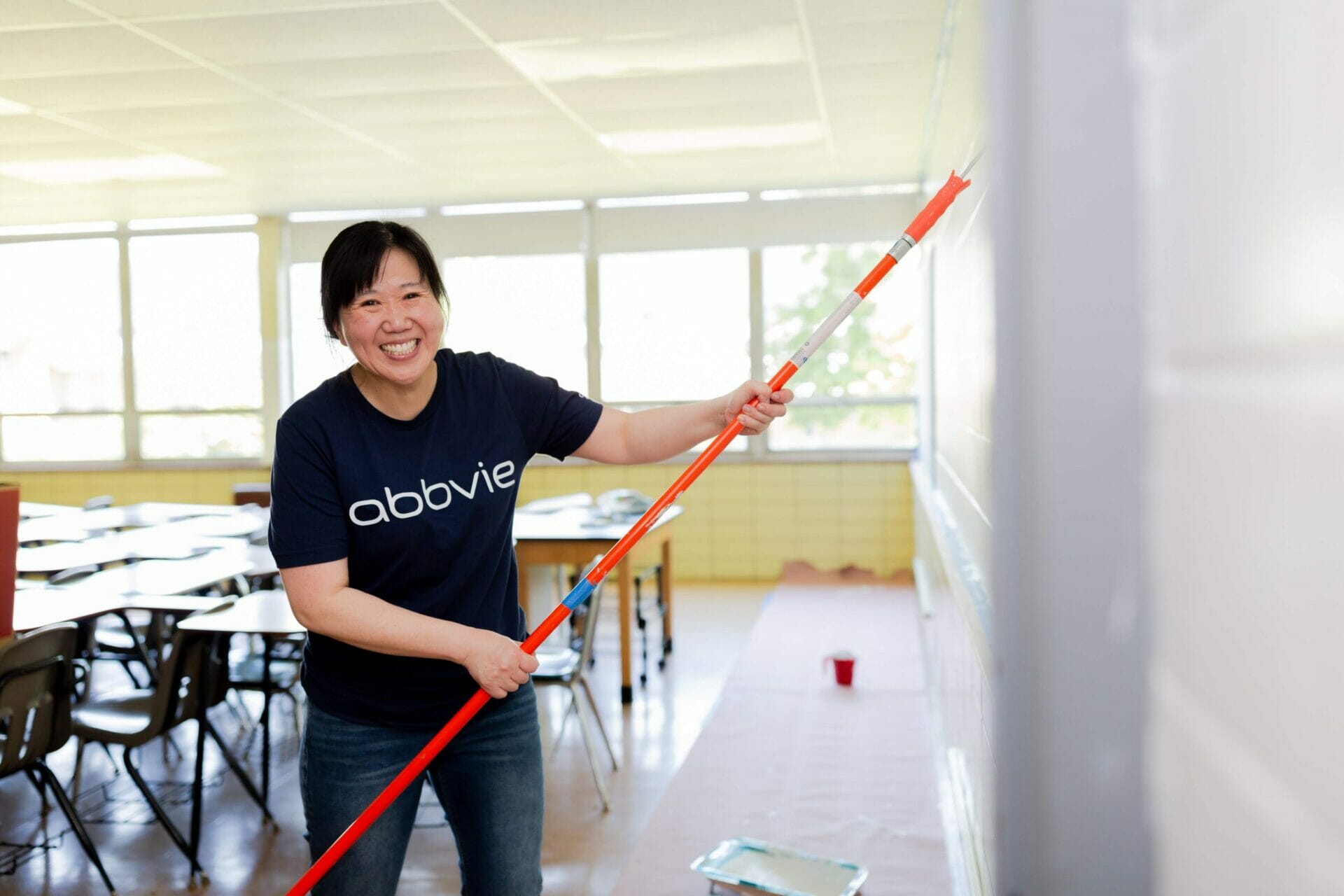
This investment in community at this level reflects AbbVie’s values, and their commitment to supporting the people and causes that matter to the communities where they work and live.
Claudia Carravetta, AbbVie vice president, Corporate Responsibility & Global Philanthropy, shared a little more about the Week of Possibilities and how AbbVie works to transform the communities where they work and live.
“Working with our local communities is a big part of who we are at AbbVie,” said Claudia Carravetta. “Through our AbbVie volunteer programs, we strive to inspire our people to do purposeful work around the world.”
We share the story about this work as an inspiration and model of how companies are engaging.
Points of Light’s recent global civic engagement research shows 82 percent of people expect companies to take a stand on social issues. However, over the past few years, companies have had the difficult task of responding to various and ongoing worldwide crisis, including the COVID-19 pandemic, social unrest and the war in Ukraine.
AbbVie’s Week of Possibilities is an inspiration and model of how companies are engaging employees to drive positive change in communities. Beyond supporting communities, corporate volunteering is a great way to build employee engagement and culture. According to Carravetta, thousands of AbbVie employees will experience its global, in-person volunteering event for the first time after a two-year pause due to the pandemic.
“We are thrilled our employee volunteers are returning to service projects in local communities this year and we could not do this program without Points of Light to make a real impact across the globe,” added Carravetta.
Hands-on projects for Week of Possibilities includes renovating schools, playgrounds and community centers to benefit local communities impacting tens of thousands of people. For example, in the U.S., employee volunteers will support local school enhancements to enrich the student experience, including the development of immersive STEM labs and STEM-focused library spaces, as well as transform new playgrounds for community parks and support local food programs.
. Through our Global Network of 178 affiliates in 38 countries, we work in and with communities to understand their needs and help corporate partners respond, engaging their resources and employees. It is this kind of partnership and ability that makes events like these possible.
While the past few years have brought changes in employment for many people, that also means a wave of new employees in new roles.
Companies can lead the way and set a model for what it looks like to work with and in communities, making a positive impact on the communities and their employees. And Points of Light is
.
We are grateful to AbbVie for making this investment and showing how employee engagement creates possibilities.
Natalye Paquin was the president and chief executive officer of Points of Light from 2017–2022. She is a visionary and results-oriented leader, with more than 20 years of experience providing strategic, operations and fiscal leadership in the nonprofit and public sectors.
Can an Old Fashioned Day of Service Strengthen Post-pandemic Connections?
The collective global experience of the COVID-19 pandemic has changed the world in many ways. The shift to remote work has revolutionized the workplace, with positive outcomes such as reduced commuting times and increased flexibility. On the flip side, it has resulted in isolation of workers from colleagues, a depleted sense of belonging and sometimes struggles with mental and physical health. These disruptions to workplace relationships, as well as volunteering, have kept us apart, separating us from our communities and each other.
Workplaces around the world are seeking strategies to build post-pandemic culture and reset toward a future vision. As a civic engagement leader, it got me to thinking, can an old-fashioned day, week or month of service hosted by businesses around the world spur a culture comeback and reconnect colleagues and communities?
The answer is
yes.
At Points of Light, we live by this principle every day, and it’s a clear affirmation of everything
In a recent conversation, a Points of Light corporate partner reflected that, “Volunteering used to be a way to get people out of the office. But now, perhaps, it’s a way to get people back in.”
Focusing on greater purpose, both individually and for your company, can boost your mood, improve work performance and help rebuild a values-based culture. Bea Boccalandro’s,
are both fun and meaningful tools for exploring how you can build purpose. purpose.
There are countless ways to help your community — a host of issues just waiting for a willing pool of volunteers to help solve. Throughout the pandemic, communities have struggled
have increased and spread from cities to suburbs. Volumes of residential waste and recycling have placed increased demand on city workers and infrastructure. There’s no denying the increase in plastics and cardboard usage as ordering-in and home delivery have thwarted our reduce, reuse, recycle goals. School districts and parks need a helping hand to refresh and revitalize their public spaces.
Can your company build a day of service into its return to work plan? The classic example of a clean-up day provides much-needed extra hands to tackle a real need. It also engages colleagues, captures the health benefits of people being outside and introduces everyone to neighborhoods and communities for ongoing learning and action.
Perhaps there is a hybrid volunteer model that matches your company’s hybrid return to work.
showed that all students are behind in reading and math, and students in majority-Black schools are now 12 months behind their peers in majority-white schools. Programs like
are responding to those challenges with new initiatives that engage employees as mentors and coaches and use aligned talent and capabilities to bring programs that close the gap both in-person and online. A great volunteering experience can address important community needs, inspire your employees and support your company’s comeback strategy, but how do you make it great? Points of Light recommends working at the intersection of good for community, good for employees and good for your brand:
Focus on Company Values: What aligns with the authentic products, services and values of your brand? Who are your customers? What community needs align with these attributes? Company values demonstrated by volunteering in support of a community need offer the greatest opportunity to instill refreshed purpose and strengthen culture. These efforts can start in the virtual world as listening and learning efforts that prepare employees to be better leaders and citizens when in-person volunteering returns to your company. Many companies are expanding their employee engagement and volunteering programs to include training that serves a social purpose or benefit. Examples include providing opportunities for employees to learn sign language or take disaster training courses through the American Red Cross. Are the uncertainty, delay and hybrid variations challenging your planning? Some companies have had great success with projects like “virtual” cleanups, where employees coordinated and tracked cleanup efforts in their local areas.
Listen to Your Employees: Employees are citizens first. Are they raising community needs? How can you support them as change agents to tackle the challenges they identify? Consider offering volunteer time off and matching grants for volunteer time. Can you help organize teams of colleagues for a day of service? Can you bring leadership together with employees hired in the last two years for a litter pick up or schoolyard refresh?
Identify Your Strongest Assets: Can a day of service launch a place-based commitment for your organization? Perhaps a schoolyard update introduces your company to a school and community that might welcome mentors, advisors and coaches for students and faculty. Are there career learning experiences that your company could offer? Can leaders build relationships that expand the networks of nonprofit leaders to help them better connect to media, mentors and money?
Board training and matching programs present an impactful and scalable opportunity to engage employees. Not only can companies track and set targets for employee board service,
but
these programs can also support the organization’s DEI initiatives to increase minority board representation and expand support for racial equity-focused organizations. Check out organizations like
No matter where you chose to start, now is the time to build service into your comeback plans.
Points of Light supports companies of all sizes that are interested in building and growing their civic engagement programs. You can access tools and resources to help you get started at
for program design consulting and engagement solutions.
4 Ways to Recognize Volunteers and Keep Them Engaged
Recognition is one of the easiest and most cost-effective strategies when it comes to retaining your volunteers and growing your volunteer programs. Whether you are a nonprofit organization or a company growing your employee volunteer program, recognizing the efforts of your volunteers go a long way to making people feel engaged and appreciated!
In Points of Light’s civic engagement research, 43 percent of respondents said they agree or somewhat agree that it was “important to receive recognition, even just a ‘thank you’” after volunteering. Now more than ever, recognizing volunteers who have been helping during these unprecedent times can really mean so much. There’s no better time to thank them!
Here are a few ways you can recognize your volunteers and keep them feeling passionate about and dedicated to your mission.
Send an electronic “thank you” to your volunteers and include a personal touch. When individuals are affirmed for their actions specifically, rather than generally, they feel a deeper level of appreciation as well as authenticity from the organization. This could be as easy as an email or text, or as personalized as a handwritten card or video greeting. Give the volunteer a “shout out,” preferably using their name and citing their specific type of volunteer work.
Use social media and employee channels to increase storytelling. Not only is storytelling a fantastic way to keep your volunteers engaged, but it has the power to reach all types of audiences if distributed via social media channels. Use social media – or even email newsletters or internal employee portals – to recognize volunteers who are contributing to your cause. Humans love human stories, so include some fun details about the volunteer you are spotlighting and why they care about the mission. Plus, uplifting stories of others can inspire people to take action.
Honor your volunteers with an award. This one can be as simple or grand as you’d like it to be based on your organization’s resources and volunteer retention goals. A printed or digital certificate of achievement is a great way to honor a volunteer’s efforts. Want to go a little further? Consider a gift certificate or incentive for most volunteer hours in a time period. External recognition is always a special moment for volunteers. Points of Light’s Daily Point of Light Award began 30 years ago and has honored volunteers every weekday since. Additionally, the President’s Volunteer Service Award allows organizations to recognize their most exceptional volunteers based on annual hours served.
Host a team event to recognize outstanding volunteer efforts. While we might not be gathering en masse right now, that doesn’t mean your organization can’t host a recognition event. You can create a virtual event to celebrate your volunteers, which is a great time to distribute awards to individuals or to thank them with a small, personal speech. You might opt to have your top two or three volunteers share their story with the virtual group. Events like these — even the ones that take place on-screen rather than in-person — can go a long way to boost morale and inspire your volunteer community.
If you’re looking for some assistance with your volunteer recognition processes, the Points of Light team is here to help. We can provide you with some tangible ways you can recognize your volunteers with minimal cost and effort. Learn more about our recognition programs here.
Three Things the Pandemic Revealed About Employee Volunteerism
It’s been exactly 13 months and one week since the World Health Organization declared COVID-19 a global pandemic. So much of the world and our daily activities stopped or, to use the latest term in ”corporate buzzword bingo,” pivoted to fit within the latest health and safety guidelines and the new realities of so many working from home.
As we celebrate the second annual
, we ask two questions: what has the global health crisis illuminated about employee volunteerism and where should we go from here? Simply put, the pandemic has forced the rapid evolution of the field and has expanded what we do, how we do it and who we do it for.
What we do
Not since the early 2000s, which gave rise to enterprise-wide “days of service,” has there been such a remarkable change in the way companies meet the needs of communities while continuing to build their internal culture of service. Corporate social impact strategies increasingly include nontraditional volunteerism like informal acts of kindness for neighbors and strangers, employees expressing their voice by attending a march, listening and learning about deep-rooted community issues and the push for voting access. And why not? Serving others aligned with a 501(c)3 nonprofit partner isn’t the only way we build community. While having a trusted partner is important when it comes to liability issues and impact reporting, perhaps the old school way of volunteering has discounted the ways local communities have solved problems for decades.
Attention is now focused on developing new norms and standards, tracking and measuring the impact of informal volunteering and civic involvement. Inputs and outputs might remain similar to traditional volunteerism but standards and frameworks for measuring outcomes is evolving to include these new ways of engagement.
How we do it
New ways to serve and measure have certainly leaned heavily on technology to support the transition. CSR leaders quickly integrated virtual volunteering into their strategy and infrastructure. Engaging remote employees, who previously were often afterthoughts when developing large-scale, market-based, in-person service events, became the focal point. While not a new volunteer concept, many more companies have incorporated the use of technology to create connection and community, even doubling-down on skills-based volunteering to help partners turn in-person opportunities into virtual solutions. At the same time, nonprofit partners have had to make significant shifts to their volunteer operations to adapt their need for volunteers to the digital environment.
Because there will be more remote employees who either rarely or never come into the office, we’ll need to continue finding creative ways to symbolically bring them together to continue building a values-based culture. At the same time, we must realize that supply-heavy projects that also require shipping can put quite a strain on budgets, not to mention the “Zoom fatigue” that occurs when virtual service is added to an already long day of virtual meetings. Family integration will also be important for these employees as work and life continue to blend.
And will these activities – whether remote or virtual – still strengthen our bonds to each other, to the community and to the company the same way they do through in-person service? It is a moment of growth and expansion and for new proof points for social impact investment.
Who we do it for
As community needs increased during the pandemic, a host of inequities were exposed. Those most vulnerable in our society were much harder hit by the virus, being statistically more likely to get sick and lose their jobs, their homes and their businesses. The pandemic led to all-time highs in poverty, food insecurity, evictions and mental health challenges. Small businesses took a massive direct hit. Women left the workforce in droves to help with family needs while many BIPOC community members worked the hard, necessary jobs that couldn’t shut down or be done remotely. Students transitioned to distance learning and the digital divide was highlighted as more and more households needed computers and reliable internet services. No doubt this digital divide, along with an incredibly difficult environment for learning, will disrupt the future talent pipeline. The realities and impacts of systemic racism and social injustice called us all to a new moment of consciousness and a new responsibility for change leadership.
In the midst of fragile public trust, companies must continue to step up, not just by issuing public statements of support but by integrating equity into their existing business practices in authentic ways. CSR leaders will need to reinforce the mantra of “serving with, not for,” expanding employees’ world view and deepening opportunities for personal growth and change. The powerful opportunity to align equity solutions with employee civic engagement will require testing of strategies and sharing of outcomes to deliver new definitions of best practices. Employee civic engagement is a strong bridge between solving equity issues and developing collective empathy and it can help to build more just and equitable communities and community leaders.
We’ve come a long way since last year and we continue to witness powerful changes inside our companies, in our communities and within our daily lives that will define a ‘next normal.’
Fidelity Continues to Deepen their Commitment in the Communities they Serve
Last year has been unlike any year in recent times. As we tackled a global pandemic, we also were confronting issues of social justice and racial equity. As employers operating in this “new normal,” we should all be asking ourselves, “What does corporate volunteerism look like in 2021? How do you continue to create authentic community engagement?”
The importance of corporate social responsibility has grown over the last several years. Consumers increasingly value companies not just by what they produce, but how responsibly they operate as a business.
At Fidelity Investments, we paused to take a deeper look at our community relations efforts and listen to our nonprofit partners. Our goal was to focus on better aligning our community relations efforts with our expanding focus on diversity and inclusion.
“We are deepening our commitment to supporting racial equity across all of our programming and partnerships, and finding new ways to understand and support the underlying issues that underrepresented and underserved communities are facing”, said Teresa Pelletier, Vice President of Community Relations.
For a decade, Fidelity volunteers have helped beautify school campuses in regions where Fidelity has a large employee presence by painting classrooms and building outdoor seating. While the work we’ve done at schools has been a tremendous help to our partners over the years, we will begin to look even deeper into the issues that the students in our communities’ face. In partnership with Points of Light, we have evolved our School Transformation Day programming to a Season of Transformation for 2021.
The Season of Transformation will focus on “listening, responding and reflecting.” Our Points of Light Global Network affiliates will convene nonprofits in the communities and Fidelity associates for Listen and Learn sessions. The goal is to help Fidelity associates better understand the systemic issues affecting students and local communities and the challenges within the education sector and get connected with the ecosystem of community partners supporting students and their families.
Fidelity volunteers, working with Points of Light, will respond by designing meaningful and impactful virtual or at-home projects and programming to supply local schools with much needed resources.
Lastly, once the programming has been completed, Points of Light Global Network affiliates will help our volunteers reflect on the impact of their collective efforts and understand how they can act in their communities to support sustainable change.
By focusing and better understanding the needs of underserved communities, while adapting to a virtual environment, we are continuing our focus of supporting the communities where we live, work, learn and serve.
Employee Volunteerism and the Impact of Purposeful Partnerships
Companies have a unique and critical role to play as partners in fostering a thriving society. As both business and civic leaders, companies are responsible for serving the diverse needs of employees, customers, community partners, investors and neighbors. At their best, they share their resources and act as trusted counsel, collaborators and problem solvers. Employee volunteerism is an integral component of this equation.
Every company is born out of an idea to provide a product or service to meet a human need. As an energy company, Phillips 66 makes products people use every day – our fuels and products are an essential part of connecting, feeding, clothing and caring for the world’s growing population. We are in business with one enduring purpose: to provide energy and improve lives.
How does our company live its purpose to better society? We create purposeful partnerships – with our employees, nonprofit organizations, academia and community leaders. Together, we openly share the best of our resources, and collaborate to solve society’s greatest challenges. Our partnerships in local communities go well beyond philanthropic giving and product donations.
At Phillips 66, we seek to build purposeful social impact partnerships in multiple ways. We:
Provide community organizations with funds to meet strategic, changing and urgent needs.
Provide people power – from skilled volunteerism and leadership to simple acts of volunteer service.
Share intellectual capital and expertise.
Utilize company resources, facilities and equipment.
Help partners expand their relationships and networks.
One example of a purposeful partnership in action is our Phillips 66 multitiered collaboration with the American Red Cross. Through this partnership that we view as a “gold standard” we:
Dedicate an executive to serve on the Houston Red Cross Board of Directors.
Provide significant, annual, financial contributions to support natural disaster preparedness and response efforts.
Volunteer our time by donating blood, serving meals and building hygiene kits for those in need.
And at the onset of COVID-19, our Phillips 66 board member and the Houston Red Cross CEO initiated weekly calls to discuss best practices and learnings from the Phillips 66 Health, Safety and Environment team, which the Red Cross used to help safely open its facility as a dedicated location for blood and plasma drives.
Like many companies, Phillips 66 was eager to step up and offer its resources to help relieve the burdens of the pandemic. We shifted our involvement to meet the greatest and immediate needs of our partners. In support of the Barbara Bush Houston Literacy Foundation, we reallocated funds to include book donations as part of meal distributions in public schools and to transform educational summer camps to virtual learning opportunities. In communities around the country, we also donated personal protective equipment, sewed masks and made face shields with 3-D printers to distribute to community members, worked with a local food bank to redesign the food service model to meet COVID-19 safety standards, and significantly increased our social impact investment.
We have created a powerful model for change by working with a shared purpose and in partnership with community organizations. As we celebrate
this April, it’s a good time to consider how we can be most effective in sharing our collective talents, resources and time.
This month, alongside Points of Light, Phillips 66 is proud to mobilize a global call to volunteerism. Let’s connect with our neighbors, empower community partners and engage citizens to join in service.
Announcing the 2020 Corporate Volunteer Council of the Year!
One of the great hallmarks of the Points of Light Conference is recognizing individuals and organizations that take action that changes the world. Although the experience may be different this year, this tradition of recognition carries on.
Today, Points of Light is honoring
as the 2020 Corporate Volunteer Council of the Year for serving as a primary local resource that provides professionals with a link to peer networks, resources, and education to increase the benefits of corporate volunteerism on companies and communities. The award recognizes councils that have a clear purpose, meaningful educational activities, and measurements for success.
Since its founding in 1972, Corporate Volunteers of New York has served as a resource for CSR professionals working in greater New York City. CVNY is a coalition of 200+ professionals who represent more than 55 major corporations from a variety of industries that recognize the critical importance of volunteerism, corporate social responsibility, and the changing needs in the communities in which we all work and live. CVNY connects its members to peers, industry resources, and offers education through various ways to increase members’ knowledge and expertise, which will maximize the effectiveness of their respective employee volunteer programs.
Monthly meetings provide members with the latest best practices, tactics and tools and take a variety of formats. After each meeting, the board disseminates a brief recap to members, including contact information or follow-up information so members can learn more or reach out if interested in pursuing a particular program or nonprofit partnership.
Although other CVCs across the nation may weave professional development into their events, CVNY puts a focus on it by offering an annual Professional Development Day designed to help members succeed personally and professionally. During their most recent event, members were challenged to put aside their preconceived notions and dig in at sessions entitled, Balance is Bullsh*t, Tough Conversations, and Effortless Networking. CVNY also hosts two annual social activities that encourage discussion and collaboration among members, and provide a unique opportunity to learn about members’ priorities in a more casual setting.
In addition to monthly meetings and annual events, CVNY provides members with an online discussion forum on LinkedIn, a members-only section of their website, as well as an annual report that highlights the past year’s programming and accomplishments. As a service to members, CVNY distributes an annual Compensation Survey, and shares the anonymous results to their members. This resource can help member companies ensure they are benchmarking appropriately with their local peers.
The volunteer CVNY board, solely responsible for the maintenance of the organization, is constantly seeking to improve programming, provide more value for current members, and grow membership overall. Using responses from member surveys and informal feedback sessions, CVNY’s board meets each year during an annual planning retreat to adjust offerings to ensure the success of members’ volunteer programs, pulling topics for the upcoming program year directly from suggestions elicited from the previous year’s member survey.
As community needs change, CVNY consistently adapts to meet those needs. Most recently, they have shifted meetings to virtual, moderated COVID-19 discussions as a way to reflect current members’ needs. Points of Light celebrates CVNY’s long-standing commitment to their members and the greater New York community—especially in these challenging times—and is proud to recognize them as the 2020 Corporate Volunteer Council of the Year.
To learn more about Corporate Volunteers of New York, click
, service has been a way of life, his entire life.
Growing up as the son of an immigrant father in Brooklyn, New York, he recalls how his mother took care of everyone around her. The whole neighborhood was that way, he says. “Doors were always open. If someone was laid off, people showed up with food. Everyone helped each other out. Because everyone was just trying to survive.” Nick says he didn’t really know what “volunteering” meant. It was just what you did. It was a way of life.
Nick’s dad was working a minimum-wage job when he became disabled with multiple sclerosis. Nick was just eight years old. The responsibility of caring for the family fell to his mom. His mother and her friends made sure Nick never felt as if he was going without. “We didn’t have much, but nobody did,” he remembers. Nick says his mother worked hard to provide for the family, and in tough times showed kindness. “My mother would give the shirt off her back to help anyone,” he said, and that gave him the foundation from which to learn, to excel, and to give back.
Today, Nick has certainly built on that foundation, serving as the President of Information Technology at UPS, the world’s largest package delivery company. You can feel a sense of service and concern for others in the way he talks about his work. Nick says, “I have the privilege of leading a team of the best IT professionals in the world. Together, we build innovative, industry-leading technologies that power our customers’ supply chains.”
Photo of Nick’s Mother | Photo provided by Nick Costides
Despite his leadership role and demanding job at UPS, just as his mother instilled in him, Nick always finds time to give back. After relocating from his native New York to Atlanta for UPS several years ago, Nick’s wife began volunteering for an organization and learned they were having funding challenges. She joined their board and together, she and Nick led a financial turnaround of the organization. As part of that effort, they used a Points of Light Global Network affiliate, Hands on Atlanta, to help coordinate volunteer efforts. A few years later, Nick was asked to join Hands on Atlanta’s board and in that role, he interacted with the team at Points of Light often. Eventually, Nick was asked and honored to join the Points of Light board.
“The Points of Light mission really resonates with me, and it’s very important,” Nick says. “Points of Light
inspires and engages individuals into service – anywhere in the world. Their impact is felt by the individuals who receive service through Points of Light and its partners; they help nonprofits in terms of capacity and management, and can make these organizations feel larger than they are; and just think about how many communities are being served by Points of Light and their affiliates. They provide the processes, the infrastructure, and more – and that can turn anyone into a point of light.”
At Points of Light, Nick has worn many hats, including on the Financial Investment Committee, as the Chair of the newly created Technology Committee, and working to support strategies related to data management and innovation that can change the way nonprofits interact digitally. Nick’s a resource for Points of Light operationally as well as on our board of directors as an advisor. He says being able to provide that kind of multidimensional support, beyond just going to board meetings, is what he loves about his role with us.
“When you think about Points of Light and its impact, especially around their concept of the civic circle, I look at it as an anchor point that depicts that there’s many ways to be a point of light,” Nick says. “It’s akin to the golden rule. There are so many ways to do good. It starts with the decisions you make and the causes you lean into. It truly is the way you live your life. The people who want to do good or create change don’t assign themselves labels; they just do it. It’s all about how you express yourself each and every day.”
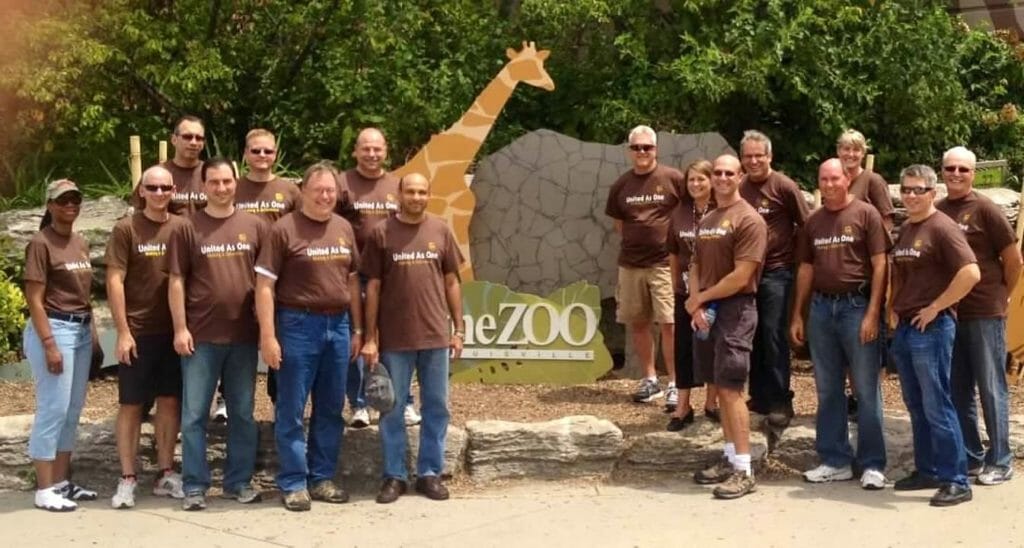
Nick Costides (back row, third from left) and UPS Volunteers at the Louisville Zoo.
When he’s not at UPS or working with Points of Light, Nick and his wife support multiple animal rights, welfare, and health organizations, including having previously served on the board of the Louisville Zoo and the Kentucky Humane Society. Nick is still an advisor to Hands on Atlanta and an advisor to a nonprofit called ToolBank, which provides tools like shovels and picks for volunteer projects. Working with them and with the UPS Foundation, Nick helped to coordinate and create a mobile warehouse of tools, so that the tools could easily be moved to markets when disasters hit.
To those looking to get involved in their communities and make a difference, Nick’s advice is simple. He says, “You just have to find a cause that resonates with you. Just get out there. If you help in even a small way, it can really make a difference in the lives of others. Whether you can help with marketing, swing a hammer, or tutor a student, it makes a difference. There’s no downside. And everybody benefits.”
Leading with Purpose: What We Learned in 2019 And How Companies Can Prepare for 2020
This year brought us clear indicators of a profound change that is taking place in society and the evolution of the business landscape.
– defined by volatility, uncertainty, complexity and ambiguity – redefining the role of business in society. As the year ends, we looked at some of the significant changes in 2019 that will continue impacting corporate social responsibility and employee engagement as we move into 2020.
The UN’s SDGs pass the five-year postmark and progress is not moving fast enough.
It’s been five years since the United Nations unveiled the Sustainable Development Goals, a set of goals and benchmarks for the entire world to unite around to make our planet a better place by the year 2030.
. Climate change appears to be an unstoppable menace that threatens all life on the planet, and humans aren’t doing enough to stop it. Progress on the Sustainable Development Goals remains uneven, and is not moving fast enough to meet the ambitious
, would become one of its greatest allies, and her role is an illustration of the many changes that are coming. Gen Z (those born after 1996) comprised
of the global workforce by 2020.
Gen Z has grown up in a society shaped by discussions around climate change, gender, equality and diversity. In the workplace, Gen Z seeks a career path, and a working lifestyle vastly different from the generations that came before them. They care about a company’s
and gravitate towards companies that are purpose-driven. They want to know their work in some way will have a positive impact on the wider community, not just the business, and place high importance on joining an organization that shares the same values as them and that is proactive in its stance. Companies will have to be prepared to address the need for transparency and openness by acting with honesty and authenticity.
Civil society has become more fragile, volatile and divided.
Civil society saw an increase in duress in 2019. Civicus’
identifies the rise of authoritarian leaders, right-wing populists and anti-rights groups as three of several reasons civil society has become more fragile. With people increasingly getting their news and information from
, it has become harder for people to know what is true and what is false.
These turbulent times will affect how companies operate and might influence their bottom line. As an example, as the most recent quarter drew to a close,
shows that despite the lowering trust in mainstream media and “the system,” one relationship does remain strong and is trending upwards – the trust an employee has in their employer. The report states that “58 percent of general population employees say they look to their employer to be a trustworthy source of information about contentious societal issues.” 76 percent also say they “expect a CEO to take the lead on change.”
SurveyMonkey recently conducted a five-country
on what people expect of business leaders. Half of the respondents said they’ve bought from or boycotted a company because of the social or political views of the company, or the way it does business and/or treats its employees. And in every country surveyed, the majority of consumers want business leaders to stand up for social or political issues they believe in.
There are more activist companies and employees.
According to a report from global communications and marketing firm Weber Shandwick, the
after learning of an agreement the home décor company made to furnish migrant detention centers. These were just but a few of the many employee protests that made headlines.
The core part of a company’s function has evolved from not only being a driver of shareholder wealth but becoming a responsible steward and benefactor in the communities in which they operate – take BlackRock CEO Larry Fink’s
as an example. Companies are increasingly putting their brand behind social causes they believe in, and employees are demanding that their employers do more than provide a salary and benefits package.
So, what does all of this mean, and how is it tied together?
All of these waves of change mean it is no longer acceptable for companies to sit on the sidelines of change. At Points of Light, we believe all of us have a role to play in creating a society where it is easy for people to take action.
As we face a new decade filled with changing roles, expectations and immense challenges, companies must engage their people – from their employees, to their suppliers, to their board room – to take action.
By companies investing in community engagement initiatives and making a conscious decision to be active, responsible and thoughtful corporate citizens, companies have the opportunity to not only continue to provide shareholder value, but provide stakeholder value as well.
What will your company do in 2020 to set yourself, your stakeholders and you communities up for success and change in the next decade?
Daniel Elliott contributed to writing this article.