



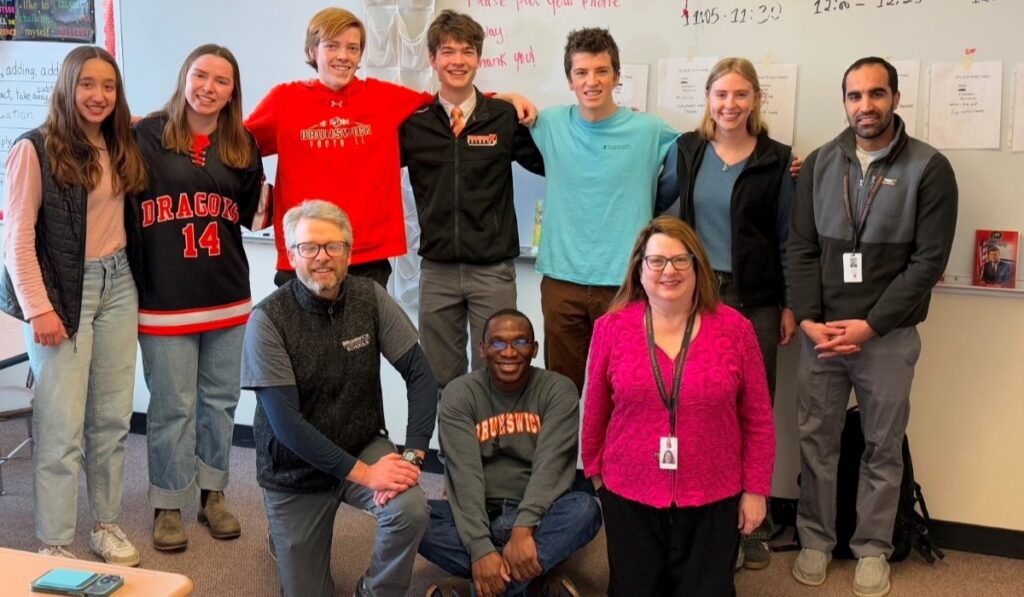
Meet Daily Point of Light Award honoree Nat Rathbone. Read his story, and nominate an outstanding volunteer or family as a Daily Point of Light.
For Nat Rathbone, the hallways of Brunswick High School revealed more than just the usual academic pressures; they highlighted a critical gap in support for a growing population of asylum-seeking peers. Observing that many “New Mainers”—students hailing from Afghanistan, Haiti and the DRC—were navigating a complex new academic system without sufficient resources, Nat stepped in to help. He began as an independent tutor, dedicating roughly 20 to 25 hours a month to guide more than 30 students through the intricacies of math, science and English. Over three years, he’s logged approximately 300 service hours with contributions that go far beyond checking homework. Nat has helped peers write resumes, apply for scholarships and even secure funding for driver’s education, ensuring they had the practical tools to succeed in their new home.
Nat viewed these connections as a two-way street, where he could develop his own communication skills and learn just as much as he taught. While strengthening his grasp of Portuguese, Spanish and Pashto, he immersed himself in the traditions of the students he supported, sharing in West African food, music and dance, and learning about Pashtun customs. These multi-year connections fostered genuine friendships and a profound sense of belonging, proving that inclusion is built on mutual respect and shared experiences.
Realizing that the need for support exceeded what one person could provide, Nat turned his personal initiative into a structural solution. In early 2024, he co-founded Dragon PALS (Partners in Academic Language Support), the school’s first peer-tutoring initiative specifically for multilingual learners. By recruiting 16 fellow students to serve as tutors, he expanded the network of support to upwards of 40 ESOL students. The program has been a massive success, coordinating sessions every other school day and tracking over 1,200 program hours to date.
Nat’s ability to turn observation into organized action has garnered significant recognition, earning him both a school community service award and the prestigious 2025 Young Maine Volunteer of the Year Award. However, his focus remains on expanding the program’s reach through strategic partnerships with community staples like Bowdoin’s McKeen Center, the Amjambo Africa newspaper and the Midcoast New Mainers Group. By building bridges between the school and the broader community, Nat has created a powerful model for youth leadership.
Tell us about your volunteer role.
I run Dragon PALS, which is my school’s first and only ESOL peer tutoring network. ESOL is English for Speakers of Other Languages, so I tutor multilingual learners in English, science—whatever they need on that specific day. I help out with resumes, as well as applying to scholarships and colleges; that’s a big thing right now. Beyond that, I recruit and coordinate with this team of peer tutors to arrange their tutoring sessions, and I work pretty closely with the ESOL department and some community organizations to expand support.
What inspired you to get started with this initiative?
I got started when I was a freshman. I noticed that there was already a huge community of ESOL learners, with dozens coming over every year from really all around the globe. Then, sophomore year, I became friends with this group of Angolan boys that happened to be in my homeroom. I started helping them out with their homework here and there, nothing super formal. I noticed it wasn’t that they couldn’t understand the material. They just needed somebody else to break it down a little bit more for them. I realized, if these kids have a problem and it’s a fixable one, how many other students are there that could be helped? So from there, I joined together with a couple of my friends, and we kept building.
Why is this issue so important to you?
Public schools have a responsibility to bring a sense of belonging. These kids, a large percentage of them, are seeking asylum—not because their home lives were easy. They’re facing a whole new school, a new language, a new culture and new policies. I want school to feel like more of a doorway than a wall. So I’m just trying to do what I can to open that doorway. I’ve had a wonderful high school experience, and I just want to show that our community is one that can bring in other people and make them feel welcome and a part of it.
What are your long-term plans or goals for the organization?
My next big step is college, wherever that might be. Especially this year, I’ve been working on building up a leadership structure beneath me. We have a super strong junior class, with five or 10 peer tutors who are incredibly committed to the program. I’ve been working on tutoring guides so we can more easily get future tutors in and ease them into the program.
Eventually, I’d love to expand this to other schools in the district. Brunswick is lucky enough to have fantastic community-based organizations and local nonprofits doing great work, so I want to partner with them. Of course, I’m graduating, so this is something I want to see continue. I’d love to bring this work with me, but I also rely on the structure I’ve built here. I think I can still help out with transitions and larger-scale plans, but I can successfully pass this program down as something that won’t fall apart right after I leave.
What’s been the most rewarding part of your work?
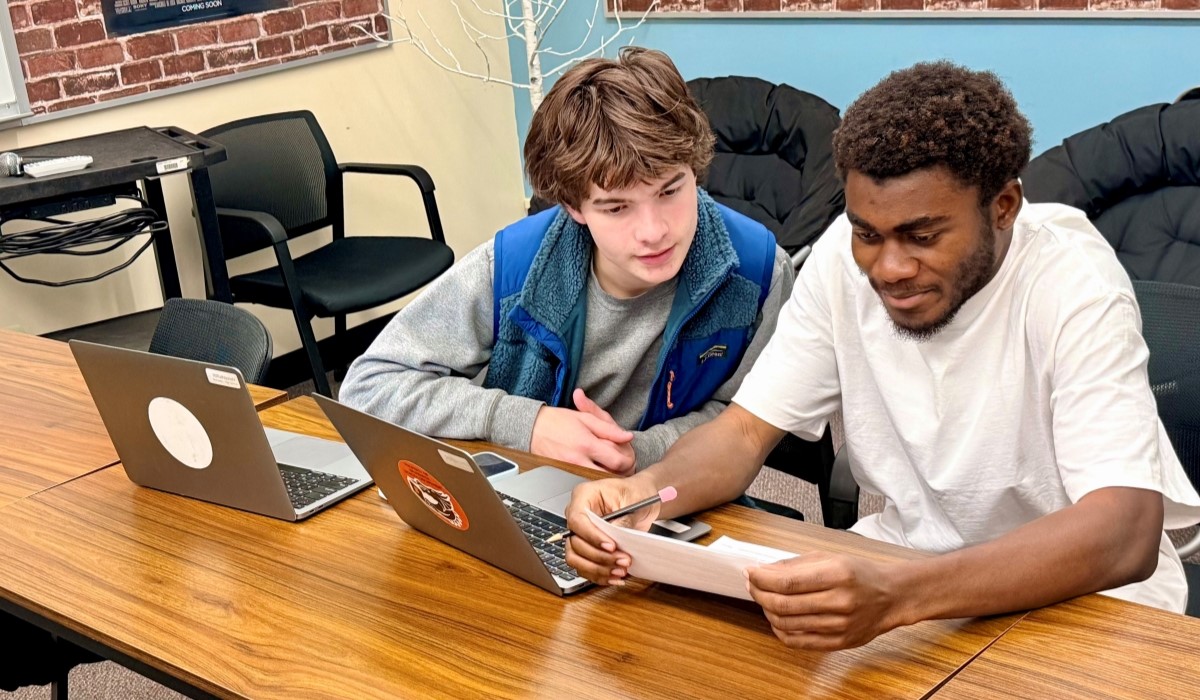
I’ve known some of these kids, really my friends, for going on three years now, and it’s been amazing to see them grow confident. Their English has, of course, blossomed incredibly. They’ve made friends, and I’ve gotten to see their personalities really open up. Sometimes they come here nervous, closed up and scared about school, but some of them have really transformed into these wonderful students and human beings.
Something that’s rewarding is that it’s become a community. I’ve gotten to know one ESOL teacher who has a flex period of ESOL students that I see a couple of days a week, and I’m pretty much best friends with all of them. I get a lot of joy out of it. It’s like making new friends, while also doing something that’s good.
What have you learned through your experiences volunteering?
A big thing is communication in general. It’s not always about language fluency (although I have improved my Spanish and Portuguese skills) but definitely about learning to communicate. Whether it’s body language, using examples or finding methods that might not be how it’s always been done, building mutual understanding between the tutor and the tutee makes things a lot better.
Since I’ve been leading this initiative, I’ve realized that leadership is a lot of behind-the-scenes work. I tutor kids quite a lot, and sometimes I get to do cool things like this, but it’s also a lot of scheduling, spreadsheets and sending a ridiculous amount of emails. In terms of actually helping, a big lesson I’ve learned is to listen to the people I’m trying to help and understand what they actually need, not what I think they need.
Why is it important for others to get involved with causes they care about?
I can speak for myself and say that it’s given me a sense of purpose that school, work or other monotonous things don’t always have the chance to provide. Helping somebody else is a unique thing. I get to expand my world and my worldview. With all the cultures that I get to see, it’s like a big melting pot, and it’s great.
Any advice for people who want to start volunteering?
Start small and consistent. That’s how momentum builds. Consistency will always beat intensity. Don’t worry about scaling things immediately, and don’t worry about it being a note on a resume. If you put in the time, it could turn into something big.
Do you want to make a difference in your community like Nat? Find local volunteer opportunities.