



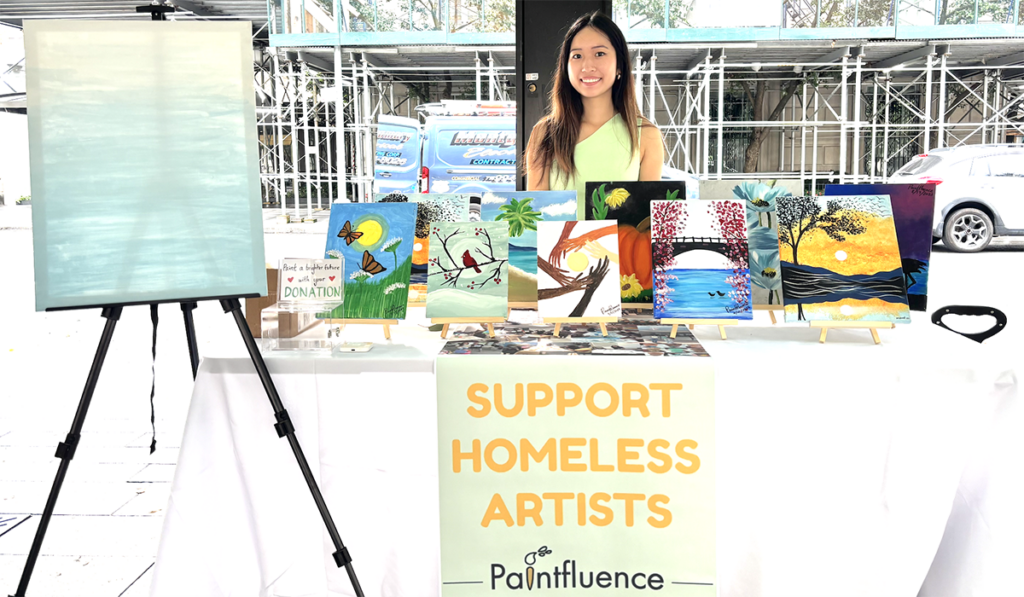
Meet Daily Point of Light Award honoree Jamie Cheng. Read her story, and nominate an outstanding volunteer or family as a Daily Point of Light.
Creating art can be a relaxing experience or a chance to reflect. It can inspire creativity or spark a memory. Fifteen-year-old Jamie Cheng loves losing herself in any medium, even if it’s simple latte art. Three years ago, Jamie and a friend founded Paintfluence, an organization that offers free art classes in shelters for the unhoused and underserved communities.
With 16 chapters across the US and more than 20 volunteers in her chapter alone, Jamie’s mission is spreading. As she works her way through high school, Jamie is empowering people with creativity. In the future, she hopes to pursue a career in social entrepreneurship. Aside from her artistic pursuits, she’s a fan of using STEM for humanity and has a particular interest in biomedical engineering and research.
What inspires you to volunteer?
My first time was around third grade with a program in my school called Jump Rope for Heart. Every year, my older brother and I would go to the mall or the local college and create a poster asking people to donate to the American Heart Association.
Tell us about your volunteer role with Paintfluence.
I serve as the executive lead. I mainly design and lead art workshops for my chapter. I also coordinate these classes for our chapter leaders. Basically, we have resources and guides for them as to how they should structure their classes as well as a few inspo pictures for painting ideas. I design the curriculum.
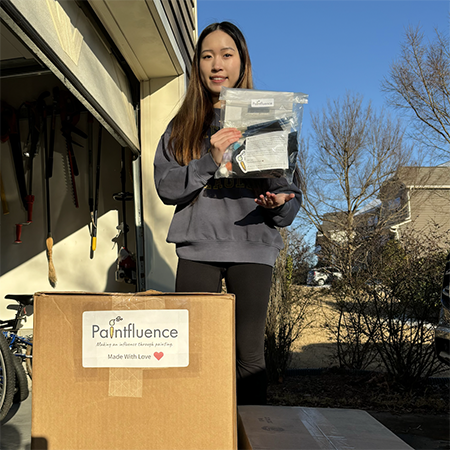
I also organize public exhibitions in my area and, once, in front of The Met while I was visiting New York. I lead team meetings every two weeks, recruit volunteers and chapter leaders and oversee the shipment of our art kits.
I often hear negative stereotypes about unhoused people, like suggesting they’re lazy. From what I’ve seen, their circumstances are reflected by systematic inequalities rather than their work ethic. And I want to challenge those stereotypes with my organization.
What inspired you to get started with this initiative?
When I was younger, financial barriers made it hard to afford art programs and supplies, so I found myself creating on my driveway. I became really passionate about it. When I was 10 or 11, volunteering at a homeless shelter, I noticed that many of the residents were struggling with finding a purpose in life. I thought it’d be meaningful to provide a creative outlet that could potentially help them rediscover a passion for art.
Paintfluence provides free art programs for people experiencing homelessness and underserved communities. There are two components. The first: we teach art classes at shelters and display and sell paintings at public art exhibitions. The artists have a choice to keep them, of course, but they can also let us sell them to raise funds for the shelters. We’ve raised over $12,000 in this way.
The other component is packing and distributing custom art kits to underserved areas around the world, including refugee camps and community centers. We’ve distributed more than 550 so far. Each kit contains a canvas, a palette of paint and a packet of brushes. We add an inspirational note as well. Sometimes, we pre-sketch the canvases for younger children, so they can just color it.
Why is art important to you, and what does it bring to the unhoused population?
Access to creative expression is often overlooked, especially in communities facing economic hardship. They focus on more vocational opportunities, but it’s important to allow people to explore other outlets. Art gives people space to process, reflect and heal. It gives people a sense of agency. I found it to be a helpful creative outlet when I was younger. I think this is especially important in underserved areas where they might feel defined by their circumstances and struggles. The ability to create something meaningful can shift how they see themselves.
What’s been the most rewarding part of your work?
It’s cool to see participants excited to paint or to hear that they haven’t created something in a while as we’re giving them that opportunity.
Once, we were doing a painting of a bike with a basket of flowers. One of the residents told us it reminded her of the last memory she has of her brother. She said painting was like therapy, and that warmed my heart. Conversations with the residents are really rewarding.
What have you learned through your experiences as a volunteer?
To make an impact, you have to be consistent. You have to actually be passionate about it and find ways to keep showing up, even if you’re busy. It’s also really important to listen. For example, ask shelters what they need, rather than assume.
Why is it important for others to get involved with causes they care about?
When people invest their time in something they care about, they strengthen their communities in a way that creates a ripple outward. It makes more people want to volunteer and build empathy and connection with each other.
How can people reading this take steps to help the unhoused or promote art education?
You don’t need a perfect plan. What you really need is the willingness to show up and learn and collaborate with others. My general advice is to find something that genuinely matters to you, because that passion will sustain you long after that initial excitement fades.
What do you want people to learn from your story?
Everyone deserves a chance to create and have meaningful opportunities. We should recognize and address social and economic inequities and work to fill the gaps in things like access to art.
Do you want to make a difference in your community like Jamie? Find local volunteer opportunities.