



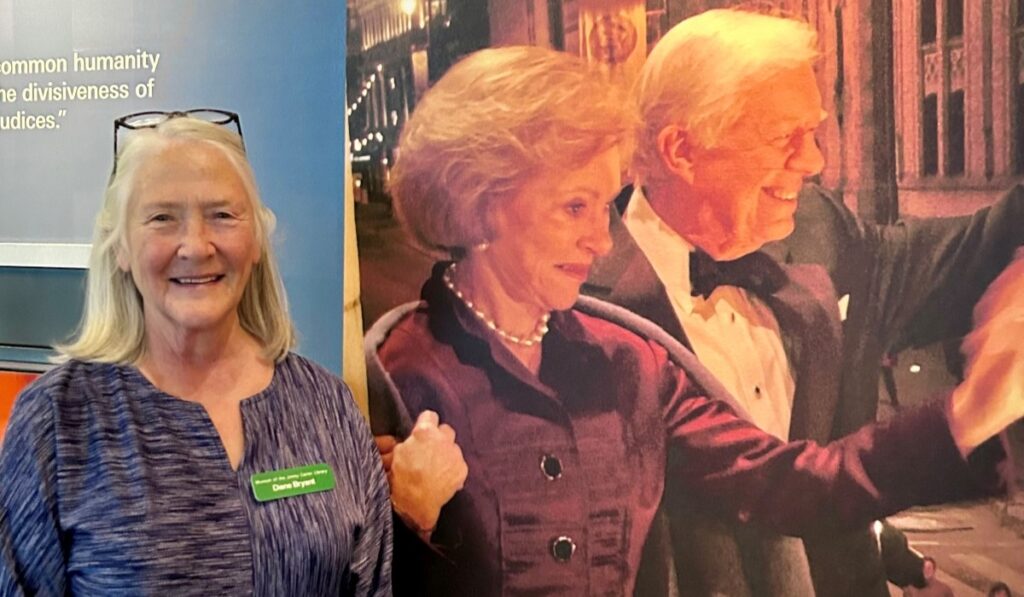
Meet Daily Point of Light Award honoree Diane Bryant. Read her story, and nominate an outstanding volunteer or family as a Daily Point of Light.
When Diane Bryant first walked through the doors of The Carter Center in Atlanta, the institution was still in its infancy. There was no formal volunteering program, just a group of people with a global mission. It was 1987, just five years after the center’s founding, and Diane found herself working under the direction of President Carter’s aunt. Her early days included the quiet, essential tasks that build a foundation: organizing newspaper clippings, stuffing envelopes and hand-writing cards. These modest beginnings sparked an impressive tenure of service, during which Diane has become a living bridge between the private values of the Carter family and the public they served.
As the institution evolved, so did Diane’s role. When the Jimmy Carter Library and Museum established its docent program, she joined the very second class of trainees, transitioning from behind-the-scenes administrative support to the front lines of education. Over nearly four decades, she has worn many hats, from puppet show performer to storyteller for toddlers, and even guide for visiting dignitaries. Whether she was traveling to rural school districts to give presentations or leading specialty tours for seniors from local nursing homes, Diane’s mission remained consistent: to show the true connection between Jimmy Carter the man and Jimmy Carter the president.
During the unprecedented challenges of the COVID-19 pandemic, the world retreated into isolation and the National Archives and Carter Center were forced to close their administrative doors. But Diane kept hospitality alive. Alongside a small security detail, she and a dedicated group of volunteers stepped up to ensure the museum remained accessible to the public. They greeted guests and navigated them through the facilities during a time of uncertainty, proving that the “accessibility and hospitality,” which were hallmarks of the Carter presidency, could persist even in a crisis.
Diane’s impact is measured not just in the decades she’s served, but in the thousands of connections she has forged along the way. Having known both President and Mrs. Carter personally – and having the profound honor of participating in their celebrations of life – she carries their stories with a unique intimacy. She understands that visitors arrive at the center because they feel a deep alignment with and curiosity about the former president’s values. By listening to their stories and sharing her own, Diane ensures that the legacy of service she helped build since the 1980s remains a vibrant, breathing reality for every person who walks through the doors.
What inspired you to get started at the Center?
I am 74 years old, and I started there when I was in my 30s. Not being from Atlanta originally, I knew everybody was really incredibly proud of President Carter and that he was going to have the Carter Center in Atlanta. When it was finally here, everybody wanted to go see it. I had little kids at the time, babies who are now in their 40s, and I went there because I first went just to look at it. Everything was new. It was a way for me to be intellectually engaged; I’m a therapist by trade and I’ve always been really involved in a lot of volunteer activity, but not this type. There are so many things that engage you intellectually as well as emotionally at the center. I never go there without seeing something or learning something new.
There was not a volunteer program at the time. Miss Sissy, President Carter’s aunt, and Miss Alice, his Sunday school teacher from Plains, were trying to start up a volunteer program. When we first went, it was like anything you were asked to do, you would do. President Carter really appreciated hospitality, so he wanted somebody to stand at the door and say, “Come in. Come in. We’re so glad you’re here.” That is the feel he wanted to give, that it was open to anyone.
Tell us about your volunteer roles over time, and what you’re doing now.
When the education program first opened, we would actually go out into the schools to do programs on the presidency – like “How a Bill Becomes a Law” – using puppets. Eventually, due to gas shortages and security issues, the focus shifted to having classes come to the Library and Museum so they could experience the whole center. It’s a beautiful, unique piece of land.
As the years passed and the Carters got older, the focus changed again. We saw more adult groups, people who had memories of his time in office and felt connected to his ethics. My role covered the gamut: kids’ tours, specialty programs for scouts and meeting visitors who just wanted to connect. Now, I do specialty tours and education programs. Because I’ve worked on both the Carter Center side and the Library side, I can provide a sense of continuity. Now that he’s gone, people want to see the entire range of his life, from being a young man to his work as a private citizen.
Why is the preservation and retelling of history so important?
It’s vital because of the transparency it provides. After the Nixon administration, laws changed so that presidential documents became the property of the American people. President Carter was one of the first to operate under that. He insisted on showing what happened – good or bad, right or wrong. He didn’t want to whitewash history. He would say he operated with the best information he had at the time, even if hindsight suggested a different path.
When I talk to kids, I use his life as a lesson. I tell them how he lost his first few elections and wanted to quit, but he kept trying. It’s about how you approach leadership and values. There are so many parallels between history and today. If you don’t understand history, you are doomed to repeat its mistakes. Seeing how a leader uses their values to impact their time in office is a very telling tale.
What are your long-term plans or goals you have with volunteering?
Some of the early people that volunteered there were connected to the Carter administration. One of our volunteers, until she was well into her 90s, would sit at the door in a chair and welcome people. I have some crazy vision of myself at 90, sitting there saying, “Come on in, see the place.” I will continue to go there until they feel that my contribution isn’t useful. I’m lucky, because I always feel like I gain more than I give by being out there and being with people.
Why is it important for others to get involved with causes they care about?
Everybody can. And the feeling of being able to give and putting yourself out there and listening to other people’s stories – listening to people – is so important in our world today, because we don’t listen enough. President Carter always listened. That was one of his hallmarks – listening to whoever he was with and negotiating with them, starting on a very personal level before moving to higher issues in resolving conflicts.
I do believe in volunteerism, getting involved. Somebody asked me in a nonprofit that I work with, “Why do you do this?” And I said, “Because we’re supposed to do this.” If we can, if we have the ability, I really believe this is what we need to do. It’s purpose in life. I also was lucky enough to grow up in a family that really valued that, and my own family values it. And that’s unusual, because not all people believe that way.
Any advice for people who want to start volunteering?
I think it’s important to invite others to walk with you. If you’re a volunteer, reach out and say, “Hey, just come with me and see what you think.” That takes away the fear of the unknown.
People often worry about not knowing the answers. When a student asks me a question I don’t know, I just say, “I don’t know, but that’s a great thing to look up when you get back to the classroom!” We’re all in this together; it’s not just about imparting knowledge, it’s about working together.
What’s been the most rewarding part of your work?
I think it’s getting to see hope. How we’ve been able to almost eradicate diseases with very simple solutions. How there are people out there, with all of their struggles, who continue to work at a grassroots level. There’s a lot of hope out there.
Even when things don’t go your way, you keep on trying. President Carter did not see himself losing the second election. His hope was to be there for eight years, not four years. And he said, “Now I can do all the things that I wanted to do as a president, but as a private citizen.” And that’s very encouraging, to think that you actually can make an impact, even on a very small level.
Do you want to make a difference in your community like Diane? Find local volunteer opportunities.