
Protecting Paws on the Pavement and Beyond
Meet Daily Point of Light Award honoree Jordan Sucato. Read her story, and nominate an outstanding volunteer or family as a Daily Point of Light.
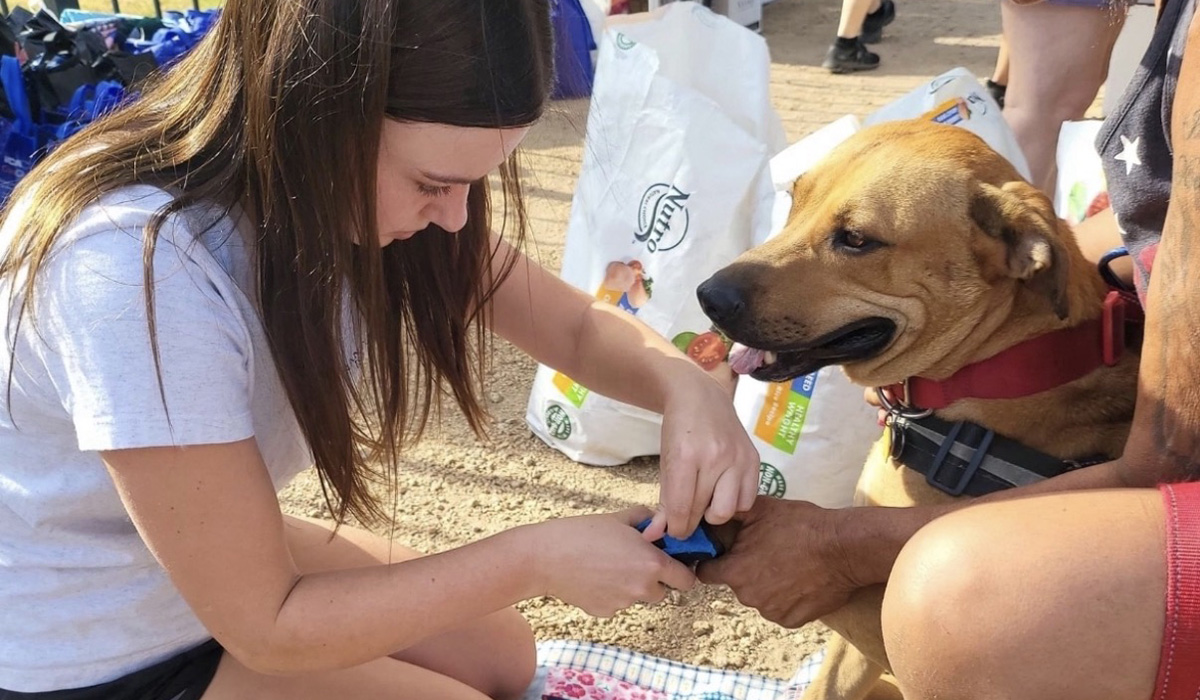
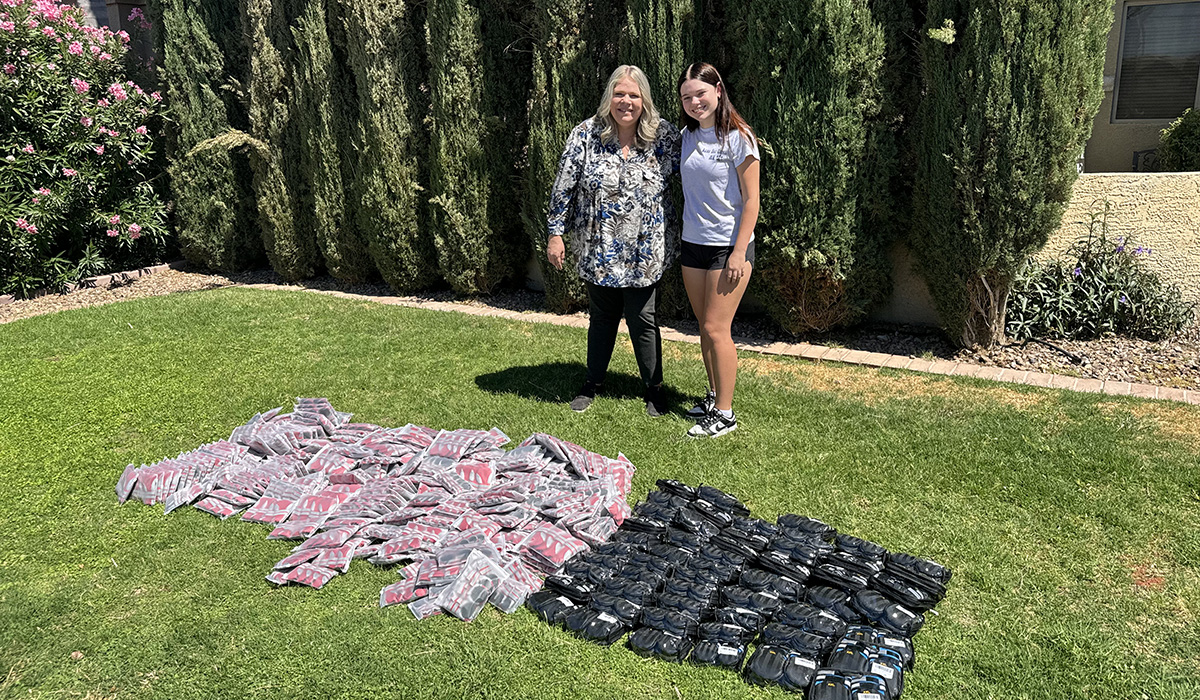
The Arizona sun can be unforgiving, but 17-year-old Jordan Sucato is providing a safety net for vulnerable, voiceless animals when desert heat meets the city pavement. Through her 501(c)(3), Laws for Paws – and in the past two summers alone – she has raised upwards of $21,000. These funds have been transformed into close to 12,000 pairs of protective dog boots to shield the paws of pets living on the streets, animal companions for the 3,500 unhoused individuals she has personally supported with essential care packages.
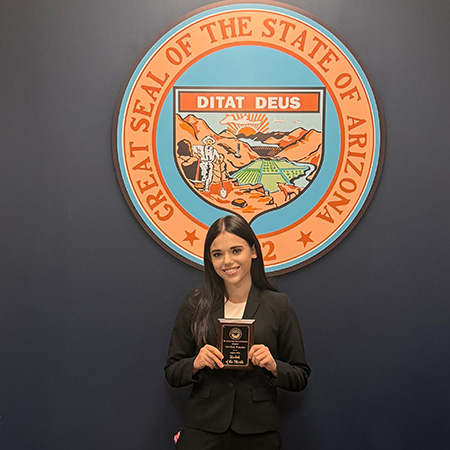
In addition to her boots-on-the-ground volunteer work, Jordan is also a fierce advocate in the Arizona Legislature. She has independently researched modern alternatives to cosmetic animal testing, such as mRNA quantification and RT-qPCR, to provide a factual backbone for her legislative pursuits. As a national legislative chair, she has spent three years collaborating with the Arizona Senate Majority Leader to draft and promote bills banning animal-tested cosmetics. Her influence crystallized in a monumental effort with the Arizona Supreme Court, where she successfully coordinated 184 courts into a centralized reporting system for a proposed state-wide animal abuser database.
Jordan’s work is vast and varied. She works as a dog trapper for the Community Rescue Project. She monitors remote cameras in the Sonoran Desert. She sets up feeding stations, manages the intake of thousands of donated items and ensures that the 10,000-strong volunteer network across the state remains fueled. Combining science and advocacy, she has created a blueprint for modern activism that treats community support and animal welfare as two halves of a whole. And while some of her bills await their final victory in the House and Senate, the thousands of lives she has touched so far – both human and animal – are living proof of her impact.
Tell us about your volunteer role.
The organization is called Laws for Paws. I like to say that I’m an advocate for those who cannot speak for themselves. I focus a lot on legislative animal welfare initiatives. I did a cosmetic animal testing bill; I’ve done that the past three years, and I’ll be running that again next year. I also did an animal abuser database, and these are both specific to Arizona, but I will be expanding these bills nationally next year.
Additionally, I do direct aid, so I do a lot of work with unhoused populations. I’ve been able to aid over 3,000 unhoused individuals and their pets because I raised $22,000 for dog boots, just because it gets so hot in Arizona. I distribute those during the summers, and I’ve been able to distribute 12,000, which is about 3,000 sets. I just love everything I do.
I established my own board, and my board and I go down there pretty frequently. We go to the same spot, or my mom and I will distribute. We’ve distributed all across Arizona, even two hours away from where I live. And my outreaches with Dog’s Day Out happen once a month.
Why is animal welfare so important to you?
I think I’m biased in this because I grew up with every species of animal, so I’ve always been surrounded by them, which is a huge blessing. I think that’s where I developed a lot of my compassion for them, but when it really struck me is when my mom volunteered with a local organization here in Scottsdale, called Love of Dogs Fund. When I was 8, after begging her for years, she finally let me come with her. The owners liked to describe me as the “dog tester” to see if the dog is friendly with kids. Thankfully, they always were! But I saw dogs come from situations like hoarding and dog fighting, and we also fostered emaciated dogs. When I saw that, it just struck something in me. Those experiences developed my compassion and empathy for these animals.
Then in sixth grade, I was assigned an argumentative essay against cosmetic animal testing, and that’s where I learned about the actual procedures. It’s not just painting a monkey’s nails; it’s chemical compounds being applied on the skin. I came home that day and I told my mom, “I’m going to get cosmetic animal testing banned.” She was – you know, I was 12 at the time – so she’s like, “Sure you are.” But I did. I developed my own LLC because of that, and it’s just been history since then.
What are your long-term plans or goals for the organization?
My biggest thing – I’m actually about to announce this – is that we’re doing a national expansion. I’ve been able to work so far with kids in New York and Texas to introduce similar legislation in their states. It’s been very successful in Texas so far. I’ve decided that I’m not going to continue to target only one or two more states; I’m going to be expanding my legislative initiatives to over 15 states.
I’m also going to be expanding the dog boot fundraiser, and hopefully get that up and running whether it’s a hot environment or a cold environment, because everybody needs dog boots, whether it’s snowing or whether it’s 110 degrees out.
What’s been the most rewarding part of your work?
I never expected to do direct aid, but that definitely has been the most rewarding part of my work. I always wanted to focus on legislation, but I was referred to Monique Hebert, who’s the founder of Dog’s Day Out AZ, the partner organization I work with for the dog boots. I’ve honestly fallen into believing stereotypes about unhoused people before, as I’m sure everybody has, but Monique humbled me very quickly. She goes, “Okay, you know what? Come down to one of our outreaches and distribute dog boots,” because I had been donating them, but I had never actually seen it in action.
I went down there and I met so many incredible people that just had specific circumstances that led to them being where they are. I saw how much love they have for their pets and hearing all their stories and realizing these are people, too. Who am I to judge someone else? That is easily my favorite part of the work. Of course, seeing the animals, but I love meeting the people and the owners and hearing their stories.
What have you learned through your experiences volunteering?
On the academic side, I did a lot of research about cosmetic animal testing and substitutes. I learned a lot about organs-on-chips and using science such as mRNA quantification to be able to assess inflammation in the chip.
But what I’ve really learned through volunteering, big picture, is empathy. I think that I was previously able to experience sympathy for people and animals, but working with all of this hands-on taught me empathy. My favorite book is To Kill a Mockingbird, and I always loved Atticus Finch’s way of saying to put yourself in other people’s shoes. This concept has literally come into my life so frequently. Empathy has been the biggest thing I’ve learned.
Why is it important for others to get involved with causes they care about?
I think it’s important because there’s so much hate in this world. Even with things like AI, people are losing their creativity and passions. If there’s something you stand for, if it’s something you believe in, you should do everything in your power to try to make that happen. If you have something that’s going to change the world for the better, regardless of age, regardless of whether you think you can do it or not, it’s so important to at least try.
Any advice for people who want to start volunteering?
I have pretty bad social anxiety. I struggle with fear, too. There’s a tool called the five-second rule, where you count to five and then you just do something. That’s how I think about volunteering. I’m like, “Okay, I’m just going to go for it.” If I hate it, I don’t ever have to go back again. But there’s never been a time where I’ve hated it. I say, just throw yourself into it and see if it works out for you.
Do you want to make a difference in your community like Jordan? Find local volunteer opportunities.
Share this post
