
Accidental Bandleader Turns Ukuleles into Community Care
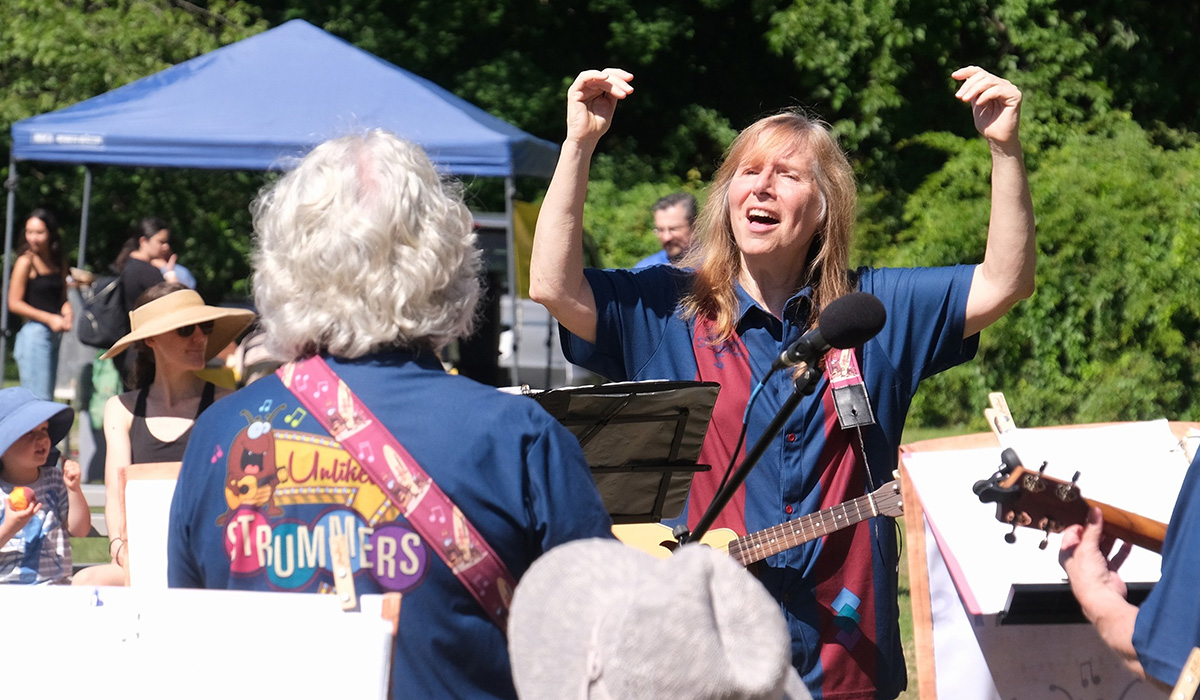
Meet Daily Point of Light Award honoree Cynthia Miller. Read her story, and nominate an outstanding volunteer or family as a Daily Point of Light.
What started as a casual gathering of ukulele students after class ended up becoming something much bigger. Nine years ago, Cynthia “Cindy” Miller answered a call from a local farmers market asking for music, gathered every ukulele player she knew and unknowingly laid the foundation for the Unlikely Strummers – a group of ukulele players from across southern Massachusetts and northern Rhode Island that performs 85 to 90 free concerts a year.
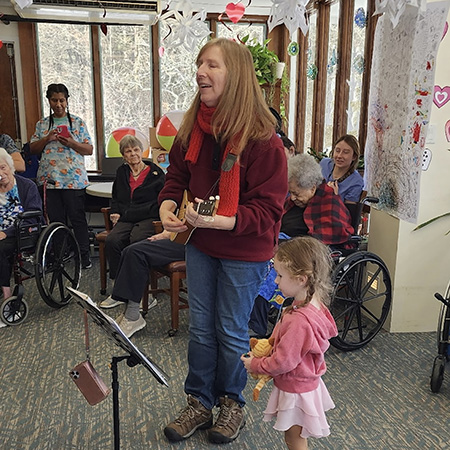
Cindy, who also works as an anthropology professor and animal control officer, serves as the group’s music director, arranger, teacher and community liaison. Most of the group’s members are over 65 — many of them first-time musicians who hadn’t picked up an instrument since grade school. Under her leadership, the Unlikely Strummers bring live music to senior centers, children’s hospitals, animal rescues, sporting events, school assemblies and community festivals. The group also actively fundraises for the Ukulele Kids Club, a nonprofit that donates ukuleles to children’s hospitals for music therapy programs, raising over $20,000 in a single year.
How did the Unlikely Strummers come to be?
It actually started by accident. I was co-teaching ukulele classes at a local bookstore, and classes had just ended. We were all still getting together to play so that the students would have somewhere to go after that. Then we got a call from a local farmers market asking if we’d be willing to play there. So I called every ukulele player I knew and said, “Hey, let’s all do this.” That ended up being the beginning of this nine-plus year journey.
Why the ukulele?
I actually grew up playing the flute — not exactly a party instrument. I came to the ukulele as an adult, as an over-50-year-old. It just stuck. It’s this happy little instrument. When I teach the very first class, people go home being able to play a few songs. There is no other instrument you can do that with, really. People who maybe have not-great memories of grade school music classes take a big deep breath to try music again as adults — and the ukulele makes them feel successful and musical. It just brings such joy to everybody. There is nowhere that people aren’t grinning from ear to ear.
How has the group grown since those early days?
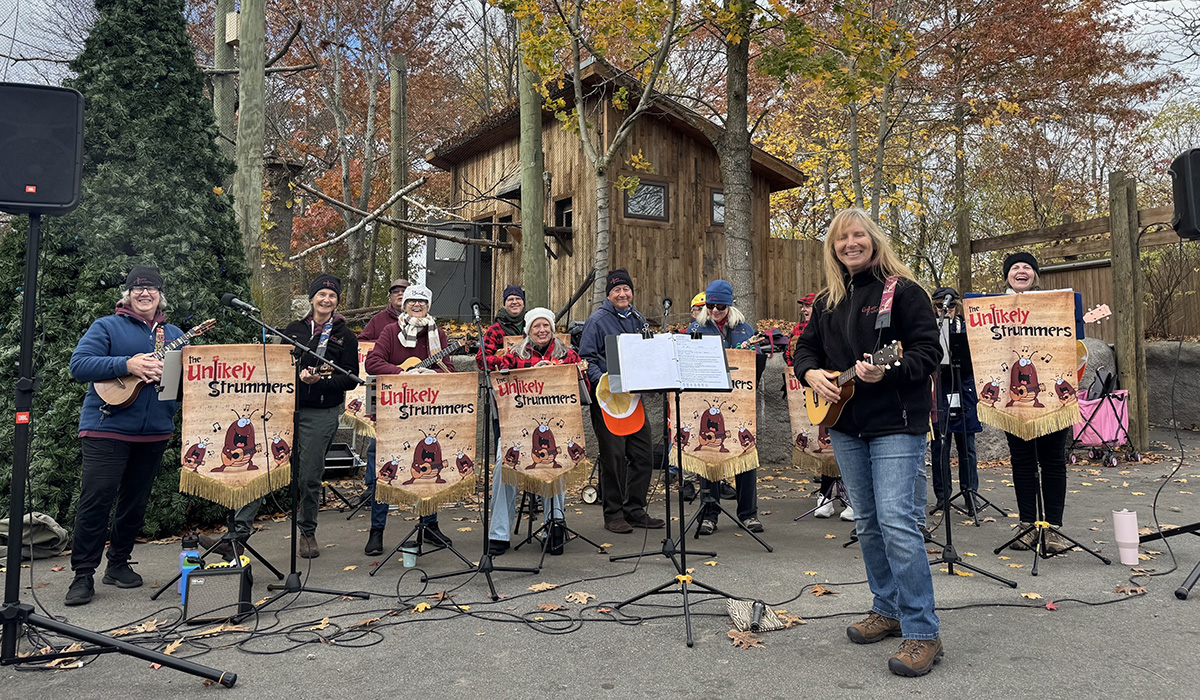
In the beginning, there were maybe eight of us. Now there are 30, which is a huge herd of ukulele players. But beyond sheer numbers, the group has become this fabulous community. People genuinely care about each other — they pitch in and help each other out, check on each other when something’s not going right. Everybody’s there for everybody else. And then as a group, they’re all there for the community. Whenever an animal rescue or a theater asks, “Hey, could you provide some music?” everybody is really happy to use what they’ve learned to contribute to the community.
What are some of your most memorable performances?
So many are special in their own way. We played the teen prom for Hasbro Children’s Hospital, and it was just the most fabulous thing — watching these young people all dressed up and having the time of their lives. We all went home feeling amazing. On the entire other end of things, we’ve opened for Jake Shimabukuro, who is pretty much everybody’s ukulele hero. We’ve also played with Peter Asher and recently shared a stage with an Irish band on their North American tour. In April, we’re actually opening for Jake again, and in May and June we’re doing a series of joint concerts with the Warwick, Rhode Island Symphony Orchestra. But the things we go home feeling really good about are the ones where you really feel like you’re touching people — playing at Hasbro, or at Roger Williams Zoo or at community fairs.
Tell us about your fundraising work with the Ukulele Kids Club.
We strongly believe that music heals, and the Ukulele Kids Club is a wonderful nonprofit that donates ukuleles to children’s hospitals for music therapy programs. The first year we started fundraising for them, we raised over $12,000, and then a little more the second year. Now we’re co-organizers of the New England Ukulele Festival, which is a whole-day fundraiser for them, and last year we raised over $20,000.
We do all kinds of creative fundraising — surprise serenades, waddling a benefit 5K in pink inflatable flamingo costumes while playing and singing the entire way. The whole idea is that music heals. These kids are in hospitals with chronic conditions, and all of a sudden, they get this gift of music in their lives. It makes such a difference not only in their outlook, but in their physical well-being — and then they get to take the ukes home and keep learning.
What has been the most rewarding part of your work?
Music does so much to bring people together. And especially in a world where there are so many things to get bogged down about, music always lifts people up. We see people smile. People come up to us and tell us how much we’ve brightened their day, how things weren’t going that great and then they stopped and they listened and they feel so much better. And we all feel so good giving back. This is a huge way to use what we have to give back to the community, which is so important to everybody. I don’t think anybody would be in the group if that didn’t matter.
Why is it important for people to get involved with the causes they care about?
First, the causes need them. But beyond that, getting involved in something you’re passionate about does so much for everyone as individuals — it benefits the cause and brings all your talents and energy to it, but it also does great things for your self-esteem and your sense of yourself in the world.
What advice would you give to someone who wants to start volunteering?
Find the thing that you would never mind how much time you put in. It’s great to say you want to spend an hour a week somewhere, but if you can find something that it doesn’t matter how much of your time it takes — because you love it, it’s important, it makes a difference and it creates a sense of community for you — that’s the thing. And then just jump in. I know a lot of people who think that at some point there will be this great moment when they’re finally ready to volunteer. Don’t wait. Just do it.
Do you want to make a difference in your community like Cindy? Find local volunteer opportunities.
Share this post
