
Framing Hope From Heartbreak on 9/11 and Beyond
Meet Daily Point of Light Award honoree Cait Leavey. Read her story, and nominate an outstanding volunteer or family as a Daily Point of Light.
Cait Leavey’s devastating loss of her father, FDNY Lieutenant Joseph Leavey, on September 11, 2001, became the catalyst for a life dedicated to healing others. Growing up in the shadow of tragedy, she experienced both profound grief and the extraordinary wave of human compassion that emerged in the days following the attacks. This dual reality shaped her path, steering her first toward education as a Teach For America corps member and later into a career as a licensed mental health counselor. Today, Cait uses her lived experience and professional expertise to support first responders, military families and individuals navigating collective trauma.
Cait founded The Spirit of 9/12, an annual service initiative inspired by the 9/11 National Day of Service movement. The project gathers youth, families, survivors and volunteers to transform remembrance into tangible action. Engaging younger generations who never knew a pre-9/11 world, Cait teaches young people that even the smallest acts of kindness carry immense weight. As a 9/11 Day Ambassador and a co-founder of the 9/11 Memorial & Museum Visionary Network, she dedicates 25 to 40 hours each month to ensuring that the legacy of that historic day is defined not just by what was lost, but by the collective care that followed.
Cait’s mission took an innovative leap forward this past September 12, with the co-founding of The Holding Frames, a 501(c)(3) nonprofit and healing-centered community art initiative. Developed alongside her annual service event, the organization uses expressive arts and community dialogue to help individuals process grief and collective adversity. Participants utilize the proprietary FRAME method to channel personal and shared pain into tangible expressions of hope. The reach of The Holding Frames has quickly expanded from a single project into an ongoing movement, bringing its workshops into schools, corporate boardrooms, museums and conferences, including ongoing collaborations with the National September 11 Memorial & Museum. 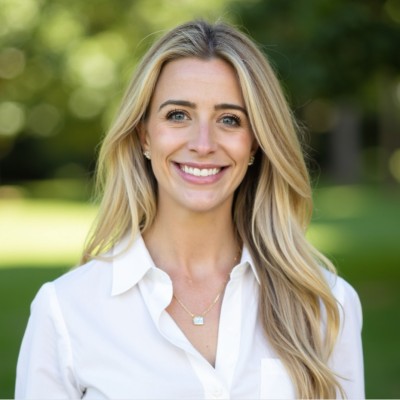
Cait continues to show the world how to move gently from trauma toward purpose, proving that we can always choose to be a light for someone else. Read on to hear more of her inspiring story.
Tell us about your volunteer role and organization.
I am the founder of the Spirit of 9/12, which is an annual event that I started about five years ago, the day after 9/11, in honor of the National Day of Service on 9/11. I also happened to be a 9/11 Day Ambassador, and the whole premise of 9/12 is to really embody that spirit of 9/12 that followed after 9/11 and wanting to do a service project that served children and families, while also educating the next generation. I think part of that is having a felt sense of what really 9/12 felt like after 9/11. For me personally, part of my story is I lost my dad on September 11. I was 10 at the time, so I remember 9/11 was a dark day, but there was a lot of light that came out of it. That has really been my journey, and my healing journey specifically is how to spread that light, how to be an example of that light and how service, specifically, not only spreads light to others, but also ignites a light within ourselves.
What inspired you to get started with this initiative?
This day started at this park down the street from the Trade Center. Before becoming a licensed mental health counselor, I was a teacher, and a lot of my students actually lived in the neighborhood of Tribeca, and so it just kind of took place. On the picnic tables in Washington Market Park, I led an art project, and all the art pieces that we created would go to other individuals who are going through a hard time. I would really scaffold it to the kids that I was working with. We started doing an art-space initiative for the first four years, and it grew. Every year kids would come and be like, “I remember you,” and the space in itself is just so inviting with One World Trade Center in the back. It started being about having these conversations and what it really means to have people at a table, in a circle, around a table, being able to create art with one another and build community, which is what really embodied what 9/12 was. Having their nannies and their parents join them and then meeting another kid. It really grew every year.
This past year my good friend Josh Garcia, who survived the Pulse shooting, joined forces with me and we created The Holding Frames, an art-based initiative. The premise of The Holding Frames is that individuals are given a frame, they decorate the outside of the frame and then the middle of the frame is: how are you holding space for someone else? What is something that you would want to send to someone else—a message, a picture—to inspire them and provide your own sense of compassion, spreading your own light, your own kindness to another individual?
This is about really understanding how healing happens in community. A lot of times after disaster and tragedy, when the GoFundMes stop, all the community, all the memorials, all these different things—there’s a support gap there. So, how do we really instill this long-term healing? We have a method with The Holding Frames called the FRAME method: Finding Resilience After Major Events.
Why is this work so important to you?
We have made impact in many, many different areas, and so it’s not just areas of disaster. We work in schools, we work internationally. We both come from this world before this, and so then kind of putting our heads together, The Holding Frames has just been buzzing. It was really special to launch it on 9/12 this year. Specifically, for the Spirit of 9/12 this year, we got a grant from 9/11 Day, so we’re trying to make it a really big, all-day thing, because usually it’s an after school event.
We like to give a lot of agency to the kids and the adults and the families that come. There is also something that’s really beautiful too about bringing the piece of why we’re doing this, relating to being able to tell my story. I think that storytelling is such a pillar of healing, but also of service. I think so much about how we get our next generations involved in service, and I think a lot of that is having them feel a sense of purpose and connection. That’s what’s really important. I always said that my calling to service comes from witnessing how acts of compassion can ignite a light in ourselves and others, especially in those moments of darkness.
Tell us what you’re excited about for the event this year.
It’s going to be an all-day event, it’s going to be on a Saturday, and so we’re really hoping to engage not only kids, but more families and adults as well. It’s going to be a larger movement this year. I think there’s something about the 25th anniversary that’s really important, and also I think that there’s really something special about the movement of 9/12. We hear all these incredible stories, not just with 9/11 but often after a tragedy. For myself and others who were alive on 9/11—we want to share what 9/12 felt like. What it really felt like: individuals being able to ignite small acts of kindness, and that community feeling.
There’s a service aspect to it, and there’s that education piece of it as well. We are really fortunate that 9/11 Day is supporting us, and it’s not just about being able to do our service project on 9/12, but also inspiring others, next year, to do their own service project. We’re going to probably have close to 400 frames that we’re going to be giving out and having individuals paint. The community partnership piece of it is going to be so beautiful.
Last year I had an organization that I’m very close with called Answer the Call. They did a table, and they were giving out their tattoos. They provide financial support for any line-of-duty death in New York City, so any fallen FDNY, NYPD, Port Authority. It was just really beautiful that they were there. First of all, the fact that they came out to support me and us was just incredible, but that is the spirit of 9/12. We’re hoping to have live music too. So it’s an event for kids and adults alike.
What have you learned through your experiences as a volunteer?
I think there’s just something that’s so cool about how you don’t have to be an artist to be creative. Everyone has a creative side of them. It’s really cool to see how people are like, “Man, I haven’t picked up a paintbrush in so long,” and people are getting into their artwork and enjoying it. In years past, we’ve displayed the artwork up on the fence outside of the park—a little bit tricky last year with the frames—but we’re getting there. We’ve always found a way. Then, when kids are walking to school throughout the week, they’re passing and they’re like, “That’s my artwork!” It’s really, really awesome to see them be able to have a sense of power and purpose.
What’s been the most rewarding part of your work?
The thing that’s really beautiful to me is that the kids not only come back, but the kids who come over are engaged. When I’m there at the park, there’s a playground there, and I have rarely had to recruit kids to come over. People see the excitement, people all sitting together. It’s so natural how the movement and the event itself attracts community and light.
Being able to tell my own story, and the why behind it is rewarding too. For many people, 9/11 is history, but there’s this idea that compassion, service and community doesn’t have to be history. The Spirit of 9/12 helps young people actively participate in carrying those values forward.
Why is it important for others to get involved with causes they care about?
We’re in an era right now where service is a way of helping individuals feel less alone. I think that there’s something about engaging youth to volunteer for a cause they care about for them to be able to be part of something bigger than their own, feel connected and feel a sense of agency—that’s really important. There’s so much of a buzz around servicing people, but I think really the reality is that we have to be thinking about service as a way for our youth to feel connected, to feel part of something bigger and to have the agency to be able to find their connection to something that is meaningful to them. That is something I think really helps with character building and leadership development.
It’s also important that we continue the storytelling piece. And that we continue exposing our youth to different causes and then giving them the agency to pick what resonates with them and what is really meaningful to them.
When we think about how to address the sense of loneliness and the isolation that exists right now among our youth, I think service is a way to help with that.
Any advice for people who want to start volunteering?
Try something new, start somewhere, reach out, hear someone’s story. Often I think people get really drawn in when they hear someone else’s story, and then it ignites something within themselves. Maybe they have a similar experience. On that note, empowering youth to tell their own story can really help inspire others, and maybe that means that just a small group of them can start their own project. No service project is too small.
Do you want to make a difference in your community like Cait? Find local volunteer opportunities.
Share this post
