
From Housing to Mental Health: Connecting Veterans to Vital Support

Meet Daily Point of Light Award honoree Jay Coppock. Read his story, and nominate an outstanding volunteer or family as a Daily Point of Light.
For nearly a decade, Jay Coppock has become a trusted pillar in the veteran community despite never having worn the uniform himself. A native Texan who recently retired after 36 years in the financial industry, Jay devoted 15 of those years as COO at the Associated Credit Union of Texas. But his second calling, and the one that reshaped his life, began in 2015 when he founded SERVE (South East Resource Veterans’ Effort), a nonprofit dedicated to connecting veteran-service organizations across the Texas Gulf Coast.
What started with just six organizations has grown into a powerful coalition of more than 80 local and national partners, all working together to ensure that veterans and their families never have to face challenges alone. Under Jay’s leadership, SERVE has coordinated mental health care, transportation, caregiver support, housing resources, education benefits and more. And since expanding to offer direct financial assistance in 2023, the organization has already provided nearly $200,000 in emergency grants, helping with rent, utilities, food insecurity, car payments, home repairs and countless unmet needs throughout the community.
Beyond SERVE, Jay also serves on multiple boards including Innovative Alternatives, a nonprofit providing free mental health services, and Stay Tuned for Vets, a nonprofit providing access to the arts for veterans. He and his wife also run Charred and Starred, a custom wooden flag-making company that donates roughly 20% of its creations to charitable causes and hosts regular workshops where veterans build their own wooden flags. For his commitment to the veteran community, he has been honored as an Honorary Admiral in the Texas Navy and a Kentucky Colonel, both awarded at the recommendation of veterans who have witnessed his work firsthand.
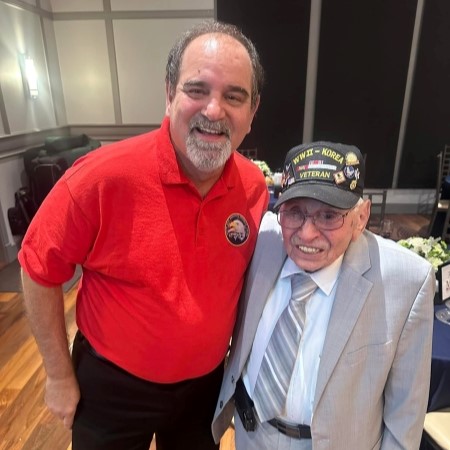
What first inspired you to start SERVE?
Around 2014, I was the COO for a local credit union. One of the things our board wanted us to do was expand our mortgage portfolio. While we were researching options, we came across a grant in the state of Texas called the Haven Grant, which allowed veterans who needed home modifications to apply for up to $7,500. Only one institution was using it at the time, and we thought, “Hey, that would be pretty cool. Let’s add that to what we offer for veterans.”
We created a nonprofit called Keystone CDC, which evolved into a program helping low- to moderate-income families with mortgages and wrapping in support for veterans. A year later, we got a Haven Grant for a gentleman whose backyard needed to be redone. When we went to complete the work, his neighbors—many of them veterans—found out, including a Marine named Donny Daughenbaugh. They rallied to help and even donated money. That was my introduction to Donny.
I met with him and another gentleman, Sam, who each had their own nonprofit work going on but had never heard of one another. I said, “Look, I know both of you. Why don’t we share resources?” And then, about a week later, I had this brainstorm: Why can’t we build something like Business Networking International, but specifically for veterans? We wanted to create a network where organizations help each other and refer resources.
We came up with the name SERVE: Southeast Resource Veterans Effort. We started with six organizations. Our first meeting was on August 13, 2015. Today, we have 80 organizations. If I need help for a veteran, I can reach out to any of them individually. And they all have networks behind them, which means our impact grows exponentially.
I’m not a veteran myself. But when I met these folks, I realized what they could do if someone helped connect them.
Can you describe some of the organizations you partner with and what they offer veterans?
Our chairman is with the WAVES Project, which teaches veterans and a person of their choice how to scuba dive. It’s a mental health and PTSD program. When you’re underwater, it doesn’t matter whether you have arms or legs. The program actually began when a quadriplegic person wanted to learn to scuba dive.
We also partner with the Yellow Ribbon Fund, which focuses on caregivers. People forget how hard caregiving is. They take spouses—male or female—out for activities like bowling, pottery or movies, just to give them a break.
Local colleges like College of the Mainland help veterans navigate the GI Bill and the Hazelwood Act, which covers tuition in Texas.
We have three or four in-home health care programs that go into veterans’ homes to help with medical needs or household tasks. There’s Cheer Up for Vets, which writes handwritten thank-you letters to veterans, which may sound simple, but opening a handwritten note that says “I appreciate you” can absolutely change your day.
Another partner, Stay Tuned for Vets, offers guitar lessons, sends veterans to plays and comedy clubs, and even to my house where my wife and I teach them to make wooden American and Texas flags. Combined Arms helps us locate resources for veterans outside Galveston County.
One of the most important partners is VOW22, whose entire mission is suicide prevention. Ultimately, that’s what all of this is about: If we can solve the problem before it leads to suicide—financial stress, caregiver burnout, lack of connection—we’re doing what we set out to do.
You’re not a veteran yourself. Why does your heart go out to them in this way?
Honestly, I didn’t know what it meant to be a veteran when I started volunteering. There’s no history of military service in my family. I didn’t start helping because Donnie and Sam were veterans—I helped because they were people who cared and who were running into roadblocks. My job was simply to say, “I don’t know your language. Teach it to me. But I can introduce you to a lot of people.”
Once I got to know their stories, and understood what they sacrificed for this country, that changed everything. And back in 2014 and 2015, veterans and first responders were really taking a beating in the public eye. We wanted to show that we were here to help.
What are some of your most memorable stories of people you’ve helped?
It changes by the season. Lately, we’ve been working with six families who were unhoused.
One young woman was living on the street with nothing but her two dogs. She had family in the area, but they wouldn’t take her in. We helped get her into housing and connected her with the VA. She’s now in permanent housing.
We’ve built multiple mobility ramps, installed grab bars for a veteran recovering from a recurring infection and helped families get placed through HUD-VASH and partners like Endeavors.
We helped feed over 14,000 families during Operation Turkey through one of our affiliated groups—and my wife and I personally delivered meals to veterans in Galveston County.
We’ve helped people get jobs, pay rent, keep their cars from being repossessed and ensured children have Christmas without their parents going into debt.
Since the grants began in 2023, we’ve issued over $200,000 in grants and had around 500 documented requests. That doesn’t include phone calls where someone asks for help and we connect them immediately. About 200 families received monetary grants, and many more received resource support.
What do you wish people understood about the challenges veterans face, especially around homelessness?
Sometimes all you have to do is ask. Not everyone on a street corner needs help—it varies—but many do. And for veterans especially, it’s complicated.
Some veterans don’t want to be unhoused, but circumstances, mental health, disability ratings or strained family relationships put them there. Others choose homelessness because they don’t want to navigate those relationships or systems. My job isn’t to drag a veteran off the street. My job is to make sure they’re safe and have resources when they’re ready.
Once they ask for help, we will move heaven and earth, but they have to take part too. We can’t go to their doctor’s appointments for them or fill out their disability forms, but we can walk beside them.
What has been the most rewarding part of your work?
Honestly, the relationships. Donny, Jeff, Rob—the board of seven veterans and their spouses. They’ve become incredible lifelong friends. I probably talk to them every day.
I don’t really care about numbers. I care about the next person who needs help and figuring out how to solve their problem. Serving veterans brought these people into my life, and that’s been the greatest reward.
Why do you think it’s important for people to volunteer or get involved with causes they care about?
You said it best: the causes you care about. I sit on five other boards, and each speaks to me in some way. But for SERVE, I just believe that if something moves you, if something matters, you should step up.
Find the cause that resonates and go get involved. People won’t tell you no. There is always a place to help.
Do you want to make a difference in your community like Jay? Find local volunteer opportunities.
Share this post
