



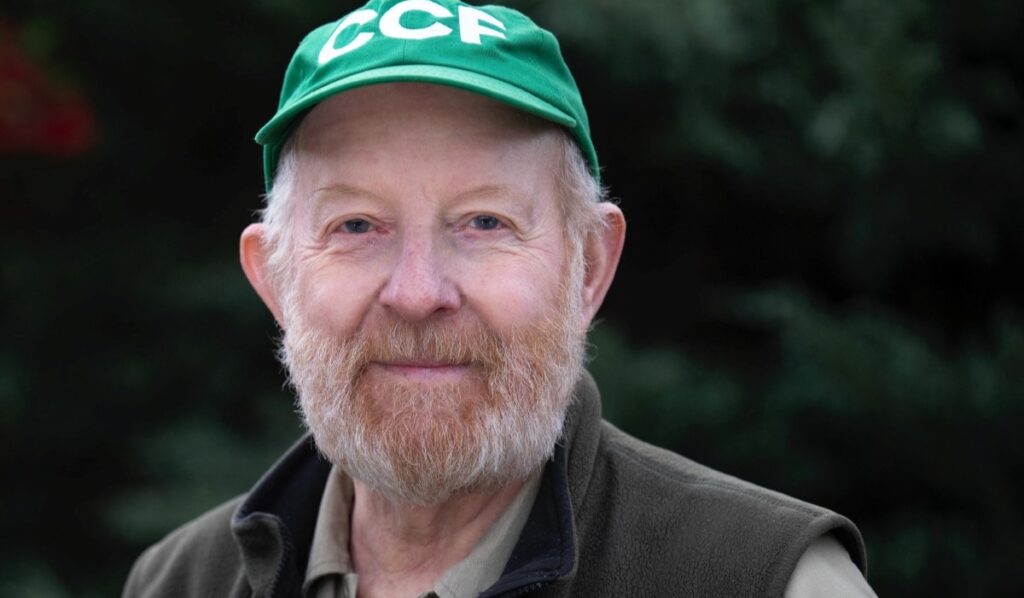
Meet Daily Point of Light Award honoree Duncan Foley. Read his story, and nominate an outstanding volunteer or family as a Daily Point of Light.
In 2021, Duncan Foley’s life took an unexpected turn during what was supposed to be a routine gallbladder removal. The surgery revealed a sobering reality: stage 4 cholangiocarcinoma, a rare and aggressive form of bile duct cancer. Faced with the sudden weight of a life-altering diagnosis and the daunting uncertainty of treatment, Duncan chose a path defined not by despair, but by hope.
Rather than retreating, Duncan transformed his personal health battle into a mission of advocacy and connection. He’s since become a steadfast pillar of the Cholangiocarcinoma Foundation (CCF), dedicating his time and energy to ensuring that no one has to face the disease in isolation. Through his leadership within the Seattle Care Team, he has pioneered a localized network of support, bridging the gap between clinical care and the emotional needs of patients and their families. Through his active participation in the CCF Annual Conference, Duncan helps organize events that bring together patients, caregivers, clinicians and researchers. He also assists with translating complex medical information into understandable dialogue, ensuring that the latest research is accessible to those who need it most.
But what truly distinguishes Duncan is not his productivity; it’s the infectious optimism he brings to every interaction. He views each day as an opportunity to radiate positivity and proactivity, refusing to let the weight of his diagnosis dim his outlook on life. When Duncan speaks, his belief in a brighter future for cholangiocarcinoma patients is so palpable that it transforms the atmosphere of support groups, hospital corridors and one-on-one conversations alike. He teaches us that while we can’t always control our circumstances, we can always choose the spirit with which we meet them.
Read on to learn more about Duncan’s inspiring story.
Tell us about your volunteer role.
I’m a patient with the Cholangiocarcinoma Foundation (CCF), and I consider myself very lucky to be in my fifth year of survival. Depending on the statistics you use, only about 10% of patients reach this milestone, so I am very fortunate that things have been going well. CCF is an unusual organization in the cancer space because it serves five distinct populations: patients and caregivers, researchers, clinicians and drug development professionals.
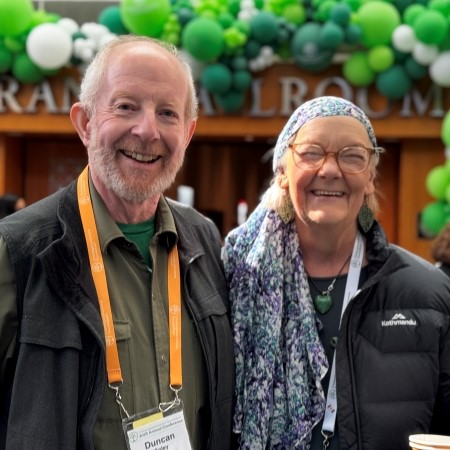
Foundation Annual conference in Salt Lake City.
I first found them following my diagnosis and realized they provided good, reliable data. I didn’t have to rely on Google for information. I went to one of their annual conferences and it was amazing. What these people are doing, and their support of the patient experience, are what led me to join a local care team and volunteer at the annual meeting. Those are the two primary ways I’m involved.
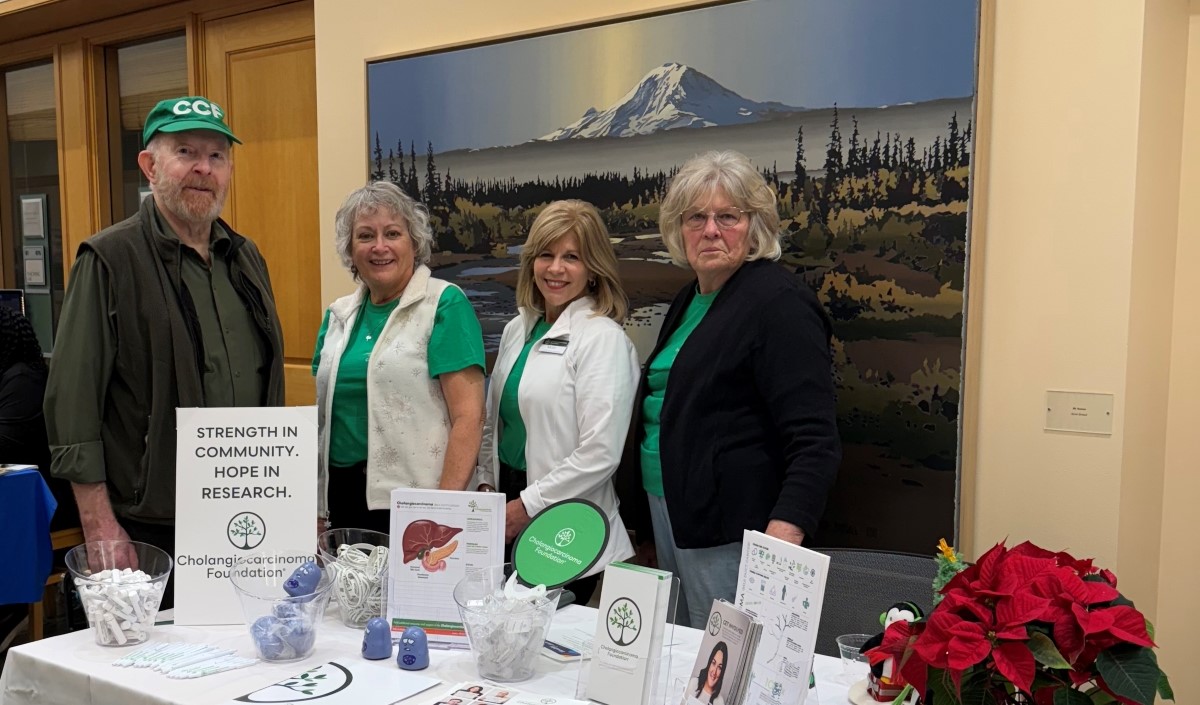
Our Seattle-Tacoma area care team currently has four members, with a fifth about to join. Our responsibility is to host regional meetings for patients and caregivers where we bring in speakers—nurses, clinicians and researchers—to discuss the various aspects of living with this disease. We cover everything from research updates and clinical practice to nutrition, fatigue and side effects. Because this is a rare cancer, affecting only 6,000 to 8,000 people in the U.S. annually, we also attend health fairs to find those one or two people who may not know the Foundation exists. We are more than happy to introduce new patients to the community. The Foundation provides the financial and logistical support to make these meetings possible, and I am happy to be involved with an organization that has given me so much.
Can you share a bit more about your journey with this cancer?
As my wife describes it, I had a “blessed gallbladder” that required surgical removal. During that process, an unusual MRI caught the attention of a very persistent physician’s assistant. He noticed something funny and had it interpreted by a specialist for a closer look. He eventually came back and said, “It looks like you’ve got cholangiocarcinoma.” My first thought was, “Gee, can I even pronounce that?”
Having the gallbladder out led to the discovery of the cancer. This is not atypical; cholangiocarcinoma is often discovered at Stage 4, meaning it has metastasized. I was lucky that mine had only spread locally near the liver. Once it was confirmed via biopsy, I began chemotherapy. And I have one piece of advice for people: do not get COVID-19 the day after receiving chemo. That landed me in the hospital for a week with sepsis. Once I got home, internal bleeding put me right back in. Fortunately, I had the same nurses and even the same ambulance crew. Since it’s a relatively small community, it was almost fun getting to talk with them about our mutual friends.
After that, I reached a very lucky stretch where I had more than three years without any chemo at all; the cancer remained stable. Recently, it started to grow again, and after six months of a new round, the chemo pretty much flattened me. We’re now looking at viable alternatives, such as radiation or a fascinating new technique called histotripsy. Histotripsy uses targeted ultrasound to destroy tumors externally without any cutting or slicing. It’s truly amazing.
Why is it so important for patients and caregivers to have this type of support?
One of the primary challenges with a rare cancer is the sense of going it alone. Often, patients feel they are the only ones facing this disease. For instance, when I was first diagnosed, my local oncologist had about 150 patients, and I was the only one with cholangiocarcinoma. This is not unusual; there are often only one or two patients per regional oncologist. This leads to a powerful sense of loneliness, which can quickly turn into hopelessness.
When you feel that way, the first thing you often do is turn to “Dr. Google.” Unfortunately, the internet is full of bad ideas, poor suggestions and people happy to sell you a magic potion to cure your cancer. As a retired geologist, my response is: “Show me the research. Show me the data.” Through our care team and the Foundation’s online support groups, we work to ensure patients and caregivers know they aren’t doing this alone and that there are reliable places to go for information.
What keeps you hopeful?
One of the reasons I maintain such strong hope is the incredible rate of change happening right now in both drug development and treatment. For example, the histotripsy technique I mentioned wasn’t even around two or three years ago. It was just being developed. One of the medicines I am scheduled to receive tomorrow was only authorized a couple of years ago.
The rate of change in how we analyze various cancers is phenomenal. Ten or 15 years ago, we didn’t have what we have now: genomic analysis. Today, it is vital for every patient to understand the DNA defects contributing to their specific cancer. Drug companies are working tirelessly to develop targeted medicines that address these specific defects. With new drugs and treatments constantly emerging, how can you not be hopeful?
What inspires you to volunteer?
What keeps me positive is the realization that while there is a finality to cancer, having a purpose is critical to dealing with it. There have been studies suggesting that cancer patients who have a sense of purpose actually live longer. In that way, my volunteering is partly selfish—it provides me with a vital motivating factor.
Contributing to others and helping them navigate this disease gives me that purpose. It is also easy to volunteer for the Cholangiocarcinoma Foundation because I believe so deeply in their mission and I am continually impressed by the high quality of their staff. From the director to the research team and throughout the entire organization, they are truly wonderful people. It makes the work of volunteering a joy.
Why is it important for others to get involved with causes they care about?
As I think about that, I bounce right back to purpose. Giving people purpose. It’s incredibly important to find something you can be passionate about, regardless of what you are volunteering for. In my own life, that passion has often been the theater; for five years, I served on the board and as board president of a local community playhouse because I believe so deeply in the power of the arts.
I also believe in the power of knowledge. I am a retired geology professor, having taught at the university level for 30 years in the Tacoma area. That desire to share reliable information is rooted deep within me. Whether it is in a classroom or a support group, my goal is to ensure people know their options—specifically the best possible options—for treating this cancer. When looking for an organization, make sure it is something you feel passionate about and that it is well-run, but also ensure you have a meaningful role as a volunteer within it.
Any advice for people who want to start volunteering?
First, think about what your passions are. Second, look for look for high-quality organizations that align with those passions. Are you passionate about feeding people? Working with unhoused populations? The theater? If you lead with your passions, you are going to feel more invested in your work, and you will ultimately do a better job as a volunteer.
Anything else you want people to learn from your story?
There is an aspect of volunteering that sounds a bit selfish, but I believe it to be true: the more you give, the more you get. It is only through volunteering that I have met so many wonderful people. If I hadn’t gotten involved, I wouldn’t have met the other members of my care team or the incredible staff at the Foundation. Without that connection, the Foundation would just be a website where I occasionally contributed.
By getting involved and learning the inner workings of an organization, you don’t just bring purpose and meaning to your own life; you are helping others. Perhaps the best way to phrase it is that helping others can help you as well. It creates a cycle of support that enriches everyone involved.
Do you want to make a difference in your community like Duncan? Find local volunteer opportunities.