
Innovating and Educating for a Better World
Meet Daily Point of Light Award honoree Anirudh. Read his story, and nominate an outstanding volunteer or family as a Daily Point of Light.
Anirudh Rao drew his first design, a sensor that would alert people of wind and dust, when he was just 5 years old. He presented it to his Kindergarten class. Now 13, he has many innovations under his belt. His interests lie at the intersection of science and history, and he uses both to solve problems worsening due to climate change. He has, for example, created a wound management solution he calls Semmelweis, inspired by ancient Greek and Egyptian civilizations’ treatment of war wounds. It detects excess moisture, helps prevent infection and ensures timely dressing changes while reducing waste. It’s particularly useful in disaster-affected regions.
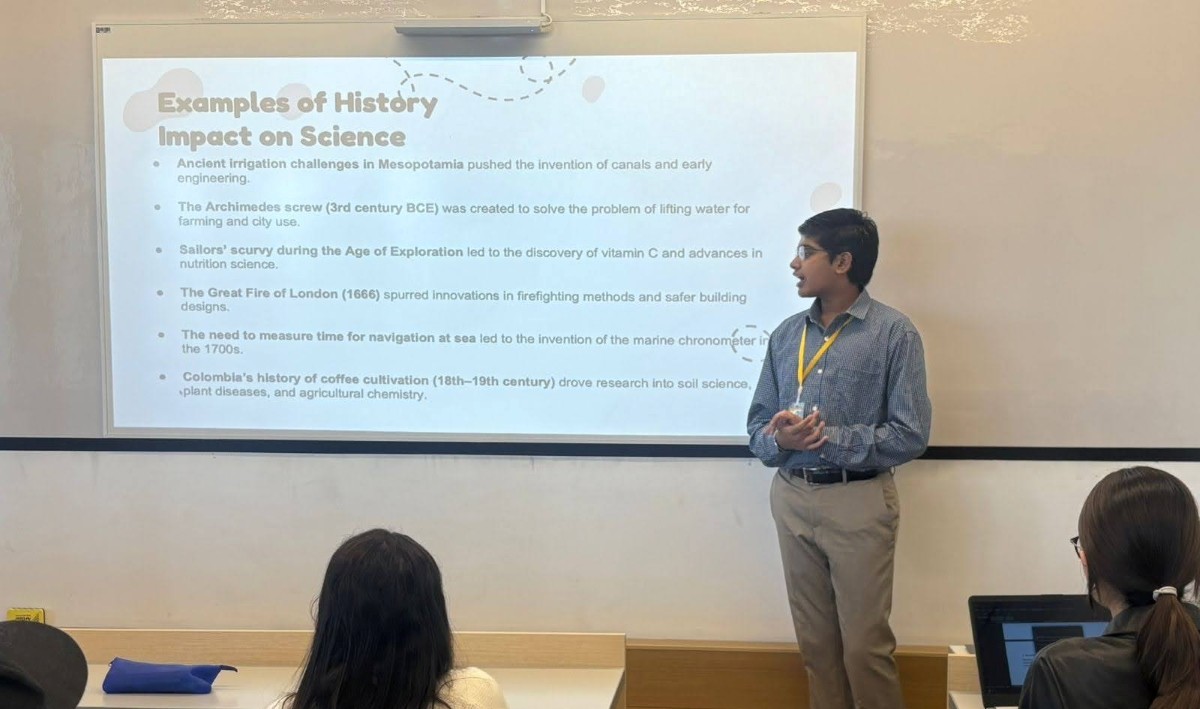
While working on his ideas over the years, Anirudh developed a workshop series that connects history, mythology, climate science and modern technology. For nearly four years, he has led programs at schools, museums, science festivals and more across the U.S. and abroad. He connects with difficult-to-reach places like refugee camps online.
His sessions build curiosity, cultural awareness and interest in STEM. But he hasn’t stopped there. Anirudh believes that artificial intelligence will affect everyone and, therefore, everyone should be able to learn about it. One of his missions is providing this education to underserved communities. He’s planning to launch the beginner AI videos he’s developing for students in the Kakuma Refugee Camp in Kenya this summer. Such communities have also benefited from the over $10,000 he raised for their support. And even amidst his other important work, he still finds time to draw.
What inspires you to volunteer?
Volunteering started from my passion for mitigating climate change. I used to live in Nashville, TN, and my friend’s home was destroyed by a tornado. That sparked my curiosity. I wanted to do something about it, so I started innovating things like an early tornado warning system.
Another impactful event was when I conducted a session on ancient Egypt and how they used scientific techniques in mummification and building their pyramids. That really resonated with me.
Tell us about your volunteerism.
I conduct in-person and virtual education programs that have reached over 6,500 people, toddlers to college-aged. I design interactive presentations and hands-on demonstrations, coordinate with partner organizations and mentor younger students. Topics include things like history and culture of different countries, 3D printing, beginner AI and the flora and fauna of Colorado. I really enjoy nature, and being a climate advocate has transformed my view on conservation.
I’ve also created various solutions for issues that I’ve then shared with people who could implement them. My early tornado warning system is based on a principle of infrasound, which is the low frequency sound that tornadoes produce in their early stages. With a network of autonomous drones, infrasound and other environmental sensors, I can detect a tornado 27 minutes earlier than the process currently used, warning people 40 minutes before it hits.
I partner with Denver Water on testing for an alternative for electrochemical batteries. And with the Colorado Department of Transportation, I’ve used adaptations in nature–i.e., mint leaves, cicada wings and Namib beetles–that manage moisture efficiently to analyze how resurfacing roads with specific patterns can reduce ice formation and speed up melting, potentially saving lives.
I also work with Children’s Kindness Network, an organization that promotes kindness in the next generation, particularly elementary students. I co-founded the Global Kindness and Art Essay Contest and, for the last five years, have facilitated.
And I conduct sessions on beginner AI for those in underserved communities and create videos on, for example, how to be safe on the internet. AI is the future and everyone deserves to learn about it. That’s why I also created a device called NeuroWeave, which helps students with learning disabilities interact with the technology.
You emphasize the importance of teaching science with history. How does that help solve future problems?
We always need to look at the past to solve something in the future. An example of this is the Archimedes screw, where water was basically taken from low-lying bodies of water uphill to irrigation ditches. The Mesopotamians started civil engineering with canals, and we still use these innovations daily. National parks still use controlled burning practices that originated with indigenous people many generations ago. Progress is made by building on previous knowledge.
What are your long-term plans or goals for your volunteer work?
One of them is to create a global network of students who can conduct AI sessions in their own areas, because we need to make sure that no one is left behind.
What’s been the most rewarding part of your work?
It’s seeing people having empathy towards different cultures, advocating on climate change, forming their own opinions and having the curiosity to innovate. Once, during a beginner AI session, we were working on a facial recognition app. Unprompted, a 7-year-old student drew a picture of an animal and showed it to the AI. He said that if it’s able to understand human faces, it can understand animal faces. That was really rewarding to see him thinking critically and building on the information he learned from our sessions.
What have you learned through your experiences as a volunteer?
If you have an idea and you’re able to help someone, go for it. You can always go back and rethink something. I believe everyone should do things that inspire them. My dad always says that whatever blessings you have, you should give to others as well.
Why is it important for others to get involved with causes they care about?
You might think that someone else is going to do it, but what if that someone else never comes?
What do you want people to learn from your story?
Empathize with different cultures and traditions, because we want a kinder future. Climate change isn’t just a technical problem but also a social and cultural one. Communities are affected differently, and solutions must be developed specifically for them. Help make our world a better, safer place.
Do you want to make a difference in your community like Anirudh? Find local volunteer opportunities.
Share this post
