
NJ Teen Leads Nonprofit Making Tech Accessible for All
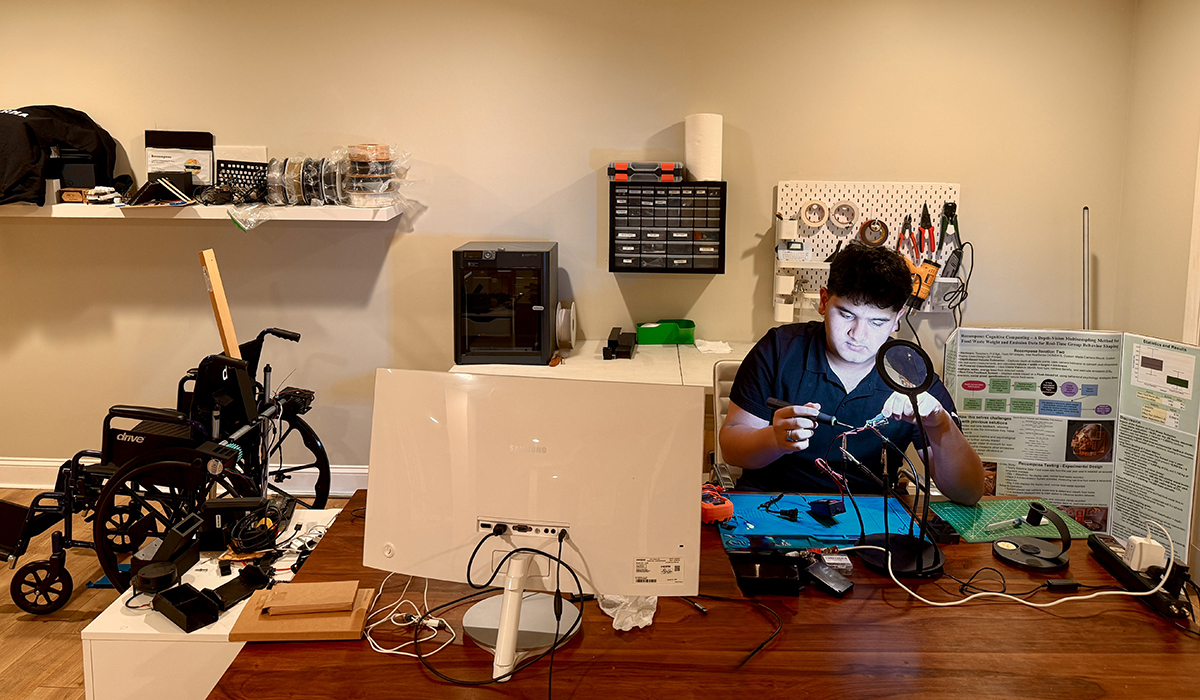
Meet Daily Point of Light Award honoree Umang Sharma. Read his story, and nominate an outstanding volunteer or family as a Daily Point of Light.
During the COVID pandemic, when others were perfecting sourdough or passing the time with puzzles, Umang Sharma was busy assembling computers in his Princeton, New Jersey home. While searching for parts online, he stumbled across an ad for a $7,000 Braille keyboard, a price that made him wonder why essential technology for people with disabilities was so inaccessible. That curiosity drove him into months of research and hands-on tinkering, eventually leading him to develop a functional Braille keyboard using 3D-printed keys and repurposed hardware for just $10 per unit.
That single project became the spark for Jdable, the youth-led nonprofit that Umang, 17, went on to create. Today, Jdable has designed 10 assistive devices—from autonomous wheelchairs to smart canes and tactile Braille maps—reaching more than 1,000 individuals across the U.S., Canada, India, Finland and the UAE. What started as a passion project is now a 50-member volunteer network that includes engineers, Ivy League professors, students and advocates—all united around a simple idea: technology should empower everyone, not just those who can afford it.
What inspired you to start Jdable?
It really began during COVID. I was already interested in building computers and keyboards, so I was buying parts and came across an ad for a $7,000 Braille keyboard. That shocked me. I knew how much keyboards should cost because I was making my own for far less, so I wanted to understand how something designed for people with disabilities could be priced so high, especially for a community that often has fewer accessible job opportunities.
I did research and confirmed my suspicions: the cost didn’t match the materials or the need. I felt I could genuinely make a difference, so I spent about a year designing a new model. By repurposing donated keyboards from local offices and schools and redesigning the key structure, I brought the cost down to $10. We tested versions, gathered feedback and criticisms, and kept improving it until it was durable, comfortable and reliable for everyday use.
That first product opened my eyes to how many assistive technologies were either too expensive or too inaccessible for people who needed them most. I started seeing the same pattern with wheelchairs, canes, maps, everything. That’s when I formally launched Jdable as a 501(c)(3) so I could recruit people, build a team and scale solutions for more communities.
How did you come up with the name Jdable?
It came from “jobs for the differently abled.” J for jobs, D for differently, and able for abled. We wanted the name to reflect our mission of empowering people with disabilities.
Why does this work matter so much to you?
The keyboard got me started, but other experiences made this work more personal. For example, my grandmother once had to walk a long distance in the airport because a wheelchair wasn’t available in time, and we ended up missing our flight. She was in pain, and watching her struggle really hit me.
It made me realize how many people lose independence simply because the right tools aren’t available—or are too expensive. That experience, and others like it, made me want to restore even a little bit of independence for people who need it most.
Can you describe some of Jdable’s products and how they came to be?
Right now, we have about 10 products, ranging from small-scale tools to major, engineering-heavy projects. They come from a mix of sources—my experiences, ideas from people with disabilities and suggestions from partner organizations and professors.
For example, Braille Maps & Globes came from Silver Line Inspiring School, one of our earliest partners. They asked if tactile navigation tools could be made more affordable and accessible, so we worked with them to develop a solution.
Our IoT smart cane originated from our chief operating officer, who had a family connection to visual impairment and wanted to create a cane with obstacle detection and navigation alerts.
Braille readers, Braille glasses, autonomous wheelchairs and more came from ongoing conversations with students, families, disability centers and volunteers.
Everything we build comes from a collaborative process. We have a global team of over 50 volunteers—engineers, researchers, students—who help design, test and refine each product to match the actual needs of the people who will use them.
How did you build such a large volunteer network at such a young age?
A lot of it started with finding people who shared the same passion. We used LinkedIn and social media to reach out widely, and we discovered that many people had personal experiences with a disability in their own families and were excited to contribute.
As our projects grew, professors and engineers started reaching out to us after seeing our work online. From there, it expanded like a tree: each new volunteer knew someone else who cared about the same issues. That’s how we built partnerships at places like Harvard, and how we grew a network of over 50 people worldwide.
Did you face challenges because of your age?
Definitely. Funding was the biggest challenge early on. Many people hesitated to donate because they assumed a youth-led organization lacked experience or accountability. There was also a trust issue. People weren’t sure if our products would truly work.
We overcame that by demonstrating real-world impact: showing people specific examples and the specific places where our products have done good. We also built a finance department that applies for grants each month. We’ve reached out to companies like Google, Microsoft, OpenAI and LinkedIn and we were able to receive donations that go right back into our product development.
What has been the most rewarding part of your work?
Seeing people interact with our products for the first time. Their faces light up, especially kids who have never had access to this kind of technology.
One student we worked with used to rely on old Windows technology that required navigating letter by letter to type. With our Braille keyboard, their typing speed improved drastically, and they were so excited that they started doing typing tests to see how much faster they were getting. Moments like that stay with me.
We’ve also received thank-you letters from schools, and we value both the positive and the critical feedback because it helps us improve every device we build.
What are your long-term goals for Jdable?
In the next four years, I want to reach one million people. Long-term, I want to expand globally—through chapters in more countries, larger partnerships and possibly a for-profit arm whose revenue can fund our nonprofit work.
We’re also planning a hackathon and accelerator program, similar to Y Combinator, but focused entirely on assistive technology. Students will create solutions, receive mentorship and get connected with experts in accessibility. My goal is to keep Jdable youth-driven and make it the world’s largest student-powered accessibility network.
Why is it important for others to get involved in causes they care about?
Volunteering is one of the biggest forces for good. Even helping one person can restore independence and change a life. And if one person volunteers, it often sparks a chain reaction in their community. You don’t need a title or a lot of money—you just need empathy and curiosity.
Do you have advice for people who want to start volunteering or launch their own service project?
Find a problem that’s personally meaningful or something you see affecting people around you. Your first step doesn’t need to be perfect. It just needs to come from genuine care. Don’t be afraid if people don’t trust your work at first or if funding is hard. Start small, stay curious and let your passion guide you.
Do you want to make a difference in your community like Umang? Find local volunteer opportunities.
Share this post
