
Scaling the Future of Accessibility with Coding

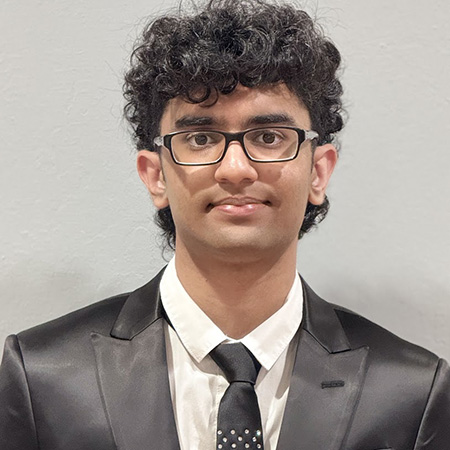
Meet Daily Point of Light Award honoree Aditya Rajesh. Read his story, and nominate an outstanding volunteer or family as a Daily Point of Light.
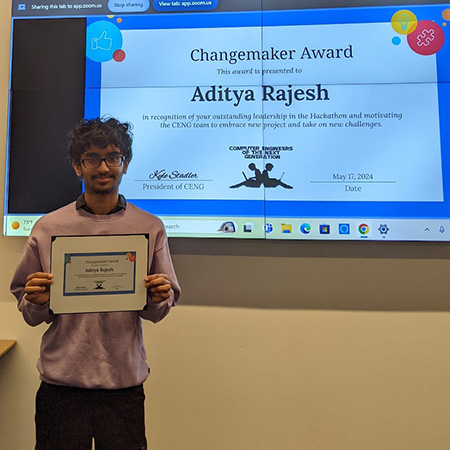
Aditya Rajesh didn’t just want to teach code; he wanted to rewrite the script of who gets to learn it. Starting his journey as a teacher and senior mentor, he mastered the nuance of the classroom before turning to the systemic barriers keeping students from the screen. As president of Computer Engineers of the Next Generation, he’s shifted the organization’s focus from general growth to targeted equity, utilizing data-driven outreach to identify Title I schools where computer science education was a distant luxury rather than a standard. By forming a dedicated outreach team and leveraging tools like Apollo.io, Aditya bridged the gap between Silicon Valley resources and underserved classrooms, expanding the organization’s partnerships from three to now 55 schools across California.
Under his strategic leadership, the organization welcomed over 3,600 students into its programs over the last two years, creating a community impact valued at $1.2 million. His commitment to the “CENG” mission focused on enrollment as well as fundraising efforts that raised over $14,000 in a single year, directly funding three $1,000 scholarships for graduates pursuing STEM majors. Whether he’s organizing four hackathons for over 150 participants or designing five distinct curricula — ranging from Scratch to ChatGPT — Aditya ensures that the quality of instruction matches the quantity of students served.
Now serving as an advisor and class supervisor, Aditya remains the backbone of the organization’s daily operations. He currently oversees the education of more than 100 students per session, maintaining high instructional standards while dedicating 15-20 hours a month to the cause. His influence is perhaps most visible in the legacy he has built through others; having recruited and trained more than 80 volunteers, he has ensured that the organization’s culture of mentorship remains self-sustaining. His transition from webmaster to executive strategist has left the organization with a robust digital infrastructure and a refined focus on underrepresented minorities in the tech space.
Looking forward, Aditya continues to serve as a senior mentor, hosting guest speakers and refining hackathon logistics to keep the momentum alive. Read on to hear more of his inspiring story.
Tell us about your volunteer role.
I currently serve as the advisor for CENG and last year I was the president. CENG provides free computer science classes for underrepresented minorities, with a focus on reaching communities that lack access to CS education. Our ultimate goal is to give kids who aren’t usually handed those opportunities a real chance to explore computer science.
As advisor, I help oversee our major events like hackathons and Hour of Code, handle a lot of the administrative work and focus on expanding our outreach and bringing in guest speakers. But I’m also still really active during class sessions, whether that’s supervising, stepping in to teach or just making sure the quality of our curriculum stays strong.
Why is this issue so important to you?
It honestly surprises me that even here in the Bay Area, the heart of Silicon Valley, there are still communities without real access to computer science education. I grew up taking it for granted. From elementary school there were computers, there were CS classes, that was just the norm. But that’s not most people’s reality, even just a few miles away in places like Oakland or parts of the South Bay.
On a broader level, I deeply believe education should be democratized, and that’s something I’ve cared about and actively worked on throughout high school. CS is one of the most powerful tools someone can have right now, and the fact that it’s still so unevenly distributed feels like a problem worth dedicating real time to.
What inspired you to get started with this initiative?
I actually got started pretty young, around the middle of seventh grade. I had been taking CENG classes myself for almost two years, and Alice, the founder, noticed I was a more advanced student and asked if I wanted to help develop a Minecraft game design curriculum. But the real reason I said yes was because I thought it was such a genuinely noble cause. Teaching CS also forces you to understand concepts at a fundamental level, which I found really valuable for my own growth too. Mostly though, it just felt like the right thing to do. It combined something I cared deeply about with the chance to help more people care about it too, and that was enough for me.
What are your long-term plans or goals for the organization?
When I became president, one of my biggest priorities was scaling our reach and really getting our resources to the communities that need them most, not just the ones closest to us. Looking ahead, I think there is a real opportunity to take CENG to a national or even global level. We have already had students join from other parts of the world, which is exciting to see.
But more than just growth for the sake of growth, I want to make sure we stay true to our mission, which is not necessarily to produce as many CS majors as possible, but to give every kid the chance to explore it and see it as a real option for their future. So to me, ensuring that we are able to effectively target areas that need our CS classes the most is a priority. That focus on access and inspiration, while keeping class quality high, is what I want CENG to be known for.
What have you learned through your experiences volunteering?
A few significant things. On the leadership side, running an organization is genuinely hard, and you only really understand that once you are in it. Building clear, low-friction systems for communication and delegation is something I have had to actively develop and keep improving on. On the teaching side, I have learned how important it is to truly take the student’s perspective, not just in how you explain a concept, but in how you design the curriculum, how you market the class, how you run icebreakers, how you lay out slides. Every single touchpoint is an opportunity to make someone feel welcome and inspired. That perspective-taking has probably been the most transferable skill I have picked up through all of this.
What’s been the most rewarding part of your work?
Honestly, the direct teaching. I have had students come in shy, nervous or even just dragged there by their parents, and by the sixth session they are genuinely excited about computer science. That shift is everything to me. It tells me we are actually doing what we set out to do. And on the flip side, when a kid comes in already curious and motivated, and our classes give them a real platform to build on that, that is just as rewarding. Seeing a student realize they now have a path forward they did not know existed before is something that never gets old.
Why is it important for others to get involved with causes they care about?
If the people who care are not getting involved, who will? I do not think there needs to be a complicated reason behind it. If something genuinely matters to you, you will feel naturally pulled toward it. When I was asked to volunteer at CENG in seventh grade, it just felt right. I love CS, I care about equal access to education, so of course I wanted to be part of it. I think the only things that really hold people back are fear or the feeling that they will not make a meaningful impact, but both of those are worth pushing through. Doing something is always better than doing nothing, and if you truly care about it, you will find a way to make it count.
Any advice for people who want to start volunteering?
Just start. That is really the whole thing. Whether you are joining an existing organization or building something yourself, the biggest mistake is waiting until everything feels perfectly planned out. There are things you simply cannot figure out until you are actually in it. Find something you genuinely care about, a cause, a community, a problem you keep coming back to… and throw yourself in. Start small if you have to, stay patient and trust that things will come together as you go. It will not be easy and you probably won’t see results right away, but that is fine. Anything is better than nothing, and if you care enough to stick with it, only good can arise from your work and you will go far!
Do you want to make a difference in your community like Aditya? Find local volunteer opportunities.
Share this post
