– an age when people become the driving force that transforms our world. We believe when future generations look back on this time, they will see it as an era of sustained and meaningful civic engagement. But
Answering the Question: “What is Civic Engagement?”
Simply put, civic engagement is change led by the power of people. In this modern era, it isn’t as always as simple as individuals volunteering their time and effort to advocate for the changes they wish to see in the world. Today’s generations engage in a variety of ways – from how they spend their dollars with socially responsible companies to how they use their voices on social media. People are eager to understand, identify and engage in the full scope of civic life.
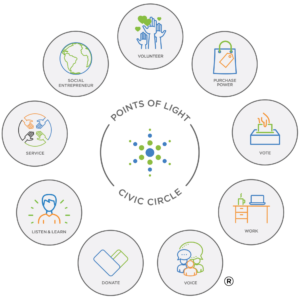
demonstrate the many ways people can become more civically engaged, whether it be their career calling, making an informed donation to a cause or taking a small action taken in the workplace.
Here are some articles on civic engagement you can read through for more information. And be sure to check out our digital magazine,
to build equity in volunteerism and providing services. We discuss MAVA’s recent initiatives and the important work they are doing as an organization to listen and learn.
is one of the key ways communities can advocate for themselves and an important part of participating in a democracy. But since 501(c)(3) charitable organizations are limited in what they can legally do during elections, we published some guidelines on how to help your community members
of your volunteers? The truth is that the way your volunteers spend their dollars and consume their goods can have a lasting impact on the communities you serve – as well as the world at large. In this article, we share
in ways that serve the very causes your organization is addressing each day.
We’re Saying Goodbye to Community – Our Online Content Hub for Nonprofits
As a convener of nonprofit thought leaders, Points of Light is always looking for ways to better serve you. Our online Community hub has provided an engaging place for idea sharing since 2020, and we’re thankful to our partners and staff who have provided valuable tips, expertise and templates over the last two years.
Our blog will still offer the same thought-provoking ideas made especially for nonprofit practitioners, like you, who want to innovate how to mobilize people power to bring your mission to life.
Thank you for being a part of Community and Points of Light.
Use Your Voice During Elections: Tips for Employees and Organizations
Pr
eviously in this series centered around voting as a way to engage in your community, we covered how employers can support their employees to
out the candidates and issues during election season.
As Election Day approaches on Tuesday, November 8, 2022, we’re diving into ways that you can use your corporation’s voice during elections, as well as encourage employees to use their voices, throughout the election season.
, 40% of respondents said they posted or shared content on a social media platform, making their voices heard. There’s no doubt that your employees will likely be posting their individual opinions on the issues and candidates this year.
But as companies are often limited in what they can publicly support, what are some other ways – outside of social media – that you can make your corporate voice heard, and encourage your workforce to make theirs heard, too?
Appoint Democracy Champions
One way to ensure that messaging is consistent across the organization is to appoint a “democracy champion” – or a task force of multiple team members, depending on the size of your organization – to spread the word about the upcoming election. Provide them with tools and goals and connect them to your Government Affairs team for training and counsel.
Not only will this model provide a leadership development opportunity, it will help you plan for local and state elections, and stay abreast of legislative proposals that might impact the communities in which your company operates. Make sure these champions understand this is a nonpartisan role meant to lift up the power of the vote, educate and inform fellow colleagues. Be consistent with messaging, and be clear on when these champions can make commitments on behalf of the company.
Voice Perspectives on Crucial Legislation
Encourage employees to engage individually in civic action by voicing perspectives on hot topics, especially legislation that could impact your workforce. Not only can you use your corporate voice to thoughtfully voice the company stance on these issues, but you can encourage your employees to contact their representatives to advocate for the causes they care about.
“Gen Z and millennial workers are looking for more than just a paycheck – they want to work for an employer that provides ways for them to use their voice and strengthen communities through the democratic process. ”– Katy Elder, vice president, Business Innovation, Points of Light
Partner With Voter Advocacy Organizations
One of the most powerful ways for your employees to use their voices, especially if you’re being mindful of maintaining a nonpartisan stance at your company, is to advocate for election turnout. Partner with voter advocacy organizations like
to write letters or make phone calls to registered voters. Vote Forward has seen over 245,000 volunteers write 27.4 million letters since 2018, educating people on how to show up to the polls on Election Day, how to vote by mail and where to check their voter registration status.
A great place to start learning about the power of voice is in our
. This digital magazine shares first-hand accounts from contributors who are using their own voices to change conversations, and provides tools and resources for you to learn more and take action.
Don’t miss our first two posts in this four-part series that cover ways to activate around
to your campaigns, and advocate for your shared cause. But purchase power can also be a dynamic tool, and we’ll show you how to help your community leverage it to drive change.
Purchase Power: A Key Piece of the Civic Engagement Puzzle
One of the most powerful, and often untapped, resources that a nonprofit has is the collective
of its volunteers. Purchase power represents an individual’s ability to make decisions around spending or consumption of goods or services. Each of your
has the ability to make decisions around how they consume or purchase goods and services.
These purchasing decisions may reflect their values or advance a social cause or issue. Buyers may deliberately purchase or avoid purchasing a product or service based on a company’s policies, social causes, size and scale, environmental footprint and more. In the same way your volunteers choose to share their talents with your organization, they may also choose where their purchase power goes.
When considering purchase power, it’s essential to recognize that, for many people, there is limited choice in where or how to shop. This circumstance can be for a variety of reasons, from lack of access to financial limitations, but there is still great value in being more informed and being able to share that knowledge with their own networks.
Even when choices are limited, there is decision-making power in these choices. And in those instances, when the only step we can take is to be more informed and share that information with others, this action is still meaningful and has value. Here are three ways you can help activate the purchasing power of your volunteers.
Curate a List of Businesses to Support
Maintain a list of businesses or brands that support causes that are aligned with your mission and share it on your website. A great example is
to life through nine issues of “Civic Life Today”, a free digital magazine series, each issue highlighting an area of the Civic Circle and taking a deep dive into how people can activate this in their own life. Share the link to the
Highlight businesses in the community you serve to help increase awareness among your volunteers and their networks. Consider engaging local businesses to volunteer with your organization and cross-promote both of your organizations through social media.
deeply centered within our community know that voting is one of the key ways communities can advocate for themselves. But how can nonprofits help voters become more civically engaged? The United States federal tax code prohibits 501(c)(3) charitable organizations from “directly or indirectly participating in, or intervening in, any political campaign on behalf of (or in opposition to) any candidate for elective public office.” This prohibition can make nonprofit organizations hesitant or even resistant to engaging in any activities around politics or voter registration.
According to the National Civic League, across the U.S. only “Fifteen to 27% of eligible voters cast a ballot in their local election” in 2020. Further, analysis of voting data shared on
shows that turnout in major American cities was less than 15% or even in the single digits.
Large swaths of communities, and even generations, are not being represented during mid-term and local elections. Yet every day elected officials are shaping policies that impact the lives of their communities. An engaged electorate has a greater opportunity to ensure that policies better align with community needs in areas such as
. As the saying goes, “elections have consequences,” and an engaged electorate that represents the broad diversity of a community is more likely to elect officials who share their values and their vision for a vibrant, healthy community.
How Your Organization Can Help Communities Through Voter Engagement
Here are a few ways you can remain within the legal bounds of the tax code and still
, which provides nonpartisan resources to help nonprofits integrate voter engagement into their ongoing activities and services, offers seven reasons to do voter registration. One of the reasons is that, as a nonprofit, your agency may be more poised to reach voters that others cannot.
Your unique position, and the trust you have fostered, can engage community influencers and leaders who may otherwise not have become involved in elections and voting. NonprofitVOTE offers a
that serves as a useful resource for organizations just starting down this path.
Share Information That Empowers Voters
Provide voters information about voting, such as the election dates and times, polling and drop-box locations, eligibility and ID requirements. Offer information about their rights as voters and numbers to contact if there are any issues. People are often interested in voting, but they do not know enough about the candidates, their platforms or their voting history.
work to serve as a neutral encyclopedia of American politics and upcoming elections. Other resources, including local newspapers, may also provide additional nonpartisan information that highlights the key platform and policy positions of each candidate.
Host a Candidate Forum
Provide an opportunity for candidates to share their vision and policy positions with your community.
offers a step-by-step guide on planning, publicizing and hosting a candidate forum. Candidate forums provide a great opportunity for community members to hear from all of the candidates at the same time. The forums also help increase public understanding of the election process.
How to Support Volunteer Engagement at the Intersection of Civic Engagement and Mental Health
What do civic engagement and mental health have in common? Points of Light Chief Growth and Strategy Officer Christine Schoppe and Crisis Text Line Chief Program Officer Becka Ross got together to talk about these two cause areas and how they intersect, starting with an overview of each organization.
Since 1990, Points of Light has acted as a cultural catalyst, working in partnership with
to build a world where it’s impossible to sit on the sidelines. Through its corporate partners and 177 affiliates in 38 countries, the organization has mobilized 5 million volunteers. In recent years, Points of Light has worked to define a
for the 21st century, one that calls on people to give their time, talents and resources to build a brighter future for everyone.
Crisis Text Line began in 2013, hosting more than 7.5 million conversations around mental health since its launch. The organization provides text-based crisis intervention by empowering a community of thousands of trained volunteers to support people in their moments of need. The service is offered in the U.S., Canada, the U.K. and Ireland. It’s free, anonymous and available round-the-clock.
Both organizations have a deep understanding of mobilizing volunteers and a focus on research in their respective cause areas.
Research Shows That Civic Engagement and Mental Health Go Together
“There’s a lot of research out there around the mental health benefits of volunteering combating loneliness in particular,” said Ross. “Volunteers are telling us that they are using their training in their personal lives, too, and it’s improving romantic relationships and work relationships and being able to build the skill of empathy and understand the importance of validating somebody’s perspective”
is open-source, sharing data-informed insights into mental health with other nonprofits, corporate partners, policymakers, media and the general public to raise awareness around mental health issues.
is also shared publicly and shows that four out of 10 people see mental health as a top cause area of concern. This cause area tops a list of more than 20, including poverty and gun rights. These trends, led by Gen Z and
, a framework of nine pathways to civic engagement. These pathways include volunteerism, listening and learning, using your voice and being strategic when choosing where you work.
“The company you work for, and the internal volunteerism you can do there. The resource groups you can join to advocate for your kind of special interest group, you can use your place of employment to express your values and your beliefs,” Schoppe pointed out. “There’s more than one way to get it done.”
In addition to choosing a workplace that supports your values, Points of Light research shows that the two of the most common actions people are taking to advocate for the issues they care about are
. Points of Light research shows that a strong motivator for people when choosing which social issue to champion is having personal experience around that issue. That connection and personal investment is central to strength and longevity of commitment.
Schoppe and Ross touched upon how to find willing volunteers and how to retain and incentivize them to keep up this work. Efforts should reach beyond how meaningful the work itself is.
“Many of our volunteers come to us because they want to make an impact and make a difference in somebody’s life. [Our crisis counselors] are really changing the mental health landscape, reducing stigma, ensuring that people know that it’s okay to reach out for help and get support,” said Ross. “We center our volunteers and their experience.”
Crisis Text Line knows a lot about volunteer engagement with a volunteer base of more than 55,000 people who have gone through a 30-hour virtual training to become crisis counselors. One of first things volunteers are asked to do is create a self-care plan, so they can recharge after a tough shift.
This type of thoughtful method of supporting a volunteer force is essential to sustainability as volunteerism remains one of the most valued pathways to civic engagement. Points of Light research shows that the top three actions people are taking around the issues they care about are:
Schoppe said, “That’s really what drives our research is understanding those goals, and then creating insights and actions with our ecosystem.”
Listen and Learn About the Intersection of Civic Engagement and Mental Health
Watch the entire conversation between Points of Light Chief Growth and Strategy Officer Christine Schoppe and Crisis Text Line Chief Program Officer Becka Ross:
How Companies Build Trust Both Inside and Outside Company Culture
Since early 2022, there has been a constant conversation about work. Return to Office, the Great Resignation, Quiet Quitting and more. Undoubtedly, work remains a large part of everyone’s lives, and no matter what form it takes, people are still spending more time working on work than most other things in their lives.
It’s essential to consider how companies build trust in this shifting environment with an increasingly younger workforce.
Social Responsibility is Now a Core Function of Business
was released last month, and it highlighted some interesting facts about where we are as a workforce.
Once again, Edelman’s findings reinforced their previous reports that stated societal leadership is now a core function of business. Nearly seven in 10 employees believe that societal impact is a strong expectation or deal breaker when considering a job, according to the report. This is backed by Points of Light’s own
from 2020, where we found that more than 40 percent of Generation Z have considered applying to or taking a job because of the company’s social responsibility. However, in this report, Edelman asserted a new mandate. This mandate stated that business should play a critical role in bridging divides and restoring societal trust. What might be required to fulfill this call to action?
In the wake of the 2016 election, a moment in time where many pinpoint the beginning of increased incivility, distrust and polarization,
, CEO of Citizen University suggested a path forward. He said what was required included “more listening, more serving, and—perhaps counterintuitively—more arguing.”
Building Trust Requires Authenticity
In April 2022, Points of Light Global Civic Engagement Research found that Eric’s suggested path may be the one people are in fact taking. Our research told us that the
. So if people are taking the right actions, why is trust still broken?
While people are engaging in these actions, they may not be equipped to engage in them in ways that are effective…and people know it.
Edelman found that 60 percent of young employees, ages 18-34, feel their employers should train employees on how to have constructive debates about contentious issues inside and outside the workplace. Employees feel it’s not just a company’s job to hold space for discourse, like Employee Resource Groups, but to cultivate the space by preparing people to enter those conversations effectively. People want their companies to create spaces where progress can be made.
Having constructive debates in a time where the world is so polarized is a critical part of civic engagement. So much so that Points of Light included the actions “Listen & Learn” and “Voice” within the
In our assembly of the Civic Circle, some questioned if these were truly actions worthy of the other elements – they’re admittedly viewed as less “hands on” than things like “Volunteer” and “Vote.” However, listening and learning are critical for building the foundation of trust and empathy within a community – including the workplace community – to support people’s ability to constructively voice their options, while listening to understand, not just respond.
Trust Equals Impact
Edelman’s report also showed that 69 percent of employees believe the people they work with are a significant source of community in their life, ahead of people who share their personal interests (64%) and their neighbors (59%). For this reason and others mentioned in the report, Edelman called the workplace an “island of civility.” While business should continue to foster their workplace communities, it shouldn’t keep these communities insulated from the world and the incivility that can threaten to push in. If you can cultivate engagement within the workplace to build purpose, trust and skill for civil discourse, you can build bridges to places outside the workplace.
This is why so much of Points of Light’s work focuses on supporting companies in activating their employees in community, creating experiences that are:
Local – Addresses issues important to the community the company works in.
Credible – Delivered by an organization with local/issue expertise.
Personal – Engages employees directly with those experiencing the issue.
Social – Allows me to engage in a common purpose with my colleagues.
Impactful – Shows employees the outcomes of their actions.
These opportunities also build trust and effectiveness. Seventy-eight percent of employees trust their employer, while trust in other institutions like government, NGOs and media plummets, so it becomes increasingly critical for companies to provide these engagement experiences The more trust you have, the more likely you are to believe in your impact. The more you believe in your impact, the more likely you are to be willing to work within the systems in place – like nonprofits or supporting elections – to create important change and be more engaged.
If you’re a business trying to figure out how to cultivate these conversations, reach out to Points of Light. Our Listen and Learn discussion series and
, marking a global day of service that celebrates the power of families who work together to support their communities and neighborhoods. This year, this special day falls on November 19. It’s a great way for nonprofits to highlight how families can help support your mission and your community’s needs. Here are five ways nonprofits can promote Family Volunteer Day and engage families in your community.
1. Create a landing page
Update your website with a landing page featuring family-friendly project ideas for your organization listing your greatest needs where families can help. Need ideas? Points of Light has a number of youth-oriented
full of social media graphics and language that you can use to promote the dayon your social channels. Encourage families in your local area to share the day and join in the opportunity to volunteer as a family – as well as any photos or videos on the day – on their social network of choice using the hashtag #FamilyVolunteerDay.
3. Share via your newsletter
Let folks know to save the date! Download and customize this
for your newsletter to share with your network or create your own call to action. We recommend giving people plenty of advance notice so they can plan accordingly. In fact, you can start promoting Family Volunteer Day now!
4. Link to existing Family Volunteer Day projects or opportunities
Direct people to search for family-friendly volunteer opportunities on your nonprofit’s landing page or volunteer search portal. Need additional opportunities? You can find them on Points of Light’s
or any other volunteer project sources. Engage is a global database with hundreds of thousands of volunteer opportunities, both in-person and virtual. Use the search filters to explore projects that are good for families, teens and seniors. If you are promoting your own Family Volunteer Day projects, be sure to tag them so people can find them easily.
5. Contact local media
Help spread the word about Family Volunteer Day and promote the activities your organization is involved with. Reach out to your local newspapers, magazines and radio stations to see how they’d be willing to promote your organization and the event.
However you choose to participate in Family Volunteer Day, we’re looking forward to watching the way you bring families in your area together. We’d love to hear from you! Tag Points of Light on your social media accounts so we can see what you’re up to for Family Volunteer Day this year.
Family Volunteer Day is a day of service that celebrates the power of families who work together to support their communities and neighborhoods. Volunteering is a great way for kids and adults to make new friends, develop compassion for their neighbors and even pick up a new skill or two.
Know a family who’s a living example of what Family Volunteer Day is all about?
Democracy is defined as a form of government but, generally, most people associate more with its characteristics than its definition. These ideals include freedom of speech and religion, the right to own property and the right to vote, among others. We hold them in high regard and defend them when they’re threatened.
where elections are ushering in sweeping changes in the parties in control. And, yes, in the United States as we approach our own mid-term election.
We talked about how to protect and strengthen democracy recently when Points of Light held a session for board members and advisors to explore the role of civic engagement in democracy. Eric Liu, CEO of Citizen University, reminded us that, “Democracy is a game of infinite repeat play.” You’re always in it; it’s an ongoing conversation, which means there needs to be a tool we can use throughout our lives to be part of the ongoing democracy.
Points of Light’s Civic Circle is just that – a tool for us to use in different ways, in different times in our life. When you’re young, you’re less likely to have the expendable income to donate, but you can use your voice and offer your time to volunteer or choose to do a year of service. As you move ahead in your career, you may have more income to use your purchase power and more influence at work to drive decisions like giving time off to employees to volunteer and vote. Eric put it best, saying, “the Civic Circle names power.” And throughout your life, you can combine these powers to advance causes you care about and create a thriving democracy.
Listening and learning is one element of the Civic Circle we can all do, at any time. At our session, Jon Meacham, Pulitzer Prize-winning author and presidential historian, called it curiosity, saying it’s one of three things needed to be successful in our civic engagement work:
To be curious – engage with and take in new ideas that make you uncomfortable;
To have candor – be honest with ourselves and others. Intellectual honesty means we can say something good about anyone, and still be critical of those we tend to agree with;
To have empathy – understanding other points of view from a place of compassion and understanding.
Finally, the best part about our democracy is there is always opportunity. Michael D. Smith, CEO of AmeriCorps, said we should all “own the challenges and opportunities in our community. We have the chance to be part of it.”
And that is one of the most critical parts of democracy. We need to create a culture where we’re all invested, “where we believe we’re better off when we’re all better off,” as Eric Liu said.
Points of Light’s Civic Circle is a cultural catalyst. It can help people figure out how they can best get engaged in their community and deepen engagement for those who are already involved.
Consider how you’re engaging in your community – from your work to your place of worship to conversations with your friends and family. How can we make civic engagement more accessible for everyone and encourage people to be curious, candid, empathetic and involved?
for videos, digital magazines and action plans to help you get started.
How we show up and take action every day creates the type of democracy we want to be part of. Whether it’s registering to vote, learning more about an issue, using your voice to advocate for a cause or being a public servant, member of the military or working with AmeriCorps. Today, take one extra step toward creating the world you wish to see. We’ll all be better for it.
Add These 9 Reads to Your Civic Engagement Book List
Calling all bookworms! Have you been following our series on ways you can activate around the
and podcasts you prefer the written word, we’ve got the civic engagement book list you’ve been waiting for.
These books take a deeper dive into the various elements of the Civic Circle, a framework designed to help individuals connect to opportunities and understand that doing good comes in many forms. Written by authoritative voices in their spaces of expertise, these reads are a must for any budding volunteer, donor, social entrepreneur or engaged citizen.
Looking for an easy-to-understand guide on donating responsibly? Advocate Dan Pollotta delivers in this book exploring topics from researching nonprofits to understanding overhead ratios to the actual impact you’re making with your donations. Written for people from all walks of life and of all ages, Dan will demystify donating so you can make better decisions about where and how to give.
American poet, essayist and playwright Claudia Rankine is perhaps best known for her award-winning collection of essays,
Citizen
, but
Just Us
is a powerful confrontation of racism. She demonstrates what racism looks like in the United States – from restaurants to theaters to airports – in this moving arrangement of essays, poems and images.
Using your wallet to make a statement? Influence your clients and customers to do the same? Become a conscious consumer and master marketer for good with this comprehensive guide to marketing based on shared values and a unique brand purpose. Even if you aren’t in marketing, this book can help you more fully understand how the companies you support with your dollar are marketing to you. A must read!
It’s not often we get to peek into the personal lives of military personnel, and even less common for us to hear detailed narratives from women in combat. Journalist Helen Thorpe follows the lives of three women deployed to Afghanistan and Iraq and the effect of their military service on their personal lives and families – over the course of twelve years. It’s a compelling illustration of just what it takes for military personnel to serve their countries.
If only social entrepreneurs had some kind of manual for exactly how to launch their enterprise… psst – they do! This playbook is the authoritative guide on the three phases of the start-up to scale-up process. Written by two Wharton professors, this tough-love approach will help social entrepreneurs avoid common pitfalls and navigate the landscape of solving the world’s toughest issues in innovative ways.
Penned by journalist Erin Geiger Smith, this book looks at the past, present, and future of voting, including the ongoing fight for voting rights. It covers the voting process, actionable steps for voters to take to become more civically engaged, and an examination of why, in the 2016 presidential election, about 40 percent of Americans didn’t vote. Even the most well-versed voter will walk away having learned something new about democracy from this read.
Your voice matters, but using it to better the world is not always clear-cut. Get a leg up with insights about the ways you choose to live your life. Jonah Berger takes us deep into the concept of social influence and how others’ behavior shapes our own. Once we fully understand why we do the things we do, we can decide what we want to to resist and what we want to embrace.
Poverty remains one of the leading issues our world has yet to solve, and it can feel so big and overwhelming that you may not know where to start. Join Peter Singer on this journey of exploration into the current state of global poverty and how you can be part of the solution. You may be surprised at some of the ways you can start working to end poverty right now, in your very own community.
VeraWorks President Bea Boccalandro teaches readers how to transform “meaningless” jobs into purpose-driven ventures in her book about making work more fulfilling. Through real-life stories and plenty of tools, tips and techniques, she offers employees in any industry a way to draw civic engagement into the workforce.
Intrigued? Time to get reading!
Tag us on social media
to share your favorite book from the list, and let us know how it impacted you and your journey of advocating for the causes you care about.
This piece is part of a series that highlights the many ways you can activate the