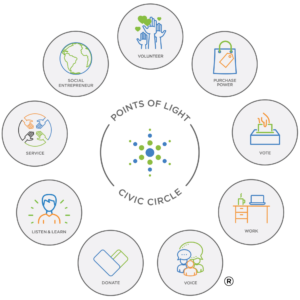
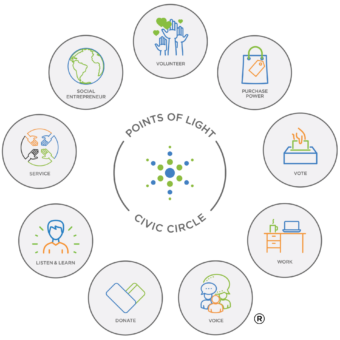
helps individuals connect to opportunities and understand that doing good comes in many forms. It represents your power to lead, lend support and take action for causes you care about and to engage more fully in civic life. Here we offer nine apps that will give you actionable steps to bring the Civic Circle to life in your own community today and every day.
Donating new or lightly used items seems straightforward, but it has the power to change someone’s circumstances and, ultimately, the trajectory of their life. Purposity
. School systems and nonprofits in local communities share their needs – for items like clothing, household goods and other supplies – and Purposity spreads the word to individuals nearby.
Listening and learning about a cause or a community before jumping in to help is crucial for effective civic engagement that honors the experiences and perspectives of others. And doing this might be as easy as listening to a podcast or scrolling an app! With over 500 incredible facts across 11 distinct categories of history, the Black History Facts App brings millennia of historical knowledge directly to your fingertips.
Every time you shop, you demonstrate your values Choosing where to spend your money and ensuring the companies you support are aligned with your values doesn’t need to take hours of research. The Buycott app lets you join campaigns to support causes you care about. You can use their built-in barcode scanner to learn a product’s history, make purchase decisions on products and communicate your decisions to companies.
Maybe you’re interested in flexing your service muscle by running for school board president or local office. Or maybe you simply want to support the candidates and causes you care about from a more informed place. Either way, Causes makes it possible to keep up with the current issues and trending bills and understand how they impact your world.
Social entrepreneurs find creative ways to solve some of the world’s toughest issues, whether through the products they create, the services they offer or how they spend their profits. A platform that unites people, businesses and nonprofits to drive collective impact across causes and communities. You can explore the social impact performance of companies and nonprofits, share and get involved in their social good efforts.
Voting is one of the central tenets of democracy. Besides ensuring that you vote in every eligible election, championing the right for all people to vote is part of leading a civic life. ActiVote is changing the way citizens engage with their government. This app educates voters on important issues, when and where they can cast their vote, connects them with their elected officials and allows them to make their voice heard by quickly answering key polling questions.
Whether at a protest, a polling place or on the go, the ACLU’s free Mobile Justice smartphone application allows users to: Record encounters with public officials and law enforcement while streaming to your closest contacts and your local chapter; report any abuse by authorities to the ACLU and its networks; and empower yourself with up-to-date information regarding your rights as well as important actions and happenings in your area.
Volunteers work with organizations by sharing their time and talent to support the causes they care about. There are hundreds of thousands of volunteer opportunities throughout the world just waiting for the right volunteer to step up. Search the Points of Light database for volunteer opportunities, inside and outside of the home, that meet critical needs.
Civic engagement belongs in all spheres of your influence, including your work. When you want your paycheck to incorporate your convictions, Idealist is one excellent way to get there. You can find a job with any number of mission-driven nonprofit organizations on their website database, then download their app to connect with fellow idealists in your area. Use these tools to make a difference in the community where you live, work, and play.
No matter how you choose to lead a more civically engaged life, these apps can help you take concrete steps toward your own goals of creating change in your community. Pick two or three that you want to try out for the issues you’re most passionate about.
on civic engagement. But what if we told you there are actually many ways to drive change?
Today’s political climate can feel divided or even stagnant, but the truth is, you really can make things better, starting with your own community, one act of kindness at a time. And those aren’t just words. We’re here to share real, practical ways for you to make a difference.
helps people connect to opportunities and understand that doing good comes in many forms. It is a framework that represents your power to lead, lend support and take action for causes you care about and live your best civic life.
The Civic Circle provides actionable examples of all the ways you can change your community to reflect the world you want to see around you. In fact, you’re probably doing some of these things already. Are you helping a neighbor by picking up groceries or chaperoning on your child’s class field trip? You’re volunteering. Did you vote in the last election or help others get to the polls so they could vote? Those acts of civic duty illustrate the “vote” element. When you buy a product, do you choose to support companies that reflect your values or advance a social cause? That’s called “purchase power.” There are nine elements of the Civic Circle, and countless ways to bring each one to life.
This blog is the first in a seven-part series that will help you find real and manageable ways to activate the Civic Circle through
.
We also offer other resources to help you connect with all the ways you can become empowered to be the change you want to see in the world. Check out our
, our digital magazine series. Each issue takes a deep dive and provides materials, ideas and inspiration so that you can become civically engaged. Get started today, and launch your own civic engagement journey with these tools.
This piece is part of a series that highlights the many ways you can activate the Points of Light Civic Circle using various tools. Check out each one so you can live your best civic life:
provides nine different paths for people to take civic action to solve the world’s toughest issues. Current and ongoing events have presented ongoing mental health struggles for many, particularly as a result of social isolation due to the COVID-19 pandemic.
There are a number of compelling data points surrounding this issue as well as exactly how people are taking action in Points of Light’s most recent
research. Data show different, yet strikingly similar, perspectives from across the globe and spanning generations. The results paint a picture of civic life in the United States, the United Kingdom, Brazil and India.
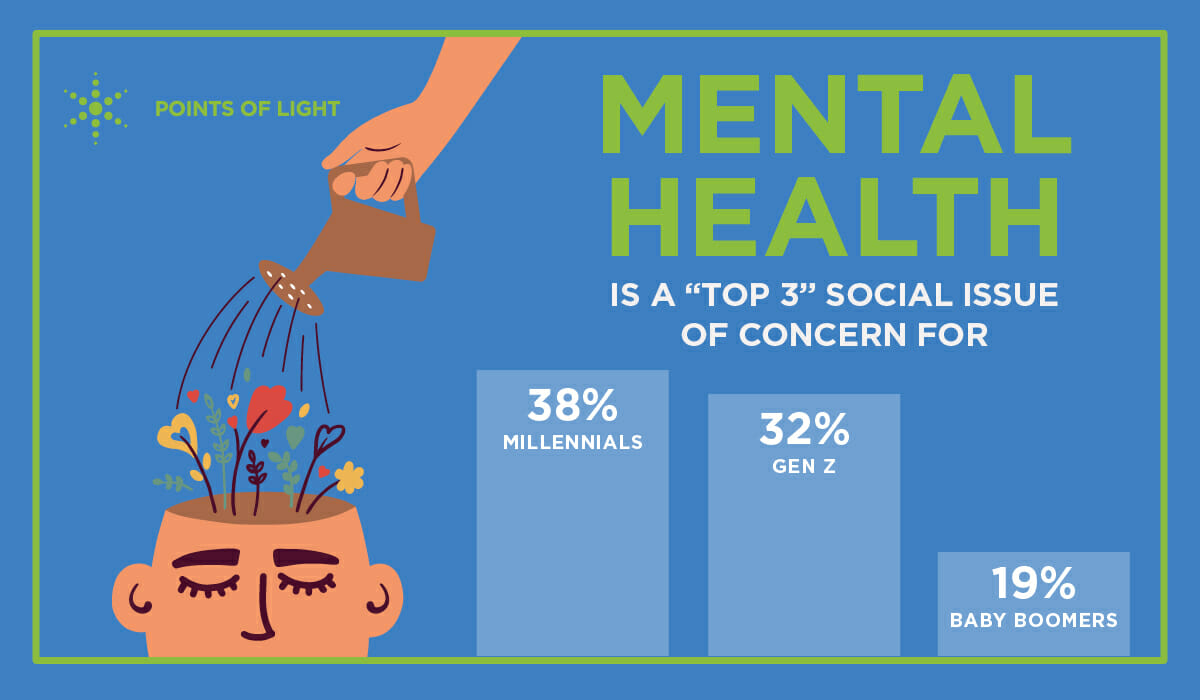
Twice as many Millennials (38%) listed mental health as a “Top 3 Social Issue of Concern” compared to Boomers (19%). Gen Z fell just behind Millennials, with 32%, listing it as a Top 3 issue. In regards to gender, 38% of women listed mental health as a Top 3 Social Issue of Concern compared to 22% of men.
With 72% of global respondents saying they took at least one civic action in the past 30 days on behalf of mental health, and 93% of global respondents claiming that they took at least one civic action on behalf of mental health in the past year, it’s clear that people are eager to contribute their time, talent, resources and attention. This data also speaks to people recognizing the necessary work of reducing the stigma around mental health.
(68%), showing that the individual posted or shared content on a social media platform. These two actions are often some of the most accessible ways to civically engage. And since speaking up about an issue is best done from an informed perspective, the two can work in tandem – listening and learning has the potential to result in more powerful, knowledgeable voices speaking on the issue.
One of the key takeaways from this research is the apparent motives behind these acts of civic engagement. Thirty-five percent of respondents said, “I have been personally impacted.” Thirty-two percent of respondents reported, “A close friend and/or family member has been impacted,” and 28% of respondents claimed that acting on this issue, “Supports my own personal well-being.” These statistics show that mental health is
personal
, and generally speaking, deeper impact is made and more momentum is maintained when people have a personal connection to the issue.
You can dive into all nine elements of Points of Light’s Civic Circle, as well as explore each of them in depth via issues of our free digital magazine, “Civic Life Today.”
What we can learn from ‘The State of Global Civic Engagement’
For nearly two and a half years, we’ve shared one collective experience around the world. And while most of us are ready to leave behind the years of fear, uncertainty, and loss, we should think twice before rushing to get back to our “old lives,” and for good reason.
History tells us that pandemics and other crises can be catalysts for rebuilding society in new and better ways. If we seek to get back to our old ways, we—especially in the nonprofit sector—are missing an opportunity to take this historic moment to address the fractured systems and stark inequities the global pandemic has exposed, exacerbated, and solidified. We cannot be “done” when there is still so much to do.
At
, we’ve been shining a light on the organizations and individuals serving as those catalysts for rebuilding society. We continue to uplift hundreds of stories of light so those changemakers who have taken action, supported their communities, and made each day just a little better for others can inspire a movement.
Beyond sharing stories, we also need to take this opportunity to meaningfully study the nonprofit sector and determine how organizations can make an impact amid this “new normal.” We’ve been asking ourselves:
Who is taking action? In what ways are they engaging and on behalf of which social issues? And for those who are not engaging, why not?
, a series of five in-depth reports that provide insight into the attitudes and behaviors of individuals and the barriers they face—globally and across the United States, the United Kingdom, Brazil, and India—to help us begin to answer these questions. Here are some of the key findings from our research:
Engagement is changing.
The studies examined the top civic actions taken in support of a social issue as defined by the engagement framework of
: donating, listening and learning, using your purchasing power, service, social entrepreneurship, using your voice, volunteering, voting, and doing good through work. In the global survey, using one’s
were the top two civic actions taken. These actions are important because they have low barriers to entry and are more accessible to different segments of the population, yet they can prove just as influential as traditional actions such as volunteering or donating.
The takeaway isn’t to replace one with the other but to embrace these new forms of engagement and the people who use them. The challenge we must collectively take up is to open and expand access to pathways of more direct engagement.
Now, the next part of the conversation needs to address how people are using these actions in tandem. And our research reinforces that taking a number of civic actions together can increase impact and effectiveness.
This may be an area where companies can set an example. How are companies not only speaking up about social issues but also demonstrating their efforts to listen to the communities they aim to support and sharing what they learn with their employees, consumers, and peers?
Address the perception of privilege.
Globally, survey respondents listed finances as the largest barrier to engagement: Two of the top three reasons people gave for not engaging in social issues were “unable to financially support social issues causes in general” (more than one in five respondents) and “unable to financially support causes due to negative effects of pandemic” (nearly one in five). This finding indicates a need for organizations to educate potential constituents and create additional pathways to participation beyond making donations.
The misconception that supporting social causes requires money is a barrier that we have to overcome in order to ensure that we are valuing and tapping into what each individual has to contribute to their community and the causes they care about.
How can social sector leaders help signal that easily accessible civic actions like using one’s voice and listening and learning are particularly important? One idea is for nonprofits to highlight their greatest unpaid social media amplifiers alongside their donors in annual reports. Who has helped bring the most attention to your cause?
Challenge inertia.
Newton’s first law of motion says: An object in motion will stay in motion, and an object at rest will stay at rest
unless acted upon by an outside force
.
Our research indicates that this phenomenon exists within civic engagement as well. Individuals already engaging in certain civic actions are the ones most likely to continue taking those actions. For example, 91 percent of the individuals who said they would volunteer over the next 30 days were the same people who had volunteered in the previous 30 days. This is an indicator that we are simply maintaining the volunteer force instead of growing it.
While maintenance is important, how can we put more people in motion on behalf of social good? We know that the most common reason someone volunteers is that they are asked. When was the last time you invited someone to volunteer with you?
Bridge individual change to systems change.
Systems are reinforced or dismantled one decision at a time. The journey of systems change starts with the individual, but it requires organizations everywhere to help people participate in the transformation of policies, to be included in the power dynamics, to evolve social norms, and to strengthen the civic mindset of this country and the world at large.
Our research underscored that people are looking to companies for leadership, with 82 percent of global respondents and 95 percent of respondents in India expecting companies to address the social issues in their country.
What we conclude from our research is that nonprofits can do more to provide opportunities for engagement, particularly ensuring new and more accessible pathways of entry into civic action. How can nonprofits and companies seek meaningful partnerships to engage employees and consumers, extend reach, and expand impact?
So much change in our world today can be directly translated into a wealth of opportunity, specifically how the social and nonprofit sector operates in this new normal. To meet this moment and engage the people who are critical for us to make an impact on our respective missions, we can’t wait for society to return to what it was. Instead, we must address these new challenges head on so that we can shine a light on tomorrow.
Natalye Paquin was the president and chief executive officer of Points of Light from 2017–2022.
She is a visionary and results-oriented leader, with more than 20 years of experience providing strategic, operations and fiscal leadership in the nonprofit and public sectors.
Volunteer Power Across Causes Remains a Constant Need, Even in a Crisis
affiliates tell us that volunteering is one of the primary ways people have supported the humanitarian relief efforts in and around Ukraine. They also explained that, because this crisis comes on the heels of the COVID-19 pandemic, there have been unforeseen ramifications including volunteer burnout as well as a singular focus on Ukraine relief work from those who want to remain engaged.
“People stopped helping in other areas, as they used to, and everyone wants to help the Ukrainian refugees — which is great — but when I talk with corporate partners or volunteers, they’re not interested in helping children, elders,” said Agnieszka Lissowska-Lewkowicz, who is the President of
affiliate and Polish non-governmental organization Centrum Wolontariatu. “We have to find a balance.”
There are countless needs waiting for support, from trash pickup in your neighborhood to walking dogs at your local animal shelter. There are so many ways to shine a light on your community by volunteering for a cause that speaks to you. To find a cause area that you feel passionate about, check out Points of Light’s
Figure out which areas of focus are important to you and which organizations you want to support. Now there are more ways to get involved than ever before. Consider whether you prefer to join volunteer opportunities that are in person or virtual.
Decide on Skills-based vs Learning Opportunities
Think about what skills you have to offer or whether you’d like to learn something new. Some organizations are looking for specialized talent like translators. Others may offer volunteer opportunities that require training, such as becoming a crisis counselor for Crisis Text Line.
Find Balance
Be realistic about balancing your volunteer time with other areas of your life, like your job and your family. Volunteering as a family may be one way to combine family time with living your best civic life.
Points of Light operates with a network of innovative volunteer-mobilizing organizations who serve more than 177 affiliates across 38 countries around the world. Together we are inspiring, equipping and mobilizing more people to use their time, talent, voice and resources to create positive change in their communities. Learn more about our Global Network.
A Tale of Three Cities: What Humanitarian Relief Looks Like Across Europe
Hungary, Ireland and Spain. When it comes to aiding in the humanitarian relief effort around the Ukraine crisis, they share common ground. They are also worlds apart.
reports that a “very disadvantaged population” is arriving in her country. Some have never seen a toilet. Most have never attended school. Those with more education or a higher income tend to travel straight through. Only about 1,200 have been allowed to apply for refugee status in the country. For the rest, Judit and her coworkers pass out hygiene kits filled with toiletries and fresh clothing.
Fifteen hundred miles
away in Ireland, Terri O’Brien, corporate & programmes manager at
says that of the 15,000 displaced Ukrainians who have arrived so far, most tend to be from more highly educated and affluent backgrounds. However, the next wave is expected to be less advantaged. She noted that for her small country of five million, this influx is significant.
“We don’t always know people are coming,” she said. “It’s quiet, then 300 people arrive.”
Although Ireland has worked quickly to welcome displaced Ukrainian citizens, accommodations are already in short supply, and new arrivals are being diverted to remote towns. This latest crisis comes on the heels of the COVID-19 pandemic, which placed tremendous strain on Irish systems.
“Covid prepared us for disaster but has also contributed to burnout,” she said. “People are getting worn out, but still, amazing stuff is happening.”
Director of corporate social innovation Almudena Pérez Molina of
, painted a picture of hope in her homeland of Spain. For the next year, new arrivals will have the same rights as Spanish citizens. They can work and have access to free healthcare services. The government has set up four refugee reception centers across the nation designed to help find housing and field other integral needs.
Almudena shared that, prior to the Ukrainian crisis, there are some towns in Spain that were becoming depopulated because younger people were moving into big cities. These are perfectly functional places with infrastructure including roads, schools, hospitals and housing. They have come to be known as “Empty Spain.” The area of Galicia is one such example. Its inhabitants have welcomed displaced Ukrainians with open arms. Elderly Spanish citizens here, and in other small towns, are happy to welcome new people.
“This could be a beautiful opportunity for refugees,” said Almudena.
How You Can Help
The universal need across Europe is cash donations. When you donate to our Global Network affiliates,
you’re directly supporting real people, on the ground, doing essential work in humanitarian relief efforts. Your donation not only supports their important work but also stimulates their local economies through purchasing and hiring, which makes for a successful transition for displaced people and their host countries.
Gifts through this fund are directed to Global Network affiliates in the region that know best what the emergent needs are in their areas. These organizations are experts in their field and have a firm grasp on what must be done and how to do it.
Points of Light operates with a network of innovative volunteer-mobilizing organizations who serve more than 177 affiliates across 38 countries around the world. Together we are inspiring, equipping and mobilizing more people to use their time, talent, voice and resources to create positive change in their communities. Learn more about our Global Network.
Can an Old Fashioned Day of Service Strengthen Post-pandemic Connections?
The collective global experience of the COVID-19 pandemic has changed the world in many ways. The shift to remote work has revolutionized the workplace, with positive outcomes such as reduced commuting times and increased flexibility. On the flip side, it has resulted in isolation of workers from colleagues, a depleted sense of belonging and sometimes struggles with mental and physical health. These disruptions to workplace relationships, as well as volunteering, have kept us apart, separating us from our communities and each other.
Workplaces around the world are seeking strategies to build post-pandemic culture and reset toward a future vision. As a civic engagement leader, it got me to thinking, can an old-fashioned day, week or month of service hosted by businesses around the world spur a culture comeback and reconnect colleagues and communities?
The answer is
yes.
At Points of Light, we live by this principle every day, and it’s a clear affirmation of everything
In a recent conversation, a Points of Light corporate partner reflected that, “Volunteering used to be a way to get people out of the office. But now, perhaps, it’s a way to get people back in.”
Focusing on greater purpose, both individually and for your company, can boost your mood, improve work performance and help rebuild a values-based culture. Bea Boccalandro’s,
are both fun and meaningful tools for exploring how you can build purpose. purpose.
There are countless ways to help your community — a host of issues just waiting for a willing pool of volunteers to help solve. Throughout the pandemic, communities have struggled
have increased and spread from cities to suburbs. Volumes of residential waste and recycling have placed increased demand on city workers and infrastructure. There’s no denying the increase in plastics and cardboard usage as ordering-in and home delivery have thwarted our reduce, reuse, recycle goals. School districts and parks need a helping hand to refresh and revitalize their public spaces.
Can your company build a day of service into its return to work plan? The classic example of a clean-up day provides much-needed extra hands to tackle a real need. It also engages colleagues, captures the health benefits of people being outside and introduces everyone to neighborhoods and communities for ongoing learning and action.
Perhaps there is a hybrid volunteer model that matches your company’s hybrid return to work.
showed that all students are behind in reading and math, and students in majority-Black schools are now 12 months behind their peers in majority-white schools. Programs like
are responding to those challenges with new initiatives that engage employees as mentors and coaches and use aligned talent and capabilities to bring programs that close the gap both in-person and online. A great volunteering experience can address important community needs, inspire your employees and support your company’s comeback strategy, but how do you make it great? Points of Light recommends working at the intersection of good for community, good for employees and good for your brand:
Focus on Company Values: What aligns with the authentic products, services and values of your brand? Who are your customers? What community needs align with these attributes? Company values demonstrated by volunteering in support of a community need offer the greatest opportunity to instill refreshed purpose and strengthen culture. These efforts can start in the virtual world as listening and learning efforts that prepare employees to be better leaders and citizens when in-person volunteering returns to your company. Many companies are expanding their employee engagement and volunteering programs to include training that serves a social purpose or benefit. Examples include providing opportunities for employees to learn sign language or take disaster training courses through the American Red Cross. Are the uncertainty, delay and hybrid variations challenging your planning? Some companies have had great success with projects like “virtual” cleanups, where employees coordinated and tracked cleanup efforts in their local areas.
Listen to Your Employees: Employees are citizens first. Are they raising community needs? How can you support them as change agents to tackle the challenges they identify? Consider offering volunteer time off and matching grants for volunteer time. Can you help organize teams of colleagues for a day of service? Can you bring leadership together with employees hired in the last two years for a litter pick up or schoolyard refresh?
Identify Your Strongest Assets: Can a day of service launch a place-based commitment for your organization? Perhaps a schoolyard update introduces your company to a school and community that might welcome mentors, advisors and coaches for students and faculty. Are there career learning experiences that your company could offer? Can leaders build relationships that expand the networks of nonprofit leaders to help them better connect to media, mentors and money?
Board training and matching programs present an impactful and scalable opportunity to engage employees. Not only can companies track and set targets for employee board service,
but
these programs can also support the organization’s DEI initiatives to increase minority board representation and expand support for racial equity-focused organizations. Check out organizations like
No matter where you chose to start, now is the time to build service into your comeback plans.
Points of Light supports companies of all sizes that are interested in building and growing their civic engagement programs. You can access tools and resources to help you get started at
for program design consulting and engagement solutions.
Polish Family Opens Home to Ukrainian Mother and Daughter
“
I had to choose between staying together with my husband or saving my little child,” said a displaced Ukrainian woman, who wished to be kept anonymous for safety reasons. She escaped Krzywy Róg, the largest city in central Ukraine, with her four-year-old daughter.
“She
is too small to understand things, like how you have to react during the bomb attack,” she said. “I also know that such traumatic experiences can influence the rest of her life.”
Agnieszka Lissowska-Lewkowicz, President of Points of Light Global Network affiliate and Polish non-governmental organization Centrum Wolontariatu.
This little family of two was forced to make the agonizing decision to leave their husband and father behind and escape to Warsaw. There they met Agnieszka Lissowska-Lewkowicz, who is the President of
affiliate and Polish non-governmental organization Centrum Wolontariatu.
From the start of the war, Agnieszka and her family knew they wanted to help. They began to consider hosting a displaced family but were unsure of what that truly meant in terms of the length of the commitment and how it would influence their home life. Then Agnieszka received a call from a friend who asked if she might consider welcoming the mother and daughter into her home.
“I thought maybe this is a good idea,” said Agnieszka. “This is an opportunity to help.”
Agnieszka and her husband, mother and 10-year-old daughter decided to open their divided two-story home. The first three weeks were a big adjustment, and then things began to fall into place. They fell into a rhythm, finding a balance between sharing meals and enjoying private time apart. Their guest found a job as a hairdresser, and her daughter was enrolled in a nearby kindergarten class.
“
I found a shelter with a good family, my daughter went to kindergarten and is doing great,” said the woman. “I already have a job. Of course, I still do not know the future. I don’t know the language, I don’t know how much time it will take me to learn Polish, if I earn enough to rent a place, when it will be possible to stand on my own.”
The Realities of Living Together
There are more than 2 million displaced people in Poland, nearly 300,000 in Warsaw alone. That makes for a 17 percent increase in the city’s population. These types of changes bring a host of complexities, the language divide being a big one.
Agnieska’s story is a micro-example of what’s happening in the city at large. The two families speak different languages – Polish and Russian. Even though the two languages are similar in many ways, the differences presented more challenges than expected.
“They are words similar, but there are words and sentences that we wouldn’t understand each other,” said Agnieszka. “I really thought it would be easier, so this was a big surprise for me.”
When the family of two arrived, they had nothing more than the clothes on their backs. Agnieszka had saved clothing that her daughter had outgrown and gathered clothing from friends. They bought toothbrushes, soap and other hygiene supplies. They also worked through the most pressing need of getting official documents in order to facilitate school enrollment and employment.
It has been three weeks since the pair moved in. Nobody knows how long they will stay, but that’s ok with Agnieszka and her family.
“She is a very strong person in a very difficult situation,” said Agnieszka. “At the beginning, I thought [they would be with us for] a few weeks. Now, I’m thinking a few months, but I’m not afraid because we stay good together. We are really lucky, which makes me smile.”
How Can You Help?
If you are in a position to host a displaced person or family, Agnieszka encourages a thoughtful approach that will enable you to sustain lasting support.
“Be sure everyone in your family is on the same page. Your family is your first obligation,” said Agnieszka. “Organize your life together in a way that there are moments together and there are moments [for just] your family. This balance is needed. Only with this balance you will be able to help long term.”
To support families doing this kind of work, visit Points of Light Global Network Affiliate
to make a donation or volunteer. Right now, they need funds and are also looking for a social media professional to help them use their voice as an organization to advocate for those in need, a service that can be offered remotely, from anywhere in the world.
Centrum Wolontariatu and other organizations like it are keenly aware of arising needs in real time. When you support the
, your gift is funneled to our affiliate network in the region so they can respond quickly and directly.
Points of Light operates with a network of innovative volunteer-mobilizing organizations who serve more than 177 affiliates across 38 countries around the world. Together we are inspiring, equipping and mobilizing more people to use their time, talent, voice and resources to create positive change in their communities. Learn more about our Global Network.
85 Orphans Rescued from Ukraine Find a New Home in Spain
At dawn on a Sunday, 85 orphaned children fled their home in Lviv, Ukraine.
Four volunteers from Fundación Madrina had traveled over 2,000 miles from Spain to help them evacuate, along with their caregivers, during crossfire. The group boarded a bus and drove for a full 24 hours, taking a circuitous route to avoid areas of conflict. They arrived in Krakow, where a military plane was waiting to deliver them to the Torrejón Air Base in Madrid. Once in Spain, they were temporarily taken in by a hotel until Spanish government officials and nonprofits were able to work collectively to find stable housing for them.
“After spending two days in a hotel in Madrid, the little ones needed a place to spend the next three months,” explained Director of Corporate Social Innovation Almudena Pérez Molina of Fundación Hazloposible, a member of the Points of Light Global Network. “They could not separate them into groups. They were offered a monastery in the province of Guadalajara, but the Guadalajara City Council, that same morning, informed them that the space was not ready with the necessary conditions. They were going to be separated, but someone from Fundación Madrina made an appeal to the collaborator, and finally, they were all transferred together to a hotel in Salamanca.”
Spain, like much of Europe, is seeing a rapid increase in displaced Ukrainians. In late March, the country welcomed 10,000. That number had increased to 100,000 in just two weeks’ time, and a quarter were not yet legally registered. Forty percent were children.
Almudena says she feels for the children who are affected by the Ukrainian crisis, but she’s also proud of how quickly Spanish citizens and organizations banded together to find a solution for this latest group. She cautioned that this crisis is going to require stamina and long-term thinking.
“The short term is already done. Many NGOs are working hard for doing this,” she said. “But this is not a one-day crisis. Four million people have left their homes, and although they would love to come back to their homes, we don’t know when the conflict will end, and probably their homes don’t exist anymore. So the people will need to build a new life, and they need the support to do it.”
When asked her advice on the best ways to help, Almudena encouraged people to connect with an organization doing work around this crisis to ask what the needs are before acting alone. A crisis of this magnitude requires a lot of coordination and united effort.
Almudena cautioned: “The individual response is great, but in these types of crises, we cannot do it all by ourselves as individuals.”
Points of Light operates with a network of innovative volunteer-mobilizing organizations who serve more than 177 affiliates across 38 countries around the world. Together we are inspiring, equipping and mobilizing more people to use their time, talent, voice and resources to create positive change in their communities. Learn more about our Global Network.
Transportation is an Essential Need in the Ukraine Crisis
As displaced Ukrainians make their way out of their homeland and begin to build new lives in new places, there are a whole host of needs that have arisen. Some are evident, like shelter and healthcare, while others are simpler but still important, like toiletries and socks. But right now, one of the most pressing needs is transportation.
At first glance, the need to move displaced people — individuals, families, and larger groups — from place to place seems obvious. Moving volunteers, goods and donations is an equally pressing issue.
Companies and individuals around the world have stepped up to answer the call for help.
The Washington Post reported that Tom Littledyke, a U.K.-based pub owner, drove his personal 16-seat minibus more than 1,000 miles from his home in Lyme Regis, a small coastal English town, to the Polish border of Ukraine to deliver more than $1,000 worth of supplies. He then continued to transport people from a train station in Lviv, Ukraine, to the Polish border so they could cross to safety.
News outlets in Europe report that Paddywagon, an Irish tour bus company, sent a fleet of coaches to Poland loaded with donations to support those who are displaced, including medical supplies, blankets, hygiene products, baby food, diapers and toys. After the buses were emptied of supplies, the drivers turned around and transported more than 200 Ukrainian refugees to France, where Brittany Ferries provided free cabins on the journey back to Ireland.
The European Travel Commission is a non-profit responsible for the promotion of Europe as a tourist destination. They have pledged to provide transportation, as well as shelter and food, to displaced Ukrainians.
“Travel is a force of peace towards a better future, and no aggression should stop it,” the ETC said in a statement.
How You Can Help
Drive.
No matter where you are in the world, you can have an impact on this humanitarian crisis. Volunteering your own time to transport those in need in your own vehicle is one path you can take. But do not self-deploy. Be sure to connect with a Points of Light
affiliate in your area that understands the landscape and the needs so that you can support the relief effort both safely and effectively.
Connect.
Appeal to companies and organizations that have the resources to help. If you know a transportation company that may be interested in loaning its vehicles, reach out to one of Points of Light’s
, we will funnel your donation directly to our affiliates in the area.
Points of Light operates with a network of innovative volunteer-mobilizing organizations who serve more than 177 affiliates across 38 countries around the world. Together we are inspiring, equipping and mobilizing more people to use their time, talent, voice and resources to create positive change in their communities. Learn more about our Global Network.