



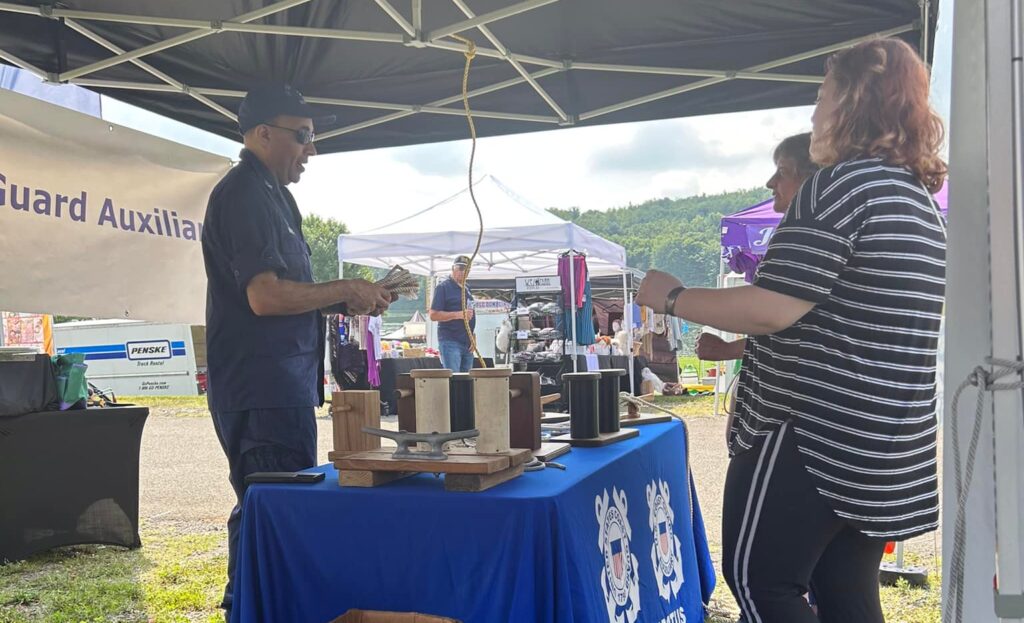
Meet Daily Point of Light Award honoree Anthony Waters. Read his story, and nominate an outstanding volunteer or family as a Daily Point of Light.
When Anthony Waters inquired about a boating safety class, he never expected to find one of his greatest opportunities right in front of him. Anthony first discovered the United States Coast Guard Auxiliary while searching through an instruction manual for another group. At the time, he didn’t even know Pittsburgh had a Coast Guard Auxiliary. When he learned that the city’s prime location at the confluence of the Allegheny, Monongahela and Ohio Rivers meant they had an active boating community, both recreationally and commercially, Anthony wanted to know how he could get further involved beyond the typical boating course.
From teaching safety courses to educating youth about how their choices on the water affect the natural environment around them, Anthony has consistently put in the work as an active volunteer. Fast forward 13 years with the organization, and Anthony now serves as the district chief of staff of the Auxiliary. He has dedicated over a decade to public safety, youth mentorship and emergency preparedness as a volunteer leader.
Anthony’s time with the Auxiliary has benefited several facets of the waterfront community, from creating a national award system that resolved years of backlogs to supporting the PA State Animal Response Team. For over 60 hours each month, Anthony tackles a variety of tasks that make the water experience safer and more enjoyable for everyone.
Some of the most exciting parts of Anthony’s involvement with the Auxiliary are the opportunities it provides him with. In the future, Anthony is looking forward to interacting more with the Sea Scouts BSA, the branch of Scouting America for young men and women that focuses on water safety and boating skills. Of course, he’s also revved up to help with the upcoming 2026 NFL Draft, which is set to take place in Pittsburgh next April. Because of the city’s location on the water, Anthony will have the chance to assist with monitoring the waterways during the major football event.
While Anthony’s journey to become an upstanding volunteer was an unplanned one, he’s now a vital component of the Coast Guard Auxiliary team. In his role, he sees it as his responsibility to train the young Coast Guard leaders of tomorrow. With his dedication and devotion to building the next generation of civic-minded volunteers, it’s easy to see just how contagious the power of volunteerism can be.
What inspires you to volunteer?
This is always the cliche answer, but it’s always important to help people. Throughout life, I’ve been dealt a pretty good hand, and I just want to go and do stuff to help people, because not everyone does it. It’s amazing to see how many people don’t volunteer to help others. You see it all the time: people just don’t want to help. A lot of stuff we do is at little or no cost to everyone.

What inspired you to get started with this initiative?
About 13 years or so ago, I was looking through an instruction manual for another group, and they mentioned my local Coast Guard Auxiliary group teaches boating safety courses. I found out that we have a Coast Guard Auxiliary in Pittsburgh, which was awesome. I reached out to find out about a boating safety course, and a guy I talked to told me that, in addition to teaching boating safety courses, they work with the community by doing vessel safety checks and program visits. We go out to different places, like libraries and doctors’ offices, and put information out. We do boat patrols on the water. He told me more, and I was enamored enough by it that I joined. Then I found out about all the other things that were possible with the auxiliary. Thirteen years later, I’m still here.
Tell us about your volunteer role with the United States Coast Guard Auxiliary.
The biggest part of it is outreach. We’re either teaching a class, doing the vessel safety checks or work vessel safety checks, or working at an information booth, just talking to people about how they can be safer on the water and how they can be a good steward of the environment. One thing I always look at is that not everyone is a boater. But in Pittsburgh, at least, water is a big asset. People come there to use it recreationally. It’s used commercially. I tell people that if they use a plastic bag, that plastic bag is something that could end up in the ocean, and you could see a sea turtle eating it. So that’s why I like to educate the public about how their actions impact. Not only the local community, but the global community at large.
What are your long-term plans or goals for the organization?
We are always looking for ways to interface better with the general public. In the past couple of years, we started working more closely with the Sea Scouts, which is the program offered by the Scouts of America, with different partnership opportunities to get those youth more involved in understandable marine domain awareness and the ecological benefits and getting more youth ingrained in the Coast Guard way. As the role of the Coast Guard changes, we adapt to whatever they need. A lot of things that we might be doing in the future are more stuff with no local emergency management. If we have a disaster around here, we will have the auxiliaries that will be able to help either at a command center or on the ground.
What’s been the most rewarding part of your work?
I do like it whenever we have an interaction with a boater and they come back and they say we really helped them. Or when we teach a class and tell someone to wear their life jacket for a reason, and they say they never thought of that. I look at that as me giving someone some knowledge. Hopefully, they apply it. Who knows? It may help them avoid an accident or may help them avoid falling overboard or becoming injured. I think when people come back to you later and they thank you for helping them out, that’s the best part.
What have you learned through your experiences as a volunteer?
There’s so much. One of the biggest things I’ve learned is the impact of boating on the Pittsburgh area. For myself, I learned that there are a lot of things that I was probably afraid to try and do earlier until I came here and had people saying I should just go ahead and do it. It’s that community of people to assist you and help you reach whatever goal you want to reach.
Why is it important for others to get involved with causes they care about?
How else can you help out a cause if you don’t get involved with it? If you care about something, and you don’t even volunteer or talk about or work on it, then how else can you promote that cause or get other people to help you with it? Lead by example. If you’re out there doing it and you’re showing people that you like doing it, it will probably attract more people. And on top of that, you could find people who share your cause and be able to have a community.
Any advice for people who want to start volunteering?
Do it. In my case, I just reached out for a completely different reason. The person I talked to just walked me through it. So I would say just be open to opportunities. If there’s something you’re interested in volunteering for, don’t be afraid to ask if the place you want to help has an option to volunteer. They may say no, but that’s the worst they can say.
Do you want to make a difference in your community like Anthony? Find local volunteer opportunities.