



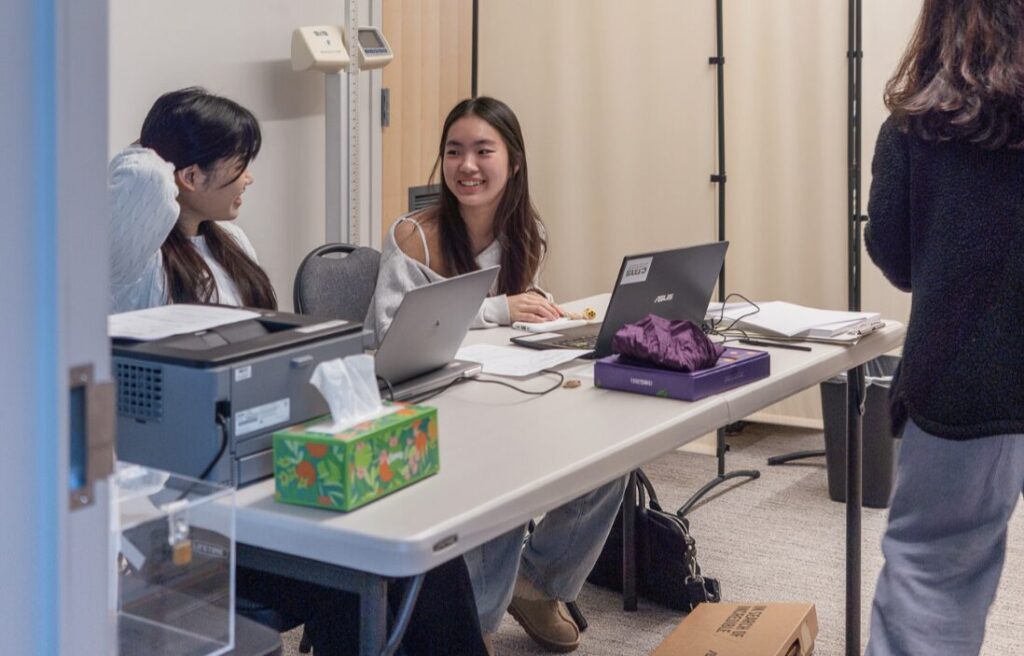
Meet Daily Point of Light Award honoree Amy Young. Read her story, and nominate an outstanding volunteer or family as a Daily Point of Light.
Amy Young may only be 17, but she’s already forging a path into a career in medicine. Interested in science at a young age, Amy had a passion to help others and wanted to contribute to her community. Always rather shy, Amy hoped to explore her interest in a future career in medicine, but wasn’t sure if she had the interpersonal skills to go about doing so. Looking to challenge herself and gain the real-world experience to prepare her for the challenges of a medical career, she reached out to Lahai Clinic and Cornerstone Medical Clinic, free clinics for patients unable to afford healthcare. The University of Washington junior knew getting hands-on experience would be an essential building block to her future career path, and she immediately jumped in. What she didn’t know was the mentorship and guidance that volunteering would provide her along the way.
As the first person patients see when they enter the clinics, Amy provides a friendly face to everyone who walks through the door. She helps them schedule appointments and understand complex intake paperwork, which is often not in their native language. She also helps both clinics operate behind the scenes, completing the administrative work that improves clinic efficiency and the overall patient experience. Amy also gets that hands-on medical experience she always craved, and recently had the opportunity to shadow an oncologist and a dentist at the clinics — two fields she finds particularly intriguing. She credits the helpful instructors and mentors at the clinics who allow her to shadow their work as vital inspirations for her future career path.
Amy dedicates over 50 hours each month to her volunteer work at clinics, and admits that the workload can sometimes get rather overwhelming. She has learned to say no when certain tasks would be too much, especially on top of her heavy academic coursework. But it’s safe to say that Amy has no regrets about putting herself out there and volunteering as she works toward her goals of pursuing a career in medicine. Her work is a strong example of how volunteering can serve as the groundwork for an incredibly bright future.
What inspired you to get started with this initiative?
Ever since I was young, I’ve always really been interested in science. I looked up websites to find clinics around me, and that’s where I found Lahai Clinic and the Cornerstone Medical Clinic. I just started volunteering, and I really found a passion for it, and that’s also what led me to pursue med school. Additionally, I’ve recently been practicing as a certified nursing assistant (CNA), which has really helped me immerse myself more in the medical field, because I can actually get that patient interaction.
Tell us about your volunteer role with Lahai Medical and Cornerstone Medical Clinic.
At Cornerstone Clinic, I’m mainly responsible for serving as the co-manager for the two clinics. It’s mainly aimed at underserved Korean-American or Korean patients, but recently we’ve had Ukrainian immigrants and generally struggling individuals from the area. I manage the grants that we get, the volunteers and make sure that everything is flowing properly. I also make sure that labs and blood tests are being sent. At Lahai, I’m working more behind the scenes on the documentation process, which means sorting out the financial situation and things like that.
What are your long-term plans or goals for the organization?
In the next couple of years, I hope to continue to stay in Washington so that I can keep volunteering here. I’m planning on potentially getting my physician assistant license, so that I can get more interaction with the patients, and also help out a lot, because a lot of the doctors, especially at Cornerstone, are planning on retiring soon. I think it’s really important to step up and practice more in those areas.
What’s been the most rewarding part of your work?
I think there have been various instances where I’ve interacted with patients and seen the gratitude in their faces after their visit. All of us, including the doctors and assistants, took the time out of the day, because a lot of the receptionists and doctors come from Bellevue or Seattle, and they’re traveling all the way for a couple of hours. I think that’s what really makes volunteering there rewarding. Even though it might be just a simple task for the doctors, it really makes such a huge difference in their patients’ lives.
What have you learned through your experiences as a volunteer?
I feel like I’ve grown a lot. When I first started, I didn’t know much about the medical field. I just knew that I wanted to become a doctor. But now, I’ve seen the different parts of medicine and the different areas where patients are struggling. Some patients come in for tooth extractions, while others come in for diabetes. Being able to shadow these doctors helped me realize which area of specialty I want to go into in the future, which I feel is really important. When I first started, I didn’t really know what I wanted to do, and didn’t have a vision of where to go.
Why is it important for others to get involved with causes they care about?
Nowadays, with a lot of resources, I feel like having authentic experiences and sharing them with other people can really inspire them. I know a lot of receptionists at Cornerstone Clinic. They’re high school students, but over time, they have definitely become a lot more interested and more proactive in helping out the clinic. I really like to see that, because I know it’s difficult, and it’s also very competitive in college, so it’s just really nice to see that passion coming through in real time.
Any advice for people who want to start volunteering?
I train the volunteers, and something that I always tell everybody who is just first starting is try to do as much as you can at the clinic. I always encourage them to shadow doctors. If you do put in an effort, some doctors are willing to let you shadow them. I think that really helps you see what this day-to-day life would be if you were a physician. Also, shadowing multiple specialties can really help you. It might seem kind of daunting, but at the end of the day, they really just want to help you. Just putting your foot in the door is what really makes such a huge difference.
What do you want people to learn from your story?
When I first started, I was very shy. I only went to the clinic because my brother was going there. I didn’t really feel like this experience was going to help me that much. Over time, my perspective changed so much. At the time, I wasn’t thinking of going to med school. I was looking through other career paths, like research, but I was still generally interested in science. I just wasn’t sure if it was going to be healthcare. I feel like this experience solidified it. I know there’s a long pathway to go ahead, but I feel like without the experiences that I’ve had, I definitely wouldn’t have the passion and the grit to be able to follow through. That’s why I feel very confident that I’m able to go through with it.
Do you want to make a difference in your community like Amy? Find local volunteer opportunities.